21(12); 1435~1447; December 2012 http://dx.doi.org/10.5322/JES.2012.21.12.1435 ORIGINAL ARTICLE
Effects of Hexaconazole on Growth and Antioxidant Potential of Cucumber Seedlings under UV-B Radiation
Tae-Yun Kim, Jung-Hee Hong
*Department of Biological Sciences, Pusan National University, Busan 609-735, Korea
Abstract
The present study was conducted to determine the effect of hexaconazole (HEX), a triazole fungicide, on the growth, yield, photosynthetic response and antioxidant potential in cucumber (Cucumis sativus L.) plants subjected to UV-B stress. UV-B radiation and HEX were applied separately or in combination to cucumber seedlings. The growth parameters were significantly reduced under UV-B treatment, however, this growth inhibition was less in HEX treated plants. HEX caused noticeable changes in plant morphology such as reduced shoot length and leaf area, and increased leaf thickness. HEX was quite persistent in inhibiting shoot growth by causing a reduction in shoot fresh and dry weight. HEX noticeably recovered the UV-B induced inhibition of biomass production. Significant accumutation in anthocyanin and flavonoid pigments in the leaves occurred as a result of HEX or UV-B treatments. HEX permitted the survival of more green leaf tissue preventing chlorophyll content reduction and higher quantum yield for photosystemⅡ under UV-B exposure. HEX treatment induced a transient rise in ABA levels in the leaves, and combined application of HEX and UV-B showed a significant enhancement of ABA content which activates H2O2 generation. UV-B exposure induced accumulation of H2O2 in the leaves, while HEX prevented UV-B induced increase in H2O2, indicating that HEX serves as an antioxidant agent able to scavenge H2O to protect cells from oxidative damage. An increase in the ascorbic acid was observed in the HEX treated cucumber leaves affecting many enzyme activities by removing H2O2 during photosynthetic processes. The activities of antioxidant enzymes including catalase(CAT), ascorbate peroxidase(APX), superoxide dismutase(SOD) and peroxidase(POD) in the leaves in the presence of HEX under UV-B stress were higher than those under UV-B stress alone. These findings suggest that HEX may participate in the enhanced tolerance to oxidative stress. From these results it can be concluded that HEX moderately ameliolate the effect of UV-B stress in cucumber by improving the components of antioxidant defense system.
Key words : Antioxidative enzymes, Cucumber, Hexaconazole, Photosynthetic pigments, UV-B
1. Introduction
1)Reduction in global stratospheric ozone has led to increased solar UV-B radiation (290 - 315 nm) reaching the earth's surface. High levels of UV-B may constitute a significant environmental stress for terrestrial plants limiting plant yield and distribution in many regions of the world. UV-B radiation induces a multitude of rapid and longterm morphogenic responses which are mediated by an unknown number
of unidentified photosensory systems (Jansen, 2002).
Some UV-B driven morphogenetic responses may not involve a dedicated photosensory system, but rather are a consequence of UV-B induced change in secondary metabolism. Previous studies have demonstrated several detrimental effects of UV-B on plants, including DNA damage, inhibition of photosynthetic activity and growth (Mark and Tevini, 1997). In order to prevent these harmful effects of
Received 28 August, 2012; Revised 3 December, 2012;
Accepted 10 December, 2012
*Corresponding author : Jung-Hee Hong, Department of Biological Sciences, Pusan National University, Busan 609-735, Korea
Phone: +82-51-510-2263 E-mail: [email protected]
ⓒ The Korean Environmental Sciences Society. All rights reserved.
This is an Open-Access article distributed under the terms of the Creative Commons Attribution Non-Commercial License (http://
creativecommons.org/licenses/by-nc/3.0) which permits unrestricted non-commercial use, distribution, and reproduction in any medium, provided the original work is properly cited.
UV-B radiation, plant have developed several defense mechanisms, including repair of inflicted damage and screening of the internal tissues against the radiation. Numerous studies have shown that UV-B radiation induces reductions in plant growth and crop yield in several species. Several mechanisms for tolerance to UV-B have been proposed, including enhanced synthesis of UV-B absorbing pigments, leaf thickening, increased synthesis of cuticular wax and reduced leaf expansion (Caldwell et al., 1995).
Enhanced free radical scavenging capacity to control oxidative damage incurred from UV-B radiation is also thought to contribute to UV-B tolerance. These are, in part, due to the direct effects of UV-B radiation on phosystem Ⅱ, nucleic acids, enzymes, pigments and growth regulators or to its indirect effects administered through the formation of reactive oxygen species (ROS) like superoxide and hydroxyl radicals and hydrogen peroxide.
High doses of UV-B light induce the production of ROS including peroxidase and free radicals, causing damage to proteins, lipids and DNA, and affecting the cell integrity, morphology, and physiology of plants (Frohnmeyer and Staiger, 2003). The level of damage caused by these factors depends on the effectiveness of the cellular defense mechanism, which includes scavenging enzymes such as superoxide dismutase, peroxidase and catalase, and non- enzymatic component such as ascorbic acid and reduced glutathione.
Triazole compounds such as paclobutrazole, triadimefon, hexaconazole etc. are widely used as fungicides and they act as growth regulator that has a profound influence on hormonal balance, photo- synthetic rate, enzyme activities, lipid peroxidation and yield component in various plants (Kishorekumar et al., 2007). Triazole compounds induce a variety of morphological and physiological responses in various plants, including retardation of shoot growth, decreased internodal elongation, increased root to
shoot ratio, enhancement in alkaloid production and increased cytokinin and abscisic acid (Jaleel et al., 2007b; Kishorekumar et al., 2007). They affect the isoprenoid pathway and alter the levels of certain plant hormones by inhibiting gibberellin synthesis, reducing ethylene evolution and increasing cytokinin levels (Manivannan et al., 2008). Crop plants are often subjected to environmental stresses that interfere with normal physiological processes affecting growth, development and, ultimately, crop yield. Triazoles have been called plant multiprotectants because of their ability to induce tolerance in plants to environmental and chemical stresses, including drought, chilling, heat, ozone and oxidative conditions (Fletcher et al., 2000). Previous works revealed the increased antioxidant potentials and an enhancement in alkaloid production under triadimefon application (Jaleel et al., 2006), induction of salt stress tolerance by paclobutrazol in Catharanthus roseus (Jaleel et al., 2007a) and drought stress tolerance by propiconazole treatment (Manivannan et al., 2007). Triazoles enhance activities of antioxidant systems to efficiently scavenge free radicals and thus enable plants to better cope with suboptimal environmental constraints.
Therefore, protection of plants from apparently unrelated stress by triazoles is mediated by a reduction in free-radical damage and increase in antioxidant potential.
Hexaconazole (HEX), a broad spectrum fungicide of the triazole group, is reported to induce morphological and physiological changes such as reduction in shoot elongation, stimulation of rooting, inhibition of gibberellin synthesis, altered biochemical constituents including defense-related enzyme and carbohydrate status, and a transient raise in abscisic acid content (Gopi et al., 2007; Johnson et al., 2008).
Some triazoles have commercially important
applications. They have been useful in controlling
growth, lodging resistance, cold hardiness, and yield
of some important crop plants. However, there is
little information on the effects of triazole treatment on the ability of plants to tolerate elevated levels of UV-B radiation in crop plants in order to predict further effects on crop yield and productivity.
Therefore, the present study was carried out to determine whether HEX can induce tolerance to elevated levels of UV-B radiation in cucumber (Cucumis sativus L.) seedlings. Morphological and physiological changes in UV-B and HEX-treated seedlings were monitored to characterize the patterns of damage induced in this sensitive plants and to investigate possible mechanisms of HEX-induced protection.
2. Materials and Methods
2.1. Plant material and growth conditions
Seeds of cucumber (Cucumis sativus L.) were germinated in wet tissue paper and sown containing a mixture of vermiculite, peat moss and perlite in 10-cm plastic pots in a growth chamber with a 13 h/11 h photoperiod under 160 µmol photons m
-2s
-1, 70±5% RH at 25°C. Plants were watered every 2 days with deionized water up to 10 days after sowing.
Then the selected uniform seedlings were transferred to a another chamber supplemented with UV-B radiation for 15 days. Over the course of growing period, the plant were exposed to UV-B and chemicals alone or in combination. Test solutions included hexaconazol (HEX) at 100 ppm. For treatments, 100 ppm HEX were sprayed on the 10-d-old plants during the UV-B treatment, while only water was applied to the control plants. Second leaf samples were taken from uniform plants in different parts of the pots at designed times. In the prelimnary experiments, UV-intensity at 2, 4, 6 and 11 kJ m
-2s
-1were used for treatments to estimate the intensity which increase the growth significantly.
Among the treatments, 6 kJ m
-2s
-1produced a significant increase in growth and this concentration
was selected to produce UV-B stress to cucumber plants. For the HEX application, HEX bioassay (0-200 ppm) was used to examine differential sensitivity to growth and photosynthesis between control and HEX-treated leaves. The concentration of 100 ppm HEX showed moderate effect, thus was used to determine the effect of HEX on UV-B stressed plants. For the induction of UV-B stress, 100 ppm HEX was applied to the leaves that has been treated with or without UV-B radiation, either alone or in combination with 100 ppm HEX under same growth conditions. After being exposed to various time periods, fresh tissues were directly used for growth analysis or immediately frozen in liquid nitrogen and stored at -70°C for further analysis.
2.2. Ultraviolet-B treatments
Supplemental UV-B was provided by fluorescent UV-B lamps (VL-6, Viber lourmat, France) filtered through 0.13 mm cellulose acetate to remove wavelengths below 290 nm. The UV-B fluence rate, at the height of seedlings, was measured to be 6 kJ m
-2s
-1UV-B
BEwith a UV spectroradiometer (Li-1800, Lycosa, USA). The lamp height above the plants was adjusted to maintain a distance at 43 cm between the lamps and the top of the plants. There are two UV-B radiation treatments, with and without UV-B supplementation.
2.3. Growth measurements
To evaluate shoot growth, shoot length, width and
biomass were measured once a day during the growth
of seedlings after treatments. Leaf area and thickness
was determined with a photoelectric area meter
(L1-3100, Lincoln, USA) and thickness meter
(ID-C1012 BS, Mitutoyo, Japan), respectively. Shoot
fresh weight was measured by using an electronic
balance. Shoot dry weight was determined by drying
samples for 48 h at 80°C in drying oven and
reweighing. For the UV-B stress survival assays,
leaves were monitored for bleaching and necrosis and photographs taken at 21th day of treatment were shown.
2.4. Determination of photosynthetic pigments
Fully expanded leaves from the plants were frozen, then transferred to N,N- dimethylformamide and stored in the dark at 4℃ until they were analyzed.
The chlorophyll and carotenoid contents were measured spectrophotometrically using specific absorption coefficients of 470, 647 and 664 nm. The concentrations of chlorophyll a, chlorophyll b and carotenoid were calculated according to Inskeep and Bloom (1985).
2.5. Determination of flavonoid and anthocyanin contents
Flavonoid and anthocyanin contents were measured as described by Mirecki and Teramura (1984) with some modifications. Excised leaves (5 g) were homogenized with a mortar and pestle at 4℃ in 5 ml of extraction buffer (99:1 methanol-HCI, v/v). The homogenate was centrifuged at 2,000 g for 10 min at 4℃, and the supernatant was used for assays.
Flavonoid and anthocyanin contents were estimated by measuring their absorbances at 300 and 530 nm, respectively.
2.6. Determination of abscisic acid content
Abscisic acid (ABA) present in secondary leaves was analyzed as described by Li et al. (2002). The samples were weighed, frozen in liquid nitrogen and freeze-dried. Then, 0.3 g fresh weight of plant material was homogenized in 5 ml of 50 mM sodium phosphate buffer, pH 7.0 with 0.02% sodium diethyldithiocarbamate as antioxidant and 30 ng
2H
4ABA as internal standard. The ABA level was calculated as ng g
-1fresh weight.
2.7. Chlorophyll fluorescence measurement
Chlorophyll fluorescence induction parameters of cucumber leaves were measured with a pulse-
modulated fluorometer (PAM-2000, Walz, Effeltrich, Germany). Mature leaves were darkened for 5 min prior to measurement, and then fluorescence data was collected during a 5-min continuous illumination using the LED of the PAM as the actinic light source (63 µmol m
-2s
-1).The minimal (dark) fluorescence yield (Fo) was obtained by applying measuring light pulses at low frequency (1 HZ). The maximal fluorescence yield (Fm) was determined by applying a suturating pulse of white light (10 Hz). Variable fluorescence (Fv) was calculated as Fm-Fo. The maximal photochemical efficiency of PSⅡ was evaluated as Fv/Fm=(Fm-Fo) / Fm where Fo and Fm represent the fluorescence levels under irradiation before and after a saturating pulse (Schreiber et al., 1986).
2.8. Determination of H2O2 content
The content of H
2O
2was determined by peroxide- coupled assay according to Veljovic-Jovanovic et al.
(2002). Excised leaves (1 g) were ground with a mortar and pestle in liquid nitrogen, and the powder was extracted in 2 ml of 1 M HClO
4in the presence of insoluble polyvinylpyrrolidone (5%, w/v). The homogenate was centrifuged at 12,000 g for 10 min at 4℃, and then the supernatant was neutralized to pH 7.5 with 5 M K
2CO
3in the presence of 0.1 ml of 0.3 M phosphate buffer (pH 5.6). The solution was centrifuged at 12,000 g at 4℃ for 1 min, and the sample was incubated for 10 min with 1 U of ascorbate oxidase to oxidize ascorbate prior to assay.
The reaction mixture consisted of 0.1 M phosphate
buffer (pH 6.5), 3.3 mM 3-(dimethylamino) benzoic
acid, 0.07 mM 3-methyl-2-benzothiazolinone hydrazone,
and 0.3 U of peroxidase. This reaction was initiated
by the addition of 0.2 ml of sample. The absorbance
was recorded at 590 nm and compared with increases
elicited by standard samples of hydrogen peroxide.
2.9. Determination of antioxidant enzyme activity
Leaves (0.5 g) were homogenized in pre-cooled mortar and pestle with 10 ml of 50 mM potassium phosphate buffer (pH 7.0) containing 1 mM EDTA, 1% polyvinylpolypyrrolidone (PVP) and 1 mM ascorbate. The homogenate was centrifuged at 15,000
g for 20 min at 4℃ and the supernatant was used forthe enzyme activity assays.
Ascorbate peroxidase (APX) activity was determined according to Chen and Asada (1989), in a reaction mixture containing 50 mM potassium phosphate buffer (pH 7.0), 0.1 mM EDTA, 0.5 mM ascorbate, 0.1 mM H
2O
2and enzyme extract. The decrease in absorbance at 290 nm due to ascorbate oxidation was measured against the blank.
Activity of total superoxide dismutase (SOD) was determined as described by the method of Spychalla and Desborough (1990). The assay was performed at 25℃ in a 3-ml cuvette containing 50 mM Na
2CO
3/ NaHCO
3buffer (pH 10.2), 0.1 mM EDTA, 0.015 mM ferricytochrome C, and 0.05 mM xanthine. One unit of SOD is defined as the amount of enzyme that inhibited the rate of ferricytochrome C reduction by 50%. Mn-SOD activity was determined as described above except that the assay mixture contained 2 mM KCN to inactivate Cu/Zn-SOD. Cu/Zn-SOD was calculated from the difference between total SOD and Mn-SOD activities.
Peroxidase (POD) activity was determined with guaiacol at 470 nm (extinction coefficient 25.2 mM cm
-1) and coniferyl alcohol at 262 nm (extinction coefficient 2.2 mM cm
-1) following the method of Polle et al. (1994). The reaction mixture contained 100 mM potassium phosphate buffer (pH 6.5), 16 mM guaiacol or 50 µM coniferyl alcohol, and 10 µl of 10% H
2O
2in a 3-ml volume. The reaction was initiated by adding plant extract and followed for 10 min.
Catalase (CAT) activity was assayed as described by Durner and Klessig (1996). The activity was
determined by monitoring the consumption of H
2O
2(extinction coefficient 39.4 mM cm
-1) at 240 nm for 5 min. The reaction mixture contained 2 ml of 100 mM potassium phosphate buffer (pH 7.0) and 50 µl of plant extract. The reaction was initiated by adding 10 µl of 30% (w/v) H
2O
2.2.10. Determination of ascorbic acid
Ascorbic acid (AsA) content was assayed as described by Walker and McKersie (1993). The extract was prepared by grinding 1 g of fresh material with 5 ml of 10% trichloroacetic acid (TCA), centrifuged at 3,500 g for 20 min, reextracted twice and supernatant made up to 10 ml and used for assay. To 0.5 ml of extract, 1 ml of 6 mM 2,4-dinitrophenylhydrazine- thiourea-CuSO
4(DTC) reagent was added, incubated at 37℃ for 3 h and 0.75 ml of ice-cold 65% H
2SO
4was added, allowed to stand at 30℃ for 30 min and resulting colour was read at 520 nm in spectrophotometer. The AsA content was determined using a standard curve prepared with AsA.
2.11. Statistical analysis
Statistical analysis was performed using the SAS program (Ver. 9) for Windows statistical software package. Data for the parameters were analyzed by one way analysis of variance (ANOVA) followed by Duncan’s Multiple Range Test (DMRT). Values represent mean ± SE for three replicates per treatment. P values < 0.05 were considered as significant.
3. Results and Discussion
3.1. Effect of HEX on morphological parameters under UV-B stress
HEX-treated leaves appeared much darker green
compared to untreated controls (Fig. 1), indicating
that this has been correlated with an increase of the
chlorophyll content in the leaves. Actually, the
foliage of triazole-treated plants exhibited intense dark
Table 1. Effects of UV-B radiation, HEX and their combination on growth traits in cucumber seedlings Treatment Plant height
(cm)
Stem length (cm)
Stem diameter (mm)
Leaf length (mm)
Leaf width (mm)
Leaf area (cm2/leaf)
Leaf thickness (mm)
Control 35.1a* 26.9a 4.62a 64.35a 87.93a 122.2a 0.60a
UV-B 23.3c 16.6b 5.25a 53.71b 70.45b 97.2c 0.78b
HEX 28.1b 22.9ab 5.12a 60.18ab 76.76b 117.1b 0.68a
UV-B + HEX 22.5c 15.4b 5.42a 57.23b 72.43b 111.3b 0.82b
* Mean separation within columns by Duncan's multiple range test at 5% level.
Fig. 1. Effects of HEX applications on leaf morphology of cucumber under UV-B radiation. The image was taken at 21 d after the end of treatment. 10-d-old seedlings were sprayed with 100 ppm HEX and exposed to 6 kJ m-2d-1 UV-B radiation alone or in combination.
green, mostly due to enhanced chlorophyll content.
High rates of triazoles may result in some leaf curling or cupping but usually do not cause chlorosis or necrosis. Triazoles are more potent than most other growth retardants and the most pronounced effect of triazoles on plants is a reduction in height, with the treated plants being greener and more compact.
Triazoles, even at relatively high application rates, generally retarded shoot growth without causing phytotoxicity.
HEX treatment significantly reduced shoot length in comparison with control, but elevated UV-B levels affected the length to a higher level than that of HEX-treated plants (Table 1). HEX had significant effects on leaves, including reduced leaf area and increased leaf thickness. The reduction in shoot length by HEX occurs primarily as a consequence of
reduced internode elengation, and the effective dose varies according to species and cultivars. The increase in leaf thickness observed in the HEX- treated plants suggests that treated leaves may have higher chlorophyll content. The inhibition of leaf growth by HEX is in agreement with previous reports on several crops and vegetables. Combination of UV-B with HEX increased the leaf growth to a level higher than the UV-B treated plants. Similar results were observed in UV-B stressed soybean treated with paclobutrazol (Kraus et al., 1995). The growth- retarding properties of HEX in relation to early shoot development are largely attributed to interference with gibberellic acid biosynthesis and the lower gibberellic acid level is a prerequisite for shoot development (Gopi et al., 2007). Paclobutazol increased leaf thickness of Chrysanthemum by increasing additional layer of palisade cells (Burrows et al., 1992), and decreased length of what leaves by reduction of cell length rather than cell number (Tonkinson et al., 1995).
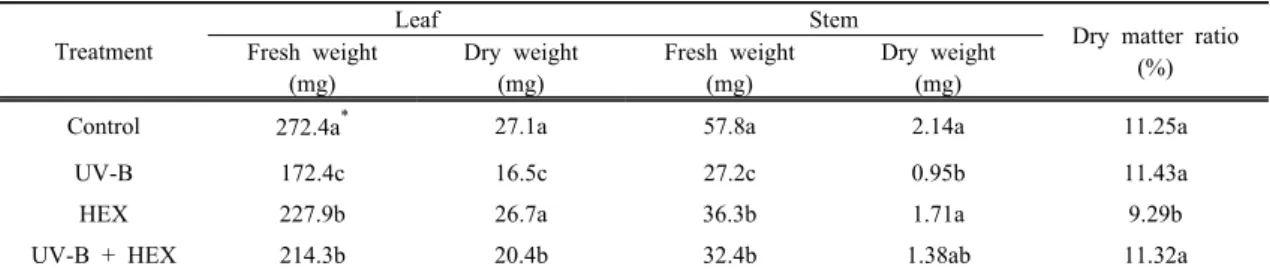
Fresh- and dry-matter accumulations were
remarkably suppressed by enhanced UV-B radiation
(Table 2). As compared to the control, HEX affected
shoot biomass to a lesser extent, but the effects of
HEX varied between untreated and treated UV-B
stress. The combination of UV-B with HEX relieved
the inhibition of UV-B treatment in the shoot
biomass. In HEX-treated cucumber, shorter shoots
and smaller, thicker leaves than control plants are
typical manifestations of triazole treatments, and may
Table 3. Effects of UV-B radiation, HEX and their combination on chlorophyll, carotenoid, anthocyanin and flavonoid contents in cucumber seedlings
Treatment Chlorophyll (mg g-1 FW) Carotenoid
(mg g-1 FW)
Anthocyanin (μg g-1 FW)
Flavonoid (μg g-1 FW)
Chl a Chl b Total Chl
Control 1.600a* 0.475a 2.075a 0.418a 0.091b 2.1a
UV-B 1.399b 0.452a 1.851b 0.382b 0.113a 2.3a
HEX 1.721a 0.481a 2.202a 0.421a 0.099b 2.2a
UV-B + HEX 1.549a 0.477a 2.026a 0.402ab 0.128a 2.6b
* Mean separation within columns by Duncan's multiple range test at 5% level.
Table 2. Effects of UV-B radiation, HEX and their combination on fresh and dry weight of cucumber seedlings Treatment
Leaf Stem
Dry matter ratio Fresh weight (%)
(mg)
Dry weight (mg)
Fresh weight (mg)
Dry weight (mg)
Control 272.4a* 27.1a 57.8a 2.14a 11.25a
UV-B 172.4c 16.5c 27.2c 0.95b 11.43a
HEX 227.9b 26.7a 36.3b 1.71a 9.29b
UV-B + HEX 214.3b 20.4b 32.4b 1.38ab 11.32a
* Mean separation within columns by Duncan's multiple range test at 5% level.
have been responsible for the reduced dry matter accumulation observed in seedlings not irradiated with UV-B. Reduction in the weight of shoot system with HEX treatment has been reported in soybean, maize and white yam.
3.2. Effect of HEX on photosynthetic responses under UV-B stress
Overall chlorophyll content was significantly higher in the treatment of HEX when based on fresh weight (Table 3). HEX increased the chlorophyll and carotenoid content, and affected chlorophyll a to a level higher than chlorophyll b. The increase in chlorophyll content with triazole treatment is attributed to the ability of triazoles to the increase to the cytokinin level and thereby the stimulation of chlorophyll biosynthesis (Fletcher et al., 2000).
Under UV-B radiation, HEX treatment showed significant effects on photosynthetic pigments, indicating that HEX alleviated UV-B stress. Increased chlorophyll synthesis was observed with paclobutrazol treatment
under low temperature in wheat seedlings (Berova et al., 2002) and triadimefon treatment under chilling stress in cucumber seedlings (Feng et al., 2003).
These results therefore indicate that UV-B induced chlorophyll loss was reversed by HEX, and HEX has protective effects on chloroplast membrane subjected to UV-B induced oxidative damage.
The ratio of chlorophyll fluorescence (Fv/Fm),
which is a good indicator of photosynthetic efficiency
in photosystem II activity, was greatly reduced under
UV-B radiation (Fig. 2). In contrast, none of the
chlorophyll fluorescence measured for the HEX-treated
plants were significantly decreased. Treatment with
HEX induced significant increase in Fv/Fm ratios,
whereas the ratios declined a lesser extent under
combined application with UV-B radiation. These
findings demonstrate that the reduction in Fv/Fm
ratio due to UV-B stress was largely prevented by
HEX treatment and chloroplast membranes were
protected to a larger extent from damage induced by UV-B
stress. Both the reduction in PS II efficiency and the
Fig. 2. Changes in chlorophyll fluorescence in cucumber leaves treated with UV-B, HEX and their combination.
Values represent the mean ± SE of three replicates.
changes in leaf morphology probably account for the large reductions in biomass accumulation that occurred in HEX treated plants under UV-B stress in the present study. Triadimefon induced the formation of sun-type chloroplasts in radish, which allows a high photosynthetic quanta conversion (Fletcher et al., 2000).
Anthocyanin and flavonoid contents in cucumber leaves increased in both UV-B and HEX treated cucumber seedlings (Table 3). The combined effects of UV-B and HEX treatments caused a significant increase in the accumulation of these compounds in leaf tissues. Masking of UV-B radiation effects in the presence of HEX may be due in part to anatomical (leaf thickening) or biochemical (pigment accumulation) adjustments to HEX which protect plants from UV-B radiation through screening mechanisms.
The photoinduced accumulation of anthocyanin and flavonoid is preceded by the induction of several enzymes involved in phenylpropanoid metabolism which are recognized as serving key antioxidant role in response to wide range of environmental stimuli including UV-B and sunlight radiation. Anthocyanins in leaf tissues have a dual function as a absorber of harmful levels of radiation and osmotic adjuster. The strong association of anthocyanins with chlorophyllous cells have been shown to have a primary role in photosynthesis perhaps by protecting chloroplasts from photoinhibition during periods of high photon flux. Triadimefon increased anthocyanin accumulation
in radish cotyledons and its effects can be compared to that produced by cytokinin (Jaleel et al., 2006).
Flavonoids are UV-B absorbing pigments which serve as optical screens and may be quantitatively increased by a wide range of environmental stimuli and stresses. Flavonoids and related phenolic compounds are thought to protect plants from the damaging effects of UV-B radiation and reduce the damage of photosynthetic function (Kondo and Kawashima, 2000). Tattini et al. (2004) suggested that flavonoids may serve antioxidant functions in response to drought and excess light stress. Significant change in flavonoid content as a result of the HEX treatment in the UV-B radiated plants indicates HEX-induced UV-B tolerance in cucumber. Increased phenol content caused by various triazole compounds were reported to reduce the disease incidence in crop plants (Singh and Thakore, 1998). The increase of phenols by HEX treatment may further enhance the antioxidant capacity of Plectranthus along with other oxidants (Lakshmanan et al., 2007).
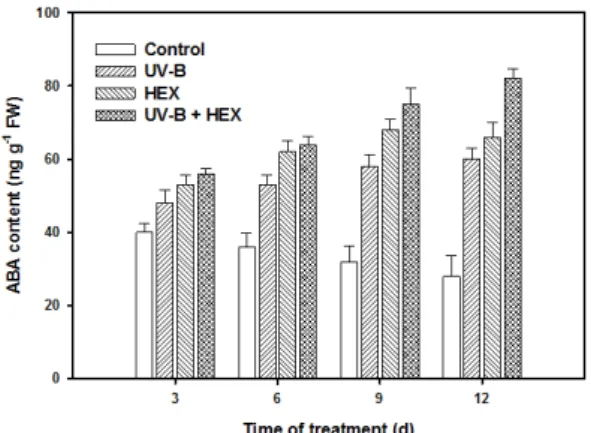
There was a significant increase in abscisic acid (ABA) content under UV-B stress, and combination of UV-B with HEX increased the content to a higher level than that of UV-B treated plants (Fig. 3). The results
Fig. 3. Changes in abscisic acid content in cucumber leaves treated with UV-B, HEX and their combination.
Values represent the mean ± SE of three replicates.
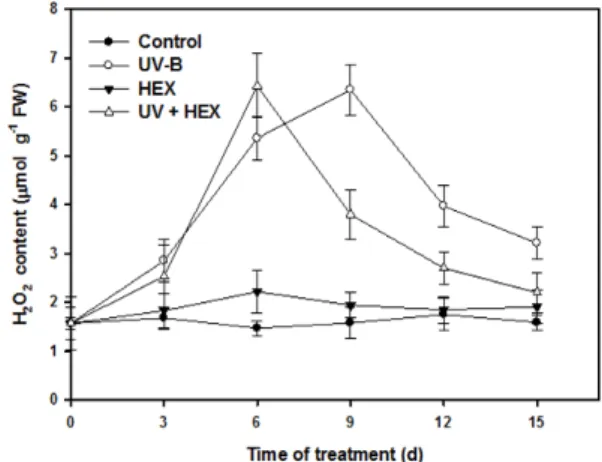
Fig. 4. Changes in H2O2 content in cucumber leaves treated with UV-B, HEX and their combination. Values represent the mean ± SE of three replicates.
presented here indicate that cucumber leaves respond to UV-B radiation by increasing the concentration of ABA, and an increase in the ABA content is one of the earliest responses involved in the signalling pathway triggered by UV-B inducing some degree of UV-B tolerance.
ABA has been implicated as second messenger in signalling in response to a variety of stresses such as drought and heat (Larkindale and Knight, 2002).
Some evidence support that ABA mediate protection against, or repair of, oxidative stress. HEX treatment induced a transient rise in ABA levels, which makes the leaf darker green, possible because of an increase in chlorophyll content. Treatment with triazoles induced ABA content in bean (Asare-Boamah et al., 1986) and in Catharanthus plants under salt stress (Jaleel et al,, 2007a). Exogenous ABA treatment increased anthocyanin accumulation, indicating that increased ABA content induced by triazole might be the cause for the increased anthocyanin content (Jiang and Joyce, 2003). A rise in ABA content in HEX- treated leaves under UV-B stress indicate that ABA is required for the HEX-mediated attenuation of deleterious effects produced by UV-B in cucumber leaves, and that HEX are highly effective on protecting plants from UV-B stress.
3.3. Effect of HEX on antioxidant system under UV-B stress
Hydrogen peroxide (H
2O
2), a main kind of ROS, accumulated under UV-B exposure, while HEX itself had little influence on H
2O
2content (Fig. 4). However, HEX in combination with UV-B induced significant increase in H
2O
2content compared with that of HEX treatment alone, although the levels showed a significant fluctuation in the early growth period. These results suggest that HEX confers a certain degree of protection to cucumber leaves from deleterious effects of UV-B radiation. The striking increase in H
2O
2seen in the leaves treated UV-B alone or in combination with HEX
may be a reflection of change in the specific activities of antioxidant enzymes and the contents of antioxidants.
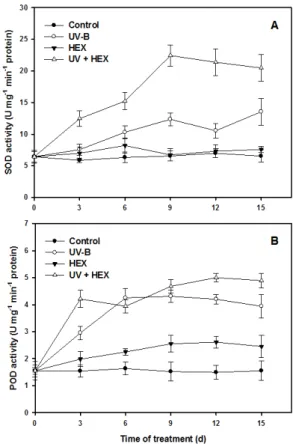
In cucumber leaves, activities of antioxidant enzymes such as CAT, APX, SOD and POD were significantly enhanced by UV-B exposure alone and in combination with HEX (Figs. 5 and 6). HEX treatment to the UV-B stressed and unstressed plants increased these enzyme activities to a higher level than those of control. However, application of HEX in the UV-B stressed leaves induced a higher level in the activities than those of UV-B alone, suggesting that HEX had a promoting effect on the enzyme activities under UV-B exposure. Activities of catalase and APX showed a similar pattern to a larger extent under UV-B exposure alone or in combination with HEX (Fig. 5).
Activities of SOD and peroxidase showed increasing pattern initially then decreasing over time under UV-B stress alone (Fig. 6). In contrast, the promotive effect of HEX on these enzymes showed constant level in late growth period.
In addition to their growth regulatory and fungicidal
effects, triazoles protected plants from injury due to
biotic and abiotic stresses, including temperature
extremes, drought and air pollutants. From the results
it has been suggested that simultaneous effects of
Fig. 5. Changes in catalase (A) and ascorbate peroxidase (B) activity in cucumber leaves treated with UV-B, HEX and their combination. Values represent the mean ± SE of three replicates.
Fig. 6. Changes in superoxide dismutase (A) and peroxidase (B) activity in cucumber leaves treated with UV-B, HEX and their combination. Values represent the mean ± SE of three replicates.
HEX and UV-B radiation on increased leaf thickness and free radical scavenging activity may be some of the factors contributing to the observed tolerance. In chickpea, triadimefon protected the seedlings against UV-damage by maintaining the level of glycoproteins and lipoproteins (Abbas and Zaidi, 1997).
Previous studies with several species have found that triazole treated plants have elevated levels of antioxidant enzyme activities, like SOD and peroxidase, that would protect them against free radical damage.
In addition, some of these protective systems have been shown to be induced by other stresses. Paclobutrazol treatment retained more SOD activities than control plants in salinity stressed soybean plants (Manivannan
et al., 2008) and in drought stressed Arachis plants (Sankar et al., 2007). Triadimefon treatment increased APX and SOD activity in drought stressed Catharanthus
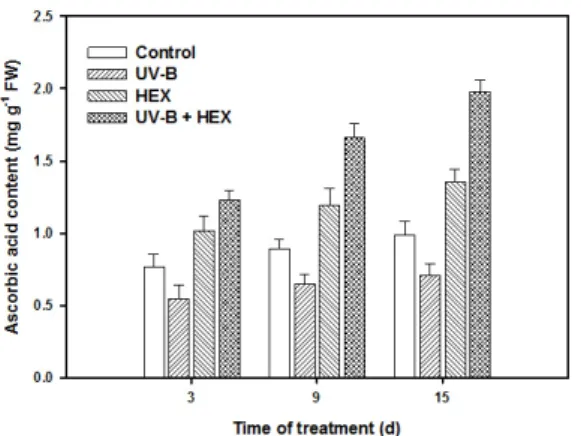
roseus plants (Jaleel et al., 2006).The ascobic acid (AsA) content of the leaf tissue increased with age in the HEX-treated and control plants (Fig. 7). UV-B stress caused a drastic reduction in AsA content, while HEX treatment significantly increased the AsA content as compared to control.
Combination of UV-B and HEX induced remakable
increase in the AsA levels. Ascorbate has a photo-
protective function as antioxidant and functions as
radical scavenger by removing H
2O
2generated during
photosynthetic processes. Additionally, ASA is also
Fig. 7. Changes in ascorbic acid (AsA) content in cucumber leaves treated with UV-B, HEX and their combination. Values represent the mean ± SE of three replicates.
involved in the modulation of PSⅡ activity (Foyer and Noctor, 2003). APX utilizes AsA as on electron donor in the neutralization of H
2O
2(Jaleel et al., 2007a). The decrease in the AsA content of cucumber seedlings upon UV-B exposure might be a consequence of substained oxidative stress.
HEX increased the level of antioxidants including AsA and
-tocopherol, and protected the membrance by preventing or reducing oxidative damage. Triadimefon, drought and salt stress treatments increased the AsA content in Catharanthus plants (Jaleel et al., 2006;
2007a). Paclobutrazol treatment retained more AsA content than that of control in Citrus limon (Jain et al., 2002). There is increasing evidence that stress protection by triazole is mediated by a reduction in free radical damage and increase in antioxidant potential. However, the combined effect of triazole and other stress treatments on antioxidant levels remain to be investigated. From these findings it can be concluded that HEX moderately ameliolate the effect of UV-B stress in cucumber and increase antioxidant enzyme activities that protect them against free radical damage, thus mediate tolerance to elevated level of UV-B radiation.
4. Conclusions
A significant variation was observed in shoot growth and yield components in HEX treated cucumber plants upon UV-B stress compared to control plants.
The growth and yield of cucumber seedlings was generally reduced by UV-B radiation, but the effects of HEX varied between untreated and treated UV-B stress. Shoot length and leaf area was significantly reduced by HEX treatment under UV-B stress. The combination of UV-B with HEX relieved the inhibition of UV-B treatment in shoot fresh and dry weights. HEX treated leaves exhibited higher chlorophyll content and remained intact on plants for a longer period than the control. The rapid increase in anthocyanin and flavonoid in UV-B treated leaves intensified by HEX treatment, which may be a defense response against UV-B stress. The Fv/Fm ratio was greatly declined by UV-B exposure, but the ratio was significantly increased by HEX treatment, showing higher quantum yield for photosystem Ⅱ.
ABA content increased in HEX treated leaves upon UV-B stress, suggesting that ABA are required for the HEX-mediated attenuation of deleterious effects of UV-B stress. The UV-B induced ascorbic acid content reduction was prevented by HEX. The photoinduced accumulation of anthocyanin and flavonoid was preceded by the induction of antioxidant enzymes like catalase, APX, SOD and peroxidase.
HEX stimulated an overall increase in antioxidant enzyme activities upon UV-B exposure, thus conferring UV-B resistance. From these results it is demonstrated that HEX mediates tolerance to elevated level of UV-B radiation and preclude oxidative damage.
Acknowledgements
This work was supported by a 2-Year Research
Grant of Pusan National University.
References
Abbas, S., Zaidi, P. H., 1997, Chemical manipulation through triadimefon against ultaviolet-B induction induced injury to membrane components of Cicer arietinum L., Plant Physiol. Biochem., 24, 64-66.
Asare-Boamah, N. K., Hofstra, G., Fletcher, R. A., Dumbroff, E. B., 1986, Triadimefon protects bean plants from water stress through its effects on abscisic acid, Plant Cell Physiol., 27, 383-390.
Berova, M., Zlatev, Z., Stoeva, N., 2002, Effect of paclobutrazol on wheat seedlings under low temperature stress, Bulg. J. Plant Physiol., 28, 75-84.
Burrows, G. E., Boag, T. S., Stewart, W. P., 1992, Changes in leaf, stem and root anatomy of Chrysanthemum cv. Lillian Hoek following paclobutrazol application, J. Plant Growth Regul., 11, 189-194.
Caldwell, M. M., Teramura, A. H., Tevini, M., Bornman, J. F., Bj"orn, I. O., Kulandaivelu, G., 1995, Effects of increased solar ultraviolet radiation on terrestrial plants, Ambio., 24, 166-173.
Chen, G. X., Asada, K., 1989, Ascorbate peroxidase in tea leaves : Occurrence of two isozymes and the differences in their enzymatic and molecular properties, Plant Cell Physiol., 30, 987-998.
Durner, J., Klessig, D. F., 1996, Salicylic acid is a modulator of tobacco and mammalian catalases, J.
Biol. Chem., 271, 28492-28502.
Feng, Z., Guo, A., Feng, Z., 2003, Amelioration of chilling stress by triadimefon in cucumber seedlings, Plant Growth Regul., 39, 277-283.
Fletcher, R. A., Gilley, A., Sankhla, N., Davis, T. D., 2000, Triazoles as plant growth regulators and stress protectants, Hort. Rev., 24, 55-138.
Foyer, C. H., Noctor, G., 2003, Redox sensing and signaling associated with reactive oxygen in chloroplasts, peroxisomes and mitochondria, Physiol.
Plant., 119, 355-364.
Frohnmeyer, H., Staiger, D., 2003, Ultraviolet-B radiation responses in plants : Balancing damage and protection, Plant Physiol., 133, 1420-1428.
Gopi, R., Jaleel, C. A., Sairam, R., Lakshmanan, G. M.
A., Gomathinayagam, M., Panneerselvam, R., 2007, Differential effects of hexaconazole and
paclobutrazol on biomass, electrolyte leakage, lipid peroxidation and antioxidant potential of Daucus carota L., Colloids Surf. B:Biointerf., 60, 180-186.
Inskeep, W. P., Bloom, P. R., 1985, Extinction coefficients of chlorophyll a and b in N, N-dimethylformamide and 80% acetone, Plant Physiol., 77, 483-485.
Jain, S. K., Singh, R., Misra, K. K., 2002, Effect of paclobutrazol on growth yield and fruit quality of lemon (Citrus limon), Indian J. Agric. Sci., 72, 488-489.
Jaleel, C. A., Gopi, R., Lakshmanan, A. G. M., Panneerselvam, R., 2006, TDM induced changes in the antioxidant metabolism and ajmalicine production in Catharanthus roseus (L.) G. Don., Plant Sci., 171, 271-276.
Jaleel, C. A., Gopi, R., Manivannan, P., Panneerselvam, R., 2007a, Responses of antioxidant defense system of Catharanthus roseus (L.) G. Don. to paclobutrazol treatment under salinity, Acta Physiol. Plant., 29, 205-209.
Jaleel, C. A., Kishorekumar, A., Manivannan, P., Sankar, B., Gomathinayagam, M., Gopi, R., Somasundaram, R., Panneerselvam, R., 2007b, Alterations in carbohydrate metabolism and enhancement in tuber production in white yam (Dioscorea rotundata Poir) under triadimefon and hexaconazole applications, J. Plant Growth Regul., 53, 7-16.
Jansen, M. A. K., 2002, Ultraviot-B radiation effects on plants : Induction of morphogenic responses, Physiol. Plant., 116, 423-429.
Jiang, Y., Joyce, D. C., 2003, ABA effects on ethylene production, PAL activity, anthocyanin and phenolic contents of strawberry fruit, Plant Growth Regul., 39, 171-174.
Johnson, I., Marimuthu, T., Samiyappan, R., Cha, B., 2008, Influence of hexaconazole on biochemieal constituents of groundnut, Kor. J. Pesticide Sci., 12, 335-341.
Kishorekumar, A., Jaleel, C. A., Manivannan, P., Sankar, B., Sridharan, R., Panneerselvam, R., 2007, Comparative effects of different triazole compounds on growth, photosynthetic pigments and carbohydrate metabolism of Solenostemon rotundifolius, Colloids Surf. B: Biointerf., 60, 207-212.
Kondo, N., Kawashima, M., 2000, Enhancement of the tolerance of oxidative stress in cucumber (Cucumis
sativus L.) seedlings by UV-B irradiation : Possible involvement of phenolic compounds and antioxidative enzymes, J. Plant Res., 113, 311-317.
Kraus, T. E., Evans, R. C., Fletcher, R. A., Pauls, K .P., 1995, Paclobutrazol enhances tolerance to increased levels of UV-B radiation in soybean (Glycine max) seedlings, Can. J. Bot., 73, 797-806.
Lakshmanan, G. M. A., Jaleel, C. A., Gomathinayagam, M., Panneerselvam, R., 2007, Changes in antioxidant potential and sink-organ dry matter with pigment accumulation induced by hexaconazole in Plectranthus forskholii Briq, C.R. Biologies, 330, 814-820.
Larkindale, J., Knight, M. R., 2002, Protection against heat stress-induced oxidative damage in Arabidopsis involves calcium, abscisic acid, ethylene and salicylic acid, Plant Physiol., 128, 682-695.
Li, C., Puhakainen, T., Welling, A., Vihera-Aarnio, A., Ernstsen, A., Junttila, O., Heino, P., Palva, E. T., 2002, Cold acclimation in silver birch (Betula pendula) development of freezing tolerance in different tissues and climatic ecotypes, Physiol.
Plant., 116, 478-488.
Manivannan, P., Jaleel, C. A., Kishorekumar, A., Sankar, B., 2008, Protection of Vigna unguicula (L.) Walp. plants from salt stress by paclobutrazol, Colloids Surf. B:Biointerf., 61, 315-318.
Manivannan, P., Jaleel, C. A., Kishorekumar, A., Sankar, B., Somasundaram, R., Sridharan, R., Panneerselvam, R., 2007, Propiconazole induced changes in antioxidant metabolism and drought stress amelioration in Vigna unguiculata (L.) Walp. by hexaconazole under water deficit stress, Colloids Surf. B: Biointerf., 57, 69-74.
Mark, U., Tevini, M., 1997, Effects of solar ultraviolet-B radiation, temperature and CO2 on growth and physiology of sunflower and maize seedlings, Plant Ecology, 128, 225-234.
Mirecki, R. M., Teramura, A. H., 1984, Effects of ultraviolet- B irradiation on soybean, Plant Physiol, 74, 475-480.
Polle, A., Otter, T., Seifert, F., 1994, Apoplastic peroxidases and lignifications in needles of Norway spruce (Picea abies L.), Plant Physiol., 106, 53-60.
Sankar, B., Jaleel, C. A., Manivannan, P., Kishorekumar, A., Somasundaram, R., Panneerselvam, R., 2007, Effect of paclobutrazol on water stress amelioration through antioxidants and free radical scavenging enzymes in Arachis hypogaea L., Colloids Surf.
B:Biointerf., 57, 123-134.
Schreiber, U., Schliwa, U., Bilger, W., 1986, Continuous recording of photochemical and nonphotochemical chlorophyll fluorescence quencing with a new type of modulation fluorometer, photosynth. Res., 10, 51-62.
Singh, R., Thakore, B. B. L., 1998, Effect of hexaconazole on chlorophyll and NPK contents of bottlegourd leaves, Indian J. Mycol. Plant Pathol., 28, 216-217.
Spychalla, J. P., Desborough, S. L., 1990, Superoxide dismutase, catalase and alpha tocopherol content of stored potato tubers, Plant Physiol., 94, 1214-1218.
Tattini, M., Galardi, C., Pinelli, P., Massai, R., Remorini, D., Agati, G., 2004, Differential accumulation of flavonoids and hydroxycinnainates in leaves of Ligustrum vulare under excess light and drought stress, New Phytol., 163, 547-561.
Tonkinson, C. L., Lyndon, R. L., Arnold, G. M., Lenton, J. R., 1995, Effect of Rht 13 dwarfing gene on dynamics of cell expansion in wheat leaves, and it's modification by gibberellic acid and paclobutrazol, J. Exp. Bot., 46, 1085-1092.
Veljovic-Jovanovic, S., Noctor, G., Foyer, C. H., 2002, Are leaf hydrogen peroxide concentration commonly overestimated? The potential influence of artefactual interference by tissue phenolics and ascorbate, Plant Physiol. Biochem., 40, 501-507.
Walker, M. A., McKersie, B. D., 1993, Role of ascorbate- glutathione antioxidant system in chilling resistance of tomato, J. Plant Physiol., 141, 234-239.