Print ISSN: 2288-4637 / Online ISSN 2288-4645 doi:10.13106/jafeb.2021.vol8.no5.0689
Do Risk-Taking, Innovativeness, and Proactivity Affect Business Performance of SMEs? A Case Study in Bangladesh
Md. Atikur RAHAMAN
1, Kaniz Fatema LUNA
2, Zhao Lin PING
3, Mohammad Saiyedul ISLAM
4, Md. Mobarak KARIM
5Received: January 30, 2021 Revised: April 05, 2021 Accepted: April 15, 2021
Abstract
In the current technology-driven era, Small and medium enterprises (SMEs) have been deemed as one of the leading and prominent drivers of sustainable economic progress in emerging and developing economies such as in the Bangladesh context. Hence, it is of significance to understand what might fuel accelerating performance of SME business as increased SME performance will bring about more sustainability and strong development of SME sector within the country, through which more employment is anticipated to be generated. Therefore, the current study examines the impact of three factors: risk-taking, innovativeness, and proactiveness on SME performance in Bangladesh.
The study has gathered data from SME entities in Dhaka city of Bangladesh, by applying a non-probability sampling strategy. 250 SME owners were contacted to act as respondents and finally, 180 SME owners fully completed the survey questionnaire, indicating that the final sample size is n=180. SPSS is used as a purpose of testing the hypotheses by considering a 5% significance level as acceptance criteria of the hypothesis. Hierarchical regression analysis was run to understand the impact of control variables and independent variables on SME performance and found that age of business, risk-taking, innovativeness, and proactiveness have an important impact on SME performance in Bangladesh.
Keywords: Risk-taking, SMEs, Performance, Innovativeness, Proactiveness JEL Classification Code: M13, M21, M31
(Kiyabo & Isaga, 2020). SMEs account for the majority of businesses worldwide and are important contributors to job creation and global economic development (Asheq &
Hossain, 2019; Hossain & Asheq, 2019). They represent about 90% of businesses and more than 50% of employment worldwide. Formal SMEs contribute up to 40% of national income (GDP) in emerging economies. These numbers are significantly higher when informal SMEs are included.
(Gilmore et al., 2013). According to estimates, 600 million jobs will be needed by 2030 to absorb the growing global workforce, which makes SME development a high priority for many governments around the world. (Wang, 2016).
Also, a majority of the private enterprises have been found as small and medium-sized enterprises (SMEs) in emerging countries (Beck & Demirguc-Kunt, 2006). From a research viewpoint, SMEs have remained the focal point for scholars, educators, and investigators since SMEs have quickened the overall economic activities of a nation (Ribeiro-Soriano, 2017). Also, SMEs are well recognized because of their influential function in generating job
1
First Author and Corresponding Author. Associate Professor, School of Management, Jiujiang University, Jiangxi, China [Postal Address:
551 Qianjin Donglu, Jiujiang, Jiangxi, 332000, P.R. China]
Email: [email protected]
2
News Room Editor, DBC News (Dhaka-Bangla Channel), Bangladesh. Email: [email protected]
3
Director, The International Cooperation & Exchange Division, Communications Vocational, and Technical College, Yunnan, China.
Email: [email protected]
4
Ph.D. Fellow, School of International Trade and Economics, Jiangxi University of Finance and Economics, China.
Email: [email protected]
5
Senior Lecturer, World School of Business, World University of Bangladesh, Bangladesh. Email: [email protected]
© Copyright: The Author(s)
This is an Open Access article distributed under the terms of the Creative Commons Attribution Non-Commercial License (https://creativecommons.org/licenses/by-nc/4.0/) which permits unrestricted non-commercial use, distribution, and reproduction in any medium, provided the original work is properly cited.
1. Introduction
Small and Medium Enterprises (SMEs) play a major
role in most economies, particularly in developing countries
opportunities for the unemployed population (Kreiser et al., 2013; Gilmore et al., 2013). According to Hasan et al. (2016), it has been very difficult for business firms to function and operate without having appropriate and supportive actions from small-scale firms.
Despite facing a few societal problems across the country (Hossain & Asheq, 2019), Bangladesh is acclaimed all over the world because of maintaining a growing trend of economic prosperity with higher gross domestic product growth in the last couple of periods (Rahaman et al., 2020;
Gazi et al., 2021; Hossain et al., 2019; Jahan et al., 2020;
Akhter et al., 2020). SMEs have played a critical role in enhancing the economic growth of Bangladesh for the last few decades. Also, for any growing economy, the SME sector is one of the promising export earning sectors that also drive the country’s economic development (Imran et al., 2017). SMEs form the backbone of the manufacturing sector and have become the engine of economic growth in Bangladesh (Mata & Aliyu, 2014). To date, in Bangladesh, very few studies have focused on SME performance as it is important to understand what are the determining factors of SME business performance. Hence, understanding the determinants of SME performance will lead to more development of SME businesses which will be helpful for the economic progress. Therefore, the current study seeks to reveal the impact of risk-taking, innovativeness, and proactiveness on SME performance in Bangladesh.
2. Literature Review 2.1. Risk-Taking
Small entrepreneurs always deal with a risky environment where they are expected to take calculated risks to proceed in a new market or investment. They employ their limited resources in the competitive environment knowing that the investment may not generate any return or even face loss.
Risk can be defined as the possibility of failure or loss or other adverse consequences in pursuing some activity or venture. Risk-bearing and entrepreneurship are inseparable from each other (Altinay & Wang, 2011). Kirby (2004) argued that entrepreneurs are risk-takers and Lüthje and Franke (2003) demonstrated a higher degree of risk-taking tendency is correlated with entrepreneurial activities.
Generally speaking, entrepreneurs take risks as it allows them to distinguish themselves from their competitors. In the competitive business environment that exists today, those who are willing to risk position themselves as leaders, while others get left behind (Keh et al., 2007). Taking risks is the way to create opportunity and progress. When an entrepreneur takes certain risks the competition is not willing to take, they can become leaders in their field (Wang, 2016).
Hence, it is hypothesized:
H1: Risk-taking positively influences SME performance.
2.2. Innovativeness
Innovativeness, as a concept, refers to the process that an individual or organization undertakes to conceptualize brand new products, processes, and ideas, or to approach existing products, processes, and ideas in new ways; these sort of business activities would vitally encourage and speed up unexplored and creative business techniques, identification of new opportunities, business procedures and technologies (Runyan et al., 2006). Innovativeness is a significant component of the firm’s strategy, and small entrepreneurs might apply innovative ideas for creating a superior performance to their business (Lumpkin & Dess, 1996; Runyan et al., 2006) Therefore, it has been assumed:
H2: Innovativeness positively influences SME performance.
2.3. Proactiveness
Proactiveness is the approach to management where the leader runs the company “proactively.” Meaning, rather they are active in terms of seeking out new opportunities for the company and dealing with any threats of problems before they even emerge (Wales et al., 2016). Successfully running an organization is all about adapting to change. Proactive organizations are able to plan for and build the future that they want, rather than waiting on external forces to determine which direction they should go in (Covin & Slevin, 1989;
Wiklund & Shepherd, 2005). Considering the future today is the best way to avoid chaos tomorrow. Proactive business owners are less likely to get caught off guard, which can help mitigate risk and turn changes into opportunities rather than challenges (Lumsdaine & Binks, 2007). These businesses identify the market gap and fill the market demand with innovative products and services. Thinking ahead can help you make the moves needed to position your organization at the forefront of innovation. This is one reason why it is often small, agile companies that lead disruptive innovations (Roux & Bengesi, 2014). A proactive company places greater emphasis on forward-thinking strategic planning as opposed to reactive strategies to deal with problems or to approach opportunities as they arise. Being proactive offers a business a lot of advantages when approaching business opportunities and managing problems . (Zahra &
Covin, 1995). Therefore, proactivity tends to be potential in achieving a higher-level of performance for business firms.
Thus, it is hypothesized:
H3: Proactiveness positively influences SME
performance.
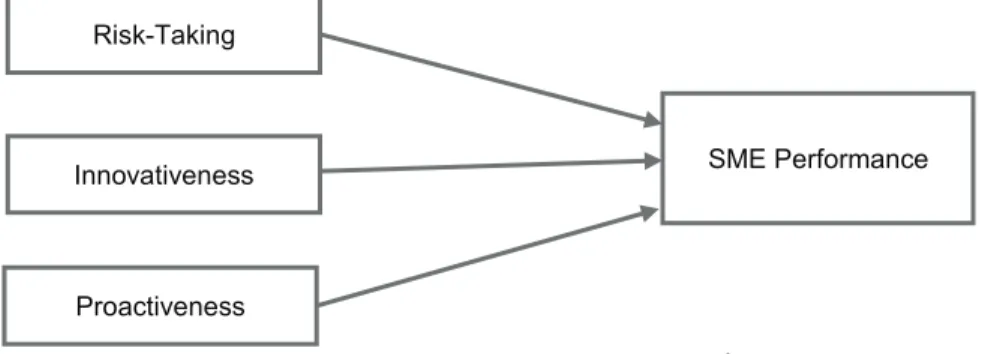
2.4. Research Framework
The study focuses on factors that determine SMEs’
performance in Bangladesh and proposes the following research framework (Figure 1):
3. Methodology
The research has gathered the data from various SME business firms in Dhaka city, Bangladesh, as Dhaka is well known for having so many SMEs operating within its municipality area. This study has used the SME directory of entrepreneurs to select the Dhaka-based SME firms on a random basis. Hence, the sampling method was a non-probability approach. A total of 250 survey questionnaires was directly mailed to the business address of randomly chosen 250 SME firms, with a cover letter that explained the importance of this research. After completion of mailing, periodic phone calls and office visits have been performed by the study team. During the office visit, a face-to-face survey was conducted with the entrepreneurs.
215 SME firm owners responded by filling up the questionnaires, in which 180 responses have been found as complete responses; therefore, the final sample size was n = 180 (see Table 2). The survey questionnaire has been structured in two portions: the first portion relates to the basic information of SME owners and the second portion relates to Likert-based questions on SME performance, risk-taking, innovativeness, and proactiveness. Relevant demographic information is captured in this study, which was controlled to understand their influence on SME performance. Hence this study has taken gender, firm’s age, and SME owner’s past experience as control variables (Danso et al., 2016). Each variable item will help to capture the distinctive feature of SME firms. In this study, data is analyzed by applying hierarchical regression, among the dependent and independent variables. To conduct these statistical assessments, SPSS 23.0 version is used.
Hierarchical regression is purposefully applied to examine
the separate impact of control variables and other dependent variables on SME firm performance.
The study considered the cut-off value of Cronbach’s value (α) of more than 0.70 as an acceptable range to measure the internal reliability of the study variable items.
Table 1 shows the Cronbach value (α) of all variables and the Cronbach value (α) of all variables was well above 0.70, meaning the study variable items were reliable and valid (Taber, 2018).
4. Results and Discussion
This study has interviewed a total of 180 male and female SME owners who have their business entities in Dhaka city of Bangladesh. Out of SME owners, male entrepreneurs consist of 145 (80.6 percent), while female entrepreneurs are 35 in numbers (19.4 percent). Table 1 depicts the overall scenario of descriptive statistics of SME firms, where 98 (54.4 percent) out of 180 firms’ age of doing business are within 0–3 years’ category, 38 (21.1 percent) firms represent 3–6 years’ age of business and 28 (15.6 percent) firms represent 6–9 years’ age of business. The majority of the entrepreneurs (n = 124; 68.9 percent) have less years of past experience (0–3 years), 30 SME owners have 3 to 6 years of past experience (16.7 percent), and only 10 owners have more than 9 years of past experience (5.6 percent).
The Durbin-Watson value reflects a statistical value of 2.014, which falls in the acceptable range of 1.5 to 2.5
Figure 1: Research Framework
Table 1: Reliability Measurement of the Study Variables
Study Variables Cronbach’s (α)
SME Performance 0.755
Risk-Taking 0.884
Innovativeness 0.787
Proactiveness 0.881
(Durbin & Watson, 1950). Variance inflation factor (VIF) values for all variables are found to be under the acceptable range of 5.00 and all tolerance values fall under the value of 0.1 to 1.0 (Kutner et al., 2004), pointing out that the research framework has no multicollinearity problems (Table 3).
The results of the hierarchical regression analysis (Figure 2) point out that in model 1 (inclusion of gender,
Table 2: Descriptive Information
Number Percentage Gender
Male 145 80.6
Female 35 19.4
Age of Firm
0–3 years 98 54.4
>3–6 years 38 21.1
>6–9 years 28 15.6
>9–12 years 10 5.6
more than 12 years 6 3.3
Past Experience
0–3 years 124 68.9
>3–6 years 30 16.7
>6–9 years 16 8.9
More than 9 years 10 5.6
(n = 180).
Table 3: Results of Hierarchical Regression
Variable Adjusted R
2R
2Change β Value T Value Sig. Tolerance VIF
Step-1 (Model-1) 0.073 0.097
Age of Firm 0.184 2.577 0.011* 0.956 1.046
Past Experience 0.194 1.540 0.125 0.305 3.275
Gender 0.135 1.079 0.282 0.310 3.230
Step-2 (Model-2) 0.323 0.261
Age of Firm 0.146 2.306 0.022* 0.891 1.123
Prior Experience 0.008 0.73 0.942 0.266 3.758
Gender 0.059 0.545 0.586 0.304 3.292
Innovation 0.133 2.022 0.045* 0.803 1.245
Risk-Taking 0.139 1.983 0.049* 0.710 1.408
Proactivity 0.176 2.710 0.007* 0.823 1.215
*p < 0.05 (n = 180).
Durbin Watson Value: 2.014.
Dependent Variable: SME Performance.
age of firm, and past experience), only age of firm affects SME performance (β = 0.184, p < 0.05), and model-1 is significant at [F (5, 186) = 4.004; p < 0.05], indicating total variance of 9.7 percent (Table-3). Model-2 consists of three variables: risk-taking, innovativeness, and proactivity, along with control variables and model-2 is also significant at [F (5, 181) = 12.098; p < 0.001], which illustrates additional variance of 26.1 percent. Model-2 also points out that all three independent variables: risk-taking, innovativeness, and proactivity are important predictors of SME performance. H1 proposes that risk-taking positively affects the performance of SME entities. The hierarchical regression result provides sufficient support for the acceptance of this hypothesis (β = 0.139; p < 0.05). SME owners or entrepreneurs having a higher level of risk-taking tendency are likely to experience superior business performance.
The result is consistent with the prior studies (Rauch et al., 2009; Sarker & Palit, 2015). During face-to-face conversations with the respondent who were SME owners, some of them stated that a risk-taking attitude is crucial in securing profitability in their SME businesses. Two of the SME owners stated that the amount they invested in their business was their own money. They have not taken any loan from any bank or any individual. For the business growth, they would love to attempt some daring tasks. As small firm owners, they believe that business decisions followed by risky elements would get them better financial attainment.
H2 predicts that innovativeness has a statistical influence
on SME business performance and the result has supported
this hypothesis (β = 0.133; p < 0.05). Hence, innovativeness
would positively affect SME firm performance. The more
creative the more innovative SME entrepreneurs will be, the better their business performance will be.
The findings are consistent with prior studies. Introducing innovation in designing and crafting products results in driving business gain (Zahra & Garvis, 2000). During the conversation, respondents described that they always come up with new and innovative designs in their business product portfolio so that their SME products could remain differentiated in the market. They reward their employees every three months for their novel and innovative thinking, and this strategy got them a lot of financial gains such as accelerating SME business growth and sales. Proactiveness is anticipated to have a statistical impact on SME performance (H3). The regression results show that proactiveness is a significant predictive variable of SME performance and H3 is supported (β = 0.176; p < 0.05). The result is consistent with previous findings (Hughes & Morgan, 2007).
The positive side of being proactive is the ability to take advantage of opportunities where your company’s strengths align with marketplace developments. New innovations, technological advances, societal movements, and changing customer perceptions and needs all contribute to potential opportunities to grow a business. The benefit of being proactive is that you recognize, plan for and invest in new opportunities before it’s too late. Proactive SMEs more effectively plan for potential problems, market evolutions, and trends, and consumer expectations before they develop. This gives them a greater ability to put systems, infrastructure, and employees in place to address these issues and opportunities as they arise. So, being proactive always benefits SME business performance as it helps SME owners to be updated with the future business trend.
5. Conclusion
The current research contributes to understanding the triggering factors that might reinforce SME performance in a
developing country context: Bangladesh. The factors which were considered in this research, are based on prior relevant research. The major objective of this research is to analyze the impact of risk-taking, innovativeness, proactiveness on the business performance of SME entities in Dhaka, Bangladesh.
The study results suggest that risk-taking, innovativeness, and proactiveness significantly affect SME performance. It does indicate that SME owners need to create such a convenient business culture that will be more beneficial for the employees to become more innovative, creative, and proactive in nature, through which they will play a satisfactory part in driving SME performance in the future.
References
Akhter, A., Hossain, M. U., & Asheq, A. A. (2020). Influential factors of social entrepreneurial intention in Bangladesh.
Journal of Asian Finance, Economics, and Business, 7(8), 645–651. https://doi.org/10.13106/jafeb.2020.vol7.no8.645 Altinay, L., & Wang, C. L. (2011). The influence of an
entrepreneur’s socio-cultural characteristics on the entrepreneurial orientation of small firms. Journal of Small Business and Enterprise Development, 18(4), 673–694. https://
doi.org/10.1108/14626001111179749
Asheq, A. A., & Hossain, M. U. (2019). SME performance: Impact of market, customer, and brand orientation. Academy of Marketing Studies Journal, 23(1), 1–9.
Beck, T., & Demirguc-Kunt, A. (2006). Small- and medium- sized enterprises: Access to finance as a growth constraint.
Journal of Banking & Finance, 30(11), 2931–2943. https://doi.
org/10.1016/j.jbankfin.2006.05.009
Covin, J. G., & Slevin, D. P. (1989). Strategic management of small firms in hostile and benign environments. Strategic Management Journal, 10(1), 75–87. https://doi.org/10.1002/
smj.4250100107
Danso, A., Adomako, S., Damoah, J. O., & Uddin, M. (2016). Risk- taking propensity, managerial network ties, and firm performance Figure 2: Results of Regression Analysis
Risk-Taking
Proactiveness
SME Performance Innovativeness
R2= 0.261
0.133*
0.176*