Print ISSN: 2288-4637 / Online ISSN 2288-4645 doi:10.13106/jafeb.2021.vol8.no5.0885
The Impact of Financial Variables on Firm Profitability:
An Empirical Study of Commercial Banks in Oman*
Gopu JAYARAMAN
1, Imran AZAD
2, Hanaa Sid AHMED
3Received: February 10, 2021 Revised: April 05, 2021 Accepted: April 15, 2021
Abstract
The general role of commercial banks is to provide financial services to the general public and business, ensuring economic and social stability and sustainable growth of the economy. Commercial banks play an important role in mobilizing and channelizing funds for investment activities. This study analyzes the impact of the key financial variables on the net profit of the selected commercial banks in Oman. The study employs times series panel data – cross-sectional analysis of the key financials of five leading commercial banks for a period of 13 years from 2007 to 2019. The results reveal that the correlation matrix of the selected variables has a positive relationship with net profit, assets, deposits, loans, and interest income. However, the findings also shows a negative relationship between net profit and net loans to total deposits ratio. The study found net loans is the main independent variable that influences the profitability of the banks since the key source of revenue comes from the lending operations. The assets, total capital adequacy ratio have a mixed effect on the profitability of commercial banks. The total deposits and capital adequacy ratio have a negative effect on profitability mainly because excessive liquidity will increase the cost of capital and reduce the return on investment. Focusing on lending operations with a sound credit portfolio will improve profitability.
Keywords: Net Profit, Net Interest Income, Net Loans, Total Assets, Deposits JEL Classification Code: G20, G21, G29
1. Introduction
The banking system plays an important role in the modern economic world. Banks collect the savings of the individuals and lend them out to a business-people and manufacturers. Thus, the banks play an important role in the creation of new capital (or capital formation) in a country and thus help the growth process. The Commercial Banking Sector in the Sultanate of Oman plays a crucial role in the fund’s mobilization and allocation for the growth of the economy. The banks’ credits play a prominent role in mobilizing savings and financing various private sector, public sector, and individuals (Ahmed et al., 2020). The stability and growth of the banking sector are vital for any economy. The banking sector’s liquidity, solvency, and profitability is the parameter indicating the condition of the economy. Besides facilitating capital formation, the banking sector with sophisticated information technology provides numerous services and support for the corporate world. The banking sector necessarily needs to be vibrant and sound in all respects to be successful in funds mobilization and allocation as it requires building unshakable confidence
* Acknowledgements:
We thank the College of Applied Science, Salalah, the University of Technology and Applied Sciences, Sultanate of Oman for funding this research work. The content of this research work is solely the responsibility of the authors and does not necessarily represent the official views of the College of Applied Sciences, University of Technology, and Applied Sciences.
1
First Author and Corresponding Author. Department of Business Administration, College of Applied Sciences Salalah, University of Technology and Applied Sciences, Oman [Postal Address: P.O. Box 347, P.C. 215, A’Saada, Sultanate of Oman]
Email: [email protected]
2
Department of Business Administration, College of Applied Sciences Salalah, University of Technology and Applied Sciences, Oman.
Email: [email protected]
3
Department of Business Administration, College of Applied Sciences Salalah, University of Technology and Applied Sciences, Oman.
Email: [email protected]
© Copyright: The Author(s)
This is an Open Access article distributed under the terms of the Creative Commons Attribution Non-Commercial License (https://creativecommons.org/licenses/by-nc/4.0/) which permits unrestricted non-commercial use, distribution, and reproduction in any medium, provided the original work is properly cited.
among the investors, depositors, borrowers, and customers.
According to Said and Tumin (2011), banks as the critical part of the financial system play an important role in contributing to a country’s economic development. If the banking industry does not perform well, the effect on the economy could be huge and broad. Athanasoglou et al.
(2008) stated that the sound and profitable banking sector is better able to withstand negative shocks and contribute to the stability of the financial system.
Islam (2003) pointed out that a well-developed efficient banking sector is the main requirement for saving and investment climate and that would faster the economic growth. The banking sector can efficiently finance profitable and economically important projects systematically.
Tarawneh (2006) stated that the major objective of Omani commercial banks is to concentrate on trade services and cash management. Sultanate of Oman is focused to achieve a wider geographical investment to narrow down the gap in the standard of living. Achieving the regional development and diversification of the economy demands wider and greater participation of commercial banks in the economy. Said and Tumin (2011) stated that the banks form the main part of the financial system and play a vital role in a country’s economic development and growth and if the banking sector is in trouble it troubles the entire economy. If the banking industry does not perform well, the effect on the economy could be huge and broad.
Banna et al. (2017) pointed out that, efficient inter- mediation of commercial banks facilitates economic growth and improves financial stability, the efficient functioning of commercial banks is very important for the whole economy.
Banks act as financial intermediaries because they stand between savers and borrowers that is they often serve as the
“intermediaries” between those who have the resources and those who want resources. Savers place deposits with banks, and then receive interest payments and withdraw money.
Borrowers receive loans from banks and repay the loans with interest. In turn, banks return money to savers in the form of withdrawals, which also include interest payments from banks to savers. Besides, banks offer numerous financial services which help in industrial and economic development.
Maudos and De Guevara (2004) stated that the banking sector plays a fundamental role in economic growth, as it is the basic element in the channeling of funds from lenders to borrowers and it is important that this work of intermediation by the banks is carried out with the lowest possible cost to achieve greater social welfare.
Kasman et al. (2010) stated that through the process of intermediary roles of channeling funds from lenders to borrowers, banks play a pivotal role in economic growth.
In this context, as the costs of intermediation affect social welfare, it is valuable to focus on the bank’s net interest margin. In the Sultanate of Oman, the financial sector was
mainly dominated by the Banking Sector and till 2013 the conventional banking was the main body of the banking sector and since 2013 the Islamic Banking System has been introduced and getting its importance and popularity.
However, conventional banking plays a dominant role and contributing significantly to the growth of the banking sector in the Sultanate of Oman. Olson and Zoubi (2011) state that the commercial banking sector in the Middle East has been experiencing significant transformations. According to Zeitun (2012), Islamic banking has been introduced in many Islamic and non-Islamic countries and is playing a significant role in financing and contributing to the development of different economic and social sectors.
2. Theoretical Background 2.1. Profitability of the Banks
Like all businesses, banks profit by earning more money than what they pay in expenses. The major portion of a bank’s profit comes from the fees that it charges for its services and the interest that it earns on its assets. Said and Tumin (2011) investigated the impact of bank-specific factors which include the liquidity, credit, capital, operating expenses, and the size of commercial banks on their performance, which is measured by return on average assets (ROAA) and return on average equity (ROAE). The study was conducted with the selected commercial banks in China and Malaysia and revealed that ratios employed in this study have different effects on the performance of banks in both countries, except credit and capital ratios. Qin and Dickson (2012) examined the profitability of commercial banks in Tanzania for a period of ten years from 2000 to 2009. The study found that the return on average assets, net interest income, and non-interest expenses have an impact on the profitability of the banks. Lepetit et al. (2008) investigated the relationship between bank risk and product diversification in the changing structure of the European banking industry.
The study revealed that the banks’ risk level is more in non- interest income activities than in interest income activities and this is highly evidenced in small banks, but in all cases, the risk is mainly positively correlated with the share of fee-based activities but not with trading activities.
Maudos and De Guevara (2004) studied the interest
margin in the principal European banking sectors in the
period 1993–2000, identifying the fundamental elements
affecting this margin and it was found that the change in the
income structure of European banks meant an increase in
the importance of banking commissions and a reduction in
the implicit payment of interest, which in turn has led to a
reduction of the interest margin. Maudos and Solís (2009)
analyzed net interest income in the Mexican banking system
over the period 1993–2005. Their study modeled the net
interest margin simultaneously including operating costs and diversification and specialization as determinants of the margin. The results referring to the Mexican case show that its high margins can be explained mainly by average operating costs and by market power. Although non-interest income has increased in recent years, its economic impact is low. According to Al-Kharusi and Murthy (2020), the key variables that are to be taken to forecasting the financial stability are returns on equity (ROE), return on assets (ROA), equity to total assets (EQTA), loan loss provisions to total loans (LLP), liquid assets to total assets (LIQ).
Sufian and Chong (2008) examined the determinants of Philippines banks’ profitability during the period 1990–2005.
The empirical findings suggest that all the bank-specific determinant variables have a statistically significant impact on bank profitability. The empirical findings suggest that size, credit risk, and expense preference behavior are negatively related to banks’ profitability, while non-interest income and capitalization have a positive impact. During the period under study, the results suggest that inflation has a negative impact on bank profitability, while the impact of economic growth, money supply, and stock market capitalization has not significantly explained the variations in the profitability of the Philippines banks. Chu and Lim (1998) found that the larger banks are more efficient than smaller banks since larger banks are able to attract more deposits, lend more and their interest spread is also larger. The leading commercial banks are able to build competitive advantage through offering a wide range of services, application of sophisticated technology, and wider distribution network, and all these help to build expanding customer network and loyalty, eventually, these competitive edge brings more revenue.
Tuan (2020) explored the application with Balanced Scorecard in enterprises according to 4 perspectives of Balanced Scorecard in Vietnamese commercial banks.
A Balanced Scorecard (BSC) will help the manager to measure and evaluate the operating performance in enterprises.
Research showed the impact of the Balanced Scorecard on the performance of Vietnamese commercial banks. This is the scientific basis for enterprises of Vietnam in general and Vietnamese commercial banks firms, in particular, have a successful application of balanced scorecard to improve the business performance. Stankevičienė and Mencaitė (2012) highlighted that the performance of the banks can be influenced by their size, the larger banks do well by managing solid assets. It is obvious that the larger banks with their adequate capital base, financial soundness are in a better position in terms of the better marketing mix, product mix and sound infrastructure, resultantly able to get significant market share in its core business. As the main source of revenue comes from funding segment, the return from the loans and credit segments is determined by the financial performance of borrowers and therefore, the interest income
and performance of loans depends on the macroeconomic conditions.
Sufian and Chong (2008) stated that the banks’
profitability is highly influenced by the macroeconomic conditions despite the trend in the banking industry such as geographic diversifications, application of financial engineering techniques for managing risk. Goddard et al.
(2004) investigated the profitability of European banks during the 1990s. Models for the determinants of profitability incorporate size, diversification, risk, and ownership type, as well as dynamic effects. Despite the intensifying competition, there is significant persistence of abnormal profit from year to year. The evidence for any consistent or systematic size- profitability relationship is relatively weak. The relationship between the importance of off-balance-sheet business in a bank’s portfolio and profitability is positive for the UK, but either neutral or negative elsewhere. The relationship between the capital-assets ratio and profitability is positive. García- Herrero et al. (2009) opined that profitability is a reflection of how banks are performing in a given environment. The quality and efficiency of the management, shareholders’ and investors’ behavior towards the bank, the bank’s competitive strategies, efficiency, and risk management capabilities are all expected to be reflected in terms of the profitability of the banks. Phan et al. (2020) found that profitability is positively affected by operating efficiency, size of loans, inflation rate, retails loan ratio, and growth rate of GDP. While the variable like credit risk, liquidity risk, bank size, capital size, and revenue diversification are insignificant to banks profitability.
Siraj and Pillai (2012) pointed out that a lower operating
expenses ratio indicates better management and control of
operating expenses and such a situation will help the banks
to enhance their profitability. However, to penetrate new
markets, introduce new products and create and retain a
customer base, the banks need to improve their operational
efficiency and achieve a competitive edge in their core
operating areas and this necessarily warrants invest and
spend adequately in its operations. Olson and Zoubi (2011)
found that there is a positive correlation between bank size
and profitability of banks in the Middle East and the analysis
indicates that the larger banks in the region are more profitable
than the smaller ones. The larger banks obviously with their
financial power and sound infrastructure are able to build
their competitive edge which will obviously reflect in better
profitability and therefore the merger and acquisitions in the
banking sector will be inevitable in the future. Al Karim and
Alam (2013) found that bank size, credit risk, operational
efficiency, and asset management have a significant impact
on the financial performance of Bangladeshi commercial
banks. The commercial banks’ majority of the assets happens
to be loans and advances, therefore efficient management of
loans and advances results in steady interest revenue and
reduced provisions impairment and subsequently, these efficiencies will bring a higher return on assets.
2.2. Net Interest Margin (NIM)
Net interest margin (NIM) is a measure of the difference between the interest income generated by banks or other financial institutions and the amount of interest paid out to their lenders (for example, deposits), relative to the amount of their (interest-earning) assets. The net interest margin is the key determinant of commercial banks’ profitability and financial growth. As the core business of commercial banks happens to be deposit mobilization and lending, the difference over the borrowing and lending rates acts as the driving force of profitability. The Net Interest Income (NII) to interest income ratio indicates the interest income after interest expenses. The commercial bank’s main source of funds is the customer deposits and the application is the loans and advances and therefore the outcome of these operations is the interest paid on deposits and interest received from the loans and advances. The difference between these interest expenses and interest revenue is net interest income, which determines the profitability, liquidity, and solvency of commercial banks. Of course with sophisticated technology and innovative new products the commercial banks explore the various avenues of fee-based services but still, the lending activities bring a major chunk of the revenues.
According to Kasman et al. (2010), it is valuable to focus on the bank’s net interest margin. The investigation of bank net interest margins is crucial since they include important information about the efficiency of banking systems. He (2018) found that the net interest spread has a positive effect on the profitability of the commercial bank. Said and Tumin (2011) stated that as for the interest rate, according to previous studies, there is a positive relationship between the interest rate and bank profits. The commercial banks’ core revenue and profitability come from net interest margin.
The net interest margin reflects the efficiency of the bank in its core business function namely deposit mobilization and lending. Besides doing the core activity of deposit mobilization and lending, the commercial banks continue to explore various other fee-based services. However, the interest revenue segment dominates the revenue structure of the commercial banks. Qin and Dickson (2012) the largest source of income to the bank is interest income from lending activity less interest paid on deposits and debt. In this study profitability was measured by three ratios which are net interest margin, return on assets and return on equity.
Lepetit et al. (2008) found that banks focusing on non - interest income activities present higher risks and higher insolvency risk than banks that may supply loans.
J. Maudos and Solís (2009) stated that the bank’s target higher intermediation margin if they enjoy a high competitive edge
in the market power. The banks with operating costs try to pass these to their borrowers by increasing the interest on credit and to its lenders by reducing interest on deposits.
However, in the present competitive market the banks to be more efficient and dynamic through offering attractive interest on deposits and charging competitive interest on its lending. Therefore, the banks must evolve a strategy to have optimum utilization of their resources especially the customer deposits.
Ramlall (2009) analyzed determinants of profitability for the Taiwanese banking system using bank-specific, industry- specific, and macroeconomic factors, under a quarterly dataset, for the period 2002 to 2007. Results show that while credit risk triggers a negative impact on profitability, capital tends to consolidate profits. In general, results suggest that the Taiwanese banking system is well-diversified. The main implication of the findings is that it may be difficult to mitigate the pro-cyclicality of banks’ profitability in Taiwan subject to a non-concentrated banking system.
Maudos and Solís (2009) found that since banks engage in different non-lending activities, these other activities may influence the pricing of loan products due to cross- subsidization of bank products. However, its economic impact is insignificant. The net interest spread is one of the key financial variables that influence the profitability of commercial banks. However, the banks have to consider the competition and guidelines of the concerned regulatory authorities in fixing interest rates on deposit mobilizations and lending. Al-Muharrami (2015) stated that to raise funds from individuals and institutions, banks are required to establish decent rates on deposits to cover at least the inflation rates.
2.3. Cost to Income Ratio
The cost-to-income ratio is calculated by dividing the operating expenses by the operating income generated i.e. net interest income plus the other income. The cost-to-income ratio is important for determining the profitability of a bank.
Mokni and Rachdi (2014) stated that the cost to income
ratio measures the efficiency of the bank in managing and
controlling operating costs. This ratio indicates the relation
between cost and income. The higher the ratio is the lesser
the efficiency of the Bank in controlling and managing the
operating expenses. As the Banking industry is facing stiff
competition, the managements are focusing on controlling
cost and trying to market their services at competitive
pricing. Operating expenses are one of the important factors
which influence the profitability of banks (Athanasoglou
et al., 2008). If the management fails to manage and control
the operating expenses, then they are expected to pass
the cost to customers or shareholders (reduced return on
equity). However, if there is severe competition, then the
management will pass the burden of inefficient management of cost to shareholders only. Mathuva (2009) found that the cost-income ratio is negatively significant, indicating that the ratio affects the profitability of the banks. Onuonga (2014) opined that the amount of expenses incurred by the bank significantly influences the profitability of the banks.
2.4. Loan Loss Reserve to Gross Loan (LLR) – Measuring Asset Quality
Loan loss reserve is a prudential regulation and super- visory concept against a bank to ensure that banks establish LLP (loan loss provisions) at a rate equivalent to the level of risk in their loan portfolio. Loan loss provisions represent funds derived from a portion of bank cash or cash equivalents and are set aside to cover potential loss estimates in the loan portfolio. The loan loss reserve ratio basically measures the provisions created to absorb bad debts arising out of the lending operations of the bank. The ratio measures the efficiency of the bank’s credit appraisal, credit management, recovery management, and overall financial health of its loan portfolio, in other words, it ultimately measures the asset quality of the bank, as the majority of the bank’s assets happened to be its loans and advances. The increased provisions for bad and doubtful loans will certainly pull down the profitability of the banks. Smaoui and Salah (2012) stated that the ratio of loan loss reserves to gross loans (LLR) measures the banks’ asset quality. Akhtar et al. (2011) found that the Non-performing loans to total loans (NPL) ratio has a relationship with Return on Assets and Return on equity.
2.5. Net Loans to Assets Ratio (NLA)
The loans to assets ratio measure the total loans outstanding as a percentage of total assets. The higher this ratio indicates a bank is loaned up and its liquidity is low.
The higher the ratio, the more risky a bank may be to higher defaults. The net loans to assets ratio is an attempt to measure the liquidity condition of the bank. But it also highlights the interest income level as the higher Net loans to assets ratio indicates a higher level of loans and advances to customers which will enhance the interest income. Smaoui and Salah (2012) found that higher NLA ratios could reduce liquidity and increase the number of marginal borrowers that default.
However, higher NLA ratios may be indicative of better bank performance because of increases in interest income.
2.6. Capital Adequacy
Capital Adequacy Ratio (CAR) is the ratio of a bank’s capital in relation to its risk-weighted assets and current liabilities. It is decided by central banks and bank regulators to prevent commercial banks from taking excess leverage
and becoming insolvent in the process. The commercial banks are expected to maintain an adequate level of capital to absorb all the risk that is expected by the banks to face and to reasonable return to the shareholders and depositors. The ability of the banks in this respect is measured in terms of capital adequacy ratio as prescribed by regulatory agencies like Central Bank. The main objective of the Central Bank of Sultanate of Oman’s (CBO) capital adequacy requirements for the banks is to ensure the required level of capital to withstand the risk. The CBO requires the Banks registered in Oman to maintain the minimum level of capital adequacy ratio of 12% and the ratio is calculated as per the guidelines of CBO and Base II Accord. The retained earnings and reserves are the important components in the calculations of capital adequacy ratios. As the net interest income is the main element of the revenue segment of banks, the net interest income determines the profitability level and subsequently the retained earnings and reserve levels of the bank. Therefore, the Net interest income level is expected to have an impact on the capital adequacy ratios of the banks.
Sangmi and Nazir (2010) stated that capital adequacy is a reflection of the inner strength of a bank, which would stand it in good stead during times of crisis. Tabash (2019) advocated that to win customers’ confidence and comply with the regulatory requirement, the banks should ensure that the Capital to the risk-weighted assets ratio is at an acceptable level. Isnurhadi et al. (2021) found that the bank’s capital has a positive effect on its stability. According to Mathuva (2009), there is a negative relationship between profitability measures and equity capital ratio. The more equity capital to the bank results in the demand of more dividend and subsequently, it reduces the retained earnings which further pull down the funds available for growth purposes and ultimately it affects the earning capacity of the banks. Olweny and Shipho (2011) found that the capital ratio (CAP) is positively related to return on assets (ROA), the profitability measure. The higher level of capital is expected to bring a higher level of profitability whereas if the banks depend on more financial leverage the earnings will be more volatile and such unstable earnings affect the credit creation and liquidity of the banks. Therefore, having a better and sound capital base enhances the liquidity, solvency and subsequently, it improves the confidence of depositors and customers of the bank. The enhanced depositors’ confidence about the bank’s liquidity and solvency increase the scope of deposit mobilization at competitive rates.
2.7. Return on Equity (ROE)
Return on equity (ROE) is a measure of financial
performance calculated by dividing net income by
shareholders’ equity. Because shareholders’ equity is equal
to a company’s assets minus its debt, ROE is considered
the return on net assets. The return on equity measures the profitability of the Shareholders’ equity and it counts the return available for shareholders on their investment.
A company with a high return on equity is considered capable of generating cash internally and profitable (Ongore
& Kusa, 2013). Ogunbiyi and Ihejirika (2014) stated that as the ultimate objective of a commercial entity is to preserve and increase the wealth of shareholders, obviously the entity’s return on equity should be more than the cost of equity. The equity shareholders return is considered and calculated after all the commitments, expenses, and required provisions therefore if the bank can deliver a reasonable return to equity shareholders it is understood that the bank’s bank has delivered values to other stakeholders as well. The Banks profitability can be measured by the ratio of Return on assets and this ratio indicates the profitability of the bank on its total assets.
Khrawish and Al-Sa’di (2011) and Said and Tumin (2011) stated that to analyze the performance of banking institutions, two profitability measures namely return on assets and return on equity are appropriate. The return on assets reflects the ability of a bank’s in generating profits on the employed assets. The return on equity shows the return on shareholders’ equity. The average assets and average equity can be applied to consider the differences that occur during the fiscal year. Smaoui and Salah (2012) researched that the higher the equity to assets ratio, the lower the need for external funding and therefore the higher the profitability of the bank. Siraj and Pillai (2012) pointed out that the Regulatory authorities and financial analysts emphasize the key ratios namely Return on Assets and Return on equity to evaluate the performance of commercial banks. The Return on equity capital measures the relationship between Net profit after tax and Equity capital of the bank).
3. Statement of the Problem
Stankevičienė and Mencaitė (2012) stated that the evaluation of banks and their performance attracts significant attention from public and financial regulators as banks are critical institutions in most economies. The banks have incredible ability and credibility in mobilizing and channelizing the financial resources which are very essential for industrial and economic development. The banking sector is the backbone of the economy and at the same time risk level is comparatively high in this sector as its revenue model focus on deposit mobilization and lending. If the cash inflows and cash outflows (interest income and interest expense) are not properly and adequately matched, it will lead to financial stress and subsequently to bankruptcy. Singh and Fida (2015) stated that as compared to the past, today’s banking industry faces tough competition and the probability
of bankruptcy is also high as the financial markets across the world are integrated. Researching the financial variables that influence the profitability of commercial banks will throw light on the key financial variables to stabilize and enhance profitability.
Ali et al. (2020) argued that data analytics strategies are very important and have a significant impact on banks’
sustainability and financial performance. Analyzing the impact of net interest income will help the regulatory authorities and bank management in developing future strategies for enhancing the profitability of the banks.
The role and contribution of net interest income towards enhancing the liquidity, solvency, profitability, and market capitalization of the banks is to be understood for better planning and managing the segment-wise revenue performance of the banks. A sound financial system is pertinent for a healthy economy and as the banks play a crucial role in the financial system, evaluating the financial efficiency and performance from different angles becomes relevant and important. According to Ongore and Kusa (2013), commercial banks can sustain their intermediation function of channelizing funds from depositors to investors through generating necessary margins in their core business activities of deposit mobilization and lending operation.
The stability, growth, and financially sound of the commercial banks ultimately depend on the profitability.
Pisedtasalasai and Edirisuriya (2020), found that the banks with higher profitability are in a better position and capable to diversify their operations. Tran et al. (2020) stated that earnings management is an important aspect for banks because it influences the interests of stakeholders. The results of Al-Kharusi and Murthy (2020) highlighted that banks may be financially unstable in the future due to negative profitability, due to low capital ratios, and may be due to credit losses during economically recessionary times. There are many internal factors and external factors that influence the profitability of the banks but mainly the internal factors that determine the profitability. Identifying the key financial variables that determine profitability becomes imperative so that the management can focus on the divers of the profitability. By keeping these points in mind, the present study has been undertaken.
4. Objectives and Research Questions
The main objectives of the present study are to find out the impact of the key financial variables on the Net profit of the selected commercial banks in Oman. In line with these main objectives the study attempts to answer the following research questions;
a) The impact of Net interest income, Deposits, Net
loans, Operating profit, Operating expenses, and
Capital adequacy on the Net profit of the commercial banks in Oman.
b) Is there any statistically significant relationship between these key financial variables and Net profit of the commercial banks in Oman.
5. Methodology
5.1. Source of Data and Period of the Study
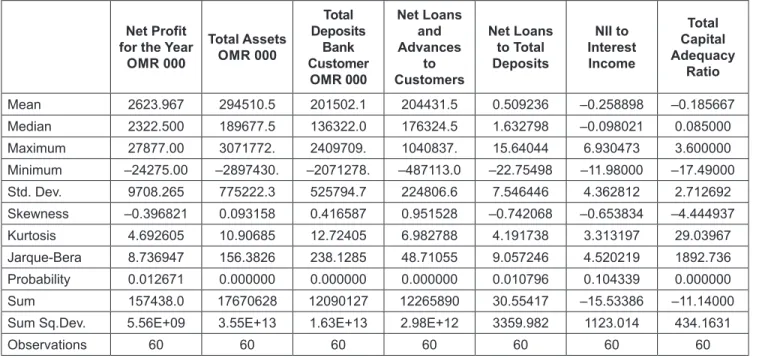
The Panel Data - Cross-sectional of a sample of five leading commercial banks out of 16 commercial banks in Sultanate of Oman namely Bank Muscat, Bank Dhofar, National Bank of Oman, Ahli Bank, and Oman Arab Bank are analyzed. The banks follow January 1 to December 31 as their accounting periods for annual financial results and the annual results are taken for the present study. The data and other financial information are taken from the annual reports of the Banks for the study period from the year 2007 to 2019 (13 years).
5.2. Variables
The commercial bank’s profitability is typically measured by Return on Assets, Return on equity, Net interest margin (Anbar & Alper, 2011). The following key financial variables are critically analyzed; NII to Interest Income (%), Net Interest Income (RO’ 000), Total Assets (RO’ 000), Net Loans and Advances to customers (RO’ 000), Total Deposits from Banks (RO’000), Total Deposits from customers (RO’000), Total Deposits (Bank & Customer), Net loans to total deposits (%), Operating profit (before impairment allowances), Net interest income to Operating income (%), Operating expenses to operating income (Cost to Income Ratio) %, Return on assets, Total capital adequacy ratio (%),
Figure 1: Model
Net Profit for the year, EPS and Return on weighted average shareholders’ equity. The Net interest income to Operating income is calculated as follows: Net interest income/
Operating income × 100. The calculations are done based on Income statements from the annual reports. The capital adequacy ratio is taken from annual reports. Total capital base/ Total risk-weighted assets and the Return on assets have been calculated by taking the Total comprehensive income for the year/Total assets.
5.3. Model of the Present Study
The conceptual framework (Figure 1) of the present study has been developed based on the review of the literature.
The Conceptual Model shown in Figure indicates the key independent financial variables that determine the Net profit.
Net profit = ∝ + + +
+ + + +
β β β
β β β
1 2 3
4 5 6