Print ISSN: 2288-4637 / Online ISSN 2288-4645 doi:10.13106/jafeb.2021.vol8.no11.0223
The Impact of Operating Cash Flows on Financial Stability of Commercial Banks: Evidence from Pakistan
Mustahsan ELAHI
1, Habib AHMAD
2, Muhammad SHAMAS UL HAQ
3, Ali SALEEM
4Received: July 30, 2021 Revised: October 09, 2021 Accepted: October 16, 2021
Abstract
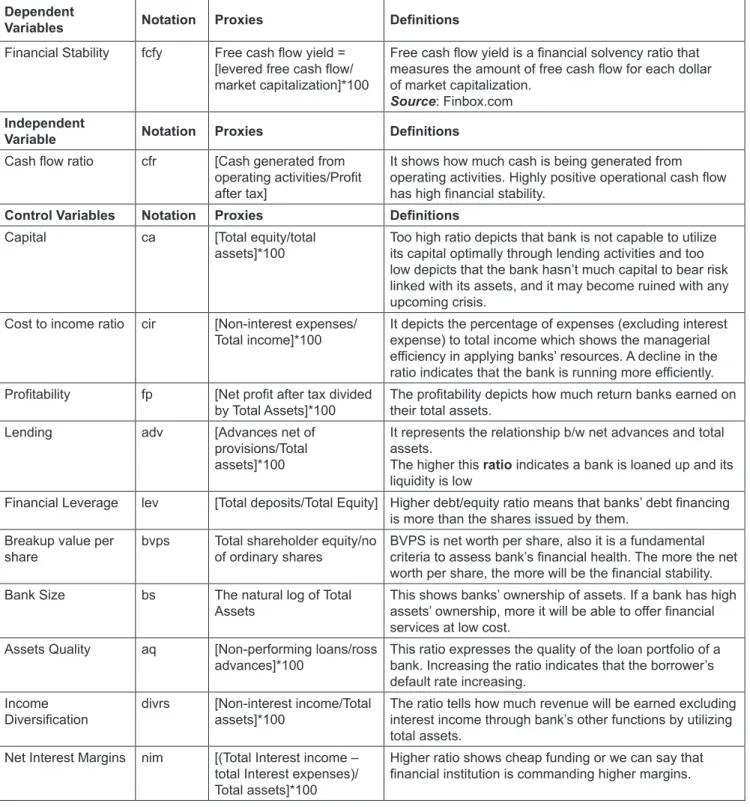
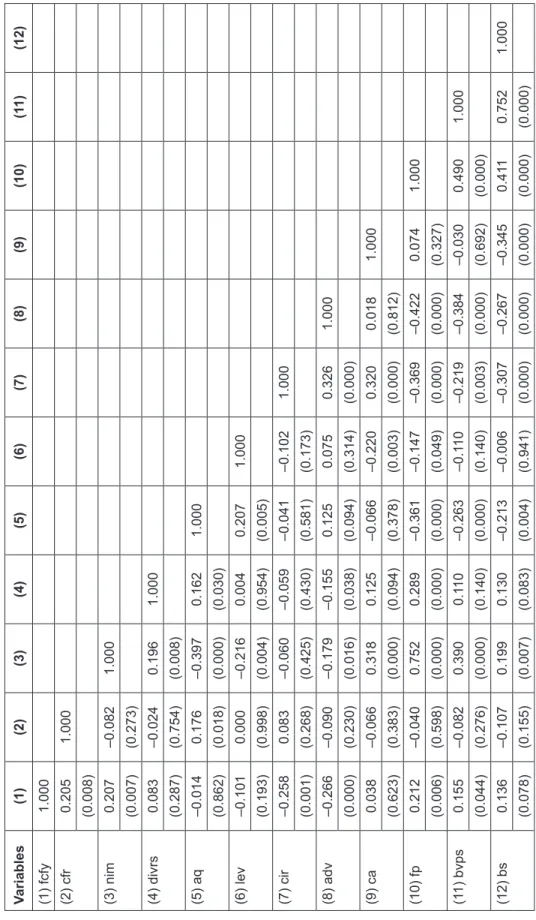
This study aims to examine whether operating cash flows influence banks’ financial stability in Pakistan. The study employed annual panel data collected from annual reports of 20 commercial banks listed on the Pakistan Stock Exchange for the year 2011 to 2019. Free cash flow yield was taken as the dependent variable while cash flow ratio was selected as the independent variable, and net interest margin, income diversification, asset quality, financial leverage, the cost to income ratio, advance net of provisions to total assets ratio, capital ratio, financial performance, breakup value per share and bank size were taken as control variables. The study performed ordinary least square technique, random and fixed effects models, Hausman test, Lagrange multiplier test, descriptive and correlation analysis. Results showed that operating cash flows and net interest margin significantly and positively influenced banks’ financial stability while the cost to income ratio and advances net of provisions to total assets ratio significantly and negatively associated with banks’ financial stability. To improve financial stability, banks should become more cost-effective and enhance their liquidity levels by lowering lending activities. In the future, it would be useful to compare commercial and investment banks, also Islamic and conventional banks in the same research setting.
Keywords: Pakistan Stock Exchange, Free Cash Flow Yield, Cash Flow Ratio, Hausman Specification, Lagrange Multiplier JEL Classification Code: C33, C58, G21
If the corona pandemic lasts more than six months or even a year, with industrial activity and the rest of the world locked down, then Pakistani banks’ liquidity problem will convert into a solvency problem, resulting in bankruptcy.
Financial stability is affected when a financial firm unable to meet anticipated and unanticipated cash flow requirements as they come due.
The post-pandemic environment is unknown, however, based on current forecasts, banking sector profitability is projected to be impacted by a decline in fee income on wealth products due to capital market instability, as well as increasing credit losses/delinquencies as a result of lockdowns. Hence, the analysis predicts that operating cash flows would be reduced in the near future due to lower profitability, and commercial banks will become more financially vulnerable.
The study takes motivation from some theories such as Jensen’s free cash flow hypothesis, agency theory, and signaling theory. According to the free cash flow theory, managers are unwilling to pay dividends or take on debt because their cash flows are lowered as a result of these activities (Kadioglu & Yilmaz, 2017). Managers’ desire
1
First Author and Corresponding Author. Ph.D. Scholar, Department of Management Sciences, Air University, Pakistan [Postal Address: Service Road E-9/E-8, Islamabad, Islamabad Capital Territory 44000, Pakistan]
Email: [email protected]
2
Associate Professor, Department of Management Sciences, Air University, Pakistan. Email: [email protected]
3
Ph.D. Scholar, Department of Management Sciences, COMSATS University, Pakistan. Email: [email protected]
4
Research Scholar, Department of Management Sciences, The University of Sialkot, Pakistan. Email: [email protected]
© Copyright: The Author(s)
This is an Open Access article distributed under the terms of the Creative Commons Attribution Non-Commercial License (https://creativecommons.org/licenses/by-nc/4.0/) which permits unrestricted non-commercial use, distribution, and reproduction in any medium, provided the original work is properly cited.