Print ISSN: 2288-4637 / Online ISSN 2288-4645 doi:10.13106/jafeb.2021.vol8.no10.0065
Product Innovation Accounting, Customer Response Capability and Market Success: An Empirical Investigation in Thailand
Kanchana SUKANTHASIRIKUL
1, Kornchai PHORNLAPHATRACHAKORN
2Received: June 15, 2021 Revised: August 29, 2021 Accepted: September 06, 2021
Abstract
This study aims at investigating the effect of product innovation accounting on the market success of instant food and convenience food businesses in Thailand with customer response capability as the mediator. In addition, it examines the effects of management accounting systems, marketing intelligence, and technology orientation on product innovation accounting. The sample for this study is 258 instant food and convenience food businesses in Thailand. To test the research relationships, a structural equation model is used. The results of this study show that product innovation accounting has a significant effect on both customer response capability and market success. Similarly, customer response capability significantly leads to market success while it mediates the product innovation accounting-market success relationship. Testing the antecedents of the research relationships, management accounting system, marketing intelligence, and technology orientation potentially affect product innovation accounting. Accordingly, product innovation accounting is a key source of competitive advantage. Product innovation accounting must be recognized by company management as a strategic tool for competing in markets and environments. They must invest their resources and capabilities to create and develop product innovation accounting principles, as well as encouraging their staff to implement and use these principles in the workplace.
Keywords: Product Innovation Accounting, Customer Response Capability, Market Success, Management Accounting System, Marketing Intelligence, Technology Orientation
JEL Classification Code: M31, M41, M49
situations and the coronavirus (COVID-19) pandemic crisis has become a serious impediment to company operations.
The COVID-19 pandemic has had considerable effects on economic and social losses, closed businesses, and direct and indirect unemployment (Parker, 2020), as well as, global and national economic gross domestic product (GDP) (Salterio, 2020). It brings about a new type of quality challenge to firms to identify, create, implement, and utilize effective strategies to adapt to the crisis in both short-run and long-run periods. Stronger internal solidarity and cohesion of these tactics can lead to better long-term success in the face of the current COVID-19 epidemic, as well as long-term economic operations (Sapta et al., 2021). Accordingly, firms with a great effective strategy, can gain sustainable competitive advantage and achieve superior success, survival, and sustainability.
To achieve the main goals of doing business, firms must create and utilize relevant strategies to successfully compete in rigorous markets and environments, strategically increase competitive advantage and expansively obtain business
1
First Author and Corresponding Author. Assistant Professor, Institute of Social Technology, Suranaree University of Technology, Thailand [Postal Address: 111, Maha Witthayalai Rd, Suranari, Mueang Nakhon Ratchasima District, Nakhon Ratchasima 30000, Thailand]
Email: [email protected]
2
Associate Professor, Faculty of Management Sciences and Information Technology, Nakhon Phanom University, Thailand.
Email: [email protected]
© Copyright: The Author(s)
This is an Open Access article distributed under the terms of the Creative Commons Attribution Non-Commercial License (https://creativecommons.org/licenses/by-nc/4.0/) which permits unrestricted non-commercial use, distribution, and reproduction in any medium, provided the original work is properly cited.
1. Introduction
Dealing successfully with the environmental
uncertainties and changes can enhance firms to survive and
sustain. These environments comprise laws and regulations,
technologies, competitions, consumer behaviors, and market
situations. The combination of economic and public health
success (Rahman & Masum, 2021). In marketing literature, product innovation is one of the firms’ effective strategies used in uncertain and changing environments and situations.
Product innovation can help businesses gain customers and market acceptance, maintain competitiveness and improve performance and profitability (Hien et al., 2021). Product innovation, interestingly, is defined as a completely new concept that can be used to significantly improve products and services with market-specific features and uses, such as significant improvements in technical specifications, constituent materials, embedded software, ease of use, and other functional characteristics (De Souza Marques et al., 2020). It is the development driven by a desire to improve the properties and performance of finished products as radical innovation and create new products and services as incremental innovation. It comprises (a) the development of new products, (b) the improvement of product properties, and (c) the enhancement of product quality. Firms with great product innovation can develop and introduce new products and services into the marketplace to satisfy customers’
needs (Rasheed et al., 2021). Moreover, it is mainly driven by market needs and ultimately external customers. Thus, product innovation is an important tool that can be used to help firms achieve competitive advantage and it is vital for the growth and sustainability of firms.
Product innovation is viewed as a strategic instrument that helps organizations achieve success, survival, and sustain- ability in highly competitive markets and environments. It is critical for businesses to understand the benefits of product innovation and the relationship between accounting and product innovation as both concepts of accounting-product innovation linkages and the effects of these linkages on customer response capability and market success to do business in this tough time. These relationships are called “product innovation accounting”. Here, product innovation accounting refers to the provision and analysis of management accounting data and information pertaining to developing and introducing new products and services that link to its competitive advantage and performance (Healy et al., 2018). It is the management accounting method that provides financial information rele- vant to activities of cost management, target costing, and budgets for the new products and services, including cost planning, cost control, profit management, and risk manage- ment (Feeney & Pierce, 2018). It is also applied to calculate the costs of products and services and innovation activities.
Successful product innovation accounting can enhance firms’
development and management of the new products and services, cost-effectiveness, and competitiveness increase.
Firms with the best product innovation accounting can effectively measure their costs and benefits linking to the new products and services. Thus, they can achieve valuable cost information, performance reporting quality, and strategic goals in both short- and long-term aspects.
As previously mentioned, product innovation accounting is a source of firms’ competitive advantage. It can help firms successfully respond to customer wants and efficiently fulfill market needs. Accordingly, both customer response and market success are the outcomes of effective product innovation accounting implementation. In this study, customer response capability and market success are proposed to become consequences of firms’ product innovation accounting. Customer response capability is defined as firms’ ability and competence to serve customer needs through effective and quick actions (Zvirgzdiņa et al., 2015). It comprises of (1) customer response expertise as the extent to which the responses of the firms effectively meet customer needs, and (2) customer response speed as the extent to which the responses to customer needs are rapid. Moreover, customer response capability becomes the long-term sustainability of firms’ competitive advantage and success. It is an essential asset for firms and directly or indirectly always helps them grow sustainability in doing business. Firms with great customer response capability can achieve a fast-moving market opportunity. They gain a more loyal and sustainable customer base and better organizational performance and improvement. In addition, market success refers to the desired outcomes of firms through competition among privately owned, self-directed, and competing enterprises, including higher productivity and greater economic growth (Eid & El-Gohary, 2013).
It reflects firms’ success in meeting their business goals.
It comprises new sales, the creation of new customers, new markets, reduction of sale costs, increased profit, increased market share, increased customer acceptance (satisfaction, awareness, retention, and loyalty), and increased brand equity.
Accordingly, market success is a critical result of efficient product innovation accounting and effective customer response capability. Strategically linking product innovation accounting to market success, customer response capability is, therefore, hypothesized to mediate the relationships.
Enhancing the benefits of the product innovation
accounting-market success relationship, management
accounting system, marketing intelligence, and technology
innovation are proposed as antecedents of the study. First,
the management accounting system is defined as a systematic
process of control within management accounting used to
influence members of an organization to achieve its goals
(Pedroso & Gomes, 2020). It comprises diagnostic use, which
is financially and historically oriented, and interactive use,
which is non-financially, prospectively, and technologically
oriented. It is a mechanism that is integrated into a network
of strategic organizational resources and capabilities in
response to external competitive environments, which, in
turn, increases information flows and improves innovation
(Pasch, 2019). Firms with a great management accounting
system can improve their efficiency and remain competitive
in a challenging environment. Second, marketing intelligence refers to a means of sharpening market know- ledge and information with a more precise understanding (Carson et al., 2020). It provides relevant information to help firms address marketing challenges, such as market segmentation and product innovation, improve accuracy and precision of marketing decisions and react faster to changes in the markets and environments. It is a key factor in achieving a competitive advantage in their markets. Firms with effective marketing intelligence can achieve more business opportunities in connecting with creating long-term relationships with customers. Finally, technology orientation is defined as the ability of firms to acquire a substantial technological background and use it in the development of new products (Ali et al., 2016). It is an inclination of firms toward the application of the latest technology for introducing new products apart from improving existing products and services through encouraging and supporting innovative ideas (Yousaf et al., 2021). It is essential to use it to update the new technology since it plays a significant role in meeting the relevant challenges with regard to competitive advantage and business performance. Thus, management accounting systems, marketing intelligence, and technology innovation are hypothesized to have positive effects on product innovation accounting.
The objective of this study is to examine the effect of product innovation accounting on the market success of instant food and convenience food businesses in Thailand through the mediating effect of customer response capability.
In addition, this study attempts to investigate the effects of management accounting systems, marketing intelligence, and technology orientation on product innovation accounting.
The instant food and convenience food businesses in Thailand are chosen as the samples of the study because Thailand is well-known as an agricultural powerhouse, with an abundance of resources from land to sea and a year-round growing season. This points out Thailand’s strengths as rich in raw materials including cassava, sugar, rice, and palm oil that serve both the domestic and global food sectors. The country is ready to drive the world’s food industry with its low prices, high quality, and outstanding innovation of products of food processing firms. Thus, the instant food and convenience food businesses in Thailand are considered suitable samples of the study. In this study, the key research question is how product innovation accounting affects market success. The specific research questions are: (1) How product innovation accounting affects customer response capability, (2) How customer response capability affects market success, (3) How customer response capability mediates the product innovation accounting-market success relationships, and (4) How do management accounting systems, marketing intelligence, and technology orientation affects product innovation accounting.
The remainder of this study is as follows. Relevant literature reviews of product innovation accounting, its antecedents, and consequences are critically examined.
Next, research methods, including sample selection proce- dure and data collection, measures, instrument tests, and statistical techniques are described. In addition, research results and discussions with empirical supports and reason- able explanations are presented. Last, contributions for theory and management, limitations of the study, directions for future research, and conclusion of the study are mentioned.
2. Literature Review and Hypotheses Development
2.1. Market Success
Interestingly, market success is a valuable outcome of implementing product innovation accounting in an organization. Best product innovation accounting is positively related to market success. Market success is defined as the desired outcomes of firms in doing business over a long period of time through competition among privately owned, self-directed, and competing enterprises (Eid & El-Gohary, 2013). It comprises new sales, the creation of new customers, new markets, reduction of sale costs, increased profit, increased market share, and increased brand equity. Firms with market success can also obtain higher productivity, better market opportunities, and greater economic growth. In addition, market success can be measured through awareness, reputation, perceived quality, customer satisfaction, customer loyalty, customer equity, customer acceptance, brand equity, and market share (Enzing et al., 2011). While market success is a goal of firms doing business in a marketplace, firms must successfully implement and utilize a valuable strategy to achieve their goal under rigorously changing environments. The valuable strategy is called “product innovation accounting”. Accordingly, the effect of product innovation accounting on market success is empirically investigated in this study.
2.2. Product Innovation Accounting
While product innovation is an important marketing resource and capability of firms, it is also a key source of competitive advantage in uncertain markets and environments. Product innovation is brand-new, and it significantly improves products and services with market- specific features and applications, such as major advances in technical specifications, constituent materials, embedded software, ease of use, and other functional aspects (De Souza Marques et al., 2020). Thus, a relationship between accounting and product innovation is critically considered.
Product innovation has become a useful strategic tool that can
help firms to gain competitive advantage, success, survival, and sustainability in competitive markets and environments.
Here, product innovation accounting is defined as the provision and analysis of management accounting data and information about developing and introducing new products and services that link to its competitive advantage and performance (Healy et al., 2018). It is the ability of firms to effectively perform functions on management accounting practices, successfully engage in innovative product activities and critically achieve strategic goals. It explicitly emphasizes budgeting and variance analysis, cost accounting, and performance measurement.
In addition, product innovation accounting provides financial information relevant to activities of management control, cost management, target costing, and budgets for new products and services, including cost planning, cost control, profit management, and risk management (Feeney
& Pierce, 2018). It is applied to calculate the costs of products and services including innovation activities.
Product innovation accounting can help businesses achieve more efficient creation and management of new products and services, as well as better cost-effectiveness and competitiveness (Lee & Wang, 2020). Product innovation allows for accurate cost and benefits analysis of new products and services. Hence, it can provide valuable cost information, high-quality performance reporting, and strategic goals in both the short and long term. As mentioned earlier, under competitive environments, firms can apply a product innovation accounting approach to create and develop new products and services. This can improve existing products and services that respond to customer needs effectively and fulfill markets requirements and enhance their business success in a marketplace (Rasheed et al., 2021). Accordingly, product innovation accounting is positively related to customer response capability and market success. It is hypothesized to have a positive effect on both customer response capability and market success. Therefore,
H1: Product innovation accounting has a positive effect on (a) customer response capability and (b) market success.
2.3. Customer Response Capability
Customer response is a strategic goal of firms’ marketing activities and business operations. It is a mechanism that helps them achieve competitive advantage and success.
Thus, customer response capability is important when competing in a marketplace. Customer response capability is defined as firms’ ability and competence to serve customer needs accurately and instantly through effective and quick actions (Zvirgzdiņa et al., 2015). It comprises (1) customer response expertise as the extent to which the responses to customer needs are effective (2) customer response speed
as the extent to which the responses to customer needs are rapid (Setia et al., 2013). It reflects firms’ preparedness to proficiently meet and rapidly satisfy customer needs.
Firms with great customer response capability can serve customer needs through effective and quick actions that are increasingly critical for sustaining competitive advantage, success, and survival in highly competitive business environments. Moreover, customer response capability refers to a core ability that provides firms with the means to influence customers and attract them to the products offered and achieve a more loyal and sustainable customer base (Wang et al., 2021). It is considered an important aspect for all firms to create business relationships and good customer satisfaction and loyalty with their customers.
Firms with a growing focus on enhancing customer- side performance can offer a quick and effective response to customer needs and serve them through the development of new products and services. They are likely to quickly and effectively address any customer grievances or complaints.
Thus, customer response capability becomes the long-term source of firms’ competitive advantage and success. It is an essential asset for firms and directly or indirectly always helps them to achieve a fast-moving market opportunity successfully and sustainability in doing business. Accor- dingly, customer response capability positively affects market success. Similarly, customer response capability plays a mediating role in the product innovation accounting- market success relationship. It links product innovation accounting to market success by providing a go-between for them. Interestingly, customer response capability is a significant outcome of product innovation accounting implementation, and it also drives, explains, and increases organizations’ market success. Therefore,
H2: Customer response capability has a positive effect on market success.
H3: Customer response capability mediates the product innovation accounting-market success relationships.
2.4. Management Accounting System
Here, product innovation accounting is a key deter-
minant of firms’ market success through a mediating
effect of customer response capability. To investigate
these relationships, this study identifies the management
accounting system as an antecedent of the study that
explicitly affects product innovation accounting. The
management accounting system is defined as a systematic
process of control within management accounting used to
influence members of an organization to achieve its goals
(Pedroso & Gomes, 2020). It also refers to the systematic
use of management accounting techniques to achieve
organizational goals (Rasid et al., 2014). Management
accounting provides information related to financial, non- financial, past performance, and future performance of both internal as well as external environments to firms for effective decision making. It comprises diagnostic use, which is financially and historically oriented, and interactive use, which is non-financially, prospectively, and technologically oriented. Firms with a great management accounting system can provide an effective decision-making process through enhancing effectiveness, control, market analysis, quality assessment, customer satisfaction, empowerment, and competitive status management.
In addition, the management accounting system is a fundamental source of updated, reliable, and accessible knowledge and information for facilitating and supporting decision-making (Ugalde Vásquez & Naranjo-Gil, 2020).
It is a mechanism that is integrated into a network of strategic organizational resources and capabilities in res- ponse to external competitive environments. It enhances business process management, increases information flows, and improves innovation (Pasch, 2019). Firms that have a good management accounting system can provide useful information for increasing efficiency, staying competitive, and managing and monitoring performance and success in a difficult environment. While product innovation accounting is one of the firms’ strategic resources and capabilities, the management accounting system can also provide valuable information which can be applied to product innovation accounting. It is likely to have a positive effect on product innovation accounting. Therefore,
H4: Management accounting system has a positive effect on product innovation accounting.
2.5. Marketing Intelligence
Marketing intelligence is the second antecedent of product innovation accounting. In this study, marketing intelligence is defined as a means of sharpening market knowledge and information with a more precise market understanding (Carson et al., 2020). It is a firm’s ability to understand, analyze, and evaluate data from internal and external environments pertaining to the organization, customers, competitors, markets, and enterprises to improve tactical and strategic decision-making, as well as the integration of competitive intelligence, marketing research, market analysis, and business and financial data analysis. (Guarda et al., 2012). It provides relevant information to help firms address marketing challenges, such as market segmentation and product innovation. It helps improve the accuracy and precision of marketing decisions and it reacts faster to changes in the markets and environments. The relevant information focuses on the acquisition and sharing of information about customer
needs and wants of current and potential customers, market changes and competitor actions as well as the development of new technologies with customer involvement to create new products (Haverila & Ashill, 2011). Thus, marketing intelligence enables firms to collect information from both internal and external environments which can be used to improve the accuracy and precision of marketing decisions. Consequently, it allows them to react faster to changes in the markets and environments (Cacciolatti &
Fearne, 2013). Firms with great marketing intelligence can obtain the relevant insights to improve and ratify decisions relative to customer value and satisfaction.
They can identify market attractiveness, build new value propositions, and drive innovation. Greater marketing intelligence can increase business opportunities in terms of connecting with customers and building long-term relationships. Accordingly, marketing intelligence is likely to have a positive effect on product innovation accounting.
Therefore,
H5: Marketing intelligence has a positive effect on product innovation accounting.
2.6. Technology Orientation
Technology orientation is the last antecedent of product innovation accounting. It is defined as the ability of firms to acquire a substantial technological background and use it in the development of new products (Ali et al., 2016).
It is an inclination of firms toward the application of the latest technology to introduce new items as well as improve existing products and services by encouraging and supporting innovative ideas (Yousaf et al., 2021). In addition, technology innovation refers to a firm’s inclination to introduce and use new technologies, products, and innovations (Chemutai, 2019). It is essential for firms to acquire and update new and advanced technologies so that they can use these sophisticated technologies in the development of their new products and services. It plays a significant role in meeting the relevant challenges pertaining to competitive advantage and business performance. Interestingly, long-term success and customer value are best created through new technological solutions, processes, products, and services under technology-oriented operations. Firms with an innovative technology focus can develop new technological solutions and offer innovative, advanced, and differentiated processes, products, and services to meet client needs. They can achieve operational and competitive benefits that help build sustainable competitive advantages and lead to superior performance.
As mentioned earlier, technology orientation is considered
important for creating and developing new processes,
products, and services. Thus, technology orientation is like
to have a positive effect on product innovation accounting.
Greater technology innovation is explicitly related to better product innovation accounting. Therefore,
H6: Technology orientation has a positive effect on product innovation accounting.
2.6. Hypotheses and Conceptual Model
Interestingly, a theory of knowledge-based view is applied to explain the product innovation accounting-market success relationships in this study. It strategically underlies knowledge as a sign of a key resource enabling firms to compete and sustain competitive advantage (Grant, 1996). It is considered the most important aspect of firms’ resources. Here, product innovation accounting becomes the firms’ resource that focuses on knowledge maximization and management to create new and innovative products for serving their target customers and new markets. Greater product innovation accounting is positively related to more customer responses and better market success. Accordingly, product innovation accounting is an independent variable whereas market success is a dependent variable and customer response capability is a mediating variable of the study respectively. Likewise, management accounting systems, marketing intelligence, and technology orientation are proposed to be antecedents of the relationships. Figure 1 shows the conceptual model of the product innovation accounting-market success relationships.
3. Research Methods
3.1. Sample Selection Procedure and Data Collection
In this study, the questionnaires via a mail survey are sent to 800 instant food and convenience food businesses in Thailand. The instant food and convenience food businesses
in Thailand are important because Thailand is well-known as an agricultural powerhouse, with an abundance of resources from land to sea and a year-round growing season. In addition, they have always created and developed new products and services and continuously improved and renewed existing products and services to respond to customer needs and fulfill market requirements in the marketplace. Thus, the instant food and convenience food businesses in Thailand are the appropriate samples of the study. The key informants of this study are accounting executives (chief financial officers, accounting directors, accounting managers, or accounting heads) of instant food and convenience food businesses in Thailand because they have taken the highest responsibilities of accounting functions, duties, practices, activities, and other related jobs in the organization. With regard to the questionnaire mailing, the valid mailing was 783 surveys, from which 273 responses were received. Of the surveys completed and returned, 258 were usable. The effective response rate was approximately 32.95%. The response rate for a mail survey, with an appropriate follow- up procedure, if greater than 20% is considered acceptable according to Aaker et al. (2001). Therefore, the response rate in this study is considered acceptable. To prove potential non-response bias, a comparison of the first and the second wave data as recommended by Armstrong and Overton (1977) is used. In this regard, neither procedure showed significant differences because there were no statistically significant differences between first and second groups at a 95% confidence level - operational age (t = 0.109, p > 0.05), employee size (t = 0.127, p > 0.05) and investment capital (t = 0.118, p > 0.05).
3.2. Measures
All constructs were measured using a 5-point Likert scale (1 = strongly disagree to 5 = strongly agree), except for control
Figure 1: The Conceptual Model of the Product Innovation Accounting-Market Success Relationships H5 H4
H5 H1a H2&H3
H6 H1b
Management accounting
system
Marketing intelligence
Technology orientation
Product innovation accounting
Customer response capability
Market
success
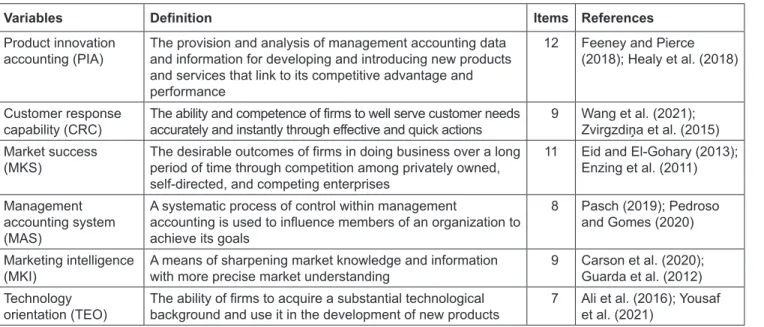
variables as operational age, employee size, and investment capital. Despite the fact that all constructions are clearly stated, Diamantopoulos and Siguaw (2000) claimed that due to the abstract nature of the construct, it is impossible to directly manifest or see the scale. Certainly, variables are estimated scales from their definitions and are applied from relevant studies of accounting, marketing, and other fields. In this study, product innovation accounting, customer response capability, and market success are the independent, mediating, and dependent variables of the study respectively and management accounting system, marketing intelligence, and technology orientation are the antecedents of the research relationships. Thus, sources of all variable measurements are presented in Table 1.
To verify the research results, control variables were empirically examined. The control variables are elements that are constant and unchanged throughout the course of the investigation. Control variables, which are used to assess the relative relationship between the dependent and independent variables, can have an impact on the study results if they are not kept consistent throughout the research process. However, the control variables themselves are not of primary importance to the research. Operational age (OPA) was measured by the number of years a firm has been in existence using a dummy variable as less than 10 years = 0 and equal to or greater than 10 years = 1. In addition, employee size (EPS) was measured by the number of employees in a firm using a dummy variable as less than 250 employees = 0 and equal to or greater than 250 employees = 1. Last, investment capital (INC) was measured by the amount of money a firm has invested in doing business using a dummy variable as less than 500 million baht = 0 and equal to or greater than 500 million baht = 1.
3.3. Instrument Tests
To verify the quality of the research instrument, factor analysis was implemented to assess the underlying relationships of a large number of items and determine whether they can be reduced to a smaller set of factors. Thus, all factor loadings had values between 0.78–0.92, which are greater than the 0.40 cut-off and are statistically significant (Nunnally & Bernstein, 1994). In addition, discriminant power was utilized to gauge the validity of the measurements by item-total correlation. In the scale validity, item-total correlations had values between 0.66–0.92, which are greater than 0.30 (Churchill, 1979). Last, the reliability of the measurements was evaluated using the Cronbach alpha coefficient. In the scale reliability, Cronbach alpha coefficient had values between 0.78–0.90, which are greater than 0.70 (Nunnally & Bernstein, 1994). Accordingly, the scales of all measures express an acceptable validity and reliability in this study. Table 2 presents the results for factor loadings, item-total correlation, and Cronbach alpha for multiple-item scales used in this study.
To investigate the product innovation accounting-market success relationship, a structural equation model (SEM) is employed. The results of this study are presented in the next section.
4. Results and Discussion
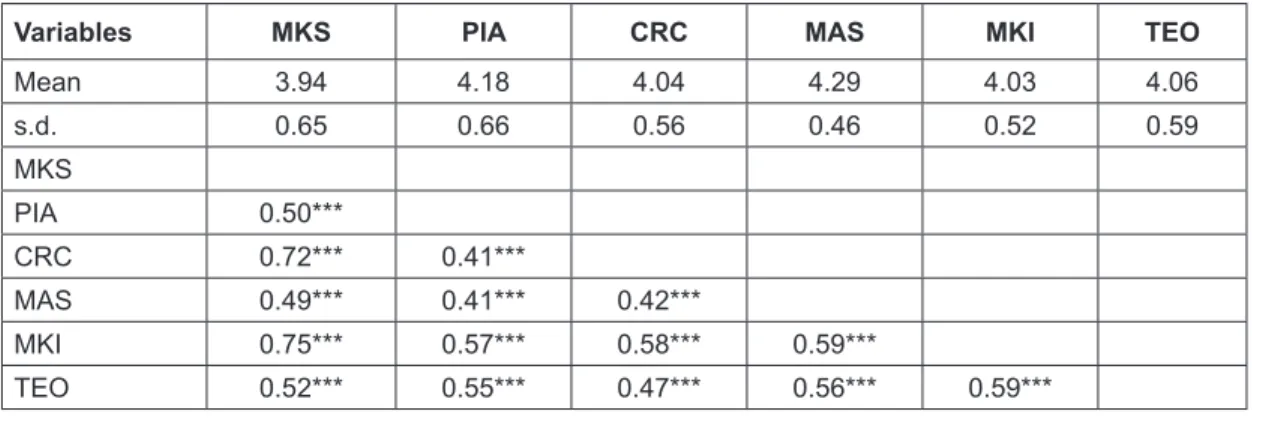
The descriptive statistics and correlation matrix for all variables are presented in Table 3. Multicollinearity might occur when inter-correlation in each predictor variable is more than 0.80, which indicates the degree of correlation
Table 1: Sources of All Variable Measurements
Variables Definition Items References
Product innovation
accounting (PIA) The provision and analysis of management accounting data and information for developing and introducing new products and services that link to its competitive advantage and performance
12 Feeney and Pierce (2018); Healy et al. (2018)
Customer response
capability (CRC) The ability and competence of firms to well serve customer needs
accurately and instantly through effective and quick actions 9 Wang et al. (2021);
Zvirgzdiņa et al. (2015) Market success
(MKS) The desirable outcomes of firms in doing business over a long period of time through competition among privately owned, self-directed, and competing enterprises
11 Eid and El-Gohary (2013);
Enzing et al. (2011) Management
accounting system (MAS)
A systematic process of control within management
accounting is used to influence members of an organization to achieve its goals
8 Pasch (2019); Pedroso and Gomes (2020) Marketing intelligence
(MKI) A means of sharpening market knowledge and information
with more precise market understanding 9 Carson et al. (2020);
Guarda et al. (2012) Technology
orientation (TEO) The ability of firms to acquire a substantial technological
background and use it in the development of new products 7 Ali et al. (2016); Yousaf
et al. (2021)
between variables is high (Hair et al., 2010). The correlations ranging from 0.41 to 0.75 at the p < 0.05 level mean that the possible relationships of the variables in the conceptual model could be tested. Thus, there are no substantial multicollinearity problems encountered in this study.
Table 4 presents the results of path coefficients and hypotheses testing of the research relationships. Figure 2 shows a summary of the product innovation accounting- market success relationship. In this study, a measure of goodness of fit for statistical models is verified (Herda &
Lavelle, 2012). The comparative fit index (CFI) has a value of 0.92, which is over 0.90 (the value always lies between 0 and 1), indicating a relatively good fit (Bentler, 1990). Next, the goodness of fit index (GFI) value with a value of 0.93, which is above 0.90 (the index value always ranges from 0 to 1) indicating a relatively good fit (Byrne, 1998). In addition, the incremental fit index (IFI) value of 0.91 exceeding 0.90 indicates a relatively good fit (Kline, 1998). Last, the root mean square error of approximation (RMSEA) value is 0.03, which is less than 0.05 indicating a close fit, and if less than 0.08, it suggests a marginal fit (Bollen & Long, 1993). Here, the initial test of the measurement model results in a good fit for the data.
Interestingly, the effect of product innovation accounting on market success through the mediation of customer response capability is examined. Product innovation plays a significant role in driving, explaining, and determining customer response capability and market success. It is positively related to customer response capability (b = 0.54, p < 0.01) and market success (b = 0.49, p < 0.01). In the existing literature, product innovation accounting is the provision and analysis of management accounting data and information about developing and introducing new products and services that link to its competitive advantage and performance (Healy et al., 2018). It provides financial information relevant to activities of management control, cost management, target costing, and budgets for the new products and services, including cost planning, cost control, profit management, and risk management (Feeney & Pierce, 2018). Firms with great product innovation accounting can successfully engage in innovative product activities and critically achieve strategic goals. They can develop new and existing products and services that respond to customer needs and fulfill market requirements. Greater customer response can enhance sustainable competitive advantage and lead to better business success in the marketplace.
Table 2: Results of Measure Validation
Items Factor
Loadings Item-total
Correlation Cronbach Alpha
Product innovation accounting (PIA) 0.88–0.92 0.66–0.81 0.89
Customer response capability (CRC) 0.91–0.92 0.91–0.92 0.90
Market success (MKS) 0.81–0.91 0.82–0.90 0.84
Management accounting system (MAS) 0.78–0.88 0.82–0.87 0.78
Marketing intelligence (MKI) 0.83–0.92 0.85–0.91 0.87
Technology orientation (TEO) 0.81–0.91 0.81–0.91 0.90
Table 3: Descriptive Statistics and Correlation Matrix
Variables MKS PIA CRC MAS MKI TEO
Mean 3.94 4.18 4.04 4.29 4.03 4.06
s.d. 0.65 0.66 0.56 0.46 0.52 0.59
MKS
PIA 0.50***
CRC 0.72*** 0.41***
MAS 0.49*** 0.41*** 0.42***
MKI 0.75*** 0.57*** 0.58*** 0.59***
TEO 0.52*** 0.55*** 0.47*** 0.56*** 0.59***
***p < 0.01.
Thus, product innovation accounting explicitly has a significant positive effect on customer response capability and market success. It is positively related to both of them.
Therefore, Hypotheses 1a–1b are supported.
Market success is regarded as an important objective of the study to meet the goal of enterprises conducting business operations. Customer response capability is an effective determinant of market success in this study. It is the ability and competence of firms to serve customer needs through effective and quick actions (Zvirgzdiņa et al., 2015). It effectively meets customer needs and rapidly responds to them (Setia et al., 2013). It is regarded as a critical asset for businesses since it assists them in achieving a fast-moving market opportunity successfully and increases corporate sustainability. Firms with great customer response capability can serve customer needs through effective and quick actions and achieve customer satisfaction and loyalty that are increasingly critical for sustained competitive advantage and success in highly competitive environments. Better customer response capability can encourage them to achieve greater competitive advantage and gain more market success in rigorous markets and environments. Thus, customer response
capability has a significant positive effect on market success.
It positively leads to market success. Therefore, Hypothesis 2 is supported.
Additionally, customer response capability is the important outcome of product innovation accounting while it is also the significant determiner of market success. In the existing literature, a mediating variable is a variable that links the independent and the dependent variables.
It can be hypothesized that the independent variable impacts the mediating variable, which in turn impacts the dependent variable. Then, customer response capability is a key mediator of the product innovation accounting- market success relationship. Hence, it mediates the research relationships. Therefore, Hypothesis 3 is supported.
In addition, management accounting systems, marketing intelligence, and technology orientations are the antece- dents of the study. These antecedents in the study are empirically investigated. The management accounting system is a systematic process of control within manage- ment accounting techniques used to influence members of an organization to achieve its goals (Pedroso & Gomes, 2020).
It provides information related to financial, non-financial, Table 4: Results of Path Coefficients and Hypotheses Testing
Hypotheses Relationships Coefficients t-value Results
H1a PIA → CRC 0.54*** 3.29 Supported
H1b PIA → MKS 0.49*** 3.07 Supported
H2 CRC → MKS 0.72*** 4.67 Supported
H3 PIA → CRC 0.54*** 3.29 Supported
CRC → MKS 0.72*** 4.67
H4 MAS → PIA 0.49*** 3.09 Supported
H5 MKI → PIA 0.35*** 2.93 Supported
H6 TEO → PIA 0.59*** 4.89 Supported
***p < 0.01; CFI = 0.92; GFI = 0.93; IFI = 0.91; RMSEA = 0.03.
Figure 2: A Summary of the Product Innovation Accounting-Market Success Relationships
H5 0.49***
0.35*** 054*** 0.72***
0.59*** 0.49***
Management accounting
system
Marketing intelligence
Technology orientation
Product innovation accounting
Customer response capability
Market success