․투고일: 2015.02.04, 심사일: 2015.03.25, 게재확정일: 2015.03.26
․Corresponding author: Jung-hyo Cho 301-724, 22-5 Daehung-dong Jung-gu, Daejeon, Korea
Dept. of Internal medicine, Dae-jeon
Long-Term Survival of Patients with Lung Cancer Treated by Traditional Korean Medicine Combined with Western Treatment:
Report of Two Cases
Ji-young Kang, Jun-young Kim, Chang-gue Son, Jung-hyo Cho Dept. of Internal Medicine, College of Korean Medicine, Dae-Jeon University
Long-Term Survival of Patients with Lung Cancer Treated by Traditional Korean Medicine Combined with Western Treatment: Report of Two Cases
Ji-young Kang, Jun-young Kim, Chang-gue Son, Jung-hyo Cho Dept. of Internal Medicine, College of Korean Medicine, Dae-Jeon University
ABSTRACT
Objectives:
To evaluate the long-term survival effects of traditional Korean medicine (TKM) on refractory metastatic lung cancer and small cell lung cancer (SCLC), which have historically poor survival rates.
Methods:
A retrospective study was conducted using the medical records of two patients in Daejeon University hospital.
The first patient, with SCLC, was treated from January 2000 to December 2009 and the other, with metastatic pulmonary cancer from primary hepatocellular carcinoma (HCC), was treated from September 2004 to February 2014. The patients were treated with herbal medicines at one-month intervals. During hospitalization, acupuncture and indirect moxibustion were performed concurrent with the administration of Western therapy. Treatment efficacy was assessed monthly using chest radiography, chest computed tomography, and laboratory examination data, and by measuring patient performance status.
Results:
Both patients exhibited a stable disease course for more than 9 years after the initial diagnosis of intractable lung cancer, suggesting that their disease status was controlled by TKM.
Conclusions:
We suggest that a combination of TKM with conventional Western therapy for refractory lung cancer patients is effective in controlling various symptoms related to lung cancer and improving quality of life, and may potentially prolong overall survival.
Key words:
lung cancer, long-term survival, traditional Korean medicine (TKM)
Ⅰ. Introduction
Lung cancer has one of the highest incidence
and mortality rates in the world. Each year in the
United States, about 178,000 people are diagnosed
the U.S
1.
Small cell lung cancer (SCLC) represents 15%
of primary lung carcinomas
2. It is characterized by a rapid cancer cell doubling time and significant sensitivity to chemotherapy and radiotherapy, with early development of drug resistance during the course of disease
3. The disease can be classified as limited stage (LD) or extensive stage (ED)
4. Since most SCLCs are detected after metastasis, chemotherapy and radiation are usually the first line of treatment.
However, despite the above treatments, the median survival rate in SCLC is very poor, with a median survival time of 14 to 16 months for patients with LD and 8 to 11 months for those with ED
5.
The second type of refractory lung cancer is metastatic lung cancer. Pulmonary metastasis is the most common type of extrahepatic recurrence of hepatocellular carcinoma (HCC)
6. The prognosis of patients with extrahepatic metastases (including lung metastases) is poor, with a median survival time of less than 7 months and a 1-year survival rate below 25%
7.
Therapeutic approaches for both SCLC and metastatic lung cancer are focused on improving the patient’s survival duration. To date, however, patient survival rates have not improved. Thus, researchers are turning to new methods of treatment with the aim of prolonging the overall survival of patients with lung cancer. There has been a few of researches on the effects of traditional Korean medicine (TKM) as a treatment for lung cancer in Korea
8,9.
Herein, we describe two rare cases of long-term survival in SCLC and metastatic pulmonary cancer from HCC that were treated by TKM.
Ⅱ. Case report
<Case 1>
A 58-year-old man who had been experiencing several symptoms including cough, hemoptysis, dyspnea, anorexia, and sputum, was referred to our department in January 2000. This patient was diagnosed with SCLC metastatic to the mediastinal lymph node in December, 1999 at Jeonbuk University Hospital and received a single round of chemotherapy at the time of diagnosis. The patient’s medical history, which included smoking, was unremarkable and any negative effect of SCLC on his performance status was relatively mild. The patient’s Eastern Cooperative Oncology Group (ECOG) scale score
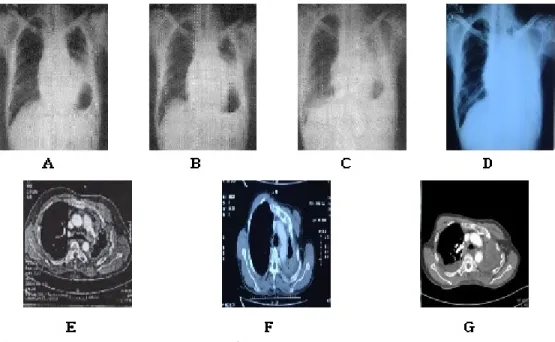
10was 1. Chest radiography showed a tumor lesion with metastasis to the mediastinal lymph node and pleural thickening (Fig. 1-A).
As followed the patient’s request, a combination treatment of TKM and Western therapies was initiated. To evaluate the effectiveness of treatment, the patient’s performance status was monitored and any change of symptoms was measured monthly using chest radiography, chest CT, and laboratory tests, primarily at Jeonbuk University Hospital and occasionally in Daejeon University hospital. The Response Evaluation Criteria in Solid Tumors (RECIST)
11was used in order to evaluate the tumor state annually.
For the TKM approach, the patient was treated with herbal medicines that are known to have anti-cancer properties such as Hangam-dan (HAD) and PSM (Polysaccharide of mushrooms).
HAD is the name of an anti-cancer herbal
prescription. The prescription had been modified
based on the experimental research on its efficacy
and safety. HAD consists of 9 anti-tumor oriental
medicine herbs. (botanical names, and dosage per one capsule (500 mg)): Coicis Semen 259.0 mg, Panax notoginseng Radix 86.0 mg, Hippocampus Kelloggii 26.0 mg, Cordyceps Militaris 26.0 mg, Santsigu Tuber 26.0 mg, Ginseng Radix 26.0 mg, Bovis Calculus 17.0 mg, Margarita 17.0 mg, and Moschus 17.0 mg. Anti-tumor effects and safety of HAD have been proven by both in vitro and in vivo studies
12,13. PSM has an effect on immune enhancement and removal of cachexia related to cancer. It is composed of polysaccharides of eight kinds of mushrooms. (botanical names, dosage per one capsule (500 mg)): Ganodema Lucidum 62.5 mg, Hericium erinaceus 62.5 mg, Coriolus versicolor 62.5 mg, Grifola frondosa 62.5 mg, Lentinus edodes 62.5 mg, Cordyceps militaris 62.5 mg, Polyporus umbellatus 62.5 mg, Pleurotus ostreatus 62.5 mg
14. Each medicine was provided in capsule form as a 500 mg/kg treatment, three times daily. As a result of this herbal medicine treatment, the patient’s main SCLC symptoms of cough, sputum, hemoptysis and chest pain were notably reduced. The patient received four additional chemotherapy and radiation treatments between March 2000 and December 2000.
Although the Western medical center recommended additional chemotherapy, the patient refused treatment and instead requested TKM treatment alone. During the TKM treatment, pulmonary tuberculosis (TB)
occurred, but the tumor size and the patient’s condition remained stable until November 2007 (Fig. 1-B, C and E).
In August 2008, the TB recurred and the patient’s general condition worsened due to side effects associated with the TB medication. The patient’s symptoms of insomnia, dyspnea, sputum, and chest discomfort were also aggravated at this time. We decided to add Mackmundong-tang in order to improve dyspnea and sputum. In 2009, the patient was hospitalized for two weeks due to general worsening of his condition. Chest radiography and CT results showed bilateral pleural effusion, bone metastasis in the left rib, and bronchopneumonia in the right lobe of the lung. The tumor state of the left lobe showed no interval changes (Fig. 1-D and F). During hospitalization, herbal medicines including Gilgyeong-tang and Quibi-tang were administered, and acupuncture and indirect moxibustion were given for symptom relief.
Although most of the patient’s symptoms
disappeared, the dyspnea and chest discomfort
worsened, and the patient was admitted to the
ICU of Jeonbuk University Hospital in December
2009. At the time of admission, the chest CT
showed increased pleural effusion and bone metastases
in the left rib, but no interval change in tumor
state (Fig. 1G). The patient died in January 2010.
Fig. 1. The change of chest x-ray and chest CT in case 1.
A : Chest x-ray showed small cell lung cancer with metastasis to mediastinal lymph node and pleural thickening. (07 Jan. 2000)
B : Chest x-ray showed no interval change. (04 Dec. 2000)
C, E : Chest x-ray and chest CT showed slight aggravation of tumor size of left lung and mild fluid collection in pleura of right lung. (02 Apr. 2004)
D, F : Chest x-ray and chest CT showed total haziness at left entire lung field, no interval change of left lung malignancy findings, both pleural effusion, bone metastasis of left rib and mild bronchopneumonia in right middle and lower lobe of lung. (09 Apr. 2009)
G : Chest CT showed increased amount of pleural effusion and no interval change. (08 Dec. 2009)
<Case 2>
A 49-year-old man with a 9-year history of hepatitis B was referred to our department for abdominal discomfort and general weakness due to HCC in September 2004. The patient was diagnosed with HCC at Seoul National University Hospital in May 2002 and underwent transarterial chemoembolization (TACE) at the time of diagnosis. Subsequently, the patient underwent lobectomy of the left lobe of the liver and TACE four additional times through December 2005.
In September 2004, the patient was hospitalized in our department for two weeks. During this
hospitalization, herbal medicines such as HAD,
Chunggan extract (CGX) and yanghyulbaemok-tang
were prescribed, and the patient was given acupuncture
and indirect moxibustion. Chunggan extract (CGX,
also called Qinggan extract, which means “cleaning
liver”) is a modified herbal drug based on a
traditional Chinese hepatotherapeutic formula. The
ingredients of CGX include 5 g each of Artemisia
capillaris Herba, Trionycis Carapax, Raphani
Semen; 3 g each of Atractylodis Macrocephalae
Rhizoma, Poria, Alismatis Rhizoma, Atractylodis
Rhizoma, Salviae Miltiorrhizae Radix; 2 g each of
Polyporus, Amomi Fructus, Aurantii Fructus, and
1 g of Glycyrrhizae Radix or Helenii Radix
15. The patient was treated with herbal medicine such as HAD and PSM until May 2006. In June 2006, the patient was diagnosed with pulmonary metastatic cancer due to HCC, and the patient underwent a left lower pulmonary lobectomy.
Regular follow-up examinations were performed at intervals of 1 to 3 months, primarily at Seoul National University Hospital. During treatment periods, chest radiography, chest and abdomen CTs, and blood tests including assessments of serum alpha-fetoprotein (AFP) and PIVKA-П were performed. Annually, RECIST was applied in order to evaluate the patient’s tumor state. The performance status of the patient was relatively mild, and the patient’s ECOG scale score was 1.
Chemotherapy treatment was recommended, but the patient declined. The patient’s postoperative course was uneventful. After the diagnosis of pulmonary metastasis, the patient was admitted to our hospital at intervals of 1 to 2 months.
Additional pulmonary metastasectomy, TACE, and chemotherapy were administered between February 2010 and November 2012. At that time, herbal medicines including CGX and HAD were prescribed, and other herbal medicines were administered depending on the symptoms. The patient also underwent concurrent acupuncture procedures and indirect moxibustion. Acupoints were chosen based upon chief complaint and condition of the patient.
Major acupuncture points during treatment were
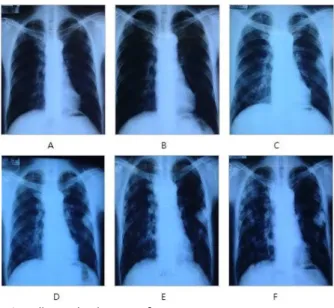
as follows : CV-6, CV-15, LR-14, GV-20, LU-11, HT-7, LU-10, GB-24, LU-1, LU-9, LR-3, LU-6 and BL-63. Routine meridian points of indirect moxibustion were CV-4, HT-8, and KT-1. Chest radiography showed no visible mass in the lung (Fig. 2-A).
Despite the combined treatment of Western medicine and TKM, the patient’s metastatic pulmonary nodule size steadily increased and new metastatic nodules were found (Fig. 2-B). Furthermore, the patient’s serum AFP level became elevated and his body weight began to decrease. Despite these conditions, the patient’s functional status was sufficiently maintained to enable him to perform ordinary physical activities. In June 2013, another round of chemotherapy was administered;
however, the tumor was refractory to treatment (Fig. 2-C). At this point, Chungpyegilgyeung-tang was administered to improve pulmonary function.
In November 2013, the patient complained of symptoms such as hemoptysis and dyspnea, which progressed to interfere with common social activities such as speaking and walking. The patient’s chest radiography demonstrated enlargement of the metastatic nodule of the left lobe of the lung and new nodules in both lungs (Fig. 2-D). Although treatment continued, his symptoms worsened and the number of pulmonary nodules increased (Fig.
2-E and F). Eventually, the patient died due to
respiratory failure in February 2014.
Fig. 2. The change of chest radiography in case 2.
A : Chest radiography revealed no definite visualization of lung mass. (11 Oct. 2011)
B : Chest radiography revealed noted pulmonary nodule at left middle lateral lung field. (09 Nov. 2012) C : Chest radiography revealed slight more enlargement of metastatic lung nodule. (25 Jul. 2013)
D : Chest radiography revealed more significant enlargement of metastatic lung nodule of lower middle lobe and new nodules of both middle and lower lobe. (11 Oct. 2013)
E : Chest radiography revealed more increased size and number of metastatic lung nodules of both lung. (07 Jan. 2014)
F : Chest radiography revealed increased size and number of metastatic lung nodules of both lung since previous study. (05 Feb. 2014)
Ⅲ. Discussion
Small cell lung cancer is the most aggressive subtype of lung cancer, characterized by rapid growth and early spread to distant sites, and has a poor prognosis. Median survival for patients with LD is currently 15 to 20 months, with 20 to 40% surviving for 2 years. For those with ED, the prognosis is worse, with a median survival of 8 to 13 months and a 5% 2-year survival rate
16. The five-year survival rate of LD is about 15 to 20%, and the five-year survival rate of ED is below 5%
17.
Lastly, another type of intractable lung cancer is metastatic lung cancer. Similar to SCLC, the
long-term prognosis of pulmonary metastasis from HCC is poor due to a high incidence of recurrence despite resection
18.
Although many therapeutic approaches have
been developed to eradicate lung cancer, there are
currently no effective treatments. Some research
has found that TKM, which has been in use for
thousands of years, is effective for the treatment
of lung cancer. For example, treatment with the
herbal medicine, HAD, remarkably increased the
survival of patients for up to eight years
19. However,
there have been relatively few studies which examined
the long-term follow-up findings of specific refractory
lung cancer patients treated with TKM. In the current
study, we followed two patients with intractable lung
cancer over a 9 to 10 year period. The main treatment modality was herbal medicines, and acupuncture and moxibustion were performed as subtreatments.
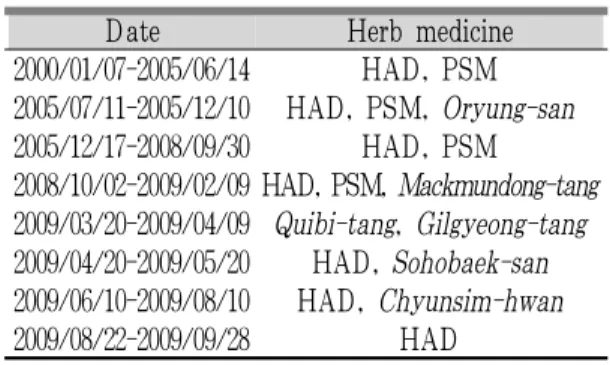
The patient in case 1 presented with SCLC and was prescribed herbal medicines on a daily basis from January 2000 to December 2009. HAD and PSM were routinely administered, and additional herbal medicines were administered in accordance with the patient’s general health condition (Table 1).
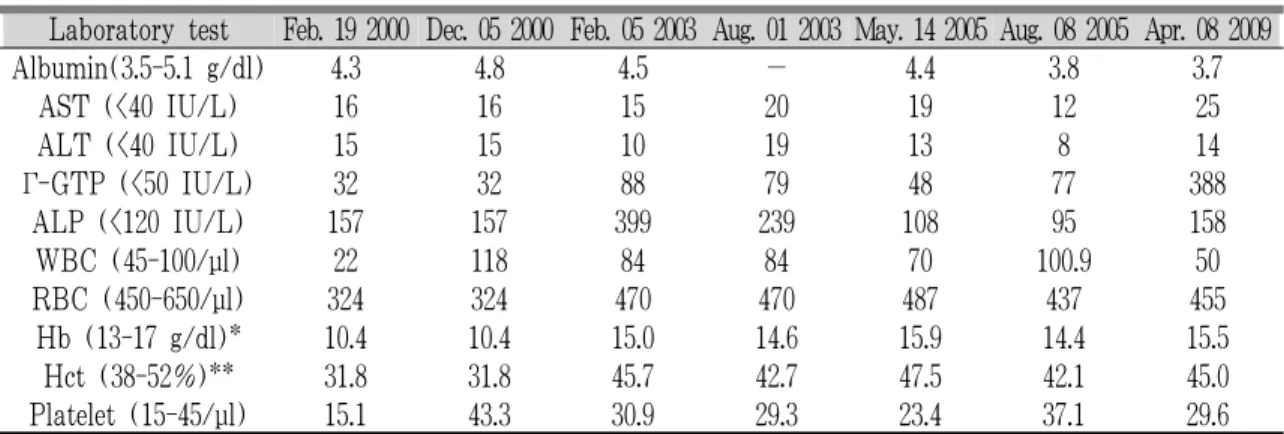
During the treatment period, symptoms associated with SCLC were well controlled and did not rapidly worsen (Table 2). The clinical laboratory test results were within normal range (Table 3).
The patient with SCLC survived more than 9 years without other metastatic foci, with a sustained good quality of life, using primarily TKM. This survival time is longer than the average overall survival time for SCLC.
The second case was a patient with metastatic lung cancer resulting from HCC, and the patient
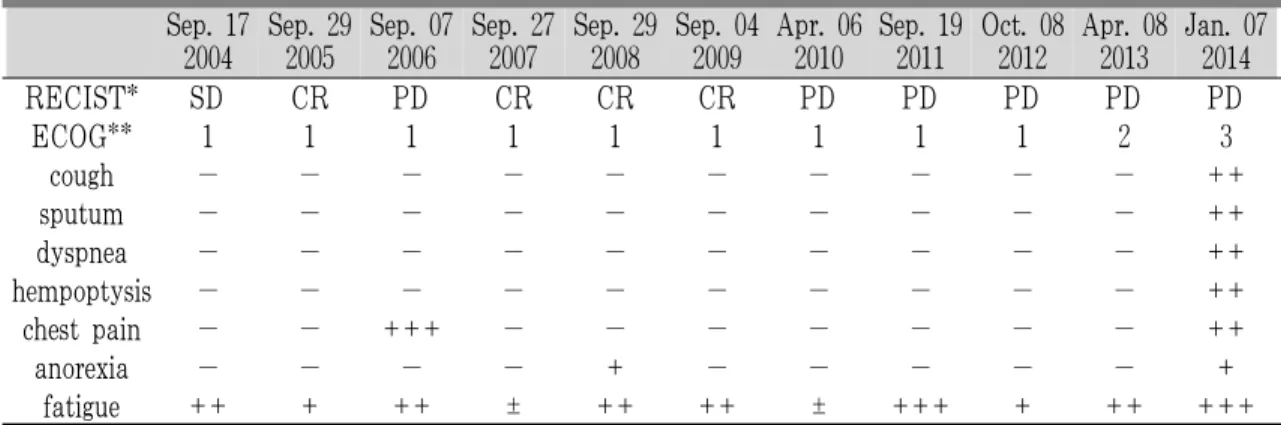
was treated with TKM from September 2004 to February 2014. The patient’s length of survival was approximately 12 years after diagnosis with HCC. Despite pulmonary metastasis, the patient appeared healthy and maintained a good quality of life for more than 10 years with TKM treatment (Table 4). The patient’s clinical symptoms were well controlled, and laboratory tests, including tumor markers, were within the normal range until 2011 (Table 5 and 6).
Date Herb medicine
2000/01/07-2005/06/14 HAD, PSM 2005/07/11-2005/12/10 HAD, PSM, Oryung-san 2005/12/17-2008/09/30 HAD, PSM
2008/10/02-2009/02/09 HAD, PSM, Mackmundong-tang 2009/03/20-2009/04/09 Quibi-tang, Gilgyeong-tang 2009/04/20-2009/05/20 HAD, Sohobaek-san 2009/06/10-2009/08/10 HAD, Chyunsim-hwan 2009/08/22-2009/09/28 HAD
Table 1. Herb Medicine Treatment in Case 1
Jan. 07 2000
Jul. 08 2000
Jun. 14 2001
Jul. 20 2002
May. 20 2003
Oct. 04 2004
Aug. 11 2005
Dec. 03 2006
Dec. 03 2007
Oct. 02 2008
Sep. 28 2009
RECIST* SD SD SD SD SD SD SD SD PD PD PD
ECOG** 1 1 1 1 1 1 1 1 1 1 3
cough ++ + + − − − ± + ± − ++
sputum ++ + + − − − − ± ± ++ ++
dyspnea + ± ± ± − − − ± − ++ ++
hempoptysis + ± − − − − − − − − −
chest pain ++ + + ++ − − − ± − ± ++
anorexia + ± ± − − − − ++ − ++ +
insomnia − − − − − − − +++ − +++ +++
* RECIST : Response Evaluation Criteria in Solid Tumors, PD : progression disease, SD : stable disease
** ECOG : ECOG Performance Status, 1=Restricted in physically strenuous activity but ambulatory and able to carry out work of a light or sedentary nature, 2=Ambulatory and capable of all selfcare but unable to carry out any work activities. Up and about more than 50% of waking hours, 3=Capable of only limited selfcare, confined to bed or chair more than 50% of waking hours
Table 2. The Clinical Progress of the Patient in Case 1
Laboratory test Feb. 19 2000 Dec. 05 2000 Feb. 05 2003 Aug. 01 2003 May. 14 2005 Aug. 08 2005 Apr. 08 2009
Albumin(3.5-5.1 g/dl) 4.3 4.8 4.5 − 4.4 3.8 3.7
AST (<40 IU/L) 16 16 15 20 19 12 25
ALT (<40 IU/L) 15 15 10 19 13 8 14
Γ-GTP (<50 IU/L) 32 32 88 79 48 77 388
ALP (<120 IU/L) 157 157 399 239 108 95 158
WBC (45-100/μl) 22 118 84 84 70 100.9 50
RBC (450-650/μl) 324 324 470 470 487 437 455
Hb (13-17 g/dl)* 10.4 10.4 15.0 14.6 15.9 14.4 15.5
Hct (38-52%)** 31.8 31.8 45.7 42.7 47.5 42.1 45.0
Platelet (15-45/μl) 15.1 43.3 30.9 29.3 23.4 37.1 29.6
* Hb : Hemoglobin, ** Hct : Hematocrit
Table 3. The Change of Laboratory Test in Case 1
Date Herb medicine
2004/09/17-2004/10/01 HAD, CGX, yanghyulbaemok-tang
2005/07/04-2006/06/20 HAD, PSM
2006/06/27-2006/07/10 HAD, PSM, Saenggangeonbi-tang 2006/08/05-2006/08/16 HAD, Saenggangeonbi-tang, Chynyong-hwan
2006/09/07-2009/08/12 HAD, Chynyong-hwan
2009/09/04-2009/10/04 HAD, Chynyong-hwan,CGX
2009/10/13-2010/02/25 CGX, Guanjeok-hwan
2010/04/06-2011/08/19 HAD
2011/09/19-2011/10/19 HAD, CGX
2011/11/21-2012/01/20 HAD
2012/02/26-2012/09/29 HAD, CGX
2012/10/08-2012/10/18 Sansaryukgami-bang, Guanjeok-hwan 2012/11/08-2012/11/14 Sansaryukgami-bang, Guanjeok-hwan
2013/01/02-2013/01/08 Baekgaejagami-bang
2013/01/21-2013/01/28 Baekgaejagami-bang
2013/02/20-2013/02/27 Yiyirengami-bang
2013/03/18-2013/03/25 Eosungchogami-bang
2013/04/08-2013/04/15 Hwangkigami-bang
2013/05/13-2013/05/20 Cheungpyekilkyunggami-tang
2013/06/10-2013/06/17 Ikgiboheol-tang
2013/07/03-2013/07/10 Cheungpyekilkyunggami-tang
2013/07/25-2013/07/31 Cheungpyekilkyunggami-tang
2013/08/02-2013/08/08 Cheungpyekilkyunggami-tang
2013/10/11-2013/10/18 Cheungpyekilkyunggami-tang
2013/10/21-2013/10/28 Cheungpyekilkyunggami-tang
2013/11/13-2013/11/20 Cheungpyekilkyunggami-tang
2013/11/25-2013/12/02 Cheungpyekilkyunggami-tang
2014/01/07-2014/01/13 Cheungpyekilkyunggami-tang
Table 4. Herb Medicine Treatment in Case 2
Sep. 17 2004
Sep. 29 2005
Sep. 07 2006
Sep. 27 2007
Sep. 29 2008
Sep. 04 2009
Apr. 06 2010
Sep. 19 2011
Oct. 08 2012
Apr. 08 2013
Jan. 07 2014
RECIST* SD CR PD CR CR CR PD PD PD PD PD
ECOG** 1 1 1 1 1 1 1 1 1 2 3
cough − − − − − − − − − − ++
sputum − − − − − − − − − − ++
dyspnea − − − − − − − − − − ++
hempoptysis − − − − − − − − − − ++
chest pain − − +++ − − − − − − − ++
anorexia − − − − + − − − − − +
fatigue ++ + ++ ± ++ ++ ± +++ + ++ +++
* RECIST : Response Evaluation Criteria in Solid Tumors, CR : complete response, PD : progression disease, SD : stable disease
** ECOG : ECOG Performance Status, 1=Restricted in physically strenuous activity but ambulatory and able to carry out work of a light or sedentary nature, 2=Ambulatory and capable of all selfcare but unable to carry out any work activities. Up and about more than 50% of waking hours, 3=Capable of only limited selfcare, confined to bed or chair more than 50% of waking hours
+++ severe, ++ moderate, + mild, ± occurred intermittently, − non-existed
Table 5. The Clinical Progress of the Patient in Case 2
Laboratory test Sep. 18 2004
Jul. 06 2005
Jan. 09 2006
Apr. 09 2009
Jan. 13 2010
Sep. 20 2011
May. 04 2012
Feb. 13 2013
Feb. 06 2014
Albumin (3.5-5.1 g/dl) 4.1 4.2 4.8 4.5 4.6 4.3 4.0 4.6 3.9
AST (<40 IU/L) 21 20 21 14 18 14 18 23 38
ALT (<40 IU/L) 13 13 11 9 11 6 10 13 31
γ-GTP (<50 IU/L) 40 10 12 - - 8 15 11 16
ALP (<120 IU/L) 59 76 71 58 67 69 89 59 78
AFP (<7 IU/ml) 24.96 9.96 12.76 79 16.4 295.7 149.3 676.7 70120
PIVKA-П (<40 mAU/ml) 22 - - 13 11 14 196 182 12298
Table 6. The Change of Laboratory Test in Case 2
In conclusion, the two cases of refractory lung cancer presented herein indicate that combining TKM with conventional Western therapies can improve a patient’s quality of life, reduce symptoms, and may also lead to an improvement in overall survival. In terms of safety, patients who were treated with herbal medicines did not have any hepatic adverse reactions. However, there are some
in both cases. We had access only to copies of medical records obtained from other hospitals; therefore, comparison of serial changes of radiological images in both cases was incomplete. The second limitation is that the tumor size was not reduced in either case.
The results in the present study, given the
aforementioned limitations, indicate that additional
case reports and clinical trials are needed to
양한방 복합투여로 장기간 생존을 보인 폐암 환자 2례
강지영, 김준영, 손창규, 조정효 대전대학교 부속 한방병원 간계내과학교실
ABSTRACT
목 적:
소세포 폐암 및 전이성 폐암은 폐암 중에서도 가장 예후가 불량하고 생존율도 상대적으로 낮은 암으로 알려져 있 다. 난치성 폐암 환자에 대해 한방치료가 생존 기간 연장 및 삶의 질 관리면에 있어서 효과가 있음을 보여주고자 한다.
연구방법 및 대상:
본원에서 입원 및 통원치료를 병행한 소세포폐암 환자 1명과 원발성 간암에서 폐로 전이된 전이성
폐암 환자 1명에 대하여 한방치료의 효과 및 임상경과를 후향적으로 조사하였다. 치료기간은 각각 2000년 1월-2009년 12월과 2004년 9월-2014년 2월이었으며 한약치료는 평균 1개월 간격으로 행해졌으며 입원기간 동안에는 한약치료를 포함한 침구치료 를 추가로 시행하였다. 치료효과 및 경과 판정을 위해 흉부 방사선 검사 및 혈액검사를 평균 1개월 간격으로 시행하였으며 내 원시마다 환자의 증상 및 상태를 확인하였다.
결 과:
2명의 폐암 환자 모두 꾸준한 한방치료를 받으며 진단시점부터 9년 이상의 상당히 오랜 기간 동안 비교적 좋은 삶 의 질을 유지하면서 종양으로 인한 임상경과 또한 완만하게 진행이 되었다.
결 론:
본 증례는 한방치료가 불응성 폐암 환자에 대해 삶의 질을 양호하게 유지하고 증상 조절 및 종양의 진행양상을 완 화시켜 주며 나아가 생존기간 연장에도 효과가 있음을 보여준다.
중심단어: