• 검색 결과가 없습니다.

The Economic Value of Residential Electricity Consumption in Seoul

N/A
N/A
Protected

Academic year: 2021

Share "The Economic Value of Residential Electricity Consumption in Seoul"

Copied!
5
0
0

로드 중.... (전체 텍스트 보기)

전체 글

(1)

http://dx.doi.org/10.5855/ENERGY.2012.21.1.081

To whom corresponding should be addressed.

232 Gongreung-Ro, Nowon-Gu, Seoul, 139-743, Republic of Korea Tel : +81-2-970-6802; E-mail : [email protected]

The Economic Value of Residential Electricity Consumption in Seoul

Seung-Hoon Yoo and Seungryul Lee

Department of Energy Policy, School of Energy & Environment, Seoul National University of Science & Technology

(Received 10 January 2012, Revised 21 February 2012, Accepted 21 February 2012)

Abstract ― Electricity is the basic building block of economic development, and constitutes one of the vital infra-structural inputs in socio-economic development. The demand for electricity has been increasing due to extensive urbanization, industrialization, and a rise in the standard of living, as is the case with residential electricity consumption. This paper attempts to estimate the consumer surplus and the economic value of the residential consumption of electricity in Seoul to assist in decision-making in electricity management. The estimated consumer surplus represents the value of the area under the demand curve, above the actual price that is paid for residential electricity consumption. The estimated annual consumer surplus and economic value for the year 2005 amount to 2,144.7 and 3,727.4 billion won, respectively. The estimates per kWh were 184.9 and 316.0 won, respectively, which imply that the consumer surplus and the economic value of residential electricity consumption significantly outweigh the average price of electricity in 2005 of 91.1 won per kWh.

Key words : electricity, consumer surplus, economic value, price elasticity, residential demand

1. Introduction

Electricity is the basic building block of economic development, and constitutes one of the vital infra- structural inputs in socio-economic development.

The demand for electricity has been increasing due to extensive urbanization, industrialization, and a rise in the standard of living (BP, 2011), as is the case with residential electricity consumption in Seoul, the capital of Korea. The residential electricity consumption of Seoul has grown at an average annual rate of 4.9%

during 1991-2007. A number of studies that have been conducted in the context of a country such as Korea, as well as in international contexts, reveal that electricity consumption leads to economic growth (e.g., Ferguson et al., 2000; Yoo, 2005). Thus, to enhance economic growth and the standard of living, efforts have been made to increase investment in electricity supply and overcome the constraints on

electricity consumption in not only developing countries but also developed countries.

Information on the economic value of electricity is useful for decisions in electricity management. First, in structural approaches to electricity management, estimates of the value inform investment decisions.

This is because nations continue to make investments in electricity resources, which constitute one of the most important components of their budgets for public infrastructure. Economic evaluation is important because it aids in ascertaining whether the public favors proposed projects for electricity supply and in estimating the degree to which it is willing to pay for benefits. In the prevalent context of constrained public budgets, conceptually correct and empirically valid estimates of the economic value of electricity are essential for making economically sound investment decisions.

Another class of decisions for which economic

values of electricity are useful is those that evaluate

non-structural or policy options. For example, as the

demand for electricity grows against a finite supply,

estimates of the economic value of electricity are

(2)

consumer surplus

 Price

demand Consumer

expenditure

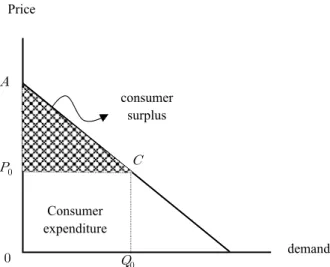
Fig. 1. Electricity demand function and consumer surplus.

useful in the context of the optimal allocation of electricity between and among electricity-using purposes and sectors. In the case of a supply shortage or outage, electricity users may not be able to obtain all of the electricity they might possibly use; sharing of the limited supply may become a central issue of electricity management.

There are several other non-structural problems regarding electricity policy for which electricity valuations are useful. These include: How much multi-objective dam water should be used to generate hydropower for present needs and how much should be saved for future needs? How much water vs. oil should be used to meet current electricity demands? How much can beneficiaries afford to pay for electricity supplies? For each of these issues, estimates of the economic value of electricity consumption are important.

The purpose of this paper is to provide a frame- work for understanding the economic value of electricity and to uncover empirical evidence of the value of electricity. More specifically, this paper attempts to estimate the economic value of the residential consumption of electricity in Seoul to assist in decision-making in electricity management. Following the tenets of modern microeconomic theory, the estimate is based on consumer surplus.

2. Methodology

2-1. The demand curve approach

In the case where a market exists for a good or service, given the price, a consumer determines the quantity that is demanded such that total utility is maximized subject to a budget constraint. Generally, ceteris paribus, changing prices of the good in question will alter the quantity that is demanded. We assume the existence of a smooth, well-defined, continuous function that represents the relationship between the quantity of electricity demanded by a consumer and the price of electricity. Given the possibility of estimating this relationship, a derived demand function can be used as a basis for measuring the value of electricity.

A demand curve illustrates the maximum price a

consumer would be willing to pay for obtaining any quantity in question. This concept of value has been often described as willingness to pay (WTP) (Willig, 1976).

As illustrated in Figure 1, the consumer surplus is the area under the demand curve that lies above the market price or the amount paid by the consumer.

If the price, P

0

, represents the market price amount that is actually paid by the consumer of electricity, the resulting quantity that is demanded will be 

. If an actual exchange occurs, the price 

represents the exchange value of the last unit. Therefore, for all the units demanded, the consumer surplus is the total value of the area under the demand curve above the market price actually paid as shown in Fig. 1. In other words, when 

units of electricity are consumed at a price 

, the economic value of electricity consumed is the sum of the consumer surplus and the actual consumer expenditure.

2-2. Estimation of consumer surplus

To execute integration for estimating the consumer

surplus shown in Fig. 1, the consumer’s choke price,

defined as the price at which demand is zero, should

be computed. However, this computation is almost

impossible to implement in the real world because

of insufficient data. Therefore, the choke price usually

has been assumed through a proxy such as the

(3)

Table 1. Estimation results for price elasticity.

Price elasticity estimate Standard error t-value 95% confidence interval

-0.2463 0.0428 -5.76 (-0.3191, -0.1601)

opportunity cost of using an alternative supply of electricity - an approach that may significantly reduce the reliability of the measured consumer surplus.

Accordingly, an alternative methodology for assessing the consumer surplus is worthy of consideration.

Alexander et al. (2000) proposed an estimate of consumer surplus that is based on only two values, the revenue from a commodity sales and the price elasticity of demand for a commodity. They applied the estimate to valuing the consumption benefits for professional sports franchises. This study uses the methodology of Alexander et al for estimating the consumer surplus and the economic value of residential electricity consumption.

Let the inverse market demand function be  

      where , , and are the price for electri- city, the demand for electricity, and a vector containing any other variables that might influence the demand, respectively. This function is assumed to have first and higher-order derivatives. If we suppose that the price and demand are 

and 

, respectively, and we suppress all arguments barring electricity demand, then Taylor’s theorem yields:

       

   ′    

      (1)

Integration of this function from 0 to 

and subtraction of the consumer’s actual payment, 

, yields the consumer surplus (  ) as:

  



  



(2)

where  is the price elasticity of demand evaluated at 

. When the second term on the right-hand side of the second equality in (2) is sufficiently small, the first term is an approximation of the consumer

surplus. For example, if the demand function is linear, the consumer surplus is exactly

 . Thus, the following approximation can be derived.

 ≈ 



(3)

This amount is an upper bound on the consumer surplus when the demand function is strictly convex in price (Alexander et al., 2000). Equation (3) estimates the value of consumer surplus shown in Figure 1. Then, the economic value of electricity con- sumption is calculated by summing up the value of the estimated consumer surplus using equation (3) and the actual consumer expenditure on electricity.

3. Data and empirical results

3-1. Data

As already discussed above, the measurement of the economic value of electricity consumption involves the estimation of consumer surplus. A key parameter in this estimation is the nature and magnitude of price elasticity at a given demand for electricity. Thus, the measurement of the economic value of the residential electricity consumption crucially depends upon the correct estimation of the price elasticity of demand. Usefully, Yoo et al. (2007) dealt with the residential demand for electricity in Seoul. They gathered data from a survey of households in 2005 and computed the price elasticity of electricity demand as -0.2463, as reported in Table 1.

We allow for uncertainty by constructing a confidence

interval for the estimate of elasticity in lieu of just

a point estimate. To this end, the Monte Carlo simulation

technique of Krinsky and Robb(1986) is used. This

involves simulating the univariate normal distribution

of  by using the estimates of the elasticity and its

standard error, and generating an empirical distribution

(4)

Table 2. Consumer surplus and economic value of electricity consumption in Seoul in 2005.

Estimates Consumer surplus Economic value

Total value Unit value Total value Unit value

Estimated value 2,144.7 billion won 184.9 won 3,727.4 billion won 316.0 won

95% confidence interval 1,605.1 to 3,299.5 billion won

138.4 to 284.4 won

3,187.8 to 4,882.2 billion won

269.5 to 415.5 won

function for the elasticity. The last column of Table 1 presents the 95% confidence interval that is obtained by employing 5,000 replications and omitting 2.5 percent of the observations from both tails. This method quantifies and models the uncertainty. It also shows the likely range of elasticity, given the uncer- tainties that are involved in this type of estimation.

3.2 Empirical results

To estimate the economic value of electricity consump- tion, the estimated consumer surplus is added to the total expenditure for residential electricity consumption.

A total of 2,144.7 billion won is the estimated consumer surplus for residential electricity consumption in the year 2005. This value corresponds to 184.9 won per kWh, which is about two times bigger than the price of electricity in 2005 of 91.1 won per kWh.

Table 2 shows the results of estimating the consumer surplus and the economic value of electricity consumption in Seoul for the year 2005. The economic value of electricity consumption in 2005 is estimated to be 3,727.4 billion won. This value amounts to 316.0 won per kWh, which is about 3.5 times bigger than the price of electricity in 2005. These figure simply that the consumer surplus and the economic value of residential electricity consumption significantly outweigh the price of electricity. Table 2 also reports 95% confidence intervals for the estimated values.

4. Concluding remarks

As commonly known, electricity has become the preferred and dominant form of energy for a progressi- vely increasing portion of economic life in industrial economies. It has been a major source of betterment

of the standard ofliving, and has played a crucial role in scientific and technological advancement (Rosenberg, 1998). This paper has attempted to estimate the economic value of residential electricity consump- tion in Seoul. To this end, it has used the concept of consumer surplus defined as the economic value less the amount that is actually paid by the consumer.

In particular, a formula suggested by Alexander et al. (2000) was employed to overcome the compli- cations that are involved in computing the consumer surplus.

The consumer surplus and the economic value of electricity consumption in Seoul for the year 2005 were estimated to be approximately 2,144.7 and 3,727.4 billion won, respectively. The estimates per kWh were 184.9 and 316.0 won, respectively, which are much bigger than the residential price of electri- city in 2005 of 91.1 won per kWh. In addition, to allow for any uncertainties involved in the estimation, the 95% confidence intervals for the estimated consumer surplus and the economic value were computed. The estimated values can be used for the purpose of electricity-related decision-making. Given that residential electricity consumption contributes to the social well-being of Seoul residents, it is essential that electricity be treated as an economic resource and managed under a comprehensive management system with well-defined objectives and goals.

References

1. Alexander, D. L., Kern, W., Neill, J. Valuing the consumption benefits from professional sports franchises.

Journal of Urban Economics, 2000, 48, 321-337.

2. Berkhout, P., Ferrer-i-Carbonellb, A. and Muskens,

J. The ex post impact of an energy tax on

(5)

household energy demand. Energy Economics, 26, 2004, 297-317.

3. Berndt, E. R. Practice of econometrics: classic and contemporary. Addison-Wesley, 1991.

4. BP, Statistical Review of World Energy 2011.

Available at http://www.bp.com, 2011.

5. Ferguson, R., Wilkinson, W., Hill, R. Electricity use and economic development. Energy Policy, 2000, 28, 923-934.

6. Filippini, M., Pachauria, S. Elasticities of electricity demand in urban Indian households. Energy Policy, 2004, 32, 429-436.

7. Holtedahl, P., Joutz, F. Residential electricity demand in Taiwan. Energy Economics, 2004, 26, 204-224.

8. Hondroyiannis, G. Estimating residential demand for electricity in Greece. Energy Economics, 2004, 26, 319-334.

9. Krinsky, I., Robb, A. On approximating the statistical properties of elasticities. Review of Economics and Statistics, 1986, 68, 715-719.

10. Rosenberg, N, The role of electricity in industrial development. The Energy Journal, 1998, 19, 7-24.

11. Willig, R.D. Consumer’s surplus without apology.

American Economic Review, 1976, 66, 589-597.

12. Yoo, S.-H. Electricity consumption and economic growth: evidence from Korea. Energy Policy, 2005, 33, 1627-1632.

13. Yoo, S.-H., Lee, J.-S, Kwak, S.-J. Estimation of

residential electricity demand function in Seoul

by correction for sample selection bias. Energy

Policy, 2007, 35, 5702-5707.

수치

Fig. 1. Electricity demand function and consumer surplus.
Table 2. Consumer surplus and economic value of electricity consumption in Seoul in 2005.

참조

관련 문서

 The Dutch physicist Pieter Zeeman showed the spectral lines emitted by atoms in a magnetic field split into multiple energy levels...  With no magnetic field to align them,

Modern Physics for Scientists and Engineers International Edition,

Five days later, on 15 January 1975, the Portuguese government signed an agreement with the MPLA, FNLA and UNITA providing for Angola to receive its independence on 11

Usefulness of co-treatment with immunomodulators in patients with inflammatory bowel disease treated with scheduled infliximab maintenance therapy.. Oussalah A, Chevaux JB, Fay

Inclusion and Inclusiveness: Shared Vision of Youth for Local, National, and Global Village Inclusion at large stands for embracing populations with disabilities and

웹 표준을 지원하는 플랫폼에서 큰 수정없이 실행 가능함 패키징을 통해 다양한 기기를 위한 앱을 작성할 수 있음 네이티브 앱과

_____ culture appears to be attractive (도시의) to the

It is impossible to change the voltage across a capacitor by a finite amount in zero time, for this requires an infinite current through the capacitor.. (A capacitor resists