• 검색 결과가 없습니다.

Temperature-dependent Differences in Heading Response at Different Growth Stages of Rice

N/A
N/A
Protected

Academic year: 2021

Share "Temperature-dependent Differences in Heading Response at Different Growth Stages of Rice"

Copied!
12
0
0

로드 중.... (전체 텍스트 보기)

전체 글

(1)

Global warming and frequent extreme weather events are likely to pose serious threats to stable rice production and supply by increasing the risk of serious adverse impacts on plant growth and development (Kotak et al., 2007). In particular, variations in the heading date of rice ascribable to extreme weather events including abrupt shifts in average temperature, especially heatwaves, can cause seed infertility in the heading-flowering stage (Satake & Yoshida, 1978;

Wang et al., 2019). Similarly, changes in weather conditions during the ripening stage can have a serious impact on the yield of rice and quality of harvest (Shi et al., 2016).

Therefore, investigating the effect of weather conditions on heading response will provide important basic data for

developing technologies or new cultivars capable of st- abilizing rice quality and yield by resisting or adapting to the changing climate. The two major environmental factors determining the heading response of rice are photoperiod and temperature (Ahn & Vergara, 1969; Dua et al., 1990;

Collinson et al., 1992). Rice copes with short photoperiods by activating the expression of florigen genes which induce panicle initiation by moving to the shoot apical meristem in leaves (Bernier & Perilleux, 2005; Corbesier et al., 2007;

Tamaki et al., 2007). To shed light on the control mech- anism of such responses responsible for the developmental transition from vegetative to reproductive growth, extensive research has been undertaken with various foci including

Temperature-dependent Differences in Heading Response at Different Growth Stages of Rice

HyeonSeok Lee 1,† , MyoungGoo Choi 2 , YunHo Lee 2 , WoonHa Hwang 1 , JaeHyeok Jeong 1 , SeoYeong Yang 1 , YeonHwa Lim 1 , ChungGen Lee 3 and KyungJin Choi 3

ABSTRACT There is an increasing frequency in the occurrence of abnormal weather phenomena such as sharp increases and decreases in temperature. Under these weather conditions, the heading time of rice changes unexpectedly, which poses problems in agriculture. Therefore, we investigated the effect of temperature on the heading response at different growth stages in rice.

During the period from transplanting to heading, the plants were subjected to different temperature treatments, each for a 9-day period, to observe the heading response. For the heading date analysis, “heading date” was defined as the number of days from transplanting to the appearance of the first spikelet. We found that the influence of temperature increased in the order of rooting stage, followed by meiosis, early tillering, spikelet differentiation, and panicle initiation stage in all ecological types and cultivars.

In particular, unlike the results reported previously, the effect of temperature on heading during the photo-sensitive period was very small. Meanwhile, the influence of temperature on vegetative growth response at different growth stages was not consistent with heading response. These results can be used as basic data for predicting the variation in heading date owing to temperature variation at each growth stage. In addition, we propose that the concept of day length should be included in determining the influence of temperature on the photo-sensitive period.

Keywords : flowering time, growth stage, heading response, phenological, random forest, rice, temperature

DOI : https://doi.org/10.7740/kjcs.2019.64.3.213

Original Research Article

ⓒ 본 학회지의 저작권은 한국작물학회지에 있으며, 이의 무단전재나 복제를 금합니다.

This is an Open-Access article distributed under the terms of the Creative Commons Attribution Non-Commercial License (http://creativecommons.org/licenses/by-nc/3.0) which permits unrestricted non-commercial use, distribution, and reproduction in any medium, provided the original work is properly cited.

1)

Junior Research Scientist, Crop Cultivation & Physiology Research Division, National Institute of Crop Science, Rural Development Administration, Wanju 55365, Korea

2)

Post-Doctorate researcher Crop Cultivation & Physiology Research Division, National Institute of Crop Science, Rural Development Administration, Wanju 55365, Korea

3)

Senior Research Scientist, Crop Cultivation & Physiology Research Division, National Institute of Crop Science, Rural Development Administration, Wanju 55365, Korea

Corresponding author: HyeonSeok Lee; (Phone) +82-63-238-5267; (E-mail) [email protected]

<Received 10 August, 2019; Revised 26 August, 2019; Accepted 28 August, 2019>

(2)

photoperiod-dependent heading response, photosensitivity- related gene expression mechanism, and quantitative trait locus (QTL) analysis (Yano et al., 1997; Yamamoto et al., 2000; Nishida et al., 2001; Yang et al., 2018). However, the effects of temperature on heading response have not been sufficiently studied to date (Luan et al., 2009; Kovi et al., 2013). Studies on temperature-dependent heading response have been conducted at the molecular level, in- vestigating the effect of temperature on promoting or in- hibiting panicle initiation control mechanism to cope with short photoperiod during a specific period, without however, establishing a direct link to temperature because plants were at different growth stages during the sampling period (Lee et al., 2011; Luan et al., 2009; Song & Luan, 2012; Song et al., 2012; Song et al., 2013). Although the effect of temperature on the heading response control mechanism has been separately studied, no results capable of elucidating the interconnected control mechanism have been reported to date (Kovi et al., 2013). On the contrary, a number of studies have been conducted to analyze temperature-dependent heading response under a fixed photoperiod (Vergara & Chang, 1985;

Roberts & Summerfield, 1987), and it has been reported that the pre-heading growth period decreases nonlinearly as the temperature increases within a certain temperature range (Yoshida, 1981; Haniu et al., 1983; Loomis & Connor, 1992).

It was found that higher the minimum temperature for the same average temperature i.e., smaller the daily temperature difference, lower the growth rate (Yin et al., 1996), and that the effect of temperature on heading varies depending on the stage of growth (Wang, 1960; Yin et al., 1997). However, earlier experiments on the effect of temperature on different growth stages yielded totally different interpretations (Ahn &

Vergara, 1969; Shibata et al., 1969; Yin et al., 1997). In this study we aimed to shed light on the effect of temperature change on heading response depending on the growth stage and ecotype of rice grown in the natural photoperiod conditions with naturally changing length of photoperiod. To this end, we investigated the association between plant growth pattern and heading variation under different treatment conditions and analyzed the effects of major temperature parameters, such as minimum, average, and maximum temperature, and daily temperature difference, on heading response in each treatment period using random forest analysis.

MATERIALS AND METHODS

Experimental materials and treatment conditions For our experiment, we used six rice (Oryza sativa) cultivars (temperate japonica type), two each for early matu- ring (Odae & Ungwang), medium maturing (Gopum &

Daebo), and mid-late maturing (Sanuri & Shindongjin) eco- types. For all cultivars, 20-day-old seedlings were trans- planted on the same day (May 30) in 2017 and 2018 using 1/5000 а Wagner pots, with three plants per pot. As a fertilizer, we used a composite slow-release fertilizer based on 9 kg/10a nitrogen, 4.5 kg/10a phosphate, and 5.7 kg/10a potassium at the area ratio corresponding to three plants (planting distance: 30 × 14 cm) instead of the pot area. Se- edlings were sown and grown in 406-cell seedling trays. The average number of leaves on the transplantation day (May 30) was 3.9. Temperature treatment was applied to three groups of freshly transplanted rice plants in thermo-regulated glass rooms of the artificial weather facility of the National Institute of Crop Science: the control group was treated with temperatures (hourly automatic temperature control) varying at 9-day intervals in each treatment period based on the 15-year (2001 –2016) average temperature in Jeonju area; the low- and high-temperature groups were treated with temperatures 3°C lower or higher than those applied to the control group (Fig.

1). Except for the temperature treatment period of nine days, the rice plants were grown in natural weather conditions.

Analytical and Statistical Methods

For the heading date analysis, “heading date” was defined

as the number of days from transplanting to the appearance

of the first spikelet, with nine replicates for each treatment

group, as counted between 13:00 h and 14:00 h on a daily

basis. The importance index of temperature on heading

response in each growth stage was calculated through the

following steps: (1) the temperature-dependent heading date

variation at 9-day intervals was checked, (2) a value of +1

or –1 was assigned to one-day delay or advance, respecti-

vely, compared with the control group, (3) the heading date

variation in response to a difference of 1°C in the daily

average temperature during each treatment period was sum-

med, (4) the total value was divided by the extent of

variation in the corresponding period, (5) the value was

(3)

expressed as a percentage. The vegetative growth phase was divided, based on the growth response of the control group grown in natural weather conditions, into the rooting stage (from transplanting to the emergence of the first leaf; ~9 days) and the early tillering stage (from the primary tillering stage, with the emergence of the primary tiller, to the secon- dary tillering stage with the emergence of the secondary tiller from the first node position; 7.5 leaves, ~9 days).

The reproductive growth phase is generally considered to be completed in 35 days but varies depending on the criteria for determining the heading date (Vergara et al., 1965; Ikeda, 1975). In our experiment, given that the heading date was determined as the time when 50% of the panicles became exserted from the boot, we calculated panicle initiation, spikelet differentiation, and meiosis stages to be 30, 24, and 15 days prior to heading, respectively (Matsubayashi, 1963; Katayama, 1971).

The temperature-dependent variation in plant height prior

to heading was computed using the following logistic model (Black & Leff, 1983):

   min         

 min   max

where E is plant height (cm), t is the number of days up to heading, Er is the curve pattern, which determines the rate of elongation reduction, E

max

and E

min

are the maximum and minimum elongation rate, respectively, and t

h

is the time when 50% of E

max

is reached. Er, E

max,

E

min,

and t

h

are coefficients determined by nonlinear regression analysis, which was performed using SigmaPlot 11.1.

Results of each experiment were analyzed using the R Statistical Package (Version 3.2.2), with the differences con- sidered to have statistical significance at p < 0.05. Random forest analysis was performed using the R-package random- Forest and caret. The values of mtry and ntree, which deter- Fig. 1. Change in weather condition by days after transplanting. (A) Day length. (B) Average temperature. (C) Minimum

temperature. (D) Maximum temperature.

(4)

mine the number of branches for explanatory variables and each node of the decision tree model, were set to those yielding the lowest OOB errors as follows, using tune RF and gridsearch: for the early maturing cultivars, mtry = 4, OOB = 0.93, and ntree = 30000; for medium maturing cul- tivars, mtry = 4, OOB = 2.15, and ntree = 10000; for the mid-late maturing cultivars, mtry = 5, OOB = 3.08, and ntree = 10000.

RESULTS

Temperature-dependent variation in heading date by growth stage

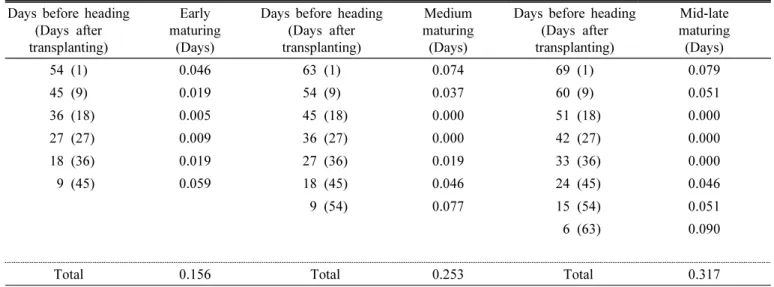
As shown in Fig. 2, the influence of temperature on heading date varied by growth stage. In all ecological types,

increase in temperature nonlinearly shortened the heading date in some growing stages, but there were also stages where no significant changes were observed, especially in the period between 36 and 27, 45 and 27, and 51 and 24 days before heading for early maturing, medium maturing, and mid-late maturing cultivars, respectively. Table 1 presents the magnitude of temperature effect on the heading date in different treatment periods as the difference in the days to heading induced by 1°C increase in the daily average te- mperature. The magnitude of temperature-dependent varia- tion in heading date increased with an increase in the length of growth period, i.e., in the order of early maturing, medium maturing, and mid-late maturing ecotypes. The same trend was observed in the growth stages nonresponsive to temperature change. The growth period of rice plants is

Fig. 2. Change in heading date according to temperature variation by days before heading. (A) Early maturing type. (B) Medium maturing type. (C) Mid-late maturing type.

Table 1. Effect of degree of temperature on heading by days before heading.

Days before heading (Days after transplanting)

Early maturing

(Days)

Days before heading (Days after transplanting)

Medium maturing (Days)

Days before heading (Days after transplanting)

Mid-late maturing (Days)

54 (1) 0.046   63 (1) 0.074 69 (1) 0.079

45 (9) 0.019   54 (9) 0.037 60 (9) 0.051

36 (18) 0.005  45 (18) 0.000 51 (18) 0.000

27 (27) 0.009 36 (27) 0.000 42 (27) 0.000

18 (36) 0.019 27 (36) 0.019 33 (36) 0.000

9 (45) 0.059 18 (45) 0.046 24 (45) 0.046

9 (54) 0.077 15 (54) 0.051

6 (63) 0.090

Total 0.156  Total 0.253   Total 0.317

- Effect of degree of temperature: Changes in heading date by 1°C of daily average temperature

(5)

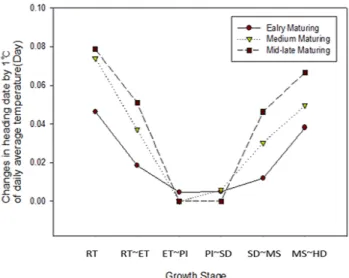
divided according to the days before heading: rooting, early tillering, panicle initiation, spikelet differentiation, and meiosis stages (Matsubayashi, 1963; Katayama, 1971). Fig. 3 illustrates the importance index in each growth stage. In all cultivars and ecotypes, the highest importance index was demonstrated by the rooting stage, followed by meiosis, early tillering, spikelet differentiation, and panicle initiation stages. In particular, during the photo-sensitive period (PSP), namely around the panicle formation time, the effect of temperature change on heading response was greatly reduced, which supports the finding of Ahn and Vergara (1969) that the effect of temperature was insignificant during PSP.

Temperature-dependent variation in growth rate by growth stage

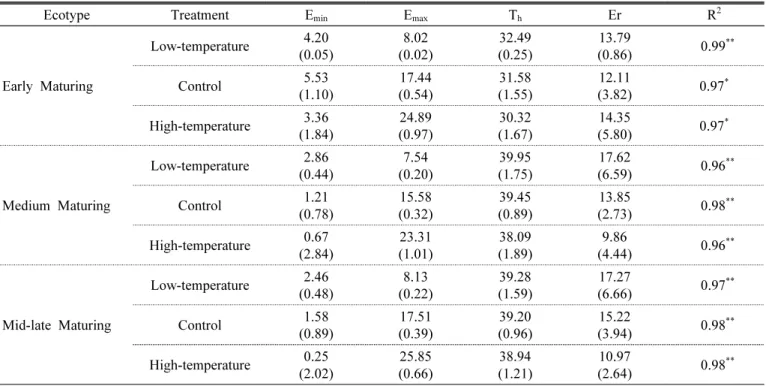
Fig. 4 shows the temperature-dependent variation in plant height growth rate by growth stage. No significant inter- ecotype differences were observed in the plant height growth rate after the 9-day temperature treatment in each growth stage. The average values (± SD) of plant height growth during the entire growth period in the low, normal, and high temperature conditions were 6.5 (± 1.2), 12.6 (±

2.1), and 17.3 (± 2.3) cm, respectively. This difference in growth response was maintained at similar levels until a specific period and sharply decreased after the peak growth period (T

h

in Table 2), which appeared earlier in the high- temperature treatment group. Contrary to the decrease in the effect of temperature on heading response around PSP, the effect of temperature on growth rate was maintained during PSP and began to decrease after the spikelet differentiation stage. Whereas, the correlation analysis bet- ween heading date and post-heading growth components, such as clum length, panicle length, number of spikelets per panicle, and number of panicles per plant, revealed a negative correlation only between the number of panicles and heading date (Fig. 5).

Major temperature parameters influencing the heading date by growth stage

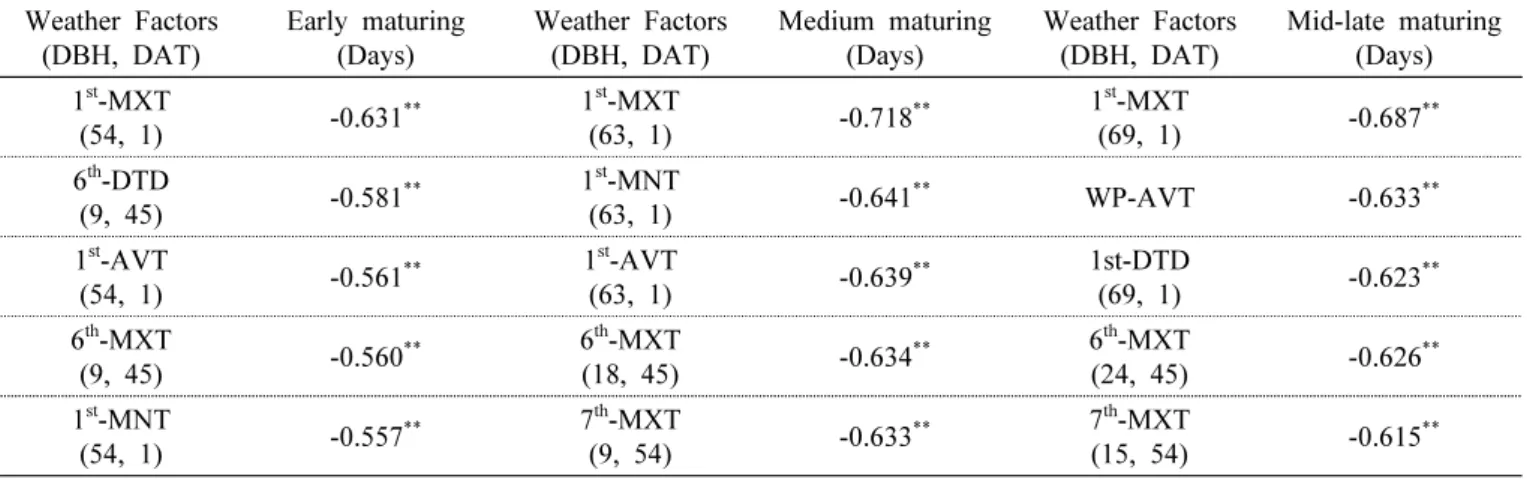
Table 3 presents the results of the correlation analysis between heading date and temperature parameters (minimum, average, and maximum temperatures and daily temperature difference) by treatment group during the growth period at

Fig. 4. Degree of elongation response by days after transplanting with the logistic model. (A) Early maturing type. (B) Medium maturing type. (C) Mid-late maturing type.

Fig. 3. Degree of heading response can be changed by 1 degree of daily average temperature at different growth stages.

RT: Rooting stage; ET: Early tillering stage; PI: Panicle

initiation; SD: Spikelet differentiation; MS: Meiosis

stage; HD: Heading date.

(6)

9-day intervals. In the table, the five highest correlation coefficients between temperature parameters and growth stage are listed. These correlation analysis results showed trends similar to that shown by the importance indices by growth stage (Table 1). Given that various environmental factors have complex interacting effects on the heading

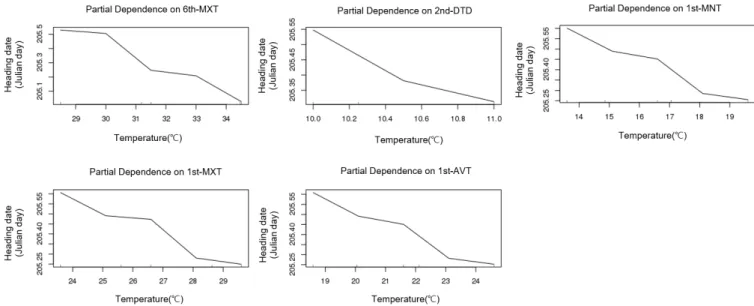
response, multiple regression analysis needs to be perfor- med for proper interpretation. However, multiple regression analysis inevitably leads to collinearity problem among minimum, maximum, and average temperatures in each treatment period, making it impossible to establish a formula using all factors as variables. In contrast, random forest analysis is better suited for highly interacting complex data using many explanatory variables with variable importance (Breiman, 2001). Fig. 6 shows the importance indices of the aforementioned temperature parameters influencing heading date resulting from random forest analysis. In the case of the early maturing cultivars, the five highest impor- tance indices were demonstrated by the temperature para- meters in the rooting and meiosis stages (1

st

and 6

th

treatment periods), similar to the results of the correlation analysis. In the cases of medium and mid-late cultivars, however, the daily temperature difference in PSP (3

rd

and 4

th

treatment periods), which is characterized by a reduced effect of temperature on heading response, was included in the group of five highest importance indices along with the temperature parameters in the 1

st

treatment period. This Table 2. Parameters of the logistic function used to describe elongation response in relation to the days after transplanting under

three temperature regimes during the growth period from transplanting to heading.

Ecotype Treatment E

min

E

max

T

h

Er R

2

Early Maturing

Low-temperature 4.20 (0.05)

8.02 (0.02)

32.49 (0.25)

13.79

(0.86) 0.99

**

Control 5.53

(1.10)

17.44 (0.54)

31.58 (1.55)

12.11

(3.82) 0.97

*

High-temperature 3.36 (1.84)

24.89 (0.97)

30.32 (1.67)

14.35

(5.80) 0.97

*

Medium Maturing

Low-temperature 2.86 (0.44)

7.54 (0.20)

39.95 (1.75)

17.62

(6.59) 0.96

**

Control 1.21

(0.78)

15.58 (0.32)

39.45 (0.89)

13.85

(2.73) 0.98

**

High-temperature 0.67 (2.84)

23.31 (1.01)

38.09 (1.89)

9.86

(4.44) 0.96

**

Mid-late Maturing

Low-temperature 2.46 (0.48)

8.13 (0.22)

39.28 (1.59)

17.27

(6.66) 0.97

**

Control 1.58

(0.89)

17.51 (0.39)

39.20 (0.96)

15.22

(3.94) 0.98

**

High-temperature 0.25 (2.02)

25.85 (0.66)

38.94 (1.21)

10.97

(2.64) 0.98

**

- Values in parentheses are standard errors

- “

*

” and “

**

” represent significance at the 0.05 and 0.01 probability levels, respectively.

Fig. 5. Negative correlation between heading date and number

of panicles per plant in all ecotypes.

(7)

result is consistent with that of the experiment conducted by Shibata et al. (1969) according to which the daytime temperature 29 and 32 days before heading had an insign- ificant effect on heading, but the nighttime temperature greatly influenced it. Figs. 7, 8 present the five major factors affecting heading date in terms of importance index in early maturing. While higher temperature tended to accele- rate heading date in the early maturing ecotype, the medium maturing ecotype did not show a negative corre- lation between the 4

th

-period average temperature and heading date, and higher daily temperature difference acce-

lerated heading date. In the medium maturing ecotype as well, higher daily temperature difference was associated with an earlier heading date with the increase in the daily temperature difference during PSP (4

th

treatment periods).

DISCUSSION

Effect of temperature on heading during the photo- sensitive period

Photoperiod and temperature are two major environmen- tal factors influencing the heading response of rice (Ahn &

Table 3. Correlation coefficient between heading date and weather factors by temperature treatment at different growth stages.

Weather Factors (DBH, DAT)

Early maturing (Days)

Weather Factors (DBH, DAT)

Medium maturing (Days)

Weather Factors (DBH, DAT)

Mid-late maturing (Days) 1

st

-MXT

(54, 1) -0.631

**

1

st

-MXT

(63, 1) -0.718

**

1

st

-MXT

(69, 1) -0.687

**

6

th

-DTD

(9, 45) -0.581

**

1

st

-MNT

(63, 1) -0.641

**

WP-AVT -0.633

**

1

st

-AVT

(54, 1) -0.561

**

1

st

-AVT

(63, 1) -0.639

**

1st-DTD

(69, 1) -0.623

**

6

th

-MXT

(9, 45) -0.560

**

6

th

-MXT

(18, 45) -0.634

**

6

th

-MXT

(24, 45) -0.626

**

1

st

-MNT

(54, 1) -0.557

**

7

th

-MXT

(9, 54) -0.633

**

7

th

-MXT

(15, 54) -0.615

**

- “

*

” and “

**

” represent significance at the 0.05 and 0.01 probability levels, respectively.

- MNT: Minimum temperature, AVT: Average temperature, MXT: Maximum temperature, DTD: Daily temperature difference, WP: Whole growth period. DBH: Days before heading. DAT: Days after transplanting

- Information on the relationship between temperature treatment periods and growth stages can be found in Materials and Methods, Table 1.

Fig. 6. Importance index (% increase MSE) of weather factors influencing heading through random forest analysis. A: Early maturing type. B: Medium maturing type. C: Mid-late maturing type. MNT: Minimum temperature, AVT: Average temperature, MXT:

Maximum temperature, DTD: Daily temperature difference, WP: Whole growth period. Information on the relationship

between temperature treatment periods and growth stages can be found in Materials and Methods, Table 1.

(8)

Vergara, 1969; Dua et al., 1990; Collinson et al., 1992).

Vergara et al. (1985) & Roberts et al. (1987) divided the pre-heading period (from germination to heading) into photo- insensitive, photo-sensitive, and again photo-insensitive stages.

In the experiment by Yin et al. (1997), these were renamed as basic vegetative period (BVP), photo sensitive period (PSP), and post photo-sensitive period (PPP), respectively, for convenience. According to previous findings regarding temperature and photoperiod, photoperiod influences heading only in PSP (Mimoto et al., 1989; Collinson et al., 1992),

and temperature throughout the entire growth period (Yoshida, 1981), but to a varying extent depending on the growth stage (Wang, 1960; Yin et al., 1997). However, results of the experiments conducted to date regarding the varying effects of temperature on heading between BVP and PSP yielded completely different interpretations. While Yin et al. (1997) reported that heading response is more sensitive to temperature in PSP than in BVP and PPP, Ahn and Vergara (1969) reported that temperature has a great effect in BVP and a negligible effect in PSP. Shibata et al. (1969) Fig. 7. Partial dependence plot of the major factors affecting heading date in the early maturing type.

Fig. 8. Partial dependence plot of the major factors affecting heading date in the medium maturing type.

(9)

reported that heading response was sensitive to daytime temperature 11 days before heading, but neutral to daytime temperature 29 and 32 days before heading. Similar to the latter two results, the results of our experiment revealed that the effect of temperature was high during the early growth stage after transplanting, negligible up to the spikelet differentiation stage, which is considered a PSP, and increased again up to the meiosis stage till heading (Fig. 3, Table 1).

The contradictory conclusions derived by the researchers from their experimental results regarding the effect of PSP temperature are presumably due to different photoperiod conditions. While Yin et al. (1997) investigated the response to temperature in an experimental setup of fixed short- photoperiod conditions (12-h light/12-h dark), the experi- ments by Ahn & Vergara (1969) & Shibata et al. (1969) were conducted in the natural photoperiod conditions (14-h 30-m light/9-h 30-m dark), similar to those in our experiment.

This can also be inferred from the results of the experiment conducted by Yoshida & Hanyu (1964) that the photoperiod critical to heading response is dependent upon temperature.

Furthermore, Komiya et al. (2009) reported that panicle initiation is caused by RFT1 (Rice Flowering Locus T 1) in long-photoperiod conditions and by RFT1 and Hd3a (Heading date 3a) in short-photoperiod conditions. RFT1 is the closest homolog of 13 FT-like genes in rice to Hd3a.

& Komiya et al. (2008) reported that RFT1 promotes flowering in the absence of Hd3a. and it act as an integrator of multiple signals under long day conditions with Ehd1. This suggests that different heading response mechanisms are activated depending on photoperiod conditions, and further studies are necessary to compare the effect of temperature on heading response in long- and short-photoperiod conditions.

The conclusion drawn from the experimental results by Summerfield et al. (1992), according to which temperature and photoperiod do not interact in their impact on heading, may be ascribable to their experimental treatment conditions, which were inappropriate to draw a conclusion applicable to photoperiodic variation, because they did not compare the temperature treatment conditions in different photoperiod conditions.

Discrepancy between heading and elongation response to temperature

Unlike heading response, degree of elongation response increased with the increase in temperature until before the spikelet differentiation stage regardless of the growth stage, and no temperature-dependent difference in growth rate was observed afterwards (Fig. 4). In particular, in contrast to heading response, elongation response sensitivity to temperature was observed in PSP treatment. These results allow the assumption that vegetative growth rate can be predicted in temperature conditions within a specific range but predicting heading response based on them may be prone to error. From the finding that individuals with a higher number of panicles per plant showed an accelerated heading date (Fig. 5), it can be inferred that individuals that grow faster until the photoperiod-induced sensitivity to short daylength produce a larger number of tillers, resulting in faster heading. This can also be inferred from the report of Tsuji et al. (2015) that Hd3a, which regulates heading response, promotes tillering.

Daily temperature difference affect heading response during photo-sensitive period

A comparison of the average heading date between

treatment periods revealed that while temperature treatment

does not induce any significant differences in heading

response, there are periods associated with a faster average

heading date, namely the 4

th

treatment period in the medium

maturing ecotype and the 4

th

and 5

th

treatment periods in

the mid-late maturing ecotype (Fig. 2). In the results of

random forest analysis as well, the importance index of

daily temperature difference in the 4

th

treatment was the

highest. This may be explained by the sudden decrease in

daily temperature difference in the natural weather condi-

tions due to the rise in minimum temperature in the 4

th

treatment period shortly after the summer solstice, whereas

the daily temperature difference was maintained at 10°C in

the artificial weather facility (Fig. 9). Comparing the growth

stages among the maturing ecotypes, both the 4

th

and 5

th

treatment periods fell after panicle initiation in the early

maturing cultivars, ~9 days before (in PSP) and after panicle

initiation, respectively, in the medium maturing cultivars,

and ~15 and ~6 days before panicle initiation (in PSP),

(10)

respectively, in the mid-late maturing cultivars (Fig. 10).

From these results, it can be inferred that daily average temperature has little impact on heading response during PSP prior to panicle initiation in normal growth conditions, but the nighttime minimum temperature and daily temperature difference affect heading response during PSP. Growth response to daily temperature difference over the entire growth period was demonstrated in the experiment conducted by Yin et al. (1997). Also, considering the experimental fin- ding by Shibata et al. (1969) that the daytime temperature 29 and 32 days before heading had an insignificant impact

on heading, but the nighttime temperature greatly influenced it, there is a need to carry out an in-depth study on the effect of daily temperature difference on heading response in PSP.

CONCLUSIONS

The following gives an overview of the key results regarding the temperature-dependent heading response of rice by growth stage and related explanations and interpretations:

1. The effect of temperature on heading response varies depending on the growth stage. It is the highest in the rooting stage, followed by meiosis, early tillering, spikelet differentiation, and panicle initiation stages; in particular, the effect of temperature in the photo-sensitive period (PSP) was verified to be negligible.

2. The analysis results for the temperature parameters in- fluencing heading by growth stage revealed the change in daily temperature difference in PSP as one of the main factors, in addition to the temperature in the rooting and meiosis stages, and an in-depth study of this aspect is considered necessary.

3. Comparing the temperature-dependent growth response by growth stage, the temperature-dependent difference in growth response was maintained up to the panicle ini- tiation period, but temperature treatment had little effect on growth response afterwards, which did not coincide with heading response.

ACKNOWLEDGEMENTS

We thank all those who supported us in carrying out this research project. This paper presents the partial results of a study (title: Variation in heading date dependent upon temperature variations in different vegetative growth stages;

project number: PJ01248801) funded by the grant of the research project sponsored by the South Korean Rural Development Administration.

REFERENCES

Ahn, S. B. and V. S. Vergara. 1969. Studies on responses of Fig. 9. Change in daily temperature difference by days after

transplanting under natural and experimental weather conditions. 4

th

, 5

th

: Days before heading [Early matu- ring: 27, 18; Medium maturing: 36, 27; Mid-late maturing: 42, 33].

Fig. 10. Growth stage (days before panicle initiation) of each

ecotype in the fourth and fifth treatment period.

(11)

the rice plant to photoperiod III. response of korean varieties. Korean Journal of Crop Science 5 : 45-49.

Bernier, G. and C. Perilleux. 2005. A physiological overview of the genetics of flowering time control. Plant Biotechnol.

J. 3 : 3-16.

Black, J. W. and P. Leff. 1983. Operational models of phara- macological agonism. Proc. R, Soc. Lond. B 220, 141-162.

Breiman, L. 2001. Random forests. Machine learning 45 : 5-32.

Collinson, S. T., R. H. Ellis, R. J. Summerfield, and E. H.

Roberts. 1992 Durations of the photoperiod-sensitive and photoperiod-insensitive phases of development to flowering in four cultivars of rice (Oryza sativa L.). Annals of Botany 70 : 339-346.

Corbesier, L., C. Vincent, and S. Jang. 2007. FT protein movement contributes to long-distance signaling in floral induction of Arabidopsis. Science 316 : 1030-1033.

Dua, A. B., F. W. T. Penning de Vires, and D. V. Seshu.

1990. Simulation to support evaluation of the production potential of rice varieties in tropical climates. Transactions of the American Society of Agricultural Engineers 33 : 1185-1194.

Haniu, Y., H. Chujo, and S. Yhosida. 1983. Effect of air temperature on floral induction by short day in rice plants.

Japanese Journal of Crop Science 52 : 135-142.

Ikeda, K. 1975. Studies on initiation and subsequent develop- ment of floral bud in rice plants. III. Appearance of photoperiodic sensitivity and its changes with plant age.

Bull. Fac. Agri. Mie Univ. 48 : 1-8.

Katayama, Y. 1971. Photoperiodism in the genus Oryza. VII.

Mem. Fac. Agric. Kagoshima Univ. 8 : 299-320.

Kotak, S., J. Larkindale, U. Lee, P. V. Koskull-Dőrling, E.

Vierling, and K. D. Scharf. 2007. Complexity of the heat stress response in plants. Current Opinion in Plant Biology 10 : 310-316.

Komiya, R., A. Ikegami, S. Tamaki, S. Yokoi, and K. Sh- imamoto. 2008. Hd3a and RFT1 are essential for flowering in rice. Development 135 : 767-774.

Komiya, R., S. Yokoi, and K. Shimamoto. 2009. A gene network for long-day flowering activates RFT1 encoding a mobile flowering signal in rice. Development 136 : 3443- 3450.

Kovi, M. R., G. Sablok, X. Bai, M. Wendell, O. A. Rognli, H. H. Yu, and Y. Z Xing. 2013. Expression patterns of photoperiod and temperature regulated heading date genes in Oryza sativa. Computational Biology and Chemistry 45 : 36-41.

Lee, J. H., S. H. Park, and J. H. A, 2012. Functional conservation and diversification between rice osmads22/

osmads55 and arabiopsis svp protein. Plant Science 185 : 97-104.

Loomis, R. S. and D. J. Connor. 1992. Crop ecology: produ-

ctivity and management in agricultural systems. Cambridge University Press Cambridge : 104-128.

Luan, W., H. Chen, Y. Fu, H. Si, W. Peng, S. Song, W. Liu, G. Hu, Z. Sun, D. Xie, and C. Sun. 2009. The effect of the cross talk between photoperiod and temperature on the heading-date in rice. PLoSONE 4, e5891. doi.:10.1371/

journal.pone.0005891.

Matsubayashi, M. 1963. Theory and practice of growing rice.

Min of Agr. and Fores. Tokyo. Japan 3 : 77-90.

Mimoto, H., M. Yanase, and H. Chujo. 1989. Varietal diffe- rences of juveninile phase duration and photoperiodic sensitivity in paddy rice. Japanese Journal of Crop Science 58 : 628-634.

Nishida, H., Y. Okumoto, H. Nakagawa, K. Ichitani, H. Inoue, T. Tnisaka. 2001. Analysis of tester lines for rice (Oryza sativa L.) heading-time genes using reciprocal photoperiodic transfer treatments. Annals of Botany 88 : 527-536.

Roberts, E. H. and R. J. Summerfield. 1987. Measurement and prediction of flowering in annual crops. In: Atherton JG, ed. Manipulation of flowering. London: Butterworths, 17-50.

Satake, T. and S. Yoshida. 1978. High temperature-induced sterility in indica rices at flowering. Japanese Journal of Crop Science 47 : 6-17.

Shi, P. H., Y. Zhu, L. Tang, J. L. Chen, T. Sun, W. X. Cao, and Y. C. Tian. 2016. Differential effects of temperature and duration of heat stress during anthesis and grain filling stages in rice. Environmental and Experimental Botany 132 : 28-41.

Song, Y. and W. Luan. 2012. Molecular regulatory network of flowering by photoperiod and temperature in rice. Rice Science 19 : 169-176.

Song, Y., Z. Gao, and W. Luan. 2012. Interaction between temperature and photoperiod in regulation of flowering time in rice. Science China Life Sciences 55 : 214-249.

Song, Y. H., S. Ito, and T. Imaizumi. 2013. Flowering time regulation: photoperiod and temperature-sensing in leaves.

Trends in Plant Science 18 : 575-583.

Tamaki, S., S. Matsuo, H. L. Wong, S. Yokoi, and K. Shimamoto.

2007. Hd3a protein is a mobile flowering signal in rice.

Science 316 : 1033-1036.

Vergara, B. S., S. Puranabhavung, and R. Lilis. 1965. Factors determing the growth duration of rice varieties. Phyton 22 : 177-185.

Vergara, B. S. and T. T. Chang/ 1985. The flowering response of the rice plant to photoperiod. 4

th

edn, Los Banos, Philippines: IRRI.

Wang, J. Y. 1960. A critique of the heat unit approach to plant response studies. Ecology 41 : 785-790.

Wang, Y., L. Wang, J. Zhou, S. Hu, H. Chen, J. Xiang, Y.

Zhang, Y. Zeng, Q. Shi, D. Zhu, and Y. Zhang.2019.

Research progress on heat stress of rice at flowering stage.

Rice Science 26 : 1-10.

(12)

Yamamoto, T., H. Lin, T. Sasaki, and M. Yano. 2000. Identi- fication of heading date quantitative trait locus Hd6 and characterization of its epistatic interactions with Hd2 in rice using advanced backcross progeny. Genetics 154 : 885-891.

Yang, Z., L. Jin, H. Zhu, S. Wang, G. Zhang, and G. Liu.

2018. Analysis of epistasis among QTLs on heading date based on single segment substitution lines in rice. Scientific Reports 8, 3059.

Yano, M., Y. Harushima, Y. Nagamura, N. Kurata, Y. Minobe, and T. Sasaki. 1997. Identification of quantitative trait loci controlling heading date in rice using a high-density linkage map. Theoretical and Applied Genetics 95 : 1025-1032.

Yin, X., M. J. Kropff, and J. Goudriaan. 1996. Differential effects of day and night temperature on development to

flowering in rice. Annals of Botany 77 : 203-213.

Yin, X., M. J. Kropff, and J. Goudriaan. 1997. Changes in temperature sensitivity of development from sowing to flowering in rice. Crop Science 37 : 1787-1794.

Yin, X., M. J. Kropff, T. Horie, H. Nakagawa, H. G. S.

Centeno, D. Zhu, and J. Goudriaan. 1997. A model for photothermal responses of flowering in rice I. Model description and parameterization. Field Crops Research 51, 189-200.

Yoshida, S. 1981. Fundamentals of rice crop science. IRRI, Los Banos, Laguna, Philippines, 269.

Yoshida, S. and Y. Hanyu. 1964. Critical daylength for rice

plants in realtion to temperature [in japanese]. Proc. Kinki

Symp. Plant Breed. Crop Sci. Soc. 9 : 34-36.

수치

Table 1. Effect of degree of temperature on heading by days before heading.
Fig. 4 shows the temperature-dependent variation in plant  height growth rate by growth stage
Fig. 5. Negative correlation between heading date and number of panicles per plant in all ecotypes
Table 3. Correlation coefficient between heading date and weather factors by temperature treatment at different growth stages
+3

참조

관련 문서

The daily variation of the extreme temperature, correlation between continentality and oceanity, and extreme value occurrence time were studied for the

In this study, the performance characteristics of a two-stage CO 2 system with two-different evaporator temperature have been analyzed according to outdoor

Days to emergence and heading, duration of growth, leaf traits and stem diameter of sweet sorghum as affected by soils. Soil type Days

In conclusion, the growth and yield of potato was not different between mixed fertilizer(chemical fertilizer : liquid pig manure = 1:1) and the

• Under the assumption of equilibrium conditions, and knowing the composition of the fluid stream coming into the separator and the working pressure and temperature

In the present study we investigated the proliferation effect of human oral cancer KB cell treated with pulsatilla koreana extract.. We analyzed the effects of this

To obtain data for the optimal growth conditions for crops in this intelligent plant growing system, sensors were used to measure and control the

In the design of reactors that are to be operated at conditions (e.g., temperature and initial concentration) identical to those at which temperature and