[논 문] Vol. 23, No. 6, 2009
재난관리 자원봉사자의 관리방안에 관한 연구
Study about Management Method of Volunteers for Disaster Management
조성완*·윤명오**·공하성†
Sung-Wan Jo* · Myong-O Yoon** · Ha-Sung Kong
†*
서울시립대학교대학원재난과학과, **
서울시립대학교재난과학과,
청운대학교건축설비소방학과
(2009. 7. 24.
접수/2009. 12. 11.
채택)
요 약
재난관리는정부만의관심사가아닌개인과단체의자발적참여를기반으로재정립되고발전시켜야할 것이다. 본논문은재난관리자원봉사자관리의개선방안으로첫째, 모집과선발과정에서개인의발전이나 자아실현, 보람및경제적이해관계등을강조하는이기적동기에중점을둔홍보와모집정책필요둘째,
재난관리자원봉사자들에대한교육프로그램을공통으로개발할수있는프로세스의구축셋째, 재난관리
자원봉사자의활동영역을재난관리의본질적업무까지확대넷째, 자원봉사활동의품질평가와보상등을
제시하였다.
ABSTRACT
Disaster Management should be re-established and developed based on voluntary participations of individuals and groups, not only as a concern of the government. This paper proposes about improve- ment methods of managing volunteers for disaster management as follows: First, a necessity for pub- licity and recruitment focused on selfish motive to emphasize individual’s development, self- realization, worth and economic interesting relationship in a process of recruitment and selection, Sec- ond, a construction of process to commonly develop education program to volunteers for disaster management, Third, an activity area of volunteers for disaster management is enlarged to the intrinsic task of disaster management, Forth, an evaluation of quality for volunteer activity and compensation.
Key words :Disaster management, Volunteers, Management Process, Education and Training
1. Introduction
1.1 Purpose of Study and Meaning
Local heavy rain, damage from storm and flood, an tidal wave by abnormal climate change increase uncertainty of disaster and its scale and damage also enlarge. Previous natural disaster can be predicted to some degree and a scale of damage can be reduced, but as it is impossible to predict a period and a place to happen by influence of climate change from the global warming, it is difficult to construct a system for disaster prevention with high completeness.
In case of human disaster to happen by fault of human behavior or technical error, density of dangerous factors by sophistication and integration of technology is increased and currently its destructive power increases much more.
Thus, at this time which risk to happen disaster and its scale of damage increase, a management of disaster centered at administrative institutes reveals its limit.
Because the response resources that Contemporary slimmer administrative institutions to emphasize small government’s efficiency owns exorbitantly scarce, it seems that people’s active participation in administration cannot be an exception in a disaster administration as well.
†E-mail: [email protected]
Hence it is the time to make general people and organizations convert their recognition as objects into subjects and to discuss methods to utilize more effectively them.
This study search a representative managing state of volunteers for the disaster management, and analyzed materials to develop a management model proper to management of volunteers. This study has an aim to propose, by diagnosing a current state, an improvement method to a managing direction of volunteers for the disaster management and a prospect in the future.
1.2 Method and Scope of Research
A research method analyzed the management state of volunteers through papers, academic journal, internet materials for volunteers to participate in volunteer activity as one way which people take part in an administration for the disaster management, diagnosed management process of volunteers and regulated the process proper to the managing volunteers for the disaster management and through analyzing the current managing state of volunteers for the disaster management by its process, found a difference between
reality and theory by each process and in the future proposes a method to overcome this difference.
The scope of research is, because volunteers for the disaster management has a limit in their activities or scales, selected and analyzed mainly with representative organizations which an active state was revealed through the media.
2. Management Process of Volunteers
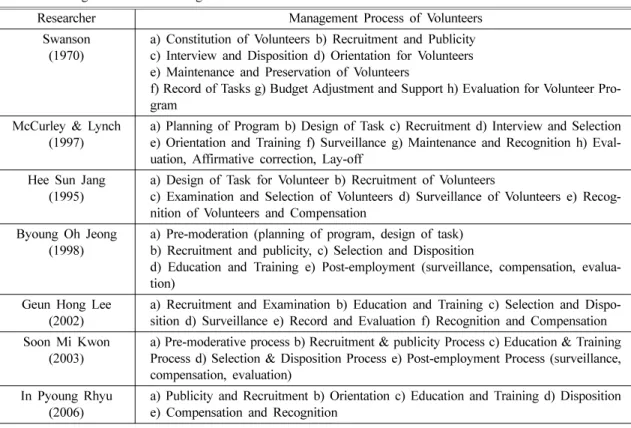
Debates on a management process of volunteers are various. Several representative views on them are like Table 1.
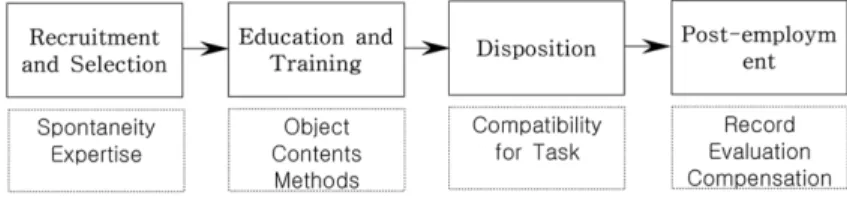
This research, as considering expertise of a disaster management and an abnormal condition of disaster field, an education and training should be implemented prior to disposition into fields, divides the process into a) recruitment and selection b) education and training c) disposition and d) post-employment.
2.1 Recruitment and Selection
A recruitment means an activity which a responsible institution picks out volunteers as a countermeasure resource for disaster management. Generally, a
Table 1. Existing Studies about Management Process of Volunteers1-5)
Researcher Management Process of Volunteers
Swanson
(1970) a) Constitution of Volunteers b) Recruitment and Publicity c) Interview and Disposition d) Orientation for Volunteers e) Maintenance and Preservation of Volunteers
f) Record of Tasks g) Budget Adjustment and Support h) Evaluation for Volunteer Pro- McCurley & Lynch gram
(1997) a) Planning of Program b) Design of Task c) Recruitment d) Interview and Selection e) Orientation and Training f) Surveillance g) Maintenance and Recognition h) Eval- uation, Affirmative correction, Lay-off
Hee Sun Jang
(1995) a) Design of Task for Volunteer b) Recruitment of Volunteers
c) Examination and Selection of Volunteers d) Surveillance of Volunteers e) Recog- nition of Volunteers and Compensation
Byoung Oh Jeong
(1998) a) Pre-moderation (planning of program, design of task) b) Recruitment and publicity, c) Selection and Disposition
d) Education and Training e) Post-employment (surveillance, compensation, evalua- tion)
Geun Hong Lee
(2002) a) Recruitment and Examination b) Education and Training c) Selection and Dispo- sition d) Surveillance e) Record and Evaluation f) Recognition and Compensation Soon Mi Kwon
(2003) a) Pre-moderative process b) Recruitment & publicity Process c) Education & Training Process d) Selection & Disposition Process e) Post-employment Process (surveillance, compensation, evaluation)
In Pyoung Rhyu
(2006) a) Publicity and Recruitment b) Orientation c) Education and Training d) Disposition
e) Compensation and Recognition
recruitment of a certain organization is a series of activities to induce people to hold an ability and an attitude to help achieve an aim of it and this is influenced from various environmental factors including a position of institution, a kind of task, a current employment and a condition of labor market. A recruiting method of volunteer may be divided into a self-recruitment which one owns strong motive by himself and takes part in volunteer, a non-public recruitment through existing volunteers or staffs of institution and common recruitment through a public advertisement within a local community.
This study, focused on spontaneity of volunteer, divides into a self-recruitment and a recruitment by institution and divides non-public recruitment and common recruitment into recruitment by institution.
A selection has a more value-oriented meaning different from a general concept of the recruitment. It sets a regular standard for ability and has a property to include judgment whether to satisfy it.
In this study, it is used as a division standard to select the object to complete an education for an ability related to the disaster management or possess a qualification.
2.2 Education and Training
Volunteers reinforce a motive to volunteer through an education, help understand a meaning to volunteer and get ready to be suitable for tasks to carry out volunteer technologically or psychologically.
An education for volunteers includes a basic education to consist of general summary for volunteer and orientation for a policy and a job training to acquire professional knowledge and technology necessary to engage in the disaster management.
The factors necessary for education and training include main agents for educational training, contents for it and methods for it and as this is an important factor to determine efficiency of an education training, it is utilized as an analyzing standard for a process of education and training.
2.3 Disposition
A disposition means a process to correspond to or connect to a personal feature and task. If an assignment of task appropriate for volunteers to possess a specific technology or a talent or own much potential cannot be made, to display their abilities is hard, an achievement is lack and it is difficult to increase continuity and positiveness of it.
2.4 Post-employment
A post-employment includes tasks like record, evaluation and compensation for the volunteer’s activities and tasks to keep a contact with volunteers.
To activate volunteer, while it is important to make even more residents participate there, it is also necessary to endeavor to make residents who join there continuously participate in. If a post-employment is not properly implemented, in a view of volunteer, a volunteer can be finished merely as a daily event and a maintenance of volunteer only depends on the spontaneity of them.
3. Analysis of State of Managing Volunteers for Disaster Management Domestic
and Abroad
3.1 Analysis Method
Like Figure 1, by means of the management process model of volunteers, through analyzing factors by each process and clarifying a difference with an ideal management process, I would deduce current problems to manage volunteers for the disaster management.
3.2 Analysis of State of Managing Volunteers As, that an object and range of this study is restricted to volunteers for disaster management and particularly, through media, regulated to volunteer organizations which their activities are vigorous not only has a purpose for convenience of study but also is to consider that domestic management system for volunteers is constructed with centered around volunteer organizations
Figure 1. Management process for volunteers and factors for division.
and it is difficult for direct approach to an individual volunteer, if considering a limit to use an internet easy to access even in a situation not to make a direct investigation like question or interview, an object for analysis is forced to be restricted only within a few volunteer organizations.
According to a status of registration of non-profit civil organizations, a status of volunteer centers and a national basic plan to promote the volunteer activities in the Ministry of Public Administration and Security, it
assumed that by 2008, about 40,000 volunteer organizations are active now in domestic.
Among these volunteer organizations, we can divide main organizations by their functions like Table 2.
In the Table 2, the Korea Disaster Safety Network among volunteer organizations for the disaster manage- ment is the one which every volunteer organizations and relevant government institutes widely construct a network, shows a management property rather than does an independent activity, and so it is excluded from
Table 2. Main Organization Related to Volunteer
Division Main Organizations
Conference Organization
Korea Council of Volunteering, Korea Federation of Volunteer Center, Korea National Council on Social Welfare, Korean University Council for Social Service, National council on Youth Service Center
Regional
Organization Citizens' federation of society for neighbors, Gyeonggi Volunteer Center Council Policy
Research Korea academy of volunteer, Korea Forum of Volunteerism, Korea volunteer development institute, etc
Education &
Training Volunteer 21, Federation of Volunteer Efforts in Korea(Busan), etc Social
Welfare World Vision, Korea welfare corporation, Good Neighbors, etc Disaster
Management Korean Disaster Safety Network, The Republic Of Korea National Red Cross, Volunteer Fire Brigade, Citizens’ Coalition for Safety, etc.
Overseas
Service Korea NGO Council for Overseas Cooperation, Korean Pioneers in Overseas, Service for Peace, etc.
National
Movement Saemaul Undong Center, Korea Freedom League, The Society for A Better Tomorrow, etc.
Manager
Organization Korea Association of Volunteer Management, Korea Association of Volunteer Manager, etc.
Company Samsung, SKT, LG Electronics, etc.
Table 3. Volunteer for Disaster Management of the Republic of Korea National Red Cross
Stage Prevention Preparation Countermeasure Recovery
Activity
Campaign for waterside excursion accident, Operation of cyber-lec- ture for disaster relief, Seminar related to disaster
Diffusion of first aid, Diffusion of Cardiopul- monary Resuscitation, Education of psycholog- ical support
Saving Disaster relief materials, Check-up relief equipment, Opera- tion of disaster network
Emergency relief activ- ity, Operation of coun- termeasure headquarter, Operation of briefing room, Operation of disaster network, Opera- tion of emergency com- munication,
Investigation of damage, Support of relief goods, volunteer of meal, Pub- licity to People
Operation red cross vol-
unteer center, Volunteer
of washing and meal,
Free diagnosis, Arrange-
ment of household
belongings, Recovery
for damage of agricul-
tural and stockbreeding
products, Treatment of
waste, Collection & dif-
fusion of contribution
money and articles
the object for analysis of this study.
3.2.1 The Republic of Korea National Red Cross Main activity contents by each stage of the disaster management of the Republic of Korea National Red Cross are like Table 3.
(1) Recruitment and Selection
For a recruitment of volunteers, as, through homepage, an individual can apply, it satisfies a spontaneity, an important factor for a recruitment of volunteers.
An applicant to possess a special ability discloses his/
her ability and as volunteer organizations get ready for selecting him/her by his/her ability, it looks like securing an expertise in selection. However, without confirming a quality ownership or a process confirming completion of requisite education, it may be a little insufficient to be able to keep effective expertise.
(2) Education and Training
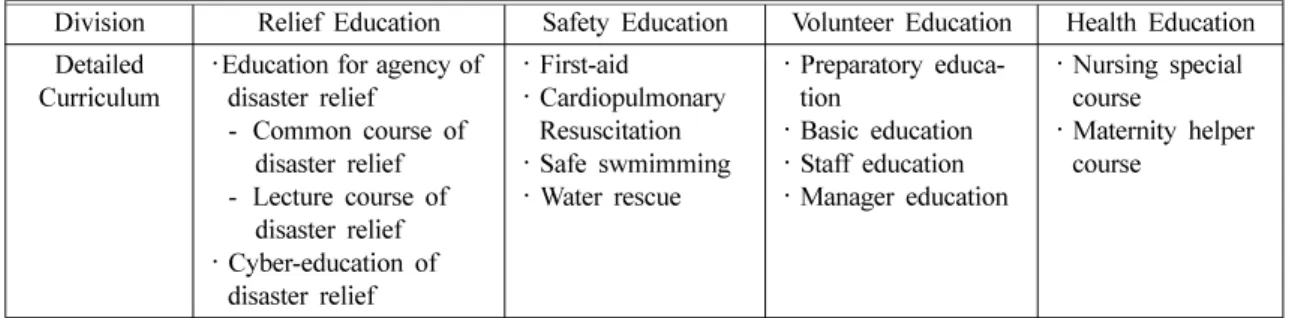
A process of education is divided into a relief education, a safety education, a volunteer education, and a health education, the registered members are given an opportunity to apply and by using each branch and an educational place, an education is progressed on-line or off-line with the education contents proper to each process.
As it is not a structure that an applicant to possess expertise and interest in regular field is presented with comprehensive and systematic educational training process and endowed a motive, it is entrusted with autonomous selection, it has a limit to be made of a structure which discordance between a basic ability to require on volunteer activity and a scope for completing education is only to happen.
(3) Disposition
In the Republic of Korea National Red Cross, a disposition of volunteer is implemented simultaneously with recruitment and selection. That is, when a branch
office to need volunteers recruits them, an individual can apply it considering his/her property, his/her special skill discloses and he or she can be selected and disposed in a way that an organization to need it selects him/her.
In this case, a selection to consider an applicant’s special skill or ability can be implemented, and a compatibility for tasks is high and a continuity and spontaneity of volunteer can be maintained, but because an applicant’s or organization’s information is limit, it is necessary to endeavor to optimize a range and an amount of this information.
(4) Post-employment
As record, evaluation and its compensation for volunteer activities of volunteers ought be properly controlled, it will be a motive power to continuously endow a motive for the volunteer activity. In the Republic of Korea National Red Cross, the time for the normal volunteer activity to be made through this institute is recorded and when over 10,000hours, it prepares for compensation system like registration in the ‘Fame Hall.’
However, an evaluation structure for quality of an activity of volunteer does not show. The concern that a negative image which an evaluation gives works as an influence to lower a spontaneity of volunteers might be a dominant reason.
3.2.2 Volunteer Fire Brigade
The Volunteer Fire Brigade is an volunteer institute for the disaster management base on the Framework Act on Fire Service and the Fire Stations distributed across the nation constitutes and manage them. Main volunteer activities of them are like Table 5.
(1) Recruitment and Selection
A recruitment for applicants of the Volunteer Fire Brigade (VFB) is a main axis of the Fire Station and displays an involuntariness like public relationship and
Table 4. Education Training Program of the Republic of Korea National Red Cross
Division Relief Education Safety Education Volunteer Education Health Education Detailed
Curriculum
·Education for agency of disaster relief
· - Common course of disaster relief
· - Lecture course of disaster relief
·
Cyber-education of disaster relief
·
First-aid
·
Cardiopulmonary Resuscitation
·
Safe swmimming
·
Water rescue
·
Preparatory educa-
·
tion Basic education
·
Staff education
·
Manager education
·
Nursing special course
·
Maternity helper
course
persuasion to use acquaintances. Due to this involuntariness, it is investigated that a result like lack of volunteer mind and lack of morale improvement is brought out.
Lack of spontaneity is directly connected to lack of applicants, and it is really to select an object to possess an expertise related to the disaster management.
(2) Education and Training
For an education & training for VFB, the Fire Station, as a subject, delivers knowledge and technology related to the disaster management or implements a literacy education like a financial technology, but as a front-line administrative institute has a limit to systematically deliver knowledge and technology related to disaster and there are intrinsic problems of objects
who is lack of eagerness to participate, its effect is doubtful.
(3) Disposition
The structure of VFB is divided into a general affairs department, a prevention department and a technical support department, and a division of affairs of each department is like Table 6.
A lack of applicants makes not only a problem to select objects to possess various functions but also a problem to allot proper task difficult and the current state is that a trend to emphasize career and age rather than expertise of task due to rigidity of a volunteer organization modeled from the Fire Station structure is prevalent.
Sun Jae Lee (2005) pointed out that an operation of
Table 5. Volunteer for Disaster Management of Volunteer Fire Brigade11)
Stage Prevention Preparation Countermeasure Recovery
Activity Campaign for water- side excursion, Public- ity for fire prevention like campaign for pre- caution of forest fire
Education & Train- ing, watchout for fire, patrol for arson
Suppression of fire,
life-saving and rescue Volunteer for washing and meal, arrangement of household belong- ings, Recovery for damage of agricultural and and stockbreeding products, Treatment of waste, Col- lection & diffusion of contribution money and articles
Table 6. Division of Affairs of VFB
Department Division of Affairs
General Affairs
Department
·Affairs regarding planning
·
Affairs regarding personnel, contact and call of members Prevention
Department
·
Affairs regarding guard and suppression of fire
·
Affairs regarding maintenance of facility for fire-water
·
Affairs regarding evacuation of residents and relief
·
Affairs regarding fire prevention and PR
·
Affairs regarding training of members
Technical Support Department
Medical
Team
·Affairs regarding treatment of emergency, emergent relief and its support Rescue
Team
·Life-saving in the field of accidents and incidents and support for its activity
·
Affairs regarding support of structural technology and PR Construction
Team
·
Safety measures and support for its relating activity in occurring an accident from collapse of building or structure.
·
Safety checkup for building or structure and support for technology of safety checkup
Chemical Team
·
Support for its treatment technology in occurring an accident related to chemicals from hazardous chemicals, etc.
·
Affairs regarding prevention of accident related to chemical Electricity &
Gas Team
·Prevention of electrical and gaseous accident and safety measures and support for
its relating activity in occurring an relating accident.
structure of VFB was very rigid, the expertise of members is scarce and they were aged.
(4) Post-employment
The activity results like the number of participating in the education and training and moving out for each member are recorded, but as a system to evaluate a quality of activity does not exist and even a com- pensation is operated as a method to pay allowances whether to participate or not, it really cannot be a factor to endow the members with a motive.
3.2.3 Citizens’ Coalition for Safety
This volunteer institute is a corporation aggregate established with a purpose that it progresses a campaign for the safety life, inspires a safety mind into whole people and settle a safety culture, endeavors to improve an institute and customs about safety, minimizes the damages of life by getting experienced to the safety, a respect for life can hold a position as the highest value in our society and owns about 20,000 members.
(1) Recruitment and Selection
Recruitment for volunteers uses a method by visit through local office and is a method which spontaneous participation of an applicant is guaranteed.
As expertise of an applicant depends on information of application to fill by visit, its verification system is insufficient.
(2) Education and Training
They don’t have comprehensive education and training program for volunteer for the disaster management but have an education program to train professional mother lecture for safety to tour-train in the kindergartens and the elementary schools of each area among honorary teachers for a transportation safety of parents of students raised by each region limited to the transportation safety.
As, for an education and training, educational contents by lecture staff itself is limited to the
transportation safety and they have more or less insufficient side to learn general knowledge and technology necessary for volunteer for the disaster management.
(3) Disposition
As the Citizens’ Coalition for Safety has narrow range of volunteer for the disaster management and focuses on the children’s transportation safety, it seems that it is more or less difficult for them to secure a consistency in expertise and ability of the applicants for volunteer.
(4) Post-employment
A trace of record for volunteer of honorary teachers for transportation safety to complete a regular training education is revealed, but there is no discussion about the quality of activity level and the contents for compensation do not exist.
3.3 Analysis for Management State of Foreign Vol- unteers
By analyzing, by means of the same analyzing instrument, a management system of volunteer organiza- tions in the U.S. and the United Kingdom with high cultural maturity to volunteer comparatively, I would recognize problems for domestic conditions and set an improvement direction for them.
3.3.1 The United Kingdom (do-it.org.uk)
The British volunteer institute, an object for analysis, is “do-it.org.uk”, a brand of the YouthNet, the British non-profit charity institution, made a new start from 2001 and has built database for volunteers within the U.K. (1) Recruitment and Selection
Recruitment for volunteers is implemented voluntarily through a local center and a homepage, and it is constituted to select an application field of an applicant and to freely write his/her own special skill and ability.
In spite of not all fields, there are some fields to
Table 7. Volunteer for Disaster Management of the Citizens' Coalition for Safety11)