1
서 론
1. 연구의 필요성
마사지란 중국에서 ‘밀고 당기다’, ‘압박을 가하고 문지르다’라는 의미를 가진 ‘tui-na’ 혹은 ‘an-mo’라는 용어로 처음 사용되었다[1]. 이 는 피부의 마찰을 이용하여 피부저항을 증가시키고, 원하는 부위 에 적절한 압력과 신장을 가하는 것을 통하여 인체순환에 영향을 준다[2]. 마사지는 보완대체요법 중에서 가장 효과적이고 널리 사용 되는 방법이며[3], 오랫동안 인간의 질환을 치료하기 위한 수단으로 사용되어왔다[1]. 또한 마사지를 통하여 인간의 신체적·심리적 증 상이 조절되고 건강이 증진되기 때문에 임상에서 다양한 방면으로
활용가능하다[4].
마사지 중재는 인간의 신체적 상태인 변비, 식욕부진, 소양증, 림 프부종 등에 긍정적인 영향을 미치며, 심리적 상태인 불안, 우울, 피 로 및 스트레스와 생리적 상태인 활력징후, 혈중지질, 호르몬 및 말 초순환에 미치는 효과들도 기대할 수 있다[4-6]. 또한 아동에게 제공 되는 마사지 중재는 통증 감소[3], 성장[7], 주의력결핍과다활동장애 [8], 불안[9], 우울, 면역상태[10] 등에 효과적이라고 보고되고 있다[11].
아동은 연령대별로 고유한 특성이 존재하며, 아동의 발달은 성 장을 통하여 점진적으로 증가하며, 개인의 능력이 변화하고 확장되 는 과정이다[12]. 이들의 건강은 다음 세대 국민의 건강과 직결되고, 한 사회 인구집단의 건강잠재력과 재생산에 직접적인 영향을 미친 http://dx.doi.org/10.14370/jewnr.2016.22.1.1
아동 발달단계에 따른 마사지 중재효과에 대한 국내연구 고찰
이재영1·박소연2
1경성대학교 간호학과 조교수, 2동아대학교 간호학과 박사과정생
A Literature Review on Effect of Massage Based on Developmental Stage in Children in Korea
Lee, Jae Young1· Park, So Yeon2
1Assistant Professor, Department of Nursing Science, Kyungsung University, Busan; 2Doctoral Student, Department of Nursing, Dong-A University, Busan, Korea
Purpose: We conducted a literature review for analyzing the effect of massage on children according to their developmental stage in Korea.
Methods: Various academic databases were utilized for a bibliographic search, and the keyword, ‘massage’, was used to identify relevant ref- erences without limits on years to determine the overall research trends. Finally, 38 references cited from 1998 to 2014 were selected in Ko- rea. Results: Only two studies adapted a randomized controlled trial design. With regard to children’s developmental stage, half studies were conducted for neonates. Moreover, the percentage of application of a sensory stimulation protocol in newborn infants was 47.3%.
Eighty four point one percent of studies measured physiological characteristics as outcome variables and the rate of growth was the most common (46.5%) physiological characteristic. On the contrary, only one study (4%) was conducted to evaluate the effect of massage on psy- chological characteristics in school aged and the adolescents. Conclusion: This study provides fundamental data on the development and direction for future studies by analyzing studies on pediatric massage in Korea.
Key Words: Massage, Analysis, Literature review
주요어: 마사지, 분석, 문헌고찰
* 이 논문은 2016학년도 경성대학교 학술연구비지원에 의하여 연구되었음.
* This research was supported by Kyungsung University Research Grants in 2016.
Address reprint requests to: Park, So Yeon
Department of Nursing, Pusan National University Hospital, 179 Gudeok-ro, Seo-gu, Busan 49241, Korea Tel: +82-51-240-7000 Fax: +82-10-2829-9184 E-mail: [email protected]
Received: 1 October 2015 Revised: 30 December 2015 Accepted: 13 January 2016
다[13]. 임상 현장에서 과학적이고 질적인 간호실무를 수행하기 위 해서는 간호중재연구의 효과를 파악하여 뒷받침하는 것이 선행되 어야 한다[14]. 아동의 건강증진을 위한 마사지 중재는 특성과 효과 를 파악하는 것이 필요하며, 이를 위해서는 선행연구를 고찰하는 것이 필수적일 뿐만 아니라 아동의 발달단계별로 분석되어야 한다.
기존의 국내 마사지 중재 분석연구들은 주로 성인[4,11,15]을 중심 으로 시행되거나 손[16]이나 발[17]에 적용된 마사지 중재에 대하여 효과를 파악하였고, 아동대상의 간호중재 분석연구에는 마사지 중 재가 거의 포함되어 있지 않으므로, 아동대상 마사지 중재에 관한 분석은 매우 미비한 상태이다[14]. 국외 연구에서는 코크란 연합 (Cochrane collaboration)에서 미숙아[18]와 영아[19]만을 대상으로 마사지 중재의 효과를 파악하였기에 아동의 발달단계를 고려하여 시행된 마사지 중재의 특성과 효과에 대한 고찰은 부족한 실정이 다. 따라서 본 연구는 국내 학술지에 발표된 아동대상 마사지 중재 연구를 고찰함으로써 아동에게 시행된 마사지 중재의 특성과 발달 단계별 효과를 파악하여 추후 아동을 위한 마사지 중재 프로그램 개발과 적용의 근거자료를 제시하고자 한다.
2. 연구 목적
본 연구는 국내 아동을 대상으로 시행된 마사지 중재를 발달단 계별로 마사지의 특성과 효과를 파악하기 위한 고찰연구이며 구체 적인 목적인 다음과 같다.
1) 아동을 대상으로 마사지 중재가 시행된 논문의 특성을 파악한다.
2) 아동을 대상으로 마사지 중재가 시행된 논문의 효과변수를 파악 한다.
3) 아동을 대상으로 적용된 마사지 중재의 특성을 발달단계별로 파악한다.
4) 아동을 대상으로 적용된 마사지 중재의 효과를 발달단계별로 파악한다.
3. 용어의 정의 1) 아동
아동이란 국제연합의 아동권리협약(United Nations Convention on the Rights of the Child, UNCRC)에서 만 18세 미만의 사람이다[20].
본 연구에서 아동이란 0세부터 18세까지의 소아청소년을 의미한다.
2) 발달단계
발달이란 점진적인 변화와 증가로 낮은 단계의 복잡성에서 고급 단계로 진보되는 것이다[12]. 본 연구에서 아동의 발달단계는 연령 에 따라 신생아기, 영아기, 학령전기, 학령기 및 청소년기로 분류되 는 것을 의미한다.
3) 마사지
마사지는 피부의 마찰을 이용하여 피부저항을 증가시켜서 마사 지하고자 하는 부위에 적절한 압력과 신장을 가해주는 중재이다[2].
본 연구에서 마사지란 분석대상 논문에서 제시된 주요어와 실험처 치에 제시된 프로토콜을 근거로 분류한 마사지 중재를 의미한다.
연구 방법
1. 연구 설계
본 연구는 아동의 발달단계별로 마사지 중재의 특성과 효과를 파악하기 위하여 문헌고찰을 시행한 서술적 조사연구이며, 한국보 건의료연구원(National Evidence-based Healthcare Collaborating Agency [NECA])의 체계적 문헌고찰 매뉴얼[21]을 참고로 하여 수행 하였다.
2. 문헌검색방법 1) 문헌검색
고찰대상 문헌을 검색하여 수집하기 위한 절차는 다음과 같다.
2015년 4월 1일부터 10일까지 10일 동안 아동간호학 박사과정생인 연구자 2인이 주요용어(key word)를 사용하여 자료검색을 시행하였 다. 국내 아동대상 마사지 중재연구의 동향을 파악하고자 연도제 한을 두지 않고 검색을 시행하였으며, 2015년 3월까지 발표된 연구 논문을 조사하였다. 자료검색은 학술검색데이터베이스인 학술연 구정보서비스(RISS), 한국학술정보(KISS), 코리아메드(KoreaMed), 국가과학기술정보센터(NDSL), 한국의학논문데이터베이스(KM- base) 및 누리미디어(DBpia)를 이용하였다. 일반적으로 체계적 고찰 에서는 주요용어로 대상자와 중재를 사용하지만, 연구주제에 따라 서 대상자나 중재 중 한가지만을 주요용어로 이용할 수 있다[21]. 본 연구에서는 국내 아동을 대상으로 한 모든 마사지 중재연구를 누 락없이 찾아내기 위하여 주요용어 ‘마사지(massage)’만을 이용하여 검색을 시행하였다.
2) 선정 및 제외기준
본 연구에서 국내 아동을 대상으로 마사지 중재를 시행한 연구 논문을 고찰하고자 대상문헌을 다음과 같은 기준으로 선정하였다.
첫째, 아동에게 직접 마사지 중재를 적용한 연구를 대상으로 하였 다. 둘째, 전체적인 연구동향을 파악하고자 연도제한을 두지 않았 다. 셋째, 국내 학술지에 출판된 연구를 대상으로 하였다. 넷째, 발달 단계별 특성을 파악하기 위하여 아동의 연령을 확인할 수 있는 연 구를 대상으로 하였다. 다섯째, 한국어로 작성된 연구를 대상으로 하였다.
3) 문헌선택
문헌선택은 다음과 같은 과정으로 수행되었다. 먼저 주요용어로 검색된 3,563편의 자료를 초록과 제목을 검토하여 중복연구와 비중 재연구를 제외하였다. 그 후 159편의 자료의 원문을 확보하여 성인 대상연구와 아동의 발달단계파악이 불가능한 연구를 제외하였다.
그 결과 최종적으로 38편의 논문이 분석대상 연구로 선정되었다 (Figure 1). 문헌선택결과에 대하여 연구자 간 불일치가 있는 경우 토 의과정을 거치거나 제3자의 개입을 통하여 불일치를 해소하여야 하는데, 연구자 간에 불일치가 나타나는 경우는 없었다.
4) 연구자 준비
분석대상 문헌수집 및 자료분석을 위한 연구자 준비는 다음과 같다. 연구자들은 아동간호학 전공의 박사과정생이며, 상급종합병 원에서 아동간호 경력 8년 이상이다. 또한 연구자 중 일인은 영유아 발달지도사 및 유아마사지 강사자격을 보유하고 있다.
3. 문헌분석의 틀
수집된 문헌을 파악하기 위하여 문헌에 기술된 자료를 검토하고 기존의 마사지 분석연구를 참고하여 정형화된 분석틀을 마련하였 다[4,11,15-17]. 분석틀은 대상논문의 특성, 적용된 마사지의 특성, 대 상논문의 결과지표 및 대상논문에서 발달단계별 결과지표의 효과 를 파악하였으며, 분석틀의 구체적인 내용은 다음과 같다. 먼저 대 상논문의 특성에서는 게재연도, 연구설계, 게재 학술지 학문분야 및 발달단계를 파악하였다. 적용된 마사지의 특성에서는 종류, 적 용부위, 시술자, 총 적용횟수, 적용빈도, 적용기간 및 회당 적용시간 을 파악하였다. 대상논문의 결과지표에서는 생리적 특성, 심리적 특성 및 기타 특성을 파악하였으며, 선행연구를 참고로 하여 두 편 이상의 연구에서 측정된 결과지표를 분석에 이용하였다[4,17]. 발달 단계별 결과지표의 효과에서는 발달단계에 따른 결과지표의 효과
를 효과, 부분효과 및 비효과로 구분하여 조사하였다. 대상논문에 서 효과란 효과변수에 대한 유의확률이 .05 이하인 경우이며, 부분 효과란 효과변수에서 측정시점 혹은 하위변인에서 일부의 유의확 률이 .05 이하인 경우이다. 아동의 발달단계는 신생아기 생후 4주 미 만, 영아기 생후 4주부터 1세까지, 유아기 1세부터 3세까지, 학령전 기 3세부터 6세까지, 학령기 6세부터 12세까지, 청소년기 12세부터 18세까지로 구분하였다[12].
4. 자료분석방법
분석대상으로 선정된 38편의 연구에서 추출한 자료는 논문특성, 효과변수, 발달단계별 마사지 중재의 특성 및 효과를 확인하기 위 하여 정형화된 분석틀을 이용하여 엑셀에 코딩하였다. 수집된 자료 는 SPSS 21.0 for Windows Program을 이용하여 빈도와 백분율을 산 출하였다.
연구결과
1. 대상논문의 특성
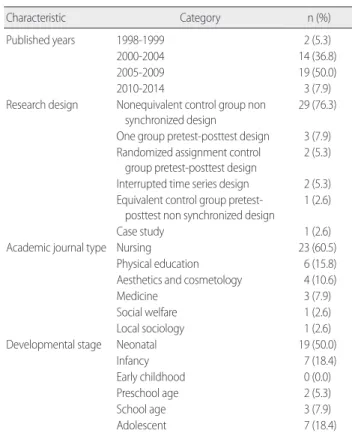
분석한 논문은 총 38편으로 대상 논문의 특성은 Table 1과 같으 며, Appendix로 첨부하였다. 대상 논문의 게재연도는 1998년부터 1999년까지 5.3%, 2000년부터 2004년까지 36.8%, 2005년부터 2009년
Records identified through database searching (n= 3,563)
Full-text articles assessed for eligibility (n= 159)
Articles included in the study (n= 38)
Records excluded (n= 3,404)
Full-text articles excluded, with reasons (n= 121)
Figure 1. Search strategy for identifying articles for literature review.
Table 1. Characteristics of Studies (N= 38)
Characteristic Category n (%)
Published years 1998-1999 2 (5.3)
2000-2004 14 (36.8)
2005-2009 19 (50.0)
2010-2014 3 (7.9)
Research design Nonequivalent control group non synchronized design
29 (76.3) One group pretest-posttest design 3 (7.9) Randomized assignment control
group pretest-posttest design
2 (5.3) Interrupted time series design 2 (5.3) Equivalent control group pretest-
posttest non synchronized design
1 (2.6)
Case study 1 (2.6)
Academic journal type Nursing 23 (60.5)
Physical education 6 (15.8)
Aesthetics and cosmetology 4 (10.6)
Medicine 3 (7.9)
Social welfare 1 (2.6)
Local sociology 1 (2.6)
Developmental stage Neonatal 19 (50.0)
Infancy 7 (18.4)
Early childhood 0 (0.0)
Preschool age 2 (5.3)
School age 3 (7.9)
Adolescent 7 (18.4)
까지 50.0%, 2010년부터 2014년까지 7.9%였다. 연구설계는 비동등성 대조군 전후 설계가 76.3%로 가장 많았으며, 무작위 대조군 연구는 5.3%였다. 게재 학술지 학문분야는 간호학 60.5%, 체육학 15.8%, 미 용학 10.6%, 의학 7.9%였고, 사회복지학 및 지역사회학이 각각 2.6%
였다. 마사지를 적용받은 아동을 발달단계별로 구분하면 신생아기 50.0%, 영아기 18.4%, 학령전기 5.3%, 학령기 7.9%, 청소년기 18.4%였으 며, 유아기는 한편도 없었다.
2. 마사지 중재의 효과변수 분석
마사지 중재의 효과변수를 분석한 결과는 Table 2와 같다. 전체 효과변수에서 생리적 특성 84.1%, 심리적 특성 4.0%, 기타 특성 11.9%였다. 각각의 특성별로 효과변수를 파악해보면, 생리적 특성 에서 85건의 효과변수가 측정되었으며 활력징후 11건, 성장 47건, 호 르몬 15건, 당 1건, 혈중지질 4건, 체성분 4건, 뇌기능 3건이 측정되었 으며, 성장 중에서 체중이 22건으로 가장 많이 사용된 효과변수였 다. 심리적 특성에서는 스트레스와 월경전증후군이 각각 2건이고,
기타 특성에서는 행동상태 10건, 식습관 2건이었다.
3. 발달단계에 따라 제공된 마사지 중재의 특성
발달단계에 따라 제공된 마사지 중재의 특성은 Table 3과 같다.
신생아기는 감각자극프로토콜이 18건으로 가장 많았고, 적용부위 는 모두 전신이었다. 연구자가 마사지 중재를 직접 제공한 경우가 13 건, 마사지 회당 적용시간은 모두 15분 이하였다. 영아기는 감각자 극프로토콜(3건)과 경락마사지(4건)가 시행되었고, 마사지 적용부 위는 모두 전신이었다. 마사지 시행자는 어머니가 6건으로 가장 많 았으며, 마사지 회당 적용시간은 모두 15분 이하였다.
학령전기는 일반마사지와 경락마사지가 각각 1건이었고, 적용부 위는 모두 전신이었다. 학령기는 일반마사지 2건, 경락마사지 1건이 었고, 적용부위는 전신 2건, 손 1건이었다. 청소년기는 일반마사지(3 건), 스포츠마사지(2건), 반사요법(1건) 및 아로마마사지(1건)가 있었 고, 적용부위는 전신(2건), 손/발(3건), 복부(1건), 다리(1건)였다. 마사 지 제공자는 연구자가 시행한 경우 6건, 아동이 직접 시행한 경우 1 건이었다.
4. 발달단계에 따른 마사지 중재의 효과
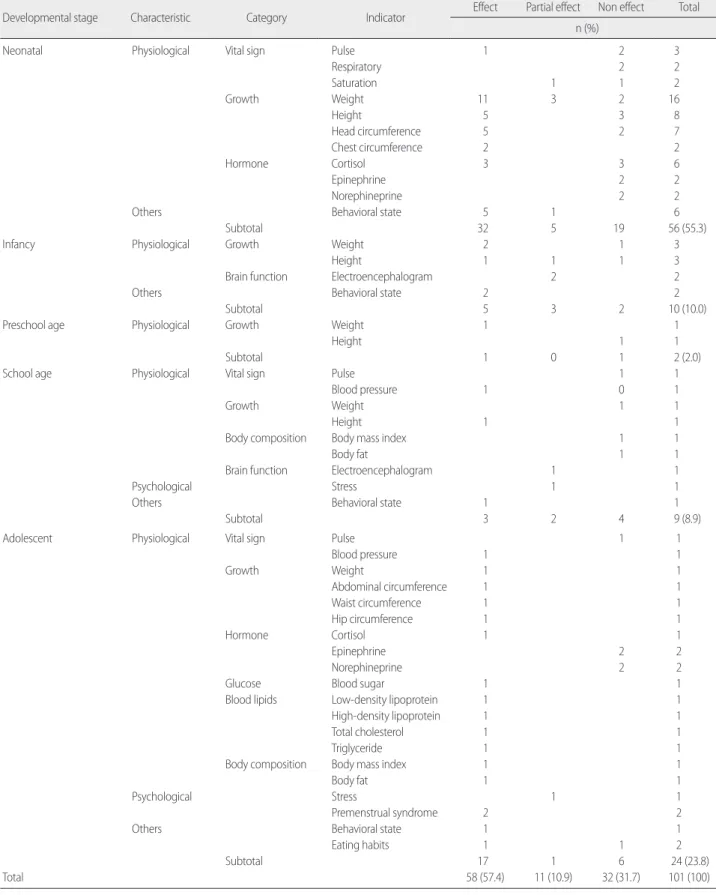
발달단계별 마사지의 효과는 Table 4와 같다. 전체 결과지표를 발 달단계별로 살펴보면, 신생아기 55.3%, 영아기 10.0%, 학령전기 2.0%, 학령기 8.9% 및 청소년기 23.8%였다. 또한 전체 결과지표 101건(100%) 중 효과가 있는 경우 58건(57.4%), 부분효과인 경우 11건(10.9%)이었 으며, 비효과인 경우는 32건(31.7%)이었다.
신생아기는 56건 중 효과 32건, 부분효과 5건, 비효과 19건이었다.
영아기는 10건 중 효과 5건, 부분효과 3건, 비효과 2건이었다. 학령전 기는 2건 중 효과 1건, 비효과 1건이고, 학령기는 9건 중 효과 3건, 부 분효과 2건, 비효과 4건이었다. 청소년기는 24건 중 효과 17건, 부분 효과 1건, 비효과 6건이었다.
논 의
마사지는 보완대체요법 중에서 널리 사용되고 있는 중재이며, 다 양한 임상현장에서 경험적으로 적용되고 있다. 마사지의 증상조절 과 치유에 대한 효과를 파악하기 위해서는 선행연구에 대한 고찰 이 필수적이다. 그러나 기존의 마사지 중재를 분석한 연구들은 대 부분 성인을 대상으로 하고 있으며, 아동에게 적용한 마사지의 특 성과 효과를 분석한 논문은 찾아보기 어렵다. 아동은 성인과 달리 성장과 발달이라는 특수한 과정에 놓여있으며 연령대별 특성이 뚜 렷하기 때문에 아동을 대상으로 마사지 중재를 고찰하는 것이 필 요하다. 본 연구는 국내 학술지에 발표된 아동대상 마사지 논문을 Table 2. Variables to Measure the Effect of Massage Intervention
(N= 38)
Characteristic Category Indicator n (%)
Physiological Vital sign Pulse 5 (4.9)
Blood pressure 2 (2.0)
Respiratory 2 (2.0)
Saturation 2 (2.0)
Growth Weight 22 (21.8)
Height 13 (12.8)
Head circumference 7 (6.9) Chest circumference 2 (2.0) Abdominal circumference 1 (1.0) Waist circumference 1 (1.0) Hip circumference 1 (1.0)
Hormone Cortisol 7 (6.9)
Epinephrine 4 (3.9)
Norephineprine 4 (3.9)
Glucose Blood sugar 1 (1.0)
Blood lipids Low-density lipoprotein 1 (1.0) High-density lipoprotein 1 (1.0) Total cholesterol 1 (1.0)
Triglyceride 1 (1.0)
Body composition Body mass index 2 (2.0)
Body fat 2 (2.0)
Brain function Electroencephalogram 3 (3.0)
Subtotal 85 (84.1)
Psychological Stress 2 (2.0)
Premenstrual syndrome 2 (2.0)
Subtotal 4 (4.0)
Other Behavioral state 10 (9.9)
Eating habits 2 (2.0)
Subtotal 12 (11.9)
Total 101 (100.0)
수집하여 정형화된 분석틀로 분석하였다. 이를 통하여 추후 아동 을 위한 마사지 중재 프로그램의 개발과 적용의 근거자료를 제공하 고, 궁극적으로 아동과 가족의 건강증진에 기여하고자 한다.
마사지에 대한 연구는 1980년대까지 주로 국외를 중심으로 이루 어지다가 1990년대 중반 이후부터는 국내에서 연구가 시작되었다.
2000년 이후부터는 마사지 중재연구들을 분석하여 중재의 효과를 취합하여 보고되고 있다[15]. 그러나 기존의 국내 마사지 분석연구 들은 성인만을 주요 대상으로 파악하였거나[15-17], 아동을 포함한 연구에서도 전체분석 논문에서 아동대상 마사지 중재연구는 2-5편 에 불과하였다[4,11,14]. 국외연구에서도 아동대상 마사지 중재는 메 타분석을 위하여 미숙아와 영아만을 대상으로 하였기에 14-36편의 연구만이 분석에 포함되었다[18,19]. 그러나 본 연구에서는 다양한 학술검색 데이터베이스를 이용하여 방대한 양의 마사지 연구논문 중 아동만을 대상으로 시행된 마사지 중재 연구 38편을 선정하였다.
이를 통하여 국내 아동대상 마사지 중재를 포괄적으로 파악하였다.
본 연구에서 분석한 마사지 중재의 연구설계를 살펴보면, 무작위 대조군 연구(randomized controlled trial)는 단 2편이었으며, 유사실 험연구가 36편이었다. 기존의 마사지 연구논문 분석에서도 무작위
대조군 연구는 한편도 없거나[4,17], 연구설계를 표기하지 않은 분 석연구도 있었다[11,15,16]. 그러나 최근에는 근거중심 임상실무를 위하여 가장 높은 수준의 근거를 제공하는 무작위 대조군 연구의 수행이 증가하고 있으며, 특히 국내 및 국외 성인대상 연구분야에 서 무작위 대조군 연구가 늘어나고 있다[14]. 향후 연구에서는 아동 대상 마사지 중재에서도 무작위 대조군 연구를 시행하여 연구결과 의 객관성과 질적수준의 보장을 고려하는 것이 바람직할 것이다.
코크란 연합의 체계적 고찰은 마사지 중재가 미숙아의 성장발달 [18]과 정상영아의 신체적·정신적 건강[19]에 미치는 영향을 보고하 였다. Vickers 등[18]은 마사지 중재가 미숙아의 성장발달에 미치는 영향을 파악하였다. 그 결과 마사지 중재를 제공받은 미숙아는 매 일 5.1 g의 체중이 증가하였으며, 재원일수는 4.5일 감소하였다. 또한 아동이 생후 4-6개월이 되었을 때 출생 후 합병증 발생이 감소하며, 체중이 증가된 것으로 나타났다. Bennett 등[19]은 6개월 미만의 정 상영아에게 시행된 마사지 중재의 효과를 분석하였다. 마사지 중재 를 제공받은 영아는 신체적인 측면에서 체중, 신장, 머리둘레 및 다 리둘레가 증가하였으며, 설사횟수와 울음시간이 줄어들었다. 생리 적인 측면에서는 수면시간이 증가하고, 혈중 빌리루빈 농도가 감소 Table 3. Characteristics of Massage according to Developmental Stages (N= 38)
Characteristic Category Developmental stage
Total Neonatal Infancy Preschool age School age Adolescent
Type of massage Sensory stimulation protocol 18 3 21
Meridian massage 1 4 1 1 7
Simple massage 1 2 3 6
Sport massage 2 2
Reflexology 1 1
Aromatherapy massage 1 1
Region Whole body 19 7 2 2 2 32
Hand 1 1 2
Foot 1 1
Hand and foot 1 1
Abdomen 1 1
Leg 1 1
Massage provider Researcher 11 1 2 6 20
Mother 5 4 1 10
Researcher and mother 2 2 1 5
Childcare teacher 1 1
Participants 1 1
Omission 1 1
Duration time per session (min) ≤ 15 19 7 1 1 1 29
16-30 1 1 3 5
31-60 1 3 4
Total number of times 1-10 8 4 1 1 5 19
11-20 7 1 1 1 10
≥ 21 2 2 1 5
Omission 1 1
Multiple 1 2 3
Total 19 7 2 3 7 38
Table 4. Effectiveness of Massage Intervention by Developmental Stage (N= 38)
Developmental stage Characteristic Category Indicator Effect Partial effect Non effect Total
n (%)
Neonatal Physiological Vital sign Pulse 1 2 3
Respiratory 2 2
Saturation 1 1 2
Growth Weight 11 3 2 16
Height 5 3 8
Head circumference 5 2 7
Chest circumference 2 2
Hormone Cortisol 3 3 6
Epinephrine 2 2
Norephineprine 2 2
Others Behavioral state 5 1 6
Subtotal 32 5 19 56 (55.3)
Infancy Physiological Growth Weight 2 1 3
Height 1 1 1 3
Brain function Electroencephalogram 2 2
Others Behavioral state 2 2
Subtotal 5 3 2 10 (10.0)
Preschool age Physiological Growth Weight 1 1
Height 1 1
Subtotal 1 0 1 2 (2.0)
School age Physiological Vital sign Pulse 1 1
Blood pressure 1 0 1
Growth Weight 1 1
Height 1 1
Body composition Body mass index 1 1
Body fat 1 1
Brain function Electroencephalogram 1 1
Psychological Stress 1 1
Others Behavioral state 1 1
Subtotal 3 2 4 9 (8.9)
Adolescent Physiological Vital sign Pulse 1 1
Blood pressure 1 1
Growth Weight 1 1
Abdominal circumference 1 1
Waist circumference 1 1
Hip circumference 1 1
Hormone Cortisol 1 1
Epinephrine 2 2
Norephineprine 2 2
Glucose Blood sugar 1 1
Blood lipids Low-density lipoprotein 1 1
High-density lipoprotein 1 1
Total cholesterol 1 1
Triglyceride 1 1
Body composition Body mass index 1 1
Body fat 1 1
Psychological Stress 1 1
Premenstrual syndrome 2 2
Others Behavioral state 1 1
Eating habits 1 1 2
Subtotal 17 1 6 24 (23.8)
Total 58 (57.4) 11 (10.9) 32 (31.7) 101 (100)
하였다. 또한 발달적인 측면에서는 전체 운동발달 및 소근육 운동 발달뿐만 아니라, 애착관계, 사회적 행동 및 정신 운동성에도 효과 적이었다.
본 연구에서 아동 발달단계별 마사지 중재 연구를 살펴보았을 때, 가장 활발하게 연구가 시행된 발달단계는 신생아기로 전체 연 구논문의 50.0%를 차지하였다. 그러나 이와 대조적으로 유아기를 대상으로 시행된 논문은 한편도 없었으며, 그 외의 발달단계를 대 상으로 한 연구 또한 2-7편에 불과하였다. 마사지 중재는 다양한 연 령대와 임상상황에서 적용가능하며, 객관적 지표로 그 효과를 확 인할 수 있었다. 생리적 영역인 순환기계, 피부계, 면역계, 호흡기계 및 성장발달에 대한 효능뿐만 아니라, 주관적 반응인 심리적 효과 로 불안, 통증, 이완 및 수면에도 유용한 보완대체요법이다[2,5,13, 22]. 국외에서는 아동에게 시행된 마사지 중재가 주로 통증경감에 많이 시행되었으며[3], 미숙아 성장[7], 주의력결핍과다활동장애[8], 우울, 면역[10] 등에 미치는 효과들이 보고되고 있다. 앞으로 아동대 상 마사지 중재는 이들에게 적합한 결과지표를 측정하여 마사지의 효과를 다각도로 파악하는 것이 필요할 것으로 사료된다.
발달단계에 따라 아동에게 제공된 마사지 중재의 특성을 살펴보 면, 신생아기와 영아기에는 15분 이하로 전신에 적용되는 마사지가 가장 많이 시행되었다. 학령전기와 학령기에는 일반마사지와 경락 마사지가 전신과 손에 적용되었다. 청소년기에는 성인과 유사하게 다양한 적용부위와 요법으로 마사지가 시행되었으며, 마사지 제공 자가 연구자나 어머니가 아닌 참여자 아동인 경우도 있었다. 향후 아동을 대상으로 마사지 중재를 제공할 때 이러한 발달단계별 마사 지의 특성을 고려하여 효율적인 프로그램을 구성하는 것이 유용할 것으로 사료된다.
본 연구에서 분석대상 연구의 결과지표를 살펴보면, 생리적 특성 이 84.1%로 가장 많은 영역을 차지하고 있었으며, 심리적 특성은 4.0% 밖에 조사되지 않았다. 선행연구에서 성인 대상 마사지 중재는 생리적 효과뿐만 아니라 심리적 효과에 대해서도 활발히 검증이 이루어지고 있는 것과 대조적인 결과이다[4,11,15-17]. 이는 아동에 게 자가보고를 통한 심리적 측정이 쉽지 않기 때문으로 사료된다.
그러나 심리적 특성으로 파악할 수 있는 삶의 질과 같은 중요한 지 표들을 고려할 때[17], 추후 연구에서는 다양한 측면에서 마사지의 효과를 제시할 필요가 있다. 이를 위하여 학령전기 미만의 아동들 은 자가보고가 어려우므로 보호자나 연구자가 측정할 수 있는 관 찰도구를 사용하는 것이 유용할 것이며, 학령기와 청소년기 아동 은 대상자가 직접 보고하는 형태로 심리적 특성을 측정하는 것이 마사지 중재의 결과에 대한 다양성을 향상시킬 수 있는 방안이 될 것이다.
발달단계별 결과지표 효과를 살펴보면, 신생아기의 생리적 특성
중 성장과 관련된 영역이 가장 많이 측정되었다. 그리고 성장은 신 생아기뿐만 아니라 영아기, 학령전기, 학령기 및 청소년기에도 다빈 도로 측정된 영역이었다. 성인 대상 마사지 연구논문은 생리적 특 성 중 혈압과 맥박이 가장 많이 측정된 지표인 것과 비교하면 상이 한 결과이다[4,11,15,17].
아동은 성인과 다르게 성장발달의 과정상에 놓여있기 때문에 이 들을 대상으로 시행된 마사지 중재는 주로 성장에 미치는 영향을 파악하였다. 마사지의 기전은 피부마찰을 이용하여 적용하고자 하 는 부위에 적절한 압력과 신장을 가해줌으로써 인체순환에 긍정적 인 영향을 준다[2]. 신생아기와 영아기에 제공되는 마사지 중재는 미 주신경을 활성화시켜 가스트린과 인슐린 분비를 증가시키고, 이러 한 기전을 통하여 호르몬들은 영양흡수를 촉진시켜 체중 증가에 기여하게 된다[23]. 특히 Field 등[3]이 개발한 감각자극프로토콜은 촉각자극과 운동자극으로 구성된 총 15분의 전신마사지 방법이며, 신생아 및 영아의 성장발달 증진에 효과적인 간호중재로 보고되고 있다[3]. Park과 Kim [22]은 신생아에게 감각자극프로토콜을 4주간 적용하였을 때, 실험군이 대조군보다 체중이 증가하였으며, 긍정적 행동변화를 보였다고 보고하였다. Kim [24]은 37주 미만의 미숙아 에게 감각자극프로토콜을 4주간 적용하였을 때, 실험군이 대조군 보다 체중, 신장 및 두위가 증가함을 파악하였다.
본 연구의 제한점은 다음과 같다. 첫째, 아동의 발달단계별로 마 사지 중재의 특성과 효과를 분석하였기에 정상아동이나 환아의 특 성을 구분하여 파악하지 못하였다. 둘째, 아동을 대상으로 시행된 마사지는 다양한 변수들이 활발하게 연구되지는 않았기에, 앞으로 마사지 중재 프로그램이 다각적으로 시도되어야 하며, 이러한 결과 는 메타분석을 이용하여 분석하여야 할 것이다.
결 론
본 연구는 국내에서 시행된 아동대상 마사지 중재연구 38편을 분 석하여 간호중재의 효과를 파악하였다는 점에서 의의가 있다. 특히 마사지 중재는 병원, 가정, 학교 및 보건소와 같은 다양한 실무상황 에서 효율적이고 비용 효과적으로 적용될 수 있는 보완대체요법이 기 때문에 이번 연구를 통하여 그동안 아동에게 적용된 마사지 중 재 연구의 효과를 확인하였다.
국내 아동대상 마사지 중재 연구들은 대부분 유사실험연구였으 며, 주로 신생아기를 대상으로 시행되었다. 결과지표는 생리적 특성 중에서도 성장이 가장 많이 측정되었다. 향후 아동대상 마사지 연 구는 무작위 대조군 연구가 시도되어야 하며, 신생아기뿐만 아니라 다양한 발달단계의 아동에게 적용되어야 할 것이다. 또한 생리적 특성에 대한 측정과 더불어 심리적 특성에 대한 측정도 다각도로
시도되어야 한다. 본 연구를 통하여 아동대상 마사지 중재요법의 연구방향을 제시하였으므로 이를 바탕으로 임상에서는 아동대상 마사지 중재가 활발하게 시행될 수 있기를 기대한다.
REFERENCES
1. Theil P. Massage therapy in classical chinese physical medicine. American Journal of Chinese Medicine. 1975;3(1):83-85. http://dx.doi.org/10.1142/
S0192415X75000104
2. Jun SH. Massage and exercise for baby, its effect on a baby’s brain activity.
Korean Journal of Physical Education. 2002;41(4):165-179.
3. Field T, Diego M, Hernandez-Reif M. Massage therapy research. Develop- mental Review. 2007;27(1):75-89. http://dx.doi.org/10.1016/j.dr.2005.12.
002
4. Roh YS, Kim SS, Kim JI. The analysis of research on massage interventions for patients in Korea. Journal of Korean Clinical Nursing Research. 2009;
15(3):171-182.
5. Kim TI, Nam MJ. Effects of abdominal meridian massage with aroma oils on relief of constipation in institutionalized children with cerebral palsy.
Journal of Korean Academy of Child Health Nursing. 2007;13(1):90-101.
6. Han JE, Moon YI, Park HR. Effect of hand massage on nausea, vomiting and anxiety in childhood with leukemia on chemotherapy. The Korean Journal of Child Health Nursing. 2005;11(4):456-464.
7. Field T, Diego MA, Hernandez-Reif M, Deeds O, Figuereido B. Moderate versus light pressure massage therapy leads to greater weight gain in pre- term infants. Infant Behavior and Development. 2006;29(4):574-578.
http://dx.doi.org/10.1016/j.infbeh.2006.07.011
8. Khilnani S, Field T, Hernandez-Reif M, Schanberg S. Massage therapy im- proves mood and behavior of students with attention-deficit/hyperactivity disorder. Adolescence. 2003;38(152):623-638.
9. Post-White J, Fitzgerald M, Savik K, Hooke MC, Hannahan AB, Sencer SF.
Massage therapy for children with cancer. Journal of Pediatric Oncology Nursing. 2008;26(1):16-28. http://dx.doi:10.1177/1043454208323295 10. Hughes D, Ladas E, Rooney D, Kelly K. Massage therapy as a supportive
care intervention for children with cancer. In Oncology Nursing Forum.
2008;35(3):431-442. http://dx.doi.org/10.1188/08.ONF.431-442
11. Ji ES, Cho KJ. An analysis of research related to the massage as the nursing intervention. Korean Parent-Child Health Journal. 2004;7(2):168-181.
12. Hockenberry MJ, Wilson D. Wong’s essentials of pediatric nursing. 9th ed.
Missouri: Elsevier Health Sciences;2012.
13. Han KJ, Bang KS, Yun SN. The study on the model development and anal- ysis of ‘child growth and developmental clinic’: Focusing on the public health center. Journal of Korean Academy of Community Health Nursing.
2001;12(1):49-59.
14. Bang KS, Kang HJ, Kim MY, Min SJ, Lee SJ, Lee HI, et al. The analysis of re- search trend on pediatric nursing intervention studies in Korea 2000-2011.
Journal of Korean Academic Society Nursing Education. 2013;19(1):24-32.
http://dx.doi:10.5977/jkasne.2013.19.1.24
15. Jung HM. Development of nursing intervention for Korean children I: The research trends on massage. Journal of the Korean Society of Maternal and Child Health. 2002;4(1):55-70.
16. Kim J, Cho YN. Analysis of studies on hand massage published in Korea:
on the effects of sleep, pain, anxiety and depression. The Korean Journal of Rehabilitation Nursing. 2012;15(1):47-53. http://dx.doi:10.7587/kjrehn.
2012.47
17. Kim GD, Suh SR. The analysis of research about foot reflexology in nurs- ing. Journal of Korean Biological Nursing Science. 2008;10(1):33-40.
18. Vickers A, Ohlsson A, Lacy J, Horsley A. Massage for promoting growth and development of preterm and/or low birth weight infants. The Co- chrane Library. 2004. http://dx.doi:10.1002/14651858.CD000390.pub2 19. Bennett C, Underdown A, Barlow J. Massage for promoting mental and
physical health in typically developing infants under the age of six months.
The Cochrane Library. 2013. http://dx.doi:10.1002/14651858.CD005038.
pub3
20. United Nations. The united nations convention on the rights of the child[Internet]. New York: United States; 1989 [cited 2015 October 28].
Available from : https://treaties.un.org/Pages/ViewDetails.aspx?src = TREATY&mtdsg_no= IV-11&chapter= 4&lang= en.
21. Kim SY, Park JE, Seo HJ, Lee YJ, Jang BH, Son HJ, et al. NECA’s guidance for undertaking systematic reviews and meta-analyses for intervention.
Seoul: National Evidence-based Healthcare Collaborating Agency. 2011 August 24.
22. Park IS, Kim DS. The effect of massage therapy on physical growth of the newborn and identity as mothers. Journal of Korean Academy of Child Health Nursing. 2006;12(3):359-367.
23. Kim TI. Effect of massage therapy on growth parameters of instituted in- fants. The Korean Journal of Child Health Nursing. 2002;8(2):204-216.
24. Kim JY. Effects of a massage program on growth of premature infants and on confidence and satisfaction in the mothering role. The Korean Journal of Child Health Nursing. 2005;11(4):381-389.
Appendix: the List of Selected Articles
A1. Bae BJ. Effects of the meridian massage on children’s stress and brain function change. Journal of the Korean Society of Esthetics & Cosmeceu- tics. 2008;3(2):73-86.
A2. Bae JA, Yoon CS. Effects of meridian growth massage on body composi- tion, physiological and psychological variables of school-age children.
Korean Journal of Aesthetic and Cosmetology. 2013;24(3):655-663.
A3. Cheung NY, Song YS. Effects of infant massage on physical growth and stress response in preterm babies. Journal of Korean Academy of Child Health Nursing. 2009;15(1):71-80. http://dx.doi.org/10.4094/jkachn.
2009.15.1.71
A4. Cho KJ, Ji ES, Kim YR. The effects of meridian massage on the behavioral state and weight in infants. The Korean Journal of Child Health Nursing.
2003;9(4):384-391.
A5. Cho KJ, Paik SN. Effects of meridian massage on weight in infants and on mother-infant interaction. The Korean Journal of Child Health Nursing.
2005;11(3):340-347.
A6. Cho KJ, Lee MH, Ji ES. The effects of meridian massage on behavioral state of infants, mothering role satisfaction and mother-infant attachment.
Journal of Korean Academy of Child Health Nursing. 2006;12(4):523- 530.
A7. Cho KJ, Lee MH, Ji, ES. The effects of meridian massage on both growth and sleep in infants and mothering role confidence and sensitivity. Jour-
nal of Korean Academy of Child Health Nursing. 2007;13(3):349-356.
A8. Cho KJ, Lee MH, Ji ES. Effects of group meridian massage on infant growth on parenting stress and parenting self-efficacy in their mothers.
Child Health Nursing Research. 2008;14(3):252-260.
A9. Cho KJ, Lee SN, Lee MH, Ji ES. Effects of group meridian massage on in- fants growth and on mother-infant interaction, mother-infant attach- ment, and mothering role satisfaction. Journal of Korean Academy of Child Health Nursing. 2009;15(1):88-96. http://dx.doi.org/10.4094/
jkachn.2009. 15.1.88
A10. Choi SY, Kim YH. The effect of infant massage on mother-infant play in- teraction. Journal of Korean Academy of Nursing. 2002;32(6):823-831.
A11. Han JE, Moon YM, Park HR. Effect of hand massage on nausea, vomiting and anxiety in childhood with leukemia on chemotherapy. The Korean Journal of Child Health Nursing. 2005;11(4):456-464.
A12. Joen SH. Massage and exercise for baby, its effect on a baby´s brain activi- ty. Korean Journal of Physical Education. 2002;41(4):165-179.
A13. Jeon SH. Study on brain activity and physical and emotional change ac- cording to baby massage and exercise. Korean Society of Sport Psycholo- gy. 2003;14(3):165-181.
A14. Kang JS, Lee YJ, Song JY, Sim JY, Choi YS, Cho SH, et al. Effect of infant massage on body weight and behavioral state in preterm infants. Journal of Korean Clinical Nursing Research. 2000;5(2):5-29.
A15. Kim BI, Kim CS. The effect of self foot reflex massage on the fatigue, vital signs, and sleep of high school students. Jounal of The Korean Society of Cosmetology. 2009;15(4): 1301-1307.
A16. Kim JS, Kang KH, Song MH. The effects of sports massage through phys- ical touch on adaptable activity of autistic students. Journal of Adapted Physical Activity and Exercise. 2003;11(1):169-180.
A17. Kim JS. The effects of child massage on interactions of autistic children and his mother. Asian Journal of Child Welfare and Development.
2008;6(1):46-69.
A18. Kim JY. Effects of a massage program on growth of premature infants and on confidence and satisfaction in the mothering role. The Korean Journal of Child Health Nursing. 2005;11(4):381-389.
A19. Kim MJ. A study of aerobic exercise and sport massage effect on premen- strual syndrome in female high school student. The Korean Society of Sports Science. 2004;13(2):663-672.
A20. Kim MJ, Oh KS, Lee CM. The effects of sports massage on premenstrual syndrome and hormone concentration in female high school students.
Journal of Korean Physical Education Association for Girls and Women.
2004;18(3):43-57.
A21. Kim MY, Kim SH. Effects of the massage therapy on weight, stress hor- mone and mother-infant interaction. Korean Parnet-Child Health Jour- nal. 2000;3(1):1-14.
A22. Kim SH, Kim EY, Park SK. Effect of massage therapy on growth of pre- term infants: Relationship with ghrelin, leptin and bone specific alkaline phosphatase levels. Journal of Korean Society of Pediatric Endocrinology.
2005;10(2):169-175.
A23. Kim TI. Effects of massage therapy on growth parameters of orphaned infants during first six months of life. Korean Parent-Child Health Jour- nal. 2002;5(2):224-240.
A24. Kim TI. Effect of massage therapy on growth parameters of instituted in- fants. The Korean Journal of Child Health Nursing. 2002;8(2):204-216.
A25. Kim YH, Choi SY, Jeong GS, Park HK, Lee DW. The effects of neonatal massage on weight gain, vital signs and stress hormone of low birth weight. Korean Parnet-Child Health Journal. 1999;2:30-52.
A26. Kim YS, Min BI, Yoon HS. The influence of lower part massage treatment in middle school student after exercise. Research on Physical Education for Life. 2001;11:125-135
A27. Lee KJ. Effects of a sensory stimulation on weight, stress hormone and be- havioral state in premature infants. Journal of Korean Academy of Nurs- ing. 1999;29(2):445-455.
A28. Lee HK. The effect of infant massage on weight gain, physiological and behavioral responses in premature infants. Journal of Korean Academy of Nursing. 2005;35(8):1451-1460.
A29. Lee HK. The effects of infant massage on weight, height, and mother-in- fant interaction. Journal of Korean Academy of Nursing. 2006;36(8):1331- 1339.
A30. Lee HS, Kim MS. Influence of massage therapy and exercise therapy on high school girls’ abdominal obesity and serum contents. Journal of the Korean Society of Esthetics & Cosmeceutics. 2007;2(3):17-30.
A31. Lee MN. The effects of infant massage on teacher-infant interaction and nursery adaptation of infants. The Korean Journal of Community Living Science. 2013;24(3):381-390. http://dx.doi.org/10.7856/kjcls.2013.24.3.
381
A32. Lee SH. Effects of self-hand massage with aroma oil on daily cigarette use, smoking craving and depression of female high school student smokers.
Korean Journal of Women Health Nursing. 2006;12(2):142-149.
A33. Lee SO. Effects of neonatal massage on newborn’s weight & height, and mothering role confidence and satisfaction. Journal of The Korean Soci- ety of Maternal and Child Health. 2014;18(2):218-226.
A34. Park IS, Kim DS. The effect of massage therapy on physical growth of the newborn and identity as mothers. Journal of Korean Academy of Child Health Nursing. 2006;12(3):359-367.
A35. Son HS, Lim JW, Choeh K, Ra CS, Kim HH. The effect of massage on premature infants. Korean Journal of Pediatrics. 2000;43(8):1046-1051.
A36. Yoo KH. The effects of providing massage for preterm infants. Journal of Soonchunhyang Medical Science. 2004;10(3):2017-2024.
A37. Yoo KH. The effects of massage on stress hormone in premature infants.
The Korean Journal of Child Health Nursing. 2005;11(1):125-131.
A38. Yoon SJ, Park IS. The effects of infant massage on growth, behavioral state of infants and postpartum depression of their mothers. Chungnam Jour- nal of Nursing Academy. 2008;11(1):49-61.