ABSTRACT
In this study, microwave irradiation, which is reflected by metals, was used to reduce the amount of sewage sludge, and the results were used to verify solubilization efficiency and determine optimum operation conditions. Biogas production and methane content of the gas under optimized conditions were measured with the biochemical methane potential (BMP) test. The sludge was taken from a thickened sludge tank at J sewage treatment plant (JSTP) in Seoul, Korea. For the experiments, 50 mL of sludge was filled in vessels and the vessels were irradiated with the power of 500, 600, 700, and 800 W for 2~5 min. In addition, Fe powder was added by 0.01, 0.05, and 0.1 g to compare the efficiency with and without Fe powder. The results confirmed that solubilization efficiency was higher in the presence of Fe powder. The optimum conditions of 0.01 g addition of Fe powder with 800 W irradiation for 5 min, yielded nearly 22.95% higher solubilization efficiency than without Fe powder. The BMP tests were carried out using sludge obtained from the experiments carried out under the optimum conditions. As a result, sludge subjected by 800 W with 0.01 g of Fe powder for 5 min displayed the highest level of gas production and methane content. Through this study, it could be confirmed that solubilization efficiency increased by addition of Fe powder.
Key words : Sewage sludge, Microwave, Reduction, Anaerobic digestion, Solubilization
1. Introduction
Demand for safe environmental levels of pollution rises as the living standards of people continue to grow and as interest in environmental problems rises. Sewage sludge is a solid by-product of various wastewater treatment processes. Accordingly, institution of effective sewage/wastewater disposal plants become paramount as the levels of sewage sludge increase with economic development (Kim, 2004).
For several decades, industrial development and population growth have lead to ever-increasing amount of wastewater. At present, there are 357 sewage treat- ment plants in Korea that produce 7,518 ton/day of sludge in 2008 (Ministry of Environment, Korea, 2009).
Since the sludge produced in most sewage treatment plants contains 98% or more water by volume, the production volume is tremendously larger than the dry- base volume. The amount of organic matter in the dry sludge is nearly 78%, consisting mostly of organic matter
dissolved. When sludge of organic matter is reclaimed, an offensive odor arises due to decomposition. Further- more, there exist serious secondary environmental pollution considerations, such as pollution of ground- water system by leachate (Shin et al., 2007). As such, final disposal of the solid waste should occur after volume reduction and stabilization renders it environ- mentally benign. Every year in South Korea, the final disposal methods have consistently produced the highest ocean disposal ratios (72.3%) (Yoon, 2003).
Ocean disposal will be placed completely under an embargo in 2011 by the 96 Protocol of London Convention (Jung, B.G., et al., 2007). Accordingly, effective technical development of stable and economical sewage sludge treatment and reuse are thus required.
Sludge processing costs dominate 60% of the whole sewage/wastewater treatment expenses. Comparative treatment expenses of sewage sludge follows: ocean disposal (US$ 21/m
3); landfill (US$ 22.5/m
3); incineration (US$ 45.8/m
3); reuse (US$ 40/m
3) (Ministry of Environ-
*Corresponding author : [email protected]
원고접수일 : 2010. 0. 0 심사일 : 2010. 0. 0 게재승인일 : 2010. 0. 0 질의 및 토의 : 2010. 0. 0 까지
ment, Korea, 2007). Thus, disposal by ash (that is, incineration) is the most expensive while ocean disposal is the cheapest. Difference of treatment expenses through various treatment methods is, therefore, substantial.
Sewage sludge treatment by incineration and reuse, however, bears a low economical efficiency. In order to address this problem, it is necessary to reduce sludge production in the sewage treatment plants.
Organic matter involved in sludge requires suitable pre-treatment methods for stabilization of organic matter and volume reduction of the sludge for final disposal.
Various sludge-processing methods are presented from both inside and outside the country.
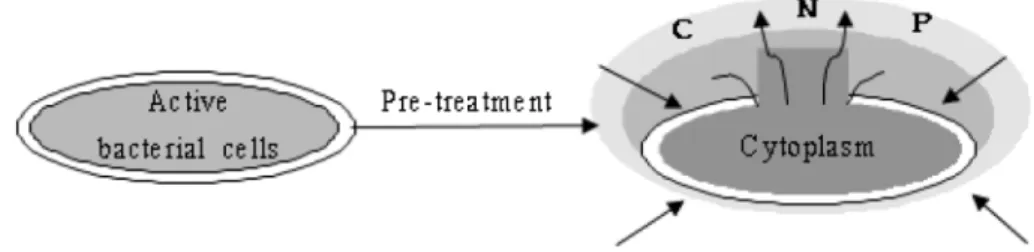
Sludge pre-treatment is classified by physical, chemical, and biological methods according to the means that destroy the cell walls protecting the microorganisms (Fig. 1) (Lee et al., 2008; Yoon, 2007).
Microwave is prevailed in everyday life and less danger and there is advantage that operation is simple.
Therefore, microwave is appraised as a clean technology that can be applied in pre-treatment and/or dry of sewage sludge. Dipole rotation destroys microbial cell wall so that biodegradation of organic matter is easy, and colloids and general suspended solids are dissolved to sewage sludge using microwave. Then, anaerobic digestion processes can increase the efficiency, promoting hydrolysis steps equivalent to the rate-limiting step through the process (Jeon et al., 2003; Kim et al., 2008). Short solids retention time (SRT) of the anaerobic digester is caused by effective influence upon reduction of the sewage sludge. Microwave cannot pass through metals and shows that it is reflected. Therefore, when pre-treating by microwave with Fe powder is used for sludge treatment, energy consumption can be
minimized and heating rate is increased.
Anaerobic digestion is a widely used method for reduction and stabilization of sewage sludge that involves the digestion of biodegradable organic matter into CH
4and CO
2by anaerobes in the absence of oxygen (Bae, 2005). These processes of waste activated sludge (WAS) that yield methane gas contain several biological reaction steps and therefore are achieved through several stages: hydrolysis; acidogenesis; methaneogenesis (Ministry of Commerce, Industry and Energy, Korea, 2006).
Nevertheless, there are some disadvantages; residence time is extensive (20~30 d), the reaction is unstable, and treatment efficiency can be lower than with the aerobic treatment process (Kim et al., 2008; Tiehm et al., 2001).
The objective of this study is sludge reduction using microwave and Fe powder on thickened sludge (TS), with enhanced solubilization efficiency increasing biogas production in anaerobic digestion.
2. Materials and Methods
This study employed microwave irradiation supplied from the accelerated reaction system as shown in Fig. 2 (MARS, CEM Corporation, 0-1200W, 2,450MHz frequency).
For the microwave irradiation experiments, 50mL of sludge was filled in vessels and then microwave was irradiated to the sludge by 500 W, 600 W, 700 W, and 800 W for 2~5 minutes. Also, addition of 0.01 g, 0.05 g, 0.1 g of Fe powder was made to compare the efficiency with and without Fe powder. In this study, 70-mesh (< 212 µ m) Fe powder was employed (Acros, Belgium).
Deduced solubilization efficiency was obtained using the following expression.
Fig. 1.
Schematic representation of sludge solubilization (Kim
et al., 2007).
Solubilization efficiency(%)=(SCODU − SCODO)/(TCODO − SCODO) × 100
SCODU = Soluble COD of sludge after irradiation of microwave
SCODO = Initial soluble COD TCODO = Initial total COD
Concentration of proteins in the soluble phase (< 0.2
µ m) was measured by the Bicinchoninic Acid Protein (BCA) Kit method and proteins were analyzed by microplate reader µQuant (Bio-Tek Instruments, USA).
The BMP tests were used to verify the increase in methane gas production volume from samples processed under optimum conditions.
Samples were taken from a sludge thicker (100 mL)
and seed sludge (300 mL) was taken from used anaerobic sludge digester. Samples were injected 500 mL serum bottles sealed with butyl rubber stopper. Serum bottles were kept in a dark, temperature controlled shaking incubator at 35 ± 2
oC and 120rpm until they stopped producing biogas. Biogas produced was measured daily by inserting a needle attached to a syringe. Biogas composition was determined with a Gas Chromato- graphy (Shimadzu 8A, Japan) with a metal packed column and a thermal conductivity detector (TCD) using helium as the carrier gas. Table 1 shows each of the analytical methods and instruments used in the experiments.
The thickened waste activated sludge (TWAS) was obtained from the thickener centrifuge at the J sewage treatment plant center (JSTP) located in Seoul, Korea.
Prior to use, the mixed liquor was passed through a sieve to remove large debris. Samples for determining soluble components were immediately filtered using GF/
C filter paper and cooled to 4
oC to prevent further reaction after sampling. The characteristics of the TWAS are shown in Table 2.
3. Results and Discussion 3.1. Solubilization Efficiency
The sludge solubilization efficiency depending on the
VS Standard method
Fe Shimadzu, ICPE 9000
Protein BCA method,
µQuant
CH
4, CO
2BMP test (Gas Chromatograph, Shimadzu 8A)
Fig. 2.
Microwave.
Table 2.
Characteristics of thickened sludge
Parameter Unit Concentrations
TCODcr mg/L 18,600 ~ 21,700
SCODcr mg/L 600 ~ 1,300
SCODcr/TCODcr % 7 ~ 15
TS % 2
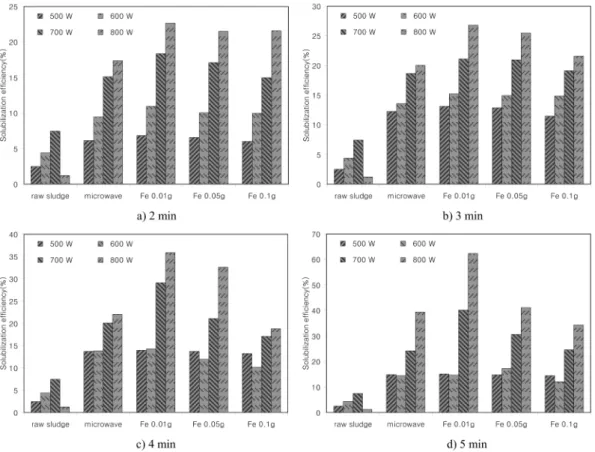
microwave irradiation strength and addition of Fe powder, is shown in Fig. 3. In an earlier study, the most suitable irradiation strength was determined between 600 ~ 700 W (Lee, 2008). Therefore, in this study, irradiation strengths applied were 500, 600, 700, and 800 W with 2-, 3-, 4-, and 5- min irradiation times.
Sludge solubilization efficiency by microwave irradiation with and without addition of Fe powder (0.01, 0.05, 0.1 g) was also compared.
As a result, solubilization efficiency proved higher in the presence of Fe powder than with microwave irradiation alone. Furthermore, the efficiency was highest with 0.01 g Fe powder, though it was expected that solubilization efficiency would be highest with 0.1 g. This could be due to the excess Fe powder causing an inverse reaction (such as interference of wave irradiation) of the solubilization.
The results confirmed that solubilization efficiency was higher with Fe powder, with optimum conditions confirmed at 0.01 g of Fe powder irradiated by 800 W
for 5 min. A 22.95% higher solubilization efficiency was achieved than without Fe powder. In addition, as microwave irradiation time increases, solubilization efficiency increases.
3.2. Protein Elution Characteristics
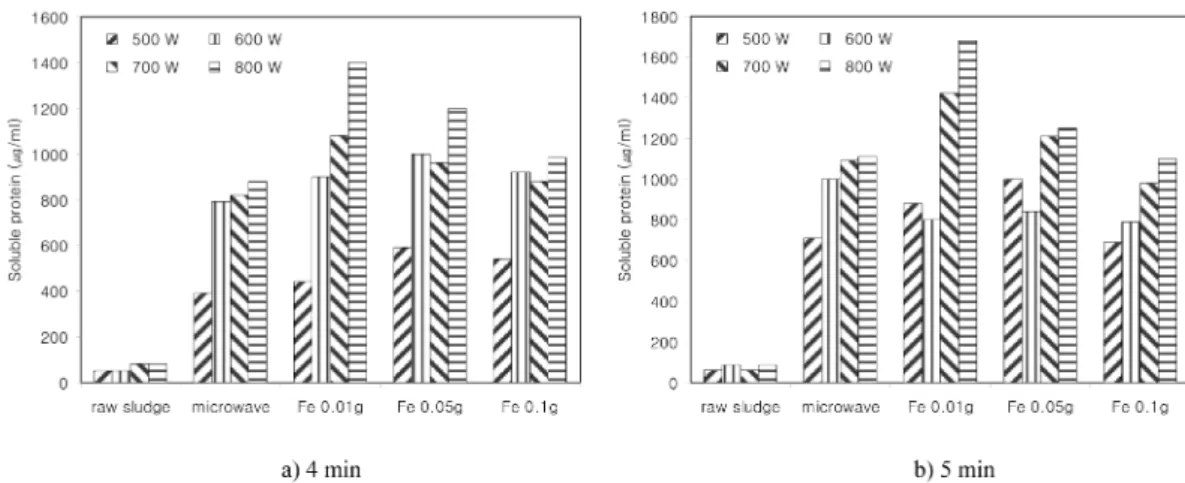
Fig. 4a shows soluble protein concentration with 4- min microwave irradiation at the power of 500, 600, 700, and 800 W. Similar to Fig. 3, with Fe powder (0.01 g) and an irradiation strength of 700 and 800 W, more protein was eluted. Fig. 4b shows soluble protein concentration at 5-min irradiation. Similar to irradiation at 4 min, when Fe powder (0.01 g) was added, more protein was eluted, approximately 1.5 times that of irradiation at 4 min, confirming greater microbial cell wall destruction with increased irradiation time and strength.
Furthermore, efficiency increases in the presence of Fe powder at higher irradiation strengths of 700 and 800 W over 500 and 600 W.
Fig. 3.
Variations of solubilization efficiency by microwave irradiation with/without Fe powder.
3.3 Cumulative Biogas Production
The BMP test was carried out using sludge obtained from the experiments under the optimum conditions.
Biogas production from samples treated with Fe powder (0.01 g) was higher than single microwave irradiation alone. Fig. 5 shows the highest values at 5 min irradiation. However, produced gas amounts did not
show big differences. Because, these results were from small sample amounts about 100 mL. If the process is up-scaled and increased, a bigger difference would be expected.
3.4. Methane Production
Figs. 6a and 6b display the content of produced
Fig. 4.
Concentration of soluble proteins by microwave irradiation with/without Fe powder.
Fig. 5.
Cumulative biogas production by microwave irradiation with/without Fe powder (0.01 g).
Fig. 6.