Vol. 16, No. 3, p. 339−345, September 2012 DOI 10.1007/s12303-012-0023-6
ⓒ The Association of Korean Geoscience Societies and Springer 2012
Micellar solubilization of multi-component non-aqueous phase liquids (NAPLs) by Tween 80
ABSTRACT: Non-aqueous phase liquids (NAPLs) at contaminated sites often consist of multiple organic pollutants. In this study, the solubilization behavior of multi-component NAPLs was examined for the ternary mixtures of TCE−PCE−octane, PCE−o-xylene−octane, and hexane−octane−decane in Tween 80 solutions. In the TCE−
PCE−octane mixtures, the most hydrophobic octane exhibited the enhanced solubilization compared with that predicted by the ideal behavior, but the least hydrophobic TCE showed the decreased solubilization. In reference to the ideal solubilization, PCE, the intermediate hydrophobic component in the mixtures, was less sol- ubilized in an octane-rich region but more solubilized in a TCE- rich region. Similarly, in the PCE−o-xylene−octane mixtures, the relatively hydrophobic octane was preferentially solubilized, whereas the less hydrophobic PCE and o-xylene were outcom- peted. The mutual effect on the solubilization between PCE and o- xylene was not significant due to the small difference in their hydrophobicity. Compared with the preceding NAPL mixtures, the hexane−octane−decane mixtures showed the lesser extent of the nonideal solubilization behavior, which might be attributed to the proximity in the hydrophobicity and molecular structure among these components. Thus, the nonideal solubilization behav- ior in NAPL mixtures was largely controlled by the relative hydro- phobicity among NAPL components.
Key words: NAPL, MSR, Raoult’s law, Tween 80 1. INTRODUCTION
Groundwater contamination by organic non-aqueous phase liquids (NAPLs) is a widespread problem. For example, around 60% of the Superfund sites may be contaminated with NAPLs (U.S. EPA, 1993). NAPLs can be persistent sources of contamination by slowly dissolving to form the plumes of contaminants that can widely spread out along groundwater paths. Pump-and-treat technology is the most frequently used method for remediating aquifers contami- nated with NAPLs (MacDonald and Kavanaugh, 1994).
However, due to the low solubilities of NAPLs and their low dissolution rates into groundwater, conventional pump- and-treat technology has had little success in the removal of NAPLs (MacKay and Cherry, 1989; Mercer and Cohen, 1990). Alternatively, surfactant-enhanced aquifer remedia- tion (SEAR) has been investigated as a promising technol- ogy to increase the efficiency of conventional pump-and-
treat technology (West and Harwell, 1992; Pennell et al., 1993).
Due to the amphiphilic nature, dissolved surfactant mol- ecules form stable aggregates known as micelles above the critical micelle concentrations (CMC). In micelles, the hydrophobic tails of surfactant molecules are directed into the center of micelles, with the hydrophilic heads orientated toward the bulk aqueous phase (Rosen, 1989). Hydrophobic organic pollutants can partition into the hydrophobic cores of surfactant micelles, resulting in their increased apparent aqueous solubilities (West and Harwell, 1992; Pennell et al., 1993). The NAPL removal by increasing the apparent aque- ous phase solubility via micelle formation is often referred to as micellar solubilization. In both laboratory and field experiments, micellar solubilization has been shown to sig- nificantly enhance the efficiency of NAPL removal from contaminated soils (Kile and Chiou, 1989; Diallo et al., 1994; Sun et al., 1995). Thus, the surfactant-enhanced aqui- fer remediation (SEAR) coupled with pump-and-treat tech- nology may allow NAPL contaminants to be removed at a rate with several orders of magnitude greater than the oper- ation of conventional pump-and-treat method alone.
NAPLs may contain mixtures of multiple organic pollut- ants (Chaiko et al., 1984; Park and Bielefeldt, 2003). For example, the spill and leakage of gasoline and coal tar led to the formation of multi-component NAPLs in groundwa- ters (Bernardez and Ghoshal, 2004). Furthermore, many hazardous waste sites were found to be contaminated with NAPL mixtures (Mercer and Cohen, 1990; McCray and Brusseau, 1998; Knox et al., 1999). Nonetheless, only a few studies have investigated the micellar solubilization of multi-component NAPLs (Chaiko et al., 1984; McCray et al., 2001; Bernardez and Ghoshal, 2004; Mir et al., 2011).
In NAPL mixtures, the micellar solubilization of an organic component was often found to behave nonideally: either enhanced or decreased relative to that predicted from the corresponding single-component NAPL (Chaiko et al., 1984;
McCray et al., 2001). For example, the solubilization of the more hydrophobic component in NAPL mixtures was increased relative to that found in its pure NAPL system, whereas the solubilization of the more hydrophilic compo- nent was relatively decreased (Guha et al., 1998; McCray et Hoon Young Jeong* Department of Geological Sciences, Pusan National University, Busan 609-735, Republic of Korea
*Corresponding author: [email protected]
al., 2001). The nonideal behavior in multi-component NAPLs was also found to be strongly affected by the compositions of NAPL mixtures (Chaiko et al., 1984; McCray et al., 2001).
Yet, most of such works were limited to mixtures of organics within a homologous series or binary mixtures (Chaiko et al., 1984; McCray et al., 2001; Bernardez and Ghoshal, 2004; Mir et al., 2011). Also, in those studies, chlorinated organic solvents such as tetrachloroethylene (PCE) and trichloroethylene (TCE) were not included as NAPL components. These chlorinated compounds are the most frequent NAPL constituents at the Superfund sites and other hazardous waste sites (U.S. EPA, 2004). In the present study, the solubilization behavior of multi-component NAPLs was investigated for ternary mixtures of organic compounds including PCE and TCE using polyoxyethylene-20-sorbitan monooleate (Tween 80), a nonionic biodegradable surfac- tant. Tween 80 has been shown to be effective in solubi- lizing a range of hydrophobic organic compounds (Prak and Pritchard, 2002; Kim and Weber, 2003; Bernardez and Ghoshal, 2004; Suchomel et al., 2007). The objective of this study was to compare the micellar solubilization behav- ior between single-component NAPLs and multi-compo- nent NAPLs. Furthermore, we aimed to provide a better insight into the complicated nature (e.g., nonideal behavior) of the micellar solubilization in multi-component NAPLs.
2. MATERIALS AND METHODS 2.1. Chemicals
Two chlorinated alkenes (TCE and PCE), three alkanes (n-hexane, n-octane, and n-decane), and one alkyl benzene (o-xylene) were chosen to form three ternary NAPL sys- tems: (i) TCE−PCE−octane, (ii) PCE−o-xylene−octane, and (iii) hexane−octane−decane. While TCE and PCE are rep- resentative of dense NAPLs (DNAPLs), the three alkanes are the common pollutants comprising light NAPLs (LNAPLs) such as gasoline and jet fuels. o-Xylene is an important BTEX pollutant. These organic contaminants exhibit a wide
range of hydrophobicity and molar volume. Table 1 lists some selected physical properties of these organics. Tween 80, the surfactant used in this study, has the average molec- ular weight of 1,310 g/mol, the critical micelle concentration (CMC) of 35 mg/L, and the hydrophile-lipophile balance (HLB) of 15.0 (Pennell et al., 1997). All these chemicals, pur- chased from Sigma-Aldrich, were at least 99% pure and used as received.
2.2. Batch Test
Batch experiments were performed to determine the micellar solubilization of NAPL mixtures. Reaction batches were prepared by reacting 100 µL of organic mixtures with 3 mL of 80 g/L Tween 80 solutions in 4 mL glass vials sealed with open-top screw caps and Teflon-faced rubber septa. The batches were then allowed to equilibrate on an end-over- end rotor for 3 days at 25 °C. This period was found to be sufficient to reach the equilibrium solubilization (Zimmer- man et al., 1999; Cowell et al., 2000).
After the equilibration period, the batches were centri- fuged at 4,000 rpm for 1 h to separate the aqueous phase from NAPL phases. One mL of the aqueous phase was carefully withdrawn using a gas-tight syringe. The half of the sample taken was analyzed on a gas chromatograph (GC) to quantify the solubilized organic concentration, and the remaining half was analyzed on a high performance liq- uid chromatography (HPLC) to determine the aqueous con- centration of Tween 80 as described in the following section.
2.3. Analytical Methods
Prior to GC analysis, 0.5 mL of the aqueous sample was mixed with the equivalent volume of HPLC-grade metha- nol. The resultant mix was then analyzed on a Hewlett- Packard 5880 GC with a Scientific DB-624 column (3 m × 0.53 mm i.d. with 3 µm film thickness, J&W Scientific, Folsom, CA) and a flame ionization detector. To prevent the potential interference from Tween 80, GC was equipped with a Hewlett-Packard split liner filled with PorePak P 80- 100 (AllTech, Deerfield, IL). Injector temperature was 250 °C.
Oven temperature was initially isothermal at 40 °C for 4 min, then ramped at 10 °C/min to 80 °C and kept isother- mal for 10 min, and finally ramped at 15 °C/min to 200 °C and kept isothermal for 5 min. Concentrations of the solu- bilized organics were determined by comparing GC peak areas to five-point standard curves.
Aqueous phase concentration of Tween 80 was deter- mined by analyzing 0.5 mL of the sample on a Hewlett- Packard 1050 HPLC with a Hypersil silica precolumn (7.5 mm × 4.6 mm i.d. with 5 µm film thickness, AllTech, Deer- field, IL) with an evaporate light scattering detector (ELSD) operated at 40 °C. The mobile phase was composed of pure methanol pumped at a rate of 1 mL/min. A calibration stan- Table 1. Physical properties of organic compounds used for ternary
NAPL mixtures at 25 °C: molecular weight (MW), molar volume (Vmo), aqueous solubility (So), and octanol-water partition coeffi- cient (Kow)
Organic compound
chemical formula
MW [g/mol]
Vmo [cm3/mol]
log So [mol/L]
log Kow [−]
trichloroethylene C2HCl3 131.4 90.2a −2.04b 2.42b tetrachloroethylene C2Cl4 165.8 103a −3.04b 2.88b o-xylene C8H10 106.2 121.2a −2.76b 3.12b n-hexane C6H14 86.2 131.6a −3.83b 4.11b n-octane C8H18 114.2 162.5c −5.20b 5.18b n-decane C10H22 142.3 195.9a −7.52b 5.62d
aBarton (1983), bSchwarzenbach et al. (1993), cMiller and Wasik (1985), and dDiallo et al. (1994).
dard curve was generated for Tween 80 using a wide range of the concentrations as described in Kibbey and Hayes (1997).
3. RESULTS AND DISCUSSION 3.1. Single-Component NAPLs
The extent of micellar solubilization can be quantified using the molar solubilization ratio (MSR), a ratio of the moles of an organic compound solubilized to the moles of a surfactant in micelles (Edwards et al., 1991). In a single- component NAPL, the MSR of an organic i (MSRio) is given by
MSRio= (1)
where the superscript o denotes a single-component NAPL, Cio is the molar concentration of the solubilized organic i in a single-component NAPL, Sio is the molar aqueous sol- ubility of the organic i in a single-component NAPL, Csurf
is the molar concentration of the added surfactant, and Csurf,cmc is the molar surfactant concentration at CMC.
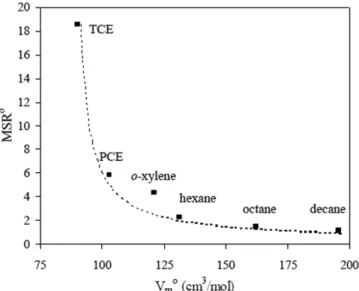
Figure 1 presents the molar solubilization ratios of dif- ferent organics measured from single-component NAPLs (MSRo) as a function of the molar volume (Vmo). In Figure 1, the extent of micellar solubilization in the pure NAPL systems is found to increase with the decreasing molar vol- ume, implying that the hydrophobic environment created by micelles is the main diving force for the partitioning of hydrophobic organics into micelles. The inverse relation- ship between MSRo and Vmo was previously reported (Chaiko et al., 1984; Diallo et al., 1994). Nonetheless, the molar vol- ume is not a complete descriptor for the observed molar sol-
ubilization ratios (see Fig. 1). A possible explanation for this is that specific interactions may occur between organics and micelles. For example, some aromatic compounds such as benzene, naphthalene, and phenanthrene were found to partition into the polar shell portion of the micelles as well as the hydrophobic core (Chaiko et al., 1984; Nagarajan et al., 1984; Bernardez and Ghoshal, 2004). Consistent with this, o-xylene (an isomer of dimethyl benzene) shows the great- est deviation from the correlation between MSRo and Vmo. 3.2. Multi-Component NAPLs
Analogous to single-component NAPLs, the molar solu- bilization ratio of the ith organic in a multi-component NAPL is given by:
MSRi= (2)
where Ci is the molar concentration of the solubilized organic i in a multi-component NAPL and Si is the molar aqueous solubility of the organic i in a multi-component NAPL. Assuming the ideal behavior of the organic i in all the aqueous, NAPL, and micellar phases, Equation (2) can be modified according to Raoult’s law into:
MSRi= (3)
where Xi is the mole fraction of the organic i in the NAPL phase. It should be noted that Equation (3) is valid only when the organic i behaves ideally. Any nonideality of the organic i in the NAPL, aqueous, or micellar phases causes the deviation of MSRi from the one predicted by Raoult’s law in Equation (3). To quantify the degree of the nonideal solubilization behavior in a multi-component NAPL, the normalized molar solubilization ratio of the organic i (MSRinorm) is defined as
MSRinorm= (4)
where the normalized molar solubilization ratio is obtained by rearranging Equation (3). When MSRinorm is equal to the unity, the organic i exhibits the ideal solubilization behav- ior in NAPL mixtures. When MSRinorm differs from the unity, the solubilization of the organic i is nonideal. Spe- cifically, the MSRinorm with the value greater than 1 indi- cates the enhanced solubilization of the organic i compared with the corresponding single-component NAPL, whereas the MSRinorm with the value less than 1 points to the reduced solubilization. For three ternary NAPL mixtures, the impact of the NAPL composition on the micellar solubilization behavior will be discussed in the following sections.
Cio
Sio
– Csurf–Csurf cmc,
---
Ci–Si
Csurf–Csurf cmc,
---
Xi Cio
Sio
( – )
Csurf–Csurf cmc,
--- =XiMSRio
MSRi XiMSRio ---
Fig. 1. The molar solubilization ratios of organics in single-com- ponent NAPLs (MSRo) versus the molar volumes (Vmo). The dashed line represents the data fit based on the inverse relationship between MSRo and Vmo.
3.2.1. TCE−PCE−octane system
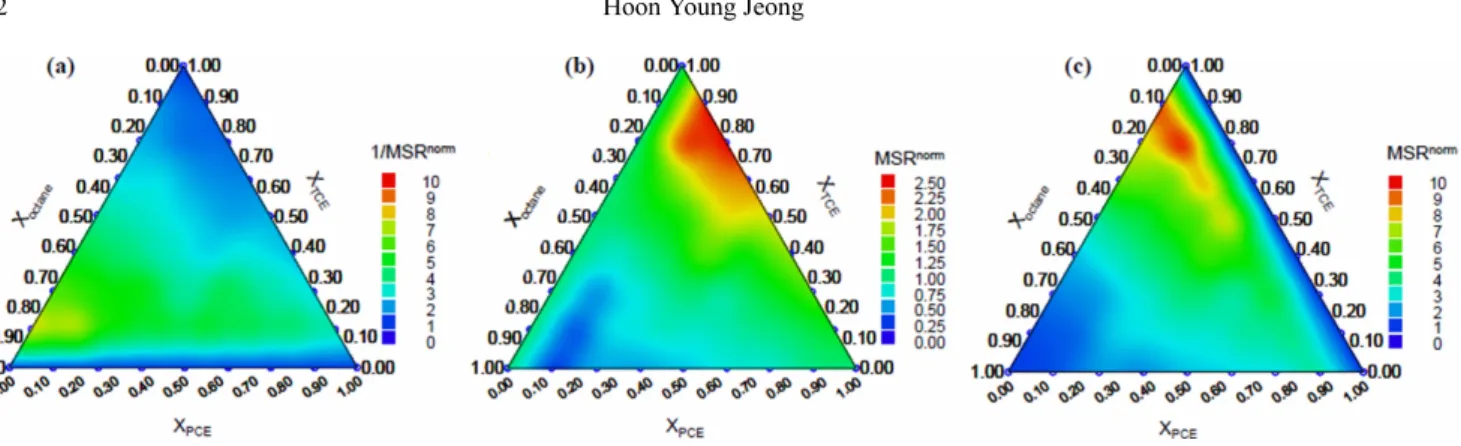
Figure 2 shows ternary plots of MSRinorm (or its recipro- cal) for TCE, PCE, and octane in the TCE−PCE−octane system. Among the three components in this system, TCE is the most hydrophilic organic (as indicated by the lowest octanol-water partition coefficient; see Kow values in Table 1), and octane is the most hydrophobic organic, with PCE being the intermediate one. In Figure 2a, the 1/MSRinorm of TCE is greater than 1 in most regions, indicating that the micellar solubilization of the most hydrophilic TCE in this system is reduced compared with that expected from the ideal behavior. The reduced solubilization of TCE also becomes more evident as its mole fraction in the NAPL phase decreases. In an octane-rich region, the solubilization of TCE is reduced by ~8 times as much as that predicted by Raoult’s law. In a PCE-rich region, the solubilization of TCE is reduced by ~6 times compared with that expected from the ideal behavior.
In Figure 2b, the MSRinorm of PCE shows several distinct features. First, compared with that expected from the ideal behavior, the solubilization of PCE is enhanced in the TCE- rich half, but it is reduced in the octane-rich half, indicating that PCE is solubilized more preferentially than the less hydrophobic TCE but less favorably than the more hydro- phobic octane. Second, the ideal solubilization of PCE is observed at the ratio of XTCE/Xoctane being between ~0.5 and ~0.8. This is probably because the enhanced solubili- zation on PCE by TCE is counterbalanced by the reduced solubilization by octane at these ratios. Similarly, McCray et al. (2001) observed that the intermediate hydrophobic ethyl benzene was solubilized in nearly an ideal manner in the co-presence of the less hydrophobic toluene and the more hydrophobic butyl benzene. Third, the solubilization of PCE in an octane-rich region is reduced by ~4 times compared with that expected from the ideal behavior. By comparing Figures 2a and b, the reduced solubilization of PCE by octane is found to be less than that of TCE by octane. Taken together, the relative hydrophobicity among the NAPL components is critical in determining the solu- bilization behavior in multi-component NAPL systems.
In Figure 2c, octane exhibits the enhanced solubilization behavior in most regions. Such enhancement solubilization becomes more intensified as its mole fraction in the NAPL phase decreases. Notably, the enhanced solubilization of octane is greater in a TCE-rich region (~9 times increase compared with that predicted by Raoult’s law) than in a PCE-rich region (~3 times increase compared with that pre- dicted by Raoult’s law). This implies that the solubilization of a relatively hydrophobic component is enhanced to a greater extent with the decreasing hydrophobicity of a co- present component in NAPL mixtures.
3.2.2. PCE−o-xylene−octane system
Figure 3 shows ternary plots of MSRinorm (or its recipro- cal) for PCE, o-xylene, and octane in the PCE−o-xylene−
octane system. As indicated by octanol-partition coeffi- cients (Kow) in Table 1, PCE is the least hydrophobic com- ponent, o-xylene is the intermediate one, and octane is the most hydrophobic one. In Figure 3a, the 1/MSRinorm of PCE is greater than 1 in the octane-rich half, indicating the reduced solubilization of PCE by the more hydrophobic octane. This result is consistent with that observed in the TCE-PCE-octane system. In contrast, the 1/MSRinorm of PCE in the o-xylene-rich half is close to the unity, indicating the solubilization behavior of PCE in nearly an ideal manner.
This may be attributed to the similar hydrophobicity between PCE and o-xylene (Table 1).
o-Xylene in this ternary system is solubilized in a similar way to PCE. The solubilization of o-xylene is reduced in the octane-rich half, as indicated by its 1/ MSRinorm with the value larger than the unity (see Fig. 3b). Although slightly reduced, the solubilization of o-xylene in the PCE-rich half is close to that expected from the ideal behavior. In Figure 3c, the deviation of octane from the ideal solubilization behavior becomes larger as its mole fraction in the NAPL phase decreases. The solubilization of octane is substan- tially enhanced compared with that predicted from the ideal behavior in the regions abundant in the less hydrophobic PCE and o-xylene.
Fig. 2. The normalized MSR (MSRinorm) or its reciprocal for TCE (a), PCE (b), and octane (c) in the TCE−PCE−octane ternary system.
3.2.3. Hexane−octane−decane system
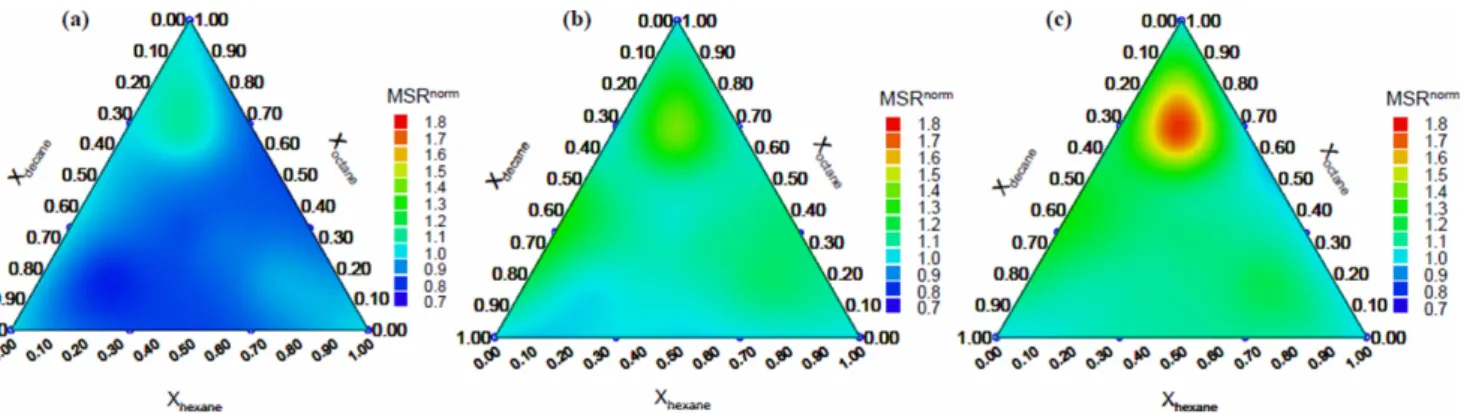
Figure 4 shows ternary plots of MSRinorm for hexane, octane, and decane in the hexane−octane−decane system. It should be noted the degree of the nonideal solubilization in this system is much smaller than those observed in the two preceding systems, likely due to the relatively small differ- ence in hydrophobicity among the NAPL components in this system and their structural similarity (in this system, all components are saturated alkanes). Generally, the solubili- zation of the least hydrophobic hexane is slightly reduced as its mole fraction in the NAPL phase decreases (Fig. 4a). To our surprise, hexane exhibits the highest solubilization in an octane-rich region, despite hexane being less hydrophobic than octane.
In Figure 4b, octane shows the slightly enhanced solubi- lization in three distinct regions, among which the greatest solubilization is encountered in an octane-rich region. Except such regions, octane displays either the ideal solubilization or the slightly reduced solubilization, depending on the NAPL composition. In Figure 4c, decane displays the sol- ubilization enhancement in the regions where the enhanced solubilization of octane is observed. Interestingly, the region where the highest solubilization of each component occurs coincides with one another, which cannot be explained by the relative hydrophobicity alone.
3.2.4. Ideal and nonideal solubilization in multi-compo- nent NAPLs
The micellar solubilization behavior in multi-component NAPLs is found to be a function of the NAPL phase com- position. The ideal solubilization occurs at only limited compositions. An organic component exhibits the ideal sol- ubilization behavior as its mole fraction in the NAPL phase approaches the unity (see Figs. 2−4). This is logical since a multi-component NAPL virtually becomes the single-com- ponent NAPL as Xi approaches 1.0 (McCray et al., 2001).
On the other hand, the extent of the nonideal solubilization behavior becomes greater as Xi decreases (see Figs. 2−4).
As evidenced by the hexane−octane−decane system (Fig. 4), the deviation from the ideal solubilization behavior is rel- atively small for the NAPL mixtures composed of organics with the similar hydrophobicity. Previously, the ideal solu- bilization was observed for the binary mixture of n-hexane and cyclohexane, which have the similar hydrophobicity (Chaiko et al., 1984). In the TCE−PCE−octane system, PCE (the component with the intermediate hydrophobicity) is solubilized ideally at ~0.5 < XTCE/Xoctane < ~0.8 (see Fig.
2). Similarly, McCray et al. (2001) reported the ideal sol- ubilization of ethyl benzene in the presence of the less hydrophobic toluene and the more hydrophobic butyl ben- zene.
Fig. 3. The normalized MSR (MSRinorm) or its reciprocal for PCE (a), o-xylene (b), and octane (c) in the PCE−o-xylene−octane ternary system.
Fig. 4. The normalized MSR (MSRinorm) for hexane (a), octane (b), and decane (c) in the hexane−octane−decane ternary system.
As discussed above, the more hydrophobic component in NAPL mixtures shows the enhanced solubilization com- pared with that predicted by the ideal behavior, whereas the less hydrophobic component shows the reduced solubiliza- tion. One explanation for this is the competition for the par- titioning into micelles among NAPL components (Chaiko et al., 1984). Since the hydrophobic nature of organics makes them partition into micelles, the more hydrophobic compo- nent is expected to be preferentially incorporated into the hydrophobic environments created by micelles. According to the competition effect, thus, the enhanced solubilization of the more hydrophobic component in NAPL mixtures should be accompanied by the reduced solubilization of the less hydrophobic component. However, no such things are observed in this study. In Figure 2, the enhanced solubili- zation of the most hydrophobic octane is not always con- comitant with the reduced solubilization of the other components in the TCE−PCE−octane system. Also, the enhanced solubilization of octane does not coincide with the reduced solubilization of the less hydrophobic components in the PCE−o-xylene−octane system (see Fig. 3). Thus, the observed nonideal behavior cannot be explained by the competition effect alone.
The enhanced solubilization of the relatively hydrophobic component in NAPL mixtures was attributed to the palisade effect (Guha et al., 1998). In NAPL mixtures, the relatively hydrophilic component can sorb to the interfacial region between the micellar core and the bulk water (the palisade layer), resulting in the reduced micellar core-water interfa- cial tension so as to enlarge the micellar core and conse- quently increase the partitioning of the relatively hydrophobic component into the core (Nagarajan et al., 1984). For exam- ple, the solubilization of hexane was found to significantly increase by the interfacial sorption of the more hydrophilic benzene (Chaiko et al., 1984). Consistent with the palisade effect, the enhanced solubilization of the relatively hydro- phobic octane becomes greater as the mole fraction of the relatively hydrophilic components increases (see Figs. 2c and 3c). Nonetheless, the palisade effect cannot account for the reduced solubilization of the relatively hydrophilic com- ponents in NAPL mixtures. Nagarajan et al. (1984) have shown that the micelle-water partition coefficient of the rel- atively hydrophilic compound is essentially unchanged despite it sorption into the palisade layer. Thus, the palisade effect is considered to be a relevant account just for the nonideal behavior of the relatively hydrophobic component in NAPL mixtures.
Besides the competition and palisade effects, the nonide- ality in both NAPL and micellar phases may contribute to the complexed solubilization behavior in NAPL mixtures.
In this study, the hexane−octane−decane system, which comprises the components with the similar hydrophobicity and molecular structure, is expected to exhibit the near- ideal behavior in the NAPL and micellar phases. In con-
trast, both TCE−PCE−octane and PCE−o-xylene−octane systems consist of the components with a range of hydro- phobicity and molecular structure. Thus, the expected greater nonideality of the latter systems in the NAPL and micellar phases is in line with their larger deviation from the ideal solubilization behavior compared with the former system.
Other factors responsible for the nonideal solubilization behavior may include the aqueous phase cosolute effects and the partitioning of surfactants into the NAPL phase (McCray et al., 2001). Despite the aforementioned causes, the exact mechanisms for the nonideal solubilization behav- ior in this study are not clear. Multiple factors, not a single one, are thought to be collectively responsible for the observed solubilization behavior in this study.
4. CONCLUSIONS
The micellar solubilization behavior was investigated for the following ternary NAPL mixtures: TCE−PCE−octane, PCE−o-xylene−octane, and hexane−octane−decane systems.
Several important results can be gleaned in this study. First, the solubilization of NAPL mixtures is dependent on the type of components. While the ternary system comprising the components with the similar physical properties shows the solubilization closer to the ideal behavior predicted by Raoult’s law, the one containing the components with sig- nificantly different properties displays the greater deviation from the ideal solubilization. Second, the solubilization of NAPL mixtures is specific to the NAPL composition. The solubilization of a component in NAPL mixtures becomes ideal as its mole fraction in the NAPL phase approaches the unity, whereas the nonideal behavior gets intensified as the mole fraction decreases. Third, the solubilization of NAPL mixtures is largely controlled by the relative hydrophobicity among components. The more hydrophobic component shows the enhanced solubilization relative to that predicted by the ideal behavior, but the less hydrophobic component has the opposite effect. Fourth, the observed complexity in the solubilization of NAPL mixtures is likely a combined result of the competitive partitioning into micelles, the interfacial sorption, the nonideality in the NAPL and micel- lar phases, and other effects. Our results may be useful for understanding the complex solubilization behavior of NAPL mixtures during the surfactant-enhanced aquifer remedia- tion (SEAR). Although the conclusions drawn here are gen- erally applicable, the specific solubilization behavior may differ among pairs of organics and surfactants.
ACKNOWLEDGMENTS: The author thanks Dr. Kim Hayes for his invaluable contribution to this work and Mr. Tom Yavaraski for his help with GC and HPLC analyses. This work was supported by Korea Ministry of Environment as “The GAIA Project” (173-092-011) and Basic Science Research Program through the National Research Foun- dation of Korea (NRF) funded by the Ministry of Education, Science and Technology (2010-0023824).
REFERENCES
Barton, A.F.M., 1983, CRC Handbook of Solubility Parameters and Other Cohesion Parameters. CRC Press, Boca Raton, FL, 594 p.
Bernardez, L.A. and Ghoshal, S., 2004, Selective solubilization of polycyclic aromatic hydrocarbons from multicomponent non- aqueous-phase liquids into nonionic surfactant micelles. Envi- ronmental Science & Technology, 38, 5878−5887.
Chaiko, M.A., Nagarajan, R., and Ruckenstein, E., 1984, Solubili- zation of single-component and binary mixtures of hydrocarbons in aqueous micellar solutions. Journal of Colloid and Interface Science, 99, 168−182.
Cowell, M.A., Kibbey, T.C.G., Zimmerman, J.B., and Hayes, K.F., 2000, Partitioning of ethoxylated nonionic surfactants in water/
NAPL systems: Effects of surfactant and NAPL properties. Envi- ronmental Science & Technology, 34, 1583−1588.
Diallo, M.S., Abriola, L.M., and Weber, W.J., 1994, Solubilization of nonaqueous phase liquid hydrocarbons in micellar solutions of dodecyl alcohol ethoxylates. Environmental Science & Technol- ogy, 28, 1829−1837.
Edwards, D.A., Luthy, R.G., and Liu, Z., 1991, Solubilization of polycyclic aromatic hydrocarbons in micellar nonionic surfactant solutions. Environmental Science & Technology, 25, 127−133.
Guha, S., Jaffe, P.R., and Peters, C.A., 1998, Solubilization of PAH mixtures by a nonionic surfactant. Environmental Science &
Technology, 32, 930−935.
Kibbey, T.G.C. and Hayes, K.F., 1997, A multicomponent analysis of the sorption of polydisperse ethoxylated nonionic surfactants to aquifer materials: Equilibrium sorption behavior. Environmental Science & Technology, 31, 1171−1177.
Kile, D.E. and Chiou, C.T., 1989, Water solubility enhancements of DDT and trichlorobenzene by some surfactants below and above the critical micelle concentration. Environmental Science &
Technology, 23, 832−838.
Kim, H.S. and Weber, W.J., 2003, Preferential surfactant utilization by a PAH-degrading strain: Effects on micellar solubilization phenomena. Environmental Science & Technology, 37, 3574− 3580.
Knox, R.C., Shiau, B.J., Sabatini, D.A., and Harwell, J.H., 1999, Field demonstration studies of surfactant enhanced solubilization and mobilization at Hill AFB, Utah. In: Brusseau, M., Sabatini, D., Gierke, J., and Annable, M. (eds.), Innovative Subsurface Remediation: Field Testing of Physical, Chemical, and Charac- terization Technologies. Oxford University Press, Washington, DC., p. 49−63.
MacDonald, J.A. and Kavanaugh, M.C., 1994, High-speed GC anal- ysis of VOCs: Sample collection and inlet systems. Environmen- tal Science & Technology, 28, 362A−368A.
MacKay, D.M. and Cherry, J.A., 1989, Ground water contamination:
Pump-and-treat remediation. Environmental Science & Technol- ogy, 21, 630−636.
McCray, J.E. and Brusseau, M.L., 1998, Cyclodextrin-enhanced in- situ flushing of multiple-component immiscible organic liquid contamination at the field scale: Mass-removal effectiveness.
Environmental Science & Technology, 32, 1285−1293.
McCray, J.E., Bai, G., Maier, R.M., and Brusseau, M.L., 2001, Bio- surfactant-enhanced solubilization of NAPL mixtures. Journal of
Contaminant Hydrology, 48, 45−68.
Mercer, J.W. and Cohen, R.M., 1990, A review of immiscible fluids in the subsurface: Properties, models, characterization, and reme- diation. Journal of Contaminant Hydrology, 6, 107−163.
Miller, M.M. and Wasik, S.P., 1985, Relationships between octanol- water partition coefficient and aqueous solubility. Environmental Science & Technology, 19, 522−529.
Mir, M.A., Chat, O.A., Najar, M.H., Younis, M., Dar, A.A., and Rather, G.M., 2011, Solubilization of triphenylamine, triphe- nylphosphine, triphenylphosphineoxide and triphenylmethanol in single and binary surfactant systems. Journal of Colloid and Interface Science, 364, 163−169.
Nagarajan, R., Chaiko, M.A., and Ruckenstein, E., 1984, Locus of solubilization of benzene in surfactant micelles. Journal of Phys- ical Chemistry, 88, 2916−2922.
Park, S.-K. and Bielefeldt, A.R., 2003, Equilibrium partitioning of a non-ionic surfactant and pentachlorophenol between water and a non-aqueous phase liquid. Water Research, 37, 3412−3420.
Pennell, K.D., Abriola, L.M., and Weber, W.J., 1993, Surfactant- enhanced solubilization of residual dodecane in soil columns. 1.
Experimental investigation. Environmental Science & Technol- ogy, 27, 2332−2340.
Pennell, K.D., Adinolfi, A.M., Abriola, L.M., and Diallo, M.S., 1997, Solubilization of dodecane, tetrachloroethylene and 1, 2-dichlo- robenzene in micellar solutions of ethoxylated nonionic surfac- tants. Environmental Science & Technology, 31, 1382−1389.
Prak, D.J.L. and Pritchard, P.H., 2002, Solubilization of polycyclic aromatic hydrocarbon mixtures in micellar nonionic surfactant solutions. Water Research, 36, 3463−3472.
Rosen, M.J., 1989, Surfactants and Interfacial Phenomena, 2nd ed.
John Wiley & Sons, New York, 431 p.
Schwarzenbach, R.P., Gschwend, P.M., and Imboden, D.M., 1993, Environmental Organic Chemistry. John Wiley & Sons, New York, 681 p.
Suchomel, E.J., Ramsburg, C.A., and Pennell, K.D., 2007, Evalua- tion of trichloroethene recovery processes in heterogeneous aqui- fer cells flushed with biodegradable surfactants. Journal of Contaminant Hydrology, 94, 195−214.
Sun, S., Inskeep, W.P., and Boyd, S.A., 1995, Sorption of nonionic organic compounds in soil-water systems containing a micelle- forming surfactant. Environmental Science & Technology, 29, 903−913.
U.S. EPA, 1993, Evaluation of the Likelihood of DNAPL Presence at NPL Sites. EPA 15401R-93-073, U.S. EPA, Washington D.C.
U.S. EPA, 2004, DNAPL Remediation: Selected Projects Approach- ing Regulatory Closure. EPA 542-R-04-016, U.S. EPA, Wash- ington D.C.
West, C.C. and Harwell, J.H., 1992, Surfactants and subsurface reme- diation. Environmental Science & Technology, 26, 2324−2330.
Zimmerman, J.B., Kibbey, T.C.G., Cowell, M.A., and Hayes, K.F., 1999, Partitioning of ethoxylated nonionic surfactants into non- aqueous-phase organic liquids: Influence on solubilization behav- ior. Environmental Science & Technology, 33, 169−176.
Manuscript received January 23, 2012 Manuscript accepted June 2, 2012