Introduction
In early 2020s Finland will be the first nation in the world starting the geological disposal of the spent nuclear fuel. The road towards disposal has been systematic and straightforward since 1978 when the disposal studies started, just after the first nuclear power reactors were built. Currently the Loviisa power plant in Southern Finland has two pressurised water reactors (VVER) each producing 510 MW of electricity and first taken into use in 1977. The Olkiluoto plant in Western Finland consists of two Boiling Water Reactors (BWRs) each producing 880 MW of elec- tricity, taken into use in 1979 and 1982. The third reactor of the Olkiluoto plant, a 1600 MW European Pressurized Reactor (EPR) has been under construction since 2005 and will be soon start to operate. Besides these, sixth reactor (latest VVER type) producing 1200 MW of electricity when ready is being built in Northern Finland.
While the new power plants are being built, the geological disposal of the spent nuclear fuel is continuing forward.
One of key success factors of disposal of spent nuclear fuel
has been the political commitment and the two-phase-app- roach where a second generation underground research laboratory (URL) was built to the disposal site, before applying for the construction license for the final disposal facility. The confirming rock characterization conducted in the ONKALO in Olkiluoto Island, located in Western Finland (Fig. 1), has increased the confidence to the rock properties to that point that it was possible to grant the
Overview of Finnish Spent Nuclear Fuel Disposal Programme
Topias Siren
1)*
(Received 10 July 2017; Final version Received 31 July 2017; Accepted 30 August 2017)
Abstract : Finland is the first country in the world constructing the geological spent nuclear fuel disposal facility. The Finnish programme for spent nuclear fuel is organized through a private company Posiva Oy that has been established by the two power companies currently operating nuclear power plants in Finland to dispose owners spent nuclear fuel.
First plans for the disposal of the spent nuclear fuel started already at 1978 when first studies for the geological disposal started. The planning was followed by the site selection programme, culminating to the selection of the Olkiluoto site as the disposal site in 2001 by decision in principle by Parlament of Finland. In 2004 the construction of the rock characterization facility ONKALO ™started on the disposal site. ONKALO has served in confirming underground site studies, while it has been designed to be an inseparable part of the final disposal facility. After 10 years of confirming studies in 2015, Posiva Oy, was granted the construction license for the final repository. In early 2020s the disposal of the spent nuclear fuel is expected to start in ONKALO.
Key words : Nuclear waste disposal, Geological, Repository, Underground, KBS-3
1) Aalto University
*Corresponding Author(Topias Siren) E-mail; [email protected]
Address; Aalto University, Rakentajanaukio 4 A, 02150 Espoo, Finland
ISSN 2288-2790(online) Vol. 54, No. 4 (2017) pp. 367-376, https://doi.org/10.12972/ksmer.2017.54.4.367
Fig. 1. The location of the Olkiluoto site on the western Finland.
기술보고
collaboration with the Swedish Nuclear Fuel and Waste Management Co. (SKB) has benefited the Finnish progamme, not only by knowledge exchange, but also by having access to Äspö Hard Rock Laboratory in Sweden. Also in Sweden the nuclear waste disposal project is heading for the implementation phase in the next decade or so.
Disposal concept
The Swedish and Finnish plan for disposal of spent fuel is based on the multi-barrier KBS-3 concept. In the KBS-3 approach, the spent fuel will be deposited in a cast iron insert surrounded by copper canister with copper lid that is friction stir welded in place (Posiva, 2014). The iron insert provides mechanical strength while the copper canister protects the spent fuel from corrosion. The copper canisters will be disposed at approximately 400 –500 m depth in crystalline rock at a selected geological domain. The canisters will be holes surrounded by compacted bentonite clay, and tunnels will be sealed using concrete plugs and backfilled using bentonite and rock mixture.
The reference concept for the nuclear waste disposal is the vertical KBS-3V disposal concept as illustrated in Fig. 2 on the left. The horizontal KBS-3H disposal concept (Fig. 2 on the right) is being developed simultaneously with the vertical concept (Suikkanen et al., 2016). In both disposal concepts, the principle with multiple protective barriers is followed. The barriers include final disposal canister, bentonite buffer, tunnel backfill and bedrock (Saanio et al., 2012).
The deposition holes are filled with compressed blocks made from bentonite clay (buffer), and the gaps between blocks and rock surface with bentonite pellets. The purpose of the bentonite buffer is to provide support pressure for
the deposition hole (Juvankoski, 2013). The maximum temperature of the bentonite buffer is limited to +100 ºC (Ikonen and Raiko, 2012). The deposition tunnels will be filled with backfill material, which is required to have sufficient swelling pressure to contribute to the stability of the tunnels (Keto et al., 2013). The rock mass surrounding the deposition tunnel is affected by stress-induced excavation damage zone (EDZ
SI) and construction-induced excavation damage zone (EDZ
CI) (Siren et al., 2015b), which decreases the rock strength and increases the hydraulic conductivity of the rock mass.
Finnish progamme structure
The Finnish programme for the disposal for spent nuclear fuel is organized through a private company, Posiva Oy, which has been established by the two power companies, Teollisuuden Voima Oyj (TVO) and Fortum Power and Heat Oy, currently operating nuclear power plants in Finland to dispose owners spent nuclear fuel (see Fig. 3). The repository being build by Posiva will deposit 3,250 canisters that contain 6,500 tons of uranium.
Third company, Fennovoima Oy, is also currently building a nuclear power plant in Finland. Fennovoima is at the moment studying alternatives for final disposal to be started in 2090’s and Posiva Solutions is assisting them in the project.
First plans for the geological disposal of the spent
nuclear fuel started already at 1978 by TVO operating a
powerplant constructed by ASEA-Atom. However the
power plants operated by Fortum (formely named Imatran
Voima) were built by the former Soviet Union and Fortum
was able to return the spent nuclear fuel to Russia. This
changed in 1995 when Finland joined the European Union and signed the Euratom Treaty, leading to the amendment of the Finnish Nuclear Energy Act banning the export (and import) of spent fuel from 1997 on, and the only remaining option was disposal in the Finnish bedrock. This led the two companies join their forces in disposal and establish a joint venture, Posiva Oy, with mission to take care of the final disposal of spent nuclear fuel of the owners. However both companies still operate their own operational waste repositories for low and medium level nuclear waste.
Timetable
In 1983 the Finnish Government made a policy decision of the main goals and timetable of the management of nuclear waste. According to the decision several sites were to be evaluated by the end of the year 2000. Finally the detailed site investigations were started in 1993 (McEven and Äikäs, 2000).
In the site selection studies several suitable candidate sites were recognised to be suitable for disposal of the spent nuclear fuel. In the site selection studies following items were considered: long-term safety, the feasibility of repository development, the possibility of repository enlar- gement, repository operation, social acceptance, land usage and the environmental burden, infrastructure and costs. Finally there were four candidate sites that were studied in detail. In geological aspect, all of the sites were considered to be suitable for disposal of spent nuclear fuel, however especially the infrastructure, transport costs and social acceptance were better in sites with existing nuclear facilities – Olkiluoto and Loviisa. Based on these aspects,
the Finnish Parlament made a decision-in-principle that the spent nuclear fuel shall be disposed in Olkiluoto. The decision was almost unianimous, 159 parlament members voted for the decision and only 3 members opposed. The result is politically encouraging since for example tradition- ally the Green League (with 11 parlament members in 2001) generally are against nuclear energy. The decision is a statement that no political party is willing to leave any possible waste problems for the future generations to handle, although the political parties strongly disagree on nuclear energy.
In 2004, Posiva Oy started to build ONKALO rock characterization facility in the Olkiluoto Island. After years of confirming research, at the end of 2012, Posiva Oy submitted an application for construction licence for a final disposal facility. Based on the application and their constant review of the project, the Finnish Radiation and Nuclear Safety Authority stated in February 2015 that final disposal facility can be built to be safe (STUK, 2015).
Finally in November 12 2015 the Finnish Government granted a licence to Posiva for the construction of world’s first final disposal facility for spent nuclear fuel (TEM, 2015). The decision made Finland an international pioneer in nuclear waste management and provides commercial opportunities in developing nuclear waste management in other countries.
The main goal of the Government decision in 1983 is to
start the disposal of spent fuel in 2020s. Generally this has
been interpreted to mean the beginning of the decade and
most probably the disposal will commence in 2024. After
the disposal facilities are ready an operation license appli-
Fig. 3. Organization of finnish spent nuclear fuel disposal programme. (Courtesy of Posiva Oy).
cation will be applied. Cooling time depends on the burnup of the spent fuel and will be ca. 30 to 40 years. This means that the facility will be open while nuclear power is used and 30 to 40 years after the closure of the nuclear reactors. The current estimate is that the facility will operate for 120 years before it is closed. The general timeline is presented in Fig. 4.
Confirming site studies in ONKALO
The site selection phase suggested that an underground research laboratory (URL) should be build to study local the hydraulic heads, hydrochemistry and the properties of the bedrock. The special issues at Olkiluoto were the presence
and significance of saline water at depth and groundwater flow. The underground research laboratory was designed to study the effects of repository construction and to provide confirmation of the understanding of the site (McEven and Äikäs, 2000). One example in designing the URL has been Äspö Hard Rock Laboratory (HRL) in Sweden, being build already at 1990s, and served as a place for testing in situ properties of rock and testing disposal concept. Although the Äspö HRL was not designed as to ever host spent fuel, the rock conditions are suitable for disposal.
Based on the example, in 2004, Posiva Oy started to build ONKALO rock characterization facility (Fig. 5).
The ONKALO consists of an access tunnel and three shafts that have been excavated to anticipated repository Fig. 4. Timeline for the disposal of the finnish nuclear waste (Courtesy of Posiva Oy).
Fig. 5. ONKALO underground facility from SW direction (Courtesy of Posiva Oy).
level. The access tunnel has been excavated by using the drill-and-blast method to -457 m depth. Three shafts (one personnel shaft Ø4.5 m and two ventilation shafts Ø 3.5 m) have been raise bored to the depth of -450 m. At level -437 m Technical facilities have been excavated and at a depth of -420 m the demonstration tunnels, where the current main research focus is concentrated. In the Demonstration tunnels the disposal concept components and other large
scale tests are carried out and the methodology for locating suitable rock volumes is demonstrated.
Geology
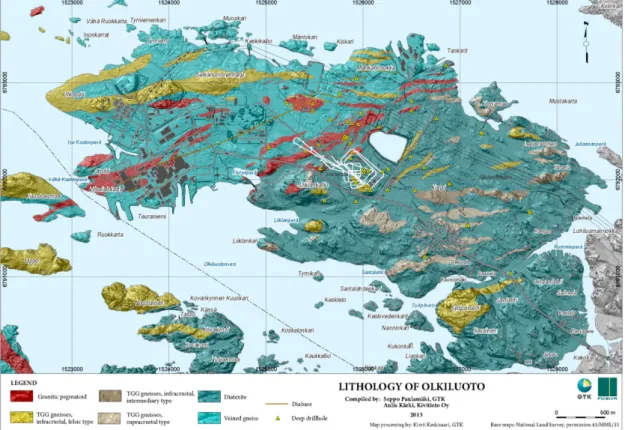
Geology in Olkiluoto is complex, characterised by crystalline bedrock dominated by migmatitic, foliated gneiss with some brittle deformation zones crossing the repository area. Massive, coarse-grained pegmatitic granites
Fig. 6. Bedrock map of Olkiluoto (Posiva, 2013).
Fig. 7. Digitized tunnel mapping data from ONKALO (Courtesy of Posiva Oy).
striking strike-slip faults, the low-angle SE dipping zones also being the main hydraulically conductive zone. All in all, the bedrock in Olkiluoto is very heterogeneous and anisotropic both in the small- and medium-scale (Aaltonen et al., 2016).
The detailed geotechnical and geological tunnel mapping has frequently stopped the tunnel excavation, making the excavation time long, however providing never seen set of tunnel mapping data. There are over 100,000 mapped fractures in the Posiva’s research data base, with full mapping data and accurately measured trace (Fig. 7). The average rock mass quality has in general been good or very good after first 130 m depth (Johansson et al., 2015).
in detail by Johansson et al. (2014), Valli et al. (2014) and Siren et al. (2015a). In the in situ experiment it was concluded that the rock strength is largely defined by the heterogeneous geology, because the weakest parts of the rock fail in structurally controlled (see Fig. 8) manner (Siren et al., 2015a). The mean rock UCS strength is 108 MPa, however it ranges from 40 MPa to 180 MPa. After excavation new fractures have been created subcritically at the repository level, however no brittle spalling type failures has been observed.
The observed discontinious failure pattern causes a discontinious flow path that reduces the hydraulic conduc- tivity from the disposal facility to the ground surface.
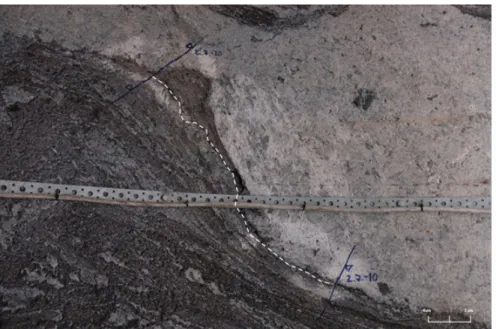
Fig. 8. One observed structurally controlled shear failure in disposal hole perimeter under compressive stress field. The dotted line
indicates crack growth in the ONK-EH1 experiment hole that occurred sometime after boring of the hole and before boring of the
second experiment hole. The crack growth was observed on the 2nd of July 2010.
Continuous spalling formations could create radionuclide transport routes in situations in which nuclear waste canisters are damaged.
Based on the experimental results, the vertical disposal concept (KBS-3V) suffers from initiation of new fractures sometime after excavation. However, according to the calculations, the horizontal disposal concept suffers from no fracture initiation when the tunnels are excavated; however, approximately 60 years after commencement of the disposal, both concepts will be prone to fracture initiation. Neither of the disposal concepts is expected to suffer from any major rock mass failure. This stems from the secondary stresses being well below the rock mass strength (Siren, 2015).
Based on the modelling, the vertical disposal concept is not particularly sensitive if the trend of the tunnels is within 30° of the major principal stress direction. In overall the rock mechanics research conducted during last 10 years reveal that, the rock damage in Olkiluoto is modest and
rock is well-suited for nuclear waste disposal (Siren, 2015).
Hydrogeology
The groundwater flow is one of the most important research areas for the long-term safety of the repository.
The groundwater flow is a significant potential pathway for transport of components which may be harmful for containment and for radionuclides that are released from the spent fuel. Groundwater also affects to the evolution of the groundwater composition, possibly being harmful for the engineering barrier (EBS) and canister. The hydraulic properties in large depend on connectivity of the fractures through the repository space. The transmissivity of fractures intersecting boreholes has also been measured by Posiva’s Flow Log (PFL) tool. While excavating the tunnels of ONKALO, the hydraulic head of different sections of surface boreholes have been monitored. Based on this it has been possible to characterize the transmissivity of the bedrock. Also the
Fig. 9. Transmissivity of brittle deformation zone at disposal site. Boreholes shown in the figure is from the surface down to ca.
1 km (Modified after Posiva, 2013).
disturbance of tunnel excavation has been monitored during construction. Particularly interesting sub-vertical zones HZ20A and OL-BFZ020A are crossing the access tunnel of ONKALO and shafts at depth of approximately -300 m.
The zones have significantly higher transmissivity (in scale of 10
-5m
2/s) compared to the adjanced bedrock (Fig. 9).
The total groundwater inflow to whole ONKALO facility was only 32 l/min in 2016 (Posiva, 2017).
Geochemistry
The prevailing groundwater composition affects to the performance of the engineered barrier system system and the solubility of the radionuclides. Therefore the ground- water composition has been studied in detail in ONKALO.
The groundwater compositions at different time periods are based on the groundwater flow modelling and the general understanding of the geochemical evolution at the site.
The groundwater at repository depth is brackish and saline, and dilution with time due to infiltration of meteoric water is modelled when the safety of repository is assessed for 100,000 years. An interpretation of history and current composition of Olkiluoto bedrock geochemistry is presented in Fig. 10 (Hellä et al., 2014).
Conclusions
Posiva Oy has developed it’s expertise for decades aiming for their sole goal of safe disposal of spent nuclear fuel.
The Finnish spent nuclear fuel programme is proceeding determinedly towards the start of disposal in 2020s. So far the programme has been following the milestones set in 1983. The construction of the on site rock characterization facility ONKALO has significantly increased the site specific knowledge. The ONKALO has enabled direct in situ measurements, experiments and testing of different investigation tools underground. In addition to the in situ tests, all the observations made during the ONKALO excavations and constructions have also provided valuable information for the rock mass property characterisation to build up more reliable site descriptive models. The ongoing and future tests will confirm the elements of the final disposal concept and will demonstrate the design, construction and host rock suitability assessment process (RSC) to be utilized during the final disposal. All that information is essential for the repository design and for the safety analyses. The ONKALO facility plays an important role in Posiva’s repository development programme.
The Radiation and Nuclear Safety Authority evaluated
Fig. 10. Schematic representation of interpreted history and current composition of Olkiluoto bedrock geochemistry since the last
glacial period. Dashed lines implies minor mixing of groundwaters (Posiva, 2013).
in 2015 that the facility for spent nuclear fuel can be built to be safe (STUK, 2015). Later in 2015 Finnish Parlament decided to grant a Construction license for the final disposal facility (TEM, 2015). The decision made Finland an inter- national pioneer in nuclear waste management and provides commercial opportunities in developing nuclear waste management and construction of responsible and safe repository in other countries.
Acknowledgements
The author wishes to thank Posiva Oy and their consulting company Posiva Solutions Oy for help and permission to use material. The viewpoints and conclusions presented in the paper are solely those of the author.
References
Aaltonen, I., Engström, J., Front, K., Gehör, S., Kosunen, P., Kärki, A., Paananen, M., Paulamäki, S., and Mattila, J., 2016. Geology of Olkiluoto, POSIVA Report 2016-16, Posiva Oy, Eurajoki, Finland, 398p.
Hakala, M., Kemppainen, K., Siren, T., Heine, J., Christiansson, R., Martin, C.D., and Koskinen, T., 2012. Experience with a new LVDT-Cell to measure in-situ stress from an existing tunnel. Proc. of the EUROCK 2012 - Rock Engineering and Technology for Sustainable Underground Construction, ISRM, Stockholm, Sweden, 14p.
Hellä, P., Pitkänen, P., Löfman, J., Partamies, Wersin, P., and Vuorinen, U., 2014. Safety Case for the Disposal of Spent Nuclear Fuel at Olkiluoto - Definition of Reference and Bounding Groundwaters, Buffer and Backfill Porewaters.
POSIVA Report 2014-4, Posiva Oy, Eurajoki, Finland, 164p.
Ikonen, K. and Raiko, H., 2012. Thermal Dimensioning of Olkiluoto Repository for Spent Fuel. Working report 2012-56, Posiva Oy, Eurajoki, Finland, 70p.
Johansson, E., Siren, T., Hakala, M., and Kantia, P., 2014.
ONKALO POSE Experiment – Phase 1 & 2: Execution and Monitoring. Working report 2012-60, Posiva Oy, Eurajoki, Finland, 130p.
Johansson, E., Siren, T., and Kemppainen, K., 2015. ONKALO – Underground Rock Characterization Facility for In-Situ Testing for Nuclear Waste Disposal. Proc. of the 13th ISRM International Congress of Rock Mechanics, ISRM, Montreal, Canada, 17p.
Juvankoski, M., 2013. Buffer Design 2012, Posiva report
2012-14, Posiva Oy, Eurajoki, Finland, 247p.
Keto, P., Hassan, M., Karttunen, P., Kiviranta, L., Kumpulainen, S., Korkiala-Tanttu, L., Koskinen, V., Jalonen, T., Koho, P., and Sievänen, U., 2013. Backfill Production Line 2012.
Design, Production and Initial State of the Deposition Tunnel Backfill and Plug, Posiva report 2012-18, Posiva Oy, Eurajoki, Finland, 164p.
McEven, T., and Äikäs, T., 2000. The Site Selection Process for a Spent Fuel Repository in Finland - Summary Report, Posiva Report 2000-15, Posiva Oy, Helsinki, Finland, 231p.
Posiva, 2013. Olkiluoto Site Description 2011, Posiva report 2011-02, Posiva Oy, Eurajoki, Finland, 1029 p.
Posiva, 2014. Posiva chose friction stir welding for the encapsulation of spent nuclear fuel. Press release, http://www.
posiva.fi/en/media/press_releases/posiva_chose_friction_s tir_welding_for_the_encapsulation_of_spent_nuclear_fuel.
2277.news
Posiva, 2017. Nuclear waste management of the Olkiluoto and Loviisa power plants - Summary 2016. Yearly summary, http://www.posiva.fi/files/4658/Olkiluodon_ja_Loviisan_
voimalaitosten_ydinja_tehuollon_toimintakertomus_2016_
ENGLANTI._netti.pdf
Saanio, T., Ikonen, A., Keto, P., Kirkkomäki, T., Kukkola, T., Nieminen, J., and Raiko, H., 2012. Design of the Disposal Facility 2012, Working report 2013-17, Posiva Oy, Eurajoki, Finland, 190p.
Siren, T., 2015, Excavation damage zones, fracture mechanics simulation and in situ strength of migmatitic gneiss and pegmatitic granite at the nuclear waste disposal site in Olkiluoto, Western Finland, D.Sc.(Tech.) Thesis, Aalto University, Finland, 55p.
Siren, T., Hakala, M., Valli, J., Kantia, P., Hudson, J.A., and Johansson, E., 2015a. In situ strength and failure mechanisms of migmatitic gneiss and pegmatitic granite at the nuclear waste disposal site in Olkiluoto, Western Finland. Int. J.
Rock Mechanics and Mining Sciences, 79, 135-148.
Siren, T., Kantia, P., and Rinne, M., 2015b. Considerations and Observations of Stress-Induced and Construction-Induced Excavation Damage Zone in Crystalline Rock. Int. J. Rock Mechanics and Mining Sciences, 73, 165 –174.
STUK, 2015. Nuclear waste facility can be built to be safe.
Press release, http://www.stuk.fi/web/en/-/stuk-nuclear-waste- facility-can-be-built-to-be-safe
Suikkanen, J., Lönnqvist, M., and Hökmark, H., 2016. Analyses of the Stability of a KBS-3H Deposition Drift at the Olkiluoto Site during Excavation, Thermal Loading and Glacial Loading, Posiva Report 2016-15, Posiva Oy, Eurajoki, Finland, 118p.
TEM, 2015. Posiva receives a construction licence for a spent
nuclear fuel disposal facility. Press release, http://valtioneu-
Topias Siren
Dr. Topias Siren works as post-doctoral researcher at the Department of Civil Engineering, Aalto University, Finland. He specialized in rock mechanics issues related to disposal of spent nuclear fuel, while working as project manager at Posiva. His current research topics include the time-dependent and mechanical behaviour of rocks at disposal site. Lately he has been also involved in research of thermal energy storages in high latitudes and related to this project he visited SNU for 3 months in early 2017 as visiting researcher.
(E-mail; [email protected])