I. INTRODUCTION
The world is experiencing an unprecedented crisis in 2020 due to the spread of the COVID-19. The aviation industry, which is classified as a national key industry, has been particularly affected significantly to an extent that its foundation is shaken to this day. How- ever, the air cargo sector is showing a growth trend centering on some items. Therefore, the
purpose of this study is to analyze the trend of air cargo exports before and after the COVID- 19, and to examine the possibility of overcoming the crisis and growth of the aviation industry through future prospects. According to the analysis results, air cargo exports in Korea increased rapidly due to the growth trend of high-value-added high-tech IT products and vitalization of e-commerce prior to the COVID- 19. It was analyzed recently that the wireless communication devices and displays centering on semiconductors account for the majority of exports by item, China is the largest exporter by country, and the growth rate of Vietnam is steep. Since the COVID-19, the growth trend has continued centering on computers and its peripheral devices, and it can be characterized by a significant increase in the transport rate of cargo aircraft. In addition, the transport cost is stabilizing for short-/medium-hauls, while
Technical Review
https://doi.org/10.12985/ksaa.2020.28.4.164 ISSN 1225-9705(print) ISSN 2466-1791(online)Analysis and Prospect of Export Trend of Air Cargo Market before and after COVID-19
Young-Rok Kim*, Jae-Hwan Lim**, Yun-Chul Choi***
ABSTRACT
Recently, the aviation industry faced a major crisis due to the impact of COVID-19.
However, despite the sluggish passenger transportation, the cargo transportation sector is relatively maintained or increasing depending on the item. In this study, we will look at the trends before and after COVID-19, focusing on the cargo export field, which is a concern of the aviation industry. First, it analyzes the entire air cargo and then analyzes the trends of each item and country in detail. In particular, it examines the process of changes in air transport costs, which increased significantly immediately after COVID-19, and conducts future trends and prospects in the cargo export field. As a result of the study, some characteristics of air cargo exports before and after COVID-19 were found in an analysis by item and country, and transportation costs varied according to route distance.
Key Words : COVID-19(코로나19), Air Cargo Export Field(항공화물 수출 분야), Future Trend and Prospect(향후 동향과 전망), Air Transport Cost(항공운송비용)
Received: 20. Nov. 2020, Revised: 02. Dec. 2020, Accepted: 09. Dec. 2020
* Professor, Department of Aeronautical Science & Flight Operation, Silla University
** Professor, Department of Aviation Management &
Logistics, Catholic Kwandong University
*** Professor, Department of Aviation, Hanseo University Corresponding Author E-mail : [email protected] Corresponding Author address : Room 531, Maria Hall, Catholic Kwandong University, Gangneung-si, Gangwon-do, Korea
the cost for long-hauls still remains high.
This study was conducted in the following order. First, the characteristics of air cargo exports were examined, and trends of air cargo exports before and after the COVID-19 were analyzed by item and country. After examining the process of changes in air transport costs, the findings of this study were summarized and the future air export market was prospected.
Ⅱ. BODY
2.1 Characteristics of air cargo export Air transport refers to an economical activity1) in which passengers or cargo are transported to two or more destinations through airports and airways by means of transport called aircraft. In terms of the characteristics of air cargo export, first, punctuality and speed are required, product quality is maintained con- stantly during the transport, and the risk of damage is relatively small. In addition, it is characterized by a small-scale transportation system mainly on high value-added products and IT products with a higher level of charge than other means.
In terms of the representative export products, air transport is used for most of the high value-added products such as semiconductors, computers, and wireless communication devices since they have more risk of damage in pro- portion to the duration of transport. In addition, in the case of pharmaceuticals, cosmetics, and other goods that have some risk, it is common to use air transport to control the external environment such as temperature. Moreover, the recent expansion of consumer demand for express delivery has led to the advancement of total logistics, which has rather lowered the charges than in the past and, thereby expanding the transport market centering on small con-
sumer goods as a result. In particular, the customer satisfaction can be increased by reali- zing fast and relatively low fares through efficient connection between air and land transport.
2.2 Air cargo export status analysis
2.2.1 Total export status
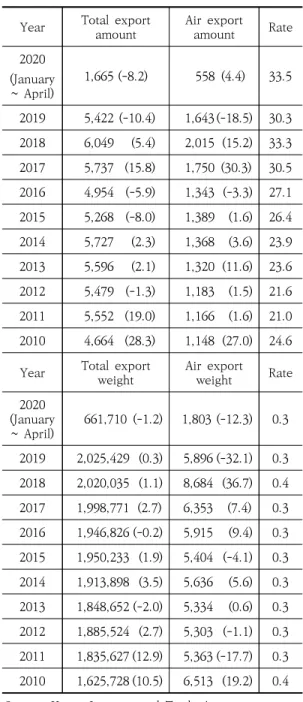
As shown in Table 1, air cargo exports before the COVID-19 have been increasing for a decade at a higher rate than total exports every year. However, air exports totaled $164.3 billion, which is a 18.5% decrease year on year, in 2019. The proportion of total exports also declined for the first time in a decade. The rate of decline is even more evident in the export weight. It increased by 36.7% year on year in 2018, while it decreased significantly by 32.1% in 2019. The fact that it accounts for more than 30% of the amount while it still accounts for less than 0.3% of the weight clearly shows that the air transport export items have become high added value.
Air cargo exports have grown at an annual average rate of about 3.5% over the past decade, which seems to be due to the expansion of the e-commerce market, the advancement of the export industry, and the diversification of the air transport market. First, the expansion of the e-commerce market shows that exports of consumer goods such as fashion goods and cosmetics have contributed significantly as the direct overseas reverse purchasing has been actively established in emerging economic economies such as China and ASEAN. In terms of the scale of the direct overseas reverse purchasing and the proportion of air transport with China, it accounted for 861.8 billion won in 2015, but it increased about 6 folds to 5,178.1 billion won in 2019. Moreover, mainly expensive and small products such as semi-
1) Paul Shaw and Stephen J. Shaw. Transport: Strategy and Policy, p. 63.
conductors and wireless communication devices are being exported through air transport accor- ding to the export industry advancement strategy.
In addition, it was analyzed that the supply of the cargo transport market as a whole has increased due to the expansion of cargo aircrafts and the increase in demand for air passengers as the supply pattern of air transport services has also diversified.
Since the COVID-19, air cargo exports from January to April 2020 amounted to $55.8 billion, accounting for 33.7% of the total exports. This is about a 5% increase year on year. On the other hand, the total export during the same period was 166.5 billion won, which is about an 8% decrease year on year.
Even after the COVID-19, air cargo exports were mainly used for light weight and expensive items. Comparing the export unit price during this period, air cargo accounted for appro- ximately 1842) times that of cargo shipping and more than about 80% of the total export of the major export items such as semiconductors, wireless communication devices, and computers used air transport. In addition, the proportion of air transport was high in exports to nearby regions centered on Asia. In particular, the proportion of air transport in exports to Hong Kong was high, since semiconductors accounted for about 68% of total exports to Hong Kong.
2.2.2 Export status by item
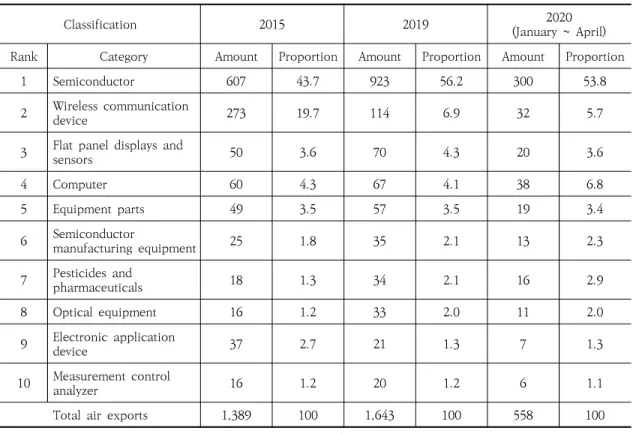
As shown in Table 2, in terms of air cargo exports by item, the top three items centering on semiconductors, which can be referred to as high-value products, accounted for more than 67% of the total air cargo exports as of 2019.
In fact, although it decreased in 2019 from 2018, the total air cargo exports was $164.3 billion, of which the total amount of the top three items was $110.7 billion, an increase of about 19% from $93 billion in 2015, which can be analyzed that the phenomenon of export bias of certain commodities remained signi-
2) Air cargo : 558/181 = 3.0829, cargo shipping : 1,100/65,425 = 0.0168 (unit: 100 million dollars/
thousand tons).
Table 1. Air cargo export status unit: 100 million dollars (100 tons, %)
Year Total export amount
Air export
amount Rate
2020 (January
~ April)
1,665 (-8.2) 558 (4.4) 33.5
2019 5,422 (-10.4) 1,643 (-18.5) 30.3 2018 6,049 (5.4) 2,015 (15.2) 33.3 2017 5,737 (15.8) 1,750 (30.3) 30.5 2016 4,954 (-5.9) 1,343 (-3.3) 27.1 2015 5,268 (-8.0) 1,389 (1.6) 26.4 2014 5,727 (2.3) 1,368 (3.6) 23.9 2013 5,596 (2.1) 1,320 (11.6) 23.6 2012 5,479 (-1.3) 1,183 (1.5) 21.6 2011 5,552 (19.0) 1,166 (1.6) 21.0 2010 4,664 (28.3) 1,148 (27.0) 24.6
Year Total export weight
Air export
weight Rate
2020 (January
~ April)
661,710 (-1.2) 1,803 (-12.3) 0.3
2019 2,025,429 (0.3) 5,896 (-32.1) 0.3 2018 2,020,035 (1.1) 8,684 (36.7) 0.4 2017 1,998,771 (2.7) 6,353 (7.4) 0.3 2016 1,946,826 (-0.2) 5,915 (9.4) 0.3 2015 1,950,233 (1.9) 5,404 (-4.1) 0.3 2014 1,913,898 (3.5) 5,636 (5.6) 0.3 2013 1,848,652 (-2.0) 5,334 (0.6) 0.3 2012 1,885,524 (2.7) 5,303 (-1.1) 0.3 2011 1,835,627 (12.9) 5,363 (-17.7) 0.3 2010 1,625,728 (10.5) 6,513 (19.2) 0.4 Source: Korea International Trade Association,
( ) is the year-on-year rate of change.
ficant. By item, although semiconductors in- creased significantly in 2017 and 2018, they decreased by about 26% year on year in 2019, accounting for 56% of all air cargo, and wireless communication devices have been showing a decreasing trend since 2015.
In particular, as shown in Table 3, pesticides and pharmaceuticals have recorded a significant increase rate of over 14% per year on average over the past five years. Among them, phar- maceuticals reached $4.1 billion in 2019, with an annual average increase of 16% over the past six years, starting at $1.5 billion in 2013 through continuous technology development and product advancement. Among them, the amount of air transport was about $3.4 billion, with air
transport accounting for about 83% of the total exports.
Among air exports, the top five items such as semiconductors and computers, which can be referred to has high-tech products, accounted for most of the exports at 73.3% of the total air exports. In the case of semi- conductors, the largest export item, the pro- portion of semiconductors has continuously decreased since 2018 until recently, while the proportion of computers has increased since the COVID-19. In detail, the amount of computer exports increased by about 2.2 times from
$1.68 billion to $3.76 billion year on year, and data recording media increased by about 3.5 times from $0.91 billion to $3.2 billion in
3) MTI (Ministry of Trade and Industry, import/export classification system by industry/item): The Ministry of Trade, Industry and Energy uses 6-digits as a classification standard.
Table 2. Air export status by item (Unit: 100 million dollars, %)
Classification 2015 2019 2020
(January ~ April)
Rank Category Amount Proportion Amount Proportion Amount Proportion
1 Semiconductor 607 43.7 923 56.2 300 53.8
2 Wireless communication
device 273 19.7 114 6.9 32 5.7
3 Flat panel displays and
sensors 50 3.6 70 4.3 20 3.6
4 Computer 60 4.3 67 4.1 38 6.8
5 Equipment parts 49 3.5 57 3.5 19 3.4
6 Semiconductor
manufacturing equipment 25 1.8 35 2.1 13 2.3
7 Pesticides and
pharmaceuticals 18 1.3 34 2.1 16 2.9
8 Optical equipment 16 1.2 33 2.0 11 2.0
9 Electronic application
device 37 2.7 21 1.3 7 1.3
10 Measurement control
analyzer 16 1.2 20 1.2 6 1.1
Total air exports 1,389 100 1,643 100 558 100
Note: Top 10 items based on export amount in 2019 (MTI3) 3-digit headings).
Source: Korea International Trade Association.
particular.
As shown in Table 4, a feature of the change in the air exports since the COVID-19 is that the proportion of cargo aircrafts has increased.
In the case of exports in 2019, the ratio of cargo aircraft and passenger aircraft was about 6:4, but the proportion of cargo aircraft increased by about 20% due to the recent decrease in passenger flight operations, showing a ratio of about 7:3.
2.2.3 Export status by country
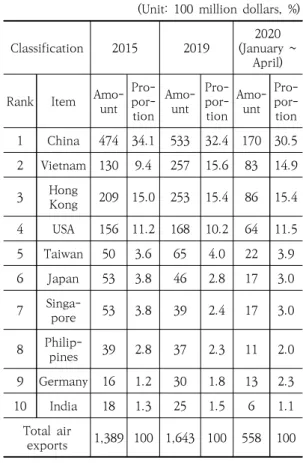
As shown in Table 5, the amount of air exports by country as of 2019 was in the order of China and Vietnam, with the top five countries accounting for about 78% of the total
air exports. Air exports from these five countries increased by about 25% from $101.9 billion in 2015 to $127.6 billion in 2019, and their pro- portion increased from 73.3% to 77.6% over the same period. China, the largest trading country in air exports, accounted for 32.4% of the total air exports, but decreased by 1.8% points year on year. On the other hand, Vietnam has grown rapidly from 4th in 2015 to 2nd in 2019, which seems to be due to the expansion of production lines related to semiconductors and mobile devices.
Even after the COVID-19 outbreak, the amount of air exports remained high mainly in Asia, which is in a relatively short distance. Air exports to the top five countries such as China and Hong Kong accounted for the majority of Table 3. Pharmaceutical export status
(Unit: 100 million dollars, %)
Year
Total exports amount
Air exports amount
Air export rate
2013 15 11 71.4
2014 17 12 72.1
2015 23 18 78.4
2016 27 22 80.7
2017 32 26 80.5
2018 37 30 81.1
2019 41 34 82.9
Source: Korea International Trade Association.
Table 4. Air cargo export ratio by aircraft type (Unit: 100 million dollars, %)
Year Cargo
aircraft
Passenger
aircraft Total
2019 1,016(62) 627(38) 1,643
2020 January ~
April
394(71) 164(29) 558
Note: ( ) is the ratio of cargo aircraft to passenger aircraft.
Source: Korea International Trade Association, Korea Civil Aviation Association.
Table 5. Air export status by country
(Unit: 100 million dollars, %)
Classification 2015 2019
2020 (January ~
April)
Rank Item Amo- unt
Pro- por- tion
Amo- unt
Pro- por- tion
Amo- unt
Pro- por- tion 1 China 474 34.1 533 32.4 170 30.5 2 Vietnam 130 9.4 257 15.6 83 14.9
3 Hong
Kong 209 15.0 253 15.4 86 15.4
4 USA 156 11.2 168 10.2 64 11.5
5 Taiwan 50 3.6 65 4.0 22 3.9
6 Japan 53 3.8 46 2.8 17 3.0
7 Singa-
pore 53 3.8 39 2.4 17 3.0
8 Philip-
pines 39 2.8 37 2.3 11 2.0
9 Germany 16 1.2 30 1.8 13 2.3
10 India 18 1.3 25 1.5 6 1.1
Total air
exports 1,389 100 1,643 100 558 100 Note: Top 10 countries based on export amount in 2019.
Source: Korea International Trade Association.
exports at about 76.2% of the total. In particular, in the case of Hong Kong, air transport accoun- ted for about 84% of the total export amount of $10.2 billion, of which about two-thirds were semiconductors. However, in the case of China, the proportion has been gradually decreasing since 2018.
2.2.4 Air cargo transport cost status
Immediately after the recent spread of the COVID-19, cargo transport costs temporarily surged due to the decrease and suspension of passenger flights. However, the cost of short-/
medium-haul cargo transport has been gradually stabilizing as many airlines expanded their cargo aircrafts supply to secure profitability. In particular, as shown in Table 6, although the cost of short-/medium- haul cargo transport rose temporarily immediately after the COVID- 19, it is analyzed that transport costs have reached a stable stage as the supply of cargo aircrafts increased mainly in Asia. In detail, transport costs at Shanghai and Hanoi airports are recovering to pre- COVID-19 levels, while transport costs at Singapore airports remain high.
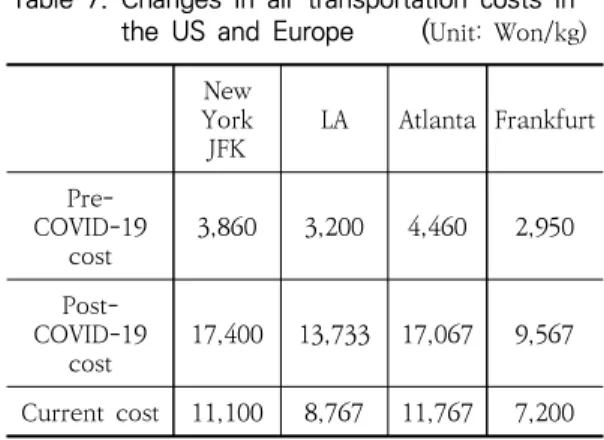
On the other hand, as shown in Table 7, for long-hauls, transport costs skyrocketed nearly five folds immediately after the COVID-19, and
the cost still remains high due to the limited supply of cargo aircrafts. However, there is sufficient possibility of a drop in transport costs as demand may decrease due to the efforts of airlines to supply additional cargo aircrafts to recover profitability and the prospects of continued economic contraction in major exporting countries.
Ⅲ. CONCLUSION
Korea achieved rapid economic growth through expanded exports under rather un- favorable circumstances such as limited resource conditions and geopolitical location compared to other countries. However, the global aviation industry, including Korea, is facing a big crisis due to the recent impact of the COVID-19. However, air cargo exports (January ~ April 2020) increased by about 4.4%
year on year fortunately due to steady semi- conductor exports, increased computer unit prices, and increased exports in related sectors despite the rapid decline in revenue in the passenger sector.
Although the limited cargo supply due to the decrease in passenger flight operations led to an increase in air transport costs immediately after the COVID-19, it is currently only limited mainly to long-hauls. As mentioned above,
Table 7. Changes in air transportation costs in the US and Europe (Unit: Won/kg)
New York JFK
LA Atlanta Frankfurt
Pre- COVID-19
cost
3,860 3,200 4,460 2,950
Post- COVID-19
cost
17,400 13,733 17,067 9,567
Current cost 11,100 8,767 11,767 7,200 Source: Korea International Trade Association, as
of June 2020.
Table 6. Changes in air transportation costs in
Asia (Unit: Won/kg)
ClassificationShanghai Pudong
Hong Kong Airport
Hanoi Singapore
Pre- COVID-19
cost
700 600 1,650 900
Post- COVID-19
cost
1,200 1,300 3,500 3,733
Current cost 833 800 1,967 3,733 Source: Korea International Trade Association, as
of June 2020.
cargo transport costs are expected to decline in the future due to the expansion of cargo aircraft supply and a decrease in demand amid the global economic contraction. In particular, the strengthening of the certification require- ments for personal protective equipment from China to the US due to the COVID-19 and the contraction in consumer sentiment in the Americas and Europe are expected to lower the cargo transport costs, which is prospected to be a positive factor in the growth of the air cargo export sector. Moreover, it is prospected that about 8,000 Boeing 747-class large cargo aircrafts will be required to transport 10 billion doses of the COVID-19 vaccine worldwide according to a recent report released by IATA.
Since this can be analyzed as a potential oppor- tunity for the growth of the air cargo market in the future, Korean airlines also need to be prepared preemptively.
References
1. Paul, S. and Stephen J. S. (1993). “Transport:
Strategy and policy”, Wiley-Blackwell.
2. International Air Transport Association. https:
//www.iata.org/
3. Korea Civil Aviation Association. http://ww w.airtransport.or.kr/main.do
4. Korea International Trade Association. https:
//www.kita.net/