정향 및 목향과 백지를 혼합한 한약재 에탄올 추출물의 항산화 효능
윤석나1#, 김유진2, 김미려2, 유왕근3*
1 : 대구한의대학교 일반대학원 보건학과, 2 : 대구한의대학교 한의과대학 본초약리학교실 3 : 대구한의대학교 보건학부
Anti-oxidant effect of ethanol extract from mixture including Caryophylli Flos, Aucklandiae Radix and Angelicae Dahuricae Radix
Seok Na Youn
1#, Yoo Jin Kim
2, Mi Ryeo Kim
2, Wang Keun Yoo
3*1 : Department of Public Health Graduate School, Daegu Haany University, Gyeongsan, Gyeongbuk, Korea 2 : Department of Herbal Pharmacology, Daegu Haany University, Daegu, Korea
3 : Department of Health Science, Daegu Haany University, Gyeongsan, Gyeongbuk, Korea
ABSTRACT
Objectives : Herbal medicinal mixture (JMB) are consisted of Caryophylli Flos, Aucklandiae Radix and Angelicae Dahuricae Radix. Each of herbal medicines has studied on anti-oxidant effect. So this study was conducted to investigate efficacy and potency of JMB on anti-oxidation.
Methods : The JMB was extracted at room temperature by 80% ethanol. And total polyphenol contents, total flavonoid contents in JMB ethanol extract were determined by colorimetric method. Also, DPPH, ABTS free radical scavenging capacity and reducing power of JMB ethanol extract were measured at 100, 500, 1000, 5000 ㎍/㎖ concentrations by spectrometric assay. Positive control was used BHA (butylated hydroxyanisole).
Results : The total polyphenol contents and total flavonoid contents of the extract were 55.38 ㎎/TAEg, 513.72 ㎎ /RUEg, respectively. Also, DPPH free radical scavenging capacity and reducing power of JMB ethanol extract in treated concentrations (100, 500, 1000, 5000 ㎍/㎖) increased dose dependently. In particular, DPPH free radical scavenging capacity of JMB ethanol extract at 500, 1000, 5000 ㎍/㎖ was similar to positive control (BHA) at high concentration (50, 100 ㎍/㎖). ABTS free radical scavenging capacity of JMB ethanol extract at 500, 1000, 5000 ug/ml was similar to BHA at high concentration (50, 100 ㎍/㎖). Also, reducing power was showed that JMB ethanol extract at 5000 ㎍/㎖
was similar to BHA at high concentration (50, 100 ㎍/㎖).
Conclusions : These results suggest that JMB ethanol extract has effects to scavenge free radicals. Therefore, JMB has potential and applicable benefits for development of materials and products to have anti-oxidation functions.
1)
Key words : Anti-oxidant, JMB, free radical scavenging capacity, total polyphenols, total flavonoids
Ⅰ. 서 론
정향(Caryophylli Flos)은 정향나무과(Myristicaceae)에 속
한 상록교목인 정향수(Eugenia caryophyllata Thunb.)의 꽃 봉우리를 채취한 것이다
1). 맛은 맵고 성질이 따뜻하며 독이 없 으며
2), 강렬한 맛과 특이한 냄새를 가진다. 서양에서는 주로 꽃
*Corresponding author : Wang Keun Yoo, Department of Health Science, Daegu Haany University, 1 Haany-daero, Gyeongsan, Gyeongbuk.
·Tel : +82-53-819-1411 ·E-mail : [email protected]
#First author : Seok Na Youn, Department of Public Health Graduate School, Daegu Haany University, 1 Haany-daero, Gyeongsan, Gyeongbuk.
·Tel : +82-51-200-1529 ·E-mail : [email protected]
·Received : 11 October 2018 ·Revised : 05 November 2018 ·Accepted : 25 November 2018
봉우리를 향신료와 방부제로 사용하였으며, 그 외에 치약의 향기성분과 치통에 대한 진통제 등으로도 활용되었다
3,4). 한 의학에서는 비위(脾胃)를 따뜻하게 하고, 곽란(霍亂), 분돈기 (奔豚氣)와 냉기로 배가 아프고 음낭이 아픈 것을 치료하는 등 주로 약재로 사용되었다
5). 정향의 주성분은 eugenol, eugenyl acetate, beta-caryophyllene와 2-heptanone, eugenol salicylate, methyl salicylate, chavicol 등으로 정유 성분을 가진다
6). 또한, 항산화, 항균 등의 효과를 가지는 플라보노이드 의 성분 중 rhamnetin, keampferol을 함유한다
7). 최근 논문 에 따르면 항산화, 항균, 항진균 작용 등의 다양한 약리적 활성 을 나타낸다고 보고되었다
8-11).
목향(Aucklandiae Radix)은 국화과(Compositae)에 속한 다년생 식물인 운목향(
Saussurea lappa)의 뿌리로서 한의학 에서는 구토, 설사 및 염증치료 등에 사용되고 있으며 대표적 인 이기제이다
12). 성질이 따뜻하고 맛은 맵고 쓰며 한의학에 서는 행기지통, 건비소식의 효능이 있어 복통, 설사, 구토, 식 체, 이질 등에 주로 사용되어 왔다
13). 주성분은 costunolide와 dehydrocostus lactone 등으로 sesquiterpene 및 sesquiterpene lactone계 화합물을 함유하고 있다
14,15). 목향의 주성분은 항염 증, 항균, 혈관생성 억제 효능 등의 많은 약리학적 효능을 가진 다고 보고되었다
16-18).
백지(Angelicae Dahuricae Radix)는 산형과(Umbelliferae)
Angelica속의 다년생 초본으로 꽃대가 올라오기 전 채취한 구 릿대의 뿌리를 건조한 것이다. 성질은 따뜻하고 맛은 매우며, 감기, 어지럼증, 두통, 치통 등에 진정 및 진경 효과가 있다. 또 한 어혈을 풀어주고 풍한을 제거하여 혈액순환의 촉진으로 안 면신경통, 산전산후의 하혈, 혈뇨 등을 치료한다
19-21). 백지에는 다량의 무기질과 당을 함유하고
22), 20여종 이상의 coumarin 성분과 angelicosin, imperatorin, anomalin과 정유성분을 함 유한다
23-28). 이러한 백지의 성분은 항혈전
29), 항균작용
26), 약 물대사효소 억제 및 대사 저해 활성
30), acetylcholinesterase 저해 활성
31), 콜라겐 생성 촉진
28), 백혈병
32)등에 약리학적 효 능을 가진다. 또한, Lee 등
33)의 연구에서는 백지의 항산화 효과 가 보고된 바 있다.
활성산소종(reactive oxygen species, ROS)은 생체 내에서 발생하는 것으로 superoxide anion radical, hydroxyl radical, singlet oxygen, hypochlorite, hydrogen peroxide 등을 포 함한다. ROS는 단백질, DNA, 세포 분자들의 산화적 스트레스 를 일으켜 세포 사멸 및 암 발생 등 다양한 질병을 유도한다
34). 항산화제는 이러한 ROS를 제거시킴으로써 생체내산화성 스트 레스로 인하여 생성되는 산화물질들을 억제 또는 중화시켜 ROS로부터의 세포손상을 방어하는 역할을 한다
35). 다양한 합 성 항산화제 물질들이 개발되어 이용되고 있지만, 합성 항산화 제의 과량 사용시 암 유발 등 부작용의 가능성이 있다.
식물에 함유된 페놀 화합물(phenolic compound)은 식물의 광합성 과정에서 생성되어 활성산소로부터 자신을 보호할 수 있는 효소와 이차 대사산물로서 free radical을 수용할 수 있는 phenolic hydroxyl기를 여러 개 가지고 있는 물질이다. 거대 한 분자들과 결합하여 활성산소종을 제거하는 것으로 알려지고
있어
36-38), 천연물이나 한방제제 및 각종 식물성 소재로부터 더
안전하고 생체방어력을 증가시킬 수 있는 천연 항산화제로서 의 항산화 기능성 물질을 탐색하는 많은 연구들이 진행되고 있 다
39).
따라서 본 저자들은 항산화 효능이 보고된 각각의 한약재를 혼합하여 총 폴리페놀과 플라보노이드 함량을 측정하였고, DPPH, ABTS, 환원력 등으로 free radical 소거능을 분석한 결과, 뛰어난 항산화 효과를 나타내는 것을 확인하였으므로 이 를 보고하고자 한다.
Ⅱ. 재료 및 방법
1. 시료 추출
정향, 목향, 백지(중국산, 조은제약(안양, 한국))에 재료의 10배수에 해당하는 80% ethanol을 첨가하여 24시간 실온 추 출한 후 12시간 초음파 추출하였다. Adcantec Filter paper NO.2 이용하여 여과 후 Rotavapor R-210을 사용하여 50
ºC 에서 감압 농축하였다. 15 brix로 농축 후 deep freezer에서 – 70℃로 동결한 뒤 Freeze Dryer FDB-5503을 이용하여 동결 건조 하였다.
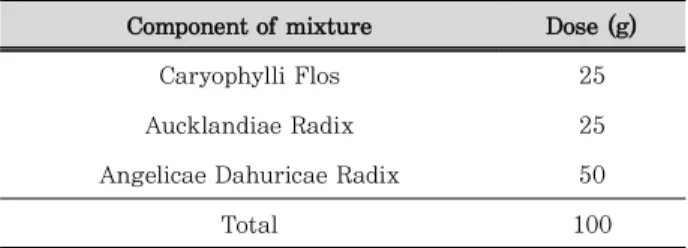
Component of mixture Dose (g)
Caryophylli Flos 25
Aucklandiae Radix 25
Angelicae Dahuricae Radix 50
Total 100
Table 1. Composition of mixed herbal medicine (JMB) ethanol extract
2. 총 폴리페놀 함량 측정
Phosphomolydic acid가 페놀성 물질과 반응하여 청색으로 발색되는 측정법으로 폴리페놀 함량을 측정하였다. 5% DMSO 에 희석한 5000 ㎍/㎖ 농도의 JMB 에탄올 추출물 0.5 ㎖와 Folin & Ciocalteau’s phenol reagent (Sigma) 0.5 ㎖를 잘 혼합한 뒤 상온에서 3분간 반응시켰다. 3분 후 10% Na
2CO
3(sodium carbonate, Junsei) 0.5 ㎖를 첨가하여 충분히 혼합 시킨 뒤 상온에서 1시간 반응시켰다. UV/VIS Spectrophotometer (Lambda35, Perkin Elmer)로 760 ㎚에서 흡광도를 측정하였 으며 측정된 흡광도의 값은 tannic acid (Sigma)를 표준물질로 한 표준검정곡선을 작성하여 총 폴리페놀 함량을 계산하였다.
3. 총 플라보노이드 함량 측정
5% DMSO에 희석한 5000 ㎍/㎖ 농도의 JMB 에탄올 추출
물을 0.1 N NaOH (Generay Biotech) 0.2 ㎖와 diethylene
glycol (Junsei) 2 ㎖를 혼합하여 상온에서 1시간 동안 반응시
켰다. 1시간 후 420 ㎚에서 흡광도를 측정하였으며 표준검정곡
선은 rutin hydrate (Sigma)을 표준물질로 하였다.
JMB
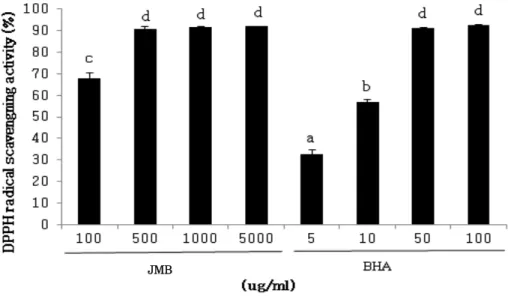
Figure 1. DPPH free radical scavenging activities of ethanol extract from mixed herbal medicine (JMB).
The data were expressed as the mean ± SD (n=3). abcdMeans not sharing a common letter are significantly different among the BHA group at p<0.05.
4. DPPH (1,1-diphenyl-2-picrylhydrazyl) free radical 소거능 측정
양성대조군은 앞선 항산화 실험의 농도를 토대로 하여
40-42)butylated hydroxyanisole (BHA, Sigma)를 5 ㎍/㎖, 10 ㎍/㎖, 50 ㎍/㎖, 100 ㎍/㎖의 농도로 하여 사용하였다. 5% DMSO를 용매로 하여 JMB 에탄올 추출물을 농도별로 희석하여 각각 1 ㎖와 에탄올에 희석한 0.4 mM DPPH (1,1-diphenyl-2- picrylhydrazyl, Sigma) 0.05 ㎖를 vortex mixer (G-560, Scientific industries)로 혼합하였다. 상온에서 30분간 차광하 여 반응시킨 반응액을 517 ㎚에서 흡광도를 측정하였다.
5. ABTS radical 소거능 측정
양성 대조군은 BHA를 사용하였으며 2'-azino-bis (3- ethylbenzothiazoline-6-sulfonic acid; ABTS+)의 색을 띤 양이온 라디칼이 감소하는 것을 측정하였다. 100 ㎖ 증류수에 희석한 2.45 mM potassium persulfate (Sigma)에 7 mM ABTS (2,2-azino-bis (3-ethylbenzthiazoline-6-sulfonic acid) diammonium salt, Sigma)와 혼합하였다. 상온에서 차 광한 후 16시간 방치시켜 ABTS+를 생성시켰다. ABTS+가 0.7±0.05의 값을 나타내도록 에탄올에 희석하여 734 ㎚에서 흡광도를 측정하였다. 에탄올에 희석하여 만든 ABTS 시약 1
㎖와 5% DMSO를 용매로 한 JMB 에탄올 추출물 0.05 ml를 혼합하였다. 30℃에서 20분 반응시킨 후 734 ㎚에서 흡광도를 측정하였다.
6. Reducing power (환원력) 측정
JMB 에탄올 추출물을 100, 500, 1000, 5000 ㎍/㎖의 농도 로 5% DMSO에 희석한 후 각각 0.1 ㎖를 분주하였다. JMB 에 탄올 추출물에 0.2 M 인산 완충액 (phosphoric acid, Duksan, pH 6.8) 0.25 ㎖와 1% potassium ferricyanide (K
3Fe(CN)
6,
Duksan) 0.25 ㎖를 혼합하여, 항온수조(WB-11, Daihan scientific) 50℃에서 20분간 반응시켰다. 반응액에 10% TCA (trichloroacetic acid, Duksan)를 0.25 ㎖ 첨가하였다. 원심 분리를 3000 rpm에서 10분간하여 상층액을 취하였다. 발색반 응을 유도시키기 위해 ferric chloride (Fecl
3)를 0.1% 농도로 하여 0.05 ㎖를 넣은 후 700 ㎚에서 흡광도를 측정하였다.
7. 통계처리
실험결과 통계 처리는 SPSS 11.5 (SPSS Inc., USA)를 사 용하여 분석하였다. one-way-ANOVA를 실시하여, 분석결과 에 대한 p<0.05 수준에서 Duncan 사후 검정을 통하여 각 군 간의 평균값에 대한 유의성을 나타내었다.
Ⅲ. 결 과
1. 총 폴리페놀 및 총 플라보노이드 함량
JMB 에탄올 추출물의 항산화 활성을 평가하기 위해 항산화 관련 작용이 보고되어 있는 총 폴리페놀과 총 플라보노이드 함 량을 측정하였다. 추출물에 함유된 총 폴리페놀 및 플라보노이 드는 건조 시료의 g당 tannic acid와 rutin의 ㎎으로 나타내었 을 때 각각 55.38 ㎎/TAEg, 513.72 ㎎/RUEg 이었다(Table 2).
Total polyphenols Total flavonoids (㎎/TAEg)1) (㎎/RUEg)2)
JMB 55.38±1.15 513.72±1.21
The data were expressed as the mean ± SD. (n=3).
1) Tannic acid equivalents. 2) Rutin equivalents.
Table 2. The total polyphenol and total flavonoid contents of ethanol extract from mixed herbal medicine (JMB).
JMB
Figure 2. ABTS radical scavenging activities of ethanol extract from mixed herbal medicine (JMB).
The data were expressed as the mean ± SD (n=3). abcdMeans not sharing a common letter are significantly different among the BHA group at p<0.05.
JMB
Figure 3. Reducing power of ethanol extract from mixed herbal medicine (JMB).
The data were expressed as the mean ± SD (n=3). abcdMeans not sharing a common letter are significantly different among the BHA group at p<0.05.
2. DPPH free radical 소거활성
JMB 에탄올 추출물의 항산화 활성을 평가하기 위해 DPPH 라디칼 소거능을 측정하였다. 추출물 및 양성대조군인 BHA의 처리농도별로 소거활성을 측정한 결과, JMB 에탄올 추출물과 BHA가 농도 의존적으로 유의하게 증가하였다. 100 ㎍/㎖, 500
㎍/㎖, 1000 ㎍/㎖, 5000 ㎍/㎖의 농도로 JMB 에탄올 추출물 을 처리한 결과 각각 67.84%, 90.88%, 91.77%, 91.96%를 나 타냈다. 양성 대조군인 BHA를 5 ㎍/㎖, 10 ㎍/㎖, 50 ㎍/㎖, 100 ㎍/㎖의 농도로 처리한 결과 32.63%, 56.65%, 91.28%, 92.64%로 측정되었다. 따라서 JMB 에탄올 추출물의 500 ㎍/㎖, 1000 ㎍/㎖, 5000 ㎍/㎖에서 고농도의 BHA와 유의적인 차이 가 없는 것으로 보임으로써 지방질 산화 억제 및 인체 내의 활 성 라디칼에 의한 노화를 억제시키는 DPPH 라디칼 소거 활성
이 탁월함을 보여주었다 (Figure 1).
3. ABTS radical 소거능 측정
ABTS는 항산화 활성을 탐색하기에 안정한 자유라디칼의 특 징을 가지는 항산화 바이오 마커이므로 JMB 에탄올 추출물을 처리 후 소거능을 측정하였다. 100 ㎍/㎖, 500 ㎍/㎖, 1000
㎍/㎖, 5000 ㎍/㎖의 농도로 JMB 에탄올 추출물을 처리한 결
과, 각 농도별로 84.88%, 92.03%, 91.87%, 91.75%를 나타내
었다. 양성 대조군인 BHA를 5 ㎍/㎖, 10 ㎍/㎖, 50 ㎍/㎖,
100 ㎍/㎖의 농도로 처리한 결과 각각 40.12%, 74.26%,
91.71% 91.75%로 농도 의존적으로 증가하였으며, JMB 에탄올
추출물의 처리농도인 중~고농도(500 ㎍/㎖ 이상)에서 고농도의
BHA의 효능과 유사하여 통계적으로 차이가 없었다(Figure 2).
4. Reducing power (환원력) 측정
환원력은 항산화제로서 사용될 수 있는 시료를 측정하기에 가장 대표적인 지표로 산화된 물질을 환원시키는 능력을 의미 한다. JMB 에탄올 추출물의 환원력을 각 처리농도에서 측정한 결과, 각각 47.53%, 75.56%, 82.99%, 85.01%를 나타내었으 며 농도 의존적으로 유의한 증가를 보였다. 한편 양성대조군인 양성 대조군인 BHA를 5 ㎍/㎖, 10 ㎍/㎖, 50 ㎍/㎖, 100 ㎍/
㎖의 농도로 처리한 결과 각각 36.43%, 51.41%, 81.83%, 85.85%를 나타내었다. 따라서 JMB 에탄올 추출물의 1000 ㎍ /㎖, 5000 ㎍/㎖ 처리농도에서는 고농도의 양성 대조군과 통 계적으로 유의한 차이가 나타나지 않았다(Figure 3).
Ⅳ. 고 찰
최근 서구화된 식생활로 인한 비만, 고콜레스테롤증, 고지 혈, 고혈압, 당뇨, 동맥경화 등의 질병과 급속한 경제성장으로 인해 생활 습관병이 발병하여 여러 합병증이 유발된다고 보고 되었다
43). 특히, 이러한 식습관과 스트레스로 인한 활성산소의 증가는 각종 질병의 원인이 된다. 또한, 평균수명이 늘어나고 인구 고령화가 급증함에 따라 소비자들의 생활수준 및 위생수 준의 향상과 건강에 관한 관심이 높아지고 있으며
44), 웰빙에 대 한 만성질환, 성인병 등을 예방할 수 있는 기능성 식품의 선호 도가 증가하고 있다. 따라서 약리학적 기능을 가진 천연물을 이 용한 기능성 식품 개발에 따른 연구가 활발히 진행되고 있다
45). 본 연구에서 사용된 복합 한약재의 구성 한약재인 정향 및 목향 은 방향이 있는 이기약이며, 백지는 해표약으로서 풍한사를 없 애고 혈액순환을 원활히 하여 통규, 지통시키므로
2,13,19)항염, 항산화, 항혈전 등 활성산소와 관련된 생활습관병이나 스트레 스나 면역관련 질환의 개선을 포함하는 항산화 효능이 뛰어날 것으로 사료되어 기초연구인 본 실험을 진행하였다.
항산화제는 천연 항산화제와 합성 항산화제로 구분되는데 대 표적인 합성 항산화제는 butylated hydroxytoluene (BHT), butylated hydroxyanisole (BHA)로 식품첨가물로 이용된 다
35). 합성 항산화제는 저렴한 가격으로 널리 사용되지만 과량 섭취 시 암 등의 부작용이 우려되어 안전성이 보장된 천연 항산 화제의 개발이 요구되고 있다
46).
폴리페놀 화합물은 과일 및 엽채류 등 식물계에 널리 분포되 어 있으며 flavonoids, tannins, isoflavones, anthocyanins, catechins, lignans, resveratrols 등을 함유한다
47,48). 폴리페 놀에 다수 존재하는 hydroxy radical (-OH)는 여러 화합물과 쉽게 결합하는 특성을 가져 항산화, 항염, 항암 등의 효과가 뛰
어나다
49,50). 플라보노이드는 담황색의 페놀계 화합물에 속하는
성분으로 식물, 곡물, 과일 등에 풍부하게 함유되어 있다
51). 항 염, 항암, 항바이러스 등의 효과가 있으며 항산화 효과로 활성 산소종을 제거한다고 알려져 있다
52-55). 본 실험에서 쓰 총 폴 리페놀과 플라보노이드의 함량을 측정한 결과 총 폴리페놀의 함량이 55.38 ㎎/g, 총 플라보노이드의 함량이 513.72 ㎎/g으 로 높게 나타났다. 총 플라보노이드 함량이 폴리페놀 함량에 비 해 높게 나타난 것은 Kim 등
56)의 연구에서 여러 식물의 폴리페
놀 및 플라보노이드 함량을 측정하였을 때 추출 과정과 용매에 따라 반드시 폴리페놀의 함량이 높게 나타나지 않는다고 보고 된 것으로 보아 추출 과정과 용매를 달리하여 추가적인 실험이 진행되어야 한다고 사료된다.
DPPH radical 소거능은 항산화 활성을 측정하는 대표적인 반응물질이며 그 자체로 안정한 자유라디칼이다. 자색의 화합 물이 노란색으로 탈색되는 원리를 이용한 방법으로 hydroxy radical (-OH)을 함유하는 페놀계 화합물을 가지는 물질에서 수소 공여로 인한 라디칼 소거 활성이다
57). 본 연구에서 JMB 에탄올 추출물을 농도별로 처리하여 측정한 결과 67.84%, 90.88%, 91.77%, 91.96%를 나타내었으며 32.63%, 56.65%, 91.28%, 92.64%인 BHA와 비교하여 고농도인 BHA와 통계적 인 차이를 나타나지 않는 것으로 보아 높은 소거활성이 측정되 었다.
ABTS radical 소거능은 폴리페놀계의 화합물을 함유하는 물질에서 소거활성이 증가되며 DPPH radical 소거능과 유의적 인 상관관계를 갖는다
56,58). Radical의 기질에 따라 선택적으로 작용하는 페놀계 물질이 존재하므로 DPPH와 ABTS radical 소거능을 모두 측정하였다. ABTS radical 소거 활성을 농도별 로 측정한 결과 84.88%, 92.03%, 91.87%, 91.75%를 나타내 었으며 양성대조군인 BHA는 40.12%, 74.26%, 91.71% 91.75
%로 측정되었다. DPPH radical 소거능과 유사하게 JMB 에탄 올 추출물의 중~고농도(500 ㎍/㎖ 이상)에서 BHA의 고농도와 통계적인 차이가 없었다.
환원력은 활성 산소와 유리기에 작용하는 전자 공여능으로 항산화 활성을 검정하는 수단이다. 항산화 활성이 큰 물질일수 록 녹색에 가깝게 발색되며 높은 흡광도를 나타낸다
59). 본 실험 에서는 JMB 에탄올 추출물과 BHA를 농도별로 처리한 결과 각 각 47.53%, 75.56%, 82.99%, 85.01%와 36.43%, 51.41%, 81.83%, 85.85%를 나타내었으며 농도 의존적으로 유의한 증 가를 보였다. 또한 추출물의 고농도와 BHA의 고농도에서 유의 적인 차이가 나타나지 않았다.
본 실험은 정향, 목향, 백지를 혼합하여 항산화 효과를 확인 하기 위해 실행되었다. Cha 등
60)의 연구에서 DPPH radical 소 거능을 통해 1000 ㎍/㎖ 정향의 항산화 활성을 측정하였을 때 51.61%가 측정되었다. 목향의 80% 에탄올 추출물을 이용한 Lee 등
61)의 연구에서는 DPPH와 ABTS radical 소거 활성이 1
㎍/㎖, 10 ㎍/㎖, 100 ㎍/㎖의 처리농도에서 각각 6.6±1.7%, 23.0±1.9%, 87.5±1.0%와 0.7±0.5%, 9.1±1.1%, 47.7±
2.8%로 측정되었다. 또한, 백지를 실험한 Lee 등
62)의 연구에 서는 100 ㎍/㎖에서 1000 ㎍/㎖까지의 농도에서 DPPH radical 소거능이 3.38%~33.45%로 측정되었다. 본 연구에서는 100
㎍/㎖, 500 ㎍/㎖, 1000 ㎍/㎖, 5000 ㎍/㎖의 처리농도에서
DPPH와 ABTS radical 소거 활성능이 각각 67.84%, 90.88%,
91.77%, 91.96%와 84.88%, 92.03%, 91.87%, 91.75%로 측
정되었다. 따라서, JMB 에탄올 추출물은 기존의 연구에서 보
고한 단독 한약재의 항산화 활성결과보다 우수한 항산화 활성
을 보였다. 또한 일반적인 천연유래 시료의 항산화력보다 뛰어
난 효력을 보였으며, 양성대조군으로 사용된 합성 BHA와도 비
교할만한 항산화 효능, 효력을 보임으로써 한약재 3종 복합물
이 산화과정에서 유도되는 자유기의 소거 활성이 우수함을 나 타냈다. 본 논문에서는 데이터를 제시하지는 않았지만 OH- 소 거능에서도 우수한 효과를 보였다. 또한 추출용매별 항산화 활 성의 탐색 연구에서도 용매별로 차이를 보여 항산화과정에는 지용성물질이 관여하는 것으로 생각된다. 그러므로 추후 세포 에서의 항산화와 관련된 기전 및 유효 성분 분석 등에 대한 추 가 연구가 필요할 것으로 판단되며, JMB는 항산화와 관련된 건강 기능 식품 및 화장품, 의약 원료 등의 기능성 소재로 활용 될 가능성이 있을 것으로 사료된다.
Ⅴ. 결 론
본 연구에서는 JMB 80% 에탄올 추출물의 기초연구로서, 항 산화 활성을 실험한 결과 다음과 같은 결론을 얻었다.
1. JMB 에탄올 추출물의 총 폴리페놀 및 총 플라보노이드 함량이 높게 측정되었다.
2. JMB 에탄올 추출물의 DPPH radical 소거능을 측정한 결과 농도 의존적으로 유의하게 증가하였고, 중~고농도 (500 ㎍/㎖ 이상)에서 양성 대조군인 BHA의 효능과 유사 하여 통계적으로 차이가 없었다.
3. JMB 에탄올 추출물의 ABTS radical 소거능은 농도 의 존적이었으며, 중~고농도(500 ㎍/㎖ 이상)에서는 양성 대조군인 BHA의 효능과 유사하게 나타나 통계적으로 차이가 없었다.
4. JMB 에탄올 추출물의 환원력은 농도 의존적으로 유의하 게 증가하였고, 양성 대조군인 BHA와 고농도(500 ㎍/㎖
이상)에서 효능이 유사하여 통계적으로 차이가 없었다.
따라서 실험 결과 한약재 복합물인 JMB 에탄올 추출물의 항산화능이 탁월하였으므로, 항산화와 관련된 질환의 예방 및 치료를 위한 식품, 의약품 및 화장품 소재로서의 활용 가능성이 기대된다.
References