pISSN 2289-0203ㆍeISSN 2383-7101 http://dx.doi.org/10.15747/jcn.2015.7.3.70
2015 Canadian 임상진료지침의 변경사항
이대상
삼성서울병원 중환자의학과
Changes in 2015 Canadian Clinical Practice Guidelines
Dae-Sang Lee
Department of Critical Care Medicine, Samsung Medical Center, Seoul, Korea
Careful nutritional strategy is an essential component in the management of critically ill patients. Evidence-based clinical practice guidelines can be an effective solution to improving the process and structure of nutritional strategy for critically ill patients.
The 2015 Canadian clinical practice guidelines (CPGs) summarized the evidence from approximately 354 randomized controlled trials in the area of critical care nutrition since 1980. The Canadian CPGs were first developed in 2003 and have been updated every 2 years. It is important for the acquisition of new evidence-based knowledge. This paper includes a brief summary on changes in 2015 CPGs compared with 2013 CPGs.
Key Words: Practice guideline, Nutrition, Critical care
Received Dec 13, 2015; Revised Dec 16, 2015; Accepted Dec 17, 2015 Correspondence to Dae-Sang Lee
Department of Critical Care Medicine, Samsung Medical Center, 81 Irwon-ro, Gangnam-gu, Seoul 06351, Korea
Tel: +82-2-3410-6357, Fax: +82-2-2148-7088, E-mail: [email protected] Conflict of interest: None.
This is an Open Access article distributed under the terms of the Creative Commons Attribution Non-Commercial License (http://creativecommons.org/licenses/by-nc/4.0) which permits unrestricted non-commercial use, distribution, and reproduction in any medium, provided the original work is properly cited.
서 론
중환자에서의 영양공급 전략은 단순히 열량을 공급하는 것이 아니라 환자의 전반적인 상태에 대한 이해를 바탕으로 세워져 야 한다. 하지만 최근의 연구들은 기존의 연구나 통념과는 모순 된 결과를 보고하고 있으며, 이러한 상반되는 결과를 실제 임상 에 적용하는 것은 어렵다. 체계적으로 개발된 임상진료지침은 임상의사의 의사결정뿐만 아니라, 환자의 예후를 향상시키고 비용절감에도 도움이 된다.1,2 Canadian clinical practice guidelines (CPGs)는 2003년 9월 처음 발표되었으며, 이후 2
년마다 최신지견을 추가하여 주제별로 strongly recommend, recommend, should be considered, do not recommend, in- sufficient data로 분류, 권고한다. 2013년 Canadian CPGs가 발표된 이후로 중환자 영양과 관련된 41개의 새로운 무작위 비 교연구(randomized controlled trial, RCT)가 더 진행되었다.
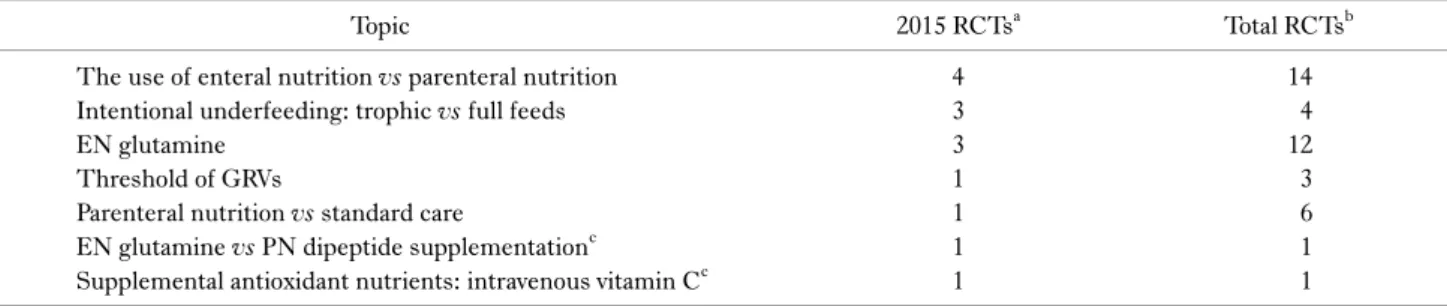
2015년 Canadian CPGs에서는 12개의 대주제와 몇몇 소주제 에 대해서 총 46개의 권고사항을 제안하였다.3 5가지 주제에 대 해서는 권고수준의 변경이 있었으며, 글루타민의 투여 경로에 따른 비교(enteral glutamine vs parenteral glutamine)와 비 타민 C에 대한 주제가 추가되었다(Table 1). 이미 중환자에서 의 조기 영양공급과 경관영양공급의 유용성은 잘 알려져 임상 에서도 적용이 되고 있지만, 아직도 간과되고 있는 몇몇 사항과 2015년에서 바뀐 권고사항에 대해서 소개해 보고자 한다.
본 론
1. The use of enteral nutrition
vs
parenteral nutrition 메타분석(meta-analysis)에 따르면 경장영양공급은 정맥영Table 1. Changes and new topics in Canadian clinical practice guidelines 2015
Topic 2015 RCTsa Total RCTsb
The use of enteral nutrition vs parenteral nutrition 4 14
Intentional underfeeding: trophic vs full feeds 3 4
EN glutamine 3 12
Threshold of GRVs 1 3
Parenteral nutrition vs standard care 1 6
EN glutamine vs PN dipeptide supplementationc 1 1
Supplemental antioxidant nutrients: intravenous vitamin Cc 1 1
EN = enteral nutrition; GRVs = gastric residual volumes; PN = parenteral nutrition; RCTs = randomized controlled trials.
aNumber of randomized controlled trial newly included Canadian clinical practice guidelines 2015 compared with 2013.
bTotal numbers of randomized controlled trial included under each topic in Canadian clinical practice guidelines 2015.
cNew topics in Canadian clinical practice guidelines 2015.
양공급에 비하여 감염 합병증을 줄여주고, 중환자실 재원기간 을 줄여주는 것으로 알려져 있다.4 또한 병원 재원기간 감소와 사망률 감소와도 관련이 있는 것으로 알려져 있다. 하지만, 2,400명의 환자를 RCT한 CALORIES trial은5 조기 경장영양 공급을 시행한 군과 조기 정맥영양을 시행한 군의 30일 사망률 에 차이가 없음을 보고하였다(34.2% vs 33.1%, P=0.57). 이는 경장영양공급을 통한 열량과 정맥영양공급 열량이 비슷하게 이 루어진 기존의 연구들에서 보여주었던 경장영양공급의 긍정적 경향을 희석시킬 정도의 대규모 연구였다. 더구나 조기 경장영 양공급군에서 저혈당과 구토(vomiting)의 빈도가 2배 더 많은 것으로 관찰되었다. CALORIES trial은5 이제까지 보고된 연구 중 가장 대규모의 RCT로 메타분석에서도 약 50%의 비중 (weight)을 차지하고 있어 앞으로 다른 연구가 진행된다고 하 더라도 경장영양공급의 사망률에 미치는 영향을 바꾸기에는 어 려워 보인다. 2015년 Canadian CPGs에서는 사망률에는 차이 가 없었지만, Harvey 등5의 연구뿐만 아니라 다른 연구들에서도 공통적으로 보여주는 경장영양공급에 따른 감염 합병증 감소에 대한 긍정적 효과에 주목하여 여전히 경장영양공급의 중요성을 인정하였지만, 구토와 흡인에 따른 위험성과 저혈당의 위험을 강조하였다. 따라서 2015년 Canadian CPCs에서는4 영양지원 이 필요한 중환자에게 정맥영양보다 경장영양공급을 우선하라 는 권고수준을 ‘strongly recommend’에서 ‘recommend’로 하 향 조정하였다.
2. Intentional underfeeding: hypocaloric enteral nutrition 의도된 저열량경장공급(intentional underfeeding)은 2013 년 Canadian CPGs에서6 처음 언급된 권고사항으로, 단순히 적 은 열량을 주는 것이 아니라 단백질은 필요량을 공급하면서 (1.1∼1.5 g/kg/day) 필요 열량의 40%∼70% 이하의 열량을 공 급하는 것을 의미한다. 2011년 Arabi 등7이 발표한 연구에 따르
면 의도된 저열량공급이 사망률을 낮춘다고 보고하였지만, 2013년 Canadian CPGs에서는6 근거자료의 부족으로 권고를 하지는 못하였다. 이후 3개의 RCT가8-10 추가되었으며 메타분 석에서11 기계호흡기간을 줄여주고(relative risk [RR], −2.34;
95% confidence interval [CI], −4.15∼−0.53; P=0.01), 중 환자실 사망률(RR, 0.85; 95% CI, 0.67∼1.07; P=0.17)과 원 내 사망률(RR, 0.85; 95% CI, 0.71∼1.01; P=0.07)이 감소하 는 경향을 보여주었다. 2015년 Canadian CPGs에서는11 이러 한 결과를 바탕으로 영양위험도가 낮은 환자에 한해서 적절한 단백질공급이 전제된 의도된 저열량경장공급을 고려해 볼 수 있다고 권고하였다(should be considered).
3. Enteral glutamine
글루타민(glutamine, C5H10N2O3)은 외상, 화상, 패혈증 등의 중증질환상태에서 요구량이 증가하는 조건부 아미노산이
다.12,13 이러한 중증질환 환자에게 글루타민을 공급하는 것은 환
자의 예후를 향상시킬 수 있을 것으로 예상되어 많은 연구가 진 행되었다. 하지만 2013년 Canadian CPGs에서 제시한 메타분 석 결과는 경장 글루타민의 공급은 병원 재원기간을 줄여주지 만, 사망률, 감염, 중환자실 재원기간에는 영향이 없었다. 다만 화상환자에서는 사망률의 뚜렷한 감소를 보여주었다(RR, 0.19;
95% CI, 0.06∼0.67). 이후에 3개의 RCT가14-16 더 추가되었지 만, 이 연구들이 포함된 메타분석에서도 화상환자의(subgroup analysis) 사망률의 감소와 감염위험의 감소를 제외하고는 이전 결과와 별다른 차이를 보이지는 않았다.17
최근 van Zanten 등14의 연구에서는 경장 글루타민을 공급한 내과계 환자들에서 고식적 영양공급을 시행한 내과계 환자들에 비하여 사망률이 더 높았다(54% vs 35%; P=0.04). 이는 쇼크 (shock)나 다장기부전(multi-organ failure) 환자가 많이 포함 된 REDOXS 연구에서18 보고하였던 글루타민 사용군에서의 높
Fig. 1. Incidence of regurgitation and aspiration by range of residual volume. There were no positive trend in regurgitation (P=0.134) and aspiration (P=0.412) by range of residual volume. P-value was analysed by Cochran-Armitage test for positive trend. Data from the article of McClave et al. Crit Care Med 2005;33(2):324-30.21 은 사망률과 같은 결과이다. REDOXS 연구에서는18 글루타민 의 사용이 쇼크 상태이거나 다장기 부전이 있는 환자들에게 주 로 이루어졌다는 것과, 권장량(0.2∼0.35 g/kg)보다 과량(0.6∼
0.8 g/kg)을 사용하였다는 한계가 있으나 van Zanten 등14의 연 구와 REDOXS 연구18를 근거로 2015 Canadian CPGs에서는 중환자에서 경장 글루타민을 사용하지 말 것을 권고하였다. 이 는 2013년의 화상환자에서의 선택적 경장 글루타민 사용을 고 려할 수 있다는 권고수준에서 하향 조정된 것으로, 향후 화상 환 자를 대상으로 한 전향적연구인 RE-ENERGIZE Study19 결과 가 나올 때까지 경장 글루타민의 사용을 모든 중환자에서 제한 할 것을 권고하였다.17
4. Threshold of gastric residual volumes
중증환자들에서 고용량의 승압제 사용 및 불안정한 상태로 인 하여 위장관 운동이 감소되어 있으며, 많은 위잔여량으로 인한 구토나 흡인의 위험성을 우려하여 경장영양공급을 망설이게 되 는 경우가 많다. 하지만 McClave 등20의 연구에 따르면 위잔여 량 증가에 따른 역류나 흡인의 위험이 통계적으로 더 증가하지 않았고(Fig. 1), 경장영양공급을 제한하는 위잔여량 기준을 200 mL로 한 군과 400 mL로 한 군 간 비교에서 역류나 흡인 발생 의 차이가 없었다. Montejo 등21과 Reignier 등22의 연구에서도 위잔여량에 따른 폐렴 발생에는 차이가 없었으며, 위잔여량 측 정 간격에 따른 예후를 비교한 Williams 등23의 연구에서도 위 잔여량 측정을 4시간마다 하는 것과 8시간마다 하는 것을 비교 하였을 때 사망률, 기계호흡관련폐렴, 중환자실 재원기간 모두
에서 차이를 보이지 않았다. 허용 위잔여량(threshold of gas- tric residual volumes)에 대한 내용은 2013년 Canadian CPGs에서 새롭게 등장한 주제로,24 2015년 Canadian CPGs에 서는25 위잔여량을 250∼500 mL까지 허용할 수 있으며, 4∼8 시간마다 위잔여량을 측정하도록 권고수준을 상향조정하였다 (insufficient data → should be considered).
5. Parenteral nutrition
vs
standard care대부분의 문헌에서 중환자에서 영양공급은 혈역학적으로 안 정된 이후에 가능한 조기에 경장영양으로 시작할 것을 권고하 고 있다.26-28 하지만, 여러 가지 이유로 경장영양공급이 불가능 한 경우에 대한 정맥영양 방법에 대한 권고안은 가이드라인마 다 조금씩 차이를 보인다. 미국정맥경장영양학회 가이드라인에 서는27 중증환자에서 7일 이내의 정맥영양공급을 권고하지 않 지만, 입원 시부터 영양불량이 있었던 환자에 대해서는 혈역학 적으로 안정된 직후부터 정맥영양공급을 권고하고 있다. 반면 유럽정맥경장영양학회 가이드라인에서는26 경장영양공급이 불 가능한 환자에서 48시간 이내에 조기 정맥영양공급을 권고한 다. 2011년에 시행된 다기관 RCT에서는 7일 이후 정맥영양공 급을 시작한 군에 비하여 조기에 정맥영양공급을 시작한 군에 서 감영성 합병증과 사망률이 더 높게 나타났다.29 하지만, ANZICS 그룹이 주도한 2013년의 연구에서는 조기 정맥영양 공급을 시행한 군에서 기계호흡기의 사용기간이 통계적으로 더 짧았으며, 사망률과 감염 합병증에서는 차이가 없었다.30 또한 조기 정맥영양공급군에서 60일째에 평가한 근력에 차이가 없었 지만, 근육량 소실이나 피하지방의 감소가 더 적었다고 보고하 였다. 2015 Canadian CPGs에서는31 이상의 내용을 종합하여 경구영양이 가능한 환자에서는 정맥영양공급을 하지 말 것을 권고하였으며, 조기에 경구나 경장으로 영양공급이 불가능한 영양불량환자에 한해서 조기 정맥영양공급을 고려하여야 한다 고 권고수준을 상향 조정하였다(parenteral nutrition not be used → early parenteral nutrition should be considered in nutritionally high-risk patients with a relative contraindi- cation to early enteral nutrition).
6. Enteral glutamine
vs
parenteral dipeptide supplementationUranjek 등32은 외상을 포함한 외과계 환자들에서 5일간의 경 구 글루타민 공급이 정맥 글루타민 공급에 비하여 중환자실 사 망률을 감소시키고 중환자실 재원기간 및 병원 재원기간이 감 소함을 보고하였다. 경장 글루타민의 사용과 정맥 글루타민의 사용에 대한 내용은 2015년 Canadian CPGs에서 새롭게 등장
한 주제로 경구 글루타민의 공급의 효과에 주목하였지만, 추가 적인 연구가 부족하며, 최근 잇달아 보고되는 중증환자에서 글 루타민의 부정적 효과를14,18 고려하여 이번 가이드라인에서는 권고수준을 결정하지 않았다(insufficient data).33
7. Supplemental antioxidant nutrients: intravenous vitamin C
Fowler 등34은 중증패혈증 환자에서의 고용량의 정맥 비타민 C 사용(200 mg/kg/day)의 안정성과 비타민 C 사용군에서의 C-reactive protein과 procalcitonin 수치의 감소를 보고하였 다. 이와 관련된 몇몇 연구가 ClinicalTrials.gov에 등록되어 진 행되고는 있지만, 아직까지 잘 수행된 RCT 결과는 거의 없는 상황으로 2015년 Canadian CPGs에서는 중증환자에서 정맥 비타민 C 투여에 대한 권고를 유보하였다(insufficient data).35
결 론
중환자에서의 영양공급은 환자의 회복과 예후에 중요한 부분 을 차지한다. 중환자 영양에 대한 많은 관심으로 인하여, 중환자 에서의 조기 경장영양공급에 대한 필요성에 대해서는 누구나 공감하고 있다. 최근의 연구는 조기 경장영양공급이 불가능한 영양불량 환자에 대해서 조기 정맥영양공급의 필요성을 보여주 고 있으며, 영양상태가 양호한 환자에서는 적정량의 단백질공 급과 전체필요열량의 40%∼70% 정도의 열량공급을 제안하고 있다. 한때 immunonutrition으로 각광을 받았던 글루타민은 중증환자에서는 사용이 제한되는 추세이지만, 화상 환자에서의 글루타민 사용과, 외과계 환자에서 경장 글루타민의 사용에 대 한 가능성은 남겨 둘 필요가 있다. 구토와 흡인에 대한 두려움으 로 200 mL 이하의 위잔여량에도 식이진행을 중단하는 것은 환 자의 영양공급계획에 많은 차질을 가져오게 된다. 이러한 두려 움은 관습적인 것으로 여러 근거에 따르면 250 mL까지의 위잔 여량은 구토나 흡인의 위험성을 크게 증가시키지 않으면서 환 자에게 적절한 열량을 공급할 수 있는 수치이다. 중환자 치료에 있어서 많은 상반되는 연구결과가 보고되고 있어 무엇을 어떻 게 임상에 적용할지 판단하는 것은 쉬운 일이 아니다. 최신 근거 에 기반한 가이드라인을 활용하여 각 병원의 실정에 맞는 프로 토콜을 확립하고, 그것을 기반으로 환자에게 적절한 영양지원 을 하도록 노력해야 한다.
REFERENCES
1. Woolf SH, Grol R, Hutchinson A, Eccles M, Grimshaw J. Clinical
guidelines: potential benefits, limitations, and harms of clinical guidelines. BMJ 1999;318(7182):527-30.
2. Lesho EP, Myers CP, Ott M, Winslow C, Brown JE. Do clinical practice guidelines improve processes or outcomes in primary care? Mil Med 2005;170(3):243-6.
3. 2015 Canadian clinical practice guidelines [Internet]. Kingston:
Critical Care Nutrition;2015 [cited 2015 Dec 9]. Available from:
http://criticalcarenutrition.com/index.php?option=com_conte nt&view=category&layout=blog&id=25&Itemid=109.
4. The use of enteral nutrition vs. parenteral nutrition [Internet].
Kingston:Critical Care Nutrition;2015 [cited 2015 Dec 9]. Avail- able from: http://criticalcarenutrition.com/docs/CPGs%202015/
1.0%202015.pdf.
5. Harvey SE, Parrott F, Harrison DA, Bear DE, Segaran E, Beale R, et al; CALORIES Trial Investigators. Trial of the route of early nutritional support in critically ill adults. N Engl J Med 2014;
371(18):1673-84.
6. 2013 Canadian clinical practice guidelines [Internet]. Kingston:
Critical Care Nutrition;2013 [cited 2015 Dec 9]. Available from:
http://criticalcarenutrition.com/index.php?option=com_conte nt&view=category&layout=blog&id=21&Itemid=10.
7. Arabi YM, Tamim HM, Dhar GS, Al-Dawood A, Al-Sultan M, Sakkijha MH, et al. Permissive underfeeding and intensive insulin therapy in critically ill patients: a randomized controlled trial. Am J Clin Nutr 2011;93(3):569-77.
8. Petros S, Horbach M, Seidel F, Weidhase L. Hypocaloric vs normocaloric nutrition in critically ill patients: a prospective randomized pilot trial. JPEN J Parenter Enteral Nutr 2014. doi:
10.1177/0148607114528980. [Epub ahead of print]
9. Charles EJ, Petroze RT, Metzger R, Hranjec T, Rosenberger LH, Riccio LM, et al. Hypocaloric compared with eucaloric nutri- tional support and its effect on infection rates in a surgical intensive care unit: a randomized controlled trial. Am J Clin Nutr 2014;100(5):1337-43.
10. Arabi YM, Aldawood AS, Haddad SH, Al-Dorzi HM, Tamim HM, Jones G, et al; PermiT Trial Group. Permissive under- feeding or standard enteral feeding in critically ill adults. N Engl J Med 2015;372(25):2398-408.
11. Intentional underfeeding: hypocaloric enteral nutrition [In- ternet]. Kingston:Critical Care Nutrition;2015 [cited 2015 Dec 9]. Available from: http://criticalcarenutrition.com/docs/CPGs%
202015/3.3b%202015.pdf.
12. Hankard R, Mauras N, Hammond D, Haymond M, Darmaun D.
Is glutamine a ‘conditionally essential’ amino acid in Duchenne muscular dystrophy? Clin Nutr 1999;18(6):365-9.
13. Park HJ. Role of parenteral glutamine in nutrition support for critically ill patients. J Clin Nutr 2015;7(2):42-8.
14. van Zanten AR, Sztark F, Kaisers UX, Zielmann S, Felbinger TW, Sablotzki AR, et al. High-protein enteral nutrition enriched with immune-modulating nutrients vs standard high-protein enteral nutrition and nosocomial infections in the ICU: a randomized
clinical trial. JAMA 2014;312(5):514-24.
15. Pattanshetti VM, Powar RS, Godhi AS, Metgud SC. Enteral glutamine supplementation reducing infectious morbidity in burns patients: a randomised controlled trial. Indian J Surg 2009;71(4):193-7.
16. Koksal GM, Erbabacan E, Tunali Y, Karaoren G, Vehid S, Oz H.
The effects of intravenous, enteral and combined adminis- tration of glutamine on malnutrition in sepsis: a randomized clinical trial. Asia Pac J Clin Nutr 2014;23(1):34-40.
17. Composition of EN: glutamine [Internet]. Kingston:Critical Care Nutrition;2015 [cited 2015 Dec 9]. Available from: http://
criticalcarenutrition.com/docs/CPGs%202015/4.1c%202015.pdf.
18. Heyland D, Muscedere J, Wischmeyer PE, Cook D, Jones G, Albert M, et al; Canadian Critical Care Trials Group. A randomized trial of glutamine and antioxidants in critically ill patients. N Engl J Med 2013;368(16):1489-97.
19. The RE-ENERGIZE Study: RandomizEd trial of ENtERal Glutamine to minimIZE thermal injury. ClinicalTrials.gov Iden- tifier: NCT00985205 [Internet]. Bethesda:ClinicalTrials.gov [cited 2015 Dec 13]. Available from: https://clinicaltrials.gov/ct2/
show/NCT00985205? term=reenergize&rank=1.
20. McClave SA, Lukan JK, Stefater JA, Lowen CC, Looney SW, Matheson PJ, et al. Poor validity of residual volumes as a marker for risk of aspiration in critically ill patients. Crit Care Med 2005;33(2):324-30.
21. Montejo JC, Miñambres E, Bordejé L, Mesejo A, Acosta J, Heras A, et al. Gastric residual volume during enteral nutrition in ICU patients: the REGANE study. Intensive Care Med 2010;36(8):
1386-93.
22. Reignier J, Mercier E, Le Gouge A, Boulain T, Desachy A, Bellec F, et al; Clinical Research in Intensive Care and Sepsis (CRICS) Group. Effect of not monitoring residual gastric volume on risk of ventilator-associated pneumonia in adults receiving mecha- nical ventilation and early enteral feeding: a randomized con- trolled trial. JAMA 2013;309(3):249-56.
23. Williams TA, Leslie G, Mills L, Leen T, Davies H, Hendron D, et al. Frequency of aspirating gastric tubes for patients receiving enteral nutrition in the ICU: a randomized controlled trial.
JPEN J Parenter Enteral Nutr 2014;38(7):809-16.
24. Strategies to optimize the delivery of EN: use of and threshold for gastric residual volumes [Internet]. Kingston:Critical Care Nutrition;2013 [cited 2015 Dec 9]. Available from: http://
http://criticalcarenutrition.com/docs/cpgs2012/5.5.pdf.
25. Strategies to optimize the delivery of EN: use of and threshold for gastric residual volumes [Internet]. Kingston:Critical Care
Nutrition;2015 [cited 2015 Dec 9]. Available from: http://
criticalcarenutrition.com/docs/CPGs%202015/5.5%202015.pdf.
26. Singer P, Berger MM, Van den Berghe G, Biolo G, Calder P, Forbes A, et al. ESPEN Guidelines on Parenteral Nutrition:
intensive care. Clin Nutr 2009;28(4):387-400.
27. Martindale RG, McClave SA, Vanek VW, McCarthy M, Roberts P, Taylor B, et al; American College of Critical Care Medicine;
A.S.P.E.N. Board of Directors. Guidelines for the provision and assessment of nutrition support therapy in the adult critically ill patient: Society of Critical Care Medicine and American Society for Parenteral and Enteral Nutrition: executive summary. Crit Care Med 2009;37(5):1757-61.
28. Park CM. Nutritional support in critically ill surgical patients. J Korean Soc Parenter Enter Nutr 2013;5(1):15-9.
29. Casaer MP, Mesotten D, Hermans G, Wouters PJ, Schetz M, Meyfroidt G, et al. Early versus late parenteral nutrition in critically ill adults. N Engl J Med 2011;365(6):506-17.
30. Doig GS, Simpson F, Sweetman EA, Finfer SR, Cooper DJ, Heighes PT, et al; Early PN Investigators of the ANZICS Clinical Trials Group. Early parenteral nutrition in critically ill patients with short-term relative contraindications to early enteral nutrition: a randomized controlled trial. JAMA 2013;309(20):
2130-8.
31. Parenteral nutrition vs. standard care [Internet]. Kingston:
Critical Care Nutrition;2015 [cited 2015 Dec 9]. Available from:
http://criticalcarenutrition.com/docs/CPGs%202015/8.0%2020 15.pdf.
32. Uranjek J, Vovk I, Kompan L. Effect of the route of glutamine supplementation (enteral versus parenteral) on intestinal permeability on surgical intensive care unit patients: a pilot study. Surg Pract 2013;17(4):153-60.
33. Enteral glutamine vs. parenteral dipeptide supplementation [Internet]. Kingston:Critical Care Nutrition;2015 [cited 2015 Dec 9]. Available from: http://criticalcarenutrition.com/docs/
CPGs%202015/9.4c%202015.pdf.
34. Fowler AA 3rd, Syed AA, Knowlson S, Sculthorpe R, Farthing D, DeWilde C, et al; Medical Respiratory Intensive Care Unit Nursing, Fisher BJ, Natarajan R. Phase I safety trial of intravenous ascorbic acid in patients with severe sepsis. J Transl Med 2014;12:32.
35. New topic: vitamin C supplementation [Internet]. Kingston:
Critical Care Nutrition;2015 [cited 2015 Dec 9]. Available from:
http://criticalcarenutrition.com/docs/CPGs%202015/11.3%202 015.pdf.