Simultaneous Determination of Plasticizers in Food Simulants Using GC/MS
Na Young Park, Hae Jung Yoon
1, In Shin Kwak
2, Dae Hoon Jeon, Hyun Chul Choi
3, Mi Ok Eum, Hyung Il Kim
2, Jun Hyun Sung
2, So Hee Kim
2, and Young Ja Lee
†Food Additive Standards Division, Korea Food and Drug Administration, Seoul 122-704, Korea
1Food Chemical Residues Division, National Institute of Food and Drug Safety Evaluation, Seoul 122-704, Korea
2Food Additives and Packages Division, National Institute of Food and Drug Safety Evaluation, Seoul 122-704, Korea
3Laboratory Audit and Policy Division, Korea Food and Drug Administration, Seoul 122-704, Korea
4Analysis Team, Sajo Research Institute, Incheon 178-116, Korea
Abstract. Migration levels of plasticizers, di-n-butyl phthalate (DBP), benzyl-butyl phthalate (BBP), di-n-octyl phtha- late (DNOP), di-iso-decyl phthalate (DIDP) and di-iso-nonyl phthalate (DINP), di-(2-ethylhexyl) adipate (DEHA), from 46 poly(vinyl chloride) (PVC) wrap films and 54 PVC gaskets into food simulants were determined using gas chro- matography/mass spectrometry (GC/MS). The method was validated with limit of detection (LOD) of 0.01 ~ 0.02µg/mL for DBP, BBP, DNOP and DEHA, and 2µg/mL for DIDP and DINP. The linearity were found to be > 0.99 for all the compounds in concentration range of 0.1 ~ 81.4µg/mL, and overall recoveries were ranged from 90.4 ~ 99.6%. DBP, BBP, DNOP, DEHA, DIDP and DINP were not detected in food simulants, except 1 wrap sample from which 0.28 and 0.99µg/mL of DEHA were detected respectively when tested with 20% ethanol and n-heptane as food simulants. These values were below the regulatory limitation in European Union (EU).
Keywords Phthalate, Plasticizer, PVC, Analysis, GC/MS
서 론
가소제는 합성수지에 유연성을 부여하기 위하여 첨가하 는 비휘발성 유기화합물이다. 가소제가 사용되는 합성수지 재질은 주로 염화비닐수지(poly(vinyl chloride), PVC)이며, PVC는 비결정성 합성수지로서 내약품성, 내산성, 내알칼리 성, 투명성 및 광택성이 우수하고, 가소제와의 상용성이 좋 아 물성조절을 통한 사용 용도가 광범위하다1). PVC의 가 소제로는 프탈레이트류, 아디페이트류 및 지방산에스테르류 등이 사용될 수 있다. PVC는 사용된 가소제 함량 수준에 따라 경질 PVC와 연질 PVC로 나눌 수 있으며, 가소제 함량이 10% 미만인 경질 PVC는 주로 배관이나 탱크 등 에 사용되며, 가소제 함량이 20% 이상인 연질 PVC는 랩필 름, 장갑이나 호스 등에 사용된다2). 가소제 중 프탈레이트류 로는 di-n-butyl phthalate(DBP), benzyl-butyl phthalate(BBP), di-(2-ethylhexyl) phthalate(DEHP), di-n-octyl phthalate(DNOP), di-iso-nonyl phthalate(DINP), di-iso-decyl phthalate(DIDP) 등이 알려져 있으며, 아디페이트류로는 di-(2-ethylhexyl)
adipate(DEHA)가 알려져 있다3~5).
DBP, BBP, DIDP, DINP, DNOP 및 DEHA는 동물실험 에서 간 및 신장에 영향이 보고된 바 있으며6) 유럽식품안 전청(European Food Safety Authority(EFSA))에서는 DBP, BBP, DIDP, DINP 및 DEHA의 일일섭취허용량(Tolerable Daily Intake(TDI))을 각각 0.5, 0.01, 0.15, 0.15 및 0.3 mg/kg b.w./day로 보고하고 있다7~11).
이러한 가소제는 합성수지에 비하여 분자량이 작으므로 식품용 기구 및 용기·포장에 사용할 경우 식품의 저장, 유 통 과정에서 식품으로 이행될 우려가 있다. 따라서 식품용 기구 및 용기·포장의 경우 위생상 세심한 주의가 필요하 므로, 우리나라뿐만 아니라 유럽연합 및 미국 등 각국에서 는 이에 대한 엄격한 규격을 마련하여 관리하고 있다. 우리 나라에서는 현재 식품용 기구 및 용기·포장의 제조시 DEHP의 사용을 금지하고 있으며12), 2009년 5월 BBP, DBP, DIDP, DINP, DNOP 및 DEHA에 대하여 유럽연합 과 동일하게 각각 30 µg/mL 이하, 0.3 µg/mL 이하, 5 µg/mL 이하, 9 µg/mL 이하, 9 µg/mL이하 및 18 µg/mL이하의 용 출규격을 신설하였다13~14). 미국의 경우에는 21 CFR(Code of Federal Regulation)에 BBP, DEHA, DINP 및 DIDP 등의 가소제를 병마개 개스킷 등에 사용할 수 있는 첨가제 로 허용하고 있기는 하지만, 별도의 용출규격을 설정하고
†Corresponding Author : Young Ja Lee
Food Additives Standards Division, Korea Food and Drug Admin- istration, Seoul 122-704, Korea
E-mail : <[email protected]>
있지 않은 실정이다15).
본 연구에서는 gas chromatography(GC)/mass spectrometry(MS) 를 이용하여 최근 용출규격이 새롭게 마련된 가소제들인 DBP, BBP, DNOP, DEHA, DIDP 및 DINP등에 대한 동 시분석법을 확립하고 국내 유통 중인 식품포장용 PVC 랩 필름 및 병마개 개스킷에서 식품유사용매별 이행실태를 조 사하였다.
재료 및 방법
1. 실험재료
2008년 5월부터 8월까지 3개월 간 국내 8개 도시(서울, 대전, 대구, 부산, 인천, 광주, 전주, 원주)에 위치한 대형할 인마트와 백화점 등에서 PVC 재질 병마개 개스킷 54 품 목, 식품 포장용 랩 46품목 등 총 100 품목을 구입하여 실험재료로 사용하였다.
2. 시약 및 시액
분석에 사용한 n-헵탄, 헥산, 아세톤은 Merck사(Germany) 의 HPLC용 시약을 정제없이 사용하였다. 표준물질로 BBP 와 DNOP는 Supelco사(USA), DBP와 DEHA는 Wako사 (Japan), 그리고 DIDP와 DINP는 Fluka사(USA)에서 각각 구입하여 사용하였다.
3. 표준용액의 조제
DBP 표준품 30 mg을 정밀히 달아 아세톤에 녹여 100 mL로 한 액을 DBP 표준원액으로 하였다. BBP, DNOP, DEHA, DIDP 및 DINP 표준품을 각각 300, 50, 180, 90 및 90 mg씩 정밀히 달아 아세톤에 녹여 10 mL로 한 액을 BBP, DNOP, DEHA, DIDP 및 DINP의 표준원액으로 하 였다. DBP, BBP, DNOP 및 DEHA 각 표준원액 일정량 을 각각 취하여 100 mL 메스플라스크에 합하고 아세톤을 가하여 단계별로 희석한 액을 DBP, BBP, DNOP 및 DEHA 검량선 작성용 혼합표준용액으로 하였다. 따로 DIDP 및 DINP 표준원액 일정량을 각각 100 mL 메스플라
스크에 취하고 각각 아세톤을 가하여 단계별로 희석한 액 을 DIDP 및 DINP 검량선 작성용 표준용액으로 하였다.
4. 시험용액의 조제
현행 식품공전에서 규정하고 있는 시험용액의 조제방법 에 따라 시험용액을 조제하였다12). 식품유사용매로는 병마 개 개스킷의 경우 pH 5를 초과하는 식품과 접촉하는 시료 는 물을, pH 5 이하인 식품과 접촉하는 시료는 4%초산을, 주류와 접촉하는 시료는 20%에탄올을, 유지 또는 지방성식 품을 함유하는 식품과 접촉하는 시료는 n-헵탄을 사용하였 으며, 식품 포장용 랩의 경우 언급한 모든 형태의 식품과 접촉하여 사용될 우려가 있으므로 4가지 모두를 식품유사 용매로 사용하였다.
시료의 용출은 병마개 개스킷의 경우, 개스킷을 병마개로 부터 떼어내어 병 제품 내용물 용량의 2배의 60로 미리 가 온한 식품유사용매에 담근 후 60를 유지하면서 때때로 저 어가며 30분간 방치한 액을 시험용액으로 하였다. 물, 4%
초산 및 20%에탄올을 식품유사용매로 사용한 경우 이를 25 mL를 분액여두에 옮겨 아세톤 : 헥산(1 : 1) 50 mL를 가 하고 2회 추출하여 아세톤·헥산층을 감압농축 한 후 잔류 물을 아세톤으로 녹여 최종 25 mL로 한 액을 시험용액으 로 하였다. 다만 n-헵탄을 식품유사용매로 사용한 경우에는 25oC를 유지하면서 1시간 방치한 액을 그대로 시험용액으 로 하였다.
식품 포장용 랩의 경우, 시료를 5 cm × 5 cm로 자른 다 음 이를 표면적 1 cm2에 대하여 2 mL의 비율로 60로 미리 가온한 식품유사용매에 담근 후 60를 유지하면서 때때로 저어가며 30분간 방치한 한 액을 시험용액으로 하였다. 이 경우에도 n-헵탄을 식품유사용매로 사용한 경우에는 25를 유지하면서 1시간 방치한 액을 그대로 시험용액으로 하였 다. 분석대상 시료 및 식품 성분에 따른 식품유사용매 적용 현황을 Table 1에 요약하였다.
5. 분석기기 및 방법
본 연구에서는 기체크로마토그래프/질량분석기(Gas Table 1. Sample types and food simulants for migration test
Category Food types contacted with sample No. of samples Food simulants
Wrap film All the food types to be contacted 46 Distilled water, 4% Acetic acid, 20% Ethanol, n-Heptane
Gasket
Tea Aqueous (> pH 5) 13 Distilled water
Jam Acidic (< pH 5) 15 4% Acetic acid
Juice Acidic (< pH 5) 12 4% Acetic acid
Pickle Acidic (< pH 5) 4 4% Acetic acid
Salted fish Acidic (> pH 5) 2 Distilled water
Beer Alcoholic 2 20% Ethanol
Soybean milk Aqueous and fatty 5
n-Heptane
Sauce Fatty 1
chromatograph/Mass Spectrometer, GC-6890, MS-5973, Hewlett Packard, Wilmington, DE, USA)를 이용하여 분석하였다.
GC 컬럼은 DB-1701(30 m×0.25 mm, 0.25 µm)을 사용하였 으며, 오븐 온도는 처음 100에서 2분간 머물게 한 후, 1분 당 10oC씩 승온하여 280oC에 도달한 후 10분간 유지하였 다. 표준용액 및 시험용액은 분할주입법(split 10 : 1)을 적용 하여 2 µL씩 주입하였으며, 운반기체로는 헬륨(유량 1.0 mL/min)을 사용하였다. 시료주입구 및 이온원의 온도는 각각 240oC 및 230oC였다. 질량분석은 전자충격이온화 (70eV) 방식을 적용하였으며, 스캔모드에서의 질량범위는 m/z = 50 ~ 500, 선택이온모드(Selected ion mode)에서의 선 택이온은 각각 프탈레이트류에 대하여 m/z = 149, DEHA에 대하여 m/z = 129였다.
결과 및 고찰
1. 크로마토그램 및 질량스펙트럼
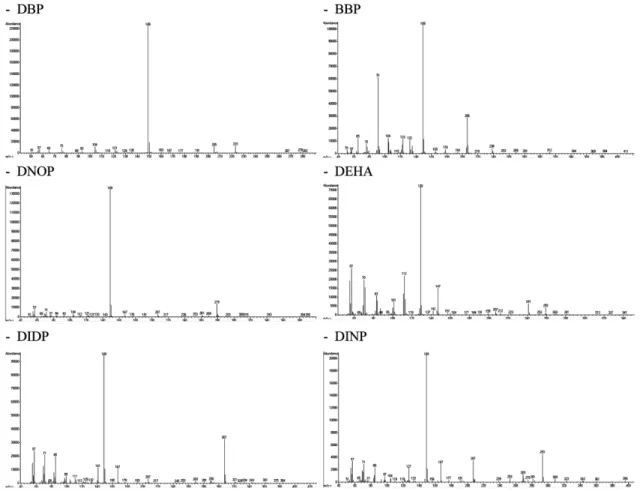
Fig. 1에는 GC/MS 스캔모드로 분석한 결과 얻어진 크로 마토그램의 각 피크로부터 확인한 각 분석물질의 질랑분석 스펙트럼을 나타내었다. Fig. 1에서 보는 바와 같이 프탈레
이트류(DBP, BBP, DEHP, DNOP, DIDP, DINP)의 경우 m/z = 149 이온이, 아디페이트류인 DEHA의 경우 m/z = 129 이온이 가장 감도가 좋은 특성 이온(characteristic fragment ion)임을 확인할 수 있었다3-5).
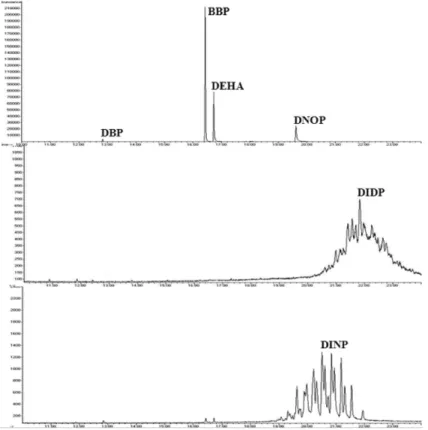
Fig. 2는 Fig. 1에서 확인한 m/z = 129 및 149 이온을 선택이온으로 하여, GC/MS SIM 모드로 분석하여 얻어진 크로마토그램을 나타내었다. Fig. 2에서 보는 바와 같이 개 별 성분에 대한 혼합표준용액 분석 결과, 각각의 성분이 적 절히 분리됨을 확인할 수 있었으며, DIDP 및 DINP의 경 우 10개 이상의 isomer 피크로 나타나며, 각 isomer들을 완전히 분리할 수는 없었으나, 얻어진 피크 패턴으로부터 각 성분의 확인이 가능할 것으로 사료되었다.
2. 분석법 검증
농도별로 조제한 표준용액을 이용하여 검량선을 작성한 결과 Table 2에 요약한 바와 같이 모든 성분에 대하여 주 어진 농도범위에서 상관계수(r2) 0.99 이상의 우수한 직선성 을 확인할 수 있었다. 이 때 DIDP와 DINP는 많은 isomer로 이루어진 혼합물이므로 피크면적은 이들 isomer의 피크면 적의 합으로 하였다.
Fig. 1. Electron impact ionization (EI) mass spectra obtained from TIC chromatograms of each standard solution.
표준용액 분석결과 얻어진 크로마토그램으로부터 signal/
noise(S/N) = 3에 해당하는 농도를 검출한계(limit of detection, LOD)로, S/N = 10에 해당하는 농도를 정량한계(limit of quantification, LOQ)로 결정하였다. 그 결과, DBP, BBP, DNOP, DEHA, DIDP 및 DINP,의 LOD는 각각 0.01, 0.02, 0.01, 0.02, 2 및 2 µg/mL이었으며, LOQ는 각각 0.03, 0.06, 0.03, 0.06, 5 및 5 µg/mL이었다.
식품유사용매인 물, 4% 초산, 20% 에탄올 및 n-헵탄에 DBP, BBP, DNOP 및 DEHA를 첨가하여 각각 최종 0.3, 30, 5 및 18 µg/mL가 되도록 조제하고, 따로 각각의 식품 유사용매에 DIDP 및 DINP 표준용액을 첨가하여 각각 최 종 9 µg/mL가 되도록 조제한 시험용액에 대하여 회수율을 검토한 결과, 모든 식품유사용매에 대하여 90% 이상의 회 수율을 확인할 수 있었으며, 모든 결과를 Table 3에 요약하 였다.
3. 시료의 분석
국내유통 PVC 재질 식품포장용 랩 및 병마개 개스킷에 대한 식품유사용매별 분석결과를 Table 4에 나타내었다. 식 Fig. 2. GC/MS Chromatograms (SIM mode, m/z = 129, 149) for the standard solutions (DBP (0.3µg/mL) of BBP (30µg/mL), DEHA (18µg/mL), DNOP (5µg/mL), DIDP (9µg/mL) and DINP (9µg/mL)).
Table 2. Linearity test results for DBP, BBP, DNOP, DEHA and DIDP and DINP
DBP BBP DNOP DEHA DIDP DINP
Cal. range
(µg/mL) 0.1~40.3 0.1~39.8 0.1~41.2 0.1~40.3 5.1~81.4 5.2~81.4
Y = ax + b y = 479112x− 166462
y = 213304x− 103879
y = 431876x− 343804
y = 175358x− 134410
y = 163043x− 917377
y = 222521x− 1108247
R2 0.9995 0.9992 0.9981 0.9982 0.9923 0.9945
Table 3. Recovery test results for DBP, BBP, DNOP, DEHA, DIDP and DINP from different food simulants
Recovery percents from food simulants (%) Distilled
water
4% Acetic acid
20%
Ethanol n-Heptane DBP 92.1±3.0 94.3±0.4 96.8±1.7 99.1±5.3 BBP 96.0±2.3 97.0±1.1 93.9±1.0 99.6±3.8 DNOP 92.4±2.4 93.4±1.1 90.5±1.4 95.6±3.7 DEHA 92.2±2.1 96.1±1.2 93.0±1.3 94.1±3.7 DIDP 90.4±2.0 95.8±1.0 93.3±1.1 95.6±3.9 DINP 93.2±0.6 91.4±0.8 90.5±1.0 91.6±2.1
품포장용 랩 46품목에 대한 분석결과, 4가지 식품유사용매 모두에 대하여 DBP, BBP, DNOP, DEHA, DIDP 및 DINP는 모두 불검출이었으며, 1개 품목에서 20% 에탄올, n-헵탄으로 용출시 DEHA가 각각 0.28 µg/mL 및 0.99 µg/mL 수준으로 검출되었으나, 이는 유럽연합의 DEHA의 이행량 기준인 18 µg/mL과 비교해볼 때 매우 낮은 수준으로 안전 성에는 문제가 없는 것으로 판단되었다. 또한, 병마개 개스 킷의 경우 대상 식품의 유형에 따라 식품유사용매를 선정 하여 이행량을 조사하였으며 Table 4에서 보는 바와 같이 54품목에서 DBP, BBP, DNOP, DEHA, DIDP 및 DINP 는 모두 불검출이었다.
결 론
GC/MS를 이용하여 DBP, BBP, DNOP, DEHA, DIDP 및 DINP의 분석방법을 확립하였으며, DBP, BBP, DNOP 및 DEHA의 경우 LOD는 0.01 ~ 0.02 µg/mL였다. DIDP 및 DINP의 경우 LOD는 각각 2 µg/mL였으며, 가소제 6 개 성분 모두 직선성은 0.99 이상, 식품유사용매에 대한 회 수율은 90% 이상으로 우수한 직선성과 회수율을 보였다.
확립된 분석방법을 적용하여 국내 유통 중인 PVC재질의 기구 및 용기·포장(랩 46품목, 개스킷 54품목)을 대상으 로 하여 식품유사용매인 물, 4% 초산, 20% 에탄올, n-헵 탄으로의 이행량을 모니터링 한 결과, 랩의 경우 45품목에 서 DBP, BBP, DNOP, DEHA, DIDP 및 DINP는 모두 불 검출이었으며, 1품목에서 20% 에탄올, n-헵탄으로 용출시 DEHA가 미량 검출되었으나, 검출된 양은 유럽연합의 DEHA 이행량 기준인 18 µg/mL에 비해 매우 낮은 수준이었다. 또 한, 개스킷의 경우 54품목에서 DBP, BBP, DNOP, DEHA, DIDP 및 DINP등 모든 가소제가 모두 검출되지 않았다.
감사의 글
본 연구는 2008년도 식품의약품안전청 연구개발사업의 연구비지원(08081식품안009)에 의해 수행되었으며 이에 감 사드립니다.
참고문헌
1.김청. 2003. 플라스틱 패키징의 기초와 응용. 도서출판(주)포 장산업, pp. 137-141.
2.河村葉子. 2006. 器具容器包裝の規格基準とその試驗法. 中央
法規, JP, pp. 46-47.
3. Ezerskis, Z., Morkunas, V., Suman, M. and Simoneau, C.
2007. Analytical screening of polyadipates and other plasticisers in poly(vinyl chloride) gasket seals and in fatty food by gas chromatography-mass spectrometry. Analytica Chimica Acta. 604(1): 29-38.
4. Fankhauser-Noti, A. and Grob, K. 2006. Migration of plasticizers from PVC gaskets of lids for glass jars into oily foods: Amount of gasket material in food contact, Proportion of plasticizer migrating into food and compliance testing by simulant. Trends in Food Science & Technology 17(1): 105- 112.
5. Earls, A.O., Axford, I.P. and Braybrook, J.H. 2003. Gas chromatography-mass spectrometry determination of the migration of phthalate plasticizers from polyvinyl chloride toys and childcare articles. Journal of Chromatography A.
983(1): 237-246.
6. Http://cerhr.niehs.nih.gov/reports/index.html. Accessed on 10th July 2009.
7. European Food Safety Authority(EFSA). 2005. Opinion of the scientific panel on food additives, flavourings processing aids and materials in contact with food on a request from the commission related to BBP for use in food contact Table 4. Migration levels of plasticizers from PVC wrap and gasket seals into various food simulants
Category Food simulants Amount of plasticizer migrated into food simulants (µg/mL)
DBP BBP DNOP DEHA DIDP DINP
Wrap film (46)1)
Distilled water n.d.2) (46) n.d. (46) n.d. (46) n.d. (46) n.d. (46) n.d. (46) 4% Acetic acid n.d. (46) n.d. (46) n.d. (46) n.d. (46) n.d. (46) n.d. (46) 20% Ethanol n.d. (46) n.d. (46) n.d. (46) n.d. (45)
0.28 (1) n.d. (46) n.d. (46) n-Heptane n.d. (46) n.d. (46) n.d. (46) n.d. (45)
0.99 (1) n.d. (46) n.d. (46)
Gasket (54)
Distilled water n.d. (15) n.d. (15) n.d. (15) n.d. (15) n.d. (15) n.d. (15) 4% Acetic acid n.d. (31) n.d. (31) n.d. (31) n.d. (31) n.d. (31) n.d. (31)
20% Ethanol n.d. (2) n.d. (2) n.d. (2) n.d. (2) n.d. (2) n.d. (2)
n-Heptane n.d. (6) n.d. (6) n.d. (6) n.d. (6) n.d. (6) n.d. (6)
1)( ): Number of samples tested in this study
2)n.d.: < LOD (0.01µg/mL for DBP, 0.02µg/mL for BBP, 0.01µg/mL for DNOP, 0.02µg/mL for DEHA, 2µg/mL for DIDP and 2µg/mL for DINP)
materials. EFSA Journal 241: 1-14.
8. European Food Safety Authority(EFSA). 2005. Opinion of the scientific panel on food additives, flavourings processing aids and materials in contact with food on a request from the commission related to DBP for use in food contact materials. EFSA Journal 242: 1-14.
9. European Food Safety Authority(EFSA). 2005. Opinion of the scientific panel on food additives, flavourings processing aids and materials in contact with food on a request from the commission related to DIDP for use in food contact materials. EFSA Journal 245: 1-14.
10. European Food Safety Authority(EFSA). 2005. Opinion of the scientific panel on food additives, flavourings processing aids and materials in contact with food on a request from the commission related to DINP for use in food contact materials. EFSA Journal 244: 1-14.
11. European Food Safety Authority(EFSA). 2005. Opinion of the scientific panel on food additives, flavourings processing
aids and materials in contact with food on a request from the commission on the application of total reduction factor of 5 for DEHA used as plasticizer in flexible PVC food packaging films. EFSA Journal 217: 1-5.
12.식품의약품안전청, 2008. 식품공전 제7. 기구 및 용기·포장 의 기준·규격, pp. 7-1-1~7-3-10-1.
13.식품의약품안전청, 2009. 식품의약품안전청고시 제2009-29 호(2009.5.13).
14. European Commission. 2007. Commission Directive 2007/19/
EC of 30 March 2007 amending directive 2002/72/EC relating to plastic materials and articles intended to come into contact with food and council directive 85/572/EEC laying down the list of simalants to be used for testing migration of constituents of plastic material and articles intended to come into contact with foodstuffs.
15. Food and Drug Administration (FDA). 2008. 21 Code of Federal Regulation (CFR), Parts 170-199.