6
©The Korean Society of Food Science and Technology
헤드스페이스 GC/MS를 이용한 폴리염화비닐/폴리염화비닐리덴 식품 포장 중
염화비닐/염화비닐리덴 잔류량 연구
성준현·곽인신·박성관·김형일·임호수·이주영·변미연·김소희*
식품의약품안전평가원 첨가물포장과
A Study on Residual Amounts of Vinyl Chloride/Vinylidene Chloride in
Poly(vinyl chloride)/Poly(vinylidene chloride) Food Packaging using
Headspace GC/MS
Jun Hyun Sung, In Shin Kwak, Sung Kwan Park, Hyung Il Kim, Ho Soo Lim, Ju Young Lee, Mi Yun Byun, and So Hee Kim*
Food Additives and Packages Division, National Institute of Food and Drug Safety Evaluation
Abstract Vinyl chloride (VC) and vinylidene chloride (VDC), which may be present in poly(vinyl chloride) (PVC) and poly(vinylidene chloride) (PVDC) food packaging, were analyzed by using a headspace-gas chromatograph (GC)/mass spectrometer (MS) equipped with a PLOT Q column. 1-Chloropropane (1-CP) was used as an internal standard. The determinations of VC and VDC were carried out by monitoring the characteristic ions for each compound: m/z=61, 62, 64 and m/z=61, 96, 98, respectively. The method validated in this study can be suitable for the compliance test of EU regulation. Among 103 food packaging samples, VC and VDC were not detected, except in one PVDC food package. However, the detected level of VDC in the sample was below the EU regulatory specific limitation.
Keywords: vinyl chloride, vinylidene chloride, food packaging
서
론
염화비닐(vinyl chloride, VC)은 상온에서 무색의 기체로 주로 폴리염화비닐(poly(vinyl chloride), PVC) 제조시 원료물질로 사용 된다(1,2). VC는 국제 암 연구기구(International Agency for Research on Cancer, IARC)에서 Group 1으로 분류하고 있으며(3), 동물실험으로부터 산출된 NOAEL 0.09 mg/kg b.w./day에 uncer-tainty factor 30을 적용하여 Reference Dose(RfD)를 0.003 mg/kg b.w./day로 평가한 바 있다(4). PVC는 주로 자동차 부품, 파이프, 건축재, 전선피복 등 산업 용도로 널리 사용되며 일부 식품 접촉 용도로도 사용되고 있는 것으로 알려져 있다. 현재 유럽연합, 일 본 및 우리나라에서는 식품 포장 중 VC의 잔류량을 재질규격 1 mg/kg로 설정하고 있으며, 유럽연합에서는 VC의 식품으로의 이 행량을 용출규격 0.01 mg/kg로 설정하고 있다(5). 또한, 염화비닐리덴(vinylidene chloride, VDC)은 상온에서 액체 이며, 주로 폴리염화비닐리덴(poly(vinylidene chloride), PVDC) 제 조시 원료물질로 사용된다(6). IARC에서는 VDC를 인체 발암물 질로 분류되지 않는 Group 3로 분류하고 있으며(7), 미국 EPA등
에서는 VDC의 RfD와 일일섭취내용량(tolerable daily intake, TDI) 을 0.046 mg/kg b.w./day(약 50 µg/kg b.w./day)로 평가하고 있다 (6,8). PVDC는 내화학성 및 기체 차단성이 폴리에틸렌(polyethyl-ene, PE) 등 여타의 재질에 비하여 우수하여, 강한 향을 갖는 식 품, 산소와 수분에 민감한 식품의 포장에 효과적으로 사용되고, 햄, 소시지 등의 식품 포장에도 사용되는 것으로 보고된 바 있다 (10). 현재 식품포장 중 VDC의 잔류량은 재질규격으로 유럽연합 에서 5 mg/kg, 미국에서 10 mg/kg 및 일본과 우리나라에서 6 mg/ kg으로 설정하고 있다. 또한, 유럽연합에서는 VDC의 식품으로의 이행량을 용출규격 0.05 mg/kg로 설정하고 있다(5,11,12). 기구 및 용기·포장 중 VC 및 VDC를 관리하고 있는 유럽연 합, 일본 및 우리나라는 각각 해당 시험항목에 대한 시험방법을 규정하고 있다. 유럽연합은 Commission Directive에서 VC의 재질 중 잔류량 및 침출용매로의 이행량 시험방법을 headspace GC/ flame ionization detector(FID)법으로 규정하고 있으며(13,14), 일본 에서도 2006년에 VC 및 VDC 시험방법을 headspace GC/FID법 으로 변경한 바 있다(11). 본 연구에서는 FID 보다 감도 및 선택 성이 우수한 검출기인 MS를 이용하여 분석법을 검증하고, 국내 유통 PVC 및 PVDC 재질의 식품 포장에 대하여 VC 및 VDC의 잔류량을 조사하였다.
재료 및 방법
표준품 및 시약표준품으로 VC는 Supelco사의 제품(200 µg/mL in methanol, Cat. No. 48625, Bellefonte, PA, USA)을 사용하였으며, VDC는 Fluka사 *Corresponding author: So Hee Kim, Food Additives and Packages
Division, National Institute of Food and Drug Safety Evaluation, Cheongwon, Chungbuk 363-951, Korea
Tel: 82-43-719-4355 Fax: 82-43-719-4350 E-mail: [email protected]
Received August 20, 2010; revised October 5, 2010; accepted October 15, 2010
헤드스페이스 GC/MS를 이용한 폴리염화비닐/폴리염화비닐리덴 식품 포장 중 염화비닐/염화비닐리덴 잔류량 연구 7 의 제품(99.9%, Cat. No. 02574, Steinheim, Germany)을 사용하였
다. 또한, 내부표준물질로는 1-chloropropane(1-CP)을 Fluka사로부터 구입(99.9%, Cat. No. 02488)하여 사용하였다. 용매로 사용한 N,N-dimethylacetamide는 Sigma-Aldrich사로부터 구입(99.8%, Cat. No. 27012, St. Louis, MO, USA)하여 사용하였으며, 증류수는 Millipore 사(Billerica, MA, USA)의 Milli Q 초순수 제조장치로 제조한 실험 실용 3차 증류수를 사용하였다. 그 밖의 용매는 Merck사의 HPLC 급을 구입하여 별도의 정제 없이 사용하였다. 또한 headspace 바 이알은 20 mL 용량의 screw cap 형태(Agilent Technology, Santa Clara, CA, USA)를 사용하였다.
분석장비
Headspace autosampler(COMBI PAL, CTC Anlytics, Zwin-gen, Switzerland)가 장착된 GC/MS(HP 6890 GC, 5973 MS, Agilent Technology)를 이용하여 분석하였다. 또한 분석대상 시료 의 재질 확인을 위하여 Perkinelmer사(Waltham, MA, USA)의 fourier transform-infra red spectrometer(FT-IR)를 이용하였다. 시료 분석대상 식품 포장은 2009년 3월부터 5개월 간 국내 8개 도 시(서울, 대전, 대구, 부산, 인천, 광주, 전주, 원주)에 위치한 대 형할인마트와 백화점 등에서 구입하였으며, PVC 재질 81 품목, PVDC 재질 22 품목을 분석대상 시료로 하였다. 재질확인 재질확인을 위한 FT-IR 측정은 파장 450-6,000 cm−1 범위에서 측정하였으며, 시료 중 존재할 수 있는 가소제 등 첨가제를 제거 하기 위하여 다음의 과정을 거쳐 정제한 후 측정하였다. 먼저 재 질 1 g을 소량의 tetrahydrofuran에 녹인 다음 이 용액을 acetone 200 mL에 교반하면서 점적하여 중합체를 석출하고, 이를 여과하 여 잔류물을 40oC에서 진공·건조하여 재질 확인용 시료로 하였 다. 최종 얻어진 첨가제가 제거된 시료는 파우더 또는 섬유상이 므로 이를 KBr에 혼합하여 디스크 형태로 만들어 측정하거나, 다 시 소량의 tetrahydrofuran에 녹이고 용매를 제거하여 필름 형태 로 만들어 측정하였다. 내부표준용액의 조제 N,N-dimethylacetamide가 담긴 메스플라스크에 1-CP 일정량을 취하고 N,N-dimethylacetamide로 희석하여 5 µg/mL 농도가 되도 록 한 액을 내부표준용액으로 하였다. 표준용액의 조제 N,N-dimethylacetamide가 담긴 메스플라스크에 VC 및 VDC 일 정량을 취하고 N,N-dimethylacetamide로 희석하여 각각 5 µg/mL 농도가 되도록 한 액을 혼합표준용액으로 하였다. GC 컬럼의 선정
HP-1(60 m×0.25 mm, 1.0µm film thickness) 및 PLOT Q(30 m ×0.32 mm, 20µm film thickness) 컬럼을 이용하여 VC, VDC 및 1-CP 혼합용액을 분석함으로써 각 컬럼에 대한 분리도를 비교· 검토하였다. Headspace 바이알에 혼합표준용액 2 mL 및 내부표 준용액 2 mL를 가한 후 밀봉하고 90oC에서 30분간 교반(500 rpm) 한 후, headspace의 기체 0.5 mL를 취하여 각 컬럼에 대하여 분 석하였다. 질량스펙트럼의 확인 및 선택이온 선정 얻어진 크로마토그램으로부터 VC, VDC 및 1-CP에 대한 질량 스펙트럼을 확인하였다. 이를 GC/MS NIST library와 비교하여 각 각에 대한 성분을 확인하였다. 또한 얻어진 질량 스펙트럼 중 이 온 질량과 강도가 비교적 큰 이온을 정량분석을 위한 선택이온 으로 하였다. Headspace 전처리 조건의 확립 Headspace 바이알에 혼합표준용액 2 mL 및 내부표준용액 2 mL 를 가한 후 밀봉하고, headspace 가열 온도 및 시간을 달리하며 측정한 결과를 토대로 각 headspace 조건에 따른 분석감도를 비 교하였다. 또한 동일하게 조제한 headspace 바이알에 N,N-dime-thylacetamide를 각각 0, 2.5 및 5 mL씩 추가로 가하여 headspace 부피에 따른 분석감도를 함께 비교·검토하였다.
검출한계(limit of detection, LOD) 및 정량한계(limit of quantification, LOQ) 혼합표준용액을 N,N-dimethylacetamide로 희석하여 VC 및 VDC 각각 5 ng/mL가 되도록 한 액 5 mL를 headspace 바이알에 취하 고 이에 내부표준용액 0.2 mL를 가한 후 밀봉하여 확립된 분석 조건에 따라 분석결과를 이용하여 signal/noise(S/N) 비 3에 해당 하는 농도를 LOD로 하였으며, S/N 비 10에 해당하는 농도를 LOQ로 하였다. 검량선의 작성 혼합표준용액을 N,N-dimethylacetamide로 단계별로 희석하여 5-200 ng/mL 범위의 5개 농도로 조제한 액 5 mL씩을 headspace 바 이알에 넣고 각각에 내부표준용액 0.2 mL를 가한 후 확립된 분 석조건에 따라 분석하였다. 분석결과를 토대로 1-CP의 피크면적 에 대한 VC 및 VDC의 피크면적의 비(peak area ratio)를 각각의 농도에 대하여 plot하여 검량선을 작성하였다. 얻어진 검량선으로 부터 상관계수를 구하여 직선성을 검토하였다. 회수율 N,N-dimethylacetamide에 VC 표준용액 및 VDC 표준품을 가하 여 각각 0.02 및 0.1 µg/mL의 농도가 되도록 조제한 액 5 mL를 headspace 바이알에 넣고 내부표준용액 0.2 mL를 가한 후 확립된 분석조건에 따라 분석하였다. 얻어진 시험결과로부터 최초 첨가 량에 대한 정량분석 결과를 비교여 회수율을 산출하였다. 시험용액의 조제 가로×세로 0.5×0.5 cm2 이하로 잘게 자른 시료 0.1 g을 head-space 바이알에 넣고, N,N-dimethylacetamide 5 mL 및 내부표준용 액 0.2 mL를 가하고 밀봉하여 서서히 흔들어 시료를 완전히 녹 인 액을 시험용액으로 사용하였다.
결과 및 고찰
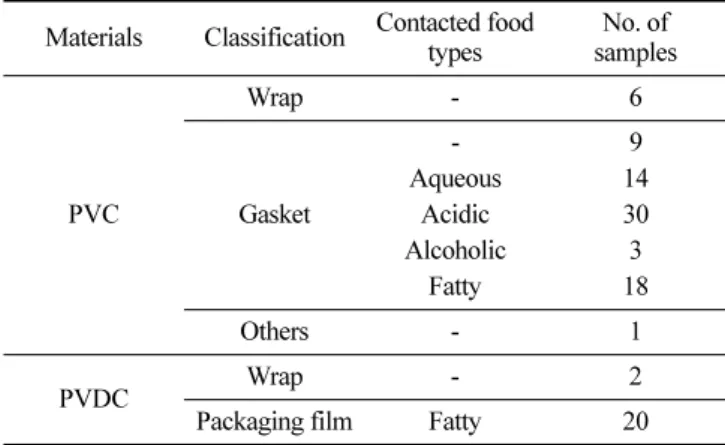
분석대상 시료의 재질확인 분석에 사용한 시료에 대한 각 재질을 FT-IR로 분석하여 얻어 진 IR 스펙트럼을 문헌에 보고된 PVC 및 PVDC 재질에 대한 스 펙트럼과 비교함으로써 재질을 확인하였다(15,16). 분석결과 본 연구에 사용한 시료는 모두 표시사항에 표시된 재질과 일치하는 PVC 또는 PVDC 재질임을 확인할 수 있었으며, 대표적인 IR 스펙트럼을 문헌과 비교하여 Fig. 1에 나타내었다. 본 연구에서 분 석대상으로 한 시료는 PVC의 경우 식품 포장용 랩 6품목, 병마 개 가스킷 74 품목, 기타 1품목으로 총 81품목이었으며, PVDC 의 경우 식품포장용 랩 2품목, 소시지 포장 20품목으로 총 22품 목이었다. 모든 분석대상 시료 103품목을 접촉 식품별로 분류하 여 Table 1에 요약하였다. 칼럼 선정 상용되는 GC 칼럼 중 휘발성물질의 분석에 적합하고 국내외 문헌에서 사용예가 있는 HP-1 및 PLOT Q 칼럼을 이용하여 VC, VDC 및 내부표준물질을 분석함으로써 각 칼럼에 대한 분리도를 비교·분석하였다. 각 칼럼을 이용한 분석조건 및 얻어진 결과 를 Fig. 2에 나타내었다. Fig. 2에서 보는 바와 같이 HP-1 칼럼의 경우 낮은 온도에서만 VC 및 VDC의 분리가 가능하였으며, 상 대적으로 PLOT Q 칼럼에 비하여 VC 및 VDC의 분리도 및 분 석감도가 좋지 않음을 알 수 있었다. 따라서 본 연구에서는 PLOT Q 칼럼을 분석칼럼으로 선정하였다. 선택이온 및 크로마토그램
Fig. 2의 GC/MS-total ion chromatogram(TIC)으로부터 얻어진 각 피크의 질량스펙트럼을 Fig. 3에 나타내었다. 얻어진 질량스 펙트럼으로부터 가장 이온강도가 크고, 선택성이 우수한 이온을 선택하여 정량분석에 이용하였으며, VC의 경우 m/z=61, 62, 64, VDC의 경우 m/z=61, 96, 98 및 IS의 경우 m/z=42를 정량 및 정 성분석을 위한 선택이온으로 하였다. 선택이온을 적용하여 농도 별로 조제한 혼합표준용액을 GC/MS-selected ion monitoring(SIM) 모드로 분석한 결과를 Fig. 4에 나타내었으며, SIM 모드로 분석 함으로써 TIC 모드에 비하여 우수한 분석감도를 확인할 수 있었 다. 아울러 N,N-dimethylacetamide만을 이용한 공시험 결과 VC, VDC 및 1-CP가 검출되는 위치에서 다른 간섭 피크는 확인할 수 없었다.
Fig. 1. Representative IR spectra of PVC sample (a) and PVDC sample (b).
Table 1. All the samples and contacted food types tested VC and VDC in this study
Materials Classification Contacted food types No. of samples PVC Wrap - 6 Gasket -Aqueous Acidic Alcoholic Fatty 9 14 30 3 18 Others - 1 PVDC Wrap - 2
Packaging film Fatty 20
Fig. 2. GC/MS-TIC chromatograms of standard mixture for different columns (a) column: HP-1 (60 m×0.25 mm, 1.0 µm), oven temp.: 40oC (15 min)→15oC/min→240oC (5 min), injection: headspace 0.5 mL and (b) column: HP-PLOT Q (30 m×0.32 mm, 20 µm), oven temp.: 100oC (2 min)→10oC/min→250oC (10 min), injection: headspace 0.5 mL.
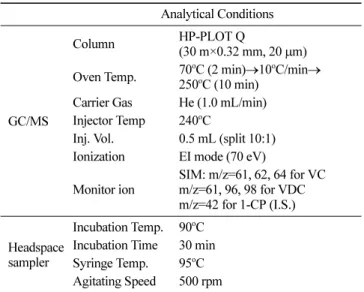
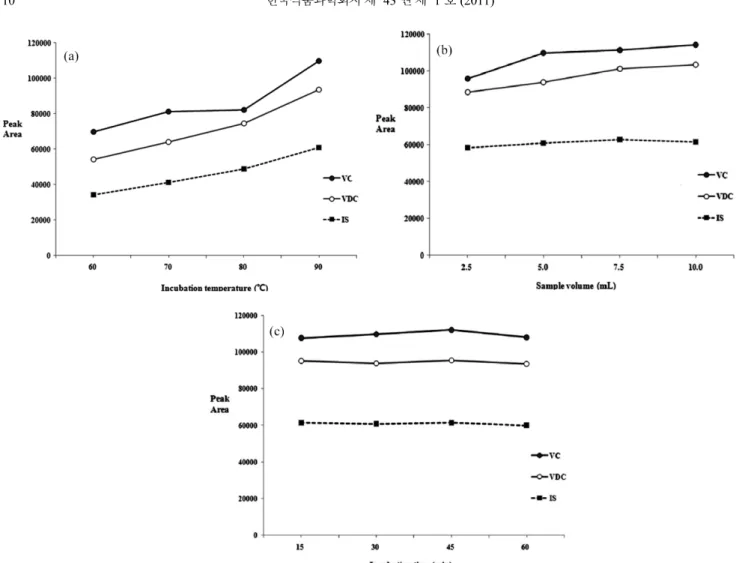
헤드스페이스 GC/MS를 이용한 폴리염화비닐/폴리염화비닐리덴 식품 포장 중 염화비닐/염화비닐리덴 잔류량 연구 9 Headspace 전처리 조건의 확립 가열온도, 가열시간 및 headspace 부피 등 headspace 조건에 따 른 분석감도 비교 결과를 Fig. 5에 나타내었다. 가열온도의 경우 온도가 높을수록 분석감도가 증가함을 알 수 있었으며, 가열시간 은 15분 이상이면 분석감도에 큰 차이는 발견할 수 없었다. Headspace 부피와 관련하여 시료부피 5 mL에서 가장 높은 감도 를 나타내었고 그 이상으로 시료 부피를 증가하더라도 분석감도 에 있어 현격한 차이는 발견되지 않았다. 이상의 결과로부터 headspace 전처리 조건은 시험용액 5 mL를 이용하여 90oC에서 30 분간 교반하여 분석하는 것으로 결정하였다. 최종 확립된 분석조 건을 선택이온을 포함한 GC/MS 조건과 함께 Table 2에 요약하 였다. LOD 및 LOQ 정량한계 부근 농도의 혼합표준용액 분석 결과로부터 산출된 기기적 LOD 및 LOQ를 Table 3에 요약하였으며, 본 연구에서 산
출된 LOD를 재질 중 함량으로 환산한 결과, 유럽연합의 PVC 또 는 PVDC 각각에 대한 VC 및 VDC 재질규격과 비교 시 10배 미만에 해당함을 알 수 있었다. 따라서 본 연구에서 도입한 headspace-GC/MS를 이용한 VC 및 VDC 분석법은 유럽연합의 규 격 검사에도 적용 가능한 충분한 선택성 및 감도를 가짐을 확인 할 수 있었다.
Fig. 3. Electron impact (EI) mass spectra of VC (a), VDC (b) and 1-CP (I.S.) (c).
Fig. 4. GC/MS-SIM chromatograms of standard mixture (100, 50, 5 ng/mL for VC and VDC, respectively)
Table 2. Analytical conditions for the determination of VC and VDC
Analytical Conditions
GC/MS
Column HP-PLOT Q
(30 m×0.32 mm, 20µm) Oven Temp. 70oC (2 min)→10oC/min→
250oC (10 min) Carrier Gas He (1.0 mL/min) Injector Temp 240oC
Inj. Vol. 0.5 mL (split 10:1) Ionization EI mode (70 eV) Monitor ion SIM: m/z=61, 62, 64 for VC m/z=61, 96, 98 for VDC m/z=42 for 1-CP (I.S.) Headspace sampler Incubation Temp. 90oC Incubation Time 30 min Syringe Temp. 95oC Agitating Speed 500 rpm
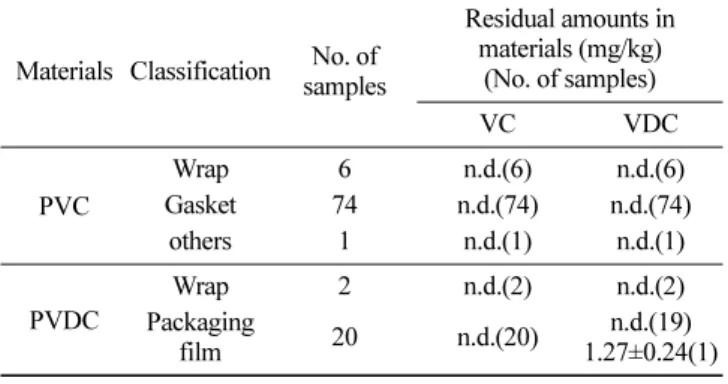
직선성 5-200 ng/mL 범위에서 작성한 검량선으로부터 직선성을 검토 한 결과를 Table 3에 요약하였으며, VC 및 VDC 각각에 대하 여 모두 상관계수(r2) 0.98 이상의 우수한 직선성을 확인할 수 있었다. 회수율 및 재현성 유럽연합 기준치에 해당하는 량의 VC 및 VDC를 N,N-dimeth-ylacetamide에 각각 첨가하여 재질시험의 회수율 검토결과를 Table 3에 요약하였다. 모든 회수율 시험결과, VC 및 VDC 각각에 대 하여 90% 이상의 회수율을 확인할 수 있었으며, 3회 반복시험 결과 상대표준편차로 표현되는 재현성은 모두 10% 이내였으며, 이는 해당 농도에 대한 Horwitz value의 1/2 수준 이내에 드는 결 과였다. 시료분석 결과 국내유통 PVC 및 PVDC 재질의 식품 포장 중 VC 및 VDC 잔류량 시험결과를 Table 4에 요약하였다. 재질시험을 실시한 103 건의 시료 중 PVDC 재질의 식품 포장 1건에서 VDC가 1.27± 0.24 mg/kg 수준으로 검출되었으나, 검출량은 현행 유럽연합의 재 질규격 이내의 미미한 수준이었다. 그밖에 다른 모든 시료에서는 VC 및 VDC가 검출되지 않았다.
Fig. 5. Comparison of peak sensitivities for VC, VDC and 1-CP (I.S.) according to headspace sample preparation conditions (a) incubation temperature, (b) sample volume in headspace vial and (c) incubation time.
Table 3. Validation parameters obtained in this study LOD Linearity (r2) Recovery Repeatability Method LOD (mg/kg) EU limitation (mg/kg) Fortified (µg/mL) Found (µg/mL) RSD (%) 0.5×Horwitz valuea) (%) VC 0.01 1 0.982 0.10 0.097 ± 0.005 4.9 11.3 VDC 0.03 5 0.989 0.50 0.471 ± 0.021 5.5 8.9
헤드스페이스 GC/MS를 이용한 폴리염화비닐/폴리염화비닐리덴 식품 포장 중 염화비닐/염화비닐리덴 잔류량 연구 11
요
약
PVC 및 PVDC 재질의 식품포장에 잔류할 수 있는 원료물질 인 VC 및 VDC를 PLOT Q 컬럼이 장착된 headspace-GC/MS를 이용하여 분석하였다. VC 및 VDC 각각에 대하여 m/z=61, 62, 64 및 m/z=61, 96, 98 이온을 선택 이온으로 하여 분석하였으 며, 내부표준 물질로는 1-CP를 사용하였다. 분석법 검증결과 본 연구에서 도입한 분석법은 유럽연합의 재질규격 시험에 적합하 였으며, 국내유통 PVC 및 PVDC 재질의 식품 포장 103 품목에 대한 분석 결과, PVDC 식품포장 1건에서 재질 중 VDC가 검출 되었으나, 이는 유럽연합에서 설정하고 있는 재질규격 이내에 드 는 미미한 수준이었으며, 나머지 모든 시료에서는 VC 및 VDC 가 검출되지 않았다.감사의 글
본 연구는 2009년도 식품의약품안전청 연구개발과제의 연구개 발비 지원(09071식품안005)에 의하여 수행되었으며, 이에 감사드 립니다.문
헌
1. U.S. Environmetnal Protection Agency (EPA). Toxicological review of vinyl chloride. In support of summary information on the integrated risk information system (IRIS). EPA/635R-00/004: 2-3 (2002), available online at http://www.epa.gov/ncea/iris/toxre-views/1001tr.pdf. Accessed Aug. 19, 2010.
2. U.S. Department of health and human services. toxicological pro-file for vinyl chloride. Agency for toxic substances and disease registry (ATSDR): 2-4 (2006), available online at http://www. atsdr.cdc.gov/toxprofiles/tp20.pdf. Accessed Aug. 19, 2010. 3. International Agency for Research on Cancer (IARC). IARC
Monographs on the evaluation of carcinogenic risks to humans:
overall evaluations of carcinogenicity: An updating of IARC Monographs Volumes 1 to 42, Supplement 7: 372-375 (1987), available online at http://monographs.iarc.fr/ENG/Monographs/ suppl7/Suppl7.pdf. Accessed Aug. 19, 2010.
4. U.S. EPA. IRIS. Vinyl chloride. (2000), available online at http:// www.epa.gov/iris/subst/1001.htm. Accessed Aug. 19, 2010. 5. European Union (EU). Council Directive 78/142/EEC on the
approximation of the laws of the member states relating to mate-rials and articles which contain vinyl chloride monomer and are intended to come into contact with foodstuffs. Off. J. Eur. Com-mun. L44: p.15 (1978)
6. World Health Organization (WHO). 1,1-Dichloroethene (vinylidene chloride). Concise International Chemical Assessment Document 51: 6-7 (2003)
7. IARC. IARC Monographs on the evaluation of carcinogenic risks to humans: Overall evaluations of carcinogenicity: An updating of IARC Monographs Volumes 1 to 42, Supplement 7: 376-377 (1987), available online at http://monographs.iarc.fr/ENG/Mono-graphs/suppl7/Suppl7.pdf. Accessed Aug. 19, 2010.
8. U.S. EPA. Toxicological review of 1,1-dichloroethylene. In sup-port of summary information on the integrated risk information system (IRIS) EPA/635/R02/002: 37-38 (2002), available online at http://www.epa.gov/iris/toxreviews/0039tr.pdf. Accessed Aug. 19, 2010.
10. Dow Plastics. Vinylidene chloride monomer and polymers, Tech-nical report on VDC and PVDC, reprinted from K. Othmer: Encyclopedia of Chemical Technology. 4th Ed. Vol. 24, New York, John Wiley & Sons, Inc., pp. 882-923, (1997), available online at http://www.dow.com/PublishedLiterature/dh_005d/ 0901b8038005d707.pdf?filepath=plastics_la/pdfs/noreg/190-00347. pdf&fromPage=GetDoc. Accessed Aug. 19, 2010.
11. Ministry of Health and Welfare, Japan. Specification, standards and testing methods for foodstuffs, implements, containers and packaging, toys, detergents. Ministry of Health and Welfare Notice No. 499, Japan (2005)
12. Korea Food & Drug Administration (KFDA). Standards and spec-ifications for utensil, containers·packaging. KFDA Notice No. 2010-96 (2010)
13. EU. Commission Directive 80/766/EEC, the Community method of analysis for the official control of the vinyl chloride monomer level in materials and articles which are intended to come into contact with foodstuffs. (1980) avaliable online at http://eur-lex. europa.eu/LexUriServ/LexUriServ.do?uri=CELEX:31980L0766: EN:NOT. Accessed Aug. 19, 2010.
14. EU. Commission Directive 81/432/EEC, the Community method of analysis for the official control of vinyl chloride released by materials and articles into foodstuffs. (1981) available online at http://eur-lex.europa.eu/LexUriServ/LexUriServ.do?uri=CELEX: 31981L0432:en:NOT. Accessed Aug. 19, 2010.
15. Fujiwara H, Izutsu K. Mechanochemical block copolymerization in heterogeneous systems of poly(vinyl chloride) with vinyl ace-tate by ultrasonic irradiation. Memoirs of the Osaka Institute of Technology. Series A. 49(1): 1-9 (2004)
16. Shimanouchi T. ‘Tables of molecular vibrational frequencies’, Natl. Stand. Ref. Data Ser., National Bureau of Standards, Garthersburg. Vol. I (1972), available online at http://www.ecosci. jp/mva/vib_p01.html. Accessed Aug. 19, 2010.
Table 4. Residual amounts of VC and VDC in PVC and PVDC food packaging
Materials Classification No. of samples Residual amounts in materials (mg/kg) (No. of samples) VC VDC PVC Wrap 6 n.d.(6) n.d.(6) Gasket 74 n.d.(74) n.d.(74) others 1 n.d.(1) n.d.(1) PVDC Wrap 2 n.d.(2) n.d.(2) Packaging film 20 n.d.(20) n.d.(19) 1.27±0.24(1)