Veterinary Science
Development of a Lightcycler-based reverse transcription polymerase chain reaction for the detection of foot-and-mouth disease virus
Jae Ku Oem
1,*, Soo Jeong Kye
1, Kwang Nyeong Lee
1, Yong Joo Kim
1, Jee Yong Park
1, Jong Hyeon Park
1, Yi Seok Joo
1, Hee Jong Song
21
National Veterinary Research and Quarantine Service, Ministry of Agriculture and Forestry, Anyang 430-824, Korea
2
Department of Veterinary Infectious Disease, College of Veterinary Medicine, Chonbuk National University, Jeonju 561-756, Korea
One step TaqMan real-time reverse transcription polymerase chain reaction (R/T RT-PCR) using a set of primers/probes was developed for the detection of foot-and-mouth disease (FMD) virus. The gene-specific probes labeled fluorogen for the internal ribosomal entry site, Leader sequence and 2B regions were used to detect FMD virus (FMDV). This assay specifically detected FMDV both in cell culture preparations and clinical samples, and was capable of distinguishing FMD from other viral diseases similar to clinical signs (swine vesicular disease, vesicular stomatitis and bovine viral diarrhea). This assay was shown to be 1000-fold more sensitive than the conventional RT-PCR method. The detection limits of this assay was 1 TCID
50/ml of the FMDV RNA concentration. Quantification was obtained by a standard curves plotting threshold cycle values versus known infectivity titer. The assay was sensitive, specific and rapid enough to detect FMDV RNA genome in probang samples. As such, the described method is reliable and provides faster disease diagnostics than the conventional RT- PCR procedure to detect FMDV.
Key words: FMDV, quantification, TaqMan R/T RT-PCR
Introduction
Foot and mouth disease virus (FMDV) is the causative agent of an economically important viral animal disease reported all over the world. Although mortality associated with foot and mouth disease (FMD) is usually low, the disease decreases livestock productivity and for the affected country, severe restrictions are placed on international trade of animals and animal products [2,3].
There were 16 FMD cases reported in Korea on 2002, most of which (except for one case) had occurred in pig farms [6]. Thirteen of 16 outbreak farms were sacrificed
within 24 hours after diagnosis, which was an important factor in reducing the spread of the disease [13]. The laboratory confirmation of FMD outbreak was carried out according to FMD diagnostic methods [7]. Upon the submission of samples from the infected premises, FMD was diagnosed by the detection of virus antigen in clinical samples using a combination of enzyme-linked immunosorbent assay (referred to as Ag-ELISA hereinafter) and specific gene of FMDV by reverse transcription polymerase chain reaction (RT-PCR). The virus isolation in cell culture was performed only for the first several outbreak cases because this assay takes at least 4 days for the interpretation of the result. For this reason, in the majority of the cases subsequent to the initial outbreaks, samples were tested using conventional RT-PCR. However, conventional RT- PCR has been regarded as not being sufficiently preferable to replace virus isolation for the diagnosis of FMD due to higher risk of cross-contamination compared to virus isolation [4,10]. Moreover, the final products amplified by the conventional RT-PCR are usually analyzed by gel electrophoresis that is laborious, insensitive and time- consuming leaving its interpretation subjective [10]. For this reason, the conventional RT-PCR has been performed only as a part of a diagnostic strategy where it is used to supplement the other test procedures.
To minimize this risk of cross-contamination and inconvenience of these methods, we have developed a fluorogenic real-time RT-PCR(R/T RT-PCR) method for the detection and quantification of FMDV using the FMDV- specific probes on the highly conserved region with a set of primers on its both sides. This assay didn’t show any nonspecific reaction with other animal diseases that show similar clinical signs such as vesicular stomatitis, bovine viral diarrhea and swine vesicular disease diseases.
Materials and Methods
Design of FMDV-specific primers and probes
FMDV nucleotide sequences were retrieved from GenBank
*Corresponding author
Tel: +82-31-467-1858; Fax: +82-31-449-5882
E-mail: jku0622@ nvrqs.go.kr
(Table 1) and aligned using the Dnastar software (Dnastar, USA). The target region was analyzed for the 12 strains. The sequence for A24/cruzeiro/brazil/55 strain, however, covering from Leader to partial 2B region was reflected only for the designing of leader primer/probe set. Specific primers and a fluorogenic probes were designed to target the conserved regions of FMDV gene using the Lightcycler (LC) probe design software (Roche, USA), according to the manufacture’s guidelines for the design of PCR primers and TaqMan probes. The PCR primers and TaqMan probes used in this experiment are listed in Table 2. A blast search analysis confirmed that the primer and probe sequences had no homology with those of other viral sequences and were sufficiently FMDV specific.
In TaqMan R/T RT-PCR, amplification is monitored by the fluorescence gain associated with the Taq polymerase-mediated hydrolysis of a specifically hybridizing TaqMan probe.
Preparation of viruses and samples
To assess the sensitivity of the assay, serial dilution (1TCID
50~10
5TCID
50/ml) of cell culture supernatants from the two Korean isolates of FMDV (O/SKR/2000 and O/
SKR/2002) grown in monolayers of BHK-21 cells was performed. Virus infectivity was titrated in 96 well plates by
standard method.
In addition, to evaluate the specificity of the assay, the cell culture supernatants infected by swine vesicular disease virus (SVDV) (10
5TCID
50/ml), vesicular stomatitis virus (VSV) (10
5.5TCID
50/ml) and bovine viral diarrhea virus (BVDV) (10
5TCID
50/ml) were prepared in a similar manner to the samples infected by FMDV, ascertaining that this assay did not co-amplify the target gene of these three viruses. The RNA samples from cell culture supernatants infected by O/SKR/2000 at the titer of 10
5TCID
50/ml and uninfected epithelial suspension were routinely included as positive and negative controls, respectively.
Vesicular fluids and epithelial tissues collected from 14 pig farms during the FMD outbreak in 2002 were prepared.
The Probang samples collected between 0 DPI and 7 DPI were collected from animals (cows and pigs) experimentally infected with O/SKR/2000 virus to test the presence of virus or virus genome. All samples of 10% concentration in phosphate-buffered saline (PBS) were distributed in 1.5 ml tube and then kept at − 70
oC until use.
RNA extraction
All viral RNAs were extracted using QIAamp Viral RNA Mini Kit (Qiagen, Germany), following manufacturer’s instructions. In brief, the 560µl of lysis buffer (Buffer AVL- containing Carrier RNA; Qiagen, Germany) was mixed with 140 µl of clinical sample or cell culture supernatant and incubated at room temperature for 10-minutes. Microcentrifuge tube was short-centrifuged to remove drops from inside of the lid, after which 560 µl of absolute ethanol was added to the sample and mixed. Microcentrifuge tube was again short centrifuged to remove drops from inside of the lid and 630 µl of the solution was applied to the QIAamp spin column (Qiagen, Germany) and centrifuged at 8000 rpm for 1 minute. Viral RNA was washed with 500 µl of washing buffer 1 (Buffer AW1; Qiagen, Germany) and washing buffer 2 (Buffer AW2; Qiagen, Germany) by short centrifugation, and extracted by adding 60 µl of elution buffer (Buffer AVE;
Qiagen, Germany).
Table 1. Description of FMDV strains
Serotype Virus strain Genebank accession numbers O O
O O O O O O Asia 1 SAT2
A C
TAW/2/99/BOV Tibet/CHA/99 UKG/35/2001
OM III O1 Campos TAW/2/99TC O/SKR/2002 O/SKR/2000 KEN/3/57 IND/63/72 C3 Ind iso19 A24/Cruzeiro/Brazil/55
AJ539137 AJ539138 AJ539141 AJ359854 AJ320488 AJ539136 AY312588 AJ539139 NC003992 AY304994 AY593806 AJ251476
Table 2. Design of FMDV-specific primers and probes
Region Name Sequence Position
(size of amplicon)
IRES Forward
Reverse Probe
5'-TGTGTGCAACCCCAGCAC-3' 5'-CGAGTGTCGCRTGTTACC-3'
5'-mACAGGCTAAGGATGCCCTTCAGGTACC xp-3'
845 972 (128 bp)
Leader Forward
Reverse Probe
5'-AACACGCYGTSTTYGCSTG-3' 5'-GCGTCCAKGGGTARAAGTC-3' 5'-ACCTCCAACGGGTGGTACGCGAT-3'
1521 1595 (75 bp)
2B Forward
Reverse Probe
5'-AGATGCAGGARGACATGTCAA-3' 5'-TTGTACCAGGGYTTGGCYT-3'
5'-mAAACACGGACCCGACTTTAACCGxp-3'
4000 4125 (126 bp)
*RT-PCR primers and probes for all targets were designed using available GenBank data.
The 5' end of probes was labeled with 6-FMA whereas the 3' end was labeled with TAMRA.
TaqMan R/T RT-PCR
One-step R/T RT-PCR reaction was conducted using QuantiTaq probe RT-PCR (Qiagen, Germany) in a single capillary tube according to the manufacturer’s guidelines for individual component concentrations. The reaction was performed in a final volume of 20 µ l containing 1 µ M each primer, 0.2 µ M probe, 10 µ l 2X Quantitech probe RT-PCR Master Mix, Quantitech probe RT Mix 2U/reaction, 3.6 µ l RNase-free water and 5 µ l template RNA.
Samples were amplified by using a program that included a reverse transcription procedure consisting of one cycle of an incubation at 50
oC for 20 min and 94
oC for 15 min, followed by 55 cycles of denaturation step at 94
oC for 1 sec and annealing/extension step at 60
oC for 1 min with the ramp of 20
oC / sec for each cycle.
Amplification and product detection were performed under the LC system (Roche, Germany). During PCR, the probe hybridizes to its complementary single-strand DNA sequence within the PCR target. As amplification occurs, the probe is degraded due to the exonuclease activity of Taq DNA polymerase, thereby separating the quencher from reporter dye during extension. During the entire amplification cycles, the light emission increases exponentially.
A positive result was determined by identifying the threshold cycle (C
T) value at which reporter dye emission appeared above background. If the fluorescence signal was not detected within 55 cycles, the sample was considered negative.
Comparison of the detection limit of R/T RT-PCR and other tests
To compare the results obtained by R/T RT-PCR with those by other diagnostic tools, the conventional RT-PCR and Ag-ELISA were performed with the cell culture supernatants of different TCID
50concentrations. The conventional RT- PCR procedures were undertaken with a primer set targeting the 3ABC region of FMDV [12]. The Ag-ELISA was carried out using the test kit produced by Pirbright Lab, Institute for Animal Health [9]. The sample was considered positive if the net OD value was ≥ 0.1.
Results
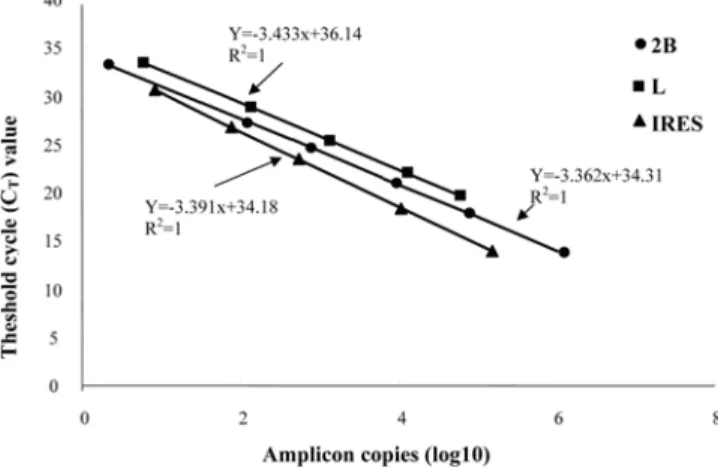
R/T RT-PCR of the standard dilution series and selection of adequate primer/probe sets
Standard curves for FMDV were obtained using serial dilution from 10
5TCID
50/ml to 1TCID
50/ml with three different primer/probe sets. The absolute negative for any test sample or negative control corresponded to a C
Tvalue of 35. The C
Tvalues obtained from the standard dilution in assays with three different primer and probe sets were plotted. The respective C
Tvalues were determined and a linear relationship was established between C
Tvalues and the logarithm of the standard dilution of FMDV RNA concentration of infectivity equivalent. All sets of primer/
probe had similar sensitivity but the standard curve generated using 2B primer/probe set was more sensitive and specific for FMDV detection than the others (Fig. 1).
Sensitivity of R/T RT-PCR in comparison with those of conventional RT-PCR and Ag-ELISA
To evaluate the sensitivity of the R/T RT-PCR, cell culture supernatants of various TCID
50concentrations were prepared.
Analytical sensitivity was determined by testing sequential 10-fold dilutions in D-MEM (Gibco, USA). The sensitivity of the R/T RT-PCR was compared with those of other diagnostic tests such as conventional RT-PCR and Ag- ELISA. Table 3 shows that the samples of at least 1TCID
50/ ml viral RNA concentration were positive in the R/T RT- PCR. The detection limit of the conventional RT-PCR was the viral RNA concentration of 10
3TCID
50/ml, whereas no antigen detection was observed when tested by Ag-ELISA.
The R/T RT-PCR assay had a 1000 fold higher sensitivity than conventional RT-PCR assay.
Specificity
The analytical specificity of the R/T RT-PCR was determined by testing different non-FMDV isolates related to vesicular diseases or causing diseases with similar symptoms (SVDV, VSV and BVDV). None of the SVDV, VSV and BVDV isolates tested were positive by R/T RT- PCR (Fig. 2). Also, whether the result of the R/T RT-PCR depended on the type of tissue, we determined by testing different tissues collected from a non-infected cow. All tissues tested did not react by R/T RT-PCR.
Fig. 1. Standard curves for FMDV O/SKR/2002 obtained using
serial dilutions with three different primer/probe sets. The
quantitative RT-PCRs with TaqMan probes were performed on a
serial dilution of 10
5TCID
50/ml to 10
0TCID
50/ml of FMDV
standard RNA to evaluate its detection limits. With increasing
amounts of standard RNA templates, the respective C
Tvalues
were determined and a linear relationship was established
between the C
Tvalues and the logarithm of initial template
amounts. R/T RT-PCR efficiencies were calculated according to the
equation E = 10
−1/slope.The coefficient of reliability (R
2) of the
regression was 1.
Analysis of R/T RT-PCR results using clinical and experimental samples
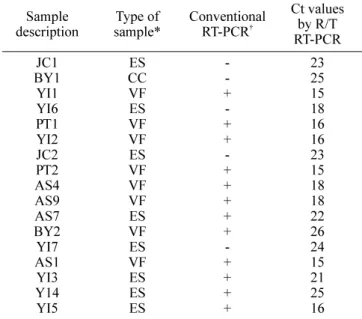
To determine whether the preliminary experiment with the viruses grown in cell culture using O/SKR/2002 would generate the same results for the diagnosis of FMDV in clinical samples, further experiment had been conducted against a panel of epithelial suspensions and vesicular fluids.
Of the 17 samples with a positive result by R/T RT-PCR, twelve were positive by conventional RT-PCR (Table 4).
The samples negative in R/T RT-PCR were also negative by conventional RT-PCR, indicating identical specificities for both RT-PCR systems (data not shown).
For the detection of FMDV RNA in Probang samples, R/
T RT-PCR and conventional RT-PCR were performed, and the results were compared (Table 5). Both live virus and viral RNA could be detected by R/T RT-PCR in Probang samples taken from cattle between 1 DPI and 6 DPI, and pigs were positive for viral RNA between 1 DPI and 3.DPI.
However, both live virus and viral RNA could be detected by conventional RT-PCR between 1 DPI and 2 DPI.
Discussion
A number of previously published studies on R/T RT-PCR methods have targeted the different sequences from either internal ribosomal entry site (IRES) [4,5,11] or 3D region [1,8] in an effort to introduce a rapid diagnosis of FMD. In this study, we have developed optimal TaqMan primers and probes using the LC probe design software to allow the detection of all serotypes of FMDV by way of targeting a highly conserved region within the 2B gene. The ability of these primers to specifically amplify FMDV RNAs was verified by obtaining the fluorescent gain only in the FMDV samples when applied to the cell culture supernatants infected by SVDV, VSV, BVDV and FMDV.
The cell culture supernatants infected with FMDV were
tested by the R/T and conventional RT-PCR in parallel with Ag-ELISA. The R/T RT-PCR was more sensitive than the other diagnostic methods for the detection of FMDV. Both RT-PCR methods has successfully detected specific gene of FMDV even though the sensitivity of conventional RT-PCR failed to identify the sample of less than 10
2TCID
50/ml titer when compared to the R/T RT-PCR which could detect the viral RNA concentration as low as 10TCID
50/ml. Whereas the viral RNAs of serial dilutions (titers; 1TCID
50~10
5TCID
50/ml) using the Korean isolate O/SKR/2002 had a C
Tvalue in the range of 13.76 ± 0.589 to 31.94 ± 0.671, the Ag- ELISA did not detect any antigen in these samples. The clinical samples positive by conventional RT-PCR have also been diagnosed as positive under the fluorogenic R/T RT- PCR system. Moreover, with this automated 5’-nuclease probe-based RT-PCR procedure (using LC system) described
Fig. 2. Specificity of R/T RT-PCR for O/SKR/2002 using 2B primer/probe set. BVDV, VSV (Indiana and New Jersey strain) and SVD of the titer of 10
5TCID
50/ml was used to assess the specificity of the R/T RT-PCR. M: 100 bp ladder; 1: 10
5TCID
50/ ml; 2: 10
4TCID
50/ml; 3: 10
3TCID
50/ml; 4: 10
2TCID
50/ml; 5: 10
1TCID
50/ml; 6: 10
0TCID
50/ml; 7: Negative sample; 8: BVDV; 9:
VSV Indiana; 10: VSV New Jersey; 11: SVDV.
Table 4. Diagnostic comparison between the conventional and R/T RT-PCR on the epithelial suspensions and vesicular fluids from animals infected with O/SKR/2002 FMDV
Sample
description Type of
sample* Conventional
RT-PCR
†Ct values by R/T RT-PCR BY1 JC1
YI1 YI6 PT1 YI2 JC2 PT2 AS4 AS9 BY2 AS7 AS1 YI7 Y14 YI3 YI5
CC ES VF ES VF VF ES VF VF VF ES VF ES VF ES ES ES
- - + - + + + - + + + + + - + + +
23 25 15 18 16 16 23 15 18 18 22 26 24 15 21 25 16
*ES: epithelial suspension; CC, cell culture supernatant fluid; VF, vesicular fluid.
†
+: positive , -: negative.
Table 3. Comparisons of diagnostic methods with different virus titers of O/SKR/2002
FMD virus
concentration 2B R/T RT-PCR
(C
T± SD) Conventional
RT-PCR* Ag-ELISA
‡10
5TCID
50/ml
10
4TCID
50/ml 10
3TCID
50/ml 10
2TCID
50/ml 10
1TCID
50/ml 10
0TCID
50/ml
Negative
13.76 ± 0.589 17.84 ± 0.550 20.89 ± 2.273 24.51 ± 1.692 27.29 ± 1.022 31.94 ± 0.671
-
§+ + + - - - -
-(0.02) -(0.00) -(0.01) -(0.01) -(0.01) -(0.01) -(0.01)
* +; positive -; negative.
†
Mean values and standard deviations were based on three different experiments.
‡
If the net OD value in Ag-ELISA is above 0.1, the sample is considered positive.
§