http://dx.doi.org/10.5468/ogs.2014.57.6.492 pISSN 2287-8572 · eISSN 2287-8580
Introduction
Although the incidence of the cervical cancer is steadily de- creasing, it still is the third most common malignancy in fe- males worldwide [1,2]. Reflecting this decline, cervical cancer was the most common cancer in women during the 1980s in Korea, but the seventh most common cancer (3,733 cases, 4% of all cancers in females) in 2009 [3]. Clinicopathologic factors for cervical cancer including International Federation of Gynecology and Obstetrics (FIGO) stage, lymph node metas- tasis (LNM), parametrial spread (PM), nonsquamous histology, lymph-vascular space invasion (LVSI), and depth of invasion (DOI) are associated with the prognosis. Human papillomavirus (HPV) is a major causal factor in the development of cervical
Human papillomavirus 18 as a poor prognostic factor in stage I-IIA cervical cancer following primary
surgical treatment
Sun-Hye Yang, Su-Kyoung Kong, Seung-Ho Lee, So-Yi Lim, Chan-Yong Park
Department of Obstetrics and Gynecology, Gachon University Gil Medical Center, Incheon, Korea
Objective
This study evaluates the effect of the specific human papillomavirus (HPV) genotype as a prognostic factor in stage I-IIA cervical cancer patients following primary surgical treatment.
Methods
The medical records of 116 cervical cancer patients treated with primary surgical treatment were reviewed. The HPV genotypes were categorized into following groups: negative and unclassified, HPV 16, HPV 18, and other high risk (HPV 31, 33, 35, 45, 51, 52, 56, and 58).
Results
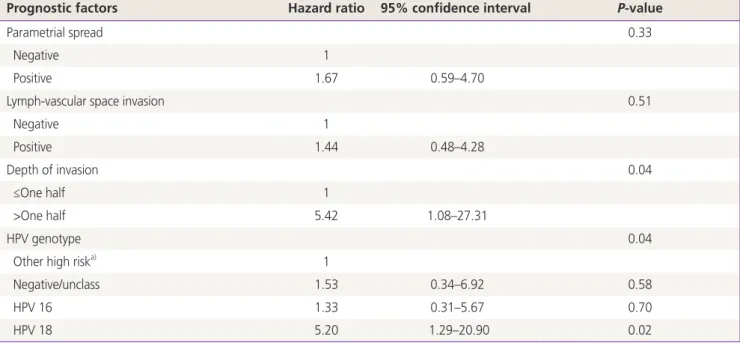
Among the HPV genotypes, HPV 16 predomi nated (40.52%), followed by intermediate risk and unclassified (25%), HPV 18, 45, and 56 (17.24%) and negative (17.24%). In univariate analysis, HPV genotypes (P=0.03), parametrial spread (P=0.02), depth of invasion (DOI) (P<0.01) and lymph-vascular space invasion (P=0.02) were significantly associated with progression free survival (PFS). In multivariate analysis, HPV 18 (hazard ratio [HR], 5.2; 95% confidence interval [CI], 1.29 to 20.90; P=0.02) and ≥one half of DOI (HR, 5.4; 95% CI, 1.08 to 27.31; P=0.04) were significantly associated with PFS. HPV genotypes are not significantly associated with overall survival.
Conclusion
HPV 18 was a poor prognostic factor for the PFS in stage I-IIA cervical cancer patients following primary surgical treatment. Careful long-term observation and regular exams are recommended for cervical cancer patients with HPV 18 compared to those with other HPV genotypes.
Keywords: Genotype; Human papillomavirus; Prognosis; Uterine cervical neoplasms
Received: 2014.5.27. Revised: 2014.6.24. Accepted: 2014.7.15.
Corresponding author: Seung-Ho Lee
Department of Obstetrics and Gynecology, Gachon University Gil Medical Center, 21 Namdong-daero 774beon-gil, Namdong-gu, Incheon 405-760, Korea
Tel: +82-32-460-3254 Fax: +82-32-460-3290 E-mail: [email protected]
Articles published in Obstet Gynecol Sci are open-access, distributed under the terms of the Creative Commons Attribution Non-Commercial License (http://creativecommons.
org/licenses/by-nc/3.0/) which permits unrestricted non-commercial use, distribution, and reproduction in any medium, provided the original work is properly cited.
Copyright © 2014 Korean Society of Obstetrics and Gynecology
cancer. The HPV DNA detection rates approach 95% to 100%
in cervical carcinoma tissue with adequately sensitive methods [4-7]. The etiological link between HPV genotypes and cervical cancer is well established. Specific genotypes are responsible for the oncogenic potency of HPV, and each HPV genotype results in a different prognosis. Therefore, the precise geno- typing of HPV is clinically important. Recent research focuses on specific HPV genotypes as a prognostic factor in cervical cancer. Several studies find that HPV 18 positivity is associated with poorer prognosis [8-13], whereas others find that HPV 16 positivity, rather than HPV 18 positivity, is a poor prognos- tic factor [14]. In addition, HPV 58 related and HPV 31 related types are associated with better prognosis [15] and these types also predicted better survival outcome [16]. In contrast, other researchers found no prognostic value for HPV status or HPV genotype [5,17,18]. The role of HPV genotype as a prog- nostic factor for the early stage cervical cancer is not clear and the usefulness of specific genotypes in predicting the progno- sis of early stage cervical cancer patients treated with primary surgical treatment remains questionable. Therefore, the effect of the specific HPV genotype on prognosis in stage I-IIA cervi- cal cancer patients who underwent primary surgical treatment was evaluated in our study.
Materials and methods
1. Case selection
One hundred and thirty-two women were diagnosed with FIGO stage I-IIA cervical cancer and primarily treated with surgery in the Department of Obstetrics and Gynecology, Gachon University Gil Medical Center from January 2007 to December 2010. Of 132 patients, 16 patients who did not take HPV genotype testing before the surgery were excluded.
One hundred and sixteen women who underwent HPV geno- type testing at the time of diagnosis were considered eligible for our study. Primary surgery methods for the 132 women were simple hysterectomy and radical hysterectomy including retroperitoneal lymphadenectomy. The HPV genotypes were categorized into following four groups: negative and unclassi- fied, HPV 16, HPV 18, and other high risk (HPV 31, 33, 35, 45, 51, 52, 56 and 58).
Post-treatment surveillance consisted of visits every three months for the first two years, every six months between years three and five, and annually after five years. Each visit
consisted of a clinical history, physical and pelvic examinations, Pap smear, and serum tumor markers. Annual chest X-ray was recommended in asymptomatic patients, while computed tomography or magnetic resonance imaging scans were per- formed for those at high risk or when clinically indicated.
Evaluation of the progression after the first-line therapy fol- lowed the guidelines of the Gynecology Cancer Intergroup [19]. The results of progression were recorded based on either the objective RECIST criteria or the CA-125 criteria [19,20].
When progression was documented by both, the date of pro- gression represented the date of the earlier of the two events.
Progression free survival (PFS) was defined the interval be- tween the date of primary surgery and the date of recurrence.
2. Human papillomavirus DNA chip test
Cervical cells for HPV genotype testing were sampled before starting the treatment. HPV genotypes were identified with a commercially available HPV-DNA chip purchased from the Ahn-Gook Pharmaceutical Corporation (Seoul, Korea). The HPV-DNA chip contains 32 type-specific probes: 18 kinds of the high-risk types (HPV 16, 18, 26, 31, 33, 35, 39, 45, 51, 52, 56, 58, 59, 66, 68, 69, 70, and 73) and 14 kinds of the low-risk types (HPV 6, 11, 32, 34, 40, 42, 43, 44, 53, 54, 55, 57, 61, and 62).
3. Statistical analysis
The statistical analyses were performed with IBM SPSS ver.
21.0 (IBM Corp., Armonk, NY, USA). The associations between various clinicopathologic factors and HPV genotype were ana- lyzed with Pearson’s chi-square test or Fisher’s exact test. The Kaplan-Meier method with the log-rank test and multivariate Cox proportional hazard analysis with hazard ratio (HR) and 95% confidence interval (CI) were used to examine the asso- ciation between HPV genotype and the survival outcome. Null hypotheses of no difference were rejected if P-values were less than 0.05, or equivalently, if the 95% CIs of risk point esti- mates excluded 1.
4. Ethics
The institutional review board of Gachon University Gil Medi- cal Center, Korea, approved the study (GBIRB2014-32). The informed consent requirement was waived because the cur- rent study was performed by a retrospective review.
Results
1. Patient characteristics
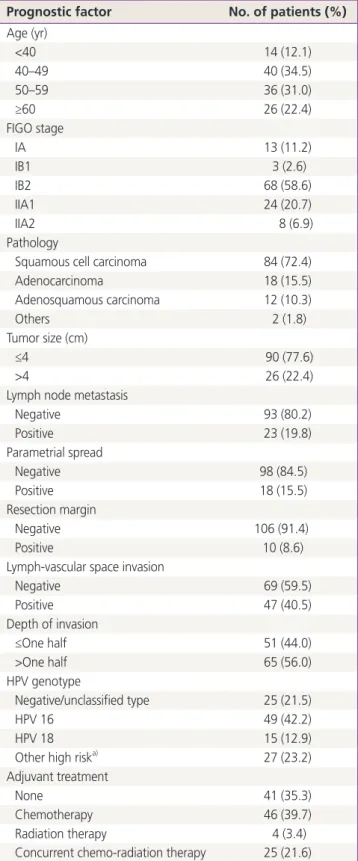
Age was categorized into four roughly equal strata: <40 (14 patients, 12.1%), 40 to 49 (40 patients, 34.5%), 50 to 59 (36 patients, 31.0%), and ≥60 (26 patients, 22.4%). The patho- logic types were identified as follows: squamous cell carci- noma (84 cases, 73.9%), adenocarcinoma (18 cases, 14.4%), adenosquamous carcinoma (12 cases, 10.3%), and others (2 cases, 1.7%). With regard to the FIGO stage, stage IB2 was the most common with 68 cases (58.6%), and 13 cases were IA (11.2%), three cases were IBI (2.6%), 24 cases were IIA1 (20.7%), and eight cases were IIA2 (6.9%). Eighteen cases (15.5%) were positive in PM, 10 cases (8.6%) had positive resection margin (RM), and 47 cases (40.5%) had positive LVSI. In our study we divided the DOI into two groups: ≤one half group included 51 cases (44.0%) and >one half group was 65 cases (56.0%). There were 26 cases (22.4%) patients with tumor size larger than the maximum diameter of 4 cm, and 90 patients’ tumors (77.6%) were less than the maximum diameter of 4 cm.
HPV 16 was the most prevalent genotype (49 cases, 42.2%), followed by other high risk types (27 cases, 23.2%), negative and unclassified (25 cases, 21.5%) and HPV 18 (15 cases, 12.9%).
Adjuvant treatment was performed as follows: 41 patients (none), 46 patients (chemotherapy), four patients (radiation therapy), and 25 patients (concurrent chemo-radiation therapy) (Table 1).
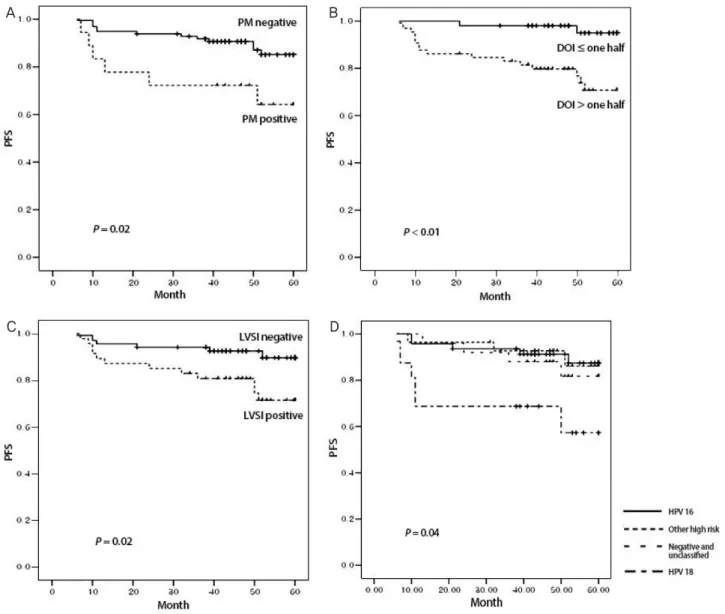
2. Univariate and multivariate analyses of clinicopathologic factors on progression free survival and overall survival The median duration of observation of surviving patients was 51 months (range, 10 to 60 months). Among clinicopathologic factors, PM, LVSI, DOI, and HPV genotype were significantly as- sociated with PFS by univariate analysis (Fig. 1), while age, FIGO stage, pathology, tumor size, LNM, and RM were not. Based on the multivariate analysis, the risk of recurrence was 5.2 times higher in HPV 18 positive patients (HR, 5.2; 95% CI, 1.29 to 20.90; P=0.02) and 5.4 times higher in >one half of DOI (HR, 5.4; 95% CI, 1.08 to 27.31; P=0.04) (Table 2). In univariate analysis, age, tumor size, LNM, PM, LVSI, and DOI were sig- nificantly associated with overall survival (OS), but FIGO stage, pathology and HPV genotype were not significantly associated with OS. No clinicopathologic factor was significantly associ- ated with OS in multivariate analysis. Of note, HPV genotype was not significantly associated with OS in either univariate analysis or multivariate analysis. We therefore performed mul-
Table 1. Clinical and histological characteristics (n=116) Prognostic factor No. of patients (%) Age (yr)
<40 14 (12.1)
40–49 40 (34.5)
50–59 36 (31.0)
≥60 26 (22.4)
FIGO stage
IA 13 (11.2)
IB1 3 (2.6)
IB2 68 (58.6)
IIA1 24 (20.7)
IIA2 8 (6.9)
Pathology
Squamous cell carcinoma 84 (72.4)
Adenocarcinoma 18 (15.5)
Adenosquamous carcinoma 12 (10.3)
Others 2 (1.8)
Tumor size (cm)
≤4 90 (77.6)
>4 26 (22.4)
Lymph node metastasis
Negative 93 (80.2)
Positive 23 (19.8)
Parametrial spread
Negative 98 (84.5)
Positive 18 (15.5)
Resection margin
Negative 106 (91.4)
Positive 10 (8.6)
Lymph-vascular space invasion
Negative 69 (59.5)
Positive 47 (40.5)
Depth of invasion
≤One half 51 (44.0)
>One half 65 (56.0)
HPV genotype
Negative/unclassified type 25 (21.5)
HPV 16 49 (42.2)
HPV 18 15 (12.9)
Other high riska) 27 (23.2)
Adjuvant treatment
None 41 (35.3)
Chemotherapy 46 (39.7)
Radiation therapy 4 (3.4)
Concurrent chemo-radiation therapy 25 (21.6) FIGO, International Federation of Gynecology and Obstetrics; HPV, human papillomavirus.
a)HPV 31, 33, 35, 45, 51, 52, 56, and 58.
Table 2. Prognostic factors affecting progression free survival (a) Univariate analysis
Prognostic factors Survival rate (%) P-value Prognostic factors Survival rate (%) P-value
Age (yr) 0.27 Lymph node metastasis 0.13
<40 71.4 Negative 87.1
40–49 85 Positive 73.9
50–59 88.9 Parametrial spread 0.02
≥60 84.6 Negative 87.8
FIGO stage 0.12 Positive 66.7
IA1 100 Lymph-vascular space invasion 0.02
IA2 100 Negative 91.3
IB1 85.3 Positive 74.5
IB2 70.8 Depth of invasion 0.01
IIA 87.5 ≤One half 96.1
Pathology 0.11 >One half 75.4
Squamous cell carcinoma 88.1 Resection margin 0.24
Adenocarcinoma 66.7 Negative 85.8
Adenosquamous carcinoma 83.3 Positive 70.0
Others 100 HPV genotype 0.03
Tumor size (cm) 0.18 Negative/unclassified type 84.0
≤4 86.7 HPV 16 89.3
>4 76.9 HPV 18 62.5
Other high riska) 89.2
(b) Cox proportional hazards analysis
Prognostic factors Hazard ratio 95% confidence interval P-value
Parametrial spread 0.33
Negative 1
Positive 1.67 0.59–4.70
Lymph-vascular space invasion 0.51
Negative 1
Positive 1.44 0.48–4.28
Depth of invasion 0.04
≤One half 1
>One half 5.42 1.08–27.31
HPV genotype 0.04
Other high riska) 1
Negative/unclass 1.53 0.34–6.92 0.58
HPV 16 1.33 0.31–5.67 0.70
HPV 18 5.20 1.29–20.90 0.02
FIGO, International Federation of Gynecology and Obstetrics; HPV, human papillomavirus.
a)HPV 31, 33, 35, 45, 51, 52, 56, and 58.
tivariate analysis for PM and LNM, which are strong risk factors for survival of cervical cancer patients. The results showed that PM was significantly associated with OS (Table 3).
3. Comparison of clinicopathologic factors of patients with human papillomavirus 18 and all other patients Age, FIGO stage, pathology, tumor size, LNM, PM, LVSI, DOI, and RM did not differ significantly between groups. We com- pared the clinicopathologic factors of patients with human papillomavirus 18 and all other patients. Age, FIGO stage, pathology, tumor size, LNM, PM, LVSI, DOI, and RM did not differ significantly between groups (Table 4).
Discussion
Our study evaluated the prognostic value of the HPV genotype for the survival of women with FIGO stage I-IIA cervical cancer following primary surgical treatment. In fact, comparisons among studies of HPV genotype and the risk of recurrence of cervical cancer are difficult because of different study designs, different grouping of HPV genotype, no homogeneity of the sample and the outcome procedures among the studies.
Different researchers categorized HPV genotypes into differ- ent groups, and the studies were conducted to evaluate sig- nificant associations between HPV genotype and PFS and OS.
Fig. 1. Univariate analyses of clinicopathologic factors on progression free survival (PFS). Of the clinicopathologic factors, (A) parametrial spread (PM), (B) depth of invasion (DOI), (C) lymph-vascular space invasion (LVSI), and (D) human papillomavirus (HPV) genotype were significantly associated with PFS.
A B
C D
Burger et al. [10] classified HPV genotypes into four groups (HPV 16, HPV 18, other and undetected), as did Lombard et al. [11] (HPV 16, HPV 18, intermediate risk and undeter- mined). Rose et al. [8] and Pilch [21] classified HPV genotypes into two groups (HPV 16 positivity and HPV 18 positivity). In our study, HPV genotypes were classified into four groups as follows: negative and unclassified, HPV 16, HPV 18, and other high risk. Since many studies classified HPV genotype differ- ently without an established standard classification, compari- son among studies is not feasible.
The effect of HPV genotype on prognosis of early stage cervical cancer remains controversial [8,10-12,14]. Burger et al. [10] identified HPV 18 positivity as an independent poor prognostic factor in a subgroup of 171 cervical cancer patients treated with radical hysterectomy and pelvic lymph node dis- section. Lombard et al. [11] confirmed that patients with HPV 18 associated tumors had a relative risk of death 2.4 times greater (95% CI, 1.29 to 4.59) than that of patients with HPV 16. In another study, HPV 18 positivity was associated with double the risk of death in cervical cancer patients with
tumors containing HPV DNA. This association was limited en- tirely to the patients with early stage cervical cancer [12].
In contrast, Pilch et al. [21] found that HPV 16 positivity, but not HPV 18 positivity, was a poor prognostic factor in 204 patients with radical hysterectomy and pelvic lymph node dissection. Viladiu et al. [14] reported that clinical stage is the only independent prognostic factor, and that HPV 16 E7 antibody predicts mortality in patients with stage I-II cervical cancer only. In addition, Bachtiary et al. [22], in a study of 106 cervical cancer patients receiving radiation therapy, found that multiple-type HPV was an independent poor prognostic factor.
In our study, HPV 18 positivity and DOI were associated with PFS while other factors were not, in both univariate analysis and multivariate analysis. HPV 18 positivity was associated with an approximately 5.2 fold increase in the risk of recur- rence. For OS, we performed multivariate analysis for the factors that were significant in the univariate analysis, adding HPV genotypes. However, we found no significant associations in multivariate analysis. The lack of significant associations is likely due to the small study size and the short surveillance pe- Table 3. Prognostic factors affecting overall survival
(a) Univariate analysis for prognostic factors affecting overall survival
Prognostic factors P-value Prognostic factors P-value
Age 0.03 Parametrial spread 0.01
FIGO stage 0.58 Lymph-vascular space invasion 0.04
Pathology 0.4 Depth of invasion 0.01
Tumor size 0.04 Resection margin 1
Lymph node metastasis 0.02 Human papillomavirus genotype 0.64
(b) Cox proportional hazards analysis including all the significant factors in univariate analysis and human papillomavirus genotype
Prognostic factors Hazard ratio 95% confidence interval P-value
Age 0.52 0.07–3.59 0.51
Tumor size 1.12 0.21–5.97 0.89
Lymph node metastasis 3.40 0.54–21.39 0.19
Parametrial spread 4.41 0.77–25.26 0.09
Lymph-vascular space invasion 0.88 0.11–6.78 0.9
Depth of invasion 2.45 0.44–18.26 0.95
Human papillomavirus genotype 3.17 0.24–42.27 0.38
(c) Cox proportional hazards analysis including parametrial spread and lymph node metastasis
Prognostic factors Hazard ratio 95% confidence interval P-value
Parametrial spread 4.59 1.10–19.06 0.04
Lymph node metastasis 3.31 0.79–13.75 0.09
FIGO, International Federation of Gynecology and Obstetrics.
riod. The number of events was few (18 recurrences and eight deaths). Secondly, we gave adjuvant treatment to patients at risk of recurrence after primary surgical treatment. It is likely that adjuvant treatment reduced the risk of recurrence and offset the risk of factors interrelated in univariate analysis. So we conducted the multivariate analysis for PM and LNM that
are high risk factors in survival of cervical cancer patients, and found that only PM was significantly associated with OS.
Based on the PFS results, we divided patients into two groups, HPV 18 positive patients and patients with the other genotypes, to identify whether there is a significant difference in clinico- pathologic factors between groups. However, we found no sig- Table 4. Comparison of clinicopathologic factors between the group with HPV 18 and the other groups (n=116)
Prognostic factor The other groups HPV 18 P-value
Age (yr) 0.69
<40 13 1
40–49 33 7
50–59 31 5
≥60 24 2
FIGO stage 0.50
IA1 12 1
IA2 2 1
IB1 57 11
IB2 22 2
IIA 8 0
Pathology 0.06
Squamous cell carcinoma 76 8
Adenocarcinoma 13 5
Adenosquamous carcinoma 11 1
Others 1 1
Tumor size (cm) 1
≤4 78 12
>4 23 3
Lymph node metastasis 0.30
Negative 79 14
Positive 22 1
Parametrial spread 0.46
Negative 84 14
Positive 17 1
Lymph-vascular space invasion 0.54
Negative 59 10
Positive 42 5
Depth of invasion 0.74
≤One half 45 6
>One half 56 9
Resection margin 1.00
Negative 92 14
Positive 9 1
HPV, human papillomavirus; FIGO, International Federation of Gynecology and Obstetrics.
nificant difference with respect to age, FIGO stage, pathology, tumor size, LNM, PM, LVSI, DOI, and RM. A study that divided patients into two groups just like our study, HPV 18 positive patients and all others, found that age, FIGO stage, tumor size, LNM, and PM were unrelated to HPV 18 positivity, results that correspond to our study. However, unlike the current study, HPV 18 positivity was significantly more common in patients with adenocarcinoma (42.2%) and adenosquamous carcinoma (42.9%) than squamous cell carcinoma [23].
Our study has some limitations. First, as mentioned above, the study size was small, and the surveillance period was not long. Second, also as mentioned above, the influence of ad- juvant treatment on OS was ignored during the progress of the study. According to an earlier study, HPV 18 associated cancers recur at higher rates regardless of adjuvant radiation therapy. The influence of adjuvant chemotherapy with radia- tion therapy needs further evaluation in this setting, as it may help overcome the adverse effect of HPV 18 [24]. Last, HPV genotype testing was not performed routinely at follow-up visits, so we could not evaluate the effect of residual HPV in- fection on prognosis. Therefore, we suggest that prospective studies with patients use standardized treatment protocols and standardized PCR techniques for HPV detection. Such a design can precisely address the prognostic relevance of HPV status and HPV genotype in cervical cancer patients.
In conclusion, our study shows that HPV genotype testing is important because of its independent prognostic value in early stage cervical cancer. Thus, cervical cancer patients with HPV 18 should be more carefully tracked and observed compared to those with other HPV genotypes.
Conflict of interest
No potential conflict of interest relevant to this article was reported.
References
1. Ferlay J; International Agency for Research on Cancer.
GLOBOCAN 2008: cancer incidence, mortality, and prev- alence worldwide. Lyon: IARD Press; 2008.
2. Jemal A, Siegel R, Xu J, Ward E. Cancer statistics, 2010.
CA Cancer J Clin 2010;60:277-300.
3. Kim YT. Current status of cervical cancer and HPV infec- tion in Korea. J Gynecol Oncol 2009;20:1-7.
4. Munoz N, Bosch FX, de Sanjose S, Herrero R, Castellsa- gue X, Shah KV, et al. Epidemiologic classification of hu- man papillomavirus types associated with cervical cancer.
N Engl J Med 2003;348:518-27.
5. Van Muyden RC, ter Harmsel BW, Smedts FM, Hermans J, Kuijpers JC, Raikhlin NT, et al. Detection and typing of human papillomavirus in cervical carcinomas in Russian women: a prognostic study. Cancer 1999;85:2011-6.
6. Walboomers JM, Jacobs MV, Manos MM, Bosch FX, Kummer JA, Shah KV, et al. Human papillomavirus is a necessary cause of invasive cervical cancer worldwide. J Pathol 1999;189:12-9.
7. Zur Hausen H. Papillomaviruses causing cancer: evasion from host-cell control in early events in carcinogenesis. J Natl Cancer Inst 2000;92:690-8.
8. Rose BR, Thompson CH, Simpson JM, Jarrett CS, Elliott PM, Tattersall MH, et al. Human papillomavirus deoxy- ribonucleic acid as a prognostic indicator in early-stage cervical cancer: a possible role for type 18. Am J Obstet Gynecol 1995;173:1461-8.
9. Nakagawa S, Yoshikawa H, Onda T, Kawana T, Iwa- moto A, Taketani Y. Type of human papillomavirus is related to clinical features of cervical carcinoma. Cancer 1996;78:1935-41.
10. Burger RA, Monk BJ, Kurosaki T, Anton-Culver H, Vasilev SA, Berman ML, et al. Human papillomavirus type 18:
association with poor prognosis in early stage cervical cancer. J Natl Cancer Inst 1996;88:1361-8.
11. Lombard I, Vincent-Salomon A, Validire P, Zafrani B, de la Rochefordiere A, Clough K, et al. Human papillomavirus genotype as a major determinant of the course of cervi- cal cancer. J Clin Oncol 1998;16:2613-9.
12. Schwartz SM, Daling JR, Shera KA, Madeleine MM, McKnight B, Galloway DA, et al. Human papillomavirus and prognosis of invasive cervical cancer: a population- based study. J Clin Oncol 2001;19:1906-15.
13. Im SS, Wilczynski SP, Burger RA, Monk BJ. Early stage cervical cancers containing human papillomavirus type 18 DNA have more nodal metastasis and deeper stromal invasion. Clin Cancer Res 2003;9:4145-50.
14. Viladiu P, Bosch FX, Castellsague X, Munoz N, Escriba JM, Hamsikova E, et al. Human papillomavirus DNA and antibodies to human papillomaviruses 16 E2, L2, and E7
peptides as predictors of survival in patients with squa- mous cell cervical cancer. J Clin Oncol 1997;15:610-9.
15. Huang LW, Chao SL, Hwang JL. Human papillomavirus- 31-related types predict better survival in cervical carci- noma. Cancer 2004;100:327-34.
16. Lai HC, Sun CA, Yu MH, Chen HJ, Liu HS, Chu TY. Favor- able clinical outcome of cervical cancers infected with human papilloma virus type 58 and related types. Int J Cancer 1999;84:553-7.
17. Van Bommel PF, van den Brule AJ, Helmerhorst TJ, Gallee MP, Gaarenstroom KN, Walboomers JM, et al. HPV DNA presence and HPV genotypes as prognostic factors in low-stage squamous cell cervical cancer. Gynecol Oncol 1993;48:333-7.
18. Fule T, Csapo Z, Mathe M, Tatrai P, Laszlo V, Papp Z, et al. Prognostic significance of high-risk HPV status in ad- vanced cervical cancers and pelvic lymph nodes. Gynecol Oncol 2006;100:570-8.
19. Rustin GJ, Quinn M, Thigpen T, du Bois A, Pujade-Lau- raine E, Jakobsen A, et al. Re: New guidelines to evalu- ate the response to treatment in solid tumors (ovarian cancer). J Natl Cancer Inst 2004;96:487-8.
20. Eisenhauer EA, Therasse P, Bogaerts J, Schwartz LH, Sar- gent D, Ford R, et al. New response evaluation criteria in
solid tumours: revised RECIST guideline (version 1.1). Eur J Cancer 2009;45:228-47.
21. Pilch H, Günzel S, Schaffer U, Tanner B, Brockerhoff P, Maeurer M, et al. The presence of HPV DNA in cervical cancer: correlation with clinico-pathologic parameters and prognostic significance: 10 years experience at the Department of Obstetrics and Gynecology of the Mainz University. Int J Gynecol Cancer 2001;11:39-48.
22. Bachtiary B, Obermair A, Dreier B, Birner P, Breitenecker G, Knocke TH, et al. Impact of multiple HPV infection on response to treatment and survival in patients receiv- ing radical radiotherapy for cervical cancer. Int J Cancer 2002;102:237-43.
23. Kang WD, Kim CH, Cho MK, Kim JW, Cho HY, Kim YH, et al. HPV-18 is a poor prognostic factor, unlike the HPV viral load, in patients with stage IB-IIA cervical cancer undergoing radical hysterectomy. Gynecol Oncol 2011;121:546-50.
24. Peters WA 3rd, Liu PY, Barrett RJ 2nd, Stock RJ, Monk BJ, Berek JS, et al. Concurrent chemotherapy and pel- vic radiation therapy compared with pelvic radiation therapy alone as adjuvant therapy after radical surgery in high-risk early-stage cancer of the cervix. J Clin Oncol 2000;18:1606-13.