http://dx.doi.org/10.5468/ogs.2014.57.6.471 pISSN 2287-8572 · eISSN 2287-8580
Received: 2014.3.11. Revised: 2014.6.12. Accepted: 2014.6.12.
Corresponding author: Kwang-Beom Lee
Department of Obstetrics and Gynecology, Gachon University Gil Medical Center, 21 Namdong-daero 774beon-gil, Namdong-gu, Incheon 405-760, Korea
Tel: +82-32-460-3254 Fax: +82-32-460-3290 E-mail: [email protected]
Articles published in Obstet Gynecol Sci are open-access, distributed under the terms of the Creative Commons Attribution Non-Commercial License (http://creativecommons.
org/licenses/by-nc/3.0/) which permits unrestricted non-commercial use, distribution, and reproduction in any medium, provided the original work is properly cited.
Copyright © 2014 Korean Society of Obstetrics and Gynecology
Introduction
Pretreatment hemoglobin (Hb) level is a well-known prog- nostic factor in patients with advanced cervical cancer [1,2], endometrial cancer [3], and ovarian cancer [4,5]. The relation- ship between anemia and poor treatment outcomes has been studied by many investigators. However, the correct underly- ing mechanisms are complex and remain unknown. Tumor hy- poxia has been thought to cause tumor growth and resistance to therapy as it is associated with angiogenesis, genetic muta- tions, resistance to apoptosis, and resistance to free radicals resulting from chemotherapy and radiotherapy [6]. Therefore,
An association between preoperative anemia and poor prognostic factors and decreased survival in early stage cervical cancer patients
Soyi Lim, Chae-Min Lee, Jong-Min Park, Sun-Young Jung, Kwang-Beom Lee
Department of Obstetrics and Gynecology, Gachon University Gil Medical Center, Incheon, Korea
Objective
To evaluate correlation of preoperative anemia with clinical outcomes in patients with early stage cervical cancer who were treated with radical hysterectomy and lymph node dissection.
Methods
Patients who underwent radical hysterectomy and lymph node dissection for cervical cancer from January 2001 to February 2012 were included in this study. Clinicopatholgoical factors included in univariate and multivariate analysis were age, tumor histology, FIGO (International Federation of Gyneocology and Obstetrics) stage, preoperative hemoglobin, depth of invasion, tumor size, parametrial involvement, resection margin, and lymph node status.
Results
A total of 387 patients were retrospectively analyzed in this study; 141 patients (36.4%) had preoperative anemia (hemoglobin <12 g/dL) and 16 out of 141 patients (11.3%) received blood transfusion for correction of preoperative anemia. Patients with preoperative anemia showed significant association with age <50 years, more advanced stage, non-squamous cell carcinoma histology, larger tumor size, deeper stromal invasion, and lymph node metastasis (P<0.05). Both relapse-free survival and overall survival were worse in patients with preoperative anemia in univariate analysis. In multivariate analysis, overall survival was worse in patients with preoperative anemia, but relapse-free survival was not associated with preoperative anemia. In the intergroup analysis of anemic patients for the effect of preoperative blood transfusion, preoperative anemia correction did not affect survival.
Conclusion
Preoperative anemia was not an independent prognostic factor for survival in patients with early cervical cancer.
However, it was associated with poor prognostic factors. Further study in large population is needed.
Keywords: Anemia; Hysterectomy; Uterine cervical neoplasms
many attempts have been made to correct anemia either with a blood transfusion or erythropoiesis-stimulating agents, how- ever, the clinical benefit remains elusive [7,8].
In the setting of advanced cervical cancer undergoing ra- diotherapy, a number of studies have suggested that anemia at presentation and/or during treatment might heavily impair prognosis [1,2,9]. This may be explained by the fact that tis- sue hypoxia mediates resistance to radiation. Alternatively, the possibility that anemia might also characterize biologi- cally more aggressive tumors cannot be excluded [9,10].
Therefore, it has been proposed that low Hb levels could be a useful parameter for prediction of poor response and unfa- vorable clinical outcome in patients undergoing radiotherapy or concurrent chemoradiation [4,11]. However, most studies on association of cervical cancer and anemia have included patients with locally advanced cervical cancer treated with ra- diotherapy or concurrent chemoradiation. In the current study, we hypothesized that anemic patients with early stage cervi- cal cancer may have subclinical hypoxemia; therefore, clinical outcomes may be worse for anemic patients, even those who underwent radical surgery in the early stage of cervical cancer.
This retrospective study was conducted in order to evaluate whether preoperative anemia and preoperative anemia cor- rection by blood transfusion might affect clinical outcomes in surgically treated early stage cervical cancer.
Materials and methods
A total of 387 patients underwent surgery for cervical cancer in our department between January 2001 and February 2012.
We identified patients with cervical cancer stage IB to IIA who underwent type III radical hysterectomy with pelvic and/or paraaortic lymph node dissection. After approval of the institu- tional review board of our institution, data were collected ret- rospectively and patients’ age, tumor histologic subtype, stage according to the International Federation of Gyneocology and Obstetrics (FIGO), histopathologic features, the first pretreat- ment automated blood count within two weeks before surgery, preoperative anemia correction by blood transfusion, modalities of adjuvant treatment, recurrence, and survival were reviewed from the hospital charts and follow-up records. We excluded patients with stage IA, received neoadjuvant chemotherapy or preoperative radiotherapy, had known inflammatory condi- tions, had a history of other primary cancer, and had known coagulopathy or blood disorder. A blood count was performed
using an electronic particle counting device at least two weeks before the operation. A Hb <12 g/dL without acute blood loss was defined as pretreatment anemia [12].
Patients were evaluated by conventional workup, including medical history, pelvic examination, rectovaginal examination, chest radiography, and colonoscopy. Also, laboratory exami- nations, magnetic resonance imaging, and positron emission tomography/computed tomography were performed. All patients underwent type III radical hysterectomy and pelvic lymph node dissection with or without para-aortic lymph node dissection. Adjuvant treatments were performed according to intra-institutional guidelines.
Survival times were calculated from the date of surgery. A relapse was defined as radiographic or pathologic evidence of loco-regional tumor recurrence or distant metastasis at any time after initial treatment. Primary endpoints of the study were relapse-free survival (RFS) and overall survival (OS). Fac- tors in the univariate and multivariate analysis included age, FIGO stage, tumor cell type, tumor diameter, lymphovascular
Table 1. Clinicopathological characteristics, demographics and preoperative hematological profiles (n=387)
Variable Value
Age (yr, median) 46 (18–79)
FIGO stage
IB1 284 (73.4)
IB2 70 (18.1)
IIA 33 (8.5)
Histology
Squamous cell carcinoma 287 (74.2)
Adenocarcinoma 66 (17.0)
Adenosquamous cell carcinoma 32 (8.3)
Others 2 (0.5)
Adjuvant treatment
No adjuvant treatment 130 (33.6)
Radiotherapy 28 (7.2)
Concurrent chemoradiation 118 (30.5)
Chemotherapy 111 (28.7)
Preoperative blood transfusion
No 371 (95.9)
Yes 16 (4.1)
Hemoglobin count (g/dL) 12.2±1.5
Anemia (no. of cases) 141 (36.4)
Values are presented as number (%) or mean±standard deviation.
FIGO, International Federation of Gyneocology and Obstetrics.
space invasion, depth of stromal invasion, lymph node me- tastasis, resection margin status, parametrial involvement, preoperative anemia, and correction of anemia by blood transfusion. The Kaplan-Meier method and the log-rank test were used to estimate the OS and recurrence-free survival. For patients who remained alive, data were censored at the date of the last contact. Multivariate analysis was performed using Cox proportional hazard analysis with the forward conditional method. Association between pretreatment Hb and each vari- able was examined by chi-square test. All statistical analyses
were performed using SPSS version 12.0 (SPSS Inc., Chicago, IL, USA). P-value <0.05 was considered statistically significant.
Results
A total of 387 patients were retrospectively analyzed in this study. A summary of patient characteristics is shown in Table 1. Median follow-up period was 40 months (range, 1–125 months), and the median age was 46 years (range, 18–79 Table 2. Distribution of preoperative Hb status according to clinico-pathological variables (n=387)
Characteristics No. of patients Cases without anemia(Hb ≥12 g/dL) Cases with anemia
(Hb <12 g/dL) P-value Age (yr)
<50 250 144 (57.6) 106 (42.4) 0.001
≥50 137 102 (74.5) 35 (25.5)
FIGO stage
IB1 284 197 (69.4) 87 (30.6) <0.001
IB2 70 30 (42.9) 40 (57.1)
IIA 33 19 (57.6) 14 (42.4)
Histology
SCC 287 191 (66.6) 96 (33.4) 0.039
Non-SCC 100 55 (55.0) 45 (45.0)
Tumor diameter (cm)
≤4 279 193 (69.2) 86 (30.8) <0.001
>4 108 53 (49.1) 55 (50.9)
Lymphovascular space invasion
No 191 127 (66.5) 64 (33.5) 0.238
Yes 196 119 (60.7) 77 (39.3)
Depth of invasion
≤2/3 202 143 (70.8) 59 (29.2) 0.002
>2/3 185 103 (55.7) 82 (44.3)
Lymph node metastasis
No 298 198 (66.4) 100 (33.6) 0.031
Yes 89 48 (53.9) 41(46.1)
Resection margin
No 368 236 (64.1) 132 (35.9) 0.310
Yes 19 10 (52.6) 9 (47.4)
Parametrial involvement
No 319 205 (64.3) 114 (35.7) 0.537
Yes 68 41 (60.3) 27 (39.7)
Values are presented as number or number (%).
Hb, hemoglobin; FIGO, International Federation of Gyneocology and Obstetrics; SCC, squamous cell carcinoma.
years). The majority of patients (n=284, 73.4%) had stage IB1 disease. For the entire cohort, the five-year FRS and OS were
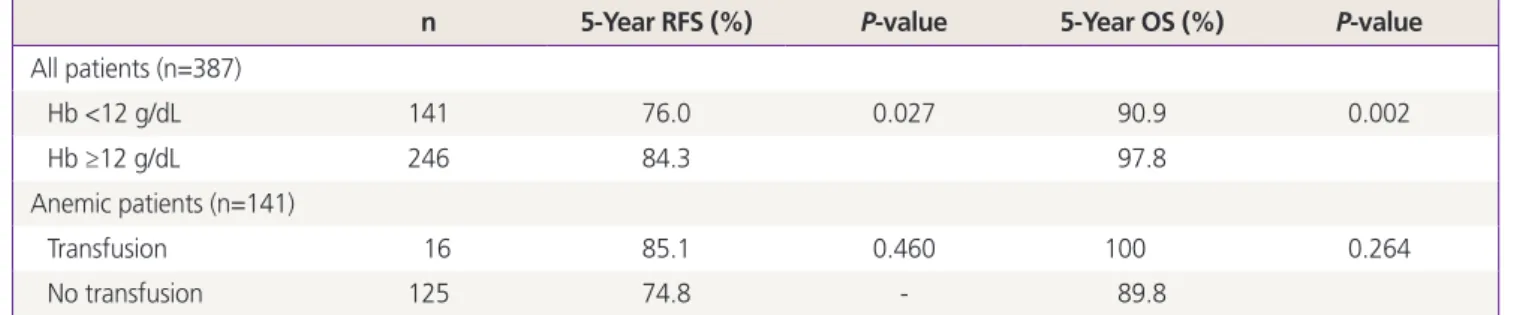
81.5 and 95.5%, respectively. Median survival for the entire cohort has not been reached. There were 141 patients (36.4%) Table 3. Survivals based on preoperative anemia and preoperative blood transfusion
n 5-Year RFS (%) P-value 5-Year OS (%) P-value
All patients (n=387)
Hb <12 g/dL 141 76.0 0.027 90.9 0.002
Hb ≥12 g/dL 246 84.3 97.8
Anemic patients (n=141)
Transfusion 16 85.1 0.460 100 0.264
No transfusion 125 74.8 - 89.8
RFS, relapse-free survival; OS, overall survival; Hb, hemoglobin.
Table 4. Factors associated with survival in multivariate analysis
Hazard ratio 95% confidence interval P-value Relapse-free survival
Parametrial involvement 4.332 2.451–7.659 <0.001
Lymph node metastasis 2.024 1.147–3.573 0.015
Non-squamous cell carcinoma histology 3.202 1.899–5.399 <0.001
Overall survival
Preoperative anemia 4.954 1.358–18.077 0.015
Parametrial involvement 3.952 1.179–13.244 0.026
Lymph node metastasis 7.075 1.752–28.576 0.006
Fig. 1. Recurrence-free survival based on preoperative anemia (P=0.027). Hb, hemoglobin.
Fig. 2. Overall survival based on preoperative anemia (P=0.002).
Hb, hemoglobin.
who had preoperative anemia (Hb <12 g/dL) and 16 out of 141 patients (11.3%) received blood transfusion for correction of preoperative anemia.
These 141 patients with preoperative anemia showed sig- nificant association with age <50 years (P=0.001), more ad- vanced stage (P=0.003), non-squamous cell carcinoma (SCC) histology (P=0.035), larger tumor size (P<0.001), deeper stro- mal invasion (P=0.002), and lymph node metastasis (P=0.031).
Lymphovascular space involvement, resection margin status, and parametrial involvement did not show a significant asso- ciation with preoperative anemia (Table 2).
In univariate analysis, the factors associated with poorer RFS were FIGO stage, non-SCC histology, larger tumor diameter, positive lymphovascular space invasion, deeper stromal inva- sion, lymph node metastasis, positive resection margin, para- metrial involvement, and preoperative anemia. In addition, factors associated with poorer OS were FIGO stage, tumor diameter, lymphovascular space invasion, depth of invasion, lymph node metastasis, positive resection margin, parame- trial involvement, and preoperative anemia. In the intergroup analysis in anemic patients, correction of preoperative anemia by blood transfusion did not affect either RFS or OS (Table 3).
Preoperative leukocytosis and thrombocytosis did not affect survival outcomes.
In univariate analysis, when considering OS and RFS, a sig- nificant difference was observed in subgroups of patients with a lower level of Hb. RFS was worse in patients with Hb <12 g/
dL versus Hb ≥12 g/dL (P=0.027) (Fig. 1). OS was also worse in patients with Hb <12 g/dL versus Hb ≥12 g/dL (P=0.002) (Fig. 2).
In multivariate analysis including the following factors: age, stage, histologic subtype, tumor diameter, lymphovascular space invasion, depth of stromal invasion, lymph node metas- tasis, resection margin status, parametrial involvement, pre- operative anemia, and correction of preoperative anemia by blood transfusion using conditional forward Cox proportional hazard analysis, indicators of RFS were parametrial involve- ment, lymph node metastasis, and histologic subtype of non- SCC. Regarding OS, preoperative anemia <12 g/dL, parametri- al involvement, and lymph node metastasis were independent indicators (Table 4).
Discussion
Findings of this study showed an association of low preop- erative Hb levels with poor prognostic factors and less favor-
able clinical outcomes in early stage cervical cancer patients undergoing radical hysterectomy and lymph node dissection.
Multivariate analysis showed that preoperative anemia had an impact on OS and that preoperative transfusion had no effect on survival. However, decreased RFS was associated with ane- mia in univariate analysis, there was no statistical significance in multivariate analysis. A number of previously reported stud- ies have suggested that anemia at presentation and/or during treatment might heavily impair prognosis in cervical cancer patients undergoing radiotherapy [13-15]. It may represent a surrogate marker for tissue hypoxia, which mediates resistance to radiation. In addition, the possibility that anemia might also characterize biologically more aggressive tumors may be con- sidered [9,10].
Although an association of anemia with prognosis in pa- tients with cervical cancer has been reported [1,2,13-15], most studies have included patients with locally advanced cervical cancer treated with radiotherapy or concurrent chemoradia- tion. Few studies have reported on the influence of pretreat- ment of anemia on clinical outcomes in patients with early stage cervical cancer undergoing surgical treatment. In various solid tumors, the significance of preoperative anemia has been demonstrated in patients who underwent surgical treatment.
In studies on patients with non-small cell lung cancer who were treated with surgery, preoperative anemia was reported as an independent negative prognostic factor [16,17].
In addition, one study reported that low pre-treatment Hb level may reflect poor prognostic factors such as positive cy- tology and cervical involvement in patients with endometrial cancer [18]. Our results support the association of preopera- tive Hb with such poor pathological variables and survival. In the current study, preoperative anemia showed an association with FIGO stage IB2, non-squamous cell histology, larger tu- mor diameter, deeper invasion depth, and lymph node metas- tasis. The results of this study appear to indicate that anemia may be a prognostic factor even for early stage cervical cancer patients.
Anemia is prevalent in the general population and is more common among cancer patients; 27% to 50% of patients undergoing cancer treatment are estimated as having baseline anemia [19,20]. Intratumoral bleeding from a friable tumor surface can result in substantial blood loss, and, therefore, anemia may be commonly seen in cervical cancer. Approxi- mately 30% of patients with cervical cancer present with anemia before treatment [21]. In the current study, 141 out of 387 patients (36.4%) had preoperative anemia (Hb <12 g/dL).
However, the pathophysiology of anemia and its relation to poorer outcomes in cancer patients remains controversial. The presence of anemia itself may be related to aggressive tumor behavior and poor prognosis by exacerbating tumor hypoxia [9,10,22]. Several biological factors can explain how anemia can lead to poor outcomes. Evidence from studies on cancer of the lung [16,17], head and neck [12], and ovarian cancer [4] has demonstrated the adverse prognostic impact of tumor hypoxia within the tumor bed, structural and functional ab- normalities result in haphazard architecture hindering oxygen diffusion from vessels to individual cells and causing hypoxia.
Low oxygen tension within cancer cells initiates biological be- haviors that lead to formation of a more aggressive phenotype and induction of angiogenesis. High levels of circulating an- giogenic factors have also been reported in patients with ane- mia. Lack of oxygen within tissue hinders generation of free radicals, hence, resulting in resistance to treatment. Tumor hy- poxia also appears to diminish the efficacy of certain chemo- and immune-therapeutic dependence on normal local oxygen levels [23]. Therefore, anemia and hypoxia mainly impact local control and can affect survival [24]. However, in the current study, preoperative anemia showed independent association with OS. RFS showed an association with preoperative anemia in univariate analysis and did not show an association in mul- tivariate analysis. The difference between our study and previ- ous studies is that our study only included patients with early stage cervical cancer who underwent radical hysterectomy.
Correction of anemia via transfusion or administration of recombinant human erythropoietin has been suggested to improve local control and OS in patients with solid tumors, however, the clinical benefit remains elusive [8]. If correction of anemia does not result in improved outcomes and not all tumors are associated with anemia, it is possible that tumors associated with anemia are more aggressive, and destined to poorer outcomes. Tumors can be heterogenous and exhibit unpredictable clinical behavior, even for the same histology and stage. One study reported that biologically aggressive tumors may release various cytokines, resulting in anemia, cachexia, and other systemic effects [25]. Therefore, anemia could be viewed as a marker of high-risk disease.
In conclusion, our data suggest that preoperative anemia was associated with poor prognostic factors in patients with early cervical cancer who underwent radical hysterectomy and lymph node dissection. Preoperative anemia was associated with OS, but RFS did not show significant association. There- fore preoperative anemia was not a significant prognostic
factor in patients with early stage cervical cancer. Although, preoperative anemia is not an independent prognostic factor, it may be associated with poor prognostic factors in patients with early stage cervical cancer. In the current study, correc- tion of anemia with transfusion in the preoperative setting did not affect the clinical outcomes. And anemia may be a sign of a more aggressive tumor that is at an increased risk of poor survival. More research into the opinion regarding adjuvant therapy in early-stage cervical cancer patients with anemia is needed.
Conflict of interest
No potential conflict of interest relevant to this article was reported.
References
1. Logsdon MD, Eifel PJ. FIGO IIIB squamous cell carcinoma of the cervix: an analysis of prognostic factors empha- sizing the balance between external beam and intra- cavitary radiation therapy. Int J Radiat Oncol Biol Phys 1999;43:763-75.
2. Mundt AJ, Connell PP, Campbell T, Hwang JH, Rot- mensch J, Waggoner S. Race and clinical outcome in pa- tients with carcinoma of the uterine cervix treated with radiation therapy. Gynecol Oncol 1998;71:151-8.
3. Tamussino KF, Gucer F, Reich O, Moser F, Petru E, Scholz HS. Pretreatment hemoglobin, platelet count, and prog- nosis in endometrial carcinoma. Int J Gynecol Cancer 2001;11:236-40.
4. Obermair A, Handisurya A, Kaider A, Sevelda P, Kolbl H, Gitsch G. The relationship of pretreatment serum hemo- globin level to the survival of epithelial ovarian carcinoma patients: a prospective review. Cancer 1998;83:726-31.
5. Li AJ, Madden AC, Cass I, Leuchter RS, Lagasse LD, Karlan BY. The prognostic significance of thrombocy- tosis in epithelial ovarian carcinoma. Gynecol Oncol 2004;92:211-4.
6. Varlotto J, Stevenson MA. Anemia, tumor hypoxemia, and the cancer patient. Int J Radiat Oncol Biol Phys 2005;63:25-36.
7. De Los Santos JF, Thomas GM. Anemia correction in ma-
lignancy management: threat or opportunity? Gynecol Oncol 2007;105:517-29.
8. Fyles AW, Milosevic M, Pintilie M, Syed A, Hill RP. Ane- mia, hypoxia and transfusion in patients with cervix can- cer: a review. Radiother Oncol 2000;57:13-9.
9. Harrison LB, Chadha M, Hill RJ, Hu K, Shasha D. Impact of tumor hypoxia and anemia on radiation therapy out- comes. Oncologist 2002;7:492-508.
10. Hockel M, Schlenger K, Hockel S, Vaupel P. Hypoxic cer- vical cancers with low apoptotic index are highly aggres- sive. Cancer Res 1999;59:4525-8.
11. Obermair A, Cheuk R, Horwood K, Neudorfer M, Janda M, Giannis G, et al. Anemia before and during concur- rent chemoradiotherapy in patients with cervical carci- noma: Effect on progression-free survival. Int J Gynecol Cancer 2003;13:633-9.
12. Chen MH, Chang PM, Chen PM, Tzeng CH, Chu PY, Chang SY, et al. Prognostic significance of a pretreat- ment hematologic profile in patients with head and neck cancer. J Cancer Res Clin Oncol 2009;135:1783-90.
13. Grogan M, Thomas GM, Melamed I, Wong FL, Pearcey RG, Joseph PK, et al. The importance of hemoglobin levels during radiotherapy for carcinoma of the cervix.
Cancer 1999;86:1528-36.
14. Dunst J, Kuhnt T, Strauss HG, Krause U, Pelz T, Koelbl H, et al. Anemia in cervical cancers: impact on survival, pat- terns of relapse, and association with hypoxia and angio- genesis. Int J Radiat Oncol Biol Phys 2003;56:778-87.
15. Girinski T, Pejovic-Lenfant MH, Bourhis J, Campana F, Cosset JM, Petit C, et al. Prognostic value of hemoglobin concentrations and blood transfusions in advanced car- cinoma of the cervix treated by radiation therapy: results of a retrospective study of 386 patients. Int J Radiat On- col Biol Phys 1989;16:37-42.
16. Panagopoulos ND, Karakantza M, Koletsis E, Apostolakis E, Sakellaropoulos GC, Filos KS, et al. Influence of blood transfusions and preoperative anemia on long-term sur- vival in patients operated for non-small cell lung cancer.
Lung Cancer 2008;62:273-80.
17. Yovino S, Kwok Y, Krasna M, Bangalore M, Suntharal- ingam M. An association between preoperative anemia and decreased survival in early-stage non-small-cell lung cancer patients treated with surgery alone. Int J Radiat Oncol Biol Phys 2005;62:1438-43.
18. Metindir J, Bilir Dilek G. Preoperative hemoglobin and platelet count and poor prognostic factors in patients with endometrial carcinoma. J Cancer Res Clin Oncol 2009;135:125-9.
19. Nissenson AR, Goodnough LT, Dubois RW. Anemia:
not just an innocent bystander? Arch Intern Med 2003;163:1400-4.
20. Harrison LB, Shasha D, Homel P. Prevalence of anemia in cancer patients undergoing radiotherapy: prognostic sig- nificance and treatment. Oncology 2002;63 Suppl 2:11-8.
21. Barkati M, Fortin I, Mileshkin L, Bernshaw D, Carrier JF, Narayan K. Hemoglobin level in cervical cancer: a sur- rogate for an infiltrative phenotype. Int J Gynecol Cancer 2013;23:724-9.
22. Vaupel P, Mayer A. Hypoxia in cancer: significance and impact on clinical outcome. Cancer Metastasis Rev 2007;26:225-39.
23. Khan AA, Klonizakis M, Shabaan A, Glynne-Jones R. As- sociation between pretreatment haemoglobin levels and morphometric characteristics of the tumour, response to neoadjuvant treatment and long-term outcomes in pa- tients with locally advanced rectal cancers. Colorectal Dis 2013;15:1232-7.
24. Rofstad EK, Sundfor K, Lyng H, Trope CG. Hypoxia-in- duced treatment failure in advanced squamous cell car- cinoma of the uterine cervix is primarily due to hypoxia- induced radiation resistance rather than hypoxia-induced metastasis. Br J Cancer 2000;83:354-9.
25. Yamaji H, Iizasa T, Koh E, Suzuki M, Otsuji M, Chang H, et al. Correlation between interleukin 6 production and tumor proliferation in non-small cell lung cancer. Cancer Immunol Immunother 2004;53:786-92.