• 검색 결과가 없습니다.

Morphometric Analysis of Tibial Bone in Three Strains ofMice Using Micro-computed Tomography

N/A
N/A
Protected

Academic year: 2022

Share "Morphometric Analysis of Tibial Bone in Three Strains ofMice Using Micro-computed Tomography"

Copied!
4
0
0

로드 중.... (전체 텍스트 보기)

전체 글

(1)

315

Morphometric Analysis of Tibial Bone in Three Strains of Mice Using Micro-computed Tomography

Byung-Su Ahn

1

, Joong-Sun Kim

2

, Chang-Geun Lee

2

, Miyoung Yang

1

, Changjong Moon

1

, Jong-Choon Kim

1

, Uhee Jung

3

and Sung-Ho Kim

1

*

1

College of Veterinary Medicine, Chonnam National University, Gwangju, Korea

2

Research Center, Dongnam Institute of Radiological & Medical Sciences (DIRAMS), Busan, Korea

3

Advanced Radiation Technology Institute, Jeongeup Campus of Korea Atomic Energy Research Institute, Jeongeup, Korea

This study investigated the trabecular and cortical bone microarchitecture of tibia in 14-week-old C3H/

HeN, C57BL/6J and ICR mice using micro-computed tomography (micro-CT). Defined volumes of interest were scanned at a resolution of 17 µm (isotropic). The X-ray tube was set at photon energy of 50 kV, current of 200 µA, exposure time 1.2 sec, and a 0.5 mm-thick aluminium filter. For quantification of bone mineral density (BMD), the bone samples were scanned by micro-CT together with 2 calibration phantoms. The image slices were reconstructed using 3-dimensional CT analyzer software. C3H/HeN mice showed significantly higher levels of bone volume fraction, trabecular number and BMD, and lower levels of trabecular separation, structure model index and degree of anisotropy compared to C57BL/6J or ICR mice in trabecular bone area. So the C3H/HeN mouse appeared to be a good model animal for the study on the changes of trabecular bone with high trabecular bone mass.

Key words: Micro-computed tomography, trabecular bone, microarchitecture, mouse strain

Received 14 July 2010; Revised version received 30 August 2010; Accepted 7 September 2010

뼈는 지지기능과 보호기능에 적합하도록 견고하고, 무 기질 물질에 세포와 섬유가 묻혀있는 결합조직이며 동물 의 일생 동안 재구성이 계속되는 동적인 조직으로, 어떤 조직보다도 적은 양으로 최대한의 장력을 제공하기 때문 에 그 구조가 특이하다(Eurell and Frappier, 2006). 골 구 조에 대한 연구는 주로 골다공증 연구의 관점에서 조직 형태학적으로 진행되어왔으며, 최근에는 방사선 영상을 이용한 연구가 보고되고 있다. 인체의학에 적용되는 방사 선학적 진단에는 단순방사선 소견, 골 주사 검사(bone scan), 전산화 단층촬영(computed tomography; CT), 자기 공명영상(magnetic resonance imaging) 및 정량적 단층촬 영(quantitative CT) 등이 있으며, 골밀도 측정법으로는 이 중에너지 방사선흡수법, 정량적 전산화단층촬영 등이 적 용된다(Mayo-Smith and Rosenthal, 1991; Blake and Fogelman, 2001). 생화학적 골표지자로써 뼈파괴세포나

뼈형성세포에서 분비하는 효소, 골흡수 및 골형성과정에 서 유리되는 골의 기질성분 등이 골질 평가에 간접적으 로 사용된다(Eastell and Hannon, 2008).

동물실험에서 뼈에 대한 전통적인 조직학적 관찰은 동 물의 뼈조직을 채취하여 탈회, 통상적 조직처리 과정을 거친 후 염색하고 현미경 검경하는 방법이다. 이러한 방 법은 장기간 탈회에 의한 조직손상, 염색 불량 및 2차원 적 평가 적용에서 절편 부위의 불균일성에 따른 결과의 왜곡 등이 단점으로 지적되고 있다(Kim et al., 2000).

X-ray 단층촬영술은 1970년대 초 개발된 이래 영상진 단적으로 광범위하게 적용되고 있다. Micro-CT는 골미세 구조의 3차원 정량화가 가능하고, 골질의 평가 지표의 정 확성을 제공하기 때문에 이를 이용한 2차원적 및 3차원 적으로 뼈를 분석하는 연구가 근래에 증가하고 있다.

Micro-CT는 5-50 µm의 voxel로 일반 CT의 백만배의 공 간적 세밀도(spatial resolution)가 매우 높은 영상을 제공 함으로써 소형설치류의 골조직 변화를 비롯한 방사선 미 세영상 연구 분야에 유용한 기기로 적용되고 있다(Guldberg et al., 2004).

본 연구에서는 3가지 마우스계통에서 micro-CT를 적용 하여 정강뼈(tibia)의 뼈몸통끝 부분의 뼈잔기둥(trabecular)

*Corresponding author: Sung-Ho Kim, College of Veterinary Medicine, Chonnam National University, 300 Yongbong-dong, Buk-gu, Gwangju 500-757, Korea

Tel: +82-62-530-2837 Fax: +82-62-530-2841 E-mail: [email protected]

Lab. Anim. Res. 2010: 26(3), 315-318

Letter

(2)

316 Byung-Su Ahn et al.

Lab. Anim. Res. | September, 2010 | Vol. 26, No. 3

과 치밀뼈(cortical bone)를 촬영하고 분석하였으며, 계통 별 차이 및 분석 방법에 따른 성적 산출의 유용성을 검 토하였고, 선택된 마우스 계통을 적용한 난소 절제 실험 모델에서 뼈소실의 양상을 확인한 바 결과를 보고하고자 한다.

실험동물로는 14주령의 C3H/HeN, C57BL/6J 및 ICR 암컷 마우스를 적용하였으며, 동물의 사육은 온도 22±2

o

C, 상대습도 50±10%, 조명시간은 12시간(오전 8시 점등-오 후 8시 소등) 및 조도 200-300 lux로 설정된 시설에서 사 육하였다. 순화기간을 거쳐 polycarbonate 사육상자에 3 마리씩 수용하고 실험동물용 고형사료(삼양사료, 원주)와 정수장치를 통과한 수도수를 자유롭게 섭취하도록 하였 다. 실험동물은 Institute of Laboratory Animal Resources 의 ‘Guide for the Care and Use of Laboratory Animal’

(1996)에 준하여 취급하였으며 동물실험은 전남대학교 동 물실험윤리위원회(Institutional Animal Care and Use Committee)의 승인 하에 수행하였다. 실험동물은 안락사 후 부검을 시행하고 좌측 정강뼈를 채취하였으며 전산화 단층촬영시까지 70% 에탄올에 보관하였다.

시료의 단층 영상은 micro-CT (Skyscan 1172; Skyscan, Kontich, Belgium)를 이용하여 다음과 같은 조건하에 채 득하였다. 원추형 빔(cone beam) 방식의 X-ray source를 이용하여 50 kV, 200 µA 하에서 시료에 방사선을 조사 하 였고, 이때 해상도(spatial resolution)는 17 µm로 조절하였 다. 시료를 0.4도씩 회전시키면서 매회 1.2초간 방사선을 조사하였으며, 촬영은 포커스 스폿(focus spot)에서 방사된 빔이 시료를 투과하여 charge-coupled devices 카메라에 영상이 맺히는 원리를 이용하였다. 채득된 영상은 NRecon 소프트웨어(Skyscan)를 이용하여 150개의 2차원 횡단면으 로 재구성되었고, 각 단면간의 거리는 85 µm로 설정하였 다. 정강뼈의 미세구조는 2차원적으로 채득된 영상의 골 영역만을 적용하여 CTan 소프트웨어(Skyscan)로 분석하였 다. 뼈잔기둥의 분석은 성장판 아래에서 1.5 mm 또는 1.0 mm를 측정 대상으로 하였다. 재구성된 2차원 이미지 로부터 치밀뼈 (cortical bone)과 뼈잔기둥을 구분하여 관 심영역(region of interest, ROI)을 설정한 후, 각 부분의 bone volume/tissue volume (BV/TV), trabecular thickness

(Tb.Th), trabecular separation (Tb.Sp), trabecular number (Tb.N) 등의 양적 분석과 structure model index (SMI), trabecular bone pattern factor (Tb.Pf), degree of anisotropy (DA) 등의 구조적 파라미터(structural parameters) 값을 측 정하였다. 골밀도(bone mineral density; BMD)는 0.25와 0.75 mg/cm

3

의 hydroxyapatite standard phantom에 대한 Hounsfield unit (HU) 값을 얻은 후, 측정하고자 하는 시 편의 HU 값을 구하여 계산식에 대응시켜 구하였다. 치 밀뼈는 뼈잔기둥 소실 부위 아래부터 1.0 mm를 측정대 상으로 하였으며, BV, percent porosity, polar moment of inertia (pMOI) 등의 값을 측정하였다. 뼈잔기둥의 ROI의 설정은 모든 뼈잔기둥의 면을 설정하는 부정형과 뼈잔기 둥의 일부를 포함하는 원형 ROI를 설정하여 성적을 비 교하였다. 뼈소실 유발 상태의 확인을 위해, 실험 적용 적정 마우스 계통으로 선택된 C3H/HeN 마우스(암컷, 9 주령)에서 난소적출술을 시행하였다. 마취는 Xylazine HCl (23.32 mg/1 mL; 바이엘코리아, 서울, 한국)과 Ketamine HCl (57.68 mg/mL; 유한양행, 서울, 한국)을 1:7로 혼합하 여 복강내 주사하고 등쪽으로 고정한 후 정중 등쪽의 피 부를 절개하고 핀셋으로 근육을 관통한 다음 좌우측 난 소를 각각 노출시키고 적출하였다. 대조군은 난소 적출군 과 동일한 방법으로 난소를 노출시켰다가 원위치로 원상 회복하였으며 각각의 수술 후 절개부위는 봉합하였다. 난 소 적출 6주 후 마우스를 안락사시키고 마우스 계통 분 석 시험에서 적용한 방법과 동일하게 뼈의 미세구조를 분 석하였다.

얻어진 수치는 평균±표준편차의 값으로 나타냈으며, 통 계학적 차이는 Mann-Whitney와 Kruskal-Wallis test (SPSS software Version 17.0, SAS Institute, Cary, NC, USA) 로 비교하였으며 P 값이 0.05보다 작을 때 유의하다고 간주 하였다.

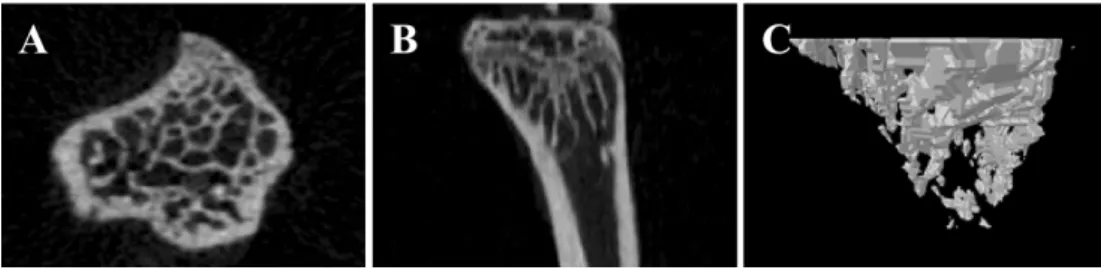
마우스에서 촬영된 정강뼈의 횡단면, 종단면 및 3차원 구조는 Figure 1과 같이 관찰된다. 뼈잔기둥 분석에서 C3H/HeN 마우스의 경우, 평균치를 기준으로 BV/TV는 C57BL/6J에 비해 250%, ICR에 비해 286%, Tb.N은 C57BL/6J에 비해 2.3배, ICR에 비해 3.2배였으며, Tb.Sp 은 C57BL/6J에 비해 70.3%, ICR에 비해 45.6%에 해당되

Figure 1. Micro-CT images of the tibia of 14-week-old C3H/HeN mice. Cross sectional view (A), vertical view (B) and reconstructed

three-dimensional image (C) are represented.

(3)

Micro-CT evaluation in mouse tibia 317

Lab. Anim. Res. | September, 2010 | Vol. 26, No. 3

었다. SMI, Tb.Pf, DA 등의 구조적 파라미터 값에서도 C3H/HeN에서 상대적으로 낮은 수치를 나타냈으며, BMD 평균치에서도 C3H/HeN 마우스에서 C57BL/6J의 22.3배, ICR의 5.9배를 나타내어, 뼈의 양적 분석 및 구조적 분 석 모두에서 강도가 높은 것으로 나타났다. Tb.Th는 기 타 지표에 비하여 차이가 적게 나타났다(Table 1). 치밀뼈 의 분석에서는 단위 면적(BV)에서 비근교계인 ICR이 가 장 양이 많았으며 pMOI 수치도 높았다(Table 2). 많은 뼈 소실 관련 연구가 정강뼈의 뼈잔기둥의 형태를 변화 판 단의 기준으로 적용하고 있으며, 치밀뼈의 경우 시험물질 적용에 의한 변화가 극히 경미한 것으로 보고(Bandstra et al., 2008)되고 있어, 본 실험에 적용된 마우스 계통 중에 서는 상대적으로 뼈잔기둥의 양이 많고 구조적 강도가 높 은 C3H/HeN 마우스가 뼈소실 관련 연구에 적용 적절한 계통으로 판단되었다.

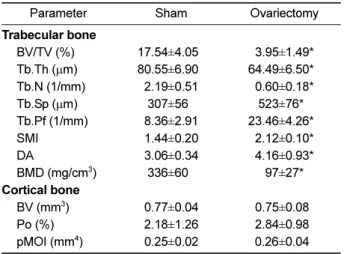
뼈 소실 평가실험 적용 적정 마우스 계통으로 선택된 C3H/HeN 마우스에서 난소적출술에 따른 뼈소실 유발 상 태는, 뼈잔기둥 결과에서는 뼈의 양적 분석 및 구조적 분 석 모두에서 유의성있는 차이가 나타났다(Table 3). 난소 제거 마우스에서 BV/TV, Tb.Th, Tb.N 및 BMD 수치는 감소하였으며, Tb.Sp, Tb.Pf, SMI 및 DA는 증가하였다. 치

밀뼈의 경우 난소적출에 따른 변화는 경미하였다(Table 3).

이상의 결과에서, micro-CT를 적용한 뼈 변화 연구에서 C3H/HeN 마우스가 적정 마우스 계통으로 적용 가능할 것으로 사료된다.

측정의 방법 중 뼈잔기둥 횡단면 상에 ROI의 설정을 모든 뼈잔기둥의 면을 설정하는 부정형과 뼈잔기둥의 일 부를 포함하는 원형 ROI를 설정하여 성적을 비교한 바 2 가지 방법에 따른 뼈 변화 결과의 경향 차이가 인정되 지 않아, 분석시간을 줄일 수 있는 원형 ROI를 설정방법 이 유용한 것으로 사료된다. 한편 정강뼈의 촬영 영상의 분석 길이는 1.0 mm 보다 1.5 mm의 분석 결과가 보다 확연한 차이를 보여 유용하였다(성적 미제시).

최근 국내외적으로 in vivo 상태에서 측정이 가능한 micro-CT 기종의 도입과 생존 실험동물을 적용한 경시적 뼈 변화 관찰 실험이 수행되고 있다(Boyd et al., 2004).

이 경우 동물이 CT 촬영에 따른 방사선에 노출되게 된 다. 방사선의 노출량은 뼈 10 µm 당 1장의 촬영을 시행 하고 2 cm의 길이를 촬영한다면 대략 2,000 촬영 노출 이 예상된다. 최근 보고에서 10.5 µm isotropic voxel size, 55 keV voltage, 109 µA current를 적용할 경우 대 략 마우스에 대한 방사선 노출량은 710 mGy에 해당된다 고 하였다(Klinck et al., 2008). 이정도의 방사선량이 난 소제거 후 뼈의 변화 관찰 모델에서 결과에 영향을 미칠 정도는 아니지만 기타 방사선 생물학적 반응을 일으킬 수 있는 양에 해당되므로 이에 대한 면밀한 영향 분석 및 이해가 요구된다.

Table 1. Microstructural properties of the proximal tibial metaphyseal trabecular bone in three strains of mice

Parameter C3H/HeN C57BL/6J ICR

BV/TV (%) 15.72±4.49

a

6.29±1.39

b

5.50±2.70

b

Tb.Th (µm) 69.92±2.57

a

63.80±7.02

a

0 77.32±6.37

c

0 Tb.N (1/mm) 02.24±0.57

a

0.98±0.11

b

0.70±0.31

b

Tb.Sp (µm) 275±37

a

391±26

b

0 603±150

b

Tb.Pf (1/mm) 09.83±4.97

a

23.79±2.89

b

0 19.70±4.73

b

0 SMI 01.45±0.24

a

2.13±0.08

b

2.09±0.15

b

DA 02.95±0.37

a

3.51±0.52

a

3.38±0.25

b

BMD (mg/cm

3

) 318±70

a

14±8

b

0 54±11

c

Data are expressed as means ±SD (n=6). BV/TV, bone volume/

tissue volume; Tb.Th, trabecular thickness; Tb.N, trabecular number; Tb.Sp, trabecular separation; Tb.Pf, trabecular bone pattern factor; SMI, structure model index; DA, degree of anisotropy; BMD, bone mineral density.

a,b,c

Values with different superscripts in the same parameter are significantly different (P<0.05).

Table 2. Microstructural properties of the tibial diaphyseal cortical bone in three strains of mice

Parameter C3H/HeN C57BL/6J ICR

BV (mm

3

) 0.72±0.04

a

0.52±0.02

b

1.01±0.01

c

Po (%) 2.06±1.35

a

0.47±0.44

b

1.54±0.26

a

pMOI (mm

4

) 0.22±0.02

a

0.36±0.03

b

0.74±0.22

c

Data are expressed as means ±SD (n=6). BV, bone volume; Po, percent porosity; pMOI, polar moment of inertia.

a,b,c

Values with different superscripts in the same parameter are significantly different (P<0.05).

Table 3. Microstructural properties of the tibial bone in ovariectomized and sham C3H/HeN mice

Parameter Sham Ovariectomy

Trabecular bone

BV/TV (%) 17.54±4.050 3.95±1.49*

Tb.Th (µm) 80.55±6.900 64.49±6.50*0

Tb.N (1/mm) 2.19±0.51 0.60±0.18*

Tb.Sp (µm) 307±560 523±76*0

Tb.Pf (1/mm) 8.36±2.91 23.46±4.26*0

SMI 1.44±0.20 2.12±0.10*

DA 3.06±0.34 4.16±0.93*

BMD (mg/cm

3

) 336±600 97±27*

Cortical bone

BV (mm

3

) 0.77±0.04 0.75±0.08*

Po (%) 2.18±1.26 2.84±0.98*

pMOI (mm

4

) 0.25±0.02 0.26±0.04*

Data are expressed as means ±SD (n=6). BV/TV, bone volume/

tissue volume; Tb.Th, trabecular thickness; Tb.N, trabecular

number; Tb.Sp, trabecular separation; Tb.Pf, trabecular bone

pattern factor; SMI, structure model index; DA, degree of

anisotropy; BMD, bone mineral density; BV, bone volume; Po,

percent porosity; pMOI, polar moment of inertia. *Significant

difference between ovariectomy and sham at P<0.05.

(4)

318 Byung-Su Ahn et al.

Lab. Anim. Res. | September, 2010 | Vol. 26, No. 3

감사의 글

이 논문은 교육과학기술부의 재원으로 시행하는 동남 권원자력의학원의 정부출연 연구 및 한국연구재단의 원 자력연구개발사업으로 지원받았습니다.

참고문헌

Bandstra, E.R., Pecaut, M.J., Anderson, E.R., Willey, J.S., De Carlo, F., Stock, S.R., Gridley, D.S., Nelson, G.A., Levine, H.G. and Bateman, T.A. (2008) Long-term dose response of trabecular bone in mice to proton radiation. Radiat. Res.

169(6), 607-614.

Blake, G.M. and Fogelman I. (2001) Bone densitometry and the diagnosis of osteoporosis. Semin. Nucl. Med. 31(1), 69-81.

Boyd, S.K., Mattmann, C., Kuhn, A., Mller, R. and Gasser, J.A.

(2004) A novel approach for monitoring and predicting bone microstructure in osteoporosis. In 26th American Society of

Bone and Mineral Research Annual Meeting, Seattle. J. Bone Miner. Res. S236­S237.

Eastell, R. and Hannon, R.A. (2008) Biomarkers of bone health and osteoporosis risk. Proc. Nutr. Soc. 67(2), 157-162.

Eurell, J.A. and Frappier, B.L. (2006) Textbook of Veterinary Histology, 6th ed., pp.46-50, Blackwell Publishing, Oxford.

Guldberg, R.E., Lin, A.S., Coleman, R., Robertson, G. and Duvall, C. (2004) Microcomputed tomography imaging of skeletal development and growth. Birth Defects Res. C Embryo Today 72(3), 250-259.

Kim, S.J., Kim, K.W. and Lee, J.H. (2000) A study on the trabecular change of femur according to 17β-estradiol dosage in ovariectomized rat. J. Korean Assoc. Maxillofac.

Plast. Reconstr. Surg. 22, 155-163.

Klinck, R.J., Campbell, G.M. and Boyd, S.K. (2008) Radiation effects on bone architecture in mice and rats resulting from in vivo micro-computed tomography scanning. Med. Eng.

Phys. 30(7), 888-895.

Mayo-Smith, W. and Rosenthal, D.I. (1991) Radiographic

appearance of osteopenia. Radiol. Clin. North Am. 29(1), 37-

47.

수치

Figure 1. Micro-CT images of the tibia of 14-week-old C3H/HeN mice. Cross sectional view (A), vertical view (B) and reconstructed three-dimensional image (C) are represented.
Table 1. Microstructural properties of the proximal tibial metaphyseal trabecular bone in three strains of mice

참조

관련 문서

5) After GBR, the membrane was removed i n i ni ti al ti me, the usage of nonabsorbabl e membrane and autogenous bone resul ted i n the mostfavorabl e bone formati

It might also act in conjunction with a growth factor, such as bone morphogenic protein (BMP), insulin-like growth factor, or platelet-derived growth factor.

Biochemical markers of bone turnover can be classified according to the process that underlie in markers of bone formation, products of the osteoblast

The result of using PLGA nanofiber membrane with bone graft material showed that the PLGA nanofiber membrane in the experimental group of 2 weeks were ten times more new

Statistical analyses were performed using SPSS software (version 12.0, SPSS Inc, Chicago, IL, USA). Measurements of the alveolar bone thickness from the root

Mean thickness of palate including bone and soft tissue according to Level at 2 and 4 mm laterally from antero-posterior reference line in

Bone is a common site of distant metastasis in prostate cancer. Association of bone and metastatic cancer cells are important in this site-specific manifestation

Clinical evaluation of the use of decalcified freeze-dried bone allograft with guided tissue regen- eration in the treatment of molar furca- tion invasions.. Wallace SC,