• 검색 결과가 없습니다.

Content Analysis of Rutin in the Leaves of Boehmeria nivea Harvested in Different Regions of South Korea by HPLC-UV

N/A
N/A
Protected

Academic year: 2022

Share "Content Analysis of Rutin in the Leaves of Boehmeria nivea Harvested in Different Regions of South Korea by HPLC-UV"

Copied!
4
0
0

로드 중.... (전체 텍스트 보기)

전체 글

(1)

Natural Product Sciences 24(1) : 36-39 (2018)

https://doi.org/10.20307/nps.2018.24.1.36

36

Content Analysis of Rutin in the Leaves of Boehmeria nivea Harvested in Different Regions of South Korea by HPLC-UV

Sunghun Cho

1

, Norman G. Quilantang

1

, Ju Sung Lee

1

, Young-Mi Kim

2

, Ho Bang Kim

3

, Eun Ju Cho

4

, Yong-Su Jung

2

, and Sanghyun Lee

1,

*

1

Department of Integrative Plant Science, Chung-Ang University, Anseong 17546, Korea

2

Yeong-Gwang Agricultural Technology Center, Yeonggwang 57031, Korea

3

Life Sciences Research Institute, Biomedic Co., Ltd., Bucheon 14548, Korea

4

Department of Food Science and Nutrition, Pusan National University, Busan 46241, Korea

Abstract − Phytochemical analysis of Boehmeria nivea (Bn) leaves by medium pressure liquid chromatography led to the isolation of a flavonoid glycoside identified by spectroscopic analysis as rutin. The amount of rutin in the leaves of Bn harvested from nine regions in South Korea (Bn 1-9) which were collected on the months of June, July, August, and September was determined by HPLC-UV analysis. A gradient elution program that utilizes a Discovery

®

C18 (4.6 × 250 mm, 5 µm) column and mobile phase composed of 1% acetic acid-water:

acetonitrile (90:10 to 60:40 for min) was followed. The injection volume and flow rate were 10 µl and 1 mL/ min, respectively. UV detection was set at 350 nm. Results show that Bn-8 harvested in September reported the highest content of rutin among the samples analyzed. This study provides a basis for the optimal harvest time of Bn which maximizes the yield of rutin.

Keywords − Boehmeria nivea, HPLC-UV, Rutin, Content analysis

Introduction

Boehmeria nivea (Urticaceae) is an herbaceous plant indigenous to many Asian countries such as China, Japan, Philippines, and Korea. It is commonly known as “ramie”

and is primarily cultivated as a raw material for many industries such as in textile, paper, and fiber-reinforced composite material production due to its fine and strong fibers.

1-3

B. nivea is also consumed as food and used in traditional herbal medicine preparations as a treatment for fever, common cold, infections of the urinary tract, and edema.

4

Several studies have provided scientific evidence regarding the biological activities of B. nivea which showed that it exhibits antioxidant, hepatoprotective, antihyperlipidemic, antidiabetic, and anti-inflammatory effects.

5-7

Moreover, phytochemical analysis revealed that it contains many bioactive compounds such polyphenols, flavonoids, sterols, and fatty acids which contributes to the medicinal properties of its extracts.

8-9

This study focuses on rutin, a flavonoid glycoside we

isolated from B. nivea leaves in our previous study.

9

Rutin is a commonly consumed dietary polyphenol that is present in various plant species which includes Fagopyrum esculentum, Sophora japonica, Amaranthus paniculatus, and Eucaplyptus spp. as major sources.

10-13

It is an econo- mically important phytochemical due to its pharmaco- logical activities. In fact, it has been used as a component of many multivitamins and in over 130 herbal medicines which sales in 1998 was estimated as $430 million in the US.

14-15

The aim of this study is to determine the amount of rutin present in the leaves of B. nivea collected from different regions of South Korea and harvested in different months by HPLC-UV analysis to assess the potential of the plant as a source of rutin. The results of this study will also provide a basis for the optimal harvest time of B. nivea which maximizes the yield of rutin from the plant.

Experimental

Plant materials − Dried leaves of B. nivea were provided by Yeonggwang Agricultural Technology and Extension Center, Korea. The samples were collected from

*Author for correspondence

Sanghyun Lee, Department of Integrative Plant Science, Chung- Ang University, Anseong 17546, Korea

Tel: +82-31-670-4688; E-mail: [email protected]

(2)

Vol. 24, No. 1, 2018 37

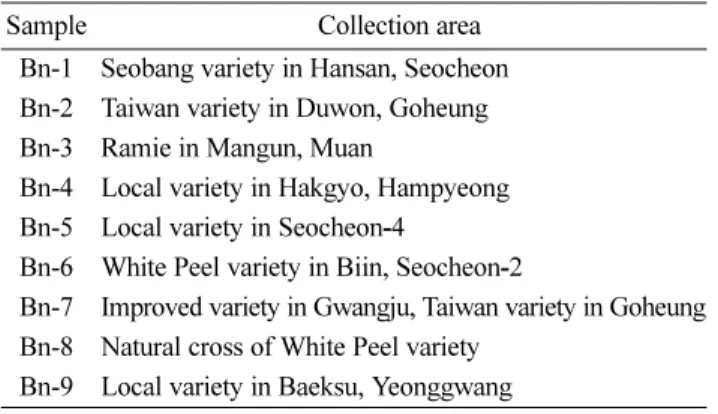
different regions in South Korea and were harvested on the months of June, July, August, and September (Table 1).

Apparatus and chemicals − Spectroscopic analysis was performed with a JEOL JMS-AX505WA FAB-MS (Japan) and a Bruker Avance 500 NMR (Rheinstetten, Germany). HPLC analysis utilized a Waters Breeze HPLC system (MA, USA) provided with a binary pump and a UV/VIS detector. HPLC water and acetonitrile were obtained from J.T. Baker Chemicals (PA, USA).

Isolation of rutin from B. nivea − Dried and powdered B. nivea leaves were extracted with methanol (MeOH) at 65 - 75

o

C for 3 hours and the resulting extract was then filtered and evaporated in vacuo to obtain the MeOH extract. Identification was performed by spectroscopic analysis and is presented in our previous study on the phytochemical analysis of B. nivea leaves.

9

The structure of rutin (purity: 97%) is shown in Fig. 1.

Preparation of standard and sample solutions − A stock solution of the standard compound was prepared by dissolving 1 mg of rutin in 50% MeOH. The working solutions used for the calibration curve was prepared by diluting the stock solution to desired concentrations. B.

nivea leaves collected from different regions of South Korea and harvested in different months were analyzed for their rutin content. Dried and powdered leaves were extracted with MeOH under a reflux system at 65 - 75

o

C for 3 h. The resulting extract was filtered and evaporated in vacuo to obtain a concentrated MeOH extract of the samples. Twenty milligrams of the MeOH extract of B.

nivea leaves were dissolved in 1 mL 50% MeOH and filtered using a 0.45 µm filter prior to HPLC analysis.

HPLC conditions − A reverse phase system utilizing a Discovery

®

C18 (4.6 × 250 mm, 5 µm) column and a gradient elution of 1% acetic acid in water and acetonitrile (90:10 to 60:40 for 60 min) were followed for the HPLC analysis. The flowrate and injection volume were 1 mL/

min and 10 µL, respectively. The UV detector was set at 350 nm.

Calibration curve − Five concentrations of the standard compound were prepared. The calibration curve was constructed by plotting the peak area of each solution against their corresponding concentration. Linearity was then determined based on the correlation coefficient (r

2

).

The amount of the analyte present in each sample was determined using the constructed calibration curve where (Y) corresponds for the peak area and (X) for the concentration of the reference compound ( µg/10 µl).

Results and Discussion

The use of B. nivea in traditional medicine to remedy various illnesses has prompted several studies to determine the bioactive components responsible for its healing properties. In our previous research, the flavonoid glycoside, rutin, was isolated from the leaves of Bn together with other organic compounds.

9

Particularly, the content of rutin in the leaves of Bn was investigated in this study by HPLC-UV analysis. Rutin is a pharmaco- logically important plant utilized in the preparations of many herbal medicines, hence, the evaluation of potential plant sources rich in this compound will prove useful in commercial production of rutin. The analytical method used showed good linearity with a correlation coefficient (r

2

) greater than 0.9999 (Fig. 2). The linear calibration equation was Y = 9972.7X − 17535, where (Y) corres- ponds to the peak area and (X) corresponds to concentration of rutin. The amount of rutin present in Table 1. Collection areas for B. nivea

Sample Collection area

Bn-1 Seobang variety in Hansan, Seocheon Bn-2 Taiwan variety in Duwon, Goheung Bn-3 Ramie in Mangun, Muan

Bn-4 Local variety in Hakgyo, Hampyeong Bn-5 Local variety in Seocheon-4

Bn-6 White Peel variety in Biin, Seocheon-2

Bn-7 Improved variety in Gwangju, Taiwan variety in Goheung Bn-8 Natural cross of White Peel variety

Bn-9 Local variety in Baeksu, Yeonggwang

Fig. 1. Structure of rutin.

Fig. 2. Calibration curve of rutin.

(3)

38 Natural Product Sciences

each sample was calculated from the calibration curve.

The chromatographic separation of rutin and the MeOH extracts of Bn is shown in Fig. 3 and the results of the quantitative analysis is summarized in Table 2. Results show that the content of rutin in Bn leaves vary according to the regions and time they were collected. The rutin content of Bn leaves ranges from 1.63 - 27.03 mg/g which is comparable with other plant species used as commercial sources of rutin such as F. esculentum (24.6 - 36.1 mg/g) and S. japonica (44 - 287 mg/g).

16-17

It can also be observed that rutin content generally increases on the month of September. Bn-8 collected on September showed the highest amount of rutin (27.03 mg/g). Moreover, Bn-8 displayed the highest total rutin content in all four months of sampling period with a total of 40.18 mg/g (Table 2).

The results of this study show that the rutin content of B. nivea leaves is affected by the geographical location and harvest time. Particularly, Bn-8 samples record the highest content of the compound showing that collecting the plants on the month of September increases the yield

of rutin. Ultimately, B. nivea is an abundant source of dietary rutin and can be employed as a source of the compound as a food additive and in the preparation of herbal medicines.

Acknowledgments

This research was funded by grants from the Korea Institute of Planning and Evaluation for Technology in Food, Agriculture, Forestry, and Fisheries (iPET), Ministry of Agriculture, Food, and Rural Affairs, Republic of Korea. We express our gratitude to the National Center for Inter-University Research Facilities, Seoul National University for facilitating the spectroscopic analysis.

References

(1) Angelini, L. G.; Lazzeri, A.; Levita, G.; Fontanelli, D.; Bozzi, C. Ind.

Crops Prod. 2000, 11, 145-161.

(2) Paiva Junior, C. Z.; de Carvalho, L. H.; Fonseca, V. M.; Monteiro, S.

N.; d’ Almeida, J. R. M. Polym. Test. 2004, 23, 131-135.

(3) Nam, S.; Netravali, A. N. Fibers Polym. 2006, 7, 372-379.

Fig. 3. HPLC chromatograms of rutin (A) and MeOH extract of B. nivea (B).

Table 2. Rutin content of the MeOH extracts of B. nivea (Bn) collected from different regions and harvest time

Harvest Time Bn-1 Bn-2 Bn-3 Bn-4 Bn-5 Bn-6 Bn-7 Bn-8 Bn-9

June 2.79 ± 0.05 3.37 ± 0.00 3.36 ± 0.00 3.64 ± 0.01 2.78 ± 0.14 2.02 ± 0.00 3.05 ± 0.03 4.06 ± 0.00 4.29 ± 0.05 July 4.47 ± 0.07 4.24 ± 0.08 5.69 ± 0.01 8.89 ± 0.05 2.84 ± 0.04 1.93 ± 0.00 7.60 ± 0.18 6.51 ± 0.01 7.22 ± 0.08 August 1.88 ± 0.01 8.04 ± 0.00 5.96 ± 0.13 5.34 ± 0.13 3.56 ± 0.11 6.52 ± 0.01 2.33 ± 0.00 2.58 ± 0.00 3.15 ± 0.03 September 1.63 ± 0.04 8.28 ± 0.57 14.78 ± 0.12 14.77 ± 0.04 16.68 ± 0.10 19.49 ± 0.17 2.86 ± 0.14 27.03 ± 0.05 4.71 ± 0.00

Total 10.76 23.93 29.79 32.64 25.86 29.96 15.84 40.18 19.37

Data is represented as the mean ± SD (n = 3) in mg/g DW.

(4)

Vol. 24, No. 1, 2018 39

(4) Xu, Q. -M.; Liu, Y. -L.; Li, X. -R.; Li, X.; Yang, S. -L. Nat. Prod.

Res. 2011, 25, 640-647.

(5) Lin, C. -C.; Yen, M. -H.; Lo, T. -S.; Linb, J. -M. J. Ethnopharmacol.

1998, 60, 9-17.

(6) Sancheti, S.; Sancheti, S.; Bafna, M.; Kim, H. -R.; You, Y. -H.; Seo, S. -Y. Braz. J. Pharm. 2011, 21, 146-154.

(7) Sung, M. J.; Davaatseren, M.; Kim, S. H.; Kim, M. J.; Hwang, J. -T.

Pharm. Biol. 2013, 51, 1131-1136.

(8) Tan, Z.; Wang, C.; Yi, Y.; Wang, H.; Li, M.; Zhou, W.; Tan, S.; Li, F.

Sep. Purif. Technol. 2014, 132, 396-400.

(9) Cho, S.; Lee, D. G.; Jung, Y. -S.; Kim, H. B.; Cho, E. J.; Lee, S. Nat.

Prod. Sci. 2016, 22, 134-139.

(10) Couch, J. F.; Naghski, J.; Krewson, C. F. J. Am. Chem. Soc. 1952, 74, 424-425.

(11) Ohsawa, R.; Tsutsumi, T. Euphytica 1995, 86, 183-189.

(12) Chua, L. S. J. Ethnopharmacol. 2013, 150, 805-817.

(13) Kraujalis, P.; Venskutonis, P. R.; Ibáñez, E.; Herrero, M. J.

Supercrit. Fluids 2015, 104, 234-242.

(14) Erlund, I.; Kosonen, T.; Alfthan, G.; Mäenpää, J.; Perttunen, K.;

Kenraali, J.; Parantainen, J.; Aro, A. Eur. J. Clin. Pharmacol. 2000, 56, 545-553.

(15) Hosseinzadeh, H.; Nassiri-Asl, M. J. Endocrinol. Invest. 2014, 37, 783-788.

(16) Kitabayashi, H.; Ujihara, A.; Hirose, T.; Minami, M. Breeding Sci.

1995, 45, 189-194.

(17) Gevrenova, R.; Kitanov, G.; Ilieva, D. Pharm. Biol. 2007, 45, 149- 155.

Received September 5, 2017

Revised September 23, 2017

Accepted September 30, 2017

수치

Fig. 2. Calibration curve of rutin.
Table 2. Rutin content of the MeOH extracts of B. nivea (Bn) collected from different regions and harvest time

참조

관련 문서

MP Yousef Al-Fadalah, Supervisor of Parliament Business Environment Committee declared that the Public Institution for Housing Care intends to dedicate nearly 150

"Naming the State of Kuwait to be Speaker of the Asian Group reflects the trust and confidence of member states in the important and active role played by Kuwait

Al-Hajeri Discussed with Prime Minister of Romania Means of Enhancing Relations Ambassador of Romania to Kuwait, Talal Al-Hajeri and Romanian Prime Minister Fiorica

Due to the heavy downpours during the coming few hours, and anticipations of Meteorological Department that weather fluctuation shall continue, it has been decided

Kuwait Direct Investment Promotion Authority (KDIPA) said the 2019 Doing Business Report of the World Bank Group, came in recognition of the reforms made between June 2, 2017, and

Current Tokyo is rich in green compared to other metro cities. In some parts, the greenery has been contributed by the many inherited gardens from the Edo era to today which

In a statement to Kuwait News Agency (KUNA) on the sidelines of a meeting of the Arab Parliament's Foreign Affairs Political and National Security

The meeting was attended by Assistant Foreign Minister for GCC Affairs, Ambassador, Nasser Al-Muzayyen, and Deputy Assistant Foreign Minister for the Office of the