Yonsei Med J http://www.eymj.org Volume 53 Number 2 March 2012 439
Brief Communication
http://dx.doi.org/10.3349/ymj.2012.53.2.439pISSN: 0513-5796, eISSN: 1976-2437 Yonsei Med J 53(2):439-441, 2012
Antimicrobial Susceptibility of Stenotrophomonas maltophilia Isolates from a Korean Tertiary Care Hospital
Hae-Sun Chung,
1Seong Geun Hong,
2Yangsoon Lee,
1Myungsook Kim,
1Dongeun Yong,
1Seok Hoon Jeong,
1Kyungwon Lee,
1and Yunsop Chong
11Department of Laboratory Medicine and Research Institute of Bacterial Resistance, Yonsei University College of Medicine, Seoul;
2Department of Laboratory Medicine, CHA Bundang Medical Center, CHA University, Seongnam, Korea.
Received: July 1, 2011 Revised: August 8, 2011 Accepted: August 8, 2011
Corresponding author: Dr. Kyungwon Lee , Department of Laboratory Medicine and Research Institute of Bacterial Resistance, Yonsei University College of Medicine, 50 Yonsei-ro, Seodaemun-gu, Seoul 120-752, Korea.
Tel: 82-2-2228-2446, Fax: 82-2-313-0908 E-mail: [email protected]
∙ The authors have no financial conflicts of interest.
© Copyright:
Yonsei University College of Medicine 2012 This is an Open Access article distributed under the terms of the Creative Commons Attribution Non- Commercial License (http://creativecommons.org/
licenses/by-nc/3.0) which permits unrestricted non- commercial use, distribution, and reproduction in any medium, provided the original work is properly cited.
We determined the antimicrobial susceptibility of 90 clinical isolates of Stenotro- phomonas maltophilia collected in 2009 at a tertiary care hospital in Korea. Trime- thoprim-sulfamethoxazole, minocycline, and levofloxacin were active against most of the isolates tested. Moxifloxacin and tigecycline were also active and hold promise as therapeutic options for S. maltophilia infections.
Key Words: Stenotrophomonas maltophilia, antimicrobial susceptibility, trime- thoprim-sulfamethoxazole, levofloxacin, minocycline
Stenotrophomonas maltophilia is one of several opportunistic pathogens of growing significance and is the third most common nonfermentative Gram-negative bacillus that has been isolated from clinical specimens.1-3 Differentiation between S. maltophil- ia colonization and infection may be difficult. Despite its relatively low virulence, S.
maltophilia can cause a wide variety of infections including bacteremia and pneumo- nia, especially in debilitated or immunocompromised patients. Risk factors for coloni- zation and infection include mechanical ventilation, use of central venous catheters, and broad-spectrum antibiotic prophylaxis and treatment.1,4
Antimicrobial susceptibility testing methods of S. maltophilia are not clearly standardized, and there is poor correlation between disk diffusion and agar dilution results for some agents.2,5 The British Society for Antimicrobial Chemotherapy (BSAC, version 10.2, 2011) recommends disk diffusion and dilution testing for tri- methoprim-sulfamethoxazole only,6 while the Clinical and Laboratory Standards Institute (CLSI) recommends dilution testing for trimethoprim-sulfamethoxazole, ceftazidime, chloramphenicol, levofloxacin, minocycline, and ticarcillin-clavula- nate, and disk diffusion testing for only trimethoprim-sulfamethoxazole, levofloxa- cin, and minocycline.7
Infections caused by S. maltophilia are particularly difficult to manage because they show resistance to many classes of antimicrobial agents. However, few stud- ies have focused on the susceptibility of S. maltophilia in Korea.8,9 The aim of this study was to determine the antimicrobial susceptibility of recent clinical S. malto-
Hae-Sun Chung, et al.
Yonsei Med J http://www.eymj.org Volume 53 Number 2 March 2012 440
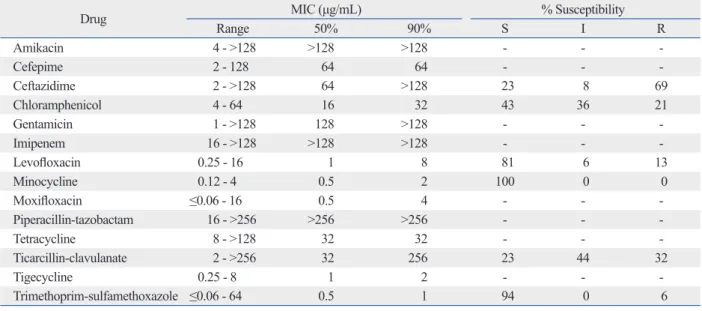
the six drugs recommended by CLSI, the relatively more active agents were trimethoprim-sulfamethoxazole, levo- floxacin and minocycline.
Trimethoprim-sulfamethoxazole showed the lowest MIC90 (1 μg/mL) and the isolates showed a high susceptibility rate of 94% to this agent. All but five isolates were inhibited at
≤2 μg/mL. Resistance rates to trimethoprim-sulfamethoxa- zole have been reported to vary geographically,1,2,10,11 but were generally less than 20%, as was also seen in this study.
However, isolates from cystic fibrosis patients and from some Asian countries, such as Taiwan and Turkey, showed high resistance rates (31.3-100%).5,12-14 Trimethoprim-sulfa- methoxazole alone, or in combination with other agents, is still considered the treatment of choice for suspected or cul- ture-proven S. maltophilia infections.
The MIC of levofloxacin ranged from 0.25 to 16 μg/mL, and the MIC50 and MIC90 were 1 and 8 μg/mL, respectively.
The resistance rate was 13%, which was slightly higher than the rates of 3 to 11% seen in a previous study.1 The new flu- oroquinolone, moxifloxacin, is more active in vitro than ciprofloxacin and levofloxacin.4 In this study, the MIC50 and MIC90 of moxifloxacin were 0.5 and 4 μg/mL, respec- tively, which were two-fold lower than those of levofloxacin.
These results indicated that moxifloxacin could be suggest- ed as an alternative to levofloxacin. Further clinical studies are necessary to evaluate the effectiveness of moxifloxacin in treating S. maltophilia infections, as there is little data pub- lished on the clinical efficacy of moxifloxacin.
In this study, all S. maltophilia isolates were inhibited by
≤4 μg/mL of minocycline, and the MIC90 was 2 μg/mL, philia isolates from Korea.
A total of 90 non-duplicate clinical isolates of S. malto- philia were collected during 2009 from patients at a tertiary care hospital in Seoul, Korea. Sources of the isolates were respiratory specimens (n=46), urine (n=15), blood (n=11), body fluid (n=9), and pus (n=9). The species were identified using conventional methods and/or the ATB 32GN system (bioMerieux, Marcy l’Etoile, France). Antimicrobial suscep- tibility was tested by the CLSI agar dilution method.7
The antimicrobial agents used were trimethoprim and sulfamethoxazole (Dong Wha, Seoul, Korea), levofloxacin (Daiichi, Tokyo, Japan), minocycline (SK Chemicals Life Science, Seoul, Korea), ticarcillin and clavulanate (Dong- A, Yongin, Korea), ceftazidime, amikacin, and gentamicin (Sigma Chemical, St. Louis, MO, USA), chloramphenicol and tetracycline (Chong Kun Dang, Seoul, Korea), moxi- floxacin (Bayer Korea, Seoul, Korea), tigecycline (Wyeth Research, Pearl River, NY, USA), cefepime (Bristol-Myers Squibb, Syracuse, NY, USA), imipenem (Choongwae, Seoul, Korea), piperacillin and tazobactam (Yuhan, Seoul, Korea). For the combinations of ticarcillin-clavulanate and piperacillin-tazobactam, constant amounts of clavulanate (2 μg/mL) and tazobactam (4 μg/mL) were added to ticarcillin and piperacillin, respectively. The breakpoints recommend- ed by CLSI for S. maltophilia were applied to interpret the minimum inhibitory concentrations (MIC).7 Escherichia coli ATCC 25922 and Pseudomonas aeruginosa ATCC 27853 were used as controls.
Table 1 shows the MICs of antimicrobial agents and the resistance rates of the S. maltophilia isolates tested. Among
Table 1. Antimicrobial Activity of Various Antimicrobial Agents Tested Against S. maltophilia Using the Agar Dilution Method
Drug MIC (μg/mL) % Susceptibility
Range 50% 90% S I R
Amikacin 4 - >128 >128 >128 - - -
Cefepime 2 - 128 64 64 - - -
Ceftazidime 2 - >128 64 >128 23 8 69
Chloramphenicol 4 - 64 16 32 43 36 21
Gentamicin 1 - >128 128 >128 - - -
Imipenem 16 - >128 >128 >128 - - -
Levofloxacin 0.25 - 16 1 8 81 6 13
Minocycline 0.12 - 4 0.5 2 100 0 0
Moxifloxacin ≤0.06 - 16 0.5 4 - - -
Piperacillin-tazobactam 16 - >256 >256 >256 - - -
Tetracycline 8 - >128 32 32 - - -
Ticarcillin-clavulanate 2 - >256 32 256 23 44 32
Tigecycline 0.25 - 8 1 2 - - -
Trimethoprim-sulfamethoxazole ≤0.06 - 64 0.5 1 94 0 6
-Not applicable.
Antimicrobial Susceptibility of S. maltophilia
Yonsei Med J http://www.eymj.org Volume 53 Number 2 March 2012 441 strains non-fermentative Gram-negative bacilli isolated in the SENTRY Antimicrobial Surveillance Program (1997-2001). Int J Antimicrob Agents 2003;22:551-6.
4. Nicodemo AC, Paez JI. Antimicrobial therapy for Stenotroph- omonas maltophilia infections. Eur J Clin Microbiol Infect Dis 2007;26:229-37.
5. Wang WS, Liu CP, Lee CM, Huang FY. Stenotrophomonas malto- philia bacteremia in adults: four years’ experience in a medical center in northern Taiwan. J Microbiol Immunol Infect 2004;37:
359-65.
6. BSAC Methods for antimicrobial susceptibility testing. Available at http://www.bsac.org.uk/Susceptibility+Testing/GUIDELINES +Standardized+Disc+Susceptibility+Testing+Method. [access on June 2011]
7. Clinical and Laboratory Standards Institute. Performance stan- dards for antimicrobial susceptibility testing; twenty-first informa- tional supplement, M100-S21. Wanye, PA: Clinical and Laborato- ry Standards Institute; 2011.
8. Song JH, Sung JY, Kwon KC, Park JW, Cho HH, Shin SY, et al.
Analysis of acquired resistance genes in Stenotrophomonas malto- philia. Korean J Lab Med 2010;30:295-300.
9. Seol SY, Jang KS, Jeong OG, Cho ER, Kim NH, Yu HS, et al.
Antimicrobial resistance and molecular epidemiologic characteris- tics of Stenotrophomonas maltophilia isolated from clinical speci- mens. J Korean Soc Microbiol 2000;35:239-50.
10. Livermore DM, Hope R, Brick G, Lillie M, Reynolds R; BSAC Working Parties on Resistance Surveillance. Non-susceptibility trends among Pseudomonas aeruginosa and other non-fermenta- tive Gram-negative bacteria from bacteraemias in the UK and Ire- land, 2001-06. J Antimicrob Chemother 2008;62 Suppl 2:ii55-63.
11. Farrell DJ, Sader HS, Jones RN. Antimicrobial susceptibilities of a worldwide collection of Stenotrophomonas maltophilia isolates tested against tigecycline and agents commonly used for S. malto- philia infections. Antimicrob Agents Chemother 2010;54:2735-7.
12. Cantón R, Valdezate S, Vindel A, Sánchez Del Saz B, Maíz L, Baquero F. Antimicrobial susceptibility profile of molecular typed cystic fibrosis Stenotrophomonas maltophilia isolates and differ- ences with noncystic fibrosis isolates. Pediatr Pulmonol 2003;35:
99-107.
13. Gülmez D, Hascelik G. Stenotrophomonas maltophilia: antimi- crobial resistance and molecular typing of an emerging pathogen in a Turkish university hospital. Clin Microbiol Infect 2005;11:
880-6.
14. Valenza G, Tappe D, Turnwald D, Frosch M, König C, Hebestreit H, et al. Prevalence and antimicrobial susceptibility of microor- ganisms isolated from sputa of patients with cystic fibrosis. J Cyst Fibros 2008;7:123-7.
15. Galles AC, Jones RN, Sader HS. Antimicrobial susceptibility pro- file of contemporary clinical strains of Stenotrophomonas malto- philia isolates: can moxifloxacin activity be predicted by levoflox- acin MIC results? J Chemother 2008;20:38-42.
16. Valdezate S, Vindel A, Loza E, Baquero F, Cantón R. Antimicro- bial susceptibilities of unique Stenotrophomonas maltophilia clini- cal strains. Antimicrob Agents Chemother 2001;45:1581-4.
17. Vartivarian S, Anaissie E, Bodey G, Sprigg H, Rolston K. A changing pattern of susceptibility of Xanthomonas maltophilia to antimicrobial agents: implications for therapy. Antimicrob Agents Chemother 1994;38:624-7.
which was 16 times lower than that of tetracycline. No iso- lates were resistant to minocycline. This data was similar to that of Taiwan, Brazil, Spain, and the USA.5,15-17 MICs of ti- gecycline ranged from 0.25 to 8 μg/mL, and MIC50 and MIC90 were 1 and 2 μg/mL, respectively, which were simi- lar to those in other studies.1,11 The tetracycline derivatives minocycline and tigecycline have shown good in vitro ac- tivity against clinical isolates of S. maltophilia; however, there is little clinical data to support this claim.
The isolates showed low rates of susceptibility (23-43%) to ceftazidime, ticarcillin-clavulanic acid and chloramphen- icol, which were slightly higher than those in other studies.1 In general, β-lactams and/or β-lactamase inhibitor combina- tions show little activity against S. maltophilia, because the organism has a high intrinsic resistance to most penicillins and cephalosporins, as well as to all carbapenems.
Aminoglycosides show poor activity against S. malto- philia because of high intrinsic resistance and, therefore, are not useful in monotherapy.1,4 Despite a lack of clinical trials, treatment of S. maltophilia infections with a combi- nation of two or three antimicrobials has become current practice where trimethoprim-sulfamethoxazole therapy is contraindicated.
In conclusion, trimethoprim-sulfamethoxazole, minocy- cline, and levofloxacin showed good in vitro activity against S. maltophilia isolates from Korea. Moxifloxacin and tige- cycline were also active and hold promise as therapeutic options for S. maltophilia.
ACKNOWLEDGEMENTS
This research was supported by the Happy Tech. Program through the National Research Foundation of Korea (NRF) funded by the Ministry of Education, Science and Technol- ogy (grant number 20110004679).
REFERENCES
1. Looney WJ, Narita M, Mühlemann K. Stenotrophomonas malto- philia: an emerging opportunist human pathogen. Lancet Infect Dis 2009;9:312-23.
2. Sader HS, Jones RN. Antimicrobial susceptibility of uncommonly isolated non-enteric Gram-negative bacilli. Int J Antimicrob Agents 2005;25:95-109.
3. Jones RN, Sader HS, Beach ML. Contemporary in vitro spectrum of activity summary for antimicrobial agents tested against 18569