• 검색 결과가 없습니다.

A retrospective study of treatment outcomes of single implants in the most posterior area of the jaw in Koreans: 3-10 year follow-up

N/A
N/A
Protected

Academic year: 2021

Share "A retrospective study of treatment outcomes of single implants in the most posterior area of the jaw in Koreans: 3-10 year follow-up"

Copied!
10
0
0

로드 중.... (전체 텍스트 보기)

전체 글

(1)

Introduction

Since the implant was first introduced in the dental academy in 1960, a variety of implant systems have been invented. Each system has been constantly developed with the changes in the design or surface treatment of an implant in order to obtain better osseointegration and therapeutic results [1,2].

The implant that was used mainly for completely edentulous patients is currently used for the partial edentulous restoration, and it is currently accepted as a sufficiently-predictable procedure

compared to the conventional fixed prosthesis due to the long- term success rate and stability [3]. Among them, the single implant is one of the most frequently performed procedures.

Compared with the conventional prosthesis, the single implant does not require the deletion of healthy adjacent teeth and allows for easier prosthesis restoration with a better teeth formation. Also, it is more beneficial in terms of oral health;

thus, it has the advantage of reducing the risk of proximal dental caries or root treatment [4]. In addition, it has economic efficiency and particularly it is said to be recommended with sufficient bone [5].

In recent years, various researches have reported a high success rate of single implants. Gotfredsen [6] reported the implant survival rate of 100% in the 5-year research and Rossi et al. [7] reported the survival rate of 95% for the period of two years. However, those researches had limitations that the

A retrospective study of treatment outcomes of single implants in the most posterior area of the jaw in Koreans: 3-10 year follow-up

Seong-Ryong Huh

1

, Hwa-Sun Lee

1

, Chae-Heon Chung

2

, Sang-Joun Yu

1

, Byung-Ock Kim

1,

*

Departments of

1

Periodontology and

2

Prosthodontics, School of Dentistry, Chosun University, Gwangju, Korea

ABSTRACT

Purpose: This study was conducted to investigate the long-term outcomes of single implants placed in the most posterior areas of the jaw in Koreans.

Materials and Methods: A total of 169 Korean patients who received implants at the Chosun University Dental Hospital (Gwangju, Korea) were enrolled in this retrospective study. Demographic data and individual implant data were recorded.

During the follow-up period, cumulative survival rates and mean marginal bone loss were calculated by standard X-rays taken at the first visit and the last follow-up. Statistical analyses were then performed on the patient-based and implant-based analysis (IBM SPSS Statistics ver. 20).

Results: All patients (total 169; 117 male and 52 female; 37 male smokers) were eligible for the study. Among the 184 inserted implants, 51 were placed in the maxilla and 20 were installed after sinus floor elevation. During follow-up (mean 4.86 years), four implants in four patients failed, giving a cumulative survival rate of 97.9%. The mean marginal bone loss calculated from standard X-ray was 1.53±0.62 mm. No patient or implant-based factor showed significant relationship between survival rates.

Conclusion: A reliable survival rate and normal range of marginal bone loss for the single implants in the most posterior areas was achieved after 3 to 10 years.

Key Words: Alveolar bone loss, Dental implants, Molar, Restrospective studies, Single-tooth, Survival rate

Received Sep 2, 2015; Revised version received Sep 2, 2015 Accepted Sep 18, 2015

Corresponding author: Byung-Ock Kim

Department of Periodontology, School of Dentistry, Chosun University, 303 Pilmun-daero, Dong-gu, Gwangju 61452, Korea Tel: 82-62-220-3854, Fax: 82-62-224-4664

E-mail: [email protected]

(2)

implant sites were not distinguished or the follow-up period was short less than 5 years.

In general, posterior teeth receive stronger bite force than anterior teeth; therefore, it has been known that a single implant for posterior teeth area is very likely to generate problems such as screw loosening, marginal bone loss and implant fracture [2].

Moreover, it is known to have a lower success rate than anterior teeth [8]. Therefore, there are some researches indicating that a single implant for posterior teeth area with strong bite force is not recommended [9], and Mayer et al. [10] has also proposed that it be connected with other implants in order to compensate for these shortcomings.

Still, many researches are required for the long-term observational results of a single implant installed in the most posterior area. Also, there are no reports on the survival rate of single implants in posterior area in Korean population who intake more rigid food than other population. Thus, this study is aimed to analyze the long-term results of a single implant installed in the most posterior area in Korean population through the retrospective study.

Materials and Methods

Paient selection

From the period of January 2001 to December 2009, following criteria was applied to the patients who had installed a single implant in the most posterior area at the Department of Periodontology, Chosun University Dental Hospital. All of the patients reviewed were Korean. The following patient groups were included in the experimental group: (1) the patients of 18 years old and above, (2) the patients whose hindmost posterior area were edentulous, (3) the patients who were granted the healing period of at least 8 weeks after tooth extraction, (4) the patients who had performed a prosthesis procedure 3 to 6 months after installing an implant, (5) the patients with systemic good health. The patient with general condition such as pregnant, diabetes mellitus, acquired immune deficiency syndrome and patient with long-term medication of immunosuppressant or steroid were excluded. However, we didn’t exclude the patient who have smoking habit.

Treatment protocol

The included patients were followed by similar treatment

protocol, which set in the manual of Chosun University Dental Hospital for implant treatment. They were treated by same clinicians throughout the treatment period. The surgical operator (professor, a chief of department of implant center, Chosun University Dental Hospital, 56 years old male who have clinical career over 30 years) had installed the implants and also other clinician (professor, a chief of department of prosthodontics, Chosun University Dental Hospital, 63 years old male who have clinical career over 30 years) had performed the prosthetic procedures.

For implant planning, cone-beam computed tomography (CBCT) using radiographic stent was taken. From the CBCT images, need for the surgical procedures (sinus elevation or guided bone regeneration [GBR]) was determined by the operator and the system of implant (company, length, and diameter) was selected by both clinicians. When pre-surgical preparation is done, the patients who had limited alveolar bone had treated with bone augmentation surgery and the implant installation was performed after 4 to 5 months-healing. The patient with proper alveolar bone could have implant installation surgery immediately. Throughout the surgical procedure, implant stability was recorded by resonance frequency analysis (RFA). After healing period (6 months for maxilla and 3-4 month for mandible), the second surgery was done and the stability of implant was re-evaluated by RFA and radiographic examination. If the implant was determined to be stable enough, the prosthetic treatment was started. The impression coping was engaged and an open tray impression was made with silicon impression material. The fabricated prosthesis was try-in and the occlusal and proximal contacts were evaluated with carbon paper. After 2 week follow-up, the prosthesis was finally set.

After finishing implant treatment, the patient was informed to visit 3 month follow-up at first year, and 6 month follow-up after 1 year. The radiographic examination was done every 1 year and in every case of suspicious inflammation around implant.

Research method

This research was conducted by the retrospective research method using the patients’ electronic medical records and the already taken radiographs after acquiring an approval of the Clinical Ethics Committee at Chosun University (IRB Number:

CDMDIRB-1217-83).

(3)

Definition of survival and failure of implant

Gender, age, smoking habit, implant site, diameter and length of installed implant, company name, augmentation performance status and implant failure status were investigated through the electronic medical records. To compare the stability of the treatment, the survival rate was determined for the evaluation value. The survival of the implants was determined by the same criteria applied to Buser et al. [11] and Cochran et al. [12].

(a) There should be no clinical agitation of implants.

(b) There should be no subjective pain or discomfort of patients.

(c) There should be no infection around the implants.

(d) There should be no continuous radiolucency around the implants.

As for the failure of the implants, elimination of implants, observation of excessive agitation or severe bone loss, severe infection around the implant and implant fracture were considered a failure.

Evaluation on marginal bone loss

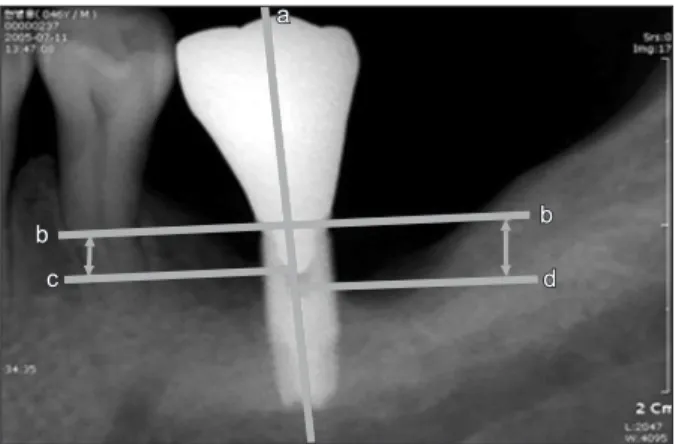
To evaluate the marginal bone loss around the implants, the standard X-rays were taken at the time of installation of the implants and at that of the most recent follow-up visit and the X-rays were taken by using paralleling cone technique. The 4 reference lines were drawn on the X-rays. The line a was the line passes the midline of the implant which is parallel to the long axis and the line b was the perpendicular line to the line a at the shoulder of implants. The line c and d were lines pass the most coronal level of bone-to-implant contact on the mesial and the distal site of implant, respectively. The distance between line b to c and line b to d was analyzed by using measurement program (PiViewStar 5.0.9.2; Infinitt, Seoul, Korea) (Fig. 1).

The measurement was conducted using the fixed magnification rate (200%) in the fixed resolution screen (1,280×720) in order to minimize the error. The mean value of the measurements at mesial and distal side was calculated.

Statistical analysis

The collected data was analyzed by using IBM SPSS Statistics ver. 20 (IBM Co., Armonk, NY, USA). The statistical analysis was performed in two categories, the patient-based and the implant-based analysis. Among the patient based

analysis, the effect of gender and smoking habit on survival rate was compiled with Fisher’s exact test. Also, the age data was evaluated with Linear-by-linear association to reveal the significance. In the implant-based analysis, the surgical procedure data was analyzed statistically with intragroup and intergroup. The significance level was p<0.05.

Results

Gender and age distribution and smoking habit of the patient

A total of 169 Korean patients were included in the present research. There were 117 men and 52 women; the number of male patients was about two times larger than that of female patients. As for the age distribution, the most common age groups were 50s, 40s and 60s in order. As for the follow-up period, the most common period was less than 4 years and the total average follow-up period was 4.86 years. There were 37 male patients who still smoke at the time of implant surgery.

The former smokers were assumed to be non-smoker. By Fisher’s exact test, the effect of gender and smoking habit on survival rate was evaluated and the result was no significant (p=1.000 and p=0.228, each). The age increasing did not significantly increase the risk of implant failure (by linear-by- linear association analysis, p=0.484).

a a

b b c

c dd

b b

Fig. 1. Reference points for the measurements of marginal bone

level. Following is the reference lines: line a Implant longitudinal

axis; line b Implant shoulder line: vertical line to a, and at the most

coronal level of the implant shoulder; line c the most coronal level of

bone-to-implant contact at the mesial site: a vertical line to a; line d

the same as c at the distal site.

(4)

Distribution for each implant site

A total of 184 single implants were installed at the most posterior area. And of those, 51 were installed in the maxilla and 133 were installed in the mandible. Approximately 2.5 times more implants were installed in the mandible than in the maxilla and approximately 5 times more implants were installed in the second molar teeth area on the left side of mandible, which had the most number of implants, than in the second posterior teeth area on the left and right sides of maxillary, which had the least number of implants (Table 1).

Distribution for each manufacturer

A s for the distribution of manufacturers sorted in the order of frequency among the 184 implants, the implants of 3i (OSSEOTITE

®

or NANOTITE

®

, BIOMET; Implant Innovations Inc., Palm Beach Gardens, FL, USA) accounted for 81 and Osstem (TSIISA

®

; OSSTEMIMPLANT, Seoul, Korea) for 26 and ITI (ITI

®

; InstituteStraumann, Basel, Switzerland) for 19 followed subsequently. There were 4 other implant systems (40 implants). The manufacturers having less than 2 implants installed were classified as ‘other’.

Diameter and length of installed implants

The most commonly installed implant had the diameter between 5 mm to 6 mm and the length between 11 mm to 12 mm (data not shown). 78.8 % of the implants was distributed in standard implant level (diameter: 4 to 6 mm, length: 10 to 12 mm).

Survival rate of the implant overtime

As for the hindmost molar single implants, 4 implants were eliminated from the 4 patients during the follow-up periods. The cumulative survival rate was 97.9%. Of the 4 failed implants, 2 were eliminated within 4 years after the installation and another was eliminated at the fourth year and another was eliminated at the eighth year additionally (Fig.

2). The cumulative survival rate and interval survival rate was calculated and at 8 to 9 year follow-up period showed highest decrease in survival rate. However, there was no statistical difference between interval survival rates. The failed implants will be analyzed in detail.

Survival rate of the implant according to the additional bone augmentation for implant installation

The cases where the maxillary sinus augmentation and the bone regeneration were performed were stated (Table 2). The maxillary sinus augmentation was performed in the 20 single implants among the total of 51 single implants installed in the maxilla, and of these, 18 cases were performed by the crestal approach while 2 cases were performed by the lateral open Table 1. Distribution of the Implants According to the Location

Variable Left Right

1st molar 2nd molar 1st molar 2nd molar Maxilla (n=51)

Mandible (n=133) 16 15

11 44

13 20

11 54

Fig. 2. Survival rate of implants in most posterior area during follow-up periods

101 100 99 98 97 96 95 94 93

Survival rate (%)

92

>10

<4 4-5 5-6 6-7 7-8 8-9 9-10

Interval survival rate Cumulative survival rate

98.9 98.9

99.2 98.3

100 98.3

100 98.3

100 98.3

95 97.9

100 97.9

100 97.9 Survival rate of implant in most posterior area

during follow-up periods

(years)

(5)

approach. The GBR procedure was performed in the total of 22 single implants. The 2 implants that were installed along with the crestal approach were eliminated; thereby, achieving the survival rate of 88.8%. Of those single implants being installed with the GBR procedure, 1 single implant was eliminated;

thereby, achieving the survival rate of 95.4%. And in the lateral open approach, the elimination of an implant has not been observed. Thus, it achieved the survival rate of 92.8% in the case of accompanying an additional augmentation technique.

However, these difference were proved to have no significance when analyzed by Fisher’s exact test. In detail, neither sinus elevation procedure nor GBR had no relationship with survival rate (p=0.598) and also the cases with additional bone augmentation didn’t have lower survival rate than the cases with proper native bone (p=0.552).

Marginal bone loss around implants overtime

The average marginal bone loss between the time of implant installation and the recent follow up visit by calculating the distance from reference lines on standard X-ray film was investigated (Fig. 1). The total bone loss quantity around the implants classified per their follow-up periods (Fig. 3).

The group with less than 4 years follow-up after the implant installation showed 1.08±0.55 mm bone loss and the group with more than 10-year follow-up showed 2.27±0.78 mm bone loss.

The mean marginal bone loss of studied implants was 1.53±0.62 mm from the initial bone-to-implant contact level. Compared to the success criteria that presented before, all of the data were within normal range of bone reaction around implant.

Analysis on failure cases

For the retrospective study, the causes of failure were investigated with reference to the electronic medical records (Table 3). During the follow-up periods, 4 implants out of the total of 4 patients were failed. Three implants from men and 1 implant from women were failed and one failure from each quadrant was observed. Looking at the pattern of the implants failure, 1 implant (5.0×10 mm, no. 1 patient) failed before loading, and 3 implants (4.0×10 mm, 5.0×10 mm, and 5.0×13.0 mm) failed after bearing the load. Particularly, the implant of

Table 2. Type of Bone Augmentation Procedures for Implant Instal- lation

Surgical procedure No. of implant

Survival rate (%) Placement with sinus floor elevation

simultaneously Crestal approach Lateral approach

Placement with GBR simultaneously Total

20

18 2 22 42

90.0

88.8 100

95.4 92.8 GBR: guided bone regeneration.

Table 3. Analysis of Failed Implants Patient

No. Gender Age

(yr) Site Implant diameter

Implant

length Time of failure Cause of failure Implant system

Augmentation procedures 1

2 3 4

Male Female Male Male

52 73 46 57

#16

#26

#46

#37 5.0 4.0 5.0 5.0

10.0 10.0 10.0 13.0

11 months after surgery 12 months after loading 8 years 4 months after loading 3 years 2 months after loading

Fixture mobility Fixture mobility Fixture mobility Peri-implant infection Severe pain

3i 3i 3i 3i

SFE: Crestal SFE: Crestal

- GBR

SFE: sinus floor elevation, GBR: guided bone regeneration.

Fig. 3. Mean marginal bone loss of implant in most posterior area during follow-up period.

3.0

2.5

2.0

1.5

1.0

Marginalboneloss(mm) 0.5

0.0

>10

<4 4 5- 5 6- 6 7- 7 8- 8 9- 9 10- Cumulative bone loss Mean m of implant in most posterior

area during follow-up periods arginal bone loss

Follou up interval (year)-
(6)

no. 4 patient failed due to the severe infectious manifestation around the implants and the severe pain during mastication was accompanied. The pattern of alveolar bone destruction around the four failed implants were different. Three of them showed hollow type bone loss which means failure of osseointegration, mainly related to occlusal factors and only one of them showed saucerization type bone loss that means inflammatory reaction around the implant.

Discussion

Until now, many studies have been reported over the survival rate of implant installed in posterior areas and the results of them are varying depending on the study design and the installed sites. Hong et al. [13] has reported 97.1%

cumulative survival rates of 278 implants installed after the sinus floor elevation, Ozkan et al. [14] reported 99.3%

survival rates of Straumann

®

, Frialit

®

, and Camlog

®

implants installed on the posterior areas as well and Jung et al. [15]

reported 96.8% survival rates of single implant at the site with over 8mm residual bone. However, these previous studies included American, European patients or mixed population in their study design. Although there are no evidence that ethnic difference could result in different osseointegration around implants, this difference in population could represent the different daily food and chewing habits and finally the accumulation of occlusal factors may have an effect on the long- term result of implants. Especially, Korean population eat more rigid food such as kimchi and green grass and this can increase the force of chewing and squeezing strain on the marginal bone of implant similar to natural teeth. So, researching the Korean population with posterior single implant would be important to determining the risk of the treatment. From our retrospective study, the cumulative survival rate of 184 single implants installed in most posterior areas of maxilla and mandible was 97.9% and these data were comparable to those from previous studies. Even there are some implants with short-term follow- up, this result can ensure the clinician to encourage single implant regardless of the region.

Also, the influence of the implant site has been focused and those studies reported that the survival rate in maxilla is lower than that in mandible [16,17]. To explain these results, the biologic aspects of maxilla such as collagen with low

density, inadequate residual bone in height due to bone loss and pneumatization, and lower density of cortical and lamellar bone were assumed for the reason for delayed osseointegration in maxilla [18,19]. Especially, among the edentulous areas in maxilla, molar area showed unfavorable result than other areas [13,20] and this is related to the poor bone quality of the most posterior area in maxilla, mostly type III and IV. Similarly, Mundt et al. [21] reported that the success rate of implant was the lowest at the upper molar area, and was the highest at the lower anterior teeth area. However, in our study, there was no significant difference in survival rates between maxilla and mandible (maxilla 96.0%, mandible 98.4%). Until now, most of the studies presented the cases with smooth implants placed in maxilla. Apart from this, this study used rough surface implants and showed similar results to the study of Buser et al. [1] who reported that the advancement of surface modification on the implant brought better bone-to-implant contact and favorable osseointegration consequently. The surface modification on the implant affects the survival rate more than the length of implant does [1] and smooth-surface implants showed greater failure rate in bone with lower density [22]. However, the effect of surface modification of implant can’t ne compared due to uneven distribution of implant system and different bone type in every patient. For the direct comparison, split mouth design should be selected.

Molar areas in both maxilla and mandible have more occlusal

loading force, which could be thought to increase failure rate

of implant. However, the masticatory force is applied not only

on the single implant, but also distributed to natural dentition,

mandibular body and temporomandibular joint and this normal

range of occlusal force (50 kg/cm

2

, 15 min/d) itself has no

harmful effect on implant survival [23]. Several studies showed

that even in immediate loading protocol, loading around the

implant improved bone healing [24] and it showed increased

ossification and comparable osseointegration to conventional

loading protocol around implants [25]. In addition, masticatory

force at single implant is mostly applied to the direction of the

longitudinal axis of teeth on the molar areas, so it gives less

damage on bone-implant osseointegration [26]. Although there

is clear explanation about the normal occlusion of implant

[27], there is no consensus about the traumatic occlusion on

implant by overloading or unilateral occlusion habit. In the

study over the influence of the state of mandibular dentition on

(7)

the survival rate of maxillary implants, Becktor et al. [28] found that among the total 118 failed implant, implants in patients with unilateral occlusal support showed the highest failure rate (43.8%).

There are studies reporting that the diameter and the length of the implant have an effect on the survival rate of implant. Li et al. [20] suggested that using longer implants was recommended for stabilization in the type IV bone. They suggested the diameter to be over 4 mm and length to be longer than 9 mm for higher success. In contrast to them, there are studies reporting no significant difference in survival rate according to the length of implant [29,30]. Lai et al. [29]

reported 97% survival rates in 6 mm short implants. The author insisted that the minimum length to ovoid failure is not certain yet, and enough osseointegration is achievable with bone-to-implant contact which is resistible to bite force even in short single implant [29]. Furthermore, Kotsovilis et al. [30]

concluded that the short implants were no less efficacious than 10 mm or longer implants in their meta-analysis. In this study, the diameter and length of the most implants used were 5 mm in diameter and 11 mm in length. However, 4 implants which were failed in this study had larger diameter and longer length.

Therefore, taken together the results from this study with the study of Lai et al. [29] and Kotsovilis et al. [30], it is considered that diameter and length of implant is not closely related to the survival rate.

As for the improvement or surgical procedures, dental implants have been installed at the site with poor residual bone in height and width. Several studies reported that the implants which were installed in bone augmented or sinus elevated area showed comparable survival rate compared to native bone [31,32]. According to the recent review by Wallace and Froum [33], the survival rate of implant placed in augmented sinus by lateral approach ranged between 61.7% to 100%

(average 91.8%). Pal et al. [34] compared the sinus elevation methods and the result introduced that osteotome technique is recommended when there are more than 6mm residual bone and lateral antrostomy in the case of the advanced resorption.

But, there were no difference in success rate between both techniques. Similar results were confirmed in the studies over the survival rate of implants placed in GBR sites [35- 37]. Erdogan et al. [35] studied two groups with or without diabetes type 2 and they showed that there were no differences

of implant survival rate between GBR or non-GBR sites in both groups but the success rate was slightly lower in diabetes group. Also, Bazrafshan and Darby [36] reported that GBR is a predictable procedure and the survival and success rates of implant placed at the same time were similar to those of non-grafted implants. In this study, total 20 sinus elevation procedures (18 crestal approaches, 2 lateral approaches) and 22 GBR procedures were performed. The survival rates were 88% in crestal approaches and 100% in lateral approaches, but the lateral approaches was done only for 2 cases, so there were limitations in analyzing the difference between them. Crestal approaches were more frequent because of higher possibility of residual teeth and adjacent teeth and less pneumatization of maxillary sinus in these cases of single implant. But within the results of the study, the performance of bone augmentation itself did not lower the survival rate and also the different bone augmenting protocol had no significant difference between their survival rates.

The group with less than 4 years follow-up after the implant installation showed 1.08±0.55 mm bone loss and the group with more than 10-year follow-up showed 2.27±0.78 mm bone loss.

The mean marginal bone loss of studied implants was 1.53±0.62

mm from the initial bone-to-implant contact level. Ozkan et

al. [14] reported that the bone loss around Straumann implant

were 0.12±0.03 mm during initial 1 year, 0.16±0.05 mm after

3 years, and 0.19±0.07 mm after 5 years. Lai et al. [29] has

reported that bone loss in single short implants installed molar

areas was 0.05±0.01 mm on average for 5 years follow-up and

0.63±0.68 mm on average for 10 years follow-up. Although the

results of this study represented larger bone loss than others,

they were within the implant success criteria provided by

Albrektsson et al. [38] (2 mm at first year and under 0.2 mm/yr

after 1 year) and Adell et al. [39] (1.5 mm at first year and under

0.1 mm/yr after 1 year for Branemark implant). A progressive

marginal bone loss around implant is accepted as a normal

reaction due to the formation of biologic width in marginal

soft tissue around implant. Even the type of implants installed

was internal connection type which have lower risk of marginal

bone loss, there were gradient bone resorption. The normal

range or marginal bone loss was defined by Albretksson [38],

which suggest under 1.5 mm bone loss at first year and 0.2 mm

annually thereafter to be normal. When estimated according

to this criteria, maximum 3.3 mm bone loss after 10 year of

(8)

loading can thought to be normal. So the amount of marginal bone loss in every interval group was within normal range.

The larger marginal bone loss in this study than that of other studies could be from poor quality of standard x-ray which was randomly taken and irregular vertical and horizontal angle.

Even the operator tied to minimize the errors in measuring the marginal bone loss, the large standard deviation means that the methods has some limitations.

The causes of four failure cases of the study were analyzed.

The pattern of alveolar bone destruction around the four failed implants were different. Three of them showed hollow type bone loss which means failure of osseointegration, mainly related to occlusal factors and only one of them showed saucerization type bone loss that means inflammatory reaction around the implant. In the implant of number 1 patient, surgical procedure in wrong indication caused implant failure. Previously, Fugazzotto [40] has suggested that the crestal approach has good prognosis in cases of having residual bone over 4 mm and the lateral approach is favorable in less 4 mm residual bone.

However, in this case the crestal approach was performed at 3 to 4 mm residual bone site because the patient did not want an additional broad operation even though the necessity of lateral approach was fully explained. The mobility of implant was detected at the second operation 8 months after installation.

Additional healing for 3 months was allowed but it finally failed.

In the case of number 4 patient, single implant installed on left mandible (#37) showed uneventful result after operation and prosthetic procedure, but due to the discomfort of contralateral teeth areas (#46, 47), unilateral chewing happened for 14 months. As a result, the implant revealed severe inflammation and pain accompanied by mastication after 3 years 2 months after installation and finally failed. Yogeshwari and Gururaj [27]

studied on the implant protective occlusion and they reported a poor implant occlusion could increase mechanical stresses and strains at the crestal bone and consequently it causes many implant complications such as prosthetic problems and peri- implantitis. As implants have low proprioception, even a slight premature contact can make higher loading [27] and this effect could be exaggerated in periodontally compromised patients.

Especially, the periodontal state of remaining tooth is important for determining the type of implant failure [22]. The first type is the failure of osseointegration and it occurs in early healing period and is related to the smooth surface implants placed

in low density bone. However, this type was seen equally no related to periodontal health. The second type of failure is peri- implantitis and it is most frequent in hydroxyapatite surfaced implant and also in periodontally compromised group. Due to the small group of failure, the study on the relation between the states of periodontal health should be required.

In this study, all failed implants were the same implant, which had double acid-etched surface. Until now, there are numerous studies on the effect of the implant surface, but no report about negative bone reaction of modified implant surface was reported [41,42]. According to Lazzara et al. [41], implants with dual acid etched surface showed higher bone to implant contact than in smooth surface (72.96% vs. 33.98%) in poor quality bone [42]. This positive effect was also proved in in vitro study and the biological mechanism was due to the improved reaction of red blood cells and fibrin to the surface [42]. The effect of dual-acid etched implant surface should be studied more.

There is another possibility of high failure rate that majority of implants installed in this hospital were concentrated on specific type of implants (81 from 184; 44.02% of total implants), so the frequency of failure could be higher than other implants.

There are some limitations in this retrospective study. First, the survival period for the single implants in the most posterior area was 4.86 years on average. As the cases connected to existing implant restorations after extraction of adjacent natural teeth for periodontal diseases were excluded, the average period of follow-up was shortened and decreased numbers of implants were evaluated at the final. Second, due to the feature of retrospective study, there was a limitation for collecting data in this study because it was based on the electronic medical record and radiograph already taken. The quantity of regenerated bone was not recorded in some cases and the quality of some standard X-ray did not have correct vertical and horizontal angle to measure the exact marginal bone level. Lack of these data could lead to errors in calculating the marginal bone distance. Reproducible X-ray data taken by paralleling technique and recording data obtained during implant placement should be emphasized in further study.

Finally, to ensure the relationship between types of food consumption originated form ethnic difference and the survival rate of implant, other study design with single implants in other region should be studied.

In conclusion, the single implants installed in the most

(9)

posterior areas in Korean showed long term stability regardless of bone type (maxilla or mandible) and presence of additional bone augmentation procedure (sinus elevation and GBR). The average follow-up period of 184 implants was 4.86 years and cumulative survival rate was 97.9%, which was comparable to the result of previous studies. According to these data, single implants could be assume to be a successful treatment option but intensive attention to the occlusion and further study on the effect of the implant surface should be required for longer prognosis.

Acknowledgments

This study was supported by research fund from Chosun Dental Hospital, 2014.

References

1. Buser D, Broggini N, Wieland M, Schenk RK, Denzer AJ, Cochran DL, Hoffmann B, Lussi A, Steinemann SG: Enhanced bone apposition to a chemically modified SLA titanium surface. J Dent Res 83:529-533, 2004.

2. Jemt T, Lekholm U: Implant treatment in edentulous maxillae:

a 5-year follow-up report on patients with different degrees of jaw resorption. Int J Oral Maxillofac Implants 10:303-311, 1995.

3. Berglundh T, Persson L, Klinge B: A systematic review of the incidence of biological and technical complications in implant dentistry reported in prospective longitudinal studies of at least 5 years. J Clin Periodontol 29 Suppl 3:197-212; discussion 232- 233, 2002.

4. Solnit GS, Schneider RL: An alternative to splinting multiple implants: use of the ITI system. J Prosthodont 7:114-119, 1998.

5. Brägger U, Krenander P, Lang NP: Economic aspects of single- tooth replacement. Clin Oral Implants Res 16:335-341, 2005.

6. Gotfredsen K: A 5-year prospective study of single-tooth replacements supported by the Astra Tech implant: a pilot study. Clin Implant Dent Relat Res 6:1-8, 2004.

7. Rossi F, Ricci E, Marchetti C, Lang NP, Botticelli D: Early loading of single crowns supported by 6-mm-long implants with a moderately rough surface: a prospective 2-year follow- up cohort study. Clin Oral Implants Res 21:937-943, 2010.

8. Parein AM, Eckert SE, Wollan PC, Keller EE: Implant reconstruction in the posterior mandible: a long-term retrospective study. J Prosthet Dent 78:34-42, 1997.

9. Rangert BR, Sullivan RM, Jemt TM: Load factor control for implants in the posterior partially edentulous segment. Int J Oral Maxillofac Implants 12:360-370, 1997.

10. Mayer TM, Hawley CE, Gunsolley JC, Feldman S: The single- tooth implant: a viable alternative for single-tooth replacement.

J Periodontol 73:687-693, 2002.

11. Buser D, Mericske-Stern R, Bernard JP, Behneke A, Behneke N, Hirt HP, Belser UC, Lang NP: Long-term evaluation of non- submerged ITI implants. Part 1: 8-year life table analysis of a prospective multi-center study with 2359 implants. Clin Oral Implants Res 8:161-172, 1997.

12. Cochran DL, Buser D, ten Bruggenkate CM, Weingart D, Taylor TM, Bernard JP, Peters F, Simpson JP: The use of reduced healing times on ITI implants with a sandblasted and acid-etched (SLA) surface: early results from clinical trials on ITI SLA implants. Clin Oral Implants Res 13:144-153, 2002.

13. Hong SB, Chai GJ, Jung UW, Kim CS, Chim JS, Choi SH, Cho KS, Kim CK: Clinical evaluation of Branemark Ti-Unite implant and ITI SLA implant in the post maxillary area with sinus elevation technique. J Korean Acad Periodontol 35:813- 822, 2005.

14. Ozkan Y, Ozcan M, Akoglu B, Ucankale M, Kulak-Ozkan Y:

Three-year treatment outcomes with three brands of implants placed in the posterior maxilla and mandible of partially edentulous patients. J Prosthet Dent 97:78-84, 2007.

15. Jung RE, Pjetursson BE, Glauser R, Zembic A, Zwahlen M, Lang NP: A systematic review of the 5-year survival and complication rates of implant-supported single crowns. Clin Oral Implants Res 19:119-130, 2008.

16. Becker W, Becker BE, Alsuwyed A, Al-Mubarak S: Long-term evaluation of 282 implants in maxillary and mandibular molar positions: a prospective study. J Periodontol 70:896-901, 1999.

17. Lekholm U, Gunne J, Henry P, Higuchi K, Lindén U, Bergström C, van Steenberghe D: Survival of the Brånemark implant in partially edentulous jaws: a 10-year prospective multicenter study. Int J Oral Maxillofac Implants 14:639-645, 1999.

18. Adell R, Eriksson B, Lekholm U, Brånemark PI, Jemt T: Long- term follow-up study of osseointegrated implants in the treatment of totally edentulous jaws. Int J Oral Maxillofac Implants 5:347-359, 1990.

19. Chung DM, Oh TJ, Lee J, Misch CE, Wang HL: Factors affecting late implant bone loss: a retrospective analysis. Int J Oral Maxillofac Implants 22:117-126, 2007.

20. Li T, Kong L, Wang Y, Hu K, Song L, Liu B, Li D, Shao J, Ding Y: Selection of optimal dental implant diameter and length in type IV bone: a three-dimensional finite element analysis. Int J Oral Maxillofac Surg 38:1077-1083, 2009.

21. Mundt T, Mack F, Schwahn C, Biffar R: Private practice results of screw-type tapered implants: survival and evaluation of risk factors. Int J Oral Maxillofac Implants 21:607-614, 2006.

22. Rosenberg ES, Cho SC, Elian N, Jalbout ZN, Froum S, Evian CI: A comparison of characteristics of implant failure and survival in periodontally compromised and periodontally healthy patients: a clinical report. Int J Oral Maxillofac Implants 19:873-879, 2004.

23. Brunski JB: Biomechanical factors affecting the bone-dental implant interface. Clin Mater 10:153-201, 1992.

24. Piattelli A, Corigliano M, Scarano A, Costigliola G, Paolantonio

(10)

M: Immediate loading of titanium plasma-sprayed implants: an histologic analysis in monkeys. J Periodontol 69:321-327, 1998.

25. Romanos GE, Toh CG, Siar CH, Swaminathan D: Histologic and histomorphometric evaluation of peri-implant bone subjected to immediate loading: an experimental study with Macaca fascicularis. Int J Oral Maxillofac Implants 17:44-51, 2002.

26. Ding X, Liao SH, Zhu XH, Zhang XH, Zhang L: Effect of diameter and length on stress distribution of the alveolar crest around immediate loading implants. Clin Implant Dent Relat Res 11:279-287, 2009.

27. Yogeshwari S, Gururaj R: Implant protected occlusion. IOSR J Dent Med Sci 11:20-25, 2013.

28. Becktor JP, Eckert SE, Isaksson S, Keller EE: The influence of mandibular dentition on implant failures in bone-grafted edentulous maxillae. Int J Oral Maxillofac Implants 17:69-77, 2002.

29. Lai HC, Si MS, Zhuang LF, Shen H, Liu YL, Wismeijer D:

Long-term outcomes of short dental implants supporting single crowns in posterior region: a clinical retrospective study of 5-10 years. Clin Oral Implants Res 24:230-237, 2013.

30. Kotsovilis S, Fourmousis I, Karoussis IK, Bamia C: A systematic review and meta-analysis on the effect of implant length on the survival of rough-surface dental implants. J Periodontol 80:1700-1718, 2009.

31. Jodia K, Sadhwani BS, Parmar BS, Anchlia S, Sadhwani SB:

Sinus elevation with an alloplastic material and simultaneous implant placement: a 1-stage procedure in severely atrophic maxillae. J Maxillofac Oral Surg 13:271-280, 2014.

32. Rajkumar GC, Aher V, Ramaiya S, Manjunath GS, Kumar DV:

Implant placement in the atrophic posterior maxilla with sinus elevation without bone grafting: a 2-year prospective study. Int J Oral Maxillofac Implants 28:526-530, 2013.

33. Wallace SS, Froum SJ: Effect of maxillary sinus augmentation

on the survival of endosseous dental implants. A systematic review. Ann Periodontol 8:328-343, 2003.

34. Pal US, Sharma NK, Singh RK, Mahammad S, Mehrotra D, Singh N, Mandhyan D: Direct vs. indirect sinus lift procedure:

A comparison. Natl J Maxillofac Surg 3:31-37, 2012.

35. Erdogan O, Uçar Y, Tatlı U, Sert M, Benlidayı ME, Evlice B: A clinical prospective study on alveolar bone augmentation and dental implant success in patients with type 2 diabetes. Clin Oral Implants Res 2014. doi: 10.1111/clr.12450. [Epub ahead of print]

36. Bazrafshan N, Darby I: Retrospective success and survival rates of dental implants placed with simultaneous bone augmentation in partially edentulous patients. Clin Oral Implants Res 25:768- 773, 2014.

37. Del Fabbro M, Testori T, Francetti L, Weinstein R: Systematic review of survival rates for implants placed in the grafted maxillary sinus. Int J Periodontics Restorative Dent 24:565-577, 2004.

38. Albrektsson T, Zarb G, Worthington P, Eriksson AR: The long- term efficacy of currently used dental implants: a review and proposed criteria of success. Int J Oral Maxillofac Implants 1:11-25, 1986.

39. Adell R, Lekholm U, Rockler B, Brånemark PI: A 15-year study of osseointegrated implants in the treatment of the edentulous jaw. Int J Oral Surg 10:387-416, 1981.

40. Fugazzotto PA: Augmentation of the posterior maxilla: a proposed hierarchy of treatment selection. J Periodontol 74:

1682-1691, 2003.

41. Lazzara RJ, Testori T, Trisi P, Porter SS, Weinstein RL: A human histologic analysis of osseotite and machined surfaces using implants with 2 opposing surfaces. Int J Periodontics Restorative Dent 19:117-129, 1999.

42. Park JY, Davies JE: Red blood cell and platelet interactions with

titanium implant surfaces. Clin Oral Implants Res 11:530-539,

2000.

수치

Fig. 1. Reference points for the measurements of marginal bone  level. Following is the reference lines: line a Implant longitudinal  axis; line b Implant shoulder line: vertical line to a, and at the most  coronal level of the implant shoulder; line c the
Fig. 2. Survival rate of implants in  most posterior area during follow-up  periods10110099989796959493Survivalrate(%)92&gt;10&lt;44-55-66-77-88-99-10
Fig. 3. Mean marginal bone loss of implant in most posterior area  during follow-up period.

참조

관련 문서

1 John Owen, Justification by Faith Alone, in The Works of John Owen, ed. John Bolt, trans. Scott Clark, &#34;Do This and Live: Christ's Active Obedience as the

Colonial Policy and Practice: A Comparative Study of Burma and Netherlands India (1948) was listed in the 14 most influential books of Southeast Asian Studies (Hui 2009).

In this study, the dislocation group had a wider width of AEB (p&lt;0.05), and the posterior slope (TR angle) of the AER and the average of AEB were smoother (p&lt;0.05) compared

3 Mean percentages of bone implant contact ratio in the control group and experimental groups at 6 and 12 weeks after placement of the

Long-term outcomes of short dental implants supporting single crowns in posterior region: a clinical retrospective study of 5-10 years.. Osteotome sinus

A clinical and radiographic evaluation of fixed partial dentures (FPDs) prepared by dental school students: a retrospective study.. A retrospective analysis

success rates of dental implants placed at the time of or after alveolar ridge augmentation with an autogenous mandibular bone graft and titanium mesh: a 3-to

Utility of T1-and T2-weighted high-resolution vessel wall imaging for the diagnosis and follow up of isolated posterior inferior cerebellar artery dissection with