컴퓨터를 이용한 속도 조절형 치과 국소마취 기구 : 문헌고찰
김영진, 이준형, 이강희, 김기덕, 정복영, 방난심, 박원서
연세대학교 치과대학 통합진료학과
Computer Controlled Local Anesthesia Delivery: Literature Review
Young-Jin Kim, Jun-Hyung Lee, Kang-Hee Lee, Kee-Deog Kim, Bock-Young Jung, Nan-sim Pang, Wonse Park
Department of Advanced General Dentistry, College of Dentistry, Yonsei University, Seoul, Korea
Background:
Today, there are computer controlled local anesthesia devices used clinically. The main principle is to control injection speed by computer aided system, and it relieves pain. However, there are few objective data considering this subject. In this literature review, we researched studies about computer controlled anesthetic delivery. We compared pain control effect of computer controlled to conventional local anesthetic syringe system.Methods:
A bibliographic search in PubMed was performed and we reviewed original articles.Results:
There were 18 publications that compared pain control effect of computer controlled to conventional system. There were 8 articles reported of children, similar pain control effect was found in 7 of them. One study showed superior pain control effect of computer controlled anesthetic delivery. For adults, 10 studies showed superior pain control effect in computer aided system.Conclusions:
Computer controlled anesthetic delivery has similar or superior pain control effect compared to conventional local anesthetic syringe system. For both children and adults, computer controlled anesthetic delivery could be clinically useful, still it may be more effective for adults.Key Words:
Computer controlled local anesthesia delivery; Local anesthesia; Pain controlReceived: 2013. 12. 9•Revised: 2013. 12. 31•Accepted: 2013. 12. 31 Corresponding Author: Wonse Park, Department of Advanced General Dentistry, Yonsei University College of Dentistry, 50 Yonsei-ro, Seodaemun-gu, Seoul 120-752, Korea
Tel: +82.2.2228.8980 Fax: +82.2.2227.8906 email: [email protected]
* 본 연구는 연세대학교 산학협력단 2012년도 신임교원 연구지원으로 이루어 졌음(8-2012-0082).
서론
치과에 방문하는 모든 환자들은 치과 치료에 대한 공포를 가지고 있다
.
환자가 치과에 공포를 느끼는 원인은 회전 기구 의 소음과 진동,
치과 치료의 통증,
치과에서 사용하는 국소마 취 주사에 대한 거부감 등을 들 수 있다[1,2].
이 중 국소 마취 주사에 대한 공포는 치과에 방문하는 환자가 불안을 느끼게 하는 가장 큰 원인이다[3].
하지만 역설적으로 치과 국소마취 는 치과 치료 중의 통증을 조절하기 위해 필수불가결한 요소 이며,
현대 치과학에서 가장 중요한 시술 중 하나이다[4].
치과 국소 마취가 통증을 유발하는 원인은 주사침이 구강 점막을 통과할 때 발생하는 연조직의 미세 손상
,
마취 용액이 퍼지면서 발생하는 압력,
마취 용액의 낮은PH
등을 들 수 있다.
이러한 통증을 줄이기 위해서는 해부학적으로 적절한국소 마취법을 시행하고
,
적절한 온도에서 마취용액을 보관해 야 하며,
멸균된 국소마취제를 사용해야 한다.
또한 도포 마취 제를 사용하기도 하고,
주사침의 자입 속도를 늦추기도 하며,
마취용액의PH
를 높여주어 통증 감소를 도모하기도 한다[5].
최근 치과 임상 분야에서 국소 마취 시 경험하게 되는 각종 통증을 줄이기 위한 다양한 시도가 진행되고 있다
.
그 중 기존의 일반적인 치과 마취 주사기를 개선하여 통증을 줄이 고자 하는 시도가 활발하게 이루어지고 있으며,
컴퓨터를 이 용한 국소마취 기기(Computer controlled local anesthesia
일련
번호 저자 출판
연도 저널 제목
1 Saloum FS, Baumgartner JC, Marshall G, Tinkle J [7].
2000 Oral surgery, Oral medicine, Oral pathology, Oral radiology, and endodontics
A clinical comparison of pain perception to the Wand and a traditional syringe
2 Rosenberg ES [8]. 2002 Journal of esthetic and restorative dentistry
A computer-controlled anesthetic delivery system in a periodontal practice: patient satisfaction and acceptance
3 Ram D, Peretz B [9]. 2003 Journal of dentistry for children The assessment of pain sensation during local anesthesia using a computerized local anesthesia (Wand) and a conventional syringe 4 Lee S, Reader A, Nusstein J,
Beck M, Weaver J [10].
2004 Anesthesia progress Anesthetic efficacy of the anterior middle superior alveolar (AMSA) injection
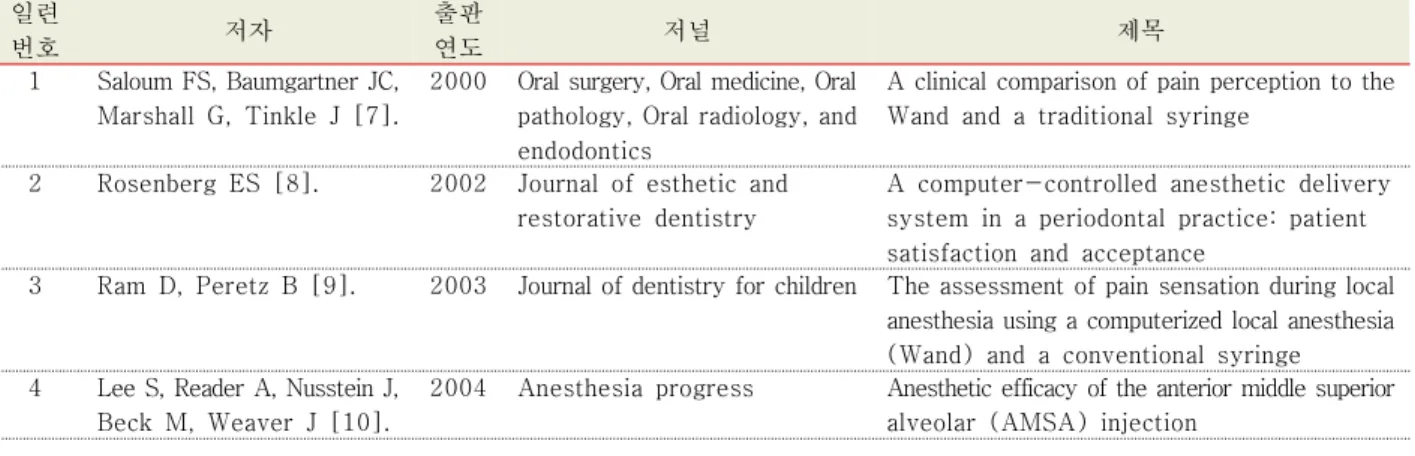
Table 1. 문헌고찰 대상이 된 논문 리스트
delivery,
이후CCLAD)
가 개발되어 다양한 제품이 출시되었 다.
그 중 대표적인 기기로는Wand
®(Milestone Scientific, Livingston, NJ), CCS
®(Midwest
‑ensply
‑anada), Quick- sleeper
®(Dental Hi-Tec, Cholet France)
등이 있다.
컴퓨터 를 이용한 국소마취기기의 기본 원리는 자입 속도를 술자의 손이 아닌,
컴퓨터를 이용하여 일정하게 조절할 수 있고,
이 러한 속도 조절을 통해 통증을 경감시킨다고 알려져 있다.
하지만,
아직 이러한 컴퓨터를 이용한 국소마취 기기에 대한 객관적 자료는 부족한 편이다[6,7].
본 연구에서는 컴퓨터를 이용한 속도 조절형 주사기기에 대한 문헌 고찰을 통해 일반적인 치과 마취 주사기와의 통증 조절 효과를 비교하여 컴퓨터를 이용한 속도 조절형 주사장 치의 효과와 한계점에 대한 정보를 정리하고자 한다
.
대상 및 방법
논문의 검색은
2
명의 치과의사가 시행하였다.
논문을 검 색한 엔진은 미국 국립의학도서관에서 제공하는 의학검색엔 진인Pubmed (NCBI Pubmed)
를 이용하였다.
컴퓨터를 이 용한 속도 조절형 국소마취 기기를 검색하기 위해 다음과 같은 검색어를 사용하였다.
논문의 언어는 영어로 된 것만을 선정하였고,
검색기간은2000
년1
월부터2012
년12
월까지로 하였다.
- ‘Computer local anesthesia’ or ‘WAND’
- ‘Traditional’ and ‘Computer local anesthesia’
- ‘Conventional’ and ‘Computer local anesthesia’
- ‘WAND’ and ‘traditional’
- ‘WAND’ and ‘conventional’
- ‘Comparison’ and ‘WAND’
- ‘Comparison’ and ‘Computer local anesthesia’
- ‘CCS’ or ‘Comfort Control Syringe’
- ‘Quicksleeper’
논문을 검색한 후
,
연구 논문의 원문을 통해 그 내용을 평가하였다. CCLAD
를 이용한 국소마취와 일반적인 치과마 취 주사기를 이용한 결과를 임상적,
실험적으로 비교한 논문 을 고찰하기 위해1)
의 조건을 만족하는 논문들을 문헌고찰 에 포함시켰고, 2)
와3)
에 해당되는 논문을 배제하였다.
1)
치과 국소 마취 영역을 대상으로 한 연구2) CCLAD
를 이용하여 사람이 아닌 다른 대상을 평가한연구는 제외
3) CCLAD
를 소개하거나 결과를 비교 대상 없이 평가한 연구는 제외선택된 논문은 두 명의 독립된 치과의사가 리뷰어로서 참 고문헌을 평가하였고
,
제3
의 리뷰어는 선정된 논문과 그Data
를 비교하였다.
세 명의 리뷰어의 동의를 통해 문헌 고 찰에 합당한 논문만을 최종적으로 포함하여 객관성과 정확성 을 도모하였다.
결과
해당 범주에 속하는 논문은 총
18
편이었으며 연도별 목록 은Table 1
과 같다.
일련
번호 저자 출판
연도 저널 제목
5 Loomer PM, Perry DA [11]. 2004 Journal of the American Dental Association
Computer-controlled delivery versus syringe delivery of local anesthetic injections for therapeutic scaling and root planning 6 Nusstein J, Lee S, Reader A,
Beck M, Weaver J [12].
2004 Oral surgery, Oral medicine, Oral pathology, Oral radiology and endodontics
Injection pain and postinjection pain of the anterior middle superior alveolar injection administered with the Wand or conventional syringe
7 Palm AM, Kirkegaard U, Poulsen S [13].
2004 Pediatric dentistry The wand versus traditional injection for mandibular nerve block in children and adolescents: perceived pain and time of onset 8 Klein U, Hunzeker C,
Hutfless S, Galloway A [14].
2005 Journal of dentistry for children Quality of anesthesia for the maxillary primary anterior segment in pediatric patients:
comparison of the P-ASA nerve block using CompuMed delivery system vs traditional supraperiosteal injections
9 Sumer M, Misir F, Koyuturk AE [15].
2006 Oral surgery, Oral medicine, Oral pathology, Oral radiology and endodontics
Comparison of the Wand with a conventional technique
10 Al Amoudi N, Feda M, Sharaf A, Hanno A, Farsi N [16].
2008 The Journal of clinical pediatric dentistry
Assessment of the anesthetic effectiveness of anterior and middle superior alveolar injection using a computerized device versus traditional technique in children
11 Versloot J, Veerkamp JS, Hoogstraten J [17].
2008 British dental journal Pain behaviour and distress in children during two sequential dental visits: comparing a computerised anaesthesia delivery system and a traditional syringe
12 Yesilyurt C, Bulut G, Taşdemir T [18].
2008 British dental journal Pain perception during inferior alveolar injection administered with the Wand or conventional syringe
13 Tahmassebi JF, Nikolaou M, Duggal MS [19].
2009 European archives of paediatric dentistry
A comparison of pain and anxiety associated with the administration of maxillary local analgesia with Wand and conventional technique 14 Yenisey M [20]. 2009 Journal of applied oral science Comparison of the pain levels of
computer-controlled and conventional anesthesia techniques in prosthodontic treatment
15 Kandiah P, Tahmassebi JF [21].
2012 British dental journal Comparing the onset of maxillary infiltration local anaesthesia and pain experience using the conventional technique vs. the Wand in children 16 Langthasa M, Yeluri R, Jain AA,
Munshi AK [22].
2012 Journal of the Indian Society of Pedodontics and Preventive Dentistry
Comparison of the pain perception in children using comfort control syringe and a conventional injection technique during pediatric dental procedures
17 Ozer S, Yaltirik M, Kirli I, Yargic I [23].
2012 Oral surgery, oral medicine, oral pathology, oral radiology, and endodontics
A comparative evaluation of pain and anxiety levels in 2 different anesthesia techniques:
locoregional anesthesia using conventional syringe versus intraosseous anesthesia using a computer-controlled system (Quicksleeper) 18 Shah M, Shivaswamy S,
Jain S, Tambwekar S [24].
2012 Journal of Indian Society of Periodontology
A clinical comparison of pain perception and
extent of area anesthetized by Wand and a
traditional syringe
저자 출판
연도 마취부위 마취
방법 환자 치과술식 평가내용 결과 평가 방법 기기
종류 Ram D, et al [9]. 2003 All I/A
B/A n=102 Operative Pain S Children's
reactions WAND
Palm AM, et al [13]. 2004 IAN B/A n=33 Operative Pain S VAS WAND
Klein U, et al [14]. 2005
Maxillary primary anterior segment
I/A
PDL n=21 All Pain
L S S
Disruptive
behaviors WAND
Al Amoudi N,
et al [16]. 2008
Maxillary primary
molars
I/A . Pulpotomy,
extraction
Anesthetic
effectiveness S SEM WAND
Versloot J, et al [17]. 2008 All
B/A PDL I/A
n=147 NA. Pain,
Anxiety S
VDS, VRS, CFSS-DS
WAND
Tahmassebi JF,
et al [19]. 2009 NA NA n=38 NA Pain,
Anxiety S VAS
VDS WAND
Kandiah P, et al [21]. 2012
Maxillary premolar,
molar
I/A n=30 None
Anesthetic effectiveness,
Pain
S EPT
VAS WAND
Langthasa M,
et al [22]. 2012 NA I/A n=50 None Pain L VAS
FRS CCS
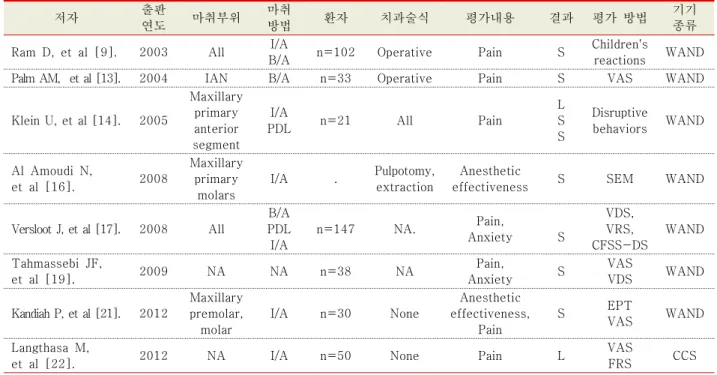
B/A: block anesthesia, I/A: infiltration anesthesia, NA: not available, IAN: inferior alveolar nerve, PASA: palatal anterior superior alveolar, S: similar, L: lower, disruptive behaviors: body movements, crying, restraint, or dentist interference, VAS: visual analog scale, SEM: sound, eye, motor, VDS: venham distress scale, VRS: verbal rating scale, CFSS-DS: children’s fear survey schedule- dental subscale, EPT: electric pulp tester, FRS: faces rating scale.
Table 2. 소아를 대상으로 한 CCLAD의 효과에 대한 문헌
1. 소아를 대상으로 한 연구(Table 2)
소아를 대상으로
CCLAD
와 통상적인 주사기를 이용한 국 소마취방법을 비교한 연구는 아래와 같으며,
통증을 평가한8
편의 연구 중7
편의 연구에서 동일하게 두 방법이 차이가 없는 것으로 평가되었고1
편의 연구에서 우수한 것으로 평가 되었다.
2. 성인을 대상으로 한 연구(Table 3)
성인을 대상으로
CCLAD
와 통상적인 주사기를 이용한 국 소마취방법을 비교한 연구는 아래와 같으며 그 결과, 10
편의 연구에서 부분적으로 혹은 전반적으로CCLAD
를 사용한 것 이 통증을 덜 느낀다고 보고하고 있다고찰
CCLAD
와 일반적인 치과마취 주사기를 임상적,
실험적으 로 사용하여 결과를 비교한 논문을Pubmed
에서 검색한 결과총
18
편이 검색되었고 그 중 소아를 대상으로 한 연구는8
편,
성인을 대상으로 한 연구는10
편이었다.
소아에서CCLAD
와 통상적인 주사기를 이용한 국소마취방법은 주사침 자입시 통 증과 마취 효과의 평가에서 대부분 비슷한 결과를 나타내었 다.
성인의 연구에서는CCLAD
가 통상적인 주사기를 이용한 국소마취방법보다 주사침 자입 시 통증과 마취 약제의 주입 시 통증 평가에서 모두 우수한 효과를 나타내었다.
1. 소아를 대상으로 한 연구에 대한 고찰
소아를 대상으로 한 연구를 먼저 살펴보면
Langthasa
등의[22]
연구는CCLAD
가 통증이 더 적은 것으로 보고하였다. Klein
등의[14]
연구에서는 주사침 자입 시CCLAD
가 통증이 더 적은 것으로 결과를 보고 하였으나,
해당 연구의 경우CCLAD
는 침윤마취법,
통상적인 주사기를 이용한 국소마취 방법은 치주인대 마취법으로 마취 방법이 달라 동일선상의 비교가 어렵다.
마취 효과의 측면에서Al Amoudi
등의[16]
연구와
Kandiah
와Tahmassebi
의[21]
연구는CCLAD
와 통 상적인 주사기를 이용한 국소마취방법이 차이가 없다는 결론을 내었다
.
하지만Kandiah
와Tahmassebi
의[21]
연구, Klein
등의[14]
연구, Palm
등의[13]
연구, Ram
와Peretz
의[9]
연구 역시 표면적으로 통증을 평가하였지만 특정 술식의 전반에서 실험이 이루어지므로 내용상으로는 마취 효과의 평가를 포함 한다고 할 수 있으며 이들의 연구에서도 둘 사이의 차이가 없다.
다만Al Amoudi
등의 연구에서 사용된 통증 평가 방법 인SEM scale
보다Kandiah
와Tahmassebi
의 연구에서 사용 된EPT
가 더 객관적이라고 생각할 수 있으며,
따라서Kandiah
와Tahmassebi
의 연구가 더 유의한 결과를 내었다 고 볼 수 있다.
국소 마취 중 나타나는 불안을 비교한 연구는
Tahmassebi
등의[19]
연구, Versloot
등의[17]
연구가 모두CCLAD
와 통상 적인 주사기를 이용한 국소마취방법에서 차이가 없음으로 결과 보고 하였는데,
다만Versloot
등의 연구에서 눈여겨 볼 것은 더 불안한 환자일수록 더 통증을 많이 느끼는 것으로 이 두 요인 사이의 상관관계를 보고하였다는 점이며 이를 미루어 볼 때 국소마취의 통증은CCLAD
와 통상적인 주사기 를 이용한 방법의 차이에서 오는 외적요인보다는 주사 자체 에 공포를 가지는 소아 환자의 특징에 따른 내적 요인에 의해 영향을 받을 수 있다.
상기의 연구에서 소아의 나이에 따른 결과의 차이는 발견되지 않으며,
마취 방법이나 마취 부위와 술식에 따라 유의한 차이가 있다고 결론지을 수 없었다.
다만 소아의 경우 평가 도구의 대부분이 환자의 반응과 행동을 주관적으로 평가하는 방법을 사용하고 있다.
이에 따라 평가 도구는 술자,
환자,
제3
자 혹은 다른 전문가 집단에 의해 복수로 평가되어 객관성의 획득을 도모하였지만 평가 방법이 가지는 주관성을 벗어날 수 없는 한계를 지니고 있다.
또한 소아는CCLAD
와 통상적인 국소 마취용 주사기의 사용과 무관하게 주사 행위 자체에 대한 공포가 성인보다 크다.
따라 서 소아에서 국소마취의 효과와 통증의 상관관계를 객관적으 로 평가하는 데에 한계가 있을 것으로 생각된다.
소아의 연구를 속도의 측면에서 다시 살펴보면
CCLAD
와 통상적인 주사기를 이용한 국소마취 시 속도를 정확히 명기 하지 않은Tahmassebi
등의[19]
연구와Versloot
등의[17]
연구에서는 비슷한 정도의 통증과 불안을 나타내었다
. Kandiah
와Tahmassebi
의[21]
연구, Palm
등의[13]
연구,
Ram
과Peretz
의[9]
연구는1 ml/min
로WAND
®와 통상적인 주사법의 자입속도를 조절하였는데,
주사침 자입 시의 통증,
전반적 통증,
마취 효과에서 비슷한 결과를 나타내었다.
다만Kandiah
와Tahmassebi
의[9]
연구에서는 통상적인 주사기를 이용한 자입과CCLAD
의 국소 마취제의 전달 시간을 실제 측정하였을 때 평균값이2.2 min/ml
와2.12 min/ml
로 거의 비슷했지만, CCLAD
의 편차가 적은 것으로 보아, CCLAD
의 경우가 실제 환자에서 목표로 한 자입 속도를 유지하면서 더 안정적으로 국소 마취를 시행한 것으로 볼 수 있다. Al Amoudi
등의[16]
연구에서는CCLAD
에서0.5 ml/min,
통상 적인 주사기를 이용한 자입에서1 ml/min
로 자입 속도를 설정하였는데 마취 효과에서는 유사한 결과를 나타내었다.
즉, CCLAD
는 통상적인 주사기를 이용한 국소마취법과 비교 하였을 때 유사한 통증 조절이 가능하고 적절한 마취 효과를 가지며 더 안정적으로 국소 마취를 시행할 수 있다.
소아의 실험군을 나이별로 세분해 살펴보면
, Klein
등의[14]
연구, Ram
와Peretz
의[9]
연구, Tahmassebi
등의[19]
연 구에서는 유아기에서 불안,
자입 시 통증 및 전반적 통증에서CCLAD
는 유사하거나 더 나은 결과를 나타내었다. Al Amoudi
등의[16]
연구와Ram
와Peretz
의[9]
연구는 학령기 아동을 대상으로, Kandiah
와Tahmassebi
의[21]
연구, Palm
등의[13]
연구, Langthasa
등의[22]
연구는 학령기와 청소년 기의 아동을 대상으로 연구를 시행하였는데, Langthasa
등의 연구에서는CCLAD
가 우수한 결과를 보였고,
다른 모든 연구 에서CCLAD
는 유사한 결과를 나타내었다.
따라서CCLAD
는 소아의 연령대에 관계없이 술식 전반의 통증 조절에 효과 가 있다고 할 수 있지만,
마취나 치과술식에 관한 설명이 어려운 유아기보다는 학령기나 청소년기에서 더 효과적이라 생각할 수 있다.
조사된 모든 소아의 실험에서 마취 전 도포 마취가 실험에 선행되었고
,
치과국소마취와 술식 전반이 부모와 소아에게 쉬운 용어로 설명되어 술전 불안 해소를 도모하였다.
이러한 적절한 술전 불안의 조절이 선행되었을 때 성공적인 국소마 취와 통증조절이 가능할 것으로 생각된다.
저자 출판
연도 마취부위 마취
방법 환자 치과술식 평가내용 결과 약제 평가 방법 기기
종류
Saloum FS, et al [7]. 2000
Maxillary Premolar I/A
n=40 None Pain L Mep 4-point VAS WAND
Mandibular
IAN B/A
Rosenberg ES
[8]. 2002 Random
PDL B/A I/A
n=150 Periodontal practice
Patient satisfaction
and acceptance
SU NA 4 point scale WAND
Lee S, et al
[10]. 2004 AMSA I/A n=40
None (healthy
teeth)
Anesthetic Efficacy
SU (Except
central incisor) SIM SIM
Lido EPT WAND
Loomer PM,
et al [11]. 2004 Maxillary
area I/A n=20 Periodontal
practice
Pain Anesthetic
Efficacy L (GP, NP)
SIM
Lido VAS
VRS WAND
Nusstein J,
et al [12]. 2004 AMSA I/A n=40 Endodontic
Treatment Pain
SIM SU PA
Lido VAS WAND
Sumer M,
et al [15]. 2006 Mandibular IAN B/A n=52 Simple extraction.
Pain, Anxiety
L L PA
NA
PRS VAS DAS
WAND
Yesilyurt C,
et al [18]. 2008 Mandibular IAN B/A n=40 Operative procedures
Pain, Anxiety,
Patient preference
L
MO NA PRS
VAS WAND
Yenisey M
[20]. 2009 AMSA I/A n=16 Prosthodontic
Treatment Pain
SU SU SIM
Arti VRS WAND
Ozer S,
et al [23]. 2012 Mandibular area
IO IAN B/A
n=40
3
rdmolar Surgical Extraction
Pain Anesthetic
effect
SU Arti
(2%) VAS Quicks
leeper
Shah M,
et al [24]. 2012 AMSA I/A n=10
Periodontal surgical treatment
Pain L NA VAS
probing WAND IAN: inferior alveolar nerve, AMSA: anterior middle superior alveolar, B/A: block anesthesia, I/A: infiltration anesthesia, GP: great palatine, NP: naso palatine, L: less pain, SU: superior, SIM: similar, MO: more preferred, PA: painful, Low: Lo, Mepi: 3% Mepivacaine plain, Lido: 2% Lidocaine with 1:100,000 epinephrine, Arti: 4% Articaine with 1:200,000 epinephrine, VAS: visual analog scale, 4 point scale: superlative, positive, or somewhat positive, negative, EPT: electric pulp tester, VRS: verbal rating scale, PRS: pain rating scale, DAS: dental anxiety scale, NA: Not available.
Table 3. 성인을 대상으로 한 CCLAD 의 효과에 대한 문헌
2. 성인을 대상으로 한 연구에 대한 고찰
성인을 대상으로 한 연구에서는
Sumer
등의[15]
연구, Yenisey
의[20]
연구는 주사침 자입시와 마취제 주입 시 모두 에서CCLAD
가 우수한 결과를 보이는 것으로 보고하였고, Nusstein
등은[12]
주사침의 자입에서는 비슷하지만 마취제 가 퍼질 때CCLAD
가 통증을 덜 느끼게 하는 것으로 결과를 보고하였다.
이는 속도조절이 가능한CCLAD
가 마취 용액이퍼지면서 발생하는 압력을 줄여준다는 이론적 가설을 입증해 주는 결과라 할 수 있다
.
하지만Saloum
등의[7]
연구는 그 대상자가 치과 대학생과 치위생과 학생 및 대학원생으로 취 약한 피험자 군에 속한다 할 수 있고,
대상자의 연령이21
세 에서36
세로 젊은 층에 한정되어 있고 남자가 여자에 비해2
배가량 많아서 실험의 결과를 일반화하기는 힘들다.
Nusstein
등의[12]
연구는 응급과 통상의 근관 치료를 시행하 는 환자를 동일선상에서 비교하였는데,
두 환자군은 초기의VAS(Visual Analogue Scale,
이하VAS)
값과 환자의 불안 정도에도 차이가 있을 것으로 생각된다.
환자의 선호도를 조사한Rosenberg
의[8]
연구와Yesilyurt
등의[18]
연구 둘 모두에서CCLAD
가 통상적인 방법보다 선호되었다.
다만Rosenberg
의 연구에서의 평가 항목superlative, positive, or somewhat positive, negative
의4
단계인데 이 중 부정적 인 항목이1
단계이고 긍정적인 항목은3
단계로 이 평가 방법 은 아주 부정적인 사람을 제외한 사람을 긍정적인 것으로 평가하고 있다.
마취 효과의 경우 건강한 치아를 대상으로 한
Lee
등의[10]
연구에서는 발현 시간과 지속 시간에서 두 방법이 유의한 차이를 보이지 않았지만
,
상악 전치부와 소구치부에서 대체 로CCLAD
의 효용이 높았다. Loomer
와Perry
의[11]
연구, Shah
등의[24]
연구로 미루어 볼 때 치주 치료를 위한 침윤 마취의 경우는 수술적 비수술적 처치 모두에서 유의한 차이 가 없었다.
마취법에 따른 비교를 해 보면 통증의 평가에서 모든 마취법을 임의로 시행한Rosenberg
의[8]
연구, Saloum
등의[7]
연구에서 환자들은CCLAD
에서 통증을 덜 느끼거나 선호도가 높았다. AMSA(anterior middle superior alveolar,
이하AMSA) block
을 위해 구개 마취를 시행한 실험인Nusstein
등의[12]
연구, Shah
등의[24]
연구, Yenisey
의[20]
연구에서도
CCLAD
의pain
이 더 적었고,
하악의 전달마취법 이 시행된Sumer
등의[15]
연구와Yesilyurt
등의[18]
연구에 서도pain
이 적어서,
적어도 이상의 논문들에서는CCLAD
가 침윤 마취와 전달 마취에서,
상악과 하악 모두에서 통상적인 방법보다 우수한 것으로 생각할 수 있다.
또한Loomer
와Perry
의[11]
연구에서는 대구개 신경과 비구개 신경을 마취 할 때 상악의 다른 신경의 마취에서보다 더 유의한 차이를 보였는데,
이는 점막이 두꺼운 구개부의 마취시 속도와 압력 을 더 잘 조절할 수 있는CCLAD
가 더 유리한 것으로 생각해 볼 수 있다. Ozer
등의[23]
연구는 하악 대구치의 발치에서 전통적인 마취법으로 하치조신경 전달마취를, CCLAD
로 골 내마취를 시행하였는데 통증조절의 측면에서CCLAD
가 통 상적인 방법보다 우수한 효과를 나타내었다.
다만 골내마취 법의 경우 자입 시간이 더 길게 소요되며,
주사바늘이 마취 중 막힐 가능성이 있으며 하치조신경 전달마취에 비해 마취시간이 짧아 시간이 길게 소요되는 술식에는 부적합한 것으 로 평가되었다
.
성인의 연구를 속도의 측면으로 다시 살펴보면
CCLAD
는 침윤마취와 전달마취에서0.015 ml/s
의 속도를 이용했다.
반면 통상적인 주사기를 이용한 국소마취의 마취액 자입속도 는 실험에 따라 차이가 있다. Rosenberg
의[8]
연구, Shah
등의[24]
연구, Yenisey
의[20]
연구는 통상적인 주사기를 이 용한 국소마취의 자입 속도를 명확히 설정하지 않았으며 통 상적인 마취법을 따랐다.
이 연구들의 결과는CCLAD
의 주사 침 자입과 마취액 주입의 통증이 더 적고 환자에게 더 선호되 는 것으로 보고하고 있는데,
이는 속도를 조절하였을 경우 조절하지 않았을 때에 비해 통증이 경감되는 것으로 볼 수 있다. Saloum
등의[7]
연구, Sumer
등의[15]
연구, Yesilyurt
등의[18]
연구는 통상적인 주사기를 이용한 국소 마취 시 자 입 속도를CCLAD
의2
배 정도로 설정하였다.
이 세 연구의 결과에서 주사침 자입시의 통증,
마취액 주입시의 통증,
환자 의 불안이 줄어들었으며 환자는CCLAD
를 선호하였다.
이는 속도를 줄이는 것이 통증의 감소에 기여한다는 결과이다. Lee
등의[10]
연구, Loomer
와Perry
의[11]
연구, Nusstein
의[12]
연구는 통상적인 방법에서 대표적인CCLAD
인WAND
® 의 과정을 그대로 모사하였다.
WAND
®는 주사침 자입 단계에서0.08 ml
을 주입한 후 마취제 주입 단계에서1.32 ml
를 자입하며,
두 단계 모두0.015 ml/s
로 동일하게 유지한다.
또한 구개점막에 주사침 자입 시에는 더 높은 압력이 요구된다.
결과적으로 두 방법을 비교해 보면,
구개부의 마취 시 주사침 자입 단계에서는 자입 시 요구되는 높은 압력으로 인해 유사한 결과를 나타내었다.
그러나 마취액 주입 단계에서는 일정한 속도를 유지할 수 있는WAND
를 사용 시 더 우수한 결과를 보였고, AMSA
block
의 성공률도 더 높았으며,
부위별로는 대구개 신경과 비구개 신경의 전달마취에서 특히 통증을 줄일 수 있었다.
이는 마취액 주입 단계의 긴 시간동안 발판에 의한 컴퓨터의 속도 조절에 비해 통상적인 주사기를 이용할 때 술자의 손으 로 속도를 조절하는 것이 불리함을 반영하며 이는 특히 구개 부의 마취에서 더 차이가 큰 결과를 나타내었다.
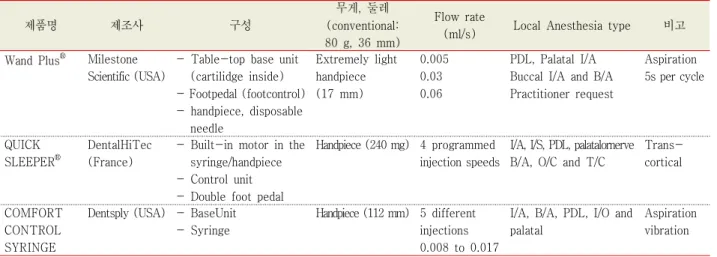
제품명 제조사 구성
무게, 둘레 (conventional:
80 g, 36 mm)
Flow rate
(ml/s) Local Anesthesia type 비고 Wand Plus
®Milestone
Scientific (USA)
- Table-top base unit (cartilidge inside) - Footpedal (footcontrol) - handpiece, disposable
needle
Extremely light handpiece (17 mm)
0.005 0.03 0.06
PDL, Palatal I/A Buccal I/A and B/A Practitioner request
Aspiration 5s per cycle
QUICK SLEEPER
®DentalHiTec (France)
- Built-in motor in the syringe/handpiece - Control unit - Double foot pedal
Handpiece (240 mg) 4 programmed injection speeds
I/A, I/S, PDL, palatalornerve B/A, O/C and T/C
Trans- cortical
COMFORT CONTROL SYRINGE
Dentsply (USA) - BaseUnit - Syringe
Handpiece (112 mm) 5 different injections 0.008 to 0.017
I/A, B/A, PDL, I/O and palatal
Aspiration vibration
B/A: block anesthesia, I/A: infiltration anesthesia, I/S: intraseptal, O/C: osteocentral anesthesia, T/C: transcortical anesthesia, I/O: intraosseous anethesia.
Table 4. 현재 출시된 CCLAD의 비교
3. CCLAD에 관한 고찰
CCLAD
에 관한 기존의 연구 중CCLAD
와 통상적인 주사 기를 이용한 국소마취법의 통증조절 효과를 비교한 논문은18
편이었고 그 중WAND
®를 이용한 연구가16
편, CCS
®를 이용한 연구가1
편, Quicksleeper
®를 이용한 연구가1
편이 었다.
1997
년Milestone Scientific (Piscataway, NJ, USA)
가 처 음으로WAND
®를 소개한 이래 몇몇 회사에서 컴퓨터를 이 용한 속도 조절형 국소 마취 기구를 개발하여 현재까지 사용 되고 있고 대표적인 제품을 조사,
비교하였다.
가장 전통적인 제품인
WAND
®는 가장 가볍고 둘레가 통 상적인 마취 주사기의 절반 정도로 술자가 다루기 쉽다.
반면Quicksleeper
®와CCS
®는 크기와 무게가 통상적인 마취 주 사기의3
배 정도로 손이 작은 술자가 다루기 다소 어려워 보인다.
이는WAND
®의 경우 주사기가 본체에 내장되어 있 는 반면Quicksleeper
®와CCS
®의 경우 주사기와 모터가 핸 드피스에 포함되어 있기 때문이다.
따라서WAND
®는 카트 리지가 본체에 내장되어 마취 중 어시스트가 카트리지를 교 체하는 것이 가능한 장점이 있지만,
튜브에 있는0.3-0.4 ml
의 마취액이 소실되며 구성품의 종류가 많고 일반적인 주사 침을 사용하는 것이 불가능하다.
가격은Quicksleeper
®가 가장 비싸고CCS
®와WAND
®가 상대적으로 저렴한데 제품 의 소매가는 국가와 판매처에 따라 다소 차이가 있었다.
마취액의 유입 속도는
WAND
®의 경우3
단계, Quicksleeper
®는4
단계, CCS
®는5
단계로CCS
®가 가장 다양한 주입 속도의 조절이 가능하며 세 제품 모두 치주인대 마취부터 전달 마취 까지 가능하다. WAND
®와CCS
®의 경우 흡인이 가능한데,
새로 개발된WAND PLUS
®의 흡인 시간이5
초로WAND
®의14
초에 비해 많이 개선되었지만 여전히 길다. Quick- sleeper
®는 피질골의 천공이 가능해 골내마취가 가능하다.
한편CCS
®는 미세진동을 일으키는 모터가 핸드피스에 내장 되어 있는 장점이 있다.
CCLAD
가 통증을 경감시킬 수 있는 원리는 다음과 같다.
우선 마취액의 자입속도를 조절 가능하므로 소량의 마취제가 지속적으로 느린 속도로 자입되면 후방의 마취액이 흘러들어 오기 전에 주사침 바로 앞의 조직이 마취되므로 마취액은 이미 마취된 조직으로 자입이 되고,
이런 일련의 과정을 통해 환자는 통증을 덜 느끼게 된다[25].
WAND
의 경우 주사기의 크기가 작아서 핸드피스를 잡는 손가락이 최대한 자입부에 가까이 위치할 수 있어서 이는 더 정밀한 주사침의 자입을 가능하게 한다[26].
또한WAND
는 주사침의 자입 동안 핸드피스가 전후방으로 회전하도록 고안 되어 있어서 손잡이의 축방향에 주사침의 방향이 일치 하지 않았을 때 발생할 수 있는 주사침의 휘어짐을 줄여 줄 수 있다[25]. Yenisey
의[20]
연구와Langthasa
등의[22]
연구 에서 주사침 자입 시의 통증이CCLAD
에서 더 감소된 결과가 이를 대변한다고 할 수 있다.
본 연구는 논문의 검색이
systematic review
가 아니고,
영문 논문만 검색하였으며 검색어가 더 있을 가능성이 있다 는 점에서 한계점을 가진다.
또한 논의된 연구들은 대부분WAND
를 이용한 연구로CCLAD
간의 비교는 힘들다.
현재 국내 생산되는CCLAD
도 사용되고 있어,
국내에서 출시된 기기들을 이용한 통증조절 효과에 관한 연구가 진행된다면 향후CCLAD
의 사용에 도움이 될 것으로 생각된다.
참고문헌
![Table 3. 성인을 대상으로 한 CCLAD 의 효과에 대한 문헌2. 성인을 대상으로 한 연구에 대한 고찰성인을 대상으로 한 연구에서는 Sumer 등의[15] 연구 , Yenisey의[20] 연구는 주사침 자입시와 마취제 주입 시 모두에서 CCLAD가 우수한 결과를 보이는 것으로 보고하였고, Nusstein 등은[12] 주사침의 자입에서는 비슷하지만 마취제가 퍼질 때 CCLAD가 통증을 덜 느끼게 하는 것으로 결과를 보고하였다](https://thumb-ap.123doks.com/thumbv2/123dokinfo/5247187.627382/6.892.92.805.368.991/대상으로-대상으로-고찰성인을-연구에서는-보고하였고-자입에서는-비슷하지만-보고하였다.webp)