INTRODUCTION
Trigeminal neuralgia (TN) is defined by the International Head- ache Society as “recurrent unilateral brief electric shock-like pains, abrupt in onset and termination, limited to the distribu- tion of one or more divisions of the trigeminal nerve and trig- gered by innocuous stimuli.”1 It is characterized by the pres- ence of a trigger zone, no objective neurological deficit, and no other identified causes of facial pain; it can cause severe pain and disrupt or impair quality of life in patients.2
Treatments for TN consist of pharmacological treatments, such as that with carbamazepine; surgical treatments, includ- ing open surgery and percutaneous procedures; and radiosur- gery, including gamma knife radiosurgery (GKRS). Historical-
ly, GKRS was introduced as a treatment for TN. The Swedish neurosurgeon Lars Leksell began treating TN patients in 1951 using a prototype guiding device linked to a dental X-ray ma- chine.3 Lindquist reported on the progress of TN patients who had undergone GKRS in 1991, and several studies have docu- mented the safety and efficacy of GKRS, including long-term results, for TN.4-6 Other techniques of radiosurgery, such as cy- ber knife surgery and linear accelerator, were introduced in the 2000s and have shown effectiveness, compared to other surgi- cal treatments.7,8
Several modifications have been made to the treatment regi- mens for GKRS over the past few decades. We reviewed the ra- tionale, effects, safety, and current treatment policies of GKRS for TN in view of our institution’s results and a review of the lit- erature to date.
PATHOPHYSIOLOGY OF TN
The pathogenesis of TN is not fully understood, and its exact pathophysiology remains controversial. However, in general, it is described by a mixed peripheral and central mechanism.9 Neurovascular conflict is the most accepted theory, as it is related to TN in a vast majority of cases.10 Chronic nerve compression results in demyelination of trigeminal sensory fibers within the
Gamma Knife Radiosurgery on the Trigeminal Root Entry Zone for Idiopathic Trigeminal Neuralgia:
Results and a Review of the Literature
So Hee Park and Jin Woo Chang
Department of Neurosurgery, Yonsei University College of Medicine, Seoul, Korea.
Trigeminal neuralgia (TN) is a chronic disorder of the trigeminal nerve characterized by repeated electrical shock-like sensations on one side of the face. It can cause severe pain in the face and disrupt or impair quality of life in patients. Options for the man- agement of TN consist of pharmacological and surgical treatments, including Gamma Knife radiosurgery (GKRS). GKRS has been used for TN for a long time because of its low rate of complications and high success rate. Moreover, GKRS can be of use for drug- resistant TN patients who are poor surgical candidates due to medical comorbidities, patients of older age, or patients who refuse invasive therapy. We reviewed the rationale, effects, safety, and current treatment policies of GKRS for TN in view of our institu- tion’s results and a review of the literature to date.
Key Words: Gamma Knife radiosurgery, trigeminal neuralgia, facial pain
pISSN: 0513-5796 · eISSN: 1976-2437
Received: November 11, 2019 Revised: December 24, 2019 Accepted: December 30, 2019
Corresponding author: Jin Woo Chang, MD, PhD, Department of Neurosurgery, Yonsei University College of Medicine, 50-1 Yonsei-ro, Seodaemun-gu, Seoul 03722, Korea.
Tel: 82-2-2228-2150, Fax: 82-2-393-9979, E-mail: [email protected]
•The authors have no potential conflicts of interest to disclose.
© Copyright: Yonsei University College of Medicine 2020
This is an Open Access article distributed under the terms of the Creative Com- mons Attribution Non-Commercial License (https://creativecommons.org/licenses/
by-nc/4.0) which permits unrestricted non-commercial use, distribution, and repro- duction in any medium, provided the original work is properly cited.
Yonsei Med J 2020 Feb;61(2):111-119 https://doi.org/10.3349/ymj.2020.61.2.111
proximal nerve root, with progressive axonal degeneration.11 Demyelination can lead to ephaptic transmission, and the reen- try mechanism causes an amplification of sensory inputs.10,12 Meanwhile, nerve injury leads to a release of mediators that sen- sitize peripheral nerve terminations, resulting in neurochemical and phenotypic changes and increased excitability of trigemi- nal neurons and trigeminal nuclei (central sensitization).11 Ultra- structural and biochemical changes in axons and myelin are seen in the root, the Gasserian ganglion, or both.13
CLINICAL FEATURES AND CLASSIFICATION
According to the International Classification of Headache Dis- orders, 3rd edition (ICHD-3), TN can be diagnosed when recur- rent paroxysms of unilateral facial pain of a severely intense, electric shock-like, shooting, stabbing, or sharp nature occurs in one or more divisions of the trigeminal nerve.1 It should not radiate beyond the territory of the trigeminal nerve, should last between 1 second and 2 minutes, and should be precipitated by innocuous stimuli within the affected trigeminal distribu- tion. TN is divided into the following three categories accord- ing to its cause: classical TN, secondary TN, and idiopathic TN.
Classical TN refers to cases without an apparent cause other than neurovascular compression. When underlying diseases are present, such as a tumor in the cerebellopontine angle, arterio- venous malformation, or multiple sclerosis, secondary TN is di- agnosed. Idiopathic TN could be diagnosed in cases where nei- ther an electrophysiological test nor magnetic resonance images show significant abnormalities. Besides the ICHD classification, the Burchiel classification is also used to categorize TN and re- lated facial pain syndromes using the characteristics of pain.14 The classification is based on the patient’s history and is shown in Table 1.
GKRS AS A TREATMENT METHOD
Treatment method for TN
Treatments for TN are divided into the following three catego- ries: pharmacological treatments; surgical treatments, includ- ing microvascular decompression (MVD) and percutaneous procedures, such as radiofrequency rhizotomy (RFR), balloon microcompression, and glycerol injection; and stereotactic ra- diosurgery.
The first therapeutic line is pharmacological treatment with carbamazepine. It is the only drug shown in a random-controlled trial to reduce the intensity and frequency of attacks, and it pro- vides significant pain control in 80–85% of patients.15 Never- theless, its efficacy can decrease, and in the long term, many patients become drug-resistant.16 Oxcarbazepine, baclofen, la- motrigine, and pimozide can also be used.17
Surgical treatment is the second therapeutic line and includes open surgery, percutaneous surgery, and radiosurgery. It is used in patients with medically intractable pain or those who suffer from side effects related to medication. MVD alleviates the un- derlying cause of a compressed trigeminal nerve root through exploration of the posterior fossa. It is considered a reference treatment modality, as it provides pain relief for approximately 90% of patients and has long-term effects (68–88% after 5 years and 61–88% after 10 years).18,19 Therefore, MVD should be con- sidered as the first surgical treatment modality for young pa- tients with an obvious neurovascular conflict.20 However, major complications of surgery can include hearing loss, cerebrospi- nal fluid leakage, infection, hemorrhage, and brainstem infarc- tion.18,21
Percutaneous procedures are ablative techniques performed at the level of the Gasserian ganglion and are mechanistically based on physical, thermic, and chemical actions. Percutane- ous procedures show a high initial success rate; however, over time, the recurrence rate is higher than that of MVD.22 The ini- tial success rate for balloon microcompression was reported at 82–99%, and the median pain-free time was 20 months.23,24 For glycerol injection, the initial success rate and the median pain-free time were 73–96% and 21 months, respectively.24,25 For RFR, the initial success rate was 78.8–100%, and the probabili- ties of remaining pain-free 1, 2, and 11 years after the procedure were 65%, 49%, and 26%, respectively.26-28 These ablative pro- cedures pose a risk of hypesthesia, dysesthesia, severe facial numbness, corneal keratitis, and masseter muscle weakness.29,30
Lastly, GKRS can be used for drug-resistant TN patients who are poor surgical candidates due to medical comorbidities or age or for those who refuse invasive therapy, especially in the absence of other primary indications, such as neurovascular conflict. GKRS has a very high rate of pain relief with minimal complications, showing a gradual decline in the complication rate due to advancement in imaging modalities.22 Burchiel’s type 1 and type 2 TN are the most common indications of GKRS.
GKRS may also be used in selected cases of multiple sclerosis- related and post-herpetic TN and in some cases of atypical fa- Table 1. Burchiel Classification of TN and Related Facial Pain Syndromes
Burchiel classification History
Spontaneous onset
TN, Type 1 >50% episodic pain, sharp, shooting, electrical shock-like
TN, Type 2 >50% constant pain, aching, throbbing, burning
Trigeminal injury
Trigeminal neuropathic pain Unintentional, incidental trauma Trigeminal deafferentation pain Intentional deafferentation
Symptomatic TN Multiple sclerosis
Postherpetic neuralgia Trigeminal Herpes zoster outbreak Atypical facial pain Somatoform pain disorder TN, trigeminal neuralgia.
cial pain.31,32
Institutional results on GKRS for TN
A total of 235 patients underwent GKRS for TN between Feb- ruary 1996 and September 2018. The indications for GKRS in- cluded failure of pharmacological treatment, significant adverse effects from medication, and failure of prior surgical treatment.
Of these patients, 157 had charts and a follow-up period of more than 1 year. Of these patients, except for those with TN related to tumors and multiple sclerosis, 142 patients were reviewed (Fig. 1). Patient characteristics are shown in Table 2. GKRS was performed with a Gamma Knife (Leksell Gamma Knife, Elekta Instruments, Atlanta, GA, USA). Seven patients were treated with the Gamma Knife Model B, 28 patients with the Gamma Knife Model C, and 107 patients with the Perfexion Gamma Knife.
GKRS treatment was planned using T2-weighted magnetic resonance images with a slice thickness of 1 mm and construc- tive interference in steady-state images with 0.5-mm axial slic-
es obtained with the stereotactic frame fixed to the head under local anesthesia. A single 4-mm isocenter with two or three beam blocking was used for treatment. It was positioned to cover the trigeminal root entry zone (REZ). After February 2005, planning was done such that a 15-Gy isodose line invaded less than 5%
of the brainstem. The dose used varied from 60 to 90 Gy.
Pain from TN was assessed using Barrow Neurologic Institute (BNI) pain scores. BNI scores of I–IIIb were considered as indic- ative of successful treatment, whereas BNI pain scores of IV and V were considered reflective of unsuccessful treatment. Fol- lowing improvements in pain after GKRS, any worsening of the pain (even if the level of pain was milder than that present pri- or to treatment) was considered as recurrence.
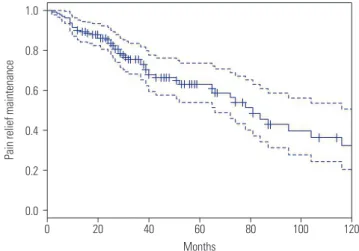
The median follow-up period was 37 months (12–250 months, 54.35±49.51 months). The median dose of gamma rays was 85 Gy (60–90 Gy, 84.23±3.743 Gy). After GKRS, 93.7% of patients (133/142) experienced successful treatment (Fig. 2). Of these, recurrence of pain occurred in 50 patients (37.6%, 50/133), and the median time to recurrence was 29 months (2–166 months, 42.26±38.08 months). Among patients who experienced recur- rence, six (12%, 6/50) needed additional surgery or procedures, and the rest were controlled by medication. Complications were reported in a total of 25 patients (17.6%, 25/142) and included facial hypesthesia in 19 patients (13.4%), dysesthesia in 2 pa- tients (1.4%), and dry eye syndrome in 4 patients (2.8%) (Table 3). Univariate comparisons were performed using the indepen- dent t-test and one-way ANOVA test. There were no statistically significant correlations between the prior procedure and com- plications (p=0.068) or between the types of prior procedures and complications (p=0.705). There were also no statistically sig- nificant relationships between dose and successful treatment, recurrence, and complications under significance of p<0.05.
Pain relief after GKRS
The rationale for achieving pain relief after GKRS is related to focal axonal degeneration of the trigeminal nerve associated TN treated with GKRS
from Feb 1996 to Sep 2018, n=235
Included patients, n=142
Excluded unidentifiable charts, n=25
Excluded at follow-up period (less than 1 year), n=53 Excluded TN related to tumor and MS, n=15
Fig. 1. Flow chart for patient inclusion. TN, trigeminal neuralgia; GKRS, Gamma Knife radiosurgery; MS, multiple sclerosis.
Table 2. Clinical Characteristics of Patients
Variables Value
Age 68.58±11.33
Sex (%)
Male 46 (32.39)
Female 97 (67.61)
Prior procedure (%)
MVD 8 (5.63)
RFR 11 (7.75)
Radiosurgery 4 (2.82)
Others 14 (9.86)
None 105 (73.94)
Trigeminal division effected (%)
V1 7 (4.93)
V2 25 (17.61)
V3 44 (30.99)
V1, 2 25 (17.61)
V2, 3 30 (21.13)
V1, 2, 3 11 (7.75)
MVD, microvascular decompression; RFR, radiofrequency rhizotomy.
1.0 0.8 0.6 0.4 0.2
0.0
120
0 20 40 60 80 100
Months
Pain relief maintenance
Fig. 2. Predicted pain relief maintenance period after Gamma Knife ra- diosurgery. Solid line represents predicted pain relief maintenance pe- riod and dotted line represents 95% confidence interval.
with nociceptive sensibility, destruction of ionic channels, and electrophysiological blocking initially after nerve irradiation.33,34 Additionally, a delayed radiation effect with axonal degenera- tion has been proposed, as some patients experience a late re- sponse after GKRS.35 In the literature, the latency to pain relief was 15 to 78 days on average, and the maximum time to pain re- lief was 6 months after treatment.29
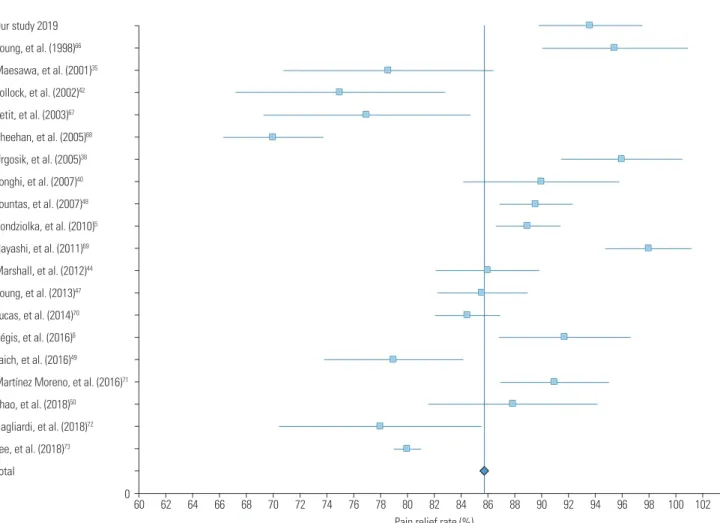
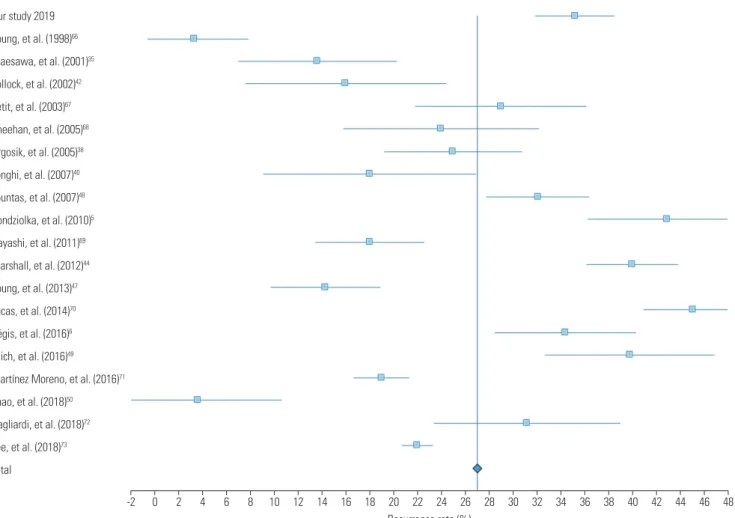
Table 4 lists studies with more than 100 patients who under- went GKRS for TN (Fig. 3). GKRS showed high rates of pain re- lief, ranging from 70–98% in large studies of over 100 patients (Fig. 4). Pain control was achieved in 69–85% of cases at 1 year, 59% at 2 years, and 38–52% at 5 years.35,36 Regarding long-term results, rates of pain control maintenance were 32–59.7% at 7 years and 30–45.3% at 10 years.5,6,37 Although follow-up periods vary among the studies, making direct comparison difficult, the average pain free duration was 7–58 months.35,38,39 The mean recurrence rate was 26.9%, with a range of 3.3–45.1% (Fig. 5).
In comparison, our data showed a higher recurrence rate than
the average. This may be due to a difference in follow-up peri- ods, because in our study, some patients experienced recurrent pain after approximately 14 years.
Complications of GKRS
Complications due to GKRS are uncommon, with hypesthesia being the most common adverse event. The incidence of hyp- esthesia is reported to be up to 2.7–55.0%, with a mean occur- rence rate of 22.55%, slightly higher than our result (Table 4).
Similar to the latency period for GKRS to be effective, there may also be a latency period between the procedure and the devel- opment of complications. The mean time to hypesthesia occur- rence ranged from 6 to 36 months.29
Other complications include dysesthesia, deafferentation pain, dysgeusia, dry eye syndrome, keratitis, hearing impair- ment, and masticator weakness.41,42 Rarely, significant injury to
Table 3. Results of Gamma Knife Radiosurgery for Trigeminal Neuralgia Treatment outcome Number of patients (%) Treatment failure (BNI pain score IV, V) 9 (6.3) Treatment success (BNI pain score I–IIIb) 133 (93.7)
Recurrence 50 (37.6)
Complication 25 (17.6)
Hypesthesia 19 (13.4)
Dysesthesia 2 (1.4)
Dry eye syndrome 4 (2.8)
BNI, Barrow Neurological Institute.
Table 4. Review of Studies with more than 100 Cases of Gamma Knife Radiosurgery for Trigeminal Neuralgia Study (year) Number of patients Mean or median follow-up
period (months) Pain relief (%) Complications (%) Recurrence (%)
Young, et al. (1998)66 110 19.8 95.5 2.7 3.3
Maesawa, et al. (2001)35 220 22 78.6 10.2 13.6
Pollock, et al. (2002)42 117 26 75 37 16
Petit, et al. (2003)67 112 30 77 7.3 29
Sheehan, et al. (2005)68 136 19 70 19 24
Urgosik, et al. (2005)38 107 60 96 20 25
Longhi, et al. (2007)40 170 37.4 90 8.75 18
Fountas, et al. (2007)48 106 34.3 89.6 16 32.1
Kondziolka, et al. (2010)5 503 24 89 10.5 42.9
Hayashi, et al. (2011)69 130 38 98 24 18.0
Marshall, et al. (2012)44 448 20.9 86 44 40
Young, et al. (2013)47 315 68.9 85.6 32.9 14.3
Lucas, et al. (2014)70 446 21.2 84.5 42 45.1
Régis, et al. (2016)6 497 43.8 91.75 21.1 34.4
Taich, et al. (2016)49 263 24 79 NA 39.8
Martínez Moreno, et al. (2016)71 117 66 91 32.5 19
Zhao, et al. (2018)50 247 49.7 87.9 31.9 3.6
Gagliardi, et al. (2018)72 166 64.7 78 24 31.2
Lee, et al. (2018)73 108 17 80 55 22
Included studies, n=19
A systemic review of English-language literature using PubMed database
• Searching terms, “Trigeminal neuralgia” and “Gamma Knife” in screening of titles and/or abstracts
• Until September 2019
• Large studies of over 100 patients
• Exclude sudies without mean or median follow-up period, pain relief rate, or recurrence rate
Fig. 3. Flow chart for inclusion of studies analyzing pain relief, complica- tion, and recurrence rates.
adjacent vasculature due to high doses have been reported.43 Terms used in each article related to complications had a lack of precision; hence, there may be differences in the rate of com- plications. Studies have reported dysesthesia in 0–16%, pares- thesia in 0–13%, deafferentation pain in 0–3.3%, dry eye syn- drome in 0–22.4%, and keratitis in 0–7%.44-47
Complications were not associated with the prior procedure in previous studies, which is consistent with our results.48-50 This may be due to some differences in the mechanisms of compli- cations in destructive procedures, such as GKRS, versus non- destructive procedures, such as MVD. Also, in MVD and other destructive procedures, such as RFR, the duration of complica- tions is short, which does not seem to affect complications in a subsequent surgery. However, in the case of radiosurgery, there is a report that previous radiosurgery affects complications be- cause there is a latency period of radiosurgery.49
Several studies have shown that complication rates are asso- ciated with the target selection, the length of the irradiated nerve, and the dose.42,51,52 Our study showed a complication rate simi- lar to that in previous studies, and complications due to GKRS do not appear to be statistically related to the high dose used.
Repeat GKRS
Due to the low incidence of complications associated with GKRS,
rather than other procedures, repeat GKRS may be considered for pain recurrence. Repeat GKRS appears to have a similar ef- ficacy to initial GKRS for TN, with rates of complete and partial pain relief ranging from 78% to 85%.51,53,54 There is a report that prior GKRS is associated with bothersome facial numbness af- ter GKRS. The main complications after repeat GKRS are new facial sensory symptoms caused by partial trigeminal nerve in- jury, seen in 11–69% of patients.54-56
Therefore, to reduce complications due to repeat GKRS, de- creasing the dose of the second GKRS would be helpful, as would moving the target to not overlap with the previous target, so that a previously treated nerve is not exposed to a high dose of ra- diation.54
GKRS policy: dose and target
When GKRS was first used for TN, Leksell3 targeted the Gasse- rian ganglion. After that, Lindquist, et al.4 reported the results of GKRS targeting the Gasserian ganglion in 1991 and then stat- ed the results of treatment of the trigeminal REZ, where periph- eral myelination with Schwann cells transits to central myelin- ation with oligodendrocytes. Rand, et al.57 reported the results of the GKRS targeting the retrogasserian area, anterior to REZ, in 1993. Since then, both the REZ and retrogasserian area have been used to treat TN with GKRS (Fig. 6).
Our study 2019 Young, et al. (1998)66 Maesawa, et al. (2001)35 Pollock, et al. (2002)42 Petit, et al. (2003)67 Sheehan, et al. (2005)68 Urgosik, et al. (2005)38 Longhi, et al. (2007)40 Fountas, et al. (2007)48 Kondziolka, et al. (2010)5 Hayashi, et al. (2011)69 Marshall, et al. (2012)44 Young, et al. (2013)47 Lucas, et al. (2014)70 Régis, et al. (2016)6 Taich, et al. (2016)49
Martínez Moreno, et al. (2016)71 Zhao, et al. (2018)50
Gagliardi, et al. (2018)72 Lee, et al. (2018)73 Total
104 060
62 64 66 68 70 72 74 76 78 80 82 84 86 88 90 92 94 96 98 100 102
Pain relief rate (%)
Fig. 4. Forest plot of pain relief rates in 19 studies. Confidence intervals were calculated at a confidence level of 95% for a single proportion.
Our study 2019 Young, et al. (1998)66 Maesawa, et al. (2001)35 Pollock, et al. (2002)42 Petit, et al. (2003)67 Sheehan, et al. (2005)68 Urgosik, et al. (2005)38 Longhi, et al. (2007)40 Fountas, et al. (2007)48 Kondziolka, et al. (2010)5 Hayashi, et al. (2011)69 Marshall, et al. (2012)44 Young, et al. (2013)47 Lucas, et al. (2014)70 Régis, et al. (2016)6 Taich, et al. (2016)49
Martínez Moreno, et al. (2016)71 Zhao, et al. (2018)50
Gagliardi, et al. (2018)72 Lee, et al. (2018)73 Total
48
-2 0 2 4 6 8 10 12 14 16 18 20 22 24 26 28 30 32 34 36 38 40 42 44 46
Recurrence rate (%)
Fig. 5. Forest plot of complication rates in 19 studies. Confidence intervals were calculated at a confidence level of 95% for a single proportion.
Fig. 6. Targets used in Gamma Knife radiosurgery for trigeminal neuralgia. Retrogasserian area (A) and trigeminal root entry zone (B).
A B
There is still controversy regarding which target is better. The major difference between the targets is the dose received by the REZ and the brainstem. However, the effect and complica- tions related to the target and the dose are not established. Sev- eral studies have compared the complications and effects be- tween anterior and posterior targets.58-60 They reported that an anterior target has lower complications than a posterior target, showing similar or better pain relief. However, since there is a difference between doses among studies and targets and the appropriate dose has not yet been established for the target, it is difficult to directly determine which target is better.
Determination of the treatment dose may vary according to the target. However, studies have shown that a dose of 70 Gy failed to control pain in 100% and that radiation below 70 Gy had little effect on the structure of the trigeminal nerve.61,62 A radiation dose of more than 80 Gy causes partial degeneration with loss of axons and demyelination, which is the mechanism of pain relief in GKRS.62 Therefore, GKRS with 80 Gy or higher is usually performed. In addition, many studies have shown that higher doses lead to greater pain control.63-65 However, a high dose of more than 90 Gy is related to a higher complication rate with similar pain control effects; hence, they are not usually used.5,6 Recently, a dose between 80 and 90 Gy is generally used, with modification depending the circumstances.
CONCLUSION
GKRS has been used for TN for a long time with low complica- tion rates and high success rates. Over time, technical refine- ments have improved its safety and efficacy. GKRS is being increasingly used as a primary intervention for TN for patients who cannot undergo surgery due to medical comorbidities and age or for those who refuse invasive therapy. To further increase safety and efficiency, discussions are underway on the treat- ment policy to be applied. In the future, advances in imaging modalities and in GKRS technique, as well as accumulation of long-term results and experience will yield better results of GRKS for TN.
AUTHOR CONTRIBUTIONS
Conceptualization: Jin Woo Chang. Data curation: So Hee Park. For- mal analysis: So Hee Park. Methodology: Jin Woo Chang and So Hee Park. Project administration: Jin Woo Chang. Resources: Jin Woo Chang and So Hee Park. Software: So Hee Park. Supervision: Jin Woo Chang. Validation: Jin Woo Chang. Visualization: So Hee Park. Writ- ing—original draft: So Hee Park. Writing—review & editing: Jin Woo Chang and So Hee Park. Approval of final manuscript: all authors.
ORCID iDs
So Hee Park https://orcid.org/0000-0003-0114-8587 Jin Woo Chang https://orcid.org/0000-0002-2717-0101
REFERENCES
1. Headache Classification Committee of the International Headache Society (IHS). The international classification of headache disor- ders, 3rd edition (beta version). Cephalalgia 2013;33:629–808.
2. McMillan R. Trigeminal Neuralgia—a debilitating facial pain. Re- views in Pain 2011;5:26-34.
3. Leksell L. The stereotactic method and radiosurgery of the brain.
Acta Chir Scand 1951;102:316-9.
4. Lindquist C, Kihlström L, Hellstrand E. Functional neurosurgery- -a future for the gamma knife? Stereotact Funct Neurosurg 1991;
57:72-81.
5. Kondziolka D, Zorro O, Lobato-Polo J, Kano H, Flannery TJ, Flick- inger JC, et al. Gamma Knife stereotactic radiosurgery for idio- pathic trigeminal neuralgia. J Neurosurg 2010;112:758-65.
6. Régis J, Tuleasca C, Resseguier N, Carron R, Donnet A, Gaudart J, et al. Long-term safety and efficacy of Gamma Knife surgery in clas- sical trigeminal neuralgia: a 497-patient historical cohort study. J Neurosurg 2016;124:1079-87.
7. Romanelli P, Heit G, Chang SD, Martin D, Pham C, Adler J. Cy- berknife radiosurgery for trigeminal neuralgia. Stereotact Funct Neurosurg 2003;81:105-9.
8. Smith ZA, Gorgulho AA, Bezrukiy N, McArthur D, Agazaryan N, Selch MT, et al. Dedicated linear accelerator radiosurgery for tri- geminal neuralgia: a single-center experience in 179 patients with varied dose prescriptions and treatment plans. Int J Radiat Oncol Biol Phys 2011;81:225-31.
9. Costa GMF, Leite CMdA. Trigeminal neuralgia: peripheral and central mechanisms. Rev Dor 2015;16:297-301.
10. Yadav YR, Nishtha Y, Sonjjay P, Vijay P, Shailendra R, Yatin K. Tri- geminal neuralgia. Asian J Neurosurg 2017;12:585-97.
11. Kumar S, Rastogi S, Kumar S, Mahendra P, Bansal M, Chandra L.
Pain in trigeminal neuralgia: neurophysiology and measurement:
a comprehensive review. J Med Life 2013;6:383-8.
12. Love S, Coakham HB. Trigeminal neuralgia: pathology and patho- genesis. Brain 2001;124:2347-60.
13. Marinkovic´ S, Gibo H, Todorovic´ V, Antic´ B, Kovacevic´ D, Milisav- ljevic´ M, et al. Ultrastructure and immunohistochemistry of the trigeminal peripheral myelinated axons in patients with neural- gia. Clin Neurol Neurosurg 2009;111:795-800.
14. Burchiel KJ. A new classification for facial pain. Neurosurgery 2003;53:1164-6.
15. Wiffen PJ, McQuay HJ, Moore RA. Carbamazepine for acute and chronic pain. Cochrane Database Syst Re 2005:CD005451.
16. Montano N, Conforti G, Di Bonaventura R, Meglio M, Fernandez E, Papacci F. Advances in diagnosis and treatment of trigeminal neuralgia. Ther Clin Risk Manag 2015;11:289-99.
17. Cruccu G, Gronseth G, Alksne J, Argoff C, Brainin M, Burchiel K, et al. AAN-EFNS guidelines on trigeminal neuralgia management.
Eur J Neurol 2008;15:1013-28.
18. Barker FG, Jannetta PJ, Bissonette DJ, Larkins MV, Jho HD. The long-term outcome of microvascular decompression for trigemi- nal neuralgia. N Engl J Med 1996;334:1077-84.
19. Burchiel KJ, Clarke H, Haglund M, Loeser JD. Long-term efficacy of microvascular decompression in trigeminal neuralgia. J Neu- rosurg 1988;69:35-8.
20. Sekula RF Jr, Frederickson AM, Jannetta PJ, Quigley MR, Aziz KM, Arnone GD. Microvascular decompression for elderly patients with trigeminal neuralgia: a prospective study and systematic re- view with meta-analysis. J Neurosurg 2011;114:172-9.
21. Yang DB, Wang ZM, Jiang DY, Chen HC. The efficacy and safety of microvascular decompression for idiopathic trigeminal neuralgia
in patients older than 65 years. J Craniofac Surg 2014;25:1393-6.
22. Parmar M, Sharma N, Modgill V, Naidu P. Comparative evaluation of surgical procedures for trigeminal neuralgia. J Maxillofac Oral Surg 2013;12:400-9.
23. Park SS, Lee MK, Kim JW, Jung JY, Kim IS, Ghang CG. Percutane- ous balloon compression of trigeminal ganglion for the treatment of idiopathic trigeminal neuralgia: experience in 50 patients. J Ko- rean Neurosurg Soc 2008;43:186-9.
24. Asplund P, Blomstedt P, Bergenheim AT. Percutaneous balloon compression vs percutaneous retrogasserian glycerol rhizotomy for the primary treatment of trigeminal neuralgia. Neurosurgery 2016;78:421-8.
25. Pollock BE. Percutaneous retrogasserian glycerol rhizotomy for patients with idiopathic trigeminal neuralgia: a prospective anal- ysis of factors related to pain relief. J Neurosurg 2005;102:223-8.
26. Yoon KB, Wiles JR, Miles JB, Nurmikko TJ. Long-term outcome of percutaneous thermocoagulation for trigeminal neuralgia. An- aesthesia 1999;54:803-8.
27. Wu CY, Meng FG, Xu SJ, Liu YG, Wang HW. Selective percutane- ous radiofrequency thermocoagulation in the treatment of trigemi- nal neuralgia: report on 1860 cases. Chin Med J (Engl) 2004;117:
467-70.
28. Fouad W. Management of trigeminal neuralgia by radiofrequency thermocoagulation. Alex J Med 2011;47:79-86.
29. Tuleasca C, Régis J, Sahgal A, De Salles A, Hayashi M, Ma L, et al.
Stereotactic radiosurgery for trigeminal neuralgia: a systematic review: International Stereotactic Radiosurgery Society Practice Guidelines. J Neurosurg 2018;130:733-57.
30. Tang YZ, Wu BS, Yang LQ, Yue JN, He LL, Li N, et al. The long- term effective rate of different branches of idiopathic trigeminal neuralgia after single radiofrequency thermocoagulation: a co- hort study. Medicine (Baltimore) 2015;94:e1994.
31. Keep MF, DeMare PA, Ashby LS. Gamma knife surgery for refrac- tory postherpetic trigeminal neuralgia: targeting in one session both the retrogasserian trigeminal nerve and the centromedian nucleus of the thalamus. J Neurosurg 2005;102 Suppl:276-82.
32. Tuleasca C, Carron R, Resseguier N, Donnet A, Roussel P, Gaud- art J, et al. Multiple sclerosis-related trigeminal neuralgia: a pro- spective series of 43 patients treated with gamma knife surgery with more than one year of follow-up. Stereotact Funct Neurosurg 2014;
92:203-10.
33. Schwarz W, Fox JM. Effects of monochromatic X-radiation on the membrane of nodes of Ranvier under voltage and current clamp conditions. Experientia 1979;35:1200-1.
34. Szeifert GT, Salmon I, Lorenzoni J, Massager N, Levivier M. Patho- logical findings following trigeminal neuralgia radiosurgery. Prog Neurol Surg 2007;20:244-8.
35. Maesawa S, Salame C, Flickinger JC, Pirris S, Kondziolka D, Lun- sford LD. Clinical outcomes after stereotactic radiosurgery for id- iopathic trigeminal neuralgia. J Neurosurg 2001;94:14-20.
36. Gronseth G, Cruccu G, Alksne J, Argoff C, Brainin M, Burchiel K, et al. Practice parameter: the diagnostic evaluation and treatment of trigeminal neuralgia (an evidence-based review): report of the Quality Standards Subcommittee of the American Academy of Neurology and the European Federation of Neurological Societ- ies. Neurology 2008;71:1183-90.
37. Little AS, Shetter AG, Shetter ME, Bay C, Rogers CL. Long-term pain response and quality of life in patients with typical trigeminal neuralgia treated with gamma knife stereotactic radiosurgery. Neu- rosurgery 2008;63:915-24.
38. Urgosik D, Liscak R, Novotny J Jr, Vymazal J, Vladyka V. Treatment of essential trigeminal neuralgia with gamma knife surgery. J Neu- rosurg 2005;102:29-33.
39. Rogers CL, Shetter AG, Fiedler JA, Smith KA, Han PP, Speiser BL.
Gamma knife radiosurgery for trigeminal neuralgia: the initial ex- perience of The Barrow Neurological Institute. Int J Radiat Oncol Biol Phys 2000;47:1013-9.
40. Longhi M, Rizzo P, Nicolato A, Foroni R, Reggio M, Gerosa M.
Gamma knife radiosurgery for trigeminal neuralgia: results and potentially predictive parameters--part I: idiopathic trigeminal neuralgia. Neurosurgery 2007;61:1254-61.
41. Guo S, Chao ST, Reuther AM, Barnett GH, Suh JH. Review of the treatment of trigeminal neuralgia with gamma knife radiosurgery.
Stereotact Funct Neurosurg 2008;86:135-46.
42. Pollock BE, Phuong LK, Gorman DA, Foote RL, Stafford SL. Ste- reotactic radiosurgery for idiopathic trigeminal neuralgia. J Neu- rosurg 2002;97:347-53.
43. Maher CO, Pollock BE. Radiation induced vascular injury after stereotactic radiosurgery for trigeminal neuralgia: case report.
Surg Neurol 2000;54:189-93.
44. Marshall K, Chan MD, McCoy TP, Aubuchon AC, Bourland JD, McMullen KP, et al. Predictive variables for the successful treat- ment of trigeminal neuralgia with gamma knife radiosurgery. Neu- rosurgery 2012;70:566-73.
45. Tang X, Wu H, Wang B, Zhang N, Dong Y, Ding J, et al. A new clas- sification and clinical results of Gamma Knife radiosurgery for cavernous sinus hemangiomas: a report of 53 cases. Acta Neuro- chir (Wien) 2015;157:961-9.
46. McNatt SA, Yu C, Giannotta SL, Zee C-S, Zelman V, Apuzzo ML, et al. Gamma knife radiosurgery for trigeminal neuralgia. Neurosur- gery 2005;56:1295-303.
47. Young B, Shivazad A, Kryscio RJ, St Clair W, Bush HM. Long-term outcome of high-dose γ knife surgery in treatment of trigeminal neuralgia. J Neurosurg 2013;119:1166-75.
48. Fountas KN, Smith JR, Lee GP, Jenkins PD, Cantrell RR, Sheils WC. Gamma Knife stereotactic radiosurgical treatment of idio- pathic trigeminal neuralgia: long-term outcome and complica- tions. Neurosurg Focus 2007;23:E8.
49. Taich ZJ, Goetsch SJ, Monaco E, Carter BS, Ott K, Alksne JF, et al.
Stereotactic radiosurgery treatment of trigeminal neuralgia: clini- cal outcomes and prognostic factors. World Neurosurg 2016;90:
604-12.e11.
50. Zhao H, Shen Y, Yao D, Xiong N, Abdelmaksoud A, Wang H. Out- comes of two-isocenter gamma knife radiosurgery for patients with typical trigeminal neuralgia: pain response and quality of life. World Neurosurg 2018;109:e531-8.
51. Nicol B, Regine WF, Courtney C, Meigooni A, Sanders M, Young B.
Gamma knife radiosurgery using 90 Gy for trigeminal neuralgia. J Neurosurg 2000;93:152-4.
52. Massager N, Nissim O, Murata N, Devriendt D, Desmedt F, Vander- linden B, et al. Effect of beam channel plugging on the outcome of gamma knife radiosurgery for trigeminal neuralgia. Int J Radiat Oncol Biol Phys 2006;65:1200-5.
53. Pollock BE, Foote RL, Stafford SL, Link MJ, Gorman DA, Schom- berg PJ. Results of repeated gamma knife radiosurgery for medical- ly unresponsive trigeminal neuralgia. J Neurosurg 2000;93:162-4.
54. Hasegawa T, Kondziolka D, Spiro R, Flickinger JC, Lunsford LD.
Repeat radiosurgery for refractory trigeminal neuralgia. Neuro- surgery 2002;50:494-500.
55. Pollock BE, Foote RL, Link MJ, Stafford SL, Brown PD, Schomberg PJ. Repeat radiosurgery for idiopathic trigeminal neuralgia. Int J Radiat Oncol Biol Phys 2005;61:192-5.
56. Aubuchon AC, Chan MD, Lovato JF, Balamucki CJ, Ellis TL, Tatter SB, et al. Repeat gamma knife radiosurgery for trigeminal neural- gia. Int J Radiat Oncol Biol Phys 2011;81:1059-65.
57. Rand RW, Jacques DB, Melbye RW, Copcutt BG, Levenick MN,
Fisher MR. Leksell Gamma Knife treatment of tic douloureux. Ste- reotact Funct Neurosurg 1993;61:93-102.
58. Xu Z, Schlesinger D, Moldovan K, Przybylowski C, Sun X, Lee CC, et al. Impact of target location on the response of trigeminal neu- ralgia to stereotactic radiosurgery. J Neurosurg 2014;120:716-24.
59. Matsuda S, Serizawa T, Nagano O, Ono J. Comparison of the re- sults of 2 targeting methods in Gamma Knife surgery for trigemi- nal neuralgia. J Neurosurg 2008;109:185-9.
60. Park SH, Hwang SK, Kang DH, Park J, Hwang JH, Sung JK. The retrogasserian zone versus dorsal root entry zone: comparison of two targeting techniques of gamma knife radiosurgery for trigem- inal neuralgia. Acta Neurochir (Wien) 2010;152:1165-70.
61. Shaya M, Jawahar A, Caldito G, Sin A, Willis BK, Nanda A. Gamma knife radiosurgery for trigeminal neuralgia: a study of predictors of success, efficacy, safety, and outcome at LSUHSC. Surg Neurol 2004;61:529-34.
62. Zhao ZF, Yang LZ, Jiang CL, Zheng YR, Zhang JW. Gamma Knife irradiation-induced histopathological changes in the trigeminal nerves of rhesus monkeys. J Neurosurg 2010;113:39-44.
63. Shrivastava A, Mohammed N, Hung YC, Xu Z, Schlesinger D, Hein- richs T, et al. Impact of integral dose on the maintenance of pain relief in patients with idiopathic trigeminal neuralgia treated with upfront Gamma knife radiosurgery. World Neurosurg 2019;129:
e375-80.
64. Morbidini-Gaffney S, Chung CT, Alpert TE, Newman N, Hahn SS, Shah H, et al. Doses greater than 85 Gy and two isocenters in Gam- ma Knife surgery for trigeminal neuralgia: updated results. J Neu- rosurg 2006;105:107-11.
65. Kim YH, Kim DG, Kim JW, Kim YH, Han JH, Chung HT, et al. Is it effective to raise the irradiation dose from 80 to 85 Gy in gamma knife radiosurgery for trigeminal neuralgia? Stereotact Funct Neu- rosurg 2010;88:169-76.
66. Young RF, Vermulen S, Posewitz A. Gamma knife radiosurgery for the treatment of trigeminal neuralgia. Stereotact Funct Neurosurg 1998;70 Suppl 1:192-9.
67. Petit JH, Herman JM, Nagda S, DiBiase SJ, Chin LS. Radiosurgical treatment of trigeminal neuralgia: evaluating quality of life and treatment outcomes. Int J Radiat Oncol Biol Phys 2003;56:1147-53.
68. Sheehan J, Pan HC, Stroila M, Steiner L. Gamma knife surgery for trigeminal neuralgia: outcomes and prognostic factors. J Neuro- surg 2005;102:434-41.
69. Hayashi M, Chernov M, Tamura N, Taira T, Izawa M, Yomo S, et al.
Stereotactic radiosurgery of essential trigeminal neuralgia using Leksell Gamma Knife model C with automatic positioning system:
technical nuances and evaluation of outcome in 130 patients with at least 2 years follow-up after treatment. Neurosurg Rev 2011;34:
497.
70. Lucas JT Jr, Nida AM, Isom S, Marshall K, Bourland JD, Laxton AW, et al. Predictive nomogram for the durability of pain relief from gamma knife radiation surgery in the treatment of trigeminal neu- ralgia. Int J Radiat Oncol Biol Phys 2014;89:120-6.
71. Martínez Moreno NE, Gutiérrez-Sárraga J, Rey-Portolés G, Jimé- nez-Huete A, Martínez Álvarez R. Long-term outcomes in the treat- ment of classical trigeminal neuralgia by Gamma Knife radiosur- gery: a retrospective study in patients with minimum 2-year follow- up. Neurosurgery 2016;79:879-88.
72. Gagliardi F, Spina A, Bailo M, Boari N, Cavalli A, Franzin A, et al.
Effectiveness of Gamma Knife Radiosurgery in improving psycho- physical performance and patient’s quality of life in idiopathic tri- geminal neuralgia. World Neurosurg 2018;110:e776-85.
73. Lee CC, Chen CJ, Chong ST, Hung SC, Yang HC, Lin CJ, et al. Early stereotactic radiosurgery for medically refractory trigeminal neu- ralgia. World Neurosurg 2018;112:e569-75.