Vol. 11, No. 2, June, 2004
ꠏꠏꠏꠏꠏꠏꠏꠏꠏꠏꠏꠏꠏꠏꠏꠏꠏꠏꠏꠏꠏꠏꠏꠏꠏꠏꠏꠏꠏꠏꠏꠏꠏꠏꠏꠏꠏꠏꠏꠏꠏꠏꠏꠏꠏꠏꠏꠏ
<접수일:2004년 1월 15일, 심사통과일:2004년 4월 29일>
※통신저자:박 용 범
서울시 서대문구 신촌동 134번지 연세대학교 의과대학 내과학교실
Tel:02) 361-5485, Fax:02) 393-6884, E-mail:[email protected]
전신성 홍반성 루푸스와 동반된 폐동맥 고혈압의 임상경과와 예후인자
연세대학교 의과대학 내과학교실
박민찬․최성호․변종원․박용범․이수곤
= Abstract =
Pulmonary Hypertension in Systemic Lupus Erythematosus: Clinical Outcome and Risk Factors for Poor Prognosis
Min-Chan Park, Sung Ho Choi, Jong Won Byun, Yong-Beom Park, Soo-Kon Lee Department of Internal Medicine, Yonsei University College of Medicine, Seoul, Korea
Objective: The prognosis of systemic lupus erythematosus (SLE) patients with pulmonary hypertension (PH) was reported to be very poor and the median duration of survival estimated to be within 2 years. This study was designed to assess the clinical outcome and risk factors for poor prognosis of patients with SLE combined with PH.
Methods: Two hundred ninety-two patients with SLE in whom echocardiography was performed were studied. The diagnosis of PH was made when the right ventricular systolic pressure (RVSP), measured by 2-dimensional echocardiography, was >30 mmHg. Demographic data, clinical manifestations, laboratory findings, and outcome of those with PH were evaluated.
Results: Twenty-one of 292 patients had PH. The mean age at diagnosis of PH was 33.8±
12.5 years. The most frequent presenting symptoms were dyspnea on exertion and dyspnea.
Eight of 21 patients died after 1.3±1.1 years from diagnosis of PH. Survival rate at first and third year were 86% and 66%, respectively, and the median duration of survival estimated 3.0 years. SLE disease activity index (SLEDAI) and damage index at diagnosis of PH were significantly higher in the deceased. Among the patients in whom sequential echocardiography was performed, RVSP were significantly lowered in the survivors. High SLEDAI and high damage index were independent risk factors for poor prognosis.
서 론
원발성 폐동맥 고혈압은 뚜렷한 이유 없이 폐동맥 압이 증가되어 있는 경우로, 미국 국립보건원(Na- tional Institutes of Health)의 기준에 의하여 휴식기 평균 폐동맥압이 25 mmHg 이상이거나 운동 시 평 균 폐동맥압이 30 mmHg 이상인 경우에 진단할 수 있다1). 하지만 실제로 평균 폐동맥압을 측정하기보 다는 심초음파 검사를 통하여 수축기 우심실압을 측 정함으로써 폐동맥 고혈압을 진단하는 경우가 많은 데 심장내 단락(shunt)이 없을 경우 수축기 우심실압 이 평균 폐동맥압을 잘 반영하는 것으로 알려져 있 으며 수축기 우심실압이 30 mmHg 이상인 경우 폐 동맥 고혈압으로 진단할 수 있다2). 폐동맥 고혈압은 인구의 0.3∼1.0%에서 발생하는 비교적 드문 질환이 지만 중간 생존 기간이 2.8년으로 예후가 불량하며 우심실 부전, 부정맥, 혈전증에 의한 급성 심정지가 주요 사망원인으로 보고되었다1,3,4). 특히 New York Heart Association (NYHA) functional class가 높은 경 우, 평균 우심실압이 높은 경우, 혹은 평균 폐동맥압 이 높은 경우 등이 사망과 관련된 중요한 예후인자 로 알려져 있다1,3).
결체조직 질환을 가진 환자에서도 드물지 않게 폐 동맥 고혈압이 동반되며 폐동맥 고혈압 자체가 예후 에 중요한 영향을 미치는 것으로 알려져 있다5-7). 특 히 전신성 홍반성 루푸스(systemic lupus erythema- tosus, SLE)에 동반되는 폐동맥 고혈압은 매우 불량 한 예후를 나타내어 중간 생존 기간이 2년 미만인 것으로 보고되었다8-11). 하지만 현재까지 SLE에 동반 되는 폐동맥 고혈압의 정확한 병인적 기전은 알려져 있지 않으며 SLE와 동반된 폐동맥 고혈압의 치료로 서 혈관확장제, 항응고제 및 면역억제제 등의 다양 한 치료가 시도되고 있으나 이러한 치료들이 환자의
생존율을 향상시키는지에 대해서 역시 정확히 밝혀 져 있지 않다. 또한 폐동맥 고혈압이 동반된 SLE 환 자의 예후와 관련된 인자에 대해서 역시 정확히 알 려져 있지 않으며, 특히 한국인 SLE 환자에 동반되 는 폐동맥 고혈압의 임상경과와 생존율에 대해서는 아직 조사된 바가 없다.
본 연구에서는 폐동맥 고혈압이 동반된 한국인 SLE 환자들의 임상경과와 사망률을 조사하고 사망 과 관련된 예후인자를 알아보고자 하였다.
대상 및 방법 1. 대상
1986년 3월부터 2003년 4월 사이에 내원하여 SLE 로 진단받은 환자들 중 심초음파 검사를 시행받은 292명의 환자를 후향적으로 조사하였다. 모든 대상 환자들은 1997년 개정된 미국 류마티스학회의 SLE 진단기준12)을 만족하였으며 이들은 모두 조사시점에 서 그 생존 및 사망 여부가 확인되었다. 심초음파 검사상 수축기 우심실압이 30 mmHg 이상인 경우를 폐동맥 고혈압으로 정의하였으며 292명의 대상 환자 중 폐동맥 고혈압을 진단받은 환자는 21명이었고 이 중 심초음파 검사를 추적 시행한 환자는 11명이었 다. SLE와 연관되지 않으며 심장내 단락을 유발할 수 있는 만성 폐쇄성 폐질환, 감염 등의 폐실질 병 변과 선천성 심질환 및 허혈성 심질환의 과거력이 있는 환자와 SLE 이외의 다른 결체조직 질환이 동 반된 환자는 배제하였다.
2. 방법
폐동맥 고혈압 진단 시점을 기준으로 대상 환자들 의 연령, SLE 이환기간, 임상양상, New York Heart Association (NYHA) functional class, SLE disease ac- tivity index (SLEDAI)13), damage index (SLICC/ACR, Conclusion: The survival rates and the median duration of survival were slightly better than those of previous reports. The high SLEDAI and high damage index were risk factors for poor prognosis of patients with SLE combined with PH.
ꠏꠏꠏꠏꠏꠏꠏꠏꠏꠏꠏꠏꠏꠏꠏꠏꠏꠏꠏꠏꠏꠏꠏꠏꠏꠏꠏꠏꠏꠏꠏꠏꠏꠏꠏꠏꠏꠏꠏꠏꠏꠏꠏꠏꠏꠏꠏꠏꠏꠏꠏꠏꠏꠏꠏꠏꠏꠏꠏꠏꠏꠏꠏꠏꠏꠏꠏꠏꠏꠏꠏꠏꠏꠏꠏꠏꠏꠏꠏꠏꠏꠏꠏꠏꠏꠏ Key Words: Systemic lupus erythematosus, Pulmonary hypertension, Clinical outcome,
Survival rate
Systemic Lupus International Collaborating Clinics/
American College of Rheumatology)14), 폐기능 검사소 견과 심초음파 검사소견을 조사하였다. 면역학적 검 사로는 lupus anticoagulant, 항 cardiolipin 항체 IgG와 IgM의 양성 여부를 측정하였고 모든 환자에 대해 복용하던 약제를 조사하였다.
3. 통계 처리
모든 자료의 통계처리는 Window용 SPSS package (version 10.0)를 이용하였고 자료값은 평균±표준편 차로 표기하였다. 폐동맥 고혈압이 있는 환자 중 사 망한 환자군과 생존한 환자군 간의 변수의 비교는 Mann-Whitney test 또는 Chi-square test를 사용하여 검정하였고 생존율과 중간 생존기간은 Kaplan-Meier method를 이용하여 산출하였다. 사망과 관련된 위험 인자는 로지스틱 회귀분석(logistic regression analysis) 을 통하여 분석하였고 각 검정의 유의도는 0.05 미 만으로 하였다.
결 과 1. 임상양상 및 검사실 소견
폐동맥 고혈압으로 진단받은 21명(남자 1명, 여자 20명)의 평균연령은 33.1±8.8세(범위 21∼49세)였고 평균 SLE 이환기간은 3.4±4.6년(범위 0∼14년)이었 다. SLE 진단 이전에 폐동맥 고혈압을 먼저 진단받 은 환자는 없었고 SLE 진단과 동시에 폐동맥 고혈 압을 진단받은 환자는 6명이었다. 폐동맥 고혈압과 연관된 증상으로는 운동 시 호흡곤란(76.2%), 호흡곤 란(42.9%), 기침(23.8%), 흉통(23.8%)의 순으로 흔하 였고 21명 중 5명의 환자(24.8%)에서는 증상이 없었 다. 21명의 환자 중 3명은 NYHA class I, 16명은 class II, 그리고 나머지 2명은 class IV였으며 폐동맥 고혈압 진단 당시의 평균 SLEDAI는 17.2±12.8이었 고 평균 damage index는 3.9±2.5이었다. 폐관류 스 캔이나 흉부 컴퓨터 단층촬영을 시행받은 16명의 환 자 중, 폐동맥 혈전증이 동반된 것으로 진단된 환자 는 4명(25.0%)이었으며 폐기능 검사를 시행받은 17 명의 환자 중 11명은 정상소견을 보였고 6명(35.3%) 은 제한성 호흡장애 소견을 보였다(표 1).
항 cardiolipin 항체 IgM과 IgG는 측정한 환자 16
명 중 각각 4명(25.0%)과 6명(37.5%)에서 양성이었고 lupus anticoagulant는 측정한 16명의 환자 중 5명 (31.3%)에서 양성소견을 보였다. 특히 폐동맥 혈전증 이 진단된 4명의 환자들 중 3명(75.0%)에서 항인지 질 항체 양성 소견이 관찰되었다.
2. 심초음파 검사 소견
폐동맥 고혈압 진단 당시의 수축기 우심실압은 57.8±14.7 mmHg (범위 33.0∼92.1 mmHg)이었다. 평 균 2.1±1.8년 후 심초음파 검사를 추적 시행한 환자 11명의 수축기 우심실압은 57.9±21.0 mmHg로 폐동 맥 고혈압 진단 당시의 우심실압과 비교하여 차이를 보이지 않았다. 심초음파 검사를 추적 시행한 11명의 환자 중 7명에서는 평균 수축기 우심실압이 -13.0
±8.4 mmHg 감소하였고 3명에서는 24.2±18.0 mmHg 증가되었으며 나머지 1명에서는 이전과 동일한 수축 기 우심실압을 보였다.
3. 치료 약제
폐동맥 고혈압 진단 후, SLE의 치료를 위하여 투 여된 치료 약제로는 20명의 환자에서 경구 스테로이 드제가 투여되었는데 이 중 13명에서 하루 40 mg 이상의 고용량이 투여되었다. 고용량 스테로이드 치 료를 받은 환자 중 6명은 스테로이드 충격요법을 시 행받았고 이 중 2명의 환자는 증식성 루푸스 신염의 치료를 위해 사이클로포스파마이드 충격요법을 시행 받았다. 폐동맥 고혈압의 치료를 위하여 투여된 약 제로는 8명의 환자에서 칼슘 통로 길항제(calcium- channel blocker)가 투여되었고 프로스타사이클린 제 제(Epoprostenol)를 투여받은 환자는 1명이었으며 쿠 마딘(coumadin)을 복용한 환자는 5명이었다.
4. 임상경과와 생존율
폐동맥 고혈압을 진단받은 SLE 환자 21명 중 8명 (38.1%)이 사망하였으며 폐동맥 고혈압 진단 시점으 로부터 사망 시점까지의 평균 이환기간은 1.3±1.1년 이었다. 8명 중 4명(50.0%)은 세균성 감염에 의한 패 혈증으로 사망하였고 3명(37.5%)은 심부전, 그리고 나머지 1명(12.5%)은 부정맥이 동반된 급성 심정지 로 사망하였다.
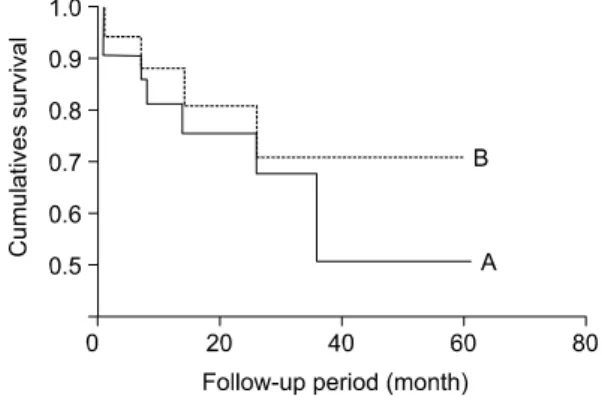
전체 사망 환자를 포함하여 산출한 생존율은 1년 생존율 81.0%, 3년 생존율 67.7.%, 그리고 5년 생존 율 50.1%이었고 중간 생존기간은 3.0년이었다. 반면 감염성 원인으로 사망한 환자를 제외하고 폐동맥 고 혈압과 관련된 사망 환자만을 포함하여 산출한 생존 율은 1년 생존율 88.2%, 2년 생존율 80.8%, 그리고 3년 생존율 70.1%로 조사되었다(그림 1).
5. 사망과 관련된 예후인자
폐동맥 고혈압을 진단받고 사망한 환자군과 생존 한 환자군 간에 폐동맥 고혈압 진단 당시의 연령, SLE 이환기간, 임상양상, NYHA functional class, 검 사실 소견 및 폐기능 검사소견은 유의한 차이를 보 이지 않았다. 하지만 폐동맥 고혈압 진단 당시의 SLEDAI와 damage index (SLICC/ACR)는 생존한 환 자군에 비하여 사망한 환자군에서 유의하게 높았다 (각각 p<0.05) (표 2). 생존한 환자 중 추적 심초음 Fig. 1. Survival curves of SLE patients with pulmo-
nary hypertension (PH). A. Black curve shows the overall survival rate, which estimated 81.0% at first year, 67.7% at third year, and 50.1% at third year. B. Spotted curve shows the survival rate estimated after excluding the deaths that were not caused by PH, which estimated 88.2% at first year, 80.1% at sec- ond year, and 70.1% at third year.
Table 2. Comparison of variables between those who survived and those who deceased at diagnosis of pulmonary hypertension
ꠧꠧꠧꠧꠧꠧꠧꠧꠧꠧꠧꠧꠧꠧꠧꠧꠧꠧꠧꠧꠧꠧꠧꠧꠧꠧꠧꠧꠧꠧꠧꠧꠧꠧꠧꠧꠧꠧꠧꠧꠧꠧꠧꠧꠧꠧꠧꠧꠧꠧꠧꠧꠧꠧꠧꠧꠧꠧꠧꠧꠧꠧꠧꠧꠧꠧꠧꠧꠧꠧꠧꠧꠧꠧꠧꠧꠧꠧꠧꠧꠧꠧꠧꠧꠧꠧꠧꠧꠧꠧꠧꠧꠧꠧꠧꠧꠧꠧꠧꠧ
Variables Survivors (n=13) Deceased (n=8) p value*
ꠏꠏꠏꠏꠏꠏꠏꠏꠏꠏꠏꠏꠏꠏꠏꠏꠏꠏꠏꠏꠏꠏꠏꠏꠏꠏꠏꠏꠏꠏꠏꠏꠏꠏꠏꠏꠏꠏꠏꠏꠏꠏꠏꠏꠏꠏꠏꠏꠏꠏꠏꠏꠏꠏꠏꠏꠏꠏꠏꠏꠏꠏꠏꠏꠏꠏꠏꠏꠏꠏꠏꠏꠏꠏꠏꠏꠏꠏꠏꠏꠏꠏꠏꠏꠏꠏꠏꠏꠏꠏꠏꠏꠏꠏꠏꠏꠏꠏꠏꠏ Age at diagnosis of PH, year (mean±SD) 31.8±8.8 35.3±9.1 NS
Duration of SLE, year (mean±SD) 4.2±5.2 2.2±3.6 NS
NYHA functional class (mean±SD) 1.8±0.4 2.4±1.1 NS
SLEDAI (mean±SD) 9.8±5.9 27.1±13.1 <0.01
Damage index (SLICC/ACR) (mean±SD) 2.7±1.4 5.4±2.9 0.02 Positive pulmonary thromboembolism, n (%) 1/13 (12.5%) 3/8 (23.1%) NS Abnormal pulmonary function test, n (%) 3/11 (27.3%) 3/6 (50.0%) NS Laboratory findings
Positive lupus anticoagulant, n (%) 4/9 (44.4%) 1/7 (14.3%) NS Positive anticardiolipin antibody IgM, n (%) 3/9 (33.3%) 1/7 (14.3%) NS Positive anticardiolipin antibody IgG, n (%) 2/9 (22.2%) 4/7 (57.1%) NS Therapeutic agents
High-dose glucocorticoid therapy, n (%) 10/12 (83.3%) 3/8 (37.5%) NS Dose of daily glucocorticoid, mg (mean±SD) 22.0±15.3 38.1±18.9 NS Glucocorticoid pulse therapy, n (%) 3/12 (25.0%) 3/8 (37.5%) NS Cyclophosphamide pulse therapy, n (%) 1/13 (7.7%) 1/8 (12.5%) NS Calcium-channel antagonist, n (%) 6/13 (46.3%) 2/8 (25.0%) NS Prostacyclin analogue, n (%) 1/13 (7.7%) 0 (0%) NS Anticoagulant, n (%) 3/13 (23.1%) 2/8 (25.0%) NS
RVSP, mmHg (mean±SD) 57.1±16.0 58.9±13.2 NS
ꠏꠏꠏꠏꠏꠏꠏꠏꠏꠏꠏꠏꠏꠏꠏꠏꠏꠏꠏꠏꠏꠏꠏꠏꠏꠏꠏꠏꠏꠏꠏꠏꠏꠏꠏꠏꠏꠏꠏꠏꠏꠏꠏꠏꠏꠏꠏꠏꠏꠏꠏꠏꠏꠏꠏꠏꠏꠏꠏꠏꠏꠏꠏꠏꠏꠏꠏꠏꠏꠏꠏꠏꠏꠏꠏꠏꠏꠏꠏꠏꠏꠏꠏꠏꠏꠏꠏꠏꠏꠏꠏꠏꠏꠏꠏꠏꠏꠏꠏꠏ
*: calculated by Mann-Whitney test or Chi-square test, NS: not significant, PH: pulmonary hypertension, SLE: systemic lupus erythematosus, NYHA: New York Heart Association, SLEDAI: SLE disease activity index, SLICC/ ACR: Systemic Lupus International Collaborating Clinics/American College of Rheumatology, RVSP: right ventricular systolic pressure
파 검사를 시행한 6명의 환자에서 추적 우심실압이 증가한 경우는 1명, 감소한 경우는 5명이었고 사망 한 환자 중 추적 심초음파 검사를 시행한 5명의 환 자에서 추적 우심실압이 증가한 경우는 2명, 감소한 경우는 2명, 그리고 나머지 1명에서는 변화가 없었 다. 추적 우심실압의 증가 혹은 감소 여부는 사망한 환자군과 생존한 환자군 간에 유의한 차이를 보이지 않았으나 폐동맥 고혈압 진단 당시의 우심실압과 추 적 시행한 심초음파상의 우심실압 간의 증가 혹은 감소 정도는 사망한 환자군에 비하여 생존한 환자군 에서 유의하게 감소되는 것으로 조사되었다(p<0.05) (표 3). 사망과 관련된 위험인자를 알아보기 위해 시 행한 로지스틱 회귀분석 결과, 폐동맥 고혈압 진단 당시의 SLEDAI (b=0.37, SE=0.11, p<0.01)와 damage index (SLICC/ACR) (b=0.69, SE=0.29, p=0.02)가 독립 적인 위험인자로 조사되었다.
고 찰
결체조직 질환을 가진 환자에 있어서 폐동맥 고혈 압이 동반되는 경우가 보고되고 있으며 특히, 전신 성 경화증이나 혼합 결체조직 질환을 가진 경우에 흔히 동반되어 전신성 경화증의 경우 33∼50%에서, 혼합형 결체조직 질환의 경우 25∼85%에서 폐동맥 고혈압이 동반되는 것으로 보고되었으며, 이러한 질 환에서 폐동맥 고혈압이 동반될 경우 그 예후가 불 량하며 폐동맥 고혈압 자체가 중요한 사망원인이 되 는 것으로 알려져 있다5-7). SLE 환자에서도 폐동맥 고혈압이 동반될 수 있으며, 이전에는 그 유병률이 0.3%로 매우 드문 것으로 알려져 있었으나15) 이후의
보고들에 의하면, SLE 환자의 4∼15%에서 폐동맥 고혈압이 동반되는 것으로 보고되어 비교적 드물지 않은 유병률을 보이고 있다16,17). 본 연구에서도 심초 음파 검사를 시행받은 292명의 환자 중 21명(7.2%) 에서 폐동맥 고혈압을 진단받아 이전의 보고와 유사 한 유병률을 보인다. 하지만 심초음파 검사를 시행 받은 SLE 환자만을 대상으로 후향적으로 조사한 것 이므로 이를 SLE와 동반된 폐동맥 고혈압의 유병률 이라 보기는 힘들 것으로 생각된다. 본 연구에서 SLE 환자들이 호소한 폐동맥 고혈압과 관련된 증상 및 폐기능 검사 결과는 SLE와 동반되지 않은 원발 성 폐동맥 고혈압 환자들에서의 결과1,3)와 유사하였 다. SLE 환자들에서 항인지질 항체의 양성률을 조사 한 이전의 보고들에 의하면, 연구집단에 따라 양성 률이 차이를 보이기는 하나 lupus anticoagulant의 양 성률은 15∼18%18,19), 항cardiolipin 항체 IgM와 IgG의 양성률은 각각 13∼19%와 22∼24%18,20,21)로 보고되 었다. 본 연구에서 항인지질 항체의 양성률은 lupus anticoagulant는 31.3%, 항cardiolipin 항체 IgM과 IgG 는 각각 25.0%와 37.5%로 조사되어 일반적으로 알 려진 SLE 환자에서의 항인지질 항체 양성률18-21)에 비하여 비교적 높은 양성률을 보였다. 이전의 보고 에 의하면, 폐혈관의 수축8), 혈관염22,23)과 더불어, 혈 전증 및 색전증이 SLE와 동반되는 폐동맥 고혈압의 병인에 관여하는 것으로 보고되었으며17,18) 특히, 항 β2-glycoprotein I 항체, 항cardiolipin 항체와 lupus anticoagulant가 양성인 환자에서 폐동맥 혈전증이 동 반되어 폐동맥 고혈압이 유발될 수 있는 것으로 알 려져 있다9,10,24). 본 연구에서 폐동맥 고혈압으로 진 단된 SLE 환자에서의 항인지질 항체 양성률이 일반 Table 3. Comparison of echocardiographic findings between the survivors and the deceased, in patients with
pulmonary hypertension in whom follow-up echocardiography was performed
ꠧꠧꠧꠧꠧꠧꠧꠧꠧꠧꠧꠧꠧꠧꠧꠧꠧꠧꠧꠧꠧꠧꠧꠧꠧꠧꠧꠧꠧꠧꠧꠧꠧꠧꠧꠧꠧꠧꠧꠧꠧꠧꠧꠧꠧꠧꠧꠧꠧꠧꠧꠧꠧꠧꠧꠧꠧꠧꠧꠧꠧꠧꠧꠧꠧꠧꠧꠧꠧꠧꠧꠧꠧꠧꠧꠧꠧꠧꠧꠧꠧꠧꠧꠧꠧꠧꠧꠧꠧꠧꠧꠧꠧꠧꠧꠧꠧꠧꠧꠧ
Echocardiographic findings Survivors (n=6) Deceased (n=5) p value*
ꠏꠏꠏꠏꠏꠏꠏꠏꠏꠏꠏꠏꠏꠏꠏꠏꠏꠏꠏꠏꠏꠏꠏꠏꠏꠏꠏꠏꠏꠏꠏꠏꠏꠏꠏꠏꠏꠏꠏꠏꠏꠏꠏꠏꠏꠏꠏꠏꠏꠏꠏꠏꠏꠏꠏꠏꠏꠏꠏꠏꠏꠏꠏꠏꠏꠏꠏꠏꠏꠏꠏꠏꠏꠏꠏꠏꠏꠏꠏꠏꠏꠏꠏꠏꠏꠏꠏꠏꠏꠏꠏꠏꠏꠏꠏꠏꠏꠏꠏꠏ Follow-up RVSP, mmHg (mean±SD) 53.7±17.7 63.0±25.6 NS
Δ RVSP, mmHg (mean±SD) -12.0±11.2 10.7±22.0 0.045
Increased RVSP on follow-up (n) 1/6 (16.7%) 2/5 (40%) NS Decreased RVSP on follow-up (n) 5/6 (83.3%) 2/5 (40%) NS Unchanged RVSP on follow-up (n) 0/6 (0%) 1/5 (20%) NS ꠏꠏꠏꠏꠏꠏꠏꠏꠏꠏꠏꠏꠏꠏꠏꠏꠏꠏꠏꠏꠏꠏꠏꠏꠏꠏꠏꠏꠏꠏꠏꠏꠏꠏꠏꠏꠏꠏꠏꠏꠏꠏꠏꠏꠏꠏꠏꠏꠏꠏꠏꠏꠏꠏꠏꠏꠏꠏꠏꠏꠏꠏꠏꠏꠏꠏꠏꠏꠏꠏꠏꠏꠏꠏꠏꠏꠏꠏꠏꠏꠏꠏꠏꠏꠏꠏꠏꠏꠏꠏꠏꠏꠏꠏꠏꠏꠏꠏꠏꠏ
*: calculated by Mann-Whitney test or Chi-square test, NS: not significant, Δ: indicates the difference of variables between initial measurement and follow-up measurement, RVSP: right ventricular systolic pressure
적인 SLE 환자에서의 양성률보다 비교적 높고 항인 지질 항체 양성을 보인 환자의 75%에서 폐동맥 색 전증이 동반되어 있는 것으로 진단되어 항인지질 항 체와 이로 인한 폐동맥 색전증이 SLE에 동반되는 폐동맥 고혈압의 중요한 원인이 될 가능성이 있을 것이라 생각된다.
본 연구에서 조사된 폐동맥 고혈압 환자의 전체 사망률은 38%이었다. 세균감염과 패혈증에 의한 사 망을 제외한, 폐동맥 고혈압과 직접적으로 연관된 사망률은 19%였으며 이들의 주된 사망원인은 심부 전과 부정맥으로 인한 급성 심정지로 조사되었으며 이는 이전에 보고된 SLE와 동반되지 않은 원발성 폐동맥 고혈압 환자의 사망원인1,3)과 동일하였다. 또 한 본 연구에서는 폐동맥 고혈압이 동반된 SLE 환 자들의 중간 생존기간은 3.0년이었으며 이는 SLE와 동반되지 않은 원발성 폐동맥 고혈압 환자의 중간 생존기간으로 보고된 2.8년1)과 비슷하였으나 SLE와 동반된 폐동맥 고혈압 환자의 중간 생존기간이 대부 분 2.0년 미만으로 보고8-11)된 것에 비하면 본 연구 의 중간 생존기간이 다소 긴 것으로 조사되었다. 하 지만 일반적인 SLE 환자에서 2년 생존율 90∼95%, 5년 생존율 82∼90%, 그리고 10년 생존율이 71∼
80%로 보고된 것에 비해25,26) 본 연구에서 조사된 폐 동맥 고혈압이 동반된 SLE 환자의 생존율이 훨씬 낮은 것으로 나타나 SLE 환자에서 폐동맥 고혈압이 동반될 경우 이는 매우 불량한 예후를 나타내는 것 으로 생각된다.
SLE 환자에서 폐동맥 고혈압이 동반된 경우, 사망 과 관련된 위험인자에 대해서는 아직 정확히 알려져 있지 않다. 본 연구에서는 생존한 환자군에 비하여 사망한 환자군에서 폐동맥 고혈압 진단 당시의 SLEDAI와 damage index (SLICC/ACR)가 유의하게 높았으며 사망과 관련된 독립적인 위험인자를 알아 보기 위해 시행한 로지스틱 회귀분석 결과에서도 폐 동맥 고혈압 진단 당시의 SLEDAI와 damage index (SLICC/ACR)가 유의한 위험인자로 나타났다. 또한 추적 시행한 심초음파 검사상 수축기 우심실압이 감 소한 환자의 수는 두 군 간에 유의한 차이를 보이지 않았으나 수축기 우심실압의 감소 정도는 사망한 환 자군에 비하여 생존한 환자군에서 유의하게 큰 것으 로 조사되었다.
기존에 폐동맥 고혈압의 치료로는 칼슘 통로 길항 제 등의 혈관 확장제나 와파린(Warfarin) 등의 항응 고제가 주로 사용되었으나 최근 프로스타사이클린제 (prostacyclin analogue)나 endothelin 길항제가 폐동맥 고혈압의 치료로 사용되고 있으며 이러한 치료가 폐 동맥 고혈압의 예후를 향상시키는 것으로 보고되었
다27-29). SLE 환자에서도 폐동맥 고혈압의 치료로 이
러한 약제들이 효과적으로 사용될 수 있음이 보고되
었으며30,31) 이 외에도 스테로이드 충격요법이나 사
이클로포스파마이드 등의 면역억제 치료가 예후를 향상시킬 수 있는 것으로 보고되었다32,33). 하지만 본 연구에서는 혈관 확장제, 항응고제 및 면역억제 치 료 여부는 SLE 환자의 생존 여부와 유의한 연관성 을 보이지 않았는데, 특히 고용량 스테로이드 치료 와 면역억제제의 투여는 폐동맥 고혈압보다는 루푸 스의 활성화나 루푸스 신염의 치료를 위해 투여된 것이 대부분이었으므로 이러한 치료가 폐동맥 고혈 압의 예후와 연관되는지를 판단하기에는 한계가 있 었다.
이상의 결과로 볼 때, SLE에 병발한 이차성 폐동 맥 고혈압의 임상양상과 사망원인은 일반적으로 알 려진 원발성 폐동맥 고혈압 환자들의 임상양상 및
사망원인1,3,4)과 유사한 것으로 관찰되지만, SLE와 동
반된 경우에는 항인지질 항체가 양성인 환자에서 폐 동맥 색전증과 동반되어 폐동맥 고혈압이 발생하는 경우가 많았으며 폐동맥 고혈압 진단 당시의 SLEDAI 와 damage index (SLICC/ACR)가 사망과 관련된 위 험인자들인 것을 알 수 있었다. 또한 SLE 환자에서 폐동맥 고혈압이 동반된 경우, 그 중간 생존기간은 이전에 알려진 보고들의 결과보다는 다소 양호하였 으나 그 생존율은 일반적인 SLE 환자의 생존율에 비하여 현저하게 낮은 것으로 조사되었다.
결 론
폐동맥 고혈압이 동반된 21명의 SLE 환자들의 임 상경과와 생존율을 분석한 결과, 그 예후가 이전의 보고보다는 다소 양호한 양상을 보이기는 하나 폐동 맥 고혈압 자체가 SLE 환자에 있어서 사망과 관련 된 중요한 위험인자가 될 것으로 생각된다. 그러므 로 SLE 환자에 있어서 심초음파 검사 등을 통하여
폐동맥 고혈압 여부를 확인하는 것이 환자의 예후 판정에 중요할 것으로 생각된다. 또한 SLEDAI와 damage index (SLICC/ACR)가 폐동맥 고혈압이 동반 된 SLE 환자의 사망과 연관되며 항인지질 항체와 연관된 폐동맥 고혈압의 발생이 흔한 것으로 조사되 어 SLE 환자에서 폐동맥 고혈압이 동반된 경우 이 에 대한 조사가 필요할 것으로 생각된다.
REFERENCES
1) Rich S, Dantzker DR, Ayres SM, Bergofsky EH, Brundage BH, Detre KM, et al. Primary pulmo- nary hypertension. A national prospective study.
Ann Intern Med 1987;107:216-23.
2) Himelman RB, Stulbarg M, Kircher B, Lee E, Kee L, Dean NC, et al. Noninvasive evaluation of pulmonary artery pressure during exercise by saline- enhanced doppler echocardiography in chronic pul- monary disease. Circulation 1989;79:863-71.
3) D'Alonzo GE, Barst RJ, Ayres SM, Bergofsky EH, Brundage BH, Detre KM, et al. Survival in patients with primary pulmonary hypertension. Re- sults from a national prospective registry. Ann Intern Med 1991;115:343-9.
4) Rich S, Brundage BH. Primary pulmonary hyper- tension. Current update. JAMA 1984;251:2252-4.
5) Ungerer RG, Tashkin DP, Furst D, Clements PJ, Gong H Jr, Bein M, et al. Prevalence and clinical correlates of pulmonary arterial hypertension in pro- gressive systemic sclerosis. Am J Med 1983;75:
65-74.
6) Sullivan WD, Hurst DJ, Harmon CE, Esther JH, Agia GA, Maltby JD, et al. A prospective evalu- ation emphasizing pulmonary involvement in pat- ients with mixed connective tissue disease. Med- icine (Baltimore) 1984;63:92-107.
7) Jones MB, Osterholm RK, Wilson RB, Martin FH, Commers JR, Bachmayer JD. Fatal pulmonary hypertension and resolving immune-complex glo- merulonephritis in mixed connective tissue disease.
A case report and review of the literature. Am J Med 1978;65:855-63.
8) Quismorio FP Jr, Sharma O, Koss M, Boylen T, Edmiston AW, Thornton PJ, et al. Immunopa- thologic and clinical studies in pulmonary hyper- tension associated with systemic lupus erythema- tosus. Semin Arthritis Rheum 1984;13:349-59.
9) Asherson RA, Higenbottam TW, Dinh Xuan AT, Khamashta MA, Hughes GR. Pulmonary hypertens- ion in a lupus clinic: experience with twenty-four patients. J Rheumatol 1990;17:1292-8.
10) Winslow TM, Ossipov MA, Fazio GP, Simonson JS, Redberg RF, Schiller NB. Five-year follow-up study of the prevalence and progression of pulmo- nary hypertension in systemic lupus erythematosus.
Am Heart J 1995;129:510-5.
11) Castleman B, Scully RE, McNeely BU. Case re- cords of the Massachusetts General Hospital. N Engl J Med 1973;289:1027-33.
12) Hochberg MC. Updating the American College of Rheumatology revised criteria for the classification of systemic lupus erythematosus [letter]. Arthritis Rheum 1997;40:1725.
13) Bombardier C, Gladman DD, Urowitz MB, Caron D, Chang CH. Derivation of the SLEDAI. A dis- ease activity index for lupus patients. The Com- mittee on Prongnosis Studies in SLE. Arthritis Rheum 1992;35:630-40.
14) Gladman D, Ginzler E, Goldsmith C, Fortin P, Liang M, Urowitz M, et al. The development and initial validation of the Systemic Lupus Interna- tional Collaborating Clinics/American College of Rheumatology Damage Index for Systemic Lupus Erythematosus. Arthritis Rheum 1996;39:363-9.
15) Simonson JS, Schiller NB, Petri M, Hellmann DB.
Pulmonary hypertension in systemic lupus ery- thematosus. J Rheumatol 1989;16:918-25.
16) Li EK, Tam LS. Pulmonary hypertension in sys- temic lupus erythematosus: clinical association and survival in 18 patients. J Rheumatol 1999;26:
1923-9.
17) Boey ML, Colaco CB, Gharavi AE, Elkon KB, Loizou S, Hughes GR. Thrombosis in systemic lupus erythematosus: striking association with the presence of circulating lupus anticoagulant. Br Med J 1983;287:1021-3.
18) Alarcon-Segovia D, Deleze M, Oria CV, Sanchez- Guerrero J, Gomez-Pacheco L, Cabiedes J, et al.
Antiphospholipid antibodies and the antiphosphol- ipid syndrome in systemic lupus erythematosus: a prospective analysis of 500 consecutive patients.
Medicine (Baltimore) 1989;68:353-65.
19) Mayumi T, Nagasawa K, Inoguchi T, Yamauchi Y, Ishii Y, Tada Y, et al. Haemostatic factors associated with vascular thrombosis in patients with systemic lupus erythematosus and the lupus
anticoagulant. Ann Rheum Dis 1991;50:543-7.
20) Buchanan RR, Wardlaw JR, Riglar AG, Littlejohn GO, Miller MH. Antiphospholipid antibodies in the connective tissue diseases: their relation to the antiphospholipid syndrome and Forme Fruste Dis- ease. J Rheumatol 1989;16:757-61.
21) Cervera R, Khamashta MA, Font J, Sebastiani GD, Gil A, Lavilla P, et al. Systemic lupus erythema- tosus: clinical and immunologic patterns of disease expression in a cohort of 1,000 patients. Medicine (Baltimore) 1993;72:113-24.
22) Turner A, Samanta A, Nichol FE. Primary pulmo- nary hypertension associated with systemic lupus erythematosus. Clin Rheumatol 1991;10:320-2.
23) Asherson RA, Oakley CM. Pulmonary hypertension and systemic lupus erythematosus. J Rheumatol 1986;13:1-5.
24) Martinuzzo ME, Pombo G, Forastiero RR, Cerrato GS, Colorio CC, Carreras LO. Lupus anticoagul- ant, high levels of anticardiolipin, and anti-b2-gly- coprotein I antibodies are associated with chronic thromboembolic pulmonary hypertension. J Rheu- matol 1998;25:1313-9.
25) Ward MM, Pyun E, Studenski S. Long-term sur- vival in systemic lupus erythematosus. Patient characteristics associated with poorer outcomes.
Arthritis Rheum 1995;38:274-83.
26) Uramoto CM, Michet CJ, Thumboo J, Sunku J, O’fallon WM, Gabriel SE. Trends in the incidence and mortality of systemic lupus erythematosus, 1950-1992. Arthritis Rheum 1999;42:46-50.
27) Barst RJ, Rubin LJ, Long WA, McGoon MD,
Rich S, Badesch DB, et al. A comparison of continuous intravenous epoprostenol (prostacyclin) with conventional therapy for primary pulmonary hypertension. The Primary Pulmonary Hypertension Study Group. N Engl J Med 1996;334:296-302.
28) Hoeper MM, Schwarze M, Ehlerding S, Adler- Schuermeyer A, Spiekerkoetter E, Niedermeyer J, et al. Long-term treatment of primary pulmonary hypertension with aerosolized Iloprost, a prosta- cyclin analogue. N Engl J Med 2000;342:1866-70.
29) Rubin LJ, Badesch DB, Barst RJ, Galie N, Black CM, Keogh A, et al. Bosentan Therapy for Pul- monary Arterial Hypertension. N Engl J Med 2002;346:896-903.
30) Mok MY, Tse HF, Lau CS. Pulmonary hyper- tension secondary to systemic lupus erythematosus:
prolonged survival following treatment with inter- mittent low dose iloprost. Lupus 1999;8:328-31.
31) Robbins IM, Gaine SP, Schilz R, Tapson VF, Rubin LJ, Loyd JE. Epoprostenol for treatment of pulmonary hypertension in patients with systemic lupus erythematosus. Chest 2000;117:14-8.
32) Groen H, Bootsma H, Postma DS, Kallenberg CG.
Primary pulmonary hypertension in a patient with systemic lupus erythematosus: partial improvement with cyclophosphamide. J Rheumatol 1993;20:1055-7.
33) Tanaka E, Harigai M, Tanaka M, Kawaguchi Y, Hara M, Kamatani N. Pulmonary hypertension in systemic lupus erythematosus: evaluation of clinical characteristics and response to immunosuppressive treatment. J Rheumatol 2002;29:282-7.