377
Open Access
Prognostic Value of Initial Echocardiographic Features in Patients With Tuberculous Pericarditis
Hyung Oh Choi, MD
1, Jong-Min Song, MD
1, Tae Sun Shim, MD
2, Sang-Hyun Kim, MD
1, In-Hyun Jung, MD
1, Duk-Hyun Kang, MD
1and Jae-Kwan Song MD
11
Division of Cardiology and
2Pulmonary and Critical Care Medicine, Asan Medical Center, University of Ulsan College of Medicine, Seoul, Korea ABSTRACT
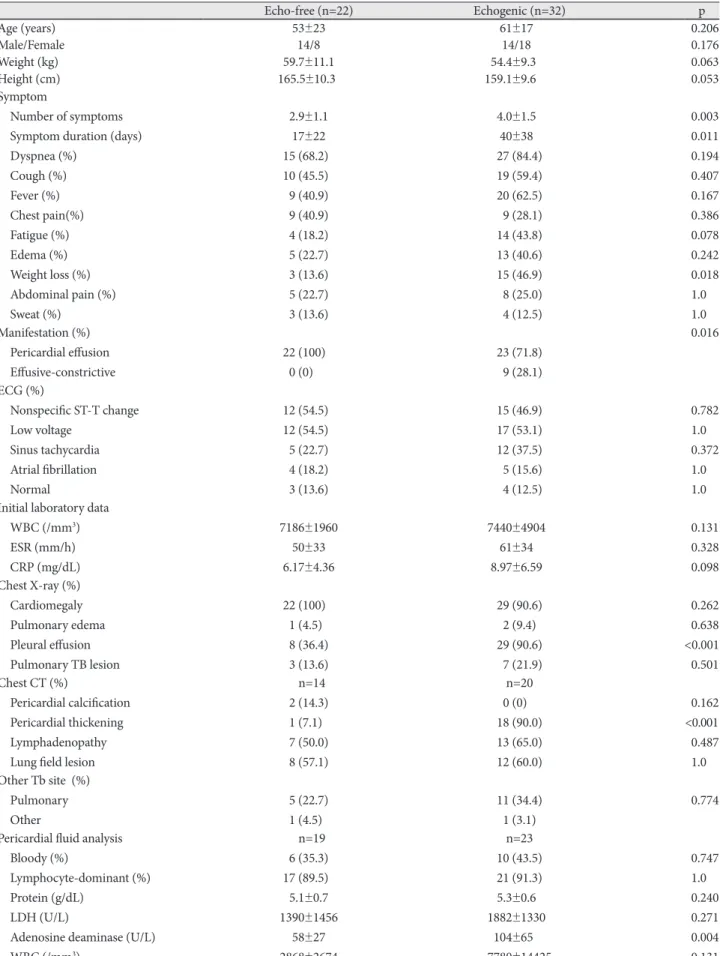
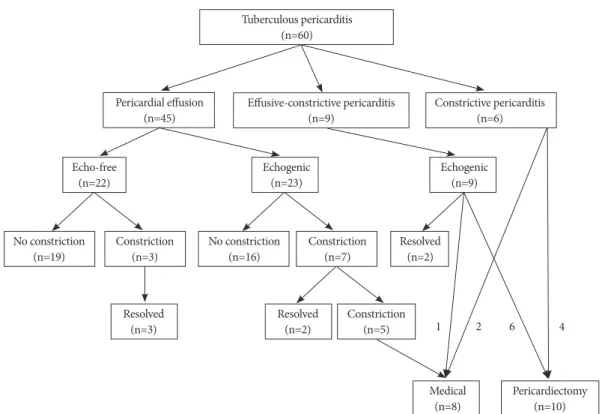
Background and Objectives: Tuberculous (TB) pericarditis is a major cause of constrictive pericarditis requiring pericar- diectomy. We sought to determine initial prognostic factors in patients with TB pericarditis. Subjects and Methods: We evaluated initial presentation and clinical outcomes (mean follow-up 32 ± 27 months) in 60 consecutive patients newly diag- nosed with TB pericarditis. Results: Initial presentations were pericardial effusion (PE), effusive-constrictive pericarditis, and constrictive pericarditis in 45 (75%), 9 (15%), and 6 (10%) patients, respectively. Of the 54 patients without initial constric- tive pericarditis, 32 (59%) showed echogenic materials in PE, including frond-like exudative coating and fibrinous strands.
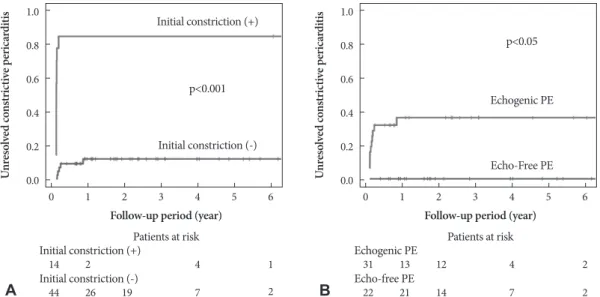
These patients had a longer disease duration before diagnosis, were initially more symptomatic, in a more advanced state, showed more persistent pericardial constrictions (38% vs. 0%, p<0.001) despite anti-TB medications, and tended to require pericardiectomy more often (19% vs. 0%, p=0.07, p<0.05 by Kaplan-Meier). All patients with effusive-constrictive pericardi- tis showed echogenic PE. Of the 60 total patients, 10 (17%) underwent pericardiectomies during follow-up. All of these pa- tients showed initial pericardial constrictions, whereas no patient without initial pericardial constriction underwent pericar- diectomy (p<0.001). Seven patients showed transient pericardial constrictions that resolved without pericardiectomy.
Conclusion: Initial pericardial constriction and echogenic PE are poor prognostic signs for persistent pericardial constric- tion and pericardiectomy in patients with newly diagnosed TB pericarditis. These results suggest that early diagnosis and prompt anti-TB medication may be critical. (Korean Circ J 2010;40:377-386)
KEY WORDS: Pericarditis; Tuberculosis; Echocardiography; Prognosis.
Received: December 16, 2009 Accepted: March 2, 2010
Correspondence: Jong-Min Song, MD, Division of Cardiology, Asan Medical Center, University of Ulsan College of Medicine, 86 Asanbyeong- won-gil, Songpa-gu, Seoul 138-736, Korea
Tel: 82-2-3010-3168, Fax: 82-2-486-5918 E-mail: [email protected]
cc