D I A B E T E S & M E T A B O L I S M J O U R N A L
This is an Open Access article distributed under the terms of the Creative Commons At- tribution Non-Commercial License (http://creativecommons.org/licenses/by-nc/3.0/) which permits unrestricted non-commercial use, distribution, and reproduction in any medium, provided the original work is properly cited.
Diabetes Metab J 2015;39:512-517
Non-Association between rs7903146 and rs12255372 Polymorphisms in Transcription Factor 7-Like 2 Gene and Type 2 Diabetes Mellitus in Jahrom City, Iran
Mohammad Pourahmadi1,2, Saiedeh Erfanian2, Malihe Moradzadeh3, Abdolreza Sotoodeh Jahromi2
1Department of Anatomy, 2Research Center for Non-Communicable Diseases, Jahrom University of Medical Sciences, Jahrom,
3Department of New Sciences and Technology, Mashhad University of Medical Sciences, Mashhad, Iran
Background: Transcription factor 7-like 2 (TCF7L2) is a transcription factor in the Wnt signaling pathway. High levels of TC- F7L2 have been reported in most human tissues, including the heart, lung, brain, liver, kidney, placenta, adipose tissues, and pancreatic β-cells. The purpose of this study was to assess the association between TCF7L2 polymorphisms (rs12255372 and rs7903146) and type 2 diabetes mellitus in the city of Jahrom, Iran.
Methods: This case-control study was conducted with 200 patients referred to Diabetes Clinics and 200 healthy subjects in Jah- rom City. Biochemical characteristics were first determined. TCF7L2 rs1255372 and rs7903146 polymorphisms were then geno- typed using the polymerase chain reaction-restriction fragment length polymorphism method.
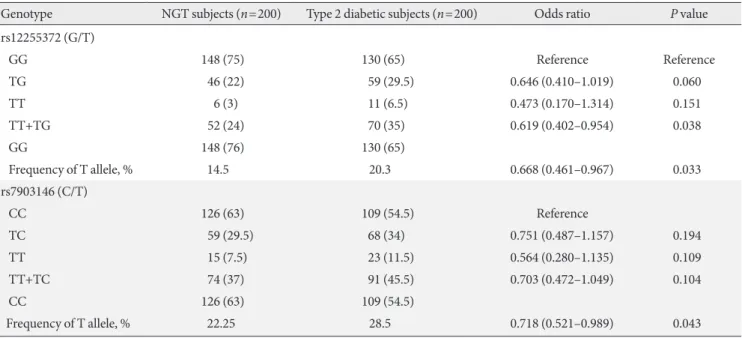
Results: T-allele frequencies of both single nucleotide polymorphisms (SNPs) were significantly higher in diabetic patients than in normal glucose-tolerant subjects (rs12255372: 20.3% vs. 14.5%; rs7903146: 28.5% vs. 22.25%). The rs12255372 (G/T) poly- morphism analysis showed an odds ratio of 0.473 (95% confidence interval [CI], 0.170 to 1.314; P=0.151) for the TT genotype and 0.646 (95% CI, 0.410 to 1.019; P=0.060) for the TG genotype, compared with the GG genotype. The rs7903146 (C/T) poly- morphism odds ratios for TT and TC genotypes were 0.564 (95% CI, 0.280 to 1.135; P=0.109) and 0.751 (95% CI, 0.487 to 1.157;
P=0.194) compared with the CC genotype, respectively.
Conclusion: The rs12255372 and rs7903146 SNPs of the TCF7L2 gene were not associated with insulin resistance in the evaluat- ed population.
Keywords: Diabetes mellitus, type 2; Polymorphisms; rs12255372; rs7903146; TCF7L gene
Corresponding author: Saeideh Erfanian
Research Center for Non-Communicable Diseases, Jahrom University of Medical Sciences, Motahari Avenue, Jahrom, Iran
E-mail: [email protected]
INTRODUCTION
Diabetes mellitus is a worldwide public health concern. This condition causes increased blood glucose level, lipid, carbohy- drate, protein metabolism disturbance, and absolute or relative insulin deficiency. Type 2 diabetes mellitus (T2DM) is the most common metabolic disease in which genetic and envi- ronmental factors contribute to its development. In fact, this condition is the final stage of a chronic and progressive disor- der resulting from insulin resistance, decreased pancreatic
β-cell function, and increased glucose production by the liver.
T2DM is currently diagnosed as a blood glucose level rate higher than normal or clinical manifestation of diabetes symp- toms [1]. Studies have shown that insulin resistance develops a decade before T2DM clinically manifests [2]. Insulin resis- tance is a pathological condition in which the target cells, par- ticularly muscle cells and adipose tissues, decrease their insu- lin response. Pancreatic β-cells increase insulin secretion to maintain glucose homeostasis [3].
Excess insulin secretion from pancreatic cells can control http://dx.doi.org/10.4093/dmj.2015.39.6.512
pISSN 2233-6079 · eISSN 2233-6087
blood glucose in the early stages of T2DM. However, compen- satory insulin is not enough to control the blood glucose level.
Over time, patients show impaired glucose tolerance (IGT) and finally present with T2DM and β-cell deficiency [4]. All types of diabetes with IGT are insulin resistant. Insulin resis- tance is involved in pathogenic disorders, such as hyperten- sion, dyslipidemia, T2DM, obesity, fatty liver disease, and car- diac diseases. These disorders combine to comprise metabolic syndromes (insulin-resistance syndromes) [5].
T2DM is a multifactorial, polygenic disease. Diverse genetic loci are involved in the susceptibility to this disease. Environ- mental factors, such as nutrition and physical activity, are also responsible for the T2DM phenotype [6,7]. Simultaneous T2DM incidence in identical twins is estimated to be 70% to 90% [8,9]. A higher risk of diabetes in infants is present if ei- ther parent suffers from T2DM. The risk increases to 40% in children if both parents are affected [10]. Insulin resistance appears by reduced glucose utilization in skeletal muscles. This condition is present in many non-diabetic, first-degree rela- tives of patients with T2DM [11].
Detection of genetic susceptibility to T2DM can be effective for prevention. Several genes are involved in the physiopathol- ogy of T2DM. Grant et al. [11] found that gene variants of tran- scription factor 7-like 2 (TCF7L2) showed strong associations with the risk of T2DM (combined odds ratio, 1.56; P=4.7) in subjects from Iceland, Denmark, and the United States.
The TCF7L2 gene has been shown to be the most important gene for diabetes susceptibility in European populations. In fact, each copy of the allele in the diabetes susceptibility gene increases the risk of diabetes 1.4- to 1.5-fold. The encoded TC- F7L2 gene is a transcription factor and member of the Wnt signaling pathway [12]. High levels of this transcription factor have been reported in most human tissues, including the heart, lung, brain, liver, kidney, placenta, adipose tissues, and pancre- atic β-cells [13].
Lyssenko et al. [14] found that single nucleotide polymor- phisms (SNPs) rs12255372 and rs7903146 in TCF7L2 have strong associations with T2DM risk. Risk alleles of these genes are associated with dysfunction in pancreatic β-cells in all sub- jects [11]. The aim of this study was to evaluate the prevalence of SNPs and their relationship with the incidence of T2DM in the Iranian city of Jahrom. Findings were presented to health administrators and university authorities to help prevent T2DM as efficiently as possible.
METHODS
Patient characteristics
The number of participants selected for this cross-sectional study was determined using statistical methods. All subjects were selected using convenience sampling. The study group comprised 200 diabetic patients who were referred to clinics in Jahrom. The control population comprised 200 healthy in- dividuals. All participants resided in the Persian-speaking re- gion of Jahrom. Population demographics are highly homoge- nous in this area, and subjects in this study included just one ethnic group.
Age, sex, high density lipoprotein (HDL) level, low density lipoprotein (LDL) level, cholesterol, and fasting blood sugar (FBS) were measured and recorded in a questionnaire. A 5 mL blood sample was then collected in ethylenediaminetetraace- tic acid tubes and stored at –20°C for DNA extraction.
Biochemical analysis
Height and weight were measured to calculate body mass in- dex (BMI). Blood samples were obtained after 12 hours of fasting. FBS and standard oral glucose tolerance tests were performed to diagnose T2DM.
Serum levels of HDL-cholesterol, total cholesterol (TC), and triglyceride (TG) were determined by standard methods and commercial kits (Pars Azmon, Tehran, Iran). LDL-choles- terol was calculated based on the Friedewald formula.
After 12 hours of fasting, 5 mL of venous blood was drawn from each of the subjects. Half of the blood sample was used for biochemical evaluation, and the other half for DNA extrac- tion. DNA was extracted from nucleated blood cells, accord- ing to the DNA extraction kit (Sinagen Co., Tehran, Iran).
DNA was quantified spectrophotometrically prior to being used in the polymerase chain reaction (PCR).
PCR was performed in PCR premix pipes, manufactured by Bioneer Co. (Daejeon, Korea). The reaction contained MgCl2
solution 1.5 μM, dNTP each 250 μM, and 0.2 μL (1 unit) Taq polymerase enzyme, DNA template 2.5 μL, 10 pmol primers each, and sterile water to 20 μL total reaction volume.
PCR was performed using a thermal cycler (Eppendorf, Hamburg, Germany). PCR cycling conditions included initial denaturation at 95°C for 5 minutes, 35 cycles of denaturation at 95°C for 30 seconds, annealing at 59°C for 45 seconds, rs7903146 and rs1255372 polymorphisms at 55°C for 40 sec- onds, extension at 72°C for 30 seconds, and final extension at
72°C for 5 minutes. Oligonucleotide primers were ordered from the Bioneer Co., based on the GenBank sequence data- base (National Centre for Biotechnology Information). Se- quence of TCF7L2 gene containing two polymorphisms were investigated, using PCR amplification with specific primers rs7903146 (C/T) F :5ʹ-AAGAGAAGATTCCTT TTTAAATG- GTG-3, R: 5ʹ-CCTCATACGGCAATTAAATTATACA-3ʹ and rs12255372 (G/T) polymorphism F: 5′-CTGGAAACTAAGG CGTGAGG-3ʹ, R: 5ʹ-GGGTCGATGTTGTTGAGCTT-3ʹ F:
5ʹ_GGTGGACTTGACTTTACTGG-3ʹ, and R: 5ʹ_TAGAAGC AGCCTGGAGAA-3ʹ was used. The final PCR product was analyzed on 2% agarose gel stained with ethidium bromide. To detect the rs7903146 (C/T) polymorphism, HpyCH4III re- striction enzyme was used. SNP rs12255372 (G/T) could also be detected by Tsp509I restriction enzymes. In the presence of polymorphisms in 1 and 2 amplicons, the sequence of enzyme cutting sites could not be detected by restriction enzymes.
Thus, a single band as large as the target amplicon existed in the presence of polymorphisms. A lack of polymorphism could be detected with more bands of specific weights.
PCR products were incubated for 24 hours at 37°C. Those with the allele-A of rs1255372 polymorphism were cut. Three bands of 143, 104, and 99 bp appeared, and uncut products (346 bp fragment) remained intact. PCR products with the G-allele of rs7903146 polymorphism were cut and two bands with lengths of 50 and 100 bp emerged. The 136 bp fragment remained intact in the uncut product. Digested products were then observed on agarose gel stained with 2% ethidium bromide.
Statistical analysis
SPSS version 11.5 was used for statistical analysis (SPSS Inc., Chicago, IL, USA). Variances between continuous variables (such as age) in diabetic and control groups were analyzed.
The mean±standard error of age was shown. Relationships between different groups, genotypes, and TCF7L2 rs12255372 and rs7903146 polymorphism alleles were assessed by odds ratios with 95% confidence interval using a chi-square. P val- ues of less than 0.05 were considered statistically significant.
RESULTS
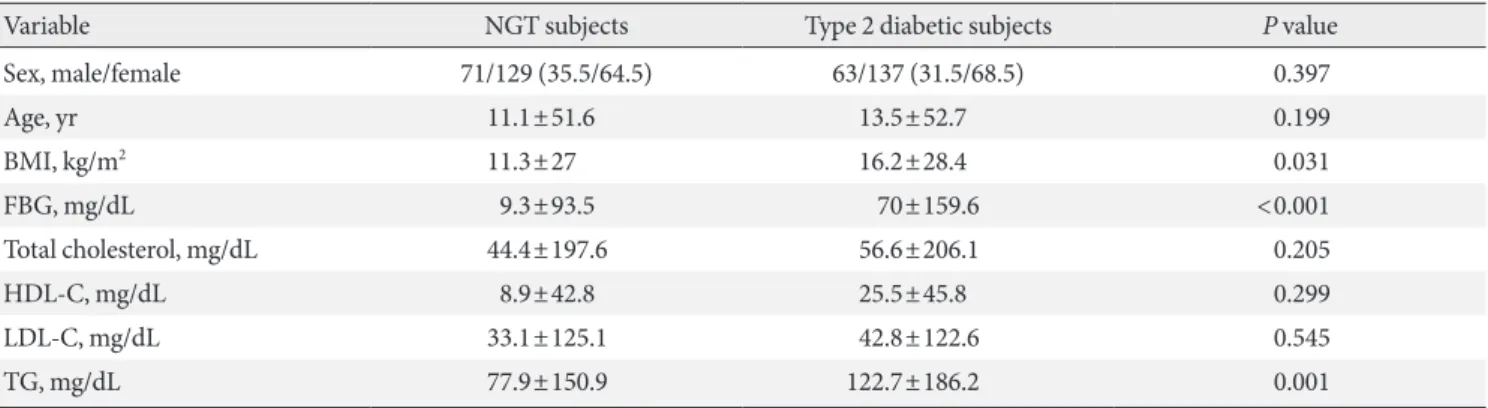
Overall, 200 patients with T2DM and 200 healthy subjects were studied to determine TCF7L2 gene rs12255372 and rs7903146 polymorphisms. Subjects ranged from 35 to 75 years of age. No significant differences in demographic characteristics were ob- served between patient and control groups. Table 1 shows de- mographic characteristics of the two groups. Males accounted for 35.5% (n=71) and 31.5% (n=63) of the control and patient groups, respectively. The difference between groups was not statistically significant (P=0.397). Diabetic patients were slightly older (52.7±13.5 vs. 51.6±11.1, P=0.199). Neither age nor BMI significantly differed between groups. Clinical data and participant baseline characteristics are shown in Table 1.
TT mutant genotype distributions for both analyzed SNPs (rs12255372 and rs7903146) did not significantly differ be- tween patients and controls (P≥0.05). T-allele frequency dis- tributions for both analyzed SNPs were significantly different (P≤0.05) (Table 2). Finally, the association between biochemi- cal parameters and TT+TG versus GG and TT+TC versus CC
Table 1. Clinical data of the study subjects
Variable NGT subjects Type 2 diabetic subjects P value
Sex, male/female 71/129 (35.5/64.5) 63/137 (31.5/68.5) 0.397
Age, yr 11.1±51.6 13.5±52.7 0.199
BMI, kg/m2 11.3±27 16.2±28.4 0.031
FBG, mg/dL 9.3±93.5 70±159.6 <0.001
Total cholesterol, mg/dL 44.4±197.6 56.6±206.1 0.205
HDL-C, mg/dL 8.9±42.8 25.5±45.8 0.299
LDL-C, mg/dL 33.1±125.1 42.8±122.6 0.545
TG, mg/dL 77.9±150.9 122.7±186.2 0.001
Values are presented as number (%) or mean±standard error.
NGT, normal glucose tolerance; BMI, body mass index; FBG, fasting blood glucose; HDL-C, high density lipoprotein cholesterol; LDL-C, low density lipoprotein cholesterol; TG, triglyceride.
genotypes was evaluated. Table 3 shows that total cholesterol in rs12255372 (G/T) and LDL in rs7903146 (C/T) were the only significant differences observed between biochemical variables and genotypes.
DISCUSSION
Recognizing genes potentially underlying T2DM is necessary for the initial prevention of the disease. Type 2 diabetes is a complex disorder resulting from an interaction between genes and the environment. Genetic variations can insert minor or major impacts on T2DM. Intronic TCF7L2 variants are asso-
ciated with T2DM. However, no specific mechanism exists demonstrating the relationship between T2DM and patho- genic genes. Although TCF7L2 has been extensively researched [11], little information about its biological role and susceptibil- ity to diabetes is available. A study on three TCF7L2 variants (rs7903146, rs12255372, and rs4506565) was performed in In- dia, and an association was detected between these three SNPs and T2DM [15].
These two SNPs have been shown to have strong correla- tions with T2DM in subjects from Iceland, Demark, and the United States [11]. A positive relationship between TCF7L2 variants and T2DM has also been demonstrated [16-19]. Four Table 2. Genotype frequencies of rs7903146 and rs12255372 polymorphisms in type 2 diabetic patients (n=200) and control subjects (n=200)
Genotype NGT subjects (n=200) Type 2 diabetic subjects (n=200) Odds ratio P value
rs12255372 (G/T)
GG 148 (75) 130 (65) Reference Reference
TG 46 (22) 59 (29.5) 0.646 (0.410–1.019) 0.060
TT 6 (3) 11 (6.5) 0.473 (0.170–1.314) 0.151
TT+TG 52 (24) 70 (35) 0.619 (0.402–0.954) 0.038
GG 148 (76) 130 (65)
Frequency of T allele, % 14.5 20.3 0.668 (0.461–0.967) 0.033
rs7903146 (C/T)
CC 126 (63) 109 (54.5) Reference
TC 59 (29.5) 68 (34) 0.751 (0.487–1.157) 0.194
TT 15 (7.5) 23 (11.5) 0.564 (0.280–1.135) 0.109
TT+TC 74 (37) 91 (45.5) 0.703 (0.472–1.049) 0.104
CC 126 (63) 109 (54.5)
Frequency of T allele, % 22.25 28.5 0.718 (0.521–0.989) 0.043
Values are presented as number (%).
NGT, normal glucose tolerance.
Table 3. Biochemical variables and genotypes
Variable rs12255372 (G/T) rs7903146 (C/T)
TT+TG GG P value TT+TC CC P value
BMI, kg/m2 28.5±1.9 27.3±0.59 0.478 27.7±0.9 27.7±0.9 0.991
Fasting glucose, mg/dL 129.4±5.5 125.3±3.6 0.536 120.6±3.9 131.1±4.2 0.086
Total cholesterol, mg/dL 212.2±4.7 197.4±2.9 0.008 194.1±4.0 204.2±3.2 0.050
HDL-C, mg/dL 46.3±1.2 43.4±1.3 0.175 45.4±2.7 44.2±0.7 0.611
LDL-C, mg/dL 128.2±3.4 121.9±2.3 0.138 117.2±2.9 126.1±2.5 0.021
TG, mg/dL 174.1±10.5 166.2±5.9 0.489 158.7±7.2 176.1±7.1 0.101
Values are presented as the mean±standard error.
BMI, body mass index; HDL-C, high density lipoprotein cholesterol; LDL-C, low density lipoprotein cholesterol; TG, triglyceride.
TCF7L2 genes (SNP rs11196205, rs7901695, rs12255372, and rs7903146) were investigated within a Japanese sample. A sig- nificant association was found between T2DM and these vari- ants. Of all SNPs, rs12255372 showed the strongest association [20].
Additionally, Cauchi et al. [21] found a significant correla- tion between the rs7903146 polymorphism of TCF7L2 gene and T2DM risk in Morocco. However, studies performed in China [22], India [23], and the United Arab Emirates [24]
found no significant association between this SNP in the TC- F7L2 gene and T2DM. The current study found that rs12255372 (G/T) and rs7903146 (C/T) are not associated with T2DM in the sample recruited from Jahrom city.
The prevalence of rs12255372 (G/T) and rs7903146 (C/T) polymorphisms in the TCF7L2 gene varies by ethnicity. This variation is due to environmental and genetics factors.
Discrepancies and similarities between the current findings and previous research, differences in the selection of patients and controls in various studies, and demographic factors like ethnicity, race, and diet warrant consideration. These polymor- phisms are not the only factors involved in diabetes occurrence.
CONFLICTS OF INTEREST
No potential conflict of interest relevant to this article was re- ported.
REFERENCES
1. Bloomgarden ZT. Insulin resistance: causes and consequences.
Int Rev Neurobiol 2005;65:1-24.
2. Kolovou GD, Anagnostopoulou KK, Cokkinos DV. Patho- physiology of dyslipidaemia in the metabolic syndrome. Post- grad Med J 2005;81:358-66.
3. Lebovitz HE, Banerji MA. Treatment of insulin resistance in diabetes mellitus. Eur J Pharmacol 2004;490:135-46.
4. Olivier M, Hsiung CA, Chuang LM, Ho LT, Ting CT, Bustos VI, Lee TM, De Witte A, Chen YD, Olshen R, Rodriguez B, Wen CC, Cox DR. Single nucleotide polymorphisms in pro- tein tyrosine phosphatase 1beta (PTPN1) are associated with essential hypertension and obesity. Hum Mol Genet 2004;13:
1885-92.
5. DeFronzo RA, Ferrannini E. Insulin resistance. A multifaceted syndrome responsible for NIDDM, obesity, hypertension, dys- lipidemia, and atherosclerotic cardiovascular disease. Diabetes
Care 1991;14:173-94.
6. Stumvoll M, Goldstein BJ, van Haeften TW. Type 2 diabetes:
principles of pathogenesis and therapy. Lancet 2005;365:1333-46.
7. Tuomilehto J, Podar T, Tuomilehto-Wolf E, Virtala E. Evidence for importance of gender and birth cohort for risk of IDDM in offspring of IDDM parents. Diabetologia 1995;38:975-82.
8. Barnett AH, Eff C, Leslie RD, Pyke DA. Diabetes in identical twins. A study of 200 pairs. Diabetologia 1981;20:87-93.
9. Olmos P, A’Hern R, Heaton DA, Millward BA, Risley D, Pyke DA, Leslie RD. The significance of the concordance rate for type 1 (insulin-dependent) diabetes in identical twins. Diabe- tologia 1988;31:747-50.
10. Klein BE, Klein R, Moss SE, Cruickshanks KJ. Parental history of diabetes in a population-based study. Diabetes Care 1996;19:
827-30.
11. Grant SF, Thorleifsson G, Reynisdottir I, Benediktsson R, Manolescu A, Sainz J, Helgason A, Stefansson H, Emilsson V, Helgadottir A, Styrkarsdottir U, Magnusson KP, Walters GB, Palsdottir E, Jonsdottir T, Gudmundsdottir T, Gylfason A, Sae- mundsdottir J, Wilensky RL, Reilly MP, Rader DJ, Bagger Y, Christiansen C, Gudnason V, Sigurdsson G, Thorsteinsdottir U, Gulcher JR, Kong A, Stefansson K. Variant of transcription factor 7-like 2 (TCF7L2) gene confers risk of type 2 diabetes.
Nat Genet 2006;38:320-3.
12. Ip W, Chiang YT, Jin T. The involvement of the wnt signaling pathway and TCF7L2 in diabetes mellitus: the current under- standing, dispute, and perspective. Cell Biosci 2012;2:28.
13. Florez JC. The new type 2 diabetes gene TCF7L2. Curr Opin Clin Nutr Metab Care 2007;10:391-6.
14. Lyssenko V, Lupi R, Marchetti P, Del Guerra S, Orho-Melander M, Almgren P, Sjogren M, Ling C, Eriksson KF, Lethagen AL, Mancarella R, Berglund G, Tuomi T, Nilsson P, Del Prato S, Groop L. Mechanisms by which common variants in the TC- F7L2 gene increase risk of type 2 diabetes. J Clin Invest 2007;
117:2155-63.
15. Chandak GR, Janipalli CS, Bhaskar S, Kulkarni SR, Mohankrish- na P, Hattersley AT, Frayling TM, Yajnik CS. Common variants in the TCF7L2 gene are strongly associated with type 2 diabetes mellitus in the Indian population. Diabetologia 2007;50:63-7.
16. Groves CJ, Zeggini E, Minton J, Frayling TM, Weedon MN, Rayner NW, Hitman GA, Walker M, Wiltshire S, Hattersley AT, McCarthy MI. Association analysis of 6,736 U.K. subjects provides replication and confirms TCF7L2 as a type 2 diabetes susceptibility gene with a substantial effect on individual risk.
Diabetes 2006;55:2640-4.
17. van Vliet-Ostaptchouk JV, Shiri-Sverdlov R, Zhernakova A, Strengman E, van Haeften TW, Hofker MH, Wijmenga C. As- sociation of variants of transcription factor 7-like 2 (TCF7L2) with susceptibility to type 2 diabetes in the Dutch Breda co- hort. Diabetologia 2007;50:59-62.
18. Damcott CM, Pollin TI, Reinhart LJ, Ott SH, Shen H, Silver KD, Mitchell BD, Shuldiner AR. Polymorphisms in the tran- scription factor 7-like 2 (TCF7L2) gene are associated with type 2 diabetes in the Amish: replication and evidence for a role in both insulin secretion and insulin resistance. Diabetes 2006;55:
2654-9.
19. Scott LJ, Bonnycastle LL, Willer CJ, Sprau AG, Jackson AU, Narisu N, Duren WL, Chines PS, Stringham HM, Erdos MR, Valle TT, Tuomilehto J, Bergman RN, Mohlke KL, Collins FS, Boehnke M. Association of transcription factor 7-like 2 (TC- F7L2) variants with type 2 diabetes in a Finnish sample. Dia- betes 2006;55:2649-53.
20. Hayashi T, Iwamoto Y, Kaku K, Hirose H, Maeda S. Replica- tion study for the association of TCF7L2 with susceptibility to type 2 diabetes in a Japanese population. Diabetologia 2007;50:
980-4.
21. Cauchi S, El Achhab Y, Choquet H, Dina C, Krempler F, Weit- gasser R, Nejjari C, Patsch W, Chikri M, Meyre D, Froguel P.
TCF7L2 is reproducibly associated with type 2 diabetes in var- ious ethnic groups: a global meta-analysis. J Mol Med (Berl) 2007;85:777-82.
22. Chang YC, Chang TJ, Jiang YD, Kuo SS, Lee KC, Chiu KC, Ch- uang LM. Association study of the genetic polymorphisms of the transcription factor 7-like 2 (TCF7L2) gene and type 2 dia- betes in the Chinese population. Diabetes 2007;56:2631-7.
23. Guo T, Hanson RL, Traurig M, Muller YL, Ma L, Mack J, Ko- bes S, Knowler WC, Bogardus C, Baier LJ. TCF7L2 is not a major susceptibility gene for type 2 diabetes in Pima Indians:
analysis of 3,501 individuals. Diabetes 2007;56:3082-8.
24. Saadi H, Nagelkerke N, Carruthers SG, Benedict S, Abdulkhalek S, Reed R, Lukic M, Nicholls MG. Association of TCF7L2 poly- morphism with diabetes mellitus, metabolic syndrome, and markers of beta cell function and insulin resistance in a popula- tion-based sample of Emirati subjects. Diabetes Res Clin Pract 2008;80:392-8.