D I A B E T E S & M E T A B O L I S M J O U R N A L
This is an Open Access article distributed under the terms of the Creative Commons At- tribution Non-Commercial License (http://creativecommons.org/licenses/by-nc/3.0/) which permits unrestricted non-commercial use, distribution, and reproduction in any medium, provided the original work is properly cited.
Long Menstrual Cycle Is Associated with Type 2 Diabetes Mellitus in Korean Women
Unjin Shim, Jee-Young Oh, Hye Jin Lee, Young Sun Hong, Yeon-Ah Sung
Division of Endocrinology, Department of Internal Medicine, Ewha Womans University School of Medicine, Seoul, Korea
Background: Long menstrual cycle is a risk factor for developing type 2 diabetes and cardiovascular disease in women. We aimed to evaluate the association between existing type 2 diabetes and oligomenorrhea before diagnosis of diabetes, and to observe the differences in this association among obese and non-obese Korean women.
Methods: Patients with type 2 diabetes (n=118) and without any clinical evidence of abnormal glucose regulation (n=258) who attended the outpatient clinic of a university hospital and were over age 30. Patients self-reporting a menstrual cycle over 40 days during their 20s were defined as oligomenorrhea before diagnosis of diabetes. Obesity was defined as having a body mass index (BMI) over 25 kg/m2.
Results: The frequency of oligomenorrhea before diagnosis of diabetes was almost two-fold higher in women with type 2 diabe- tes than in the control group (16.1% vs. 8.5%, P=0.03). Oligomenorrhea was associated with type 2 diabetes after adjusting for age, BMI, systolic blood pressure, triglycerides, and high density lipoprotein cholesterol (odds ratio, 3.89; 95% confidence inter- val, 1.37 to 11.04). Among women with oligomenorrhea before diagnosis of diabetes, the frequency of type 2 diabetes was signif- icantly higher in obese subjects than in their non-obese counterparts (90.9% vs. 30.0%, P=0.03).
Conclusion: Having a long menstrual cycle could be a risk factor for the development of type 2 diabetes, especially in obese women.
Keywords: Diabetes mellitus; Obesity; Oligomenorrhea
Corresponding author: Jee-Young Oh
Department of Internal Medicine, Ewha Womans University Mokdong Hospital, Ewha Womans University School of Medicine, 911-1 Mok-dong, Yangcheon-gu, Seoul 158-710, Korea
INTRODUCTION
Irregular menstrual cycles are frequently associated with sys- temic diseases in women, and women with diabetes frequently have irregular menstrual cycles [1]. Several studies have shown that length of menstrual cycle is one of the risk factors for the development of type 2 diabetes [2-7]. Griffin et al. [4] reported that nearly 25% to 50% of young diabetic women of reproduc- tive age suffer some form of menstrual dysfunction. A recent 6-year follow up in the Nurses’ Health Study II (NHS II) re- ported an increased risk of developing type 2 diabetes in wom- en with long (40 days or more) or irregular menstrual cycle
between the ages of 18 to 22 years [5,6]. A cross-sectional study of women in Pima India also showed an increased fre- quency of type 2 diabetes in those women with a history of very long menstrual cycles [7].
Polycystic ovary syndrome (PCOS) is the most common cause of oligo- or amenorrhea in premenopausal women and most women with PCOS are insulin resistant [8]. It is an im- portant risk factor for type 2 diabetes and the prevalence of women with impaired glucose tolerance is strikingly higher in this population than in their age comparable counterparts [9].
PCOS could reflect the potential association between risk for type 2 diabetes and menstrual irregularities.
pISSN 2233-6079 · eISSN 2233-6087
In this study, we tried to evaluate the association between currently having type 2 diabetes and oligomenorrhea before diabetes was diagnosed. We also attempted to evaluate the dif- ferences in the association between oligomenorrhea and pres- ence of type 2 diabetes among obese and non-obese Korean women.
METHODS
Study subjects
We enrolled 376 non-pregnant premenopausal women who attended the Department of Endocrinology outpatient clinic or the health center at Ewha Womans University Mokdong Hospital from April 2005 to February 2006. Among the 376 women enrolled, 118 had type 2 diabetes and 258 acted as the control group. The women had presented for either an evalua- tion of a thyroid nodule or a routine health examination with no clinical evidence of glucose intolerance or personal history of type 2 diabetes. We excluded any subject with type 1 diabe- tes, previous gestational diabetes and/or family history of dia- betes. The Institutional Review Board of Ewha Womans Uni- versity Mokdong Hospital approved the study. Informed con- sent was obtained from all participants. We certify that all ap- plicable institutional and governmental regulations concern- ing the ethical use of human volunteers were followed during this research.
Participants completed a questionnaire about menstrual history including the number of days between menstrual cy- cles during adolescence, ages 20 to 29 and at present, current menstrual duration, age at menarche, history of severe teenage acne, hirsutism and lifestyle factors, such as regular exercise, smoking and alcohol consumption. Use of medications known to affect the menstrual cycle, including oral contraceptives, was also evaluated (Fig. 1). Anthropometric measurements were obtained, including body mass index (BMI) and waist circumference. Systolic and diastolic blood pressures were measured. Fasting serum glucose levels were measured using the glucose oxidase method and lipid profiles, including total cholesterol, high density lipoprotein cholesterol (HDL-C), and triglycerides (TG) were measured using enzymatic methods.
We categorized women as oligomenorrhea before the diagno- sis of diabetes, if their menstrual cycle length during their 20s was over 40 days. We only enrolled subjects over 30 years old, since oligomenorrhea during a woman’s 20s could be a pheno- typic finding of diabetes.
We divided the subjects into obese (BMI ≥25 kg/m2) and non-obese (BMI <25 kg/m2) according to their present body weight.
Statistical analysis
Data were analyzed using SAS version 9.1 statistical software (SAS Institute, Cary, NC, USA). Because TG and HDL-C re- sults showed slightly skewed distribution, analyses were per- formed using log-transformed data. Although mean values are shown for untransformed data, all P values are based on log- transformed data. Unadjusted associations between type 2 di- abetes and potential risk factors were evaluated using the Stu- dent’s t-test and χ2 test. Stratified analysis using the Cochran- Mantel-Haenszel test was performed to control for obesity as a confounding factor to the relationship between type 2 diabetes as an outcome variable and risk factors. Additionally, the Bres- low-Day test for homogeneity was performed. Multiple logis- tic regression analyses were used to assess the independent contribution of oligomenorrhea during the participants’ 20s to type 2 diabetes. Age, BMI, systolic blood pressure, TG, HDL- C, smoking, alcohol and exercise were used as covariates. All P values are two-tailed and statistical significance was defined as a P value less than 0.05.
RESULTS
Women with type 2 diabetes were significantly older and more obese than the control subjects. The mean age was 45±5 years
I. Menstrual cycle 1) Regularity 2) Cycle 3) Duration
4) Last menstrual period 5) Previous menstrual periods II. Past history
1) Regularity 2) Age of menarche 3) Menstrual cycle
a) Menarche-19 yr b) 20-29 yr
4) Presence of irregular menstrual cycle length 5) Medical or hormonal therapy
6) Acne at adolescent 7) Hirsutism at adolescent
Fig. 1. Questionnaire about menstrual and past medical his- tory and lifestyle.
III. Pregnancy history IV. Life style habits
1) Physical activity/exercise 2) Smoking history 3) Alcohol history
V. Any past medical or medication history
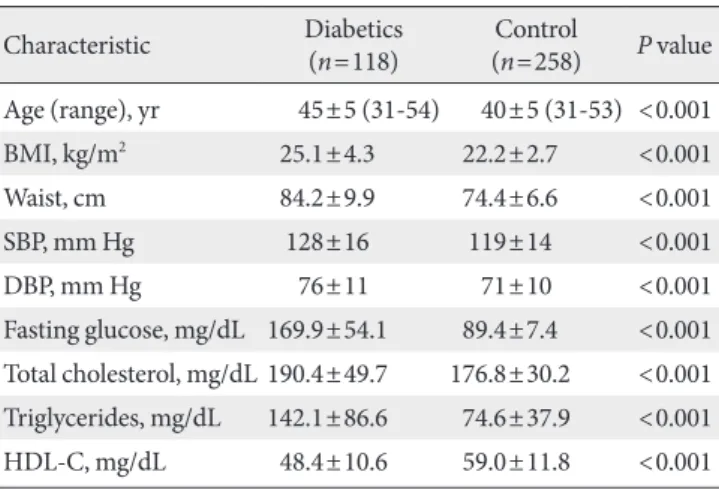
in women with type 2 diabetes and 40±5 years in the control subjects (P<0.001). Mean BMI and waist circumference were 25.1±4.3 kg/m2 and 84.2±9.9 cm in women with type 2 dia- betes and 22.2±2.7 kg/m2 and 74.4±6.6 cm for the control group (P<0.001). Systolic blood pressure, fasting serum glu- cose, total cholesterol, and TG were also significantly higher and HDL-C was significantly lower in women with type 2 dia- betes than in the control subjects (Table 1).
The menstrual history of women with type 2 diabetes and the control subjects is shown in Table 2. The current menstrual cycle was significantly longer in women with type 2 diabetes than in the control group (32.2±8.4 vs. 30.2±6.4 days, P=
0.02). The frequency of oligomenorrhea from age 20 to 29 was almost two-fold higher in women with type 2 diabetes than in the control subjects (16.1% vs. 8.5%, P=0.03). The menstrual cycles during participants’ adolescence and 20s was slightly longer in women with type 2 diabetes than in the control group;
however, the difference was not statistically significantly.
Menstrual duration were significantly longer in participants with type 2 diabetes (5.2 vs. 4.9 days, P<0.01), but age at men- arche did not differ significantly between the two groups. The frequency of oligomenorrhea before the diagnosis of diabetes or from age 20 to 29 was 18.9% for obese women with type 2 diabetes, 13.9% for non-obese women with type 2 diabetes and 8.5% for the control subjects (P for trend=0.01, Fig. 2). In mul- tiple logistic regression analysis, oligomenorrhea was signifi- cantly associated with type 2 diabetes after adjusting for age, BMI, systolic blood pressure, TG, and HDL-C (odds ratio [OR], 3.89; 95% confidence interval [CI], 1.37 to 11.04; Table 3). The
OR remained significant after the addition of lifestyle factors, such as regular exercise, smoking and alcohol consumption, as covariates (OR, 4.84; 95% CI, 1.64 to 14.28). We also compared the frequency of type 2 diabetes according to obesity and oli- gomenorrhea from age 20 to 29 (Table 4). Forty-one subjects had a past history of oligomenorrhea in their 20s. Among them, 11 were obese and 30 were non-obese. The frequency of type 2 diabetes was 90.9% (10 of 11) in obese women with a history of oligomenorrhea and 30.0% (9 of 30) in their non-obese counterparts. In contrast, 43 of 83 (51.8%) obese women with- out a history of oligomenorrhea and 56 of 252 (22.2%) non- obese women were diabetic patients. Additionally, when we performed the Cochran-Mantel-Haenszel stratified analysis to consider the possibility of an interaction between obesity, oli- Table 1. Clinical characteristics of subjects
Characteristic Diabetics
(n=118) Control
(n=258) P value Age (range), yr 45±5 (31-54) 40±5 (31-53) <0.001
BMI, kg/m2 25.1±4.3 22.2±2.7 <0.001
Waist, cm 84.2±9.9 74.4±6.6 <0.001
SBP, mm Hg 128±16 119±14 <0.001
DBP, mm Hg 76±11 71±10 <0.001
Fasting glucose, mg/dL 169.9±54.1 89.4±7.4 <0.001 Total cholesterol, mg/dL 190.4±49.7 176.8±30.2 <0.001 Triglycerides, mg/dL 142.1±86.6 74.6±37.9 <0.001 HDL-C, mg/dL 48.4±10.6 59.0±11.8 <0.001 Data are presented as means±standard deviation.
BMI, body mass index; SBP, systolic blood pressure; DBP, diastolic blood pressure; HDL-C, high density lipoprotein cholesterol.
Table 2. Menstrual history in women with type 2 diabetes and control subjects
Variable Diabetics
(n=118) Control
(n=258) P value Menstrual cycle, day
Current 32.2±8.4 30.2±6.4 0.02
Menarche to 19 yr old 32.9±12.9 31.9±12.8 0.5 20 to 29 yr old 32.8±10.0 31.4±10.4 0.2
Duration, day 5.2±1.7 4.9±1.4 0.01
Age at menarche, yr old 15±2 15±2 0.2
OM during 20sa, % 16.1 8.5 0.03
Data are presented as means±standard deviation.
OM, oligomenorrhea.
aOligomenorrhea was defined as a menstrual cycle length >40 days during participant’s 20s.
Fig. 2. Frequency of oligomenorrhea from age 20 to 29 in obese and non-obese women with type 2 diabetes and controls.
Obese Non-obese Control
DM DM
20
15
10
5
0
Frequency of oligomenorrhea (%) 18.9
13.9
8.5 P for trend=0.01
gomenorrhea and diabetes, the OR of obesity X oligomenor- rhea was 2.27 (95% CI, 1.11 to 4.66; P value for Breslow-Day test for homogeneity=0.09; data not shown). In obese sub- jects, diabetes was significantly associated with oligomenor- rhea before and after adjusting for age and BMI, which was not replicated in the non-obese subjects (Table 4).
DISCUSSION
In this study, we observed that the frequency of oligomenor- rhea during women’s 20s was almost two-fold higher in wom- en with type 2 diabetes than in the control subjects. The fre- quency was 18.9% in obese women with type 2 diabetes, 13.9%
in non-obese type 2 diabetes and 8.5% in the control group.
Type 2 diabetes is a common endocrine disorder with high prevalence in women of reproductive age. Several studies have reported an increased prevalence of amenorrhea and other menstrual irregularities in diabetic women.
Having a long interlude between menstrual cycles is a risk factor of type 2 diabetes. Solomon et al. [5] reported that wom- en with long (40 or more days) or highly irregular menstrual cycles had a significantly increased risk of developing type 2 diabetes in a 6-year follow-up study of the NHS II cohort. We observed that women with type 2 diabetes had significantly longer menstrual cycles than the control group (32.52±8.4 vs.
30.2±6.4 days, P=0.02), and the frequency of oligomenorrhea in their 20s was almost two-fold higher in women with type 2 diabetes than in the control subjects. This association was also
seen in the multiple logistic regression analysis, after adjusting for age, obesity and various lifestyle habits, such as regular ex- ercise, smoking, and alcohol consumption.
Irregular menstrual cycle and type 2 diabetes share common risk factors such as obesity, hyperinsulinemia and a more cen- tral distribution of fat [10,11]. Obesity is related to the increased peripheral conversion of androgens to estrogens in the adipose tissue [12,13]. This becomes a major risk factor for type 2 dia- betes, associated with infertility and menstrual abnormalities [7]. Higher estrogen concentrations result in menstrual ab- normalities and anovulation by negative feedback at the hypo- thalamo-pituitary level [14]. In our data, the association be- tween menstrual irregularity and type 2 diabetes was strongest in women with a BMI greater than 25 kg/m2, demonstrating that obesity increases the risk of type 2 diabetes and menstrual irregularity.
Insulin resistance and hyperinsulinemia are also associated with having an irregular menstrual cycle. The mechanism of insulin action on the ovaries leads to hyperinsulinemia result- ing in excessive androgen production, leading to menstrual cycle disturbances and decreased fertility rates [14]. Insulin resistance and the associated beta cell dysfunction predispose a person to type 2 diabetes and high insulin levels often pre- dict the progression to type 2 diabetes [15]. Hyperinsulinemia seems to synergize with pituitary gonadotropins to stimulate ovarian theca cell androgen production, exacerbating the in- sulin resistance [16]. Elevated testosterone levels have also been reported as the cause for oligomenorrhea in women with- out clinical hyperandrogenism [17].
Hyperinsulinemia inhibits sex hormone-binding globulin Table 3. Multiple logistic regression analysis for the risk of
type 2 diabetes
Variable OR 95% CI
Age 1.26 1.17–1.36
BMI 1.21 1.08–1.35
SBP 1.01 0.97–1.05
DBP 1.00 0.95–1.06
Triglycerides 3.65 1.85–7.19
HDL-C 0.96 0.93–0.99
OMa 3.89 1.37–11.04
Triglycerides were analyzed after log transformation. Covariates were age, BMI, SBP, triglycerides, and HDL-C.
OR, odds ratio; CI, confidence interval; BMI, body mass index; SBP, systolic blood pressure; DBP, diastolic blood pressure; HDL-C, high density lipoprotein cholesterol; OM, oligomenorrhea.
aOM was defined as a menstrual cycle >40 days during the participant’s 20s.
Table 4. Frequency and odds ratio of type 2 diabetes accord- ing to obesity and oligomenorrhea during the participant’s 20s
Total sub- jects, no.
Subjects with diabetes, no.
(%)
Crude
OR Adjusteda OR Obese (BMI ≥25 kg/m2, n=94)
OM (-) 83 43 (51.8) 1 1
OM (+) 11 10 (90.9) 9.0 (1.1-75.9) 9.7 (1.1-89.6) Non-obese (BMI <25 kg/m2, n=282)
OM (-) 252 56 (22.2) 1 1
OM (+) 30 9 (30.0) 1.5 (0.7-3.5) 1.8 (0.6-5.2) OM was defined as a menstrual cycle >40 days during the partici- pant’s 20s.
OM, oligomenorrhea; OR, odds ratio; BMI, body mass index.
aAdjusted for age and BMI.
(SHBG) production by the liver [18], and is associated with low SHBG concentrations, which leads to higher free testos- terone concentrations [19]. Low SHBG concentration is also a risk factor for type 2 diabetes in women [20].
PCOS is characterized by anovulation, androgen excess and insulin resistance [8]. Many women with PCOS are insulin re- sistant and approximately 20% of obese women with PCOS have impaired glucose tolerance [21]. Studies of adolescent girls with PCOS show that insulin resistance is present early in the course of the syndrome [22-24]. The high prevalence of these risk factors among adolescent girls with PCOS puts them at an increased risk for developing type 2 diabetes [25]. In wom- en with PCOS, hyperinsulinemia contributes to hyperan- drogenism by increasing ovarian androgen production and decreasing SHBG [26]. A decrease in plasma insulin results in an increase in SHBG with a concurrent decrease in free testos- terone, and these changes are consistent with the concept that insulin is a direct negative regulator of hepatic SHBG produc- tion [27-29].
There are some limitations to our study. One limitation is that the small sample size does not allow for the generalization of our results. Secondly, it is possible that while there may be an interaction between obesity, oligomenorrhea and diabetes, obesity could be a confounding factor. However, we adjusted for BMI in both the obese and non-obese groups and the OR remained markedly higher in obese subjects, as compared to the non-obese subjects. Thirdly, we did not measure testoster- one levels and hirsutism scores in all of the participants. There- fore, there may have been women with undiagnosed PCOS in the diabetic group, which could have affected the results. Obe- sity could have also been a confounding factor in the diabetic group, however, we did not ask about any weight change from age 20 to current age. Finally, there could be a recall bias. Since women in our study self-reported any history of long or irreg- ular menstrual cycles during their adolescence and from age 20 to 29, recall bias could have interfered with the study results.
Studies on validity and reliability of recall of early menstrual history have shown limitations in accuracy and precision [30- 33]. However, studies examining menstrual data as an expo- sure measure continue to rely on retrospective data, given the expense and subject burden associated with gathering this data prospectively. In conclusion, we observed an association be- tween women who currently have type 2 diabetes and having had a long menstrual cycle before being diagnosed as type 2 diabetic. Long menstrual cycles may be an important risk fac-
tor for the development of type 2 diabetes in women. Howev- er, prospective studies will be required to assess the causality.
CONFLICTS OF INTEREST
No potential conflict of interest relevant to this article was re- ported.
REFERENCES
1. Edelman SV. Type II diabetes mellitus. Adv Intern Med 1998;
43:449-500.
2. Knowler WC, Saad MF, Pettitt DJ, Nelson RG, Bennett PH.
Determinants of diabetes mellitus in the Pima Indians. Diabe- tes Care 1993;16:216-27.
3. Solomon CG, Hu FB, Dunaif A, Rich-Edwards JE, Stampfer MJ, Willett WC, Speizer FE, Manson JE. Menstrual cycle ir- regularity and risk for future cardiovascular disease. J Clin En- docrinol Metab 2002;87:2013-7.
4. Griffin ML, South SA, Yankov VI, Booth RA Jr, Asplin CM, Veldhuis JD, Evans WS. Insulin-dependent diabetes mellitus and menstrual dysfunction. Ann Med 1994;26:331-40.
5. Solomon CG, Rich-Edwards JW, Dunaif A, Willett WC, Hunt- er DJ, Stampfer MJ, Colditz GA, Spiegelman D, Manson JE.
Abnormal menstrual cycle length predicts subsequent non-in- sulin-dependent diabetes mellitus. Am J Epidemiol 1998;147 (11 Suppl):S60.
6. Solomon CG, Hu FB, Dunaif A, Rich-Edwards J, Willett WC, Hunter DJ, Colditz GA, Speizer FE, Manson JE. Long or highly irregular menstrual cycles as a marker for risk of type 2 diabe- tes mellitus. JAMA 2001;286:2421-6.
7. Roumain J, Charles MA, de Courten MP, Hanson RL, Brodie TD, Pettitt DJ, Knowler WC. The relationship of menstrual ir- regularity to type 2 diabetes in Pima Indian women. Diabetes Care 1998;21:346-9.
8. Salley KE, Wickham EP, Cheang KI, Essah PA, Karjane NW, Nestler JE. Glucose intolerance in polycystic ovary syndrome:
a position statement of the Androgen Excess Society. J Clin Endocrinol Metab 2007;92:4546-56.
9. Legro RS, Kunselman AR, Dodson WC, Dunaif A. Prevalence and predictors of risk for type 2 diabetes mellitus and impaired glucose tolerance in polycystic ovary syndrome: a prospective, controlled study in 254 affected women. J Clin Endocrinol Metab 1999;84:165-9.
10. Hartz AJ, Barboriak PN, Wong A, Katayama KP, Rimm AA.
The association of obesity with infertility and related menstur- al abnormalities in women. Int J Obes 1979;3:57-73.
11. Dunaif A. Hyperandrogenic anovulation (PCOS): a unique disorder of insulin action associated with an increased risk of non-insulin-dependent diabetes mellitus. Am J Med 1995;98 (1A):33S-9S.
12. Longcope C, Baker R, Johnston CC Jr. Androgen and estrogen metabolism: relationship to obesity. Metabolism 1986;35:235-7.
13. Weiss DJ, Charles MA, Dunaif A, Prior DE, Lillioja S, Knowler WC, Herman WH. Hyperinsulinemia is associated with men- strual irregularity and altered serum androgens in Pima Indi- an women. Metabolism 1994;43:803-7.
14. Poretsky L, Kalin MF. The gonadotropic function of insulin.
Endocr Rev 1987;8:132-41.
15. Lillioja S, Mott DM, Spraul M, Ferraro R, Foley JE, Ravussin E, Knowler WC, Bennett PH, Bogardus C. Insulin resistance and insulin secretory dysfunction as precursors of non-insulin-de- pendent diabetes mellitus: prospective studies of Pima Indians.
N Engl J Med 1993;329:1988-92.
16. Ehrmann DA, Barnes RB, Rosenfield RL, Cavaghan MK, Im- perial J. Prevalence of impaired glucose tolerance and diabetes in women with polycystic ovary syndrome. Diabetes Care 1999;
22:141-6.
17. Adams J, Polson DW, Franks S. Prevalence of polycystic ova- ries in women with anovulation and idiopathic hirsutism. Br Med J (Clin Res Ed) 1986;293:355-9.
18. Plymate SR, Matej LA, Jones RE, Friedl KE. Inhibition of sex hormone-binding globulin production in the human hepato- ma (Hep G2) cell line by insulin and prolactin. J Clin Endocri- nol Metab 1988;67:460-4.
19. Nestler JE, Powers LP, Matt DW, Steingold KA, Plymate SR, Rittmaster RS, Clore JN, Blackard WG. A direct effect of hy- perinsulinemia on serum sex hormone-binding globulin levels in obese women with the polycystic ovary syndrome. J Clin Endocrinol Metab 1991;72:83-9.
20. Haffner SM, Valdez RA, Morales PA, Hazuda HP, Stern MP.
Decreased sex hormone-binding globulin predicts noninsu- lin-dependent diabetes mellitus in women but not in men. J Clin Endocrinol Metab 1993;77:56-60.
21. Dunaif A, Finegood DT. Beta-cell dysfunction independent of
obesity and glucose intolerance in the polycystic ovary syn- drome. J Clin Endocrinol Metab 1996;81:942-7.
22. Coviello AD, Legro RS, Dunaif A. Adolescent girls with poly- cystic ovary syndrome have an increased risk of the metabolic syndrome associated with increasing androgen levels indepen- dent of obesity and insulin resistance. J Clin Endocrinol Metab 2006;91:492-7.
23. Lewy VD, Danadian K, Witchel SF, Arslanian S. Early meta- bolic abnormalities in adolescent girls with polycystic ovarian syndrome. J Pediatr 2001;138:38-44.
24. Palmert MR, Gordon CM, Kartashov AI, Legro RS, Emans SJ, Dunaif A. Screening for abnormal glucose tolerance in adoles- cents with polycystic ovary syndrome. J Clin Endocrinol Metab 2002;87:1017-23.
25. Tfayli H, Arslanian S. Menstrual health and the metabolic syn- drome in adolescents. Ann N Y Acad Sci 2008;1135:85-94.
26. Hull MG. Epidemiology of infertility and polycystic ovarian disease: endocrinological and demographic studies. Gynecol Endocrinol 1987;1:235-45.
27. Dunaif A, Graf M, Mandeli J, Laumas V, Dobrjansky A. Char- acterization of groups of hyperandrogenic women with acan- thosis nigricans, impaired glucose tolerance, and/or hyperin- sulinemia. J Clin Endocrinol Metab 1987;65:499-507.
28. Ireland K, Child T. Polycystic ovary syndrome and the post- menopausal woman. J Br Menopause Soc 2006;12:143-8.
29. Chang RJ, Nakamura RM, Judd HL, Kaplan SA. Insulin resis- tance in nonobese patients with polycystic ovarian disease. J Clin Endocrinol Metab 1983;57:356-9.
30. Must A, Phillips SM, Naumova EN, Blum M, Harris S, Daw- son-Hughes B, Rand WM. Recall of early menstrual history and menarcheal body size: after 30 years, how well do women remember? Am J Epidemiol 2002;155:672-9.
31. Jukic AM, Weinberg CR, Wilcox AJ, McConnaughey DR, Hornsby P, Baird DD. Accuracy of reporting of menstrual cy- cle length. Am J Epidemiol 2008;167:25-33.
32. Bachand AM, Cragin LA, Reif JS. Reliability of retrospectively assessed categorical menstrual cycle length data. Ann Epide- miol 2009;19:501-3.
33. Small CM, Manatunga AK, Marcus M. Validity of self-report- ed menstrual cycle length. Ann Epidemiol 2007;17:163-70.