The purpose of the present study was to investigate the causes of impingement between the patella bone and the bearing post during high flexion in the cruciate-substitut- ing total knee arthroplasty and propose a treatment strat- egy. Cruciate ligament-substituting total knee arthroplasty has the advantage of greater flexion of the knee joint and enables normal knee dynamic motion by allowing the femoral roll back phenomenon while bending.1-5) How- ever, patella impingement, patellotibial impingement, and
fat pad impingement following total knee arthroplasty are the known causes of anterior knee pain; and the methods for preventing anterior knee pain include change in bear- ing design and intraoperative removal of the fat pad.6-10) In some patients with an expected knee joint movement of more than 130° in the operative field, the range of mo- tion is less than 110° due to anterior knee pain caused by impingement between the patella bone and the bearing post after mobile and fixed type total knee arthroplasty;
these patients were treated by resection of the lower ar- ticular part of the patella bone and the impinged soft tis- sue. Therefore, impingement between the patella bone and the bearing post after total knee arthroplasty was one of the causes of less than 120° knee flexion. Since Koreans prefer kneeling and squatting postures for various cultural purposes even after total knee arthroplasty, 130° or higher
Analysis of Impingement between Patella Bone and Bearing Post in Cruciate-Substituting
High-Flexion Total Knee Arthroplasty
Jegyun Chon, MD, Bongju Lee, MD, Sangyeop Shin, MD, Gunil Jang, MD, Taehyeon Jeon, MD
Department of Orthopaedic Surgery, Sun Medical Center, Daejeon, Korea
Background: We investigated the causes of impingement between the patella bone and the bearing post during high flexion in cruciate-substituting total knee arthroplasty and proposed a treatment strategy.
Methods: This prospective cohort study included 218 cases that had undergone cruciate-substituting total knee arthroplasty from February 2014 to January 2015; a single surgeon performed the operation using the same method without patellar resurfacing in all patients.
Results: In these patients, the occurrence of impingement was determined by performing more than 120° high knee flexion after inserting a bearing perioperatively. The incidence of impingement was significantly associated with bearing design, femoral im- plant size, patella bone length, and patella inferior pole angle (p < 0.05). The impingement was resolved by resection of the lower articular side of the patella bone.
Conclusions: In the cruciate-substituting high-flexion total knee arthroplasty, impingement between the patella bone and bearing post was more common in patients with mobile bearing, small-size femoral component, and a long patella or a large inferior pole angle. In cases of intraoperative impingement between the patella bone and the bearing post, resection in the lower portion of the patella prevented impingement of the bearing with soft tissue or the patella by widening the space between the patella and the bearing post, which in turn prevented postoperative reduction in range of motion.
Keywords: Impingement, Patella, Bearing post, High flexion, Total knee arthroplasty
Copyright © 2016 by The Korean Orthopaedic Association
This is an Open Access article distributed under the terms of the Creative Commons Attribution Non-Commercial License (http://creativecommons.org/licenses/by-nc/4.0) which permits unrestricted non-commercial use, distribution, and reproduction in any medium, provided the original work is properly cited.
Clinics in Orthopedic Surgery • pISSN 2005-291X eISSN 2005-4408 Received May 11, 2015; Accepted December 28, 2015
Correspondence to: Bongju Lee, MD
Department of Orthopaedic Surgery, Sun Medical Center, 29 Mokjung-ro, Jung-gu, Daejeon 34811, Korea
Tel: +82-42-220-8460, Fax: +82-42-254-4955 E-mail: [email protected]
knee flexion is required. Hence, we conducted this pro- spective cohort study to determine the causes of impinge- ment and methods to prevent impingement between the patella bone and the bearing post after total knee arthro- plasty.
METHODS
This prospective cohort study included 218 cases that underwent cruciate ligament-substituting total knee ar- throplasty from February 2014 to January 2015; a single surgeon performed the operation using the same method without patellar resurfacing in all patients. The lateral patellofemoral ligament and the retinaculum were re- leased, and extensive osteophytes were removed from the patella bone. During surgery, a goniometer was used after insertion of a trial bearing to determine the angle at which impingement occurs between the bearing post and the patella bone when the knee was moved from 90° flexion to full flexion. In this study, impingement was considered positive when contact between the patella bone and the bearing post occurred at knee flexion of 120° or forward displacement of the patella occurred owing to impinge- ment. The study included 139 female and 13 male patients with an average age of 70.6 years (range, 54 to 89 years).
The patients were divided into the Biomet mobile type-bearing group (rotating platform knee) and the Cor- entec fixed-type bearing group (Lospa; Corentec, Seoul, Korea) to compare the impingement frequency; statistical significance was according to implant design.
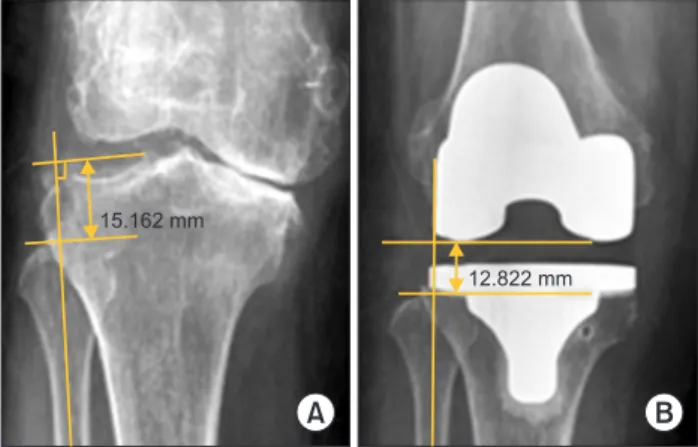
Changes to the joint line were measured at pre- and postoperative standing knee anteroposterior (AP) radio- graphic views. The most proximal point of the fibula head was selected as the reference point for this study because fibula head enables easy viewing, and is used by many au- thors.11-13) Measurements were taken by one author (SS), and the methods used were as follows: the preoperative joint line was defined as a line through the midpoint of the lateral knee joint gap that is the perpendicular line to the long axis of the fibula, and the postoperative joint line was defined as a line that contacts the lowest point of the later- al femoral component that is the perpendicular line to the long axis of the fibula. In addition, to determine the height of the joint line, we measured the distance from the top of the fibular head to the levels of preoperative and postoper- ative joint lines (Fig. 1). Moreover, images in the 30-degree flexion lateral view and Merchant view were obtained for pre- to postoperative changes in the location of the patella bone (Insall-Salvati ratio) and the anatomical configura- tions of the patella bone; while the preoperative angle and
the length of patella bone were measured with the osteo- phytes included (Fig. 2). Patella bone location, anatomical configurations of the patella bone, and size of the inserted implants was compared in the fixed-type bearing group alone, in order to investigate the statistical significance be- tween the cause of impingement occurrence with changes in joint line.
In addition, interrelationships between the size of the inserted implants and occurrence of impingement were assessed. Chi-square test was performed in the fixed- type bearing group (124 cases) to determine the increased risk of impingement with a smaller size femoral implant.
Univariate analysis, matching sample t-test, and chi- square test were used for clinical and radiological evalu- ations. SPSS ver. 12.0 (SPSS Inc., Chicago, IL, USA) was used to determine the statistical significance when the p-value was < 0.05.
RESULTS
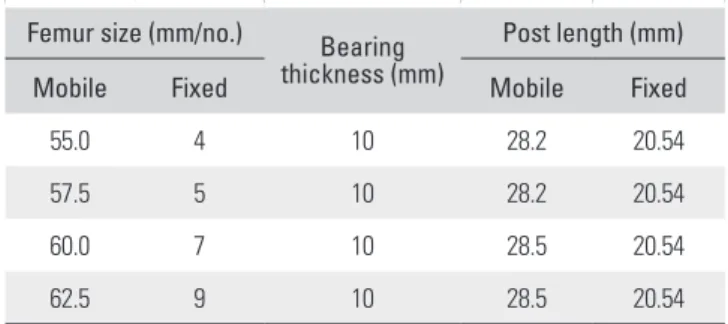
Demographics were shown in Table 1. Among the mobile- type Biomet bearing cases, impingement occurred in 90 of the 94 cases; and among the fixed-type Corentec bearing cases (n = 124), impingement occurred only in 47 of the 124 cases; impingement incidence was more common in patients with mobile bearing that was relatively more an- teriorly located and those with a longer post than in those with a fixed bearing (Tables 2 and 3, Fig. 3). There was a statistically significant correlation between impingement
15.162 mm
A B
12.822 mm
Fig. 1. (A) The preoperative joint line was defined as a line through the midpoint of the lateral knee joint gap along the perpendicular line to the long axis of the fibula. (B) The postoperative joint line was defined as a line contacting the lowest point of the lateral femoral component along the perpendicular line to the long axis of the fibula. To find out the height of the joint line, we measured the distance from the top of the fibular head to the preoperative and postoperative joint line levels.
and the type of implants (p = 0.04).
The average height of the joint line in the fixed- type bearing group (n = 124) was 14.0 mm before surgery and 13.1 mm after surgery. The joint line height decreased from 13.5 mm to 12.6 mm in the impinged cases (n = 47), and from 14.2 mm to 13.4 mm in the cases without im- pingement (n = 77). There was no statistically significant correlation between impingement and changes in the joint line (p = 0.069).
Changes in the patella bone location (Insall-Salvati ratio) was from 1.15 before surgery to 1.09 after the sur- gery in the fixed-type bearing group (n = 124). The reduc- tion in Insall-Salvati ratio was from 1.14 to 1.08 in cases with impingement (n = 47), and from 1.15 to 1.10 in cases without impingement (n = 77). There was no significant correlation between impingement and changes in patellar bone location between groups (p = 0.51).
The probability of impingement occurrence accord- ing to the characteristics of patellar shape in patients with fixed-type bearing (n = 124), was determined by measur- ing the patella length-articular ratio, the patella nonarticu- lar-articular ratio, the patella articular-nonarticular angle, the patella length, the patella inner thickness ratio, the patella inferior pole angle, the patella facet angle, and the patella inner thickness ratio.
The patella length-articular average ratio was 0.68 in the impingement cases (n = 47) and 0.70 in cases with- out impingement (n = 77); without significant correlation between the 2 groups (p = 0.575) (Fig. 2A). The patella nonarticular-articular average ratio was 2.32 in cases with
A B C D
E F G
45.28 mm 45.28 mm
38.52 mm
38.6 mm
19.72 mm
94
45.28 mm 45.28 mm
15.23 mm
55
139
11.59 mm 43.03 mm
Fig. 2. (A) Patella length-articular ratio on the lateral view; we measured the ratio between patella long length from the superior pole to inferior pole and patella posterior articular length. (B) Patella nonarticular-articular ratio on the lateral view; we measured the ratio between posteroinferior nonarticular length and patella posterior articular length. (C) Patella articular-nonarticular angle on the lateral view; we measured the angle between posteroinferior nonarticular line and posterior articular line. (D) Patella long length and patella inner thickness ratio on the lateral view; we measured patella length as the distance from the superior pole to the inferior pole of the patella and the perpendicular distance from patella length to the posterior articular margin of the patella. (E) Patella inferior pole angle on the lateral view; we measured the angle between patella long length and posteroinferior nonarticular line. (F) Patella facet angle on the Merchant view; we measured the angle between medial and lateral articular margins of the patella. (G) Patella inner thickness ratio on the Merchant view; we measured the ratio between patella long length and perpendicular distance from patella length to the posterior articular margin of the patella.
Table 1. Demographics
Characteristic Patient data
Sex (female:male) 139:13
Age (yr), mean (range) 70.6 (54–89) Operation site (right:left) 102:116 Total knee replacement (both:one) 66:86 Bearing type (mobile:fixed) 94:124
impingement (n = 47) and 2.40 in cases without impinge- ment (n = 77); without significant correlation between the 2 groups (p = 0.69) (Fig. 2B). However, the average length of the posterior articular surface from 32.4 mm to 27.0 mm to 5.4 mm following excision of the patella bone be- cause of impingement. The patella articular-nonarticular average angle was 129.2° in cases with impingement (n = 47), and 129.4° in cases without impingement (n = 77);
without significant correlation between the 2 groups (p
= 0.384) (Fig. 2C). The average patella length was 44.9 mm in cases with impingement (n = 47), and 40.3 mm in cases without impingement (n = 77); with a statistically significant correlation between the 2 groups (p = 0.04) (Fig. 2D). The patella bone inner thickness average ratio under lateral view was 0.20 in the cases with impingement (n = 47), and 0.23 in the cases without impingement (n = 77); without significant correlation between the 2 groups (p = 0.148) (Fig. 2D). In addition, the average thickness of
the articular side of the patella lateral view was 9.1 mm in the cases with impingement (n = 47), and 9.1 mm in the cases without impingement (n = 77); without significant correlation between the 2 groups (p = 0.25) (Fig. 2D).
The patella inferior pole average angle was 37.7° in cases with impingement (n = 47), and 30.5° in cases without impingement (n = 77); without significant correlation be- tween the 2 groups (p = 0.03) (Fig. 2E). The patella bone facet average angle was 117.1° in cases with impingement (n = 47), and 119.6° in cases without impingement (n = 77); without significant correlation between the 2 groups (p
= 0.414) (Fig. 2F). The patella bone inner thickness aver- age ratio under the Merchant view was 0.25 in cases with impingement (n = 47), and 0.25 in cases without impinge- ment (n = 77); without significant correlation between the 2 groups (p = 0.301) (Fig. 2G).
In the fixed-type bearing group (124 cases), im- pingement occurrence showed significant correlation with smaller size femoral implant (p = 0.01). However, accord- ing to manufacturer-recommended compatibility between the femoral and tibial implants, impingement occurred in 33 of the 88 cases in which the implant size coincided, and Fig. 3. The mobile bearing post was designed relatively anterior location and long length compared to the fixed bearing post. (A) Lateral aspect of the mobile type bearing. (B) Lateral aspect of the fixed type bearing. a*: anteroposterior distance of the bearing. b†: distance to the post position from the anterior margin of the bearing. c‡: height of the post.
b
a*
c
a* b
c +
A B
Table 2. The Mobile Bearing Post Was Designed with Relatively Anterior Location Compared to Fixed Bearing Post
Femur size (mm/no.) Bearing thickness (mm)
Ratio* (%)
Mobile Fixed Mobile Fixed
55.0 4 10 38 49
57.5 5 10 39 50
60.0 7 10 37 51
62.5 9 10 37 52
65.0 11 10 34 52
*Distance to the post position from the anterior margin of the bearing/
anteroposterior distance of the bearing.
Table 3. The Mobile Bearing Post Was Designed with Relatively Long Length Compared to Fixed Bearing Post
Femur size (mm/no.) Bearing thickness (mm)
Post length (mm)
Mobile Fixed Mobile Fixed
55.0 4 10 28.2 20.54
57.5 5 10 28.2 20.54
60.0 7 10 28.5 20.54
62.5 9 10 28.5 20.54
in 13 of the 36 cases in which the implant size did not co- incide; without significant correlation (p = 0.684).
The impingement between the patella bone and the bearing post causes forward displacement of the patella bone; furthermore, the forward displacement of the patella increases as knee flexion increases after impingement.
Forward displacement of the patella can lead to stretch- ing of the patellofemoral ligament and retinaculum and a reduction in the flexion gap. Therefore, the cases with im- pingement were treated by resection of the lower portion of the patella, without resultant forward displacement of the patella (Figs. 4 and 5).
DISCUSSION
We hypothesized that the design or size of the implant, changes in the height of the joint line prior to and after the surgery, shape of the patella bone, changes in the height of the patella bone, and discordance in the sizes of the femo- ral and tibial implants, etc. cause impingement between the patella bone and the bearing post during high flexion in the patients who underwent cruciate-substituting total knee arthroplasty without patella bone resurfacing. Our data showed that impingement between the patella bone and bearing post was more common in patients with mo-
Fig. 4. (A) A 76-year-old female patient shows impingement (arrow) between patella bone and bearing post in cruciate-substituting high-flexion total knee arthroplasty. (B) We resected the lower patellar articular part (arrow) when impingement occurred. (C) Impingement disappeared (arrow) after lower patellar articular part resection.
A B C
Fig. 5. The impingement between the patella bone and the bearing post causes forward displacement of the patella bone and forward displacement of the patella increases as knee flexion increases after impingement. (A) Forward displacement of the patella can lead to stretching of the patellofemoral ligament and retinaculum and reduction of the flexion gap. (B) Therefore, we treated cases with impingement by resection of the lower portion of the patella, and there was no occurrence of forward displacement of the patella.
B A
bile bearing, a small-size femoral component, and long patella or a large inferior pole angle.
Grigoris et al.6) reported that patellotibial impinge- ment occurred owing to vertical implant design of the bearing post. Kramers-de Quervain et al.7) reported that fat pad impingement occurred less frequently in rotating platform or meniscal bearing designs than in the AP Glide (DePuy, Leeds, UK) bearing system, which was attributed to less anterior translation of the bearing. In this study, correlation between the bearing implant designs and the occurrence of impingement was observed. Impingement occurred in 90 of the 94 cases in which mobile bearing was used, while impingement occurred only in the 47 of the 124 cases in which fixed bearing was used; impinge- ment incidence was more common in patients with mo- bile bearing that was relatively more anteriorly located and those with a longer post than in those with a fixed bearing (p = 0.04) (Tables 1 and 2, Fig. 3).
Verborgt and Victor9) reported that post impinge- ment was significantly associated with a raised joint line;
the mean change in the joint line position was increased by 6 ± 2 mm in the group with impingement; whereas only a + 3 mm change was noted in the group without impinge- ment. Tang et al.13) measured the joint line in a Chinese population using magnetic resonance imaging and report- ed the mean distance of 11.99 ± 1.20 mm from the refer- ence point, the fibular head, to the lateral tibial plateaus (the joint line). However, in our study, the preoperative mean distance from the fibular head (the reference) to the midpoint (the joint line) of the lateral knee joint gap was 14.0 mm and the postoperative mean distance to the low- est point (the joint line) of the lateral femoral component was 13.0 mm following total knee replacement (TKR). We were unable to confirm the correlation between changes in the joint line and impingement occurrence (p = 0.069), because the impingement occurred in 39 of the 81 cases in which the joint line decreased after surgery, as compared to that before surgery.
Verborgt and Victor9) reported a significant positive correlation between the Insall-Salvati ratio and the angle of impingement; in addition, they found a significant posi- tive correlation between a smaller femoral component size and the point at which impingement occurred. In this study, there was no significant correlation between im- pingement and changes in patella bone location (p = 0.51).
However, our data showed that impingement occurred more frequently in patients with a smaller femoral implant size, with a significant correlation between impingement occurrence and a smaller size femoral implant (p = 0.01).
Grigoris et al.6) also reported patellotibial impinge-
ment in patients with joint line elevation < 10 mm, in which greater flexion resulted in more forward displace- ment of the patella. In the present study, impingement be- tween the lower portion of the patella and the bearing post caused forward displacement of the patella, which caused stretching of the patellofemoral ligament and retinaculum and thus reduced the flexion gap.
Kramers-de Quervain et al.7) reported that when subjects performed flexion following TKR by the LCS AP Glide bearing system, 13 cases (5.7%) complained of anterior knee pain from fat pad impingement due to nar- rowing of the space between the anterior edge of the AP Glide bearing and the patella ligament or the distal patellar pole. Macule et al.8) found inflammatory infiltration in the Hoffa’s fat pad in 36% of the 68 TKR patients, and suggest- ed that fibrosis of Hoffa’s fat pad may cause postoperative pain and decreased range of motion.
In patients with > 45 mm patella length or > 38°
patella inferior pole angle, impingement can be treated by simple resection of the lower portion of the patella. Im- pingement between the lower portion of the patella and the bearing post caused forward displacement of the pa- tella, leading to stretching of the patellofemoral ligament and retinaculum and reduction in flexion gap; hence, it is possibly the cause of postoperative pain and reduction in range of motion. Since resection of the lower portion of the patella widens the space between the patella and the bearing post, it may prevent impingement between the bearing and soft tissue or the patella (Figs. 4 and 5).
Limitation of this study was the difficulty in setting the reference line for measurement due to severe osteo- phytes in the patella bone preoperatively. Hence, radiolog- ic measurement shows slight individual-based differences.
Another limitation of this study was the lack of measure of forward patella displacement after impingement state despite the observed forward patella displacement.
Finally, in the cruciate-substituting high-flexion total knee arthroplasty, impingement between the patella bone and bearing post was more common in patients with mobile bearing, a small-size femoral component, and a long patella or a large inferior pole angle. In cases of intra- operative impingement between the patella bone and the bearing post, resection in the lower portion of the patella prevented impingement of the bearing with soft tissue or the patella by widening the space between the patella and the bearing post, which in turn prevented postoperative reduction in range of motion.
CONFLICT OF INTEREST
No potential conflict of interest relevant to this article was reported.
REFERENCES
1. Moynihan AL, Varadarajan KM, Hanson GR, et al. In vivo knee kinematics during high flexion after a posterior-sub- stituting total knee arthroplasty. Int Orthop. 2010;34(4):497- 503.
2. Insall JN, Lachiewicz PF, Burstein AH. The posterior stabi- lized condylar prosthesis: a modification of the total condy- lar design. Two to four-year clinical experience. J Bone Joint Surg Am. 1982;64(9):1317-23.
3. Kelly MA, Clarke HD. Long-term results of posterior cru- ciate-substituting total knee arthroplasty. Clin Orthop Relat Res. 2002;(404):51-7.
4. Li G, Most E, Otterberg E, et al. Biomechanics of posterior- substituting total knee arthroplasty: an in vitro study. Clin Orthop Relat Res. 2002;(404):214-25.
5. O'Rourke MR, Callaghan JJ, Goetz DD, Sullivan PM, John- ston RC. Osteolysis associated with a cemented modular posterior-cruciate-substituting total knee design: five to eight-year follow-up. J Bone Joint Surg Am. 2002;84(8):
1362-71.
6. Grigoris PH, Treacy RB, McMinn DJ. Patellotibial impinge- ment in Kinemax stabilised total knee replacement. J Bone Joint Surg Br. 1992;74(3):472-3.
7. Kramers-de Quervain IA, Engel-Bicik I, Miehlke W, Drobny T, Munzinger U. Fat-pad impingement after total knee ar- throplasty with the LCS A/P-Glide system. Knee Surg Sports Traumatol Arthrosc. 2005;13(3):174-8.
8. Macule F, Sastre S, Lasurt S, Sala P, Segur JM, Mallofre C.
Hoffa's fat pad resection in total knee arthroplasty. Acta Or- thop Belg. 2005;71(6):714-7.
9. Verborgt O, Victor J. Post impingement in posterior stabi- lised total knee arthroplasty. Acta Orthop Belg. 2004;70(1):
46-50.
10. Patel DV, Aichroth PM, Wand JS. Posteriorly stabilised (Insall-Burstein) total condylar knee arthroplasty: a follow- up study of 157 knees. Int Orthop. 1991;15(3):211-8.
11. Selvarajah E, Hooper G. Restoration of the joint line in total knee arthroplasty. J Arthroplasty. 2009;24(7):1099-102.
12. Laskin RS. Management of the patella during revision total knee replacement arthroplasty. Orthop Clin North Am.
1998;29(2):355-60.
13. Tang Q, Zhou Y, Yang D, Tang J, Shao H. The knee joint line position measured from the tibial side in Chinese people. J Arthroplasty. 2011;26(7):989-93.