2
INTRODUCTION
Renal cell carcinoma (RCC) is the most common solid lesion within the kidney and accounts for approximately 90% of all kidney malignancies [1]. Clear cell RCC is the most common histological type of RCC, representing 80% to 90%
of the total [1,2]. RCC is widely known to be an aggressive
Role of cytoreductive nephrectomy in the targeted therapy era: A systematic review and meta-analysis
Herney A. García-Perdomo1,2,3, James A. Zapata-Copete2,3, Diego F. Castillo-Cobaleda1
1Department of Urology, School of Medicine, Universidad del Valle, Cali, 2Department of Epidemiology, Universidad Libre, Cali, 3Urological Research Group (UROGIV), Universidad del Valle, Cali, Colombia
Purpose: To determine the effectiveness and harm of cytoreductive nephrectomy versus no intervention in patients with meta- static renal carcinoma who undergo targeted therapy to improve overall survival.
Materials and Methods: A search strategy was conducted in the MEDLINE, CENTRAL, Embase, HTA, DARE, NHS, and LILACS data- bases. Searches were also conducted for unpublished literature through references from relevant articles identified through the search, conferences, thesis databases, OpenGrey, Google Scholar, and clinicaltrials.gov, among others. Studies were included with- out language restrictions. The risk of bias assessment was made by using a modified Cochrane Collaboration tool. A meta-analysis of fixed effects was conducted. The expected outcomes were overall survival, quality of life, adverse effects, mortality, and progres- sion-free survival. The measure of the effect was the hazard ratio (HR) with a 95% confidence interval (CI). The planned comparison was cytoreductive nephrectomy versus no intervention.
Results: A total of 22,507 patients were found among seven studies. Seven studies were included in the qualitative analysis (eight publications) and five in the quantitative analysis for overall survival. One study reported progression-free survival and one re- ported targeted therapy toxicities. A low risk of bias was shown for most of the study items. The HR for overall survival was 0.58 (95%
CI, 0.50 to 0.65) favoring cytoreductive nephrectomy compared with no intervention.
Conclusions: Cytoreductive nephrectomy is effective for improving overall survival in patients with metastatic renal carcinoma who undergo targeted therapy compared with no intervention.
Keywords: Carcinoma, renal cell; Meta-analysis; Molecular targeted therapy; Nephrectomy; Review
This is an Open Access article distributed under the terms of the Creative Commons Attribution Non-Commercial License (http://creativecommons.org/licenses/by-nc/4.0) which permits unrestricted non-commercial use, distribution, and reproduction in any medium, provided the original work is properly cited.
Special Article
Received: 23 August, 2017 • Accepted: 20 November, 2017 Corresponding Author: Herney A. García-Perdomo
Department of Urology, School of Medicine, Universidad del Valle, Cll 4B # 36-00, Cali, Colombia TEL: +57-3212195102, FAX: +57-2-5572208, E-mail: [email protected] ORCID: http://orcid.org/0000-0001-6945-8261
ⓒ The Korean Urological Association
cancer, and metastatic disease is found in 30% of diagnosed patients [3]. The survival rate for metastatic RCC (mRCC) ranges between 10% and 20% (2-year median survival) [4]. Because of this, many different treatments have been developed in an attempt to diminish the mortality rate.
In the early 2000s, two clinical trials showed better survival rates when cytoreductive nephrectomy (CRN) was
www.icurology.org
Investig Clin Urol 2018;59:2-9.
https://doi.org/10.4111/icu.2018.59.1.2 pISSN 2466-0493 • eISSN 2466-054X
performed prior to interferon α-2b (IFN-α) therapy compared to IFN-α therapy alone [5,6]. However, since 2005 multiple drugs have been developed and approved as the result of an improved understanding of the molecular mechanisms underlying the development and progression of RCC [7].
The mechanism of action of these drugs—tyrosine kinase inhibitors of vascular endothelial growth factor receptor—
has led to their use being called targeted therapy (TT).
Currently, TT is recommended over immunotherapy because of its better outcomes [8-12]; however, the role of CRN in the era of TT has remained under debate. Although some well-designed retrospective studies are available, no synthesis of the available literature has been performed, and there will always be a tendency to select fitter patients for the “active” CRN arm in randomized trials [13]. Therefore, no recommendation in favor or against performing CRN has been established.
The purpose of this review was to determine the effec- tiveness and harm of CRN versus no intervention in patients with mRCC who underwent TT to improve overall survival.
MATERIALS AND METHODS
We performed this review according to the recom- mendations of the Cochrane Collaboration and following the PRISMA statement. The PROSPERO registration number is CRD42017058167. This systematic review and meta-analysis meets all the ethics requirements of the Helsinki declaration and all international statements.
1. Eligibility criteria
We accepted clinical trials, quasi-experiments, cohort studies, and case-control studies that involved adults (aged at least 18 years) with a diagnosis of mRCC who underwent TT. However, we found and included only cohort studies.
The comparison was CRN versus no intervention, and the expected outcomes were overall survival, quality of life, adverse effects, mortality, and progression-free survival. For all outcomes, studies were to include at least 6 months of follow-up. There were no setting or language restrictions. We excluded pregnant women.
2. Information sources
The literature search was conducted in accordance with the recommendations of the Cochrane Collaboration. We used medical subject headings (MeSH; National Library of Medicine), Emtree language (Embase subject headings), DeCS Health Science Descriptors, and related text words.
We searched MEDLINE (Ovid), Embase, LILACS, HTA, DARE, NHS, and the Cochrane Central Register of Controlled Trials (CENTRAL) from inception to February 2017. To ensure literature saturation, we scanned references from relevant articles identified through the search, confe- rences, thesis databases, OpenGrey, Google Scholar, and clinicaltrials.gov, among others. We tried to contact authors by e-mail in case of missing information in Supplementary material.
3. Data collection
First, two researchers reviewed each reference by title and abstract. Then we scanned the full text of relevant studies, applied prespecified inclusion and exclusion criteria, and extracted the data. Disagreements were resolved by consensus; where disagreement could not be solved, a third reviewer resolved the conflict.
Two trained reviewers using a standardized form independently extracted the following information from each article: author names, study design, geographic location, title, objectives, inclusion and exclusion criteria, number of patients included, losses to follow-up, timing, definitions of outcomes, outcomes and association measures, and funding source.
4. Risk of bias
The assessment of the risk of bias for each study was done by using a modified Cochrane Collaboration tool, which covers the following: selection of participants (selection bias), comparability between groups (selection bias), conflict of interest, confounding control, statistical methods, selective reporting (detection and information bias), assessment of the outcome, whether follow-up was long enough, and loss to follow-up. Two independent researchers judged the possible risk of bias from the extracted information, which was rated as “high risk,” “low risk,” or “unclear risk.”
5. Data analysis and synthesis of results
The statistical analysis was performed by using Stata 14 (StataCorp., College Station, TX, USA). For categorical outcomes we reported information on hazard ratio (HR) with 95% confidence intervals (CIs) according to the type of variable found. We pooled the information with a fixed effect meta-analysis according to the heterogeneity expected.
The results were reported in forest plots of the estimated effects of the included studies with a 95% CI. Heterogeneity was evaluated by using the I2 test. For the interpretation, it was determined that the values of 25%, 50%, and 75% in the I2 test corresponded to low, medium, and high levels of
4 www.icurology.org https://doi.org/10.4111/icu.2018.59.1.2 heterogeneity, respectively.
There was no publication bias. We performed sensitivity analysis by extracting weighted studies and running the estimated effect to find differences. The only available information for a subgroup analysis was performance status.
RESULTS
1. Study selection
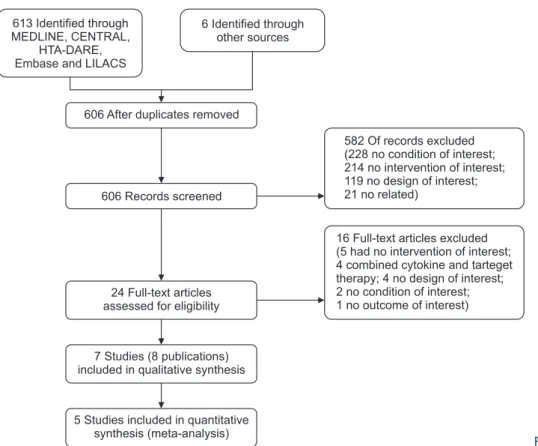
We found 613 records with the search strategies. Two ongoing clinical trials were identified (NCT00930033 and NCT01099423); however, not enough data were yet available for analysis. Finally, seven studies were included in the qualitative analysis (eight publications) [14-21]; five of them [14-16,18,21] reported the HR for overall survival of CRN versus no intervention (Fig. 1).
2. Included studies
A total of 22,507 patients were included, with a median of 3,215 patients per study. Seven studies (eight publications) reported overall survival and one study reported toxicities related to tyrosine kinase inhibitors [14-21]. You et al. [15,16]
reported two publications but of the same study. We found no studies assessing quality of life; therefore, we could not analyze this outcome. Additionally, You et al. [15] reported progression-free-survival. Four studies were excluded because
patients had previously received immunotherapy [22-25]
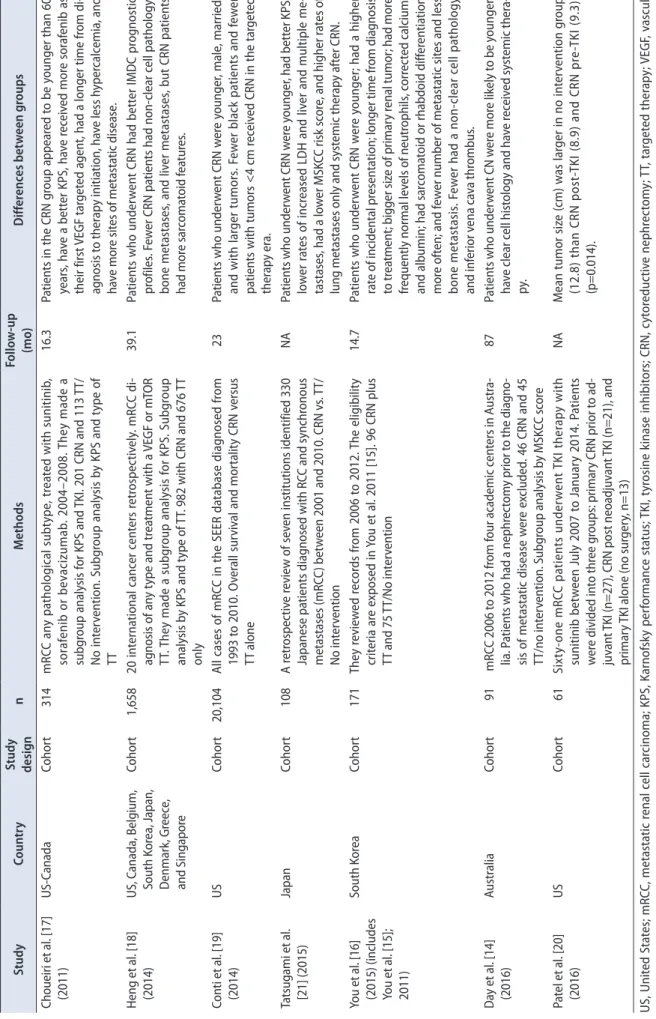
(Table 1).
3. Risk of bias
An evaluation of the risk of bias was performed with a proper scale (modified Cochrane Collaboration tool). Most studies had a low risk of bias for almost all items; however, four studies (five publications) had a high risk of bias for the comparability of groups (selection bias) [15,16,18,19,21]
(Table 2); however, those studies performed a multivariate and adjusted analysis or a propensity score analysis.
4. Overall survival
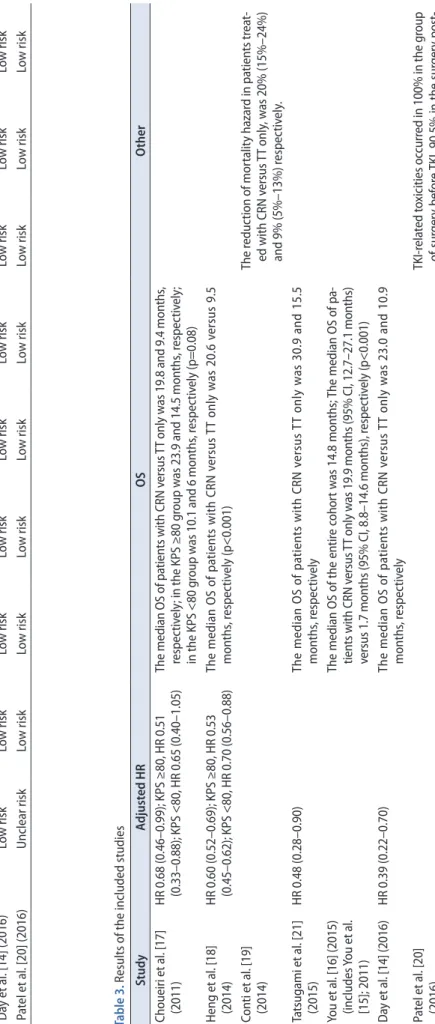
Most studies showed a higher survival rate for the CRN group (Table 3). The studies by Day et al. [14], You et al. [15], Choueiri et al. [17], , Heng et al. [18], and Tatsugami et al. [21], were included in the meta-analysis because they were the only studies that described the HRs for overall survival (CRN versus TT only). The overall result was an HR of 0.58 (95%
CI, 0.50 to 0.65) (Fig. 2) favoring CRN (I2=0%). There was no change in the effect size when we dropped the information from the study by Heng et al. [18], which was the most weighted study.
Regarding the subgroup analysis, we obtained information about the Karnofsky Performance Score (KPS). Two studies with a KPS of 80 or more were included [17,18], and
Fig. 1. Flow chart of included studies.
606 After duplicates removed
7 Studies (8 publications) included in qualitative synthesis
5 Studies included in quantitative synthesis (meta-analysis)
582 Of records excluded (228 no condition of interest;
214 no intervention of interest;
119 no design of interest;
21 no related)
16 Full-text articles excluded (5 had no intervention of interest;
4 combined cytokine and tarteget therapy; 4 no design of interest;
2 no condition of interest;
1 no outcome of interest) 606 Records screened
613 Identified through MEDLINE, CENTRAL,
HTA-DARE, Embase and LILACS
6 Identified through other sources
24 Full-text articles assessed for eligibility
Table 1. Characteristics of the included studies StudyCountryStudy designn MethodsFollow-up (mo) Differences between groups Choueiri et al. [17] (2011)US-CanadaCohort314mRCC any pathological subtype, treated with sunitinib, sorafenib or bevacizumab. 2004–2008. They made a subgroup analysis for KPS and TKI. 201 CRN and 113 TT/ No intervention. Subgroup analysis by KPS and type of TT
16.3 Patients in the CRN group appeared to be younger than 60 years, have a better KPS, have received more sorafenib as their first VEGF targeted agent, had a longer time from di- agnosis to therapy initiation, have less hypercalcemia, and have more sites of metastatic disease. Heng et al. [18] (2014)US, Canada, Belgium, South Korea, Japan, Denmark, Greece, and Singapore
Cohort1,65820 international cancer centers retrospectively. mRCC di- agnosis of any type and treatment with a VEGF or mTOR TT. They made a subgroup analysis for KPS. Subgroup analysis by KPS and type of TT. 982 with CRN and 676 TT only
39.1Patients who underwent CRN had better IMDC prognostic profiles. Fewer CRN patients had non-clear cell pathology, bone metastases, and liver metastases, but CRN patients had more sarcomatoid features. Conti et al. [19] (2014)USCohort20,104All cases of mRCC in the SEER database diagnosed from 1993 to 2010. Overall survival and mortality CRN versus TT alone
23Patients who underwent CRN were younger, male, married, and with larger tumors. Fewer black patients and fewer patients with tumors <4 cm received CRN in the targeted therapy era. Tatsugami et al. [21] (2015)JapanCohort108A retrospective review of seven institutions identified 330 Japanese patients diagnosed with RCC and synchronous metastases (mRCC) between 2001 and 2010. CRN vs. TT/ No intervention
NAPatients who underwent CRN were younger, had better KPS, lower rates of increased LDH and liver and multiple me- tastases, had a lower MSKCC risk score, and higher rates of lung metastases only and systemic therapy after CRN. You et al. [16] (2015) (includes You et al. [15]; 2011)
South KoreaCohort171They reviewed records from 2006 to 2012. The eligibility criteria are exposed in You et al. 2011 [15]. 96 CRN plus TT and 75 TT/No intervention
14.7Patients who underwent CRN were younger; had a higher rate of incidental presentation; longer time from diagnosis to treatment; bigger size of primary renal tumor; had more frequently normal levels of neutrophils, corrected calcium, and albumin; had sarcomatoid or rhabdoid differentiation more often; and fewer number of metastatic sites and less bone metastasis. Fewer had a non-clear cell pathology and inferior vena cava thrombus. Day et al. [14] (2016)AustraliaCohort91 mRCC 2006 to 2012 from four academic centers in Austra- lia. Patients who had a nephrectomy prior to the diagno- sis of metastatic disease were excluded. 46 CRN and 45 TT/no intervention. Subgroup analysis by MSKCC score
87 Patients who underwent CN were more likely to be younger, have clear cell histology and have received systemic thera- py. Patel et al. [20] (2016)USCohort61Sixty-one mRCC patients underwent TKI therapy with sunitinib between July 2007 to January 2014. Patients were divided into three groups: primary CRN prior to ad- juvant TKI (n=27), CRN post neoadjuvant TKI (n=21), and primary TKI alone (no surgery, n=13)
NA Mean tumor size (cm) was larger in no intervention group (12.8) than CRN post-TKI (8.9) and CRN pre-TKI (9.3), (p=0.014). US, United States; mRCC, metastatic renal cell carcinoma; KPS, Karnofsky performance status; TKI, tyrosine kinase inhibitors; CRN, cytoreductive nephrectomy; TT, targeted therapy; VEGF, vascular endothelial growth factor; mTOR, mechanistic target of rapamycin; IMDC, International Metastatic Renal Cell Carcinoma Database Consortium; SEER, Surveillance Epidemiology and End Results; LDH, lactate dehydrogenase; NA, not available.
6 www.icurology.org https://doi.org/10.4111/icu.2018.59.1.2 Table 3. Results of the included studies StudyAdjusted HROSOther Choueiri et al. [17] (2011)HR 0.68 (0.46–0.99); KPS ≥80, HR 0.51 (0.33–0.88); KPS <80, HR 0.65 (0.40–1.05)The median OS of patients with CRN versus TT only was 19.8 and 9.4 months, respectively; in the KPS ≥80 group was 23.9 and 14.5 months, respectively; in the KPS <80 group was 10.1 and 6 months, respectively (p=0.08) Heng et al. [18] (2014)HR 0.60 (0.52–0.69); KPS ≥80, HR 0.53 (0.45–0.62); KPS <80, HR 0.70 (0.56–0.88)The median OS of patients with CRN versus TT only was 20.6 versus 9.5 months, respectively (p<0.001) Conti et al. [19] (2014)The reduction of mortality hazard in patients treat- ed with CRN versus TT only, was 20% (15%–24%) and 9% (5%–13%) respectively. Tatsugami et al. [21] (2015)HR 0.48 (0.28–0.90)The median OS of patients with CRN versus TT only was 30.9 and 15.5 months, respectively You et al. [16] (2015) (includes You et al. [15]; 2011)
The median OS of the entire cohort was 14.8 months; The median OS of pa- tients with CRN versus TT only was 19.9 months (95% CI, 12.7–27.1 months) versus 1.7 months (95% CI, 8.8–14.6 months), respectively (p<0.001) Day et al. [14] (2016)HR 0.39 (0.22–0.70)The median OS of patients with CRN versus TT only was 23.0 and 10.9 months, respectively Patel et al. [20] (2016)TKI-related toxicities occurred in 100% in the group of surgery before TKI, 90.5% in the surgery post- TKI and 88.9% in no-surgery group (p=0.469) HR, hazard ratio; OS, overall survival; KPS, Karnofsky performance status; CRN, cytoreductive nephrectomy; TT, targeted therapy; CI, confidence interval; TKI, tyrosine kinase inhibitors.
Table 2. Risk of bias assessment StudySelection of participants (selection bias) Comparability between groups (selection bias) Conflict of interestConfounding controlStatistical methods Selective reporting (in- formation and detection bias)
Assessment of the outcomeFollow-up long enoughLost to follow-up You et al. [16] (2015) (You et al. [15]; 2011)Low riskHigh riskLow riskLow riskLow riskLow riskLow riskLow riskLow risk Choueiri et al. [17] (2011)Low riskLow riskLow riskLow riskLow riskLow riskLow riskLow riskLow risk Heng et al. [18] (2014)Low riskHigh riskLow riskLow riskLow riskLow riskLow riskLow riskLow risk Conti et al. [19] (2014)Low riskHigh riskLow riskLow riskLow riskLow riskLow riskLow riskLow risk Tatsugami et al. [21] (2015)Unclear riskHigh riskLow riskLow riskLow riskLow riskLow riskLow riskLow risk Day et al. [14] (2016)Low riskLow riskLow riskLow riskLow riskLow riskLow riskLow riskLow risk Patel et al. [20] (2016)Unclear riskLow riskLow riskLow riskLow riskLow riskLow riskLow riskLow risk
the overall HR was 0.528 (95% CI, 0.447 to 0.609; I²=0%).
Choueiri et al. [17] did not report differences when CRN was performed regarding the KPS <80 group; nonetheless, we found a better survival rate when these data were pooled with data from the same group in the study by Heng et al. [18]
(HR, 0.69; 95% CI, 0.547 to 0.834; I²= 0%).
5. Progression-free survival
You et al. [15] were the only investigators who reported this outcome, and they found no significant differences between groups (HR, 1.5; 95% CI, 0.7 to 3.5 for no CRN versus CRN).
6. Adverse effects
Patel et al. [20] found no significant differences in toxicities related to tyrosine kinase inhibitors (p=0.469) when CRN was performed. No other study reported adverse effects related to CRN.
7. Publication bias
We did not find publication bias through use of the Begg’s and Egger’s statistics (p-values=0.806 and 0.315, respectively).
DISCUSSION
TT is the recommended treatment for mRCC; accordingly, immunotherapy has been abandoned because TT is more effective for improving overall survival with fewer adverse effects. However, the current role of CRN in the era of TT has not been well established. By 2000, studies comparing CRN plus IFN with IFN alone showed that CRN could be beneficial for treating these patients; thus, the performance of CRN had its peak in 2004. However, when TT was
introduced, the number of patients undergoing CRN began to decrease [19], probably because of the lack of knowledge and a generalized sense that the procedure was not useful.
Despite this, the characteristics and demographics of people undergoing CRN remain the same [19,26]. As previously stated, the role of CRN in the immunotherapy era was well established; therefore, four studies were excluded because they combined immunotherapy and TT and a subgroup analysis of TT alone was not shown [22-25]. Nevertheless, we must note that those studies also reported better overall survival in the CRN group.
This is the first systematic review and meta-analysis performed on this topic. We found better overall survival when CRN was performed in patients undergoing TT.
Although the study by You et al. [15,16] showed no statistical significance, the trend favored CRN. Regarding the pooled information, we strongly recommend performing CRN in patients with a KPS greater than or equal to 80; for patients with a KPS <80 we suggest making the decision carefully, taking the clinical characteristics of the patient into account, although this is still a matter of question nowadays.
Performing CRN in patients with additional risk factors may be the most controversial topic. You et al. [16]
showed that in patients with two or more risk factors (KPS <80, hemoglobin less than the lower limit of normal, neutrophils greater than the upper limit of normal, and clinical N2 stage), overall survival was not modified by CRN. Furthermore, they identified nine variables that were associated with overall mortality and that could be assessed preoperatively: presentation (incidental or local systemic symptoms), KPS, hemoglobin, neutrophils, platelets (normal or greater), corrected calcium, albumin, clinical N stage, and number of metastatic sites. Culp [7] identified seven variables to distinguish between patients who benefit
Cytoreductive nephrectomy vs. no intervention/placebo overall survival
HR (95% CI) Weight (%)
Choueiri et al.
Heng et al.
Tatsugami et al.
Day et al.
You et al.
Overall (I-squared=0.0%, p=0.458)
0.68 (0.46 0.99) 0.60 (0.52 0.69) 0.48 (0.28 0.90) 0.39 (0.22 0.70) 0.52 (0.23 1.11) 0.58 (0.50 0.65)
7.67 74.58 5.61 9.36 2.78 100.00 Author Year
2011 2014 2015 2016 2011
0 0.5 1 1.5
Favours intervention Favours control
Fig. 2. Meta-analysis of included studies for overall survival. HR, hazard ratio; CI, confidence interval.
8 www.icurology.org https://doi.org/10.4111/icu.2018.59.1.2 from this therapy and noted that with at least four criteria,
there are no differences: serum albumin, LDH, T3 or T4, hepatic metastasis, metastatic-associated symptoms, and retroperitoneal and supradiaphragmatic lymph nodes.
Perhaps, the question could be: When is the correct time to perform CRN in these patients?
In terms of harm, only one study [20] evaluated toxicities, and no differences between groups were found. Although evidence is still lacking, CRN is known as a relatively safe procedure, and it does not implicate an additional risk for patients with mRCC. The complications related to this procedure in these patients would be those associated with any other surgical procedure, for example, bleeding, death, lesions to nearby structures (e.g., bowel), fistulas, and not being able to perform the procedure, among others.
Therefore, a higher incidence of adverse effects would be expected in the intervention group, contrary to what Patel et al. [20] described.
Another topic that remains unexplored is quality of life; although we wanted to analyze this factor, we did not find any related data. We suggest performing studies to determine whether any benefit exists on quality of life when performing CRN.
At the moment, two clinical trials are under way. The CARMENA study, an ongoing clinical trial (NCT00930033), will tell more about the role of CRN in the TT era. It is the first clinical trial trying to establish whether CRN plus TT has better results than TT alone; however, it is still in the recruitment phase. Additionally, the SURTIME study, another ongoing study (NCT01099423), will help us to establish the timing to perform CRN. It is the first clinical trial trying to establish whether immediate CRN is better than deferred CRN in the TT era; it has completed the recruitment phase but is not yet closed.
This is the first systematic review and meta-analysis regarding an important and interesting topic in urologic oncology. We carefully followed Cochrane and PRISMA recommendations to conduct the study and write the article.
We tried to analyze information about quality of life;
however, there was no available information, which limited our results.
We have noted that in all cohorts the groups showed statistically significant differences in some variables (Table 1). Nevertheless, the results were adjusted or fixed by these different variables to correct for these differences in the analysis and interpretation.
CONCLUSIONS
CRN is effective for improving overall survival in patients with mRCC who undergo TT compared with no intervention. We could not make conclusions regarding quality of life because of a lack of studies including this variable. Thus, we suggest performing well-designed clinical trials about this interesting and important topic.
CONFLICTS OF INTEREST
The authors have nothing to disclose.
SUPPLEMENTARY MATERIAL
Scan this QR code to see the supplementary material, or visit http://www.icurology.org/src/sm/icurology-59-2-s001.pdf.
REFERENCES
1. Ljungberg B, Bensalah K, Canfield S, Dabestani S, Hofmann F, Hora M, et al. EAU guidelines on renal cell carcinoma: 2014 update. Eur Urol 2015;67:913-24.
2. Murai M, Oya M. Renal cell carcinoma: etiology, incidence and epidemiology. Curr Opin Urol 2004;14:229-33.
3. Lam JS, Shvarts O, Leppert JT, Figlin RA, Belldegrun AS. Renal cell carcinoma 2005: new frontiers in staging, prognostication and targeted molecular therapy. J Urol 2005;173:1853-62.
4. Motzer RJ, Mazumdar M, Bacik J, Berg W, Amsterdam A, Ferr- ara J. Survival and prognostic stratification of 670 patients with advanced renal cell carcinoma. J Clin Oncol 1999;17:2530-40.
5. Flanigan RC, Salmon SE, Blumenstein BA, Bearman SI, Roy V, McGrath PC, et al. Nephrectomy followed by interferon alfa- 2b compared with interferon alfa-2b alone for metastatic renal- cell cancer. N Engl J Med 2001;345:1655-9.
6. Mickisch GH, Garin A, van Poppel H, de Prijck L, Sylvester R;
European Organisation for Research and Treatment of Cancer (EORTC) Genitourinary Group. Radical nephrectomy plus interferon-alfa-based immunotherapy compared with interfer- on alfa alone in metastatic renal-cell carcinoma: a randomised trial. Lancet 2001;358:966-70.
7. Culp SH. Cytoreductive nephrectomy and its role in the pres- ent-day period of targeted therapy. Ther Adv Urol 2015;7:275- 85.
8. Di Lorenzo G, Autorino R, Sternberg CN. Metastatic renal cell carcinoma: recent advances in the targeted therapy era. Eur Urol 2009;56:959-71.
9. Escudier B, Eisen T, Stadler WM, Szczylik C, Oudard S, Siebels M, et al. Sorafenib in advanced clear-cell renal-cell carcinoma.
N Engl J Med 2007;356:125-34.
10. Hudes G, Carducci M, Tomczak P, Dutcher J, Figlin R, Kapoor A, et al. Temsirolimus, interferon alfa, or both for advanced renal-cell carcinoma. N Engl J Med 2007;356:2271-81.
11. Motzer RJ, Hutson TE, Tomczak P, Michaelson MD, Bukowski RM, Rixe O, et al. Sunitinib versus interferon alfa in metastatic renal-cell carcinoma. N Engl J Med 2007;356:115-24.
12. Sternberg CN, Davis ID, Mardiak J, Szczylik C, Lee E, Wagstaff J, et al. Pazopanib in locally advanced or metastatic renal cell carcinoma: results of a randomized phase III trial. J Clin Oncol 2010;28:1061-8.
13. Aslam MZ, Matthews PN. Cytoreductive nephrectomy for metastatic renal cell carcinoma: a review of the historical litera- ture and its role in the era of targeted molecular therapy. ISRN Urol 2014;2014:717295.
14. Day D, Kanjanapan Y, Kwan E, Yip D, Lawrentschuk N, Da- vis ID, et al. Benefit from cytoreductive nephrectomy and the prognostic role of neutrophil-to-lymphocyte ratio in patients with metastatic renal cell carcinoma. Intern Med J 2016;46:1291-7.
15. You D, Jeong IG, Ahn JH, Lee DH, Lee JL, Hong JH, et al. The value of cytoreductive nephrectomy for metastatic renal cell carcinoma in the era of targeted therapy. J Urol 2011;185:54-9.
16. You D, Jeong IG, Song C, Lee JL, Hong B, Hong JH, et al.
Analysis of pre-operative variables for identifying patients who might benefit from upfront cytoreductive nephrectomy for metastatic renal cell carcinoma in the targeted therapy era. Jpn J Clin Oncol 2015;45:96-102.
17. Choueiri TK, Xie W, Kollmannsberger C, North S, Knox JJ, Lampard JG, et al. The impact of cytoreductive nephrectomy on survival of patients with metastatic renal cell carcinoma receiving vascular endothelial growth factor targeted therapy. J Urol 2011;185:60-6.
18. Heng DY, Wells JC, Rini BI, Beuselinck B, Lee JL, Knox JJ, et al. Cytoreductive nephrectomy in patients with synchronous
metastases from renal cell carcinoma: results from the Interna- tional Metastatic Renal Cell Carcinoma Database Consortium.
Eur Urol 2014;66:704-10.
19. Conti SL, Thomas IC, Hagedorn JC, Chung BI, Chertow GM, Wagner TH, et al. Utilization of cytoreductive nephrectomy and patient survival in the targeted therapy era. Int J Cancer 2014;134:2245-52.
20. Patel N, Woo J, Liss MA, Palazzi KL, Randall JM, Mehrazin R, et al. Does timing of targeted therapy for metastatic renal cell carcinoma impact treatment toxicity and surgical complica- tions? A comparison of primary and adjuvant approaches. Can J Urol 2016;23:8227-33.
21. Tatsugami K, Shinohara N, Kondo T, Yamasaki T, Eto M, Tsu- shima T, et al. Role of cytoreductive nephrectomy for Japanese patients with primary renal cell carcinoma in the cytokine and targeted therapy era. Int J Urol 2015;22:736-40.
22. Bamias A, Tzannis K, Papatsoris A, Oudard S, Beuselinck B, Escudier B, et al. Prognostic significance of cytoreductive ne- phrectomy in patients with synchronous metastases from renal cell carcinoma treated with first-line sunitinib: a European multiinstitutional study. Clin Genitourin Cancer 2014;12:373- 83.
23. Mutlu H, Gündüz S, Büyükçelik A, Yıldız O, Uysal M, Tural D, et al. The necessity of cytoreductive nephrectomy in patients with metastatic renal cell carcinoma using antiangiogenic tar- geted therapy after interferon alfa-2b. Clin Genitourin Cancer 2014;12:447-50.
24. Mathieu R, Pignot G, Ingles A, Crepel M, Bigot P, Bernhard JC, et al. Nephrectomy improves overall survival in patients with metastatic renal cell carcinoma in cases of favorable MSKCC or ECOG prognostic features. Urol Oncol 2015;33:339.e9-15.
25. Papavassilis P, Krabbe LM, Thielen B, Bögemann M, Moritz R, Hoffmeister I, et al. Systemic treatment of metastatic renal cell carcinoma: change of paradigms after introduction of targeted therapy. Urologe A 2014;53:531-6.
26. Tsao CK, Small AC, Kates M, Moshier EL, Wisnivesky JP, Gar- trell BA, et al. Cytoreductive nephrectomy for metastatic renal cell carcinoma in the era of targeted therapy in the United States: a SEER analysis. World J Urol 2013;31:1535-9.