http://dx.doi.org/10.12786/bn.2014.7.2.86
뇌졸중재활 통합측면에서 뇌졸중의 이차예방
경희대학교 의과대학 재활의학교실 유 승 돈
Secondary Prevention as Integral Part of Stroke Rehabilitation
Seung Don Yoo, M.D., Ph.D.
Department of Physical Medicine and Rehabilitation, Kyung Hee University College of Medicine
Stroke is the second leading cause of death, and the leading cause of acquired disability in adults. Survivors of stroke are at risk of a recurrent event, which is often more disabling than first-ever stroke. Recurrent strokes continue to account for 25∼30% of all strokes. That represents the needs of successful secondary prevention. Appropriate secondary pre- vention of recurrent stroke needs rapid diagnosis and treatment and prompt identification of the underlying cardiovascular cause. Some epidemiological data suggest that a substantial proportion of strokes can be attributed to unhealthy lifestyle behaviors. This review summarizes the evidence for optimum secondary prevention of recurrent ischemic stroke as integral part of physical medicine and rehabilitation. (Brain & NeuroRehabilitation 2014; 7: 86-92)
Key Words: stroke, secondary prevention, physical medicine and rehabilitation
Correspondence to: Seung Don Yoo, Department of Physical Medicine and Rehabilitation, Kyung Hee University College of Medicine, 892, Dongnam-ro, Gangdong-gu, Seoul 134-727, Korea
Tel: 02-440-6171, Fax: 02-440-6434 E-mail: [email protected]
서 론
1990년과 2010년 사이에 뇌졸중과 관련된 사망률은 26% (95% CI 14∼32)로 증가하였으며 전세계적으로 사 망의 두 번째 주요 원인이 되고 있다.1,2 뇌졸중으로 인한 전반적인 부담을 줄이기 위해서는 발생 위험 요인을 줄이 고 적절한 급성기 뇌졸중 치료와 뇌졸중 재발 예방이 필요 하다. 특히 모든 예방 가능한 뇌졸중 가운데 25∼30% 가 량이나 재발한다.3 재발하는 뇌졸중은 처음 발생하는 뇌 졸중보다 장애와 중증도가 심하고 비용도 많이 발생한다.
뇌졸중 재발을 줄이기 위해서는 이차 뇌졸중 예방에 대한 연구 결과를 임상에 적용하는 것이 필요하다.
본 종설에서는 우선, 조기와 장기에 재발하는 뇌졸중의 예후를 알아보고, 둘째로 뇌졸중 이차예방에 대한 최근 권 고(항혈소판, 항응고제 제외) 사항을 기술한다. 세째로, 뇌 졸중 예방과 관련이 깊은 질환인 심방세동과 난원공개존 (patent foramen ovale)에서 예방과 관련된 비약물 치료 접 근에 대하여 기술하고 마지막으로 뇌졸중의 위험 요인 관 리에 대한 결과에 대하여 고찰하고자 한다.
본 론
1) 조기에 재발하는 뇌졸중 (1) 예후 예측
뇌졸중 재발의 위험성은 뇌경색 이나 일과성 허혈발작 (transient ischemic attack, TIA) 후 6시간에 1%, 12시간에 2%, 2일째에 3%, 7일에 5%, 14일에 10%로 조기에 매우 높다.4-6 따라서 허혈성 뇌경색이나 TIA는 즉각적인 진단 과 치료가 필요한 내과적 응급 상황이다.
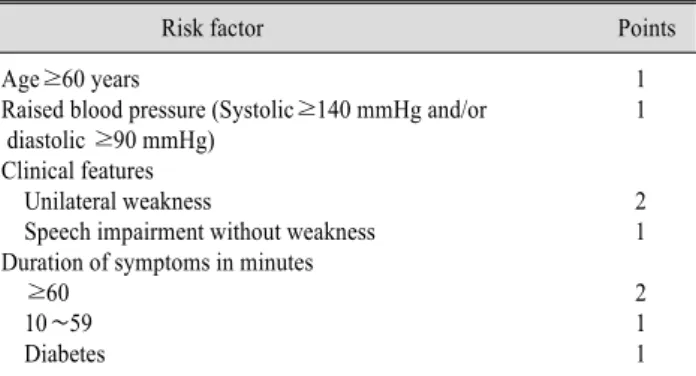
TIA가 있는 환자에서 뇌졸중으로 진행하거나 재발할 가능성을 예측하는 것은 임상에서 매우 중요하며 조기 재 활 측면에서도 알아야 하는 예측 인자이다. 이러한 예후 인자로 ABCD2 score7,8가 사용되어 왔으며 여기에 경동맥 과 뇌 영상에 관한 예후 정부를 추가한 것이 ABCD³-I score와 the recurrence risk estimator이다.9
ABCD2 score (Table 1)는 TIA 환자가 조기 재발하는 뇌 졸중으로 진행할 위험성을 경도(0∼3점), 중등도(4∼5점), 중증(6∼7점)으로 분류하였으며 7일에 뇌졸중 재발의 발 생율과 중증도를 가장 잘 반영한다. 하지만 경동맥 협착이 나 심방세동 같은 치료 가능한 정보를 포함하지 않으므로 경도라 할 지라도 이 점수와 상관 없이 치료 가능한 경동 맥 질환 또는 심방세동과 같은 심장 질환이 동반된 경우 적절한 진단과 치료가 필요하다.
Table 1. ABCD2 Score for the Prediction of Risk of Stroke
Risk factor Points
Age≥60 years 1
Raised blood pressure (Systolic≥140 mmHg and/or 1 diastolic ≥90 mmHg)
Clinical features
Unilateral weakness 2
Speech impairment without weakness 1 Duration of symptoms in minutes
≥60 2
10∼59 1
Diabetes 1
(2) 조기 이차예방을 위한 권고
급성기 뇌졸중 유니트와 항혈소판 치료, 항응고 치료가 조기 이차 예방을 위해 추천되지만 재활 영역에서 조기 재활하면서 고려해야 할 것으로 경동맥 혈관재개통(Caro- tid revascularization)이다. 따라서 경동맥 혈관재개통에 대한 최근 근거 중심의 조기 이차 예방을 위한 추천 사항 을 기술하고자 한다.
① 경동맥혈관재개통 권고 사항
- 최근 증상을 동반한 경동맥 영역의 TIA나 뇌경색 환자 에서 동측 내경동맥이 50∼99% 협착이 있는 경우 수술이 가능하고 임상적으로 안정 상태라면 가능한 1주일 이내에 빨리 경동맥 내막절제술(endarterectomy)을 시행하도록 해야 한다(근거수준 A).10,11
- 경동맥 내막절제술은 수술 전후 이환율 및 사망률이 5% 이하인 외과의사에 의해서 시행되어야 한다(근거수준 A).11
- 70세 이상의 환자에서는 경동맥 스텐트는 뇌졸중의 단기 위험률과 사망률이 높으므로 수술이 가능한 경우, 스 텐트보다는 경동맥 내막절제술이 더 적절하다(근거수준 A).11,12
70세 미만의 환자에서는 경동맥 스텐트가 내막절제술 보다 더 안전할 수 있다.12,13
- 기술적, 해부학적 또는 내과적인 이유로 경동맥 내막 절제술을 시행하지 못하는 환자의 경우 경동맥 스텐트가 고려된다(근거수준 A).13
② 경동맥혈관재개통과 관련된 예후
증상이 동반된 경동맥 협착에 환자에서 경동맥 내막절 제술과 관련된 수술 전후 기간에 뇌졸중 발생 위험율 또는 사망률은 약 7% (95% 신뢰구간 6.2∼8.0)이다.
수술 전후 기간에 위험이 증가하는 경우는 다음과 같다.
1) 여성환자; 2) 동반 질환: 대뇌반구 침범, 반대측 경동맥 폐쇄동반, 불규칙하거나 궤양이 있는 plaque, 당뇨병, 만 성폐쇄성 호흡질환, 허혈성 심장질환, 심장기능부전, 말초
동맥질환, 투석이 필요한 신장질환 환자; 3) 경동맥내막절 제술을 허혈성 뇌졸중 후 48시간 이내에 시행한 경우14,15 장기 예후와 관련하여, 적절한 내과적인 치료와 경동맥 내 막절제술을을 시행하는 경우에 증상을 동반한 70∼99%
경동맥 협착의 경우 48%에서, 50∼69% 협착의 경우 28%에서 5년 후 뇌졸중 발병이나 사망 위험을 감소시켰 다.
6개의 18개월에 걸친 2319명의 추적관찰 연구에서 내 막절제술과 비교하여 스텐트가 심한 경동맥 재협착의 위 험율이 높았으나(10.6% vs 4.4%; OR 2.41, 95% CI 1.28∼4.53), 뇌졸중의 발생률은 비슷하였다(5.6% vs 4.5%; OR 1.26, 95% CI 0.77∼2.04). CREST trial에서는 2년에 재협착과 폐쇄 발생률은 경동맥 스텐트와 내막절제 술에서 비슷하였다고 보고하였다(6.0% carotid artery stenting vs 6.3% carotid endarterectomy, hazard ratio [HR] 0.90, 95% CI 0.63∼1.29).16
2) 장기에 재발하는 뇌졸중 (1) 예후 예측
급성기 뇌졸중 후에 재발하는 위험률은 뇌졸중 발생 후 1년에 약 11.1% (95% CI 9.0∼13.3), 5년에 26.4%
(20.1∼32.8), 10년에 39.2% (27.2∼51.2)이다.17 장기적으로 재발하는 뇌졸중의 위험요인을 높이는 인 자로는 혈관위험인자(고연령, 고혈압, 당뇨병, 흡연), 증상 을 동반한 혈관 질환의 병력(뇌졸중, 심근경색, 말초동맥 질환), 불안정 혈관 질환(자주 재발하는 뇌 허혈성 질환) 색전증 원인(심방세동, 심장 또는 대동맥에 기인한 허혈성 뇌졸중), 뇌의 미세출혈이 있는 경우이다.18-20
심방세동이 있는 환자의 경우 뇌졸중의 증가 위험에 대 한 주요 예측 인자를 평가할 때 CHADS2와 CHA2DS2- VASc scores를 사용한다(Table 2).21,22
(2) 장기 이차예방을 위한 권고
항혈소판제 치료와 항응고 요법은 다른 저자의 약물치 료에서 다루므로 비약물 요법에 대한 기술을 위주로 혈압, 지질, 생활습관(흡연, 알코올섭취, 신체활동, 체중, 나트 륨, 균형 잡힌 식단)에 대한 추천 사항을 살펴보고자 한다.
① 혈압
- 혈압은 점진적으로 천천히 낮춘다. 다만 경동맥이나 척추뇌기저 폐쇄 질환이 있는 경우는 혈압 감소에 주의가 필요하다(근거수준 A).23,24
- 뇌졸중 후 혈압을 낮추기 시작하는 시점은 확실하지 않으나 병원에서 퇴원 전에는 시작되어야 한다(근거수준 B).23,24
- 혈압약의 선택은 환자의 동반 질환에 달려 있다. 안지
Table 2. Prevalence and Stroke Rate at 1 Year of CHADS2 and CHA2DS2-VASc Scores in 73 538 Patients with Non-Valvular Atrial Fibrillation22
CHADS2 CHA2DS2-VASc
Prevalence (%) Stroke rate at 1 year, % (95% CI) Prevalence (%) Stroke rate at 1 year, % (95% CI)
0 22 1.7% (1.5∼1.9) 8 0.8% (0.6∼1.0)
1 31 4.7% (4.4∼5.1) 12 2.0% (1.7∼2.4)
2 23 7.3% (6.9∼7.8) 18 3.7% (3.3∼4.1)
3 15 15.5% (14.6∼16.3) 23 5.9% (5.5∼6.3)
4 7 21.5% (20.0∼23.2) 19 9.3% (8.7∼9.9)
5 2 19.7% (16.9∼22.9) 12 15.3% (14.3∼16.2)
6 0.2 22.4% (14.6∼34.3) 6 19.7% (18.2∼21.4)
7 - - 2 21.5% (18.7∼24.6)
8 - - 0.4 22.4% (16.3∼30.8)
9 - - 0.1 23.6% (10.6∼52.6)
오텐신 전환 효소 억제제(또는 안지오텐신 II 수용체 길항 제)와 칼슘채널 차단제(또는 이뇨제)가 더 선호되는데 이 는 칼슘채널차단제와 이뇨제 등은 혈압의 변동성을 줄여 줄 수도 있다(근거수준 C).24
- 목표 수축기 혈압은 열공경색(lacunar infarction)을 가 진 환자에서 130 mmHg 이하로 낮추는 것이다(근거수준 B).25
- 근거 중심 뇌졸중 재활에서 고혈압 관련하여 혈압을 낮추면 특히 뇌내출혈의 병력을 가진 환자에서 뇌졸중의 위험성을 감소시킬 수 있다고 하였다(근거수준 1a).
2013년 발표된 Canadian Hypertension Education Pro- gram guidelines에 따르면 추천되는 혈압은 140/90 mmHg 이하로 유지 할 것을 권장하였고 치료 약제는 ACE inhi- bitor/이뇨제 복합 요법이 선호된다고 하였다.
② 지질
- LDL 콜레스테롤의 농도는 동맥경화에 의해 발생된 허 혈성 뇌졸중 환자나 TIA 환자에서 식사, 생활습관, 스타틴 치료를 통하여 감소 시켜야 한다(근거수준 A).26,27 LDL 콜 레스테롤의 농도 조절 목표치는 2 mmol/L (2 mmol/l은 약 77 mg/dl) 이하이다(근거수준 B).26,27
- 91,588명의 스타틴 치료 환자와 91,215명의 대조군 환자에 대한 31개의 무작위대조연구의 메타분석 결과 뇌 출혈의 발생률은 차이가 없었다(OR 1.08, 95% CI 0.88∼
1.32) 뇌졸중의 병력이 있는 환자에서 스타틴 치료를 한 경우 뇌출혈의 발생 위험이 높았다(AR 67% [95% CI 9∼
156]) and RR 91% [−8 to 395], respectively).
- 근거 중심 뇌졸중 재활에서 지질조절과 관련하여 허혈 성 뇌졸중이나 TIA 병력이 있는 환자에서 지질저하 효과 가 있는 스타틴 치료가 추천된다(근거수준 1a).
- 허혈성 뇌졸중이나 TIA 병력이 있는 환자에서 LDL 콜레스테롤은 적어도 50% 감소시키거나 70 mg/dl로 감소 시키는 것을 목표로 한다.
③ 생활습관 가. 흡연
- 뇌졸중 환자는 금연해야 한다(근거수준 B).28,29 - 약물요법(니코틴대체요법, bupropion, cytisine, or varenicline)과 행동요법을 병행하는 것이 고려되어야 한 다(근거수준 A).30
나. 알코올 섭취: 하루에 두 번 이하로, 남자의 경우 1주 에 14회 이하로 마시고 여자의 경우 1주에 9회 이하로 마 시도록 제한해야 한다(근거수준 C).28
다. 신체활동: 일상생활동작과 함께 1주에 4∼7일, 30∼60분 동안 중등도 신체 운동(걷기, 조깅, 자전거타기, 수영 등)이 시행되어야 한다. 심장 질환이 있는 고위험군 의 경우 의학적으로 검증된 운동 프로그램에 참여해야 한 다(근거수준 B).
근거 중심 뇌졸중 재활에서 신체활동과 관련하여 뇌졸 중의 발생 위험률을 25% 줄일 수 있으며 운동과 뇌졸중 발생 위험 사이에는 양적인 비례관계에 있다(제한적 근거 Level 2). 뇌졸중 위험률 감소를 위해 저강도나 중등도의 강도로 규칙적인 걷기(적어도 주1회, 30분 이상)가 필요하 며 운동의 강도가 세고 운동 시간이 길수록 효과가 크다.
④ 체중: 신체질량지수(BMI)가 18.5∼24.9 kg/m2로 유 지되어야 하며 허리둘레는 여자의 경우 80 cm (31.5 inch) 이하, 남자의 경우 94 cm (37 inch) 이하로 유지되어야 한 다(근거수준 B).28
⑤ 나트륨: 추천되는 적절한 나트륨 섭취량은 1500 mg (9∼50세), 1300 mg (50∼70세), 1200 mg (70세 이상)이 다. 하루 나트륨 섭취량은 연령에 상관없이 2300 mg을 넘 지 말아야 한다(근거수준 B).31,32
2011년 질병관리본부에서 국민건강영양조사를 실시한 결과 우리나라 국민의 나트륨 섭취량은 성별, 거주지역, 소득수준 등과 상관없이 모든 인구집단에서 높았으며 30∼
40대의 섭취 수준이 높았다. 남자(30∼49세)의 경우
WHO 권고기준 대비 3.4배인 6,808 mg 섭취하고 있으며 여자(30∼49세)의 경우 WHO 권고기준 대비 2.3배인 4,687 mg 섭취하고 있으므로 국내의 뇌졸중 환자들은 특 히 나트륨 섭취의 제한이 필요하다.
⑥ 균형 잡힌 건강 식단: 포화 지방, 콜레스테롤, 나트륨 이 적은 음식; 신선한 과일, 야채, 저지방 유제품, 섬유질, 잡곡, 식물성 단백질이 많은 음식을 섭취하도록 한다(근거 수준 B).32
3) 심방세동환자에서 뇌졸중 예방을 위한 비약물 접근 심방세동은 가장 흔한 심장 부정맥이며 뇌졸중의 중요 한 원인으로 알려져 왔다. 캐나다에서 모든 뇌졸중 환자의 1/6이 심방세동 때문에 발생하며 심방세동을 가지고 있는 75세 환자의 뇌졸중 발생률은 년간 8.1%에 해당한다. 심 방세동이 있는 뇌졸중은 심장의 색전에서 기인되며 이 가 운데 좌심방의 appendage (left atrial appendage, LAA)가 중요한 심장색전의 원인을 제공한다.
심방세동이 있는 환자의 뇌졸중 발생을 예방하는 방법 가운데 항응고 요법과 심방세동 ablation 치료는 본 종설 의 범위를 넘어가므로 다루지 않고 LAA가 심장 색전의 중요 원인이 되고 최근 수술적인 치료에 대한 최신 지견이 있으므로 이에 대하여 기술하고자 한다.
LAA는 제태 1st trimester 동안 배아의 좌심방으로부터 형성되는 것으로 정상 동방결절리듬(sinus rhythm)에서는 좌심방의 부분으로 유기적인 수축이 이루어진다. 심방세 동이 있는 경우 심방이 불규칙하게 수축하며 확장되고 저 류가 일어난다. 이때 LAA에서 응괴형성(clot formation)이 잘 일어난다.
이전의 연구에서 심방세동을 동반한 뇌졸중 환자 가운 데 70%가 심방 색전이 원인이었다.33,34 이 가운데 좌심방 혈전이 발견되는 경우 90%에서 LAA 내에서 발견된다.
항응고 요법을 시행하지 않은 심방세동이 있는 환자 233명 가운데 경식도 심장초음파를 시행한 경우 좌심방 혈전이 34명(15%)에서 발견되었으며 이 34명 가운데 33 명에서 LAA에서 혈전이 발견되었다.35 다른 연구에서는 비류마티스 심방세동 272명 환자에서 좌심방 혈전은 8%
발생률이었으며 좌심방 혈전가운데 LAA에서 100% 혈전 이 발견되었다.36
LAA가 심방세동 환자에서 주요 혈전 원인이 되므로 LAA occlusion이 심방세동을 가진 환자에서 뇌졸중의 발 생 위험을 감소시킬 수 있을 것이다. LAA occlusion은 1949년에 John Madden에 의해 처음 시행된 오래된 개념 이다.37 항응고치료의 한계와 심방세동의 위험성이 증가 하면서 새로이 조명되고 있다. 특히, 출혈의 위험이 있거
나 항응고치료에 제한이 있는 경우 LAA occlusion이 뇌졸 중 발생 위험을 낮출 수 있는 치료법으로 사용될 수 있다.
최근에 the European Society of Cardiology에서 승모판 수술을 시행한 심방세동 환자에서는 LAA occlusion을 권 고(근거수준 C, IIb)하였다. 또한 장기적으로 항응고 요법 을 시행하지 못하는 금기증 환자와 뇌졸중의 발생 위험이 높은 환자에서 경피적 LAA occlusion을 고려하라고 권고 하고 있다(근거수준 B, IIb).33
4) 뇌졸중 예방을 위한 심장 시술: PFO Closure 심방세동과 관련하여 LAA 심장색전증은 특히 노인 환 자에서 허혈성 뇌졸중 발생의 주요 원인으로 작용한다. 이 에 대하여 난원공개존(Patent foramen ovale, PFO)은 우측 혈액 순환으로부터 뇌로 통하는 통로가 되어 “모순 색전 증(paradoxical embolism)”으로 작용하며 젊은 환자의 원 인불명(cryptogenic)의 뇌졸중에서 중요한 인자로 생각되 고 있다.38
PFO는 태아혈액순환의 흔적이 남은 것으로 일차중격 과 이차중격이 붙지 않아 발생한다. 다인자 유전 경향과 관련 있으며 무작위 성인의 25%에서 우연히 발견되지만 임상 증상은 없다. PFO와 관련된 임상 질환으로 원인불명 (cryptogenic) 뇌졸중, Platypnea-orthodeoxia syndrome, 잠 수병, 편두통이 있다.38
원인불명뇌졸중은 모든 허혈성 뇌졸중의 약 40%에 해 당하며 1877년 Julius Cohnheim이 처음으로 PFO와의 관 련성에 대한 가설을 세웠다. 그럼에도 불구하고 원인불명 뇌졸중을 가진 환자에서 경피적 PFO closure의 역할에 대 해서는 근거가 부족하므로 수년 동안 이견의 여지가 있다.
PFO는 5 mm 이상으로 결손이 큰 경우, 안정 상태에서 지속적인 right-to-left shunting이 있는 경우, 심방중격꽈 리(atrial septal aneurysms, ASAs)가 있는 경우 paradoxical embolism의 위험성이 더 높다.
PFO 진단은 경흉부심장초음파를 가장 흔히 시행하지 만 PFO 진단의 민감도가 경식도초음파보다 낮다(TTE<
TEE; 20% vs 42% sensitivity). 따라서 임상적으로 PFO가 의심되는데 경흉부심장초음파에서 음성이거나 모호한 경 우 경식도초음파를 고려해야 한다.
원인불명 뇌졸중 환자에서 PFO closure에 대한 근거는 모호하지만 동맥경화가 없는 60세 미만의 젊은 환자이거 나 고위험 PFO 해부구조(안정 시 션트, 심방중격꽈리 등) 가 있는 경우에 시행해 볼 수 있다.
이 등9은 경식도심장초음파(TEE)를 시행하여 얻어진 해 부학적 특징과 PFO를 동반한 원인불명 뇌졸중 환자에서 뇌졸중 재발의 상관관계에 대한 종적인 추적관찰 연구를
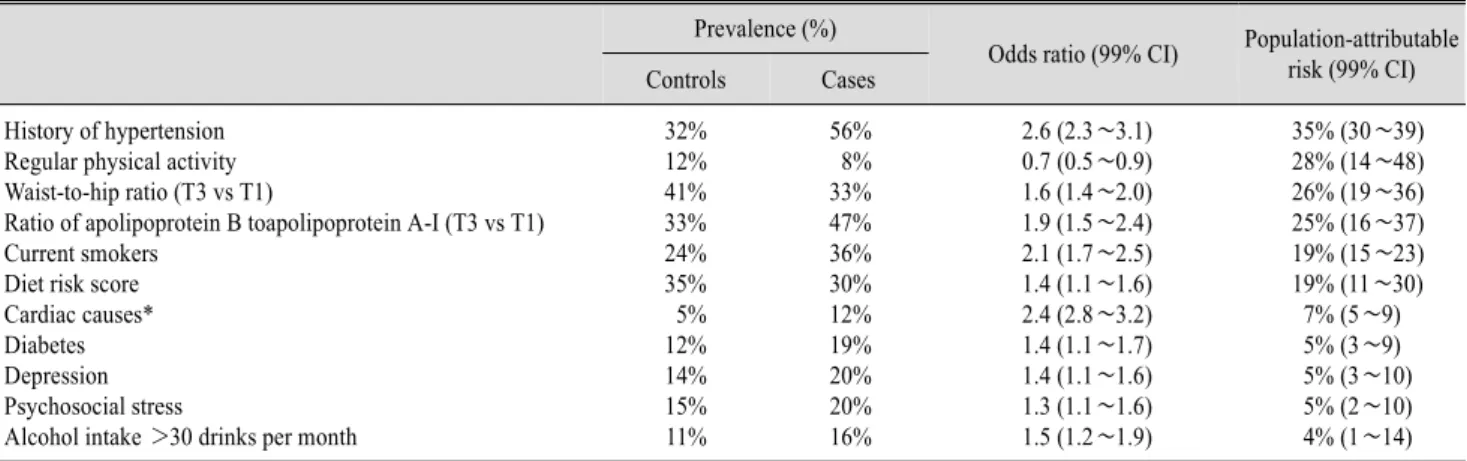
Table 3. Risk Factors for All Types of Stroke in 3000 Cases of Acute First Stroke Compared with 3000 Controls with No History of Stroke in the INTERSTROKE Study28
Prevalence (%)
Odds ratio (99% CI) Population-attributable risk (99% CI) Controls Cases
History of hypertension 32% 56% 2.6 (2.3∼3.1) 35% (30∼39)
Regular physical activity 12% 8% 0.7 (0.5∼0.9) 28% (14∼48)
Waist-to-hip ratio (T3 vs T1) 41% 33% 1.6 (1.4∼2.0) 26% (19∼36)
Ratio of apolipoprotein B toapolipoprotein A-I (T3 vs T1) 33% 47% 1.9 (1.5∼2.4) 25% (16∼37)
Current smokers 24% 36% 2.1 (1.7∼2.5) 19% (15∼23)
Diet risk score 35% 30% 1.4 (1.1∼1.6) 19% (11∼30)
Cardiac causes* 5% 12% 2.4 (2.8∼3.2) 7% (5∼9)
Diabetes 12% 19% 1.4 (1.1∼1.7) 5% (3∼9)
Depression 14% 20% 1.4 (1.1∼1.6) 5% (3∼10)
Psychosocial stress 15% 20% 1.3 (1.1∼1.6) 5% (2∼10)
Alcohol intake >30 drinks per month 11% 16% 1.5 (1.2∼1.9) 4% (1∼14)
Control participants were matched with cases for age and sex, and were assessed in 22 countries between 2007 and 2010. The multivariate model was adjusted for age, sex, and region. T3: highest tertile. T1: lowest tertile. *Cardiac causes include atrial fibrillation or flutter, previous myocardial infarction, rheumatic valve disease, or prosthetic valve disease.
실시하였다. TEE를 시행한 1,014명의 급성 허혈성 뇌졸 중 환자 가운데 184명이 PFO를 동반한 원인불명 뇌졸중 환자였으며 181명의 추적관찰 자료(평균 3.5년)를 얻었 다. 이 가운데 14명(7.7%)에서 뇌졸중 재발이 있었으며 다변량분석 결과 atrial septal aneurysm, hypermobility of the atrial septum, PFO 크기가 뇌졸중 재발의 독립적 예측 인자였다.39
3년 내에 뇌졸중 재발을 예측하는 PFO의 적절한 cutoff 수치는 3.0 mm (95% CI 2.1 to 3.7 mm, p<0.001)이며 민감도는 90%이고 특이도는 79.4%이다.39
5) 뇌졸중의 위험인자 분석
INTERSTROKE 역학적 연구 데이터는 건강하지 않은 생활 습관으로부터 상당 부분의 뇌졸중이 기인한다는 것 을 말해주고 있다(Table 3). 따라서 금연, 과도한 알코올 섭취제한, 음식 조절 및 저염식이, 고혈압관리로 뇌졸중의 발생 위험을 낮출 수 있다.
제2형 당뇨병 환자에 대한 8개의 RCT 메타분석에 따르 면 일반적인 치료(n = 15,844)와 비교하여 혈당강하제나 인슐린을 이용한 집중치료(n = 17,742)의 경우 5년 후에 뇌졸중의 위험률을(RR 0.96, 99% CI 0.83∼1.13) 또는 사 망률을 더 낮추지 못하였다(RR 1.04, 99% CI 0.91∼
1.19).40 집중치료는 심근경색(RR 0.85, 99% CI 0.74∼
0.96)과 미세알부민뇨증(0.90, 0.85∼0.96) 발생을 낮추었 지만 심한 저혈당(2.33, 1.62∼3.36)은 증가하였다. 따라 서 제2형 당뇨병에서 혈당 조절에 대한 더 많은 RCT 연구 가 필요하다.
결 론
뇌졸중 재발은 모든 뇌졸중의 25∼30%를 차지하므로 정확한 진단과 원인 규명이 필요하다. 재발하는 뇌졸중의 적절한 이차예방을 위해서도 원인 인자 분석과 동반된 기 저의 심뇌혈관 질환을 밝히고 치료해야 한다. 뇌졸중 조기 재발과 장기 재발의 예후를 예측하고 증상이 동반된 경동 맥 협착의 재개통 권고 사항을 숙지해야 한다. 노인환자에 서 심방세동이 동반되는 경우 항응고 요법을 시행하기 어 려우면 LAA occlusion에 대하여 고려할 수 있다. 젊은 원 인 불명 뇌졸중 환자가 PFO를 가지고 있는 경우 정기적인 심장초음파 추적 관찰이 필요하며 고위험 해부학적 구조 를 가지고 있는 경우 PFO 치료를 고려할 수 있다. 역학데 이터는 상당 부분의 뇌졸중이 건강하지 않은 생활습관에 서 기인한다는 것을 말해주고 있으므로 뇌졸중 예방을 위 해서는 생활습관 조절이 필요하다. 재활의학 영역에서도 뇌졸중 재발을 줄이기 위해서는 이차 뇌졸중 예방에 대한 연구 결과를 임상에 적용하는 것이 필요하다
근거수준41
ㆍLevel A=evidence from meta-analyses of randomized controlled trials or directly from randomised controlled trials. Desirable effects clearly outweigh undesirable effects, or vice versa.
ㆍLevel B=single randomised controlled trial or well-designed observational study with strong evidence; or well-designed cohort or case-control analytical study; or several time series or dramatic results of an uncontrolled
experiment. Desirable effects closely balanced with undesirable effects.
ㆍLevel C=at least one well-designed, non-experimental descriptive study (eg, comparative studies, correlation stu- dies, case studies) or expert committee reports, opinions and/or experience of respected authorities, including consensus from development and/or reviewer groups.
참 고 문 헌
1) Lozano R, Naghavi M, Foreman K, Lim S, Shibuya K, Aboyans V, et al. Global and regional mortality from 235 causes of death for 20 age groups in 1990 and 2010: a systematic analysis for the Global Burden of Disease Study 2010. Lancet. 2012;380:2095-2128 2) Murray CJ, Vos T, Lozano R, Naghavi M, Flaxman AD, Michaud C,
et al. Disability-adjusted life years (DALYs) for 291 diseases and in- juries in 21 regions, 1990-2010: a systematic analysis for the Global Burden of Disease Study 2010. Lancet. 2012;380:2197-2223 3) Rothwell PM, Coull AJ, Giles MF, Howard SC, Silver LE, Bull LM,
et al, and the Oxford Vascular Study. Change in stroke incidence, mor- tality, case-fatality, severity, and risk factors in Oxfordshire, UK from 1981 to 2004 (Oxford Vascular Study). Lancet. 2004;363:1925-1933 4) Chandratheva A, Mehta Z, Geraghty OC, Marquardt L, Rothwell PM,
and the Oxford Vascular Study. Population-based study of risk and predictors of stroke in the first few hours after a TIA. Neurology.
2009;72:1941-1947
5) Giles MF, Rothwell PM. Risk of stroke early after transient ischaemic attack: a systematic review and meta-analysis. Lancet Neurol.
2007;6:1063-1072
6) Wang Y, Wang Y, Zhao X, Liu L, Wang D, Wang C, et al, and the CHANCE investigators. Clopidogrel with aspirin in acute minor stroke or transient ischemic attack. N Engl J Med. 2013;369:11-19 7) Giles MF, Rothwell PM. Systematic review and pooled analysis of
published and unpublished validations of the ABCD and ABCD2 transient ischemic attack risk scores. Stroke. 2010;41:667-673 8) Chandratheva A, Geraghty OC, Luengo-Fernandez R, Rothwell PM,
and the Oxford Vascular Study. ABCD2 score predicts severity rather than risk of early recurrent events after transient ischemic attack.
Stroke. 2010;41:851-856
9) Arsava EM, Furie KL, Schwamm LH, Sorensen AG, Ay H. Prediction of early stroke risk in transient symptoms with infarction: relevance to the new tissue-based definition. Stroke. 2011;42:2186-2190
10) Rothwell PM, Eliasziw M, Gutnikov SA, Warlow CP, Barnett HJ, and the Carotid Endarterectomy Trialists Collaboration. Endarterectomy for symptomatic carotid stenosis in relation to clinical subgroups and timing of surgery. Lancet. 2004;363:915-924
11) Rerkasem K, Rothwell PM. Carotid endarterectomy for symptomatic carotid stenosis. Cochrane Database Syst Rev. 2011;4:CD001081 12) Bonati LH, Fraedrich G, and the Carotid Stenting Trialists’Collabor-
ation. Age modifies the relative risk of stenting versus endarterectomy for symptomatic carotid stenosis−a pooled analysis of EVA-3S, SPACE, and ICSS. Eur J Vasc Endovasc Surg. 2011;41:153-158 13) Bonati LH, Lyrer P, Ederle J, Featherstone R, Brown MM.
Percutaneous transluminal balloon angioplasty and stenting for car- otid artery stenosis. Cochrane Database Syst Rev. 2012;9:CD000515.
14) Bekelis K, Bakhoum SF, Desai A, Mackenzie TA, Goodney P, Labropoulos N. A risk factor-based predictive model of outcomes in carotid endarterectomy: the National Surgical Quality Improvement Program 2005-2010. Stroke. 2013;44:1085-1090
15) Stromberg S, Gelin J, Osterberg T, Bergstrom GM, Karlstrom L, Osterberg K, and the Swedish Vascular Registry (Swedvasc) Steering Committee. Very urgent carotid endarterectomy confers increased procedural risk. Stroke. 2012;43:1331-1335
16) Lal BK, Beach KW, Roubin GS, Lutsep HL, Moore WS, Malas MB, et al, and the CREST Investigators. Restenosis after carotid artery stenting and endarterectomy: a secondary analysis of CREST, a rando- mised controlled trial. Lancet Neurol. 2012;11:755-763
17) Mohan KM, Wolfe CD, Rudd AG, Heuschmann PU, Kolominsky- Rabas PL, Grieve AP. Risk and cumulative risk of stroke recurrence:
a systematic review and meta-analysis. Stroke. 2011;42:1489-1494 18) Purroy F, Jiménez Caballero PE, Gorospe A, Torres MJ, Alvarez-
Sabin J, Santamarina E, et al, and the Stroke Project of the Spanish Cerebrovascular Diseases Study Group. Recurrent transient ischae- mic attack and early risk of stroke: data from the PROMAPA study.
J Neurol Neurosurg Psychiatry. 2013;84:596-603
19) Ois A, Cuadrado-Godia E, Rodriguez-Campello A. Relevance of stroke subtype in vascular risk prediction. Neurology. 2013;81:575- 580
20) Charidimou A, Kakar P, Fox Z, Werring DJ. Cerebral microbleeds and recurrent stroke risk: systematic review and meta-analysis of pro- spective ischemic stroke and transient ischemic attack cohorts. Stroke.
2013;44:995-1001
21) Lip GY, Nieuwlaat R, Pisters R, Lane DA, Crijns HJ. Refining clinical
risk stratification for predicting stroke and thromboembolism in atrial fibrillation using a novel risk factor-based approach: the Euro Heart Survey on atrial fibrillation. Chest. 2010;137:263-272
22) Olesen JB, Lip GY, Hansen ML, Hansen PR, Tolstrup JS, Lindhardsen J, et al. Validation of risk stratification schemes for predicting stroke and thromboembolism in patients with atrial fibrillation: nationwide cohort study. BMJ. 2011;342:124
23) Liu L, Wang Z, Gong L, Zhang Y, Thijs L, Staessen JA, et al. Blood pressure reduction for the secondary prevention of stroke: a Chinese trial and a systematic review of the literature. Hypertens Res.
2009;32:1032-1040
24) Law MR, Morris JK, Wald NJ. Use of blood pressure lowering drugs in the prevention of cardiovascular disease: meta-analysis of 147 rand- omised trials in the context of expectations from prospective epi- demiological studies. BMJ. 2009;338:b1665
25) Benavente OR, Coffey CS, Conwit R, Hart RG, McClure LA, Pearce LA, et al, and the SPS3 Study Group. Blood-pressure targets in patients with recent lacunar stroke: the SPS3 randomised trial. Lancet.
2013;382:507-515
26) Amarenco P, Labreuche J. Lipid management in the prevention of stroke: review and updated meta-analysis of statins for stroke prevention. Lancet Neurol. 2009;8:453-463
27) Baigent C, Blackwell L, Emberson J, Holland LE, Reith C, Bhala N, et al, and the Cholesterol Treatment Trialists’ (CTT) Collaboration.
Efficacy and safety of more intensive lowering of LDL cholesterol:
a meta-analysis of data from 170,000 participants in 26 randomised trials. Lancet. 2010;376:1670-1681
28) O'Donnell MJ, Xavier D, Liu L, Zhang H, Chin SL, Rao-Melacini P, et al, and the INTERSTROKE investigators. Risk factors for ischae- mic and intracerebral haemorrhagic stroke in 22 countries (the INTERSTROKE study): a case-control study. Lancet. 2010;376:112- 123
29) Kim J, Gall SL, Dewey HM, Macdonell RAL, Sturm JW, Thrift AG.
Baseline smoking status and the long-term risk of death or nonfatal vascular event in people with stroke: a 10-year survival analysis.
Stroke. 2012;43:3173-378
30) Cahill K, Stevens S, Perera R, Lancaster T. Pharmacological inter-
ventions for smoking cessation: an overview and network meta- analysis. Cochrane Database Syst Rev. 2013;5:CD009329 31) He FJ, Li J, Macgregor GA. Effect of longer term modest salt reduction
on blood pressure: Cochrane systematic review and meta-analysis of randomised trials. BMJ. 2013;346:1325
32) Hankey GJ. Nutrition and the risk of stroke. Lancet Neurol.
2012;11:66-81
33) Whitlock RP, Hanif H, Danter M. Nonpharmacologic approaches to stroke prevention in atrial fibrillation. Can J Cardiol. 2013;29:S79-86 34) Blackshear JL, Odell JA. Appendage obliteration to reduce stroke in
cardiac surgical patients with atrial fibrillation. Ann Thorac Surg.
1996;61:755-759
35) Manning WJ, Weintraub RM, Waksmonski CA, Haering JM, Rooney PS, Maslow AD, et al. Accuracy of transesophageal echocardiog- raphy for identifying left atrial thrombi. A prospective, intraoperative study. Ann Intern Med. 1995;123:817-822
36) Leung DY, Black IW, Cranney GB, Hopkins AP, Walsh WF.
Prognostic implications of left atrial spontaneous echo contrast in non- valvular atrial fibrillation. J Am Coll Cardiol. 1994;24:755-762 37) Madden JL. Resection of the left auricular appendix; a prophylaxis
for recurrent arterial emboli. J Am Med Assoc. 1949;140:769-772 38) Freixa X, Arzamendi D, Tzikas A, Noble S, Basmadjian A, Garceau
P, et al. Cardiac procedures to prevent stroke: patent foramen ovale closure/left atrial appendage occlusion. Can J Cardiol. 2014;30:87- 95
39) Lee JY, Song JK, Song JM, Kang DH, Yun SC, Kang DW, et al.
Association between anatomic features of atrial septal abnormalities obtained by omni-plane transesophageal echocardiography and stroke recurrence in cryptogenic stroke patients with patent foramen ovale. Am J Cardiol. 2010;106:129-134
40) Boussageon R, Bejan-Angoulvant T, Saadatian-Elahi M. Effect of in- tensive glucose lowering treatment on all cause mortality, car- diovascular death, and microvascular events in type 2 diabetes:
meta-analysis of randomised controlled trials. BMJ. 2011;343:4169 41) Hankey GJ. Secondary stroke prevention. Lancet Neurol. 2014;13:
178-194