Sulfolane 용매를 이용한 톨루엔 회수공정의 모사에 관한 연구
조 정 호 동양대학교생명화학공학과
750-711 경북영주시풍기읍교촌동 1 (2005년 10월 22일접수, 2006년 1월 30일채택)
A Study on the Simulation of Toluene Recovery Process using Sulfolane as a Solvent
Jungho Cho
Department of Chemical Engineering, Dong Yang University, 1, Kyochon-dong, Poongki-eup, Youngju, Kyungbook 750-711, Korea (Received 22 October 2005; accepted 30 January 2006)
요 약
본연구에서는용매로써 sulfolane을사용하고 2기의증류탑을이용하여톨루엔이과량함유된비방향족혼합물로
부터고순도의톨루엔을생산해내는추출증류공정에대한전산모사작업을수행하였다. Sulfolane 용매를이용한추
출증류공정의모사를위한열역학모델식으로는 NRTL 액체활동도계수모델식을사용하였으며범용성화학공정모
사기인 Aspen Plus 12.1을사용하였다. 모사결과최종제품으로얻어진톨루엔의순도는 99.8 wt%였으며, 원료에대
한회수율은 99.65%로나타남을알수있었다.
Abstract −In this study, computer modeling and simulation works were performed to obtain nearly pure toluene prod- uct from toluene containing non-aromatic compounds using sulfolane as a solvent through an extractive distillation pro- cess. NRTL liquid activity coefficient model was adopted for phase equilibrium calculations and Aspen Plus release 12.1, a commercial process simulator, was used to simulate the extractive distillation process. In this study, it was con- cluded that the toluene product with a purity of 99.8 percent by weight and a recovery of 99.65 percent was obtained through an extractive distillation process.
Key words: Extractive Distillation, Solvent, NRTL Liquid Activity Coefficient Model, Simulation, Modeling
†To whom correspondence should be addressed.
E-mail: [email protected]
1. 서 론
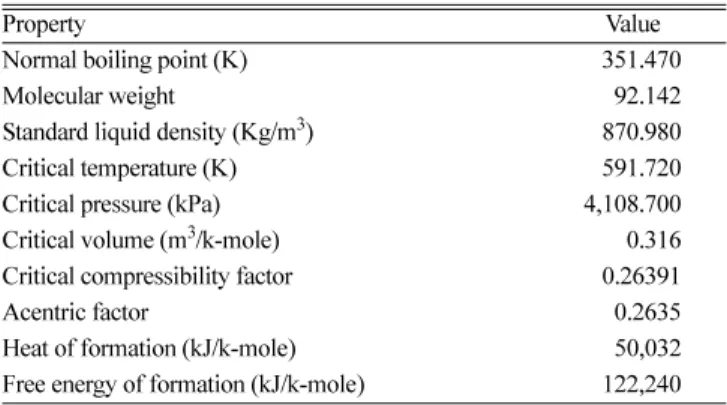
톨루엔은뛰어난용해력과증발속도를지닌대표적인방향족용 제로서페인트, 잉크, 접착제등코팅전분야와농약용제및폴리우 레탄의원료와휘발유에배합하여옥탄가향상용원료등으로광범 위하게사용[1]되는것으로이에대한기본적인물성치들을 Table 1
에나타내었다.
톨루엔과같은방향족성분은벤젠이나에틸벤젠등과같은다른 방향족성분이나메틸사이클로헥산이나에틸사이클로헥산또는 옥탄성분들과같은끓는점이비슷한다른탄화수소성분들과혼합 되어있는경우에는분리하기어려워진다. 따라서증류탑의단수를 매우높이거나환류비를증가하여분리하거나또는여러기의증류 탑을사용해서분리하여야하기때문에초기투자비용이많이소요 된다. 따라서톨루엔과선택적으로친화성이강한용매인 sulfolane
이나 normal formyl morpholine을사용해서추출증류[2, 3]하는방
법을사용하거나 sulfolane 용매를이용한추출공정[4]을이용하면
효과적으로비방향족성분들로부터톨루엔성분을분리회수할수 있다.
본연구에서는용매로써 sulfolane을사용하는추출증류공정을통
Table 1. The basic properties of toluene
Property Value
Normal boiling point (K) 351.470
Molecular weight 92.142
Standard liquid density (Kg/m3) 870.980
Critical temperature (K) 591.720
Critical pressure (kPa) 4,108.700
Critical volume (m3/k-mole) 0.316
Critical compressibility factor 0.26391
Acentric factor 0.2635
Heat of formation (kJ/k-mole) 50,032
Free energy of formation (kJ/k-mole) 122,240
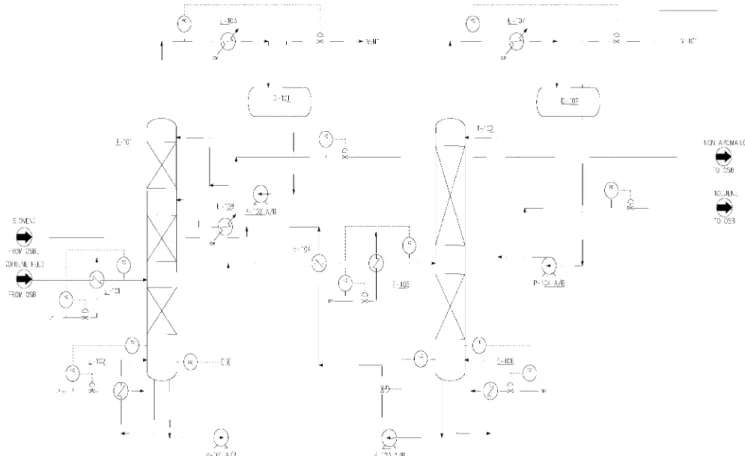
해서비방향족성분들로부터톨루엔성분을회수해내는공정에대 한전산모사작업을수행하였다. 본연구에서사용한추출증류공정 은통상적으로 2기의증류탑으로구성되는데공정개념도는 Fig. 1에
나타낸바와같다. 첫번째증류탑인 T-101은추출증류탑으로써그
역할은원료액인방향족과비방향족혼합물로부터톨루엔과같은 방향족성분과선택적으로친화성이강한용매인 sulfolane을사용 해서톨루엔성분만을선택적으로추출해내는것이다. 첫번째증 류탑을추출증류탑이라고하는것은원리상원료액도액상이고용 매를사용하기때문에추출에해당하지만탑상에응축기가있고, 탑
저에재비기가있으며탑내에서는증기와액이평형단으로접촉하 기때문에증류에해당하므로추출과증류가동시에하나의 column
에서이루어지기때문에추출증류탑이라고하였다. 용매를사용한 추출증류공정의원리는 Fig. 2에개념적으로나타내었다. Fig. 2에
나타낸것과같이끓는점이비슷하여상대휘발도차이가별로나지 않는방향족과비방향족성분들사이에방향족성분과선택적으로 친화성이강한끓는점이높은용매가추가됨으로인하여방향족성 분의상대휘발도를크게낮추어주기때문에톨루엔성분을추출증
류탑하부로얻어내고비방향족성분들은 raffinate로써추출증류탑
상부로얻어내게된다.
한편, extract로써추출증류탑하부에서얻어지는용매와용매에
선택적으로녹아있는톨루엔성분은두번째증류탑인용매회수
탑(T-102)의탑저제품과열교환된후용매회수탑의중간지점으
로주입된다. 여기에서는용매와톨루엔성분의분리가이루어지는 데, 톨루엔성분이탑상제품으로얻어지고용매인 sulfolane은탑저 에서얻어져서열교환된후추출증류탑으로환류된다. 용매회수탑
은상압보다약간낮은감압하에서운전하여야하기때문에진공
시스템(V-101)이필요한데그이유는첫째본연구에적용한대상
공정에서공급가능한스팀의공급온도에맞추기위함과두번째로
는용매인 sulfolane이열에의한변성을막기위해서용매회수탑
의운전온도를일정온도이하로낮게유지하기위해서이다.
추출증류공정의톨루엔회수를위한용매로써 sulfolane을선정한 기준은 Fig. 3[5]과같이용매인 sulfolane과방향족성분인벤젠성
분및비방향족성분인노말헵탄사이의삼성분계액액상평형실 험데이터와이를잘설명할수있는열역학모델식의이성분계상 호작용매개변수를문헌을통해서충분히얻을수있기때문이다.
추출증류공정의전산모사를위한조작변수는여러가지가가능
Fig. 1. A schematic diagram of an extractive distillation process for toluene recovery from non aromatic components using sulfolane as a solvent.
Fig. 2. Principles of extractive distillation process using sulfolane as a solvent.
하지만본연구에서는원하는순도및수율을얻기위한용매의 순환유량과추출증류탑과용매회수탑의설계및운전조건을 결 정하였다.
2. 이 론
용매로써 sulfoane을사용하여톨루엔회수를위한추출증류공정
의모델링을위한기액및액액상평형추산을위한열역학모델식 으로 Renon과 Prausnitz가제안한 NRTL(non random two liquid mixture) 액체활동도계수모델식[6]을사용하였다. 혼합물중의 ‘i’
성분에대한액체활동도계수표현식은다음의 (1)식과같이표현 된다.
(1)
위의 (1)식에서τij와 Gij는각각실험데이터와의편차를최소화하 기위한최적의이성분계 상호작용매개변수로써다음의 (2)식, (3)식과같이나타낼수있다.
(2) (3)
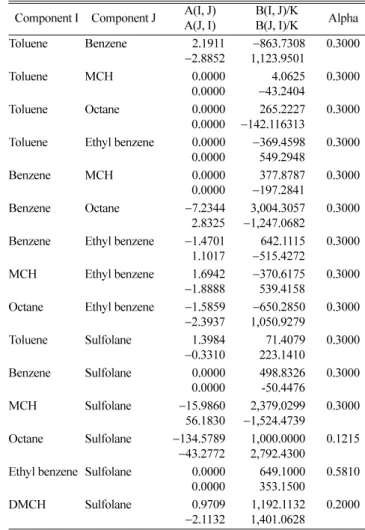
위의 (2)식에서온도 T는절대온도이며, 각각의이성분계에대하여 온도의존항까지포함하여, aij, aji, bij, bji및 aij의다섯개의상호 작용매개변수를가진다. Table 2에는각각의방향족성분과비방
향족성분및용매사이의이성분계의기액및액액상평형실험
데이터를잘추산할수있는 NRTL 기액및액액상평형매개변수
를나타내었다. 또한 Aspen Plus 화학공정모사기에내장되어있 지않은이성분계상호작용매개변수에대해서는문헌을통해서구 한이성분계상호작용매개변수값을사용하였으며문헌을통해서 도구할수없는이성분계쌍에대한열역학적인비이상성을설명 하기위해서 UNIFAC[7] Option을사용하였다.
3. 톨루엔 회수 추출증류공정 모델링 및 모사 톨루엔회수추출증류공정의모델링을위하여상용의화학공정 모사기인 Aspen Technology사의 Aspen Plus release 12.1을사용하 였다. 정상상태의증류탑거동을해석하기위한알고리즘으로는
Aspen Plus 내에내장되어있는 SUM-RATES 알고리즘[8]을사용
하였다. 다음의 Fig. 4는 SUM-RATES 알고리즘을이용해서증류탑 의거동을해석하기위한임의의단을도식적으로나타낸것이다.
Fig. 4에나타낸임의의증류단에대한성분물질수지, 에너지수지,
기액평형관계식및조성의합에대한제한조건은다음의 (4)식과 (8)식사이에나타내었다.
(4)
γi
ln τjiGjixj
∑j
Gkixk
∑k
---
= xjGij
Gkjxk
∑k
--- τij
xkτkjGkj
∑k
Gkjxk
∑k
--- –
⎝ ⎠
⎜ ⎟
⎜ ⎟
⎜ ⎟
⎛ ⎞
∑j
+
τij aij bij
T--- +
=
Gij = exp(–αijτij)
Mi j, =exp(Xi j, )Li+exp(Yi j, )Vi–exp(Xi 1 j– , )(Li 1– –Li 1D– )
Yi+1 j,
( )(Vi 1+ –Vi 1D+ )
exp
– –fi jL, –fi 1 jV– ,
i = 1 NT j 1 NC, , = , Fig. 3. Ternary liquid-liquid equilibria data and its prediction with
NRTL model for sulfolane/benzene/normal heptane component.
Table 2. NRTL binary interaction parameters for each binary set Component I Component J A(I, J)
A(J, I) B(I, J)/K
B(J, I)/K Alpha
Toluene Benzene 2.1911
−2.8852 −863.7308
1,123.9501 0.3000
Toluene MCH 0.0000
0.0000 4.0625
−43.2404 0.3000
Toluene Octane 0.0000
0.0000 265.2227
−142.116313 0.3000 Toluene Ethyl benzene 0.0000
0.0000 −369.4598
549.2948 0.3000
Benzene MCH 0.0000
0.0000 377.8787
−197.2841 0.3000
Benzene Octane −7.2344
2.8325 3,004.3057
−1,247.0682 0.3000 Benzene Ethyl benzene −1.4701
1.1017 642.1115
−515.4272 0.3000
MCH Ethyl benzene 1.6942
−1.8888 −370.6175
539.4158 0.3000 Octane Ethyl benzene −1.5859
−2.3937 −650.2850
1,050.9279 0.3000
Toluene Sulfolane 1.3984
−0.3310 71.4079
223.1410 0.3000
Benzene Sulfolane 0.0000
0.0000 498.8326
-50.4476 0.3000
MCH Sulfolane −15.9860
56.1830 2,379.0299
−1,524.4739 0.3000 Octane Sulfolane −134.5789
−43.2772 1,000.0000
2,792.4300 0.1215 Ethyl benzene Sulfolane 0.0000
0.0000 649.1000
353.1500 0.5810
DMCH Sulfolane 0.9709
−2.1132 1,192.1132
1,401.0628 0.2000
(5) (6) (7) (8)
여기에서 Fi는 임의의 ‘i’단으로 주입되는 총 몰유량을, Li는 임의의 ‘i’단으로부터 나오는 총 액상 몰유량을, Vi는 임의의 ‘i’단 으로부터 나오는 총 기상 몰유량을, Qi는 임의의 ‘i’단으로 주입되 는 시간당 열량을, Ti는 임의의 ‘i’단의 온도를, Xi,j는 액상의 몰분 률에 자연로그를 취한 값을, Yi, j는 기상의 몰분률에 자연로그를 취 한 값을, NC는 성분의 수를, NT는 이론단수를 나타낸다.
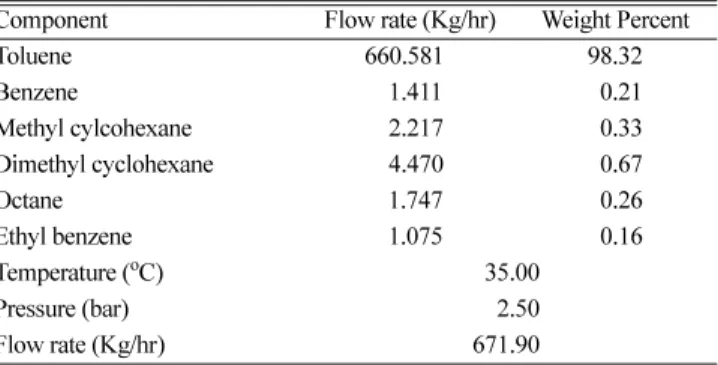
원료의 조성과 온도, 압력 및 유량 조건은 아래의 Table 3에 나타 낸 바와 같다. Aspen Plus 화학공정 모사기를 이용해서 구현한 추 출증류공정은 Fig. 5에 나타내었다.
3-1. 추출증류탑의 모사
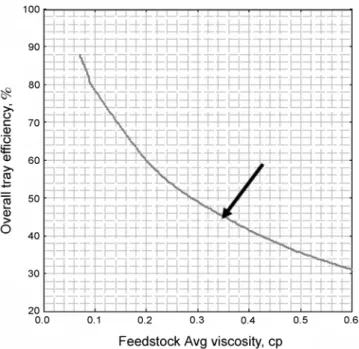
Sulfolane을 용매로 이용하여 비방향족 혼합물로부터 톨루엔 성분 을 선택적으로 회수하는 추출증류탑을 Fig. 6에 도식적으로 나타내었 다. Fig. 6에 나타낸 것과 같이 이론단수는 응축기와 재비기를 포함하 여 35단으로 정하였다. 그 이유는 현재 국내에서 가동되고 있는 용매 를 이용한 방향족 회수 추출증류탑의 실제단수가 75단[9]인데 비하여 증류탑의 효율은 45% 정도로 추산되기 때문이다. 증류탑의 단 효율 계산에 대한 근거는 Gerald[10]가 제안한 증류탑의 효율은 증류탑의 탑상과 탑저의 평균 온도 조건하에서 원료 액상의 점도 함수로 표현 한 것으로써 이는 Fig. 7에 도식적으로 나타내었다. Fig. 7에 나타낸 것과 같이 원료 액의 평균 점도가 0.34 cP 이므로 점도에 대한 증류탑 의 효율 상관관계식에 의하여 추출증류탑의 효율이 45% 가량 되므로 이를 적용하여 이론단수를 35단으로 정하였다. 원료 유량에 대한 용 매의 주입 유량은 무게 비로 3.61:1로 정하였다. 이는 주어진 추출증 류탑의 이론단수 조건하에서 톨루엔 회수율을 만족시키는 최적의 용 매 순환유량으로 정한 것이다. 추출증류탑에 대한 장치 및 운전 조 건은 Table 4에 정리하였다. Table 4에 나타낸 것과 같이 추출증류탑 의 모사를 위해서 원료는 21단에 주입하였으며, 용매는 7단으로 주 입하였다. 그 결과 환류비는 40.51이며 환류 유량으로는 500 Kg/hr Ei=LiHiL)+ViHiV)–(Li 1– –LDi 1– )H)iL–(Vi 1+ –VDi 1+ )Hi 1V+)
i = 1 NT, –Qi–FiLHFLi) –Fi 1V+ Hi 1FV+) Qi j, = Yi j, –Xi j, – ln(Ki j, ),i = 1 NT j, , = 1 NC,
Si 1 exp(Xi j, )
j=1 NC
∑ ,i =1 NT,
–
=
Si′ 1 exp(Yi j, )
j=1 NC
∑ ,i = 1 NT,
–
=
Table 3. Feed stream information
Component Flow rate (Kg/hr) Weight Percent
Toluene 660.5811 98.32
Benzene 11.411 10.21
Methyl cylcohexane 12.217 10.33
Dimethyl cyclohexane 14.470 10.67
Octane 11.747 10.26
Ethyl benzene 11.075 10.16
Temperature (oC) 35.00
Pressure (bar) 12.50
Flow rate (Kg/hr) 671.901
Fig. 4. Schematic of a simple stage for the sum-rates algorithm.
Fig. 5. Process flow sheet for the extractive distillation process of Aspen Plus 12.1.
가 계산되었으며 톨루엔의 순도는 99.65%를 얻었으며 raffinate에서 톨루엔의 함량은 무게비로 18.90%가 얻어졌다.
3-2. 용매 회수탑의 모사
추출증류탑 하부에서 용매에 용해된 톨루엔이 얻어진다. 이 extract 성분은 열교환되어서 더욱 가열되어진 후에 용매 회수탑으
로 주입되어서 용매와 톨루엔 사이의 분리가 이루어진다. 용매 회 수탑은 전형적인 증류탑의 배열을 가지는데 Fig. 8에 용매 회수탑 을 도식적으로 나타내었다. Fig. 8에 나타낸 것과 같이 이론단수는 응축기와 재비기를 포함하여 10단으로 정하였다. 그 이유는 현재 국 내에서 가동되고 있는 용매를 이용한 방향족 회수 추출증류탑의 실 제단수가 40단인데 비하여 증류탑의 효율은 25% 정도로 추산되기 때문이다. 용매 회수탑에 대한 장치 및 운전 조건은 Table 5에 정리 하였다. Table 5에 나타낸 것과 같이 용매 회수탑의 모사를 위해서 원료는 중간 단인 제 5단에 주입하였다. 그 결과 환류비는 0.5이며 환류 유량으로는 329.75 Kg/hr가 계산되었으며 탑상 제품에서 톨루 엔의 순도는 99.81 wt% 이상을 얻을 수 있었다.
Fig. 6. A schematic diagram of the extractive distillation column.
Fig. 7. Overall tray efficiencies as a function of average feedstock liquid viscosity (Viscosity is average of feed as liquid at top and bottom temperatures of the column).
Table 4. Input data, specified parameters and output data for the simulation of extractive distillation column
Input/output data and specified parameters Value Input data
Feed flow rate (Kg/hr) 671.90
Solvent flow rate (Kg/hr) 2,418.50
Feed toluene composition (weight %) 98.32 Specified design and operating parameters
Theoretical number of stage 35
Operating pressure at column top (bar) 1.20
Feedstock feed tray location 21
Solvent feed tray location 7
Reflux ratio 40.51
Reflux rate (Kg/hr) 500.00
Output data
Condenser duty (Kcal/hr) −57,279.50
Reboiler duty (Kcal/hr) 124,459.73
Toluene recovery (%) 99.65
Toluene weight percent at raffinate 18.90
Fig. 8. A schematic diagram of the solvent recovery column.
4. 결과 및 고찰
원료는 Table 3과같은온도, 압력, 유량및조성을갖고생산되
는톨루엔의순도는 99.8 wt%이상의제품을생산하는것을목표
로전산모사를수행하였다. 한편, 추출증류탑에서각성분의액상
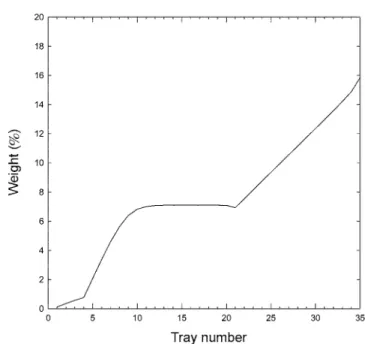
의무게분률을각단의함수로 Fig. 9에나타내었다. Fig. 9에나타 낸것과같이톨루엔의농도는각단에대하여거의일정한값을보 인반면에나머지성분들은원료주입단인 21단이하에서급격히 감소하였으며특히추출증류탑탑저에서 0.01 wt%이하로감소함
을알수있었다. 이는용매인 sulfolane이추가됨으로써용매와친
화력이적은비방향족성분들은모두추출증류탑상부로농축되기 때문임을알수있다. 한편, Fig. 10은 light key component인 methyl cylcohexane과 heavy key component인톨루엔사이의 Separating factor를 tray number의함수로도시한것이다. Fig. 10에나타낸것 과같이추출증류탑전단에걸쳐서 separating facot 값이증가하다 가감소한후에다시증가하는현상이없이연속적으로변화함을
알수있다. 이것은각단에서 key component들의조성이연속적으
로변화함을의미한다. 각단이분리단의역할을잘수행하고있음
을의미하고더욱이원료주입단인 21단을중심으로 separating
factor 값의 fluctuation 현상이일어나지않음으로원료주입단의위
치가제대로결정되어졌음을알수있다.
용매회수탑에서각성분의액상의무게분률을각단의함수로
Fig. 11에나타내었다. Fig. 11에나타낸것과같이톨루엔의농도는
탑상제품에서거의 100%의순도를보였으며반면에탑저에서는
거의나타나지않았다. 이것은용매회수탑에서용매와톨루엔사 이의분리가잘이루어졌을뿐만아니라톨루엔의회수율도높음을
Table 5. Input data, specified parameters and output data for the simulation of solvent recovery column
Input/output data and specified parameters Value Input data
Feed flow rate (Kg/hr) 3,078.00
Feed toluene composition (weight %) 21.38 Specified design and operating parameters
Theoretical number of stages 10
Operating pressure at column top (bar) 0.42
Feedstock feed tray location 5
Reflux ratio 0.5
Reflux rate (Kg/hr) 329.75
Output data
Condenser duty (Kcal/hr) −106,441.79
Reboiler duty (Kcal/hr) 166,432.84
Toluene weight percent at top product > 99.81
Fig. 9. Composition profile along the extractive distillation column.
Fig. 10. Plot of separating factor between toluene (heavy key component) and methyl cyclohexane (light key component) as a function of tray number.
Fig. 11. Composition profile along the solvent recovery distillation column.
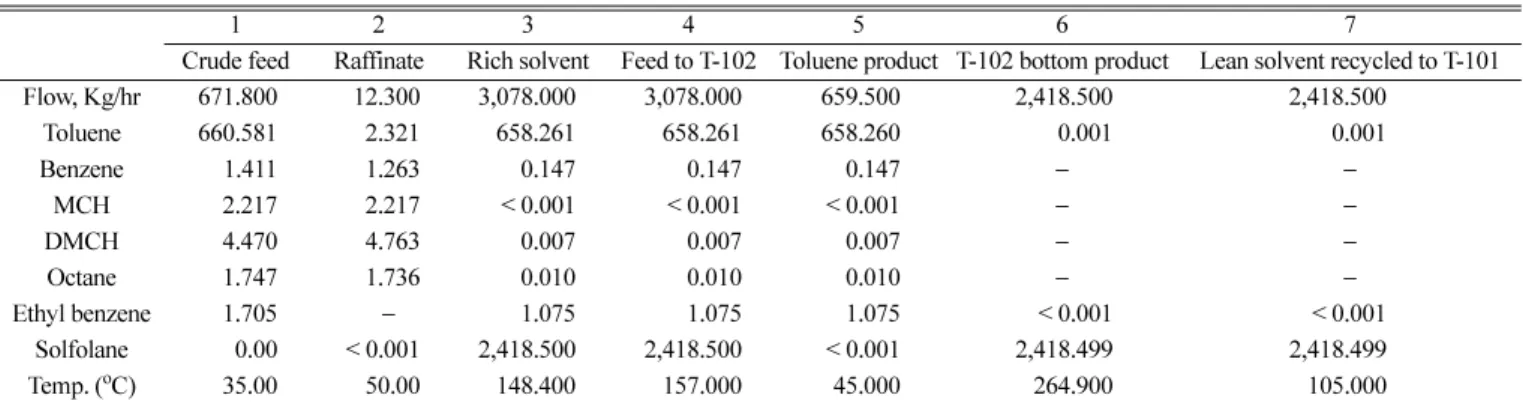
나타내는것이다. 다른성분들은원료주입단아래에서거의검출되 지않음을알수있었다. 한편, 전체공정에대한물질수지는 Table 6
에정리하였다.
5. 결 론
본연구에서는연료첨가제및각종공업용용제등으로주로사 용되고있는 99.8 wt%이상의톨루엔을용매인 sulfoale을사용하여
추출증류공정을통해서분리해내기위한전산모사작업을수행하 였다. 본연구에서실행한전산모사작업을통하여추출증류탑으로
주입되는용매의중량비는원료대비 3.61배일때톨루엔의회수율
을 99.56%이상을얻을수있었으며톨루엔의순도는 99.81wt%이
상을얻을수있었다.
사용기호
T : absolute temperature [K]
Fi : total feed flow rate to tray i [Kmole/hr]
Li : total liquid flow rate from tray i [Kmole/hr]
Vi : total vapor flow rate from tray i [Kmole/hr]
Qi : heat added to tray I [MM Kcal/hr]
Ti : temperature of tray I [K]
NC : number of components
NT : number of trays
N : number of experimental data points
γi : activity coefficient of component i xj, xk : liquid mole fraction of component j and k aij, aji, bij, aji, αij: binary interaction parameter in van der Waals
mixing rule
Fp : total molar flow rate feeding to the plate p Vp : total vapor molar flow rate coming out of the plate p Lp : total liquid molar flow rate coming out of the
plate p
Sv,p : total vapor side draw flow rate coming of the plate p
Sl,p : total liquid side draw flow rate coming of the plate p
xp, yp, zF,p : mole fraction contained in Lp, Vp and Fp, respectively
Kj,p : K-value of component ‘j’ at the plate p
fj,p : molar flow rate of component ‘j’ feeding to the plate p
lj,p : liquid molar flow rate of component ‘j’ coming out of the plate p
vj,p : vapor molar flow rate of component ‘j’ coming out of the plate p
sj,p : side stream molar flow rate of component ‘j’ coming out of the plate p
hF,p : total molar enthalpy feeding to the plate p hp : total liquid molar enthalpy coming out of the plate p Hp : total vapor molar enthalpy coming out of the plate p qc,1 : overhead condenser heat duty
h0' : saturated liquid molar enthalpy of overhead product
참고문헌
1. http://www.hyundaicorp.co.kr/global/prd_main.asp?sOffice_id=14 2. http://www.gtchouston.com/articles/operational%20Experience%
20with%20gt-btx.pdf
3. http://www.etis.net/balpyo/work19/23.pdf 4. http://www.uop.com/objects/55%20Sulfolane.pdf
5. Sungjin, L. and Hwayong, K., “Liquid-liquid Equilibria for the Ternary Systems Sulfolane+Octane+Toluene, and Sulfolane+Octane +p-xylene at Elevated Temperatures,”J. Chem. Eng. Data, 43, 358-361(1998).
6. Renon, H. and Prausnitz, J. M., “Local Composition in Thermo- dynamic Excess Functions for Liquid Mixtures,”AIChE J., 14, 135- 144 (1968).
7. Larsen, B. L., Rasmussen, P. and Fredenslund. Aa., “A Modified UNIFAC Group Contribution Model for Prediction of Phase Equilibria and Heats of Mixing,”Ind. Eng. Chem. Res., 26, 2274- 2286(1987).
8. Russel, R. A., “A Flexible and Reliable Method Solves Sing- tower and Crude-distillation-column Problems,”Chem. Eng., 90, 53-59 (1983).
9. http://www.gtchouston.com/articles/Aromatics%20Design%20-
%20The%20Future%20is%20Now.pdf
10. Gerald, L.K., Refinery Process Modeling: A Practical Guide to Steady State Modeling of Petroleum Processes, 1st ed., Kaes Enterprises, Inc.(2000).
Table 6. Material balance for the extractive distillation process
1 2 3 4 5 6 7
Crude feed Raffinate Rich solvent Feed to T-102 Toluene product T-102 bottom product Lean solvent recycled to T-101
Flow, Kg/hr 671.800 12.300 3,078.000 3,078.000 659.500 2,418.500 2,418.500
Toluene 660.581 2.321 658.261 658.261 658.260 0.001 0.001
Benzene 1.411 1.263 0.147 0.147 0.147 − −
MCH 2.217 2.217 < 0.001 < 0.001 < 0.001 − −
DMCH 4.470 4.763 0.007 0.007 0.007 − −
Octane 1.747 1.736 0.010 0.010 0.010 − −
Ethyl benzene 1.705 −00 1.075 1.075 1.075 < 0.001 < 0.001
Solfolane 0.00 < 0.001 2,418.500 2,418.500 < 0.001 2,418.499 2,418.499
Temp. (oC) 35.00 50.00 148.400 157.000 45.000 264.900 105.000