The Effect of Bi(OH)
3on Corrosion-Resistant Properties of Automotive Epoxy Primers
Wonseog Yang†, Sungki Min, and Woon-suk Hwang
School of Materials Science and Engineering, Inha University, Incheon, 452-751, Korea
In this study, we evaluated anti-corrosion properties of both commercial unleaded and lead epoxy primer for automotive substrate before applying to actual painting lines by salt spray test, and cyclic corrosion test, potentiodynamic test and electrochemical impedance spectroscopy. The difference in the corrosion resistance between automotive epoxy primers contained Bi(OH)3 and leaded one was investigated. And it was also discussed the effect of zinc phosphate pretreatment to the epoxy primers. The specimen coated epoxy primer contained Bi(OH)3 showed 0.5 V higher corrosion potential than that of bare steel. The result of salt spray test did not indicate remarkable difference of corrosion resistance in all specimens above 10 ㎛ thickness up to 1200 hours. In the cyclic corrosion test, epoxy primers contained Bi(OH)3 on phosphated substrate performed good corrosion properties until 800 hours. The epoxy primer contained Bi(OH)3 performed the equivalent corrosion resistance as leaded coating on phosphated steel, but slightly inferior to that of leaded on bare steel. These results show that the pre-treatment of zinc phosphate is effective as well as pigment changing in performing anti-corrosion properties in automotive bodies.
Keywords : bismuth, lead, epoxy primers, electrochemical impedance spectroscopy, corrosion, salt spray test, cyclic corrosion test
†Corresponding author: [email protected]
1. Introduction
Recently, two European directives very strongly influ- ence surface technology in automobile production: the 'End of Life Vehicle-Direction'1) does forbid from 2005 on the use of mercury, lead, cadmium and is limiting the content of hexavalent chromium compounds per car by 2g. Second, the 'Waste Electrical and Electronic Equipment amending Directive' also imposes a ban on lead from 2006.2) But lead has been treated importantly in catapho- retic epoxy primers until up to recently, because it has performed deblocking agent of isocyantes, anti-corrosive pigment and protecting agent of steel facilities.3) To over- come their regulations and problems, many researches and developments have not ended since the first lead free pri- mers came out onto the market in the 1990s.4)-6) But as the unleaded epoxy primers which are only substituted pig- ments with lead were performed the insufficiency of an- ti-corrosion properties, commercial unleaded primers were also modified resins and additives to increase corrosion resistance of the coating systems by manufactures.5) In this study, we evaluated anti-corrosion properties of
both commercial unleaded and lead epoxy primer for auto- motive substrate before applying to actual painting lines by salt spray test, and cyclic corrosion test, potentiody- namic test and electrochemical impedance spectroscopy.
2. Experimental Procedures
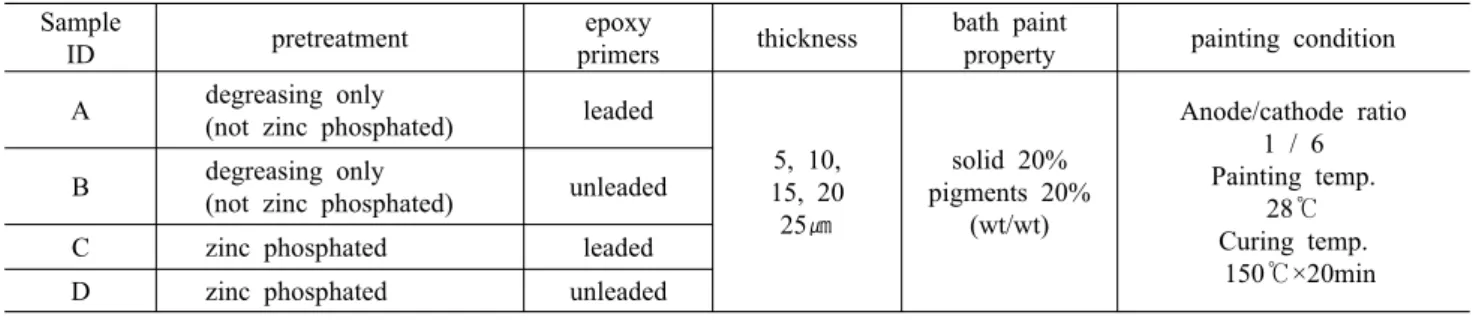
The anticorrosive epoxy primers were cationically de- posited on cold roll steel plate. The conditions of substrate type, pretreatment condition, bath paint property, painting and coating thickness are summarized in Table 1. The test panels (70 ㎜×150 ㎜×0.8 ㎜) were pretreated by degreas- ing in basic solution, zinc phosphated in actual automobile painting line. One of coatings used lead as an anticorrosive pigment while the other was unleaded and Bi(OH)3. Coated testing panel were manually scribed to 10cm length for SST and CCT.
Salt spray test was carried out in the salt spray test chamber for periods of 1200 hours and cyclic corrosion test was carried out for 400 hours and 800 hours by Fig.
1 conditions.
Photentiodynamic polarization has been carried out in 3.5% NaCl solution at R.T. without stirring. And all the potentials were referred to the saturated calomel electrode (SCE). And a.c. impedance spectroscopy was performed
Sample
ID pretreatment epoxy
primers thickness bath paint
property painting condition A degreasing only
(not zinc phosphated) leaded
5, 10, 15, 20 25㎛
solid 20%
pigments 20%
(wt/wt)
Anode/cathode ratio 1 / 6 Painting temp.
28℃
Curing temp.
150℃×20min B degreasing only
(not zinc phosphated) unleaded
C zinc phosphated leaded
D zinc phosphated unleaded
Table 1. Substrate, coating and painting conditions of the different samples tested
A B
C D
Fig. 2. The results of 1200 hours exposure tested panels by SST (thickness: 5, 10, 15, 20, 25 ㎛) 35℃ Salt spray 4hrs
35℃ Salt spray 4hrs 60℃ Dry 2hrs 60℃ Dry 2hrs 50℃ Blister Box 2hrs 50℃ Blister Box 2hrs
8hr/1cycle 8hr/1cycle
Fig. 1. The condition of cyclic corrosion test.
in 3.5% NaCl solution at 50℃ for 21days.
3. Results and discussion
The results of 1200 hours exposure tested panels by SST are presented in Fig. 2 Panels A and C are presented leaded epoxy primers type, and B and D are presented
unleaded one. And A, B are coated on bare steel while C, D are coated on phosphated steel. Fig. 2 shows that leaded epoxy primers are superior to unleaded one at the 5 ㎛ thickness. But more than 10 ㎛ thickness, unleaded epoxy primers are on the same level with leaded one.
The results of 400 hours and 800 hours exposure tested panels by cyclic corrosion test(CCT, Fig. 1) are shown in Fig. 3 (a) is presented 400 hours exposure results, and (b) is presented 800 hours and A, C are leaded epoxy primers, and B, D are leaded one. Fig. 3 (a) shows that epoxy primers on bare panel have very severe blisters near- by scribed line, which are not concerned with thickness and type of coatings. Fig. 3 (b) shows on the same level between leaded and unleaded primers. It is affected that zinc phosphate protects substrate in the painting, and in- creases adhesion with coatings7),8) However, small blisters nearby scribed line are found more than 20 ㎛ thickness, that is more shown with increasing thickness. This shows
A B
(a) The results of 400 hours (50cycle) exposure tested panels by CCT
C D
(b) The results of 800 hours (100cycle) exposure tested panels by CCT Fig. 3. The results of CCT exposure tested panels (thickness: 5, 10, 15, 20, 25 ㎛)
10-1410-1310-1210-1110-1010-9 10-810-7 10-6 10-5 10-410-3 10-2 10-1 100 -800
-600 -400 -200 0 200 400 600 800 1000
Potential(mV vs SCE)
Current density(A/cm2)
Bare steel 10um 20um
10-1410-1310-1210-1110-1010-9 10-8 10-7 10-610-5 10-4 10-310-2 10-1 100 -800
-600 -400 -200 0 200 400 600 800 1000
Potential(mV vs SCE)
Current density(A/? )
Bare steel 10um 20um
(a) Sample A (10, 20 μm) (b) Sample B (10, 20 μm)
10-1410-1310-1210-1110-10 10-9 10-8 10-7 10-6 10-5 10-4 10-3 10-2 10-1 100 -800
-600 -400 -200 0 200 400 600 800 1000
Potential(mV vs SCE)
Current Density(A/cm2)
Zinc phosphatised steel 10um 20um
10-1410-1310-1210-1110-1010-9 10-8 10-7 10-6 10-5 10-4 10-3 10-2 10-1 100 -800
-600 -400 -200 0 200 400 600 800 1000
Potential(mV vs SCE)
Current Density(A/cm2) Zinc phosphatised steel
10um 20um
(c) Sample C (10, 20 μm) (d) Sample D (10, 20 μm) Fig. 4. The results of potentiodynamic polarization with variable film thickness
Sample (at 20㎛ build up) Ecorr icorr βa βc Rp
(㎷) (nA/㎠) (V/decade) (V/decade) (㏀․㎠)
Dgreasing only -696.3 4,676 0.0575 0.2926 4
Zinc phosphated only -535 1,990 0.0714 0.2926 13
A -36.44 430 0.2159 0.2560 118
B -47.76 56.2 0.4465 0.2639 1,283
C 30.79 2.2 0.1903 0.0851 11,429
A B C D
Fig. 5. The cross-sectional SEM images of different primer after 21days immersion at 50℃ with EIS performed.
Table 2. The electrochemical parameters derived from the potentiodynamic polarization curves
that corrosion properties were not always improved by higher coating thickness that was affected by mechanical damages.
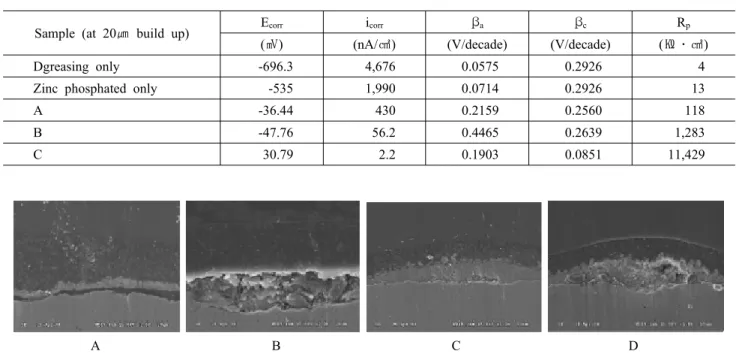
A summary of the electrochemical parameters derived from the potentiodynamic polarization curves (Fig. 4) are listed in Table 2 In Table 2, both of primer coated speci- mens were shifted about 500 mV- 600 mV to the positive direction relative to the uncoated specimen, which in- dicates that the corrosion property of the coated primers is better than that of uncoated one.
Fig. 5 show cross-sectional images of different primer after 21days immersion at 50℃ with EIS performed. All of primers exhibited corrosion product formation at pri- mer-substrate interface.
Coated primes A,B on bare steel are shown deadhesion, but that of C, D on phosphated steel exhibited good adhe- sion at primer-substrate interface. It shows that the corro- sion property of primers is more strongly affected by sur- face treatment than by pigment changes.
4. Conclusion
The anti-corrosion properties between leaded and un- leaded epoxy primers for automobiles were investigated in this study. The specimen coated epoxy primer contained Bi(OH)3 showed 0.5 V higher corrosion potential than that of bare steel. The result of salt spray test did not indicate remarkable difference of corrosion resistance in all speci- mens above 10 ㎛ thickness up to 1200 hours. In the cyclic
corrosion test, epoxy primers contained Bi(OH)3 on phos- phated substrate performed good corrosion properties until 800 hours. The epoxy primer contained Bi(OH)3 per- formed the equivalent corrosion resistance as leaded coat- ing on phosphated steel, but slightly inferior to that of leaded on bare steel. In conclusion, unleaded epoxy coat- ings were slightly inferior to leaded one at less than 10
㎛ thickness on the bare steel, but anti-corrosion resistance was same as level at more than 10 ㎛ on the zinc phosph- ated steel. And we confirmed that the pre-treatment of zinc phosphating is effective as well as pigment changing in performing anti-corrosion properties in automotive bodies.
Acknowledgement
This work was supported by INHA UNIVERSITY Research Grant.
References
1. Information on http://www.europa.eu.int/comm/environ- ment/waste/elv_index.htm.
2. W. Paatsch, Surf. Coat. Technol, 169, 753 (2003).
3. D. A. Wicks and Z. W. Wicks, Prog. Org. Coat., 41, 1 (2001).
4. E. Almeida, I. Alves, C. Brites, and L. Fedrizzi, Prog.
Org. Coat., 46, 8 (2003).
5. N. Takeshi, Y. Hideaki, and M. Tasumi, Coating Engineering, 35, 11 (2000).
6. I. Satoshi, Coating Engineering, 38, 101 (2003).
7. Gordon Fettis, Automotive Paints and Coatings/VCH, NY, p. 9 (1995).
8. A. Amirudine and D. Thierry, Prog. Org. Coat., 28, 59
(1996).
9. J. J. Suay, M. T. Rodriguez, K. A. Razzaq, J. J. Carpio, and J. J. Saura, Prog. Org. Coat., 46, 121 (2003).