PGHN
Case Report
Enterourachal Fistula as an Initial Presentation in Crohn Disease
Senthilkumar Sankararaman, Ramy Sabe, Thomas J. Sferra, and Ali Salar Khalili
Division of Pediatric Gastroenterology, Department of Pediatrics, UH Rainbow Babies & Children’s Hospital, Case Western Reserve University School of Medicine, Cleveland, OH, United States
Crohn disease has a wide spectrum of clinical presentations and rarely can present with complications such as a bowel stricture or fistula. In this case report, we describe a 17-year-old male who presented with a history of recurrent anterior abdominal wall abscesses and dysuria. He was diagnosed with Crohn disease and also found to have a fistulous communication between the terminal ileum and a patent urachus. An ileocecectomy with primary anasto- mosis and complete resection of the abscess cavity was performed. He is on azathioprine for maintenance therapy and currently in remission. Clinicians should have a high index of suspicion for this complication in Crohn disease patients presenting with symptoms suggestive of urachal anomalies such as suprapubic abdominal pain, dysuria, umbilical discharge, and periumbilical mass.
Key Words: Crohn disease, Inflammatory bowel diseases, Intestinal fistula, Urachus
Received:December 7, 2017, Revised:April 5, 2018, Accepted:April 7, 2018
Corresponding author: Ali Salar Khalili, Division of Pediatric Gastroenterology, Department of Pediatrics, UH Rainbow Babies & Children’s Hospital, Suite 737, MS RBC 6004, 11100 Euclid Avenue, Cleveland OH 44106, United States. Tel: +1-216-844-1765, Fax: +1-216-844-8750, E-mail:
Copyright ⓒ 2019 by The Korean Society of Pediatric Gastroenterology, Hepatology and Nutrition
This is an openaccess article distributed under the terms of the Creative Commons Attribution NonCommercial License (http://creativecommons.org/licenses/by-nc/4.0/) which permits unrestricted noncommercial use, distribution, and reproduction in any medium, provided the original work is properly cited.
INTRODUCTION
Crohn disease (CD) can present as a disease com- plication such as a bowel stricture or fistula. Fistula may occur between adjacent bowel loops or between a bowel loop and an adjacent organ. In this report, we present a patient who was admitted with a his- tory of recurrent anterior abdominal wall abscesses and dysuria. He was found to have CD with a fistu- lous communication between the terminal ileum (TI) and a patent urachus resulting in recurrent ab- dominal wall abscesses.
CASE REPORT
A 17-year-old male presented with a one-week history of abdominal pain and dysuria. He described the abdominal pain as sharp and localized to the in- fraumbilical and right inguinal regions. He reported a decrease in appetite. He lost approximately 15 kg over the preceding five months. He had no fever. He had normal bowel movements without blood or mucus. His past medical history was significant for recurrent anterior abdominal wall abscesses. The ini- tial abscess occurred five months prior and he was
treated with intravenous (IV) antibiotics at an out- side facility. At that institution, computed tomog- raphy (CT) of the abdomen was reported as demon- strating significant bowel wall thickening of the TI with adjacent inflammatory stranding. After the an- tibiotic course was completed, a repeat CT showed resolution of the abdominal wall abscess but persis- tence of the bowel wall abnormality. Two months later, he developed a second episode of abdominal wall abscess formation that required percutaneous surgical drainage and antibiotic therapy (amoxicillin and metronidazole). Aspirated serous fluid con- tained few leukocytes and was sterile. After this sec- ond episode, he underwent esophagogastroduod- enoscopy (EGD) and colonoscopy at the outside institution. The EGD was normal and colonoscopy revealed erythema with ulcerations in the TI. Histo- pathology confirmed severe chronic inflammation of TI. He was prescribed an oral 5-aminosalicylic acid for inflammatory bowel disease. He was not com- pliant with taking this medication. His abdominal pain slightly improved for a brief period of time. A follow-up colonoscopy was planned at the other in- stitution but he was admitted to our hospital with the current presenting symptoms.
On admission, his vital signs were within normal limits. Physical examination revealed a soft, non- distended abdomen with mild tenderness in the in- fraumbilical and right inguinal regions. A small area of erythema and induration, approximately 2 cm in diameter, was present just inferior to the umbilicus.
There was minimal guarding but no rigidity or rebound. No umbilical discharge was noted.
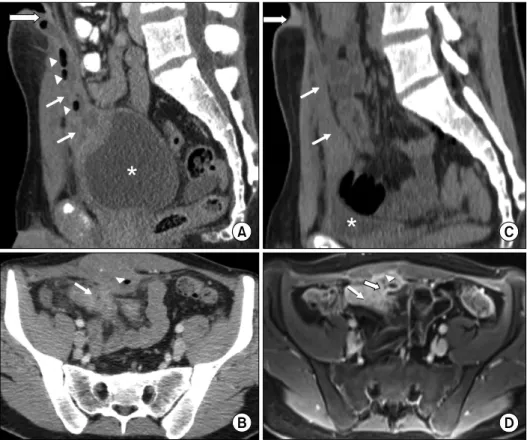
Laboratory evaluation demonstrated elevated in- flammatory markers and normal hemoglobin, plate- let count, albumin, and urinalysis. The CT of the ab- domen revealed a rim enhancing ovoid shaped fluid collection in the midline of the suprapubic region (just below the umbilicus) measuring 10.5×3×2.5 cm (Fig. 1A). This abscess cavity contained multiple small foci of gas tracking from the umbilicus to the superior-ventral aspect of the urinary bladder wall.
Contiguous with the ovoid fluid collection and just lateral to the right rectus abdominis muscle, there
was a smaller abscess approximately 1.5 cm in diameter. The CT also revealed significant thicken- ing of the wall of the distal ileum that was in close contiguity with the urachal remnant suggesting the presence of an enterourachal fistula (Fig. 1B). The prior CT performed at the outside hospital at the time of initial presentation was reviewed at our in- stitution and revealed a patent urachus at the same location of the current ovoid shaped abscess (Fig.
1C). He was started on IV piperacillin-tazobactam.
He underwent EGD and colonoscopy. EGD was normal. Colonoscopy revealed severe erythema and ulceration in the TI and colon appeared normal.
Biopsies from TI revealed chronic severe ileitis with architectural distortion. The colonic biopsies were normal. Magnetic resonance enterography (MRE) confirmed the CT scan findings and clearly demon- strated a fistula from the TI to the urachal remnant abscess (Fig. 1D). Quantiferon-TB gold test was neg- ative and chest radiograph was normal. He was diag- nosed with fistulizing CD based on the endoscopic, histologic, and MRE findings. Induction therapy for CD with prednisone was initiated. Percutaneous drainage of the abscess was performed. The aspi- rated fluid was purulent with neutrophilic predom- inance and no organism was cultured. He completed two weeks of IV piperacillin-tazobactam and two weeks of oral ciprofloxacin and metronidazole therapy. At the completion of the antibiotic course, a CT scan with sinogram (contrast administered through the drainage catheter) showed no residual fluid collection and no significant filling of the ab- scess cavity with contrast. The drainage catheter was removed. Repeat MRE showed interval improve- ment of the TI thickening, complete resolution of the anterior abdominal abscesses, and a blind-ended fis- tula from the TI without communication to the ura- chal remnant. His inflammatory markers slowly normalized. Prednisone was gradually weaned and he was started on azathioprine for maintenance therapy. He was referred for a colorectal surgical con- sultation and underwent laparoscopic exploration of the abdomen. The old abscess cavity was identified and noted to be tightly adherent to the anterior ab-
Fig. 1. (A) Sagittal computed tomography (CT) image of the abdomen and pelvis demonstrating the urachus (white arrows) which connects the urinary bladder (asterisk) and umbilicus (white arrow with black outline). The urachal remnant is thickened and distended with fluid and gas pockets (white arrow heads) consistent with an abscess. Also, the inflammatory stranding of the anterior abdominal wall is evident. (B) Axial CT image of the pelvis demonstrating the thickened wall of the distal ileum (white arrow) contiguous with the urachal remnant (white arrow head). This is suggestive of a fistula between these two structures. The urachal remnant appears edematous with a gas pocket which is consistent with an abscess and the edema extends to involve the adjacent abdominal wall. (C) Sagittal CT image of the abdomen and pelvis taken at an outside facility before the enterourachal fistula formation (5 months prior to this presentation). Urachal remnant (white arrows) extends from the anterior dome of the urinary bladder (asterisk) to the umbilicus (white arrow with black outline). (D) Axial magnetic resonance enterography with volumetric interpolated breath-hold examination image of the pelvis 3 minutes post contrast administration. Fistulous tract between urachal remnant and distal ileum clearly identified (white arrow with black outline). Marked thickening of the distal ileal wall (white arrow) and urachal remnant wall with some fluid remaining in the urachal remnant (white arrow head) consistent with an abscess.
dominal wall and in close proximity to the inflamed TI. Ileocecectomy with primary anastomosis and complete resection of the abscess cavity was performed. The enterourachal fistula could not be identified and likely obliterated with the medical management. Resection of the urachal remnant could not be simultaneously done due to dense adhesions. Histopathology of the resected specimen confirmed active CD. A repeat colonoscopy ten months after the surgery revealed the CD in remission. He had no recurrence of abscesses during
the follow up. A complete resection of the urachal remnant has been planned.
DISCUSSION
Fistula formation is a well-known complication of CD resulting from the transmural inflammation characteristic of this disease. Fistula may form be- tween adjacent bowel loops and any adjacent struc- ture including the retroperitoneum, urinary bladder, vagina, and skin. A fistulous communication be-
tween urachus and inflamed bowel from CD is ex- ceedingly rare and only a few cases are reported [1-12]. Due to the rarity and nonspecific presentation, the diagnosis of enterourachal fistula can be delayed [9].
We did a systematic literature search of MEDLINE and Embase databases using the following terms Crohn’s disease, inflammatory bowel disease, IBD, urachus, and urachal. We identified descriptions of twelve cases of CD with an associated urachal com- plication (Table 1) [1-12]. In non-English language journal articles, only abstracts were reviewed and included. We also found two retrospective chart re- views and one case series which described four addi- tional patients with CD and urachal anomalies [13-15]. These four patients are not included in the table 1 due to lack of clinical details [13-15]. Solem et al. [13] reviewed 78 CD patients and found two pa- tients had fistula between the ileum and urachus.
Ishii et al. [15] reviewed 1,551 CD patients and one patient was identified with urachal abscess and en- terourachal cutaneous fistula. This patient under- went resection of the urachus with resection of in- flamed intestine, and partial cystectomy. Paşalega et al. [14] reported a patient with CD and infected ura- chal cyst. Including the patient reported here, the to- tal number of CD patients with urachal anomalies reported in the literature since the publication of first case in the year 1980 is seventeen [1-15].
The age range of these patients was between 11 to 31 years and the median age was 19 years [1-12]. The male-to-female ratio was almost equal. Abdominal pain was the most common presenting symptom (10 of 13 patients). Umbilical discharge (6 of 13) and uri- nary symptoms such as dysuria, fecaluria, increased frequency (4 of 13) were also described. Other pre- senting symptoms included diarrhea, weight loss, and fever. The ileocecal region was involved in most patients. The urachal abnormalities described in- clude enterourachal fistula and infected urachal cyst [1-15]. Radiological imaging modalities such as CT and magnetic resonance imaging (MRI) were help- ful in diagnosing urachal anomalies and also helpful in the suspicion of a fistulous complication. Either
laparoscopy or laparotomy was useful in confirming enterourachal fistula. Most patients were success- fully managed by urachal resection with partial cys- tectomy along with partial resection of the inflamed bowel.
Similar to the patient described here, the enter- ourachal fistula could be the initial presentation of CD and this causes a diagnostic challenge [12]. The patient described by Tsukui et al. [12] had a one year history of diarrhea, weight loss, polyuria, and the sensation of residual urine. She was initially diag- nosed as having a urinary tract infection and man- aged conservatively. As her symptoms did not im- prove, she was admitted for further management and found to have a ceco-urachal fistula. On the con- trary, in some patients, the urachal complication alone was diagnosed initially and fistulizing CD di- agnosis was missed resulting in prolongation of symptoms. Sugiyama et al. [4] reported a 19-year-old woman with abdominal pain and recurrent fever for six months. Imaging revealed an urachal abscess and she underwent total urachal resection with partial resection of the bladder. A month later she devel- oped fecaluria and dysuria. She was conservatively managed and her symptoms returned 3 months later. CT demonstrated a purulent collection in the peritoneal cavity. Cystoscopy and barium contrast study of the small bowel showed an enterovesical fistula. She underwent partial resection of the ileum and bladder. She was subsequently found to have longitudinal ulcers in the ileum with granulomas confirming CD.
Infected urachal cyst or sinus without a clearly identifiable enterourachal fistula could be another urachal complication in CD. In two patients de- scribed by Weitten et al. [7] and O'Brien et al. [10], septic urachal cysts were noted without an identifi- able fistulous tract. The infection likely developed from a microperforation of bowel wall located ad- jacent to urachus resulting in local bacterial trans- location. Paşalega et al. [14] also reported a patient with CD and infected urachal cyst. Keir et al. [5] de- scribed a case of infected urachal sinus with gran- ulomatous appendicitis. Resection of the in-
Table 1. Published Cases of Crohn Disease with Complications Involving Urachal Anomalies ReferenceAge (y)SexClinical manifestationsUrachal complication Site of bowel involvement in Crohn disease
Investigations utilizedTreatmentShort term follow up Davidson, 1980 [1]28MUmbilical discharge, abdominal pain, fever and emesisEnterourachovesico- cutaneous fistulaIleum and cecumUrinalysis Sinogram Cystoscopy Urachal resection Partial cystectomy Ileocecectomy
Uneventful Artigas et al., 1998 [2]
20FUmbilical discharge and abdominal painEnterouracho-cutaneous fistulaIleumUrinalysis Sinogram Ultrasound CT Urachal resection Partial cystectomy Ileocecectomy
Uneventful Klineberg et al., 2002 [3]
19MAbdominal pain and dysuriaEnterourachal fistulaIleumUrinalysis CT Colonoscopy Cystoscopy Urachal resection Partial cystectomy Ileocecectomy
Uneventful Sugiyama et al., 2003 [4]*
19FHypogastric pain, recurrent fever, later developed fecaluriaEnterovesical fistula developed after the resection of the urachal abscess Small bowelCT Cystoscopy Contrast X-ray of the small bowel Urachal resection Partial resection of ileum and bladder
Unknown Keir et al., 2004 [5]16FUmbilical discharge and 0.5 cm ovoid granulomatous lesion in the umbilicus
Infected patent urachus Appendix, terminal ileum and cecumCT MRI Sinogram Colonoscopy Resection of urachus with surrounding inflamed mass Appendectomy Right hemicolectomy
Uneventful Bergman and Sloots, 2005 [6]*
19MFecal discharge at umbilicusEnterouracho-cutaneous fistulaUnknownUnknown UnknownUnknown Weitten et al., 2005 [7]*
21MChronic feverUrachal cyst infection developed likely by local bacterial translocation from adjacent ileum IleumUnknownUrachal cyst ablationUnknown Hollander et al., 2012 [8]
15MAbdominal pain, weight loss, diarrhea, right lower quadrant tenderness, infraumbilical mass, perianal fistula Possible enterourachal fistula between urachal cyst and terminal ileum. Small fistulous tract likely obliterated by low dose steroids and antibiotics Ileum (likely)CT MRI Colonoscopy Laparoscopy Urachal resection Partial cystectomy No bowel resection
Uneventful Yheulon et al., 2013 [9]
18FDisuse abdominal pain, tachycardiaEnterouracho-vesical fistula. A retained video capsule in the fistulous track Terminal ileumCT CystoscopyUrachal resection Partial cystectomy Partial ileal resection
Uneventful
Table 1. Continued ReferenceAge (y)SexClinical manifestationsUrachal complication Site of bowel involvement in Crohn disease
Investigations utilizedTreatmentShort term follow up O’Brien et al., 2013 [10]
26MFever, abdominal pain, umbilical discharge Infected urachal cyst was noted. No fistula was identified CecumCT LaparoscopyUrachal cyst excision Right hemicolectomy Not reported Mador and Blair, 2014 [11]
11FRecurrent feverfor one month, abdominal pain, right lower quadrant tenderness and diarrhea initially and later developed umbilical discharge Enterouracho-cutaneous fistulaIleumMRI Ultrasound Laparoscopy Urachal cyst resection Partial cystectomy Ileocecectomy
Uneventful Tsukui et al., 2017 [12]
31FAbdominal pain, polyuria, dysuria and feverCeco-urachal fistula CecumUrinalysis CT Colonoscopy Cystoscopy Urachal resection Partial cystectomy Ileocecectomy
Uneventful Current study17MAbdominal pain, dysuria, reduced appetite, weight loss, anterior abdominal wall mass
Enterourachal fistulaIleumCT MRI Ileocecectomy Resection of the adjacent abscess cavity Uneventful M: male, F: female, CT: computer tomography, MRI: magnetic resonance imaging. *Only abstracts are reviewed and included for non-English language journal articles.
flammatory mass involving the urachus with appen- dectomy was initially performed. A year later she de- veloped wound discharge. A sinogram showed small bowel stricture and also a fistula between bowel segments. Colonoscopies with biopsies were con- sistent with CD and she was started on azathioprine.
Here, the authors proposed that urachal infection is likely secondary to intra-abdominal sepsis from CD.
Enterourachal fistula sometimes could complicate the course of CD management. In the patient de- scribed by Yheulon et al. [9], the diagnosis of CD was initially doubted after a normal video capsule endos- copy and the medications were discontinued. She presented later at a different institution with ab- dominal pain, tachycardia, and leukocytosis. CT scan showed a metallic object, likely a retained video cap- sule, within the bowel in the left lower quadrant and a 4-cm phlegmon in the right lower quadrant ad- jacent to the bladder. She was conservatively man- aged with IV steroids and antibiotics. Repeat CT showed no metallic object in the abdomen indicating the possible spontaneous passage of the video capsule. She underwent laparotomy as the abscess increased in size despite continued medical therapy.
Active CD in the TI and a 5 cm infected urachal cyst with vesico-urachal and enteral urachal fistulas were noted during laparotomy. The authors stated that the video capsule was likely retained at the site of en- terourachovesical fistula.
Our case report is important in many aspects. As this combination of CD with urachal complication is rare, either the diagnosis of CD or the diagnosis of urachal complications can be easily missed resulting in treatment delay. In our patient, the urachal abnor- mality was not diagnosed at the other institution and patient was not compliant with the prescribed IBD management. He had recurrence of symptoms prior to presenting to us. The combination of presenting symptoms (i.e., dysuria, infraumbilical pain), re- current anterior abdominal wall abscesses, terminal ileitis, and typical radiological findings led to the di- agnosis of CD fistulizing to the urachal remnant.
Once he was started on induction treatment along with abscess management, his symptoms improved
significantly. During surgical exploration, the enter- ourachal fistula could not be identified and likely ob- literated with the medical management. Timely ini- tiation of CD management helped in reduction of bowel inflammation and resulted in limited surgical resection of only the ileocecal region. Similar to our patient, early aggressive management of CD resulted in obliteration of fistula limiting extensive surgical resection in the 15-year-old male with CD described by Hollander et al. [8]. The MRI demonstrated an urachal abscess and suspected a fistula between the fluid collection and the adjacent inflamed bowel. He was aggressively treated with IV antibiotics and low dose steroids. During laparotomy, urachal abscess with adjacent phlegmon containing cecum and TI with no clear identifiable fistula was noted. This pa- tient had resection of urachus with partial cys- tectomy and no resection of the bowel. Here the au- thors concluded that early medical management might have obliterated the small fistulous tract. Also in the patient reported by Mador and Blair [11], pre- operative medical management with antibiotics and steroids reduced the inflammation considerably and ileocecectomy was carried out successfully using a laparoscopic approach.
Barthalomaues Cabrolius first described the per- sistence of the urachus in 1550 [16]. During fetal life, the urachus is a patent tubular structure that con- nects the allantois at the umbilicus to the dome of the urinary bladder residing in the space of Retzius [3]. Descent of the bladder into the pelvis, during the fourth-to-fifth month of gestation, stretches the ur- achus obliterating its lumen and forms the vestigial median umbilical ligament [11]. About 1-in-5,000 cases have incomplete obliteration resulting in vari- ous urachal abnormalities [17]. These abnormalities include (i) patent urachus, (ii) urachal cyst, sinus, or diverticulum, and (iii) atretic urachal remnant [17,18]. The urachal anomalies can be symptomatic, however in many instances they are incidentally found during abdominal imaging performed for oth- er reasons. Common presenting symptoms in chil- dren with an urachal abnormality include supra- pubic abdominal pain, dysuria, umbilical discharge,
and periumbilical mass [9,19]. The majority of these symptoms occur as a result of infection. Another long term reported complication is malignant trans- formation within the urachal remnant [20]. Surgical resection usually is recommended for symptomatic urachal remnants. Management of asymptomatic urachal remnants remain controversial [20]. Although biological therapies such as anti-tumor necrosis fac- tor alpha monoclonal antibody medications are rec- ommended in the medical management of fistuliz- ing CD, the specific role of these therapies in CD with enterourachal fistulas is unknown due to paucity of information [11].
In summary, we report a case of CD complicated by an enterourachal fistula in which the initial diag- nosis was delayed due to the non-specific presenting symptoms. Clinicians should have a high index of suspicion for this complication in CD patients pre- senting with symptoms suggestive of urachal anomalies (suprapubic abdominal pain, dysuria, umbilical discharge, periumbilical mass). Typical ra- diographic signs will help to confirm the diagnosis.
REFERENCES
1. Davidson ED. Crohn's disease with spontaneous cuta- neous-urachovesicoenteric fistula. Dig Dis Sci 1980;
25:460-3.
2. Artigas JM, Blasco A, Mota J, Macho J, Gracia AI.
Spontaneous enterourachocutaneous fistula in Crohn’s disease: sonographic diagnosis. J Clin Ultrasound 1998;26:43-5.
3. Klineberg EO, James SP, Dunkin BJ. Crohn’s disease complicated by a urachoenteric fistula. Dig Dis Sci 2002;47:1728-31.
4. Sugiyama Y, Kudo J, Tanaka J. Urachal abscess with Crohn’s disease: a case report. Nishinihon J Urol 2003;
65:18-21.
5. Keir JA, McGregor R, Richards CJ, Windle R. An un- usual presentation of Crohn's disease. Ann R Coll Surg Engl 2004;86:W22-3.
6. Bergman R, Sloots CE. [Diagnostic image (246). A man with faecal production of the umbilicus]. Ned Tijdschr Geneeskd 2005;149:1940. Dutch.
7. Weitten T, Coca C, Ben Abdelghani M, Rohr S, Boujan
E, Blicklé JF, et al. [A urachus cyst revealing a torpid Crohn’s disease in a young adult with chronic fever].
Presse Med 2005;34:581-2. French.
8. Hollander LL, Girard ED, Ruscher KA, Sayej W, Kim C, Finck CM. Infected urachal cyst secondary to a Crohn’s enterourachal fistula. J Pediatr Surg 2012;47: e43-6.
9. Yheulon CG, Derosa DC, Gagliano RA. Retained pill camera at an entero-uracho-vesical fistula site in a pa- tient with Crohn's disease. Hawaii J Med Public Health 2013;72:186-9.
10. O’Brien D, Beatty N, Ramalanjaona G, Gress F, Deeb L. A rare case of septic urachal cyst mimicking abdomi- nal fistualization in Crohn’s disease [abstract]. Am J Gastroenterol 2013;108(Suppl 1):S417.
11. Mador BD, Blair GK. Pediatric Crohn disease compli- cated by an entero-uracho-cutaneous fistula. J Ped Surg Case Reports 2014;2:79-81.
12. Tsukui H, Koinuma K, Morimoto M, Horie H, Lefor AK, Kagaya Y, et al. Crohn’s disease presenting as a ce- co-urachal fistula. Clin J Gastroenterol 2017;10:32-6.
13. Solem CA, Loftus EV Jr, Tremaine WJ, Pemberton JH, Wolff BG, Sandborn WJ. Fistulas to the urinary system in Crohn's disease: clinical features and outcomes. Am J Gastroenterol 2002;97:2300-5.
14. Paşalega M, Calotă F, Paraliov T, Meşină C, Vîlcea D, Tomescu P, et al. [Crohn's disease. Clinical and ther- apeutical considerations]. Chirurgia (Bucur) 2005;100:
495-502. Romanian.
15. Ishii G, Tanaka N, Hara H, Ishii N, Matsumoto H.
[Management of urinary complication in Crohn's dis- ease]. Nihon Hinyokika Gakkai Zasshi 2007;98:757-63.
Japanese.
16. RC Begg. The urachus: its anatomy, histology and development. J Anat 1930;64:170-83.
17. Blichert-Toft M, Koch F, Nielsen OV. Anatomic var- iants of the urachus related to clinical appearance and surgical treatment of urachal lesions. Surg Gynecol Obstet 1973;137:51-4.
18. Naiditch JA, Radhakrishnan J, Chin AC. Current diag- nosis and management of urachal remnants. J Pediatr Surg 2013;48:2148-52.
19. Ashley RA, Inman BA, Routh JC, Rohlinger AL, Husmann DA, Kramer SA. Urachal anomalies: a longi- tudinal study of urachal remnants in children and adults. J Urol 2007;178:1615-8.
20. Gleason JM, Bowlin PR, Bagli DJ, Lorenzo AJ, Hassouna T, Koyle MA, et al. A comprehensive review of pediatric urachal anomalies and predictive analysis for adult ura- chal adenocarcinoma. J Urol 2015;193:632-6.