27 원고접수일: 2010년 4월 1일, 최종심사일: 2010년 6월 20일 게재확정일: 2010년 6월 20일
책임저자: 오세리, 대전광역시 서구 둔산동 1268번지 원광대학교 대전치과병원 구강악안면외과 우편번호: 302-120
Tel: +82-10-8534-2572, Fax: +82-42-366-1115 E-mail: [email protected]
구역반사가 심한 환자의 임플란트 치료에서 프로포폴과 미다졸람을 이용한 정주진정법
-증례 보고-
원광대학교 대전 치과병원 구강악안면외과
오 세 리․이 준 Abstract
Intravenous Sedation using Propofol and Midazolam in The Exaggerated Gag Reflex Patient’s Dental Implant Treatment
-A Case Report-
Se-Ri O, Jun Lee
Department of Oral and Maxillofacial Surgery, Daejeon Dental Hospital, Wonkwang University, Daejeon, Korea
The gag reflex is a physiologic reaction which safeguards the airway from foreign bodies. But, an exaggerated gag reflex can be a severe limitation to a patient's ability to accept dental care and for a clinician's ability to provide it. The overactive gag reflex can be due to psychological factors or physiological factors, or both. Psychological factors can include fear of loss of control and past traumatic experiences. A 58-year-old man, scheduled for extraction of left upper second molar, left lower second and third molar and implantation of left upper second molar, and left lower second molar had no specific underlying medical problems. He had exaggerated gag reflex. Dental treatment was successfully performed using intravenous sedation. Intravenous sedation with midazolam and propofol was a useful management technique for reflex control during dental treatment extended to the posterior regions in the oral cavity. (JKDSA 2010; 10: 27~33)
Key Words: Gag reflex; Dental treatment; Intravenous sedation; Propofol; Midazolam
서 론
헛구역질은 구강 내 구조물을 자극할 때 오는 자
연스러운 반응이며, 이에 대한 감수성은 사람마다 차이가 크고 견딜 수 있는 정도도 환자마다 다르 다. 특히 더 예민하게 반응하는 구강 내 부위로는 목구멍, 혀 기저부, 입천장, 목젖, 후인두벽이 있다.
치과 치료 중 발생하는 미약한 헛구역질은 약간의 술식 변형을 통해 성공적으로 해결할 수 있으나, 심한 경우 환자들은 의사의 손가락이나 기구가 구 강 점막에 닿기만 해도, 심지어 의사를 보기만 해 도 반사적으로 헛구역질을 일으키는 경우가 있다 (Conny and Tedesco, 1983a). 그리하여 증상이 심한
환자들은 기본적인 치료 조차도 불가능하여 불량한 구강상태를 보이며, 광범위한 치료를 받아야 하는 경우가 많다.
헛구역질의 병인은 크게 체성과 신경성으로 분류 된다(Saunders and Cameron, 1997). 체성 헛구역질은 구강 내 유발부위의 물리적인 자극에 의해 일어나 며, 신경성 헛구역질은 직접적인 자극 없이 치과치 료 자체로 유발된다. 그러나 헛구역질이 심한 대부 분의 사람들이 음식을 먹을 수 있고, 칫솔질을 스 스로 할 수 있다는 것을 고려하면 신경성요인이 헛 구역질의 많은 부분을 차지함을 알 수 있다. 특히 두려움은 신경성 헛구역질에 영향을 주는 주된 요 인이며(Kramer and Braham, 1977), 이전의 치과치료 에 대한 안 좋은 기억의 결과로 두려움이나 공포 같은 신경성증상을 가진 사람들에서는 두려움을 완 화시켜줌으로써 과도한 구역반사를 줄일 수 있다.
정주 진정법은 상부 위장관 내시경을 할 때 두려 움과 헛구역질을 조절하기 위해 시도되어(Dies et al, 1996) 지금은 성형외과에서의 간단한 미용수술, 산부인과나 외과에서의 조직검사 등 각종 간단한 시술에서 의의식하 진정에 널리 이용된다. 현재 정 주 진정법에 흔히 사용되는 약물로는, 비교적 안전 하게 의식하 진정 수준을 제공하는 midazolam과 전 신마취 대신에 충분한 진정수준을 제공하며, 회복 이 빠른 propofol 이 있다.
치과 치료 시 두려움이 심한 환자에서 긴장완화 를 위해 정맥 내 진정마취가 많이 이용되며, 저자 들은 midazolam과 propofol을 이용한 정맥 내 진정 마취로 구역반사가 심한 환자의 임플란트 치료를 성공적으로 마쳤기에 문헌고찰과 함께 보고하는 바 이다.
증 례
체중 63 kg, 키 167 cm인 58세의 건강한 남자 환 자가 상악 좌측 제2대구치와 하악 좌측 제2, 제3대 구치의 심한 우식에 의한 통증으로 내원하였다. 보 존과 진료를 위해 치근단 촬영을 시도 하였으나 구 역반사가 심해 촬영에 실패하였다. 파노라마 사진 에서 상악 제2대구치에 치은연하 우식에 의한 perio- endo lesion을 보이며 하악 제3대구치로 인한 하악 제2대구치의 심한 우식을 보였다. 진료를 위해 국
소마취를 시행하였으나 구역반사가 심하여 마취제 주입이 부적절하였고, 통증조절 및 출혈조절이 부 적절하였다. 시진 결과 방사선학적 소견과 동일한 심한 우식 소견을 보였고, 시진 시에도 구역반사는 계속되었다. 환자는 7년 전 상악 좌측 제2대구치의 근관치료를 받았고, 이 때 치료 중 헛구역질이 심 하여 힘들었던 경험이 있었다. 우식이 심한 상악 좌측 제2대구치와 하악 좌측 제2, 제3대구치의 발 거와 임플란트 치료를 결정하였다. 환자의 구역반 사가 심한 관계로 정맥 내 진정마취 하 임플란트 1 차 시술이 계획되었다. 혈압과 맥박수는 160/ 100 mmHg, 90 beats/min 체온은 36.8oC였으며 맥박 산소 포화도는 100%였다. 비강 캐뉼라를 통해 산소 3 L/min를 환자에게 공급한 후 불안을 감소시키기 위 해 midazolam 2.5 mg을 1분에 걸쳐 서서히 정맥 주 입하였다. 베릴 증후가 나타나고 국소마취를 상악, 하악에 시행하였다. 임플란트 치료 시작 직전에 propofol 20 mg을 1분 동안 서서히 정맥 주입하였 다. 시술 중 환자의 상태를 보며 추가로 midazolam 2.5 mg (1.5 mg + 1 mg)과 propofol 40 mg (1-1.5 mg/kg/hr)을 지속적 약물 주입기를 통해 주입하였 고, 시술이 끝날 무렵 ondansetron 4 mg을 정주하였 다. 환자는 1시간의 시술 동안 혈압 110/70 mmHg, 맥박수 80 beats/min, 맥박 산소 포화도 100%로 일 정하게 유지되었으며, 지속적으로 깊은 진정상태를 유지하였고, 구역반사는 일어나지 않았다. 시술이 끝나고 10분 후 의식을 회복하였고, 1시간 20분 후 특별한 문제없이 퇴원하였다. 환자는 임플란트 1차 치료 3개월 후에 상악과 하악의 인상채득을 위해 다시 내원하였다. 간단한 시진 후 인상재를 담지 않은 트레이를 상악에 맞춰보려 했으나 환자의 헛 구역질이 너무 심하여 2차 정맥 내 진정마취를 시 행하였다. 혈압과 맥박수는 140/90 mmHg, 87 beats/
min 체온은 36.8oC였으며 맥박 산소포화도는 100%
였다. 산소 3 L/min를 비강 캐뉼라를 통해 환자에게 제공한 후 midazolam 2 mg으로 진정을 유도하고, propofol 20 mg (1-1.5 mg/kg/hr)으로 의식 하 진정 마취를 시행하여 25분 동안의 인상채득을 마쳤다.
시술 중 구역반사는 일어나지 않았고, 시술이 끝나 고 5분 후에 의식을 회복하고 1시간 후 특별한 문 제없이 퇴원하였다.
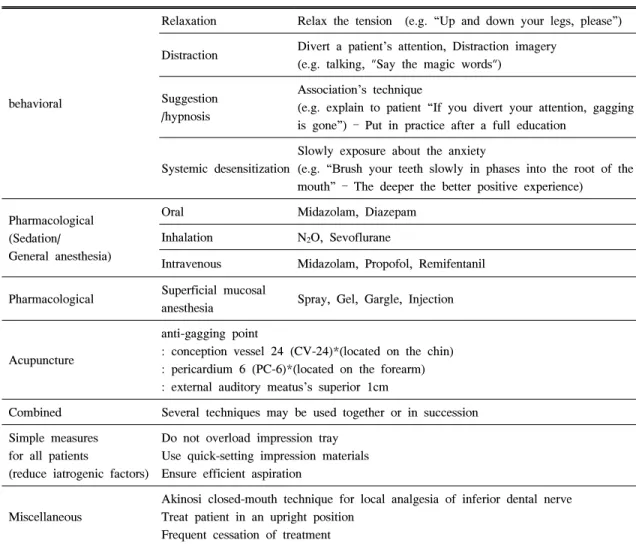
Table 1. Summary of Management of Gagging Patient
behavioral
Relaxation Relax the tension (e.g. “Up and down your legs, please”)
Distraction Divert a patient’s attention, Distraction imagery (e.g. talking, "Say the magic words")
Suggestion /hypnosis
Association’s technique
(e.g. explain to patient “If you divert your attention, gagging is gone”) – Put in practice after a full education
Systemic desensitization
Slowly exposure about the anxiety
(e.g. “Brush your teeth slowly in phases into the root of the mouth” – The deeper the better positive experience)
Pharmacological (Sedation/
General anesthesia)
Oral Midazolam, Diazepam Inhalation N2O, Sevoflurane
Intravenous Midazolam, Propofol, Remifentanil
Pharmacological Superficial mucosal
anesthesia Spray, Gel, Gargle, Injection
Acupuncture
anti-gagging point
: conception vessel 24 (CV-24)*(located on the chin) : pericardium 6 (PC-6)*(located on the forearm) : external auditory meatus’s superior 1cm
Combined Several techniques may be used together or in succession Simple measures
for all patients
(reduce iatrogenic factors)
Do not overload impression tray Use quick-setting impression materials Ensure efficient aspiration
Miscellaneous
Akinosi closed-mouth technique for local analgesia of inferior dental nerve Treat patient in an upright position
Frequent cessation of treatment
* WHO - location of acupuncture point
(Fiske and Dickinson, 2001; Bassi et al, 2004; Rosted et al, 2006)
고 찰
헛구역질은 물리적인 자극에 의해 발생하는 체 성, 정신적인 자극에 의해 발생하는 신경성, 체성과 신경성 혼합형의 복합적이고 난해한 병인을 가진다 (Fiske and Dickinson, 2001). 원인에 관계없이 심한 헛구역질이 지속적으로 있었던 환자의 경우 기본적 인 치과 치료도 받을 수 없어서 구강 상태가 좋지 않고, 광범위한 치료를 받아야 하는 경우가 많다.
여러 논문들에서는 치과 진료와 관련된 과도한 헛 구역질을 행동수정 요법과 약물요법, 침술이나 최면 의 보완적인 치료로 완화하였다(Conny and Tedesco,
1983b). 환자 관리에 오랫동안 사용된 행동수정 요 법은 장기간의 과도한 헛구역질을 학습 반응이라 보고, 이를 비학습화 시키거나 제거하는 방법이다.
주로 긴장 완화, 주의를 다른 곳으로 돌림, 연상기 법, 탈감작 등의 방법들을 단독 혹은 병합하여 사 용하며, 인식적인 행동요법과 정동 범람법 역시 유 용한 부가적인 술식이다. 그러나 이러한 행동수정 요법은 지속적으로 관리하면 과도한 헛구역질에 탁 월한 효과가 있지만 시간이 매우 오래 걸린다는 단 점이 있다. 또한 치과 치료에 부정적인 시각을 가 지고 두려움에 휩싸인 환자들에서 단순히 긴장 완 화, 주의를 다른 곳으로 돌림, 연상기법 등의 방법
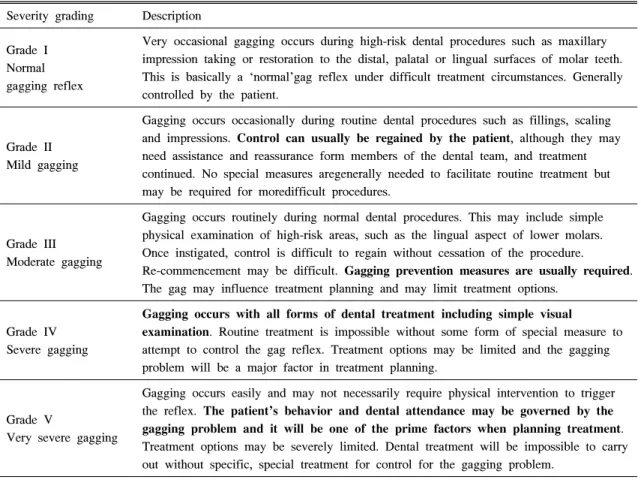
Table 2. Gagging Severity Index (GSI) Severity grading Description
Grade I Normal gagging reflex
Very occasional gagging occurs during high-risk dental procedures such as maxillary impression taking or restoration to the distal, palatal or lingual surfaces of molar teeth.
This is basically a ‘normal’gag reflex under difficult treatment circumstances. Generally controlled by the patient.
Grade II Mild gagging
Gagging occurs occasionally during routine dental procedures such as fillings, scaling and impressions. Control can usually be regained by the patient, although they may need assistance and reassurance form members of the dental team, and treatment continued. No special measures aregenerally needed to facilitate routine treatment but may be required for moredifficult procedures.
Grade III Moderate gagging
Gagging occurs routinely during normal dental procedures. This may include simple physical examination of high-risk areas, such as the lingual aspect of lower molars.
Once instigated, control is difficult to regain without cessation of the procedure.
Re-commencement may be difficult. Gagging prevention measures are usually required.
The gag may influence treatment planning and may limit treatment options.
Grade IV Severe gagging
Gagging occurs with all forms of dental treatment including simple visual
examination. Routine treatment is impossible without some form of special measure to attempt to control the gag reflex. Treatment options may be limited and the gagging problem will be a major factor in treatment planning.
Grade V
Very severe gagging
Gagging occurs easily and may not necessarily require physical intervention to trigger the reflex. The patient’s behavior and dental attendance may be governed by the gagging problem and it will be one of the prime factors when planning treatment.
Treatment options may be severely limited. Dental treatment will be impossible to carry out without specific, special treatment for control for the gagging problem.
만으로는 과도한 헛구역질을 치과치료가 가능할 정 도의 단계로 완화하기란 쉽지 않다. 행동수정 요법 에 비해 좀 더 침습적 방법인 약물요법에는 점막 면 마취, 의식 하 진정, 전신마취 등이 있다. 점막 표면 마취는 스프레이, 젤, 가글액, 주사 등이 이용 되는데, 어떤 환자들에서는 효과가 있는 반면 다른 이들에서는 오히려 증상이 심해지기도 한다. 헛구 역질을 예방하는 가장 확실한 방법인 전신마취는 치과 치료의 예후를 알기 힘들고, 비용이 비싸고 전신마취 자체의 위험성도 감수해야 하므로 가장 마지막 단계에 선택할 수 있는 방법이다. 비 침습 적인 행동수정 요법과 침습적 방법인 약물치료의 중간단계에 해당하는 침술요법이 최근 헛구역질을 예방하는 방법으로 각광을 받고 있다. Fiske 등은 (Fiske and Dickinson, 2001) 헛구역질이 심한 10명의 환자(Gagging severity index (GSI) grade Ⅳ: 4명, grade Ⅴ: 6명)를 대상으로 한 침술요법에서 외이도
상방 1 cm 지점에 침을 놓았을 때 8명은 Gagging prevention index (GPI) grade Ⅰ, 2명은 GPI grade Ⅱ 에 해당하는 성과를 얻었다고 보고하였다. 그러나 침술요법은 아직까지 정확한 기전이나 효과가 입증 되지 않은 방법이므로 환자들에게 충분한 설명을 통 해 고지에 입각한 동의를 구해야 하며, 기본적인 해 부학을 아는 침술에 숙련된 자격이 있는 자에 한하 여 무균적 시술을 통해 이뤄져야 한다(Table 1, 2, 3).
본 증례는 내원 시 심한 헛구역질로 치근 단 촬 영은 물론 국소마취제의 주입, 간단한 시진조차도 어려운, GSI grade Ⅳ에 해당하는 환자였다. 환자는 헛구역질을 일으킬만한 연구개의 해부학적 이상이 나 감기, 상악동염, 코막힘, 입마름 증상 등이 없었 으며(Mack, 1964; Wright, 1982) 오심을 일으킬만한 약제의 복용도 없었다. 또한 헛구역질의 역치를 낮 출 수 있는 위염, 장염 등의 위장관 질환도 없는 건강한 환자였다(Table 4). 치과 치료 중 헛구역질이
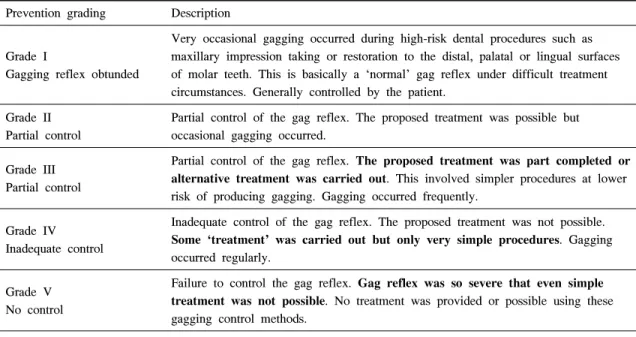
Table 3. Gagging Prevention Index (GPI) Prevention grading Description
Grade I
Gagging reflex obtunded
Very occasional gagging occurred during high-risk dental procedures such as maxillary impression taking or restoration to the distal, palatal or lingual surfaces of molar teeth. This is basically a ‘normal’ gag reflex under difficult treatment circumstances. Generally controlled by the patient.
Grade II Partial control
Partial control of the gag reflex. The proposed treatment was possible but occasional gagging occurred.
Grade III Partial control
Partial control of the gag reflex. The proposed treatment was part completed or alternative treatment was carried out. This involved simpler procedures at lower risk of producing gagging. Gagging occurred frequently.
Grade IV Inadequate control
Inadequate control of the gag reflex. The proposed treatment was not possible.
Some ‘treatment’ was carried out but only very simple procedures. Gagging occurred regularly.
Grade V No control
Failure to control the gag reflex. Gag reflex was so severe that even simple treatment was not possible. No treatment was provided or possible using these gagging control methods.
(Rosted et al, 2006)
Table 4. The Causes of Gagging
Systemic disorders Nasal obstruction, Postnasal drip, Common cold, Maxillary sinusitis, Nasal polyp, Dry mouth, Upper gastrointestinal disease
Drug-induced NSAIDs, Antidepressants, Opioids, Chemotherapy, Volatile anesthetics Physiologic Somatic gagging is induced by touching a trigger area in the oral cavity
Psychologic Apprehension, neuroticism Past dental negative experience
Iatrogenic Faults in denture design related to tongue space Retention, position of the post dam and freeway space Anatomic Position of tongue, hyoid bone, soft palate
(Fiske and Dickinson, 2001; Bassi et al, 2004)
처음 발생한 것은 7년 전 상악 좌측 제2대구치 우 식증으로 근관치료를 받을 때였고, 환자 스스로 “비 위가 약해서 칫솔질도 잘 못한다”고 표현하였다. 환 자는 치과 치료에 대한 강한 두려움을 표현하였고, 헛구역질은 일상생활에서도 일어나 혀, 입천장은 물론 상악, 하악 대구치의 칫솔질조차도 제대로 하 지 못하는 상태였다.
헛구역질은 스트레스에 대한 개개인의 반응에 의 해 강하게 영향을 받는다. 대부분의 환자들은 치료
중 과도한 인상재를 담은 트레이나 많은 양의 물이 분사되는 핸드피스, 치과의사의 부적절한 술식에 의해 헛구역질이 발생하며, 그 후 헛구역질의 원인 과 관계된 광범위한 자극에도 학습이 되어 비슷한 자극에도 헛구역질을 하게 된다(Bassi et al, 2004).
이에 의료진은 본 환자의 과도한 헛구역질도 체성 과 신경성이 혼합된 혼합형이라고 판단하고, 자극 에 둔감해지고 의식을 저하시켜 환자가 편안한 발 거 및 임플란트 치료를 받을 수 있도록 정맥 내 진
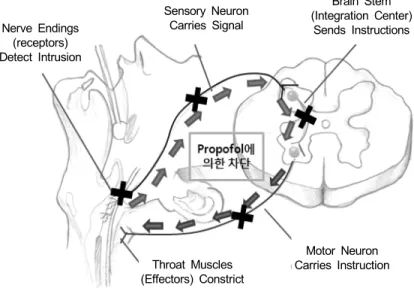
Nerve Endings (receptors) Detect Intrusion
Sensory Neuron Carries Signal
Brain Stem (Integration Center)
Sends Instructions
Throat Muscles (Effectors) Constrict
Motor Neuron Carries Instruction
Fig. 1. Reflex Arc for Gag Reflex – blocking effect of Propofol (Rudolph and Antkowiak, 2004). Nerve endings in the back of the throat detect an intrusive object. This generates nerve impulses, which a neuron carries to the integration center in the brain stem. The brain stem, using a motor neuron, instructs the muscles in the throat – the effectors – to contract. The result is a retch intended to force foreign objects out of the throat and mouth. All of this is involuntary and happens in an instant. Propofol is a useful management technique for gag reflex control during dental treatment. The effects of propofol are different according to propofol plasma concentration and anesthetic depth(sedative, hypnotic immobilizing actions). Nerve endings in the back of the throat aredull about an intrusive object by sedative propofol concentrations. Nerve impulses are interrupted by hypnotic propofol concentrations. Effectors constriction is interrupted by high anesthetic concentrations.
정마취를 계획하였다. 정맥 내 진정마취는 약물의 발현시간이 빠르고, 지속시간이 짧아 2시간 이내의 짧은 외래 수술에서 각광을 받고 있다. 특히 propofol은 숙취현상이 없고 빠른 진정, 빠른 회복에 탁월한 장점이 있어서 최근 정맥 내 진정마취에 가 장 많이 사용되는 약제이다(Antoine and Frederique, 2003). 그러나 빠른 진정에 따른 깊은 진정 또는 전 신마취 수준의 진정이 순식간에 유도되어 기도 막 힘이나 호흡정지(Yagiela, 2001), 산소포화도 감소, 기침과 후두경련(Chaushu and Becker, 2000) 같은 사 고가 유발되므로 각별한 주의가 필요하다. mida- zolam은 propofol에 비해 발현시간이 느려서 비교적 안전한 약이며 정맥 투여 시 반감기는 2시간으로 (Meechan et al, 1998) 적절한 용량을 사용하면 의식 하 진정수준을 유지할 수 있다. 또한 midazolam은 투약 후 베릴 증후가 나타나면서부터 약효가 반감 되는 시간까지의 기억을 상실하는 선행성 기억상실 효과가 있으므로 치과치료 중 발생한 부정적인 경
험들을 지울 수 있다. propofol도 midazolam만큼 기 억상실 효과가 있다(Veselis et al, 1997). 본 증례에 서는 midazolam 2.5 mg 일회주입으로 진정을 유도 하였고, propofol 40 mg/hr(1-1.5 mg/kg/hr)로 진정을 유지하고, 혈압과 맥박수를 감안하여 midazolam을 1.5 mg, 1 mg 추가 정주하였다. 발거와 임플란트 1 차 수술 시 의식 하 진정마취 하에서 헛구역질이 더 심해질 것을 우려하여 환자는 비교적 깊은 진정 상태를 유지하였다. 의식 하 진정은 환자 스스로 기도유지가 가능하며 적절한 구역반사를 할 수 있 는 상태이므로, 치과 치료에 대한 두려움을 감소시 켜 신경성 헛구역질을 예방할 수 있다. 반면 깊은 진정은 신경성 헛구역질뿐 아니라 구역반사가 예민 한 부위의 물리적인 자극에 대한 감각을 둔화시켜 체성 헛구역질도 예방 할 수 있다(Fig. 1). 따라서 저자의 경험상으로 midazolam만으로는 깊은 진정마 취를 유도할 수 없었으므로 propofol을 병행하였다.
인상채득을 위해 온 두 번째 시술 시에는 환자가
비교적 안정된 상태여서 midazolam 2 mg 정주로 진 정을 유도하고, propofol 20 mg으로 의식 하 진정과 깊은 진정 사이의 의식 수준을 유지하도록 하였다.
환자는 발치, 임플란트 식립과 상악, 하악 인상채득 동안 구역반사를 하지 않는, GPI gradeⅠ상태를 보 였다.
성공적인 정맥 내 진정마취는 선행성 건망증을 유도하므로 힘든 시술 과정의 부정적인 경험의 기 억을 지울 수 있고, 따라서 정맥 내 진정 마취 하 에 치과치료를 성공적으로 마친 환자는 치과 치료 에 대한 두려움, 헛구역질 등의 역치가 향상된다 (Harushi et al, 2007). 그러나 정맥 내 진정마취는 신중한 호흡관리가 요구되므로 진료 중 환자상태를 감시하는 요원이 추가적으로 더 필요하며, 환자는 시술이 끝나더라도 섬세하고 중요한 업무는 수행할 수 없고 시술 후 24시간 동안 보호자의 감시가 필 요하다(ADA guideline, 2007).
본 증례에서는 과도한 구역반사가 있는 환자의 임플란트 치료를 정맥 내 진정마취를 통하여 편안 하고 안전하게 시행하였다. 진정마취는 치과 치료 에 두려움이 있는 환자들의 치료 중 발생하는 헛구 역질에 탁월한 효과가 있다. 그러나 의치 등 평소 에 보철물을 계속 장착해야 하는 상황이라면 사용 할 수 없는 방법이다.
과도한 구역반사는 환자나 의사 모두에게 고통이 될 수 있다. 지금까지 행동수정요법, 약물요법, 침 술이나 최면의 보완적인 치료 등 다양한 관리 방법 들이 소개되었으며, 이를 환자 각 개인의 특성에 맞추어 이용해야 한다. 이러한 치료는 충분한 환자 문진을 통해 이루어져야 하며, 이들 방법을 단독 사용하거나 혼용하여 과도한 구역반사를 줄일 수 있는 연구를 앞으로도 계속 해나가야 하겠다.
참 고 문 헌
Antoine T, Frederique S: Intravenous techniques in ambulatory anesthesia. Anesthesiology Clin N Am 2003; 21: 273-88.
Bassi GS, Humphris GM, Longman LP: The etiology and management of gagging: A review of the literature. J Prosthet Dent 2004; 91: 459-67.
Chaushu JJ, Becker A: Behavior management needs for the orthodontic treatment of children with disabilities.
Eur J Orthod 2000; 22: 143-9.
Conny DJ, Tedesco LA: The gagging problem in prosthodontic treatment. J Prosthet Dent 1983a: 49:
601-4.
Conny DJ, Tedesco LA: The gagging problem in prosthodontic treatment. J Prosthet Dent 1983b: 49:
757-61.
Dies DF, Clarkston WK, Schratz CL: Intravenous keto- rolac tromethamine versus meperidine for adjunctive sedation in upper gastrointestinal endoscopy: a pilot study. Gastointest Endosc 1996; 43: 6-9.
Fiske J, Dickinson CM: The role of acupuncture in controlling the gagging reflex using a review of ten cases. Br Dent J 2001; 190: 611-3.
Guidelines for the use of sedation and general anesthesia by dentists. American Dental Association 2007.
Harushi Y, Terumi A, Satoru I: Management of exa- ggerated gag reflex using intravenous sedation in prosthodontic treatment. Tohocu J Exp Med 2007;
212: 373-8.
Kramer RB, Braham RL: The managament of the chronic or hysterical gagger. J Dent Child 1977; 94:
111-4.
Mack AO: Complete dentures. Br Dent J 1964; 116:
426-9.
Meechan JG, Robb ND, Seymour RA: Pain and anxiety control for the conscious dental patient. 1998; Oxford:
University press. 321-2.
Rosted P, Bundgaard M, Fiske J: The use of acupuncture in controlling the gag reflex in patients requiring an upper alginate impression: an audit. Br Dent J 2006;
201: 721-5.
Rudolph U, Antkowiak B: Molecular and neuronal substrates for general anesthetics. Nat Rev Neurosci 2004; 5: 709-20.
Saunders RM, Cameron J: Psychogenic gagging: identifi- cation and treatment recommendations. Compendium of Continuing Education in Dentistry 1997; 182: 109- 11.
Veselis RA, Reinsel RA, Feshchenko VA: The compa- rative amnestic effects of midazolam, propofol, thiop- ental and fentanyl at equisedative concentrations.
Anesthesiology 1997; 87: 749-64.
Wright SM: Medical history, social habits and individual experiences of patients who gag with dentures. J Prosthet Dent 1982; 42: 474-8.
Yagiela JA: Making patients safe and comfortable for a lifetime of dentistry. frontiers in office-based sedation.
J Dent Educ 2001; 65: 1348-56.