Ⅰ. Introduction
The remarkable evolution of contemporary dentin adhesive systems has focused on simplifying the clini- cal steps. Factors, such as time and simplification of the clinical steps have led to the increased use of simplified-step adhesives in association with resin materials.
Conventional (three-step) and simplified-step adhe- sive systems are currently available for etch and rinse systems. The bonding protocol of three-step systems requires separate acid-etching of the enamel
and dentin surfaces, the application of a primer con- taining hydrophilic resin and solvents to etched dentin, and the subsequent application of an adhe- sive containing resin monomers to both enamel and dentin1). However, in order to simplify the bonding protocol, manufacturers have attempted to produce several one-bottle dentin bonding systems that com- bine the primer and adhesive resin in a single solu- tion.
Simplified-step adhesive systems have replaced their predecessors in most clinical applications because of their reported versatility, ease of use and time-saving protocols. Most of these products are composed of hydrophilic and hydrophobic resins dis- solved in a high vapor pressure organic solvent, such as ethanol or acetone, which chase the water and bring the monomers into intimate contact with the exposed collagen fibers2). These adhesive systems This study compared the effect of an activator, intermediate bonding resin and low-viscosity flowable resin on the microtensile bond strength of a self-curing composite resin used with two-step total etching adhesives. Twenty extracted permanent molars were used. The teeth were assigned randomly to nine groups (n=10) according to the adhesive system and application of additional methods (activator, interme- diate adhesive, flowable resin). The bonding agents and additional applications of each group were applied to the dentin surfaces. Self-curing composite resin buildups were made for each tooth to form a core, 5mm in height. The restored teeth were then stored in distilled water at room temperature for 24h before sec- tioning. The microtensile bond strength of all specimens was examined. The data was analyzed statistically by one-way ANOVA and a Scheffe’s test. The application of an intermediate bonding resin (Optibond FL adhesive) and low-viscosity flowable resin (Tetric N-flow) produced higher bond strength than that with the activator in all groups. Regardless of the method selected, Optibond solo plus produced the lowest μTBS to dentin. The failure modes of the tested dentin bonding agents were mostly adhesive failure but there were some cases showed cohesive failure in the resin. [J Kor Acad Cons Dent 34(5):397-405, 2009]
Key words : activator, intermediate bonding resin, low-viscosity flowable resin, self cure composite resin, microtensile bond strength
-Received 2009.7.24., revised 2009.9.7., accepted 2009.9.8.- ABSTRACT
*Corresponding Author : JJeeoonngg--KKiill PPaarrkk Department of Conservative Dentistry
School of Dentistry, Pusan National University, 1-10, Ami-dong, Seo-gu, 602-739, Busan, Korea Tel : 051-240-7454
E-mail : [email protected]
EFFECT OF AN INTERMEDIATE BONDING RESIN AND FLOWABLE RESIN ON THE COMPATIBILITY OF TWO-STEP TOTAL ETCHING ADHESIVES WITH A SELF-CURING COMPOSITE RESIN
Sook-Kyung Choi, Ji-Wan Yum, Hyeon-Cheol Kim, Bock Hur, Jeong-Kil Park*
Department of Conservative Dentistry, School of Dentistry, Pusan National University
(one-bottle) have low and varied pH3).
Some of the two-step total etch adhesives are incompatible with a self-curing composite resin3). The decrease in dentin bond strength of self-curing com- posite resin is inversely proportional to the acidity of the uncured adhesive remaining on the dentin sur- face4,5). Sanares et al.3) reported that there is an inverse correlation between the acidity of these single bottle adhesives and the microtensile bond strength (μTBS) obtained from the use of a self-curing com- posite resin. This phenomenon has been attributed to an acid-base reaction between the basic tertiary amine in the self-curing composite resin and uncured acidic monomer of the adhesive, which prevents the tertiary amine from participating in the redox reac- tion and impedes free radical generation and com- plete curing of the resin composite6). Therefore, the degree of polymerization of this superficial layer can be reduced, resulting low bond strengths3,7).
In order to overcome this problem, some manufac- tures have developed so-called activators, which give the practitioner the option to use either dual-curing or light-curing bonding systems. Most of these acti- vators contain salts of aromatic sulfinic acids, which can react with acidic monomers to produce free radi- cals and initiate polymerization of the self-curing composite8). For adhesive systems, these components must be strong reducing agents and oxygen scav- engers, which improve polymerization, reduce the thickness of the oxygen inhibition layer and amount of uncured acidic monomer on the bonded surface9).
Some studies suggested that this incompatibility problem can be solved using either an additional adhesive resin layer without acidic monomers7) or an intermediate low-viscosity composite liner over bond- ed dentin10-12), thereby improving the bond strength between the adhesive and resin composite core mate- rial. The use of bonding systems associated with a low-viscosity resin has been suggested to improve the bond strength, marginal sealing and interfacial adap- tation of restorative composites to dentin12-15). In addition, some studies16-18) suggested that the appli- cation of a low-viscosity resin can preserve and pro- tect the hybrid layer during the shrinkage of restora- tive composites or resin cements, minimizing the postoperative sensitivity and increasing longevity of
the restoration.
Therefore, this study compared the effect of an activator, intermediate adhesive and low-viscosity flowable resin on μTBS of self-curing composite resin and compared the μTBS according to the dentin bonding agent in the same application method.
Ⅱ. Materials and Methods 1. Tooth preparation
Twenty extracted permanent molars without caries were stored in distilled water. The crown portions were sectioned horizontally at the mid-coronal level using a slow-speed diamond-saw sectioning (Accutom-50; Struers, R∅dovre, Denmark) under continuous water cooling. The flat dentin surface was polished with 600 grit silicon carbide paper under running water.
2. Dentin bonding and resin composite buildups
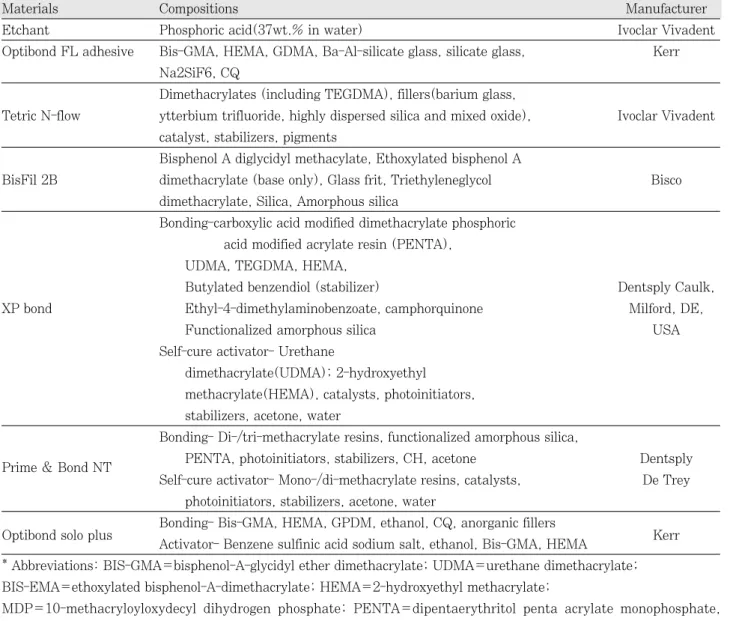
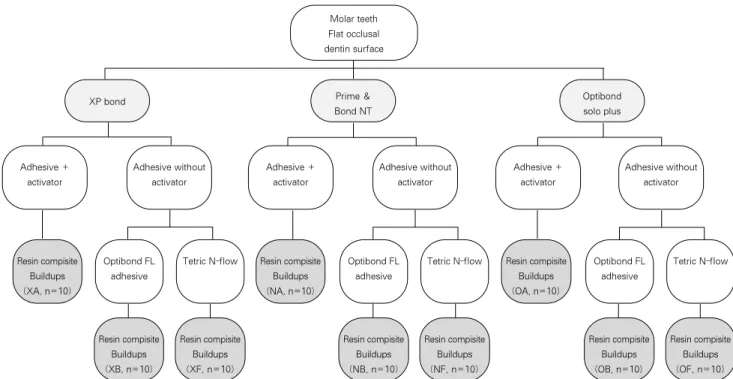
The teeth were assigned randomly to nine groups, according to the adhesive system and application of an intermediate adhesive, flowable resin between the adhesive and self-curing composite resin. Table 1 and Figure 1 show the materials and groups used in this study.
The dentin surface was etched for 15 sec with a 35% phosphoric acid etchant, and rinsed and air- dried gently for 5 sec, to leave a glossy surface. The bonding agents and additional applications in each group were applied to the dentin surfaces according to the manufacturer’s instructions (Table 2).
Optibond FL adhesive (Kerr, Orange, CA, USA) and Tetric N-flow (Ivoclar Vivadent, Schaan, Liechtenstein) were used as the intermediate adhe- sive and flowable resin, respectively. After the bond- ing procedure, the self-cure composite resin (BisFil 2B; BISCO, Inc., Schaumburg, IL, USA.) buildups were made to each tooth to form a core. The restored teeth were then stored in distilled water at room temperature for 24h.
3. μTBS testing
The restored teeth were cut longitudinally to pro- duce specimens, approximately 1×1 mm thick and 10 mm long. Each group contained 10 specimens.
The specimens were glued to the jig of the microten- sile testing machine (BISCO Inc, Schaumburg, IL, USA) using cyanoacrylate cement (Zapit; Dental Ventures of America, Corona, CA, USA). A tensile load was applied at a cross-head speed of 1 mm/min until the specimen failed.
4. Failure mode investigation
The failure mode was examined using an operating microscope (OPMI pico; Carl zeiss, Obercohen, Germany) at 25× magnification, and the results were classified as follows: adhesive, if the composite resin cone had fractured at the adhesive-tooth inter- face; cohesive in resin, if the composite resin cone had fractured inside the composite resin; cohesive in dentin, if the composite resin cone had fractured with a large portion of the dentin attached; or mixed, a combination of adhesive and cohesive in the dentin or cohesive in the resin.
Table 1.Materials used in this study
Materials Compositions Manufacturer
Etchant Phosphoric acid(37wt.% in water) Ivoclar Vivadent
Optibond FL adhesive Bis-GMA, HEMA, GDMA, Ba-Al-silicate glass, silicate glass, Kerr Na2SiF6, CQ
Dimethacrylates (including TEGDMA), fillers(barium glass,
Tetric N-flow ytterbium trifluoride, highly dispersed silica and mixed oxide), Ivoclar Vivadent catalyst, stabilizers, pigments
Bisphenol A diglycidyl methacylate, Ethoxylated bisphenol A
BisFil 2B dimethacrylate (base only), Glass frit, Triethyleneglycol Bisco dimethacrylate, Silica, Amorphous silica
Bonding-carboxylic acid modified dimethacrylate phosphoric acid modified acrylate resin (PENTA),
UDMA, TEGDMA, HEMA,
Butylated benzendiol (stabilizer) Dentsply Caulk,
XP bond Ethyl-4-dimethylaminobenzoate, camphorquinone Milford, DE,
Functionalized amorphous silica USA
Self-cure activator- Urethane
dimethacrylate(UDMA); 2-hydroxyethyl methacrylate(HEMA), catalysts, photoinitiators, stabilizers, acetone, water
Bonding- Di-/tri-methacrylate resins, functionalized amorphous silica,
Prime & Bond NT PENTA, photoinitiators, stabilizers, CH, acetone Dentsply Self-cure activator- Mono-/di-methacrylate resins, catalysts, De Trey
photoinitiators, stabilizers, acetone, water
Bonding- Bis-GMA, HEMA, GPDM, ethanol, CQ, anorganic fillers Optibond solo plus
Activator- Benzene sulfinic acid sodium salt, ethanol, Bis-GMA, HEMA Kerr
* Abbreviations: BIS-GMA=bisphenol-A-glycidyl ether dimethacrylate; UDMA=urethane dimethacrylate;
BIS-EMA=ethoxylated bisphenol-A-dimethacrylate; HEMA=2-hydroxyethyl methacrylate;
MDP=10-methacryloyloxydecyl dihydrogen phosphate; PENTA=dipentaerythritol penta acrylate monophosphate, TEGDMA=triethylene glycol dimethacrylate; BHT=butylhydroxytoluene.
5. Statistical analysis
Statistical analysis was carried out using one-way ANOVA with SPSS 12.0 software (SPSS. Chicago,
IL, USA). A Scheffe’s test was used for post-hoc multiple comparison. The level of significance was set to p < 0.05.
Figure 1.Restorative procedure of experimental groups
Resin compisite Buildups (XA, n=10)
Optibond FL adhesive
Tetric N-flow Resin compisite Buildups (NA, n=10)
Optibond FL adhesive
Tetric N-flow Resin compisite Buildups (OA, n=10)
Optibond FL adhesive
Tetric N-flow
Resin compisite Buildups (XB, n=10)
Resin compisite Buildups (XF, n=10)
Resin compisite Buildups (NB, n=10)
Resin compisite Buildups (NF, n=10)
Resin compisite Buildups (OB, n=10)
Resin compisite Buildups (OF, n=10) Adhesive +
activator
Adhesive without activator
Adhesive + activator
Adhesive without activator
Adhesive + activator
Adhesive without activator
XP bond Prime &
Bond NT
Optibond solo plus Molar teeth
Flat occlusal dentin surface
Table 2.Bonding procedures according to groups
Groups Procedures
XA Bond: Mix with Self-Cure Activator in equal amounts, apply the mixture and leave undisturbed (20s), thoroughly air dry (5s), light cure (10s)
XB Bond: Apply and leave undisturbed (20s), thoroughly air dry (5s), light cure (10s) Intermediate bonding resin: Apply to a thin layer, light cure (20s)
XF Bond: Apply and leave undisturbed (20s), thoroughly air dry (5 s), light cure (10 s) low viscosity flowable resin: Apply as a thin coat, light cure (20s)
NA Bond: Mix with Self-Cure Activator in equal amounts, apply the mixture and leave undisturbed (20s), gently air dry (5s), light cure (10s)
NB Bond: Apply and leave undisturbed (20s), thoroughly air dry (5 s), light cure (10 s) Intermediate bonding resin: Apply to a thin layer, light cure (20s)
NF Bond: Apply and leave undisturbed (20s), thoroughly air dry (5 s), light cure (10s) low viscosity flowable resin: Apply as a thin coat, light cure (20s)
OA Bond: Mix with Optibond Solo Plus Activator in equal amounts,
apply the mixture with light scrubbing motions (15s), light cure (20s) OB Bond: Apply with light scrubbing motions (15s), light cure (20s)
Intermediate bonding resin: Apply to a thin layer, light cure (20s) OF Bond: Apply with light scrubbing motions (15s), light cure (20s)
low viscosity flowable resin: Apply as a thin coat, light cure (20s)
Figure 2. μTBS of three dentin bonding agents in same application method. The subgroups under the horizontal line were not significantly different (p > 0.05).
Ⅲ. Results
1. Comparison between μTBS according to the in- tervening method of each dentin bonding agent
Table 3 shows a comparison of μTBS according to the intervening method in the same dentin bonding agent.
Group XB and XF showed higher bond strength than group XA (p < 0.05) but there was no signifi- cant difference between groups XB and XF (p >
0.05). Groups NB and NF had a higher bond strength than group NA (p < 0.05) but there was no significant difference between groups NB and NF (p >
0.05). In Optibond solo plus, group OB had the high- est μTBS, followed by group OF and OA. There were significant differences between all groups (p < 0.05).
2. Comparison between μTBS according to the dentin bonding agent of each intervening method
Figure 2 shows the μTBS of the three dentin bond- ing agents in the activator, bonding resin, and low viscosity flowable resin.
In the activator group, Prime & Bond NT showed
the highest μTBS, followed by a XP bond, Optibond solo plus. However, there was no significant differ- ence between the XP bond and Prime & Bond NT (P
> 0.05). Optibond solo plus showed the lowest μTBS of all groups (p < 0.05).
In the bonding resin group, Prime & bond NT also had the highest bond strength, followed by the XP bond, Optibond solo plus. However, there was no sig- nificant difference between the XP bond and Optibond solo plus (p > 0.05). Prime & Bond NT had the highest μTBS of all groups (p < 0.05).
In the low viscosity flowable resin group, Prime &
Bond NT had the highest μTBS, followed by the XP bond, Optibond solo plus. However, there was no sig- nificant difference between the XP bond and Prime &
Bond NT (p > 0.05). Optibond solo plus had lowest μ TBS value of the groups (p < 0.05).
3. Failure mode
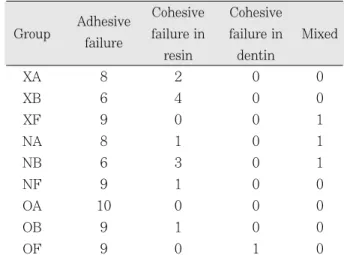
Table 4 shows the failure modes. Adhesive failure was observed predominantly in all groups. Adhesive failure was observed more often in Optibond solo plus than the other groups. All specimens in group OA showed adhesive failure.
Table 3.Mean μTBS (Mean ± SD, MPa)
each group n=10 Activator Intermediate bonding resin Low viscosity flowable resin XP bond XA (36.54 ± 3.66)a XB (43.85 ± 3.63)b XF (46.59 ± 1.32)b Prime & Bond NT NA (36.84 ± 2.18)a NB (48.15 ± 2.10)b NF (47.85 ± 4.95)b Optibond solo plus OA (13.60 ± 2.20)a OB (41.55 ± 2.32)b OF (36.49 ± 1.70)c μTBS with same superscript in the same horizontal row were not significantly different (p < 0.05).
Table 4.Failure mode
Adhesive Cohesive Cohesive Group
failure failure in failure in Mixed resin dentin
XA 8 2 0 0
XB 6 4 0 0
XF 9 0 0 1
NA 8 1 0 1
NB 6 3 0 1
NF 9 1 0 0
OA 10 0 0 0
OB 9 1 0 0
OF 9 0 1 0
Activator Intermediate Low viscosity adhesive flowable resin
XP bond Prime&Bond NT
Optibond solo plus 60
50
40
30
20
10
0
μTBS (MPa)
Ⅳ. Discussion
Recently, several one-bottle dentin bonding sys- tems that combine the primer and adhesive resin into a single solution were introduced. These materi- als have attracted considerable attention from the dental profession because some two-step total etch adhesives are incompatible with self-curing composite resins. In some studies, an adverse interaction between the tertiary amine catalytic component of the restorative composites placed over an uncured acidic resin adhesive layer was previously report- ed3,7,18).
Compromised bond strength was observed when a self-curing composite resin was coupled with unacti- vated adhesives, which can compromise their longevity. Swift19) reported two reasons for this incompatibility. The first is that the oxygen-inhibi- tion layer of polymerized adhesives contains uncured acidic resin monomer, which can react with the amines from the self-curing composite resin in the adhesion-promoting monomers to form charge-trans- fer complexes, resulting in incomplete polymerization and compromised adhesion. The second reason is that water movement occurs through the polymerized adhesive layer, which contains acidic and hydrophilic resin monomers. The slow rate of polymerization of the self-curing composite resin enables water to dif- fuse from the hydrated dentin, which can trap water, resulting in osmotic blistering or water trees20).
Some manufacturers have developed activators for self-curing composite resin to overcome the dilemma of incompatibility. Activators have been used with dentin adhesives containing acidic resin monomers to improve their bonding to self-cured composites3). The activator components must be strong reducing agents and oxygen scavengers, which improve polymeriza- tion, in order to reduce the thickness of the oxygen inhibition layer and amount of uncured acidic monomer on the bonded surface9). For adhesive sys- tems, some alternative initiators, such as sulphinic acid salts, organoboron compounds or barbituric acid/cupric chloride have been included in adhesive compositions as initiator systems. In addition, sul- fonamides can be effective coactivators for photoiniti- ation21-23). Munksgaard et al.24) suggested that the
inclusion of reducing agents, such as aromatic sul- phinic acid salts or propanal in dentin adhesives, could improve the bond strength and marginal integrity by reducing the thickness of the oxygen inhibition layer.
In another solution, Tay et al.7) suggested the application of an adhesive resin intermediate layer to avoid contact between the uncured acidic adhesive and unpolymerized resin composite, and prevent adverse interactions. In this study, intermediate adhesive (Optibond FL adhesive) and a low-viscosity flowable resin (Tetric N-flow) were used as an inter- mediate layer over bonded dentin. The application of an intermediate adhesive and low-viscosity flowable resin eliminates the incompatibility between resin- based materials, thereby avoiding the formation of a weakened bonded interface9). Jayasooriya et al. 11) suggested that the application of an intermediate bonding resin and a low-viscosity flowable resin layer can improve the degree of conversion of the underly- ing adhesive resin, and increase the bond strength.
In this study, the application of an intermediate adhesive and a low-viscosity flowable resin produces higher bond strength than the applying activator.
Therefore, applying an intermediate adhesive and low-viscosity flowable resin should be more useful in preventing adverse interactions between the acidic monomers on the adhesive surface and the tertiary amine catalytic component of the self-curing compos- ite resin.
The mean bond strengths of XP bond and Prime &
Bond NT were significantly higher than Optibond Solo Plus. According to the manufacturer’s composi- tion, XP bond, Prime & Bond NT and Optibond Solo Plus contain butanol, acetone and ethanol as sol- vents, respectively. In many studies25-27), the effect of the solvents on the efficacy of dentin bonding has been demonstrated. These chemical agents, known as “water-chases”, increase the dentin wettability and help replace the water on the acid-etched and rinsed dentin surface with hydrophilic resin monomers. Acetone is used frequently as a solvent because it can efficiently remove water from sur- faces25,26,28). By adding 10% acetone to water, the vapor-pressure increases by more than 300%, lead- ing to volatilization of some of the surface water29).
Ethanol is another organic solvent that is used as a vehicle in adhesives. However, but it has a higher boiling temperature and lower vapor pressure than acetone. Alcohol triggers more hydrogen bonding than acetone. Therefore, alcohol does not chase water as effectively as acetone, which can compromise the durability of dentin bonding25,26,30). Therefore, it is likely that Optibond solo plus containing ethanol as a solvent has low bond strength.
Sanares et al.3,31) reported that there was a linear relationship between the pH of the adhesives and their mean μTBS when using a self-cured composite.
According to their study, Prime & Bond NT, which is more acidic than Optibond solo plus, exhibited the largest decrease in bond strength. However, in this study, Prime & Bond NT, which is the most acidic of the three adhesives, exhibited higher bond strength than Optibond Solo Plus. These findings are incon- sistent with those of Sanares’s study. Therefore, it is unlikely that a decrease in the bond strength of sim- plified-step adhesives using self-cured composites is due to the pH of adhesives. Factors other than pH, such as the monomer composition, appear to be responsible for the bond strength.
Adhesive failure was the main failure mode observed in all groups. In Optibond solo plus, adhe- sive failure was observed more often than the other groups. Some cohesive failure in resin was observed.
This might due to the incorporation of air-voids with- in the self-cured composite during hand-mixing of the two-paste systems. The ultimate mechanical properties of the polymerized material are compro- mised by these voids, due to their inherent potential to increase the stress level within the self-curing composite resin32).
Composite build-up materials have different curing modes that vary from self-cured, light-cured or dual- cured. Light-cured resin composites have displaced the use of self-curing composites in esthetic dental applications. However, self-curing composite resins have a variety of clinical applications as direct core buildup materials. The success of the treatment depends on the appropriate selection of adhesive sys- tem in combination with a resin core composite.
However, it was reported that there are incompatibil- ities between two-step total etch adhesives and self-
curing composite resins. Based on these findings, it is possible that applying an intermediate adhesive and a low-viscosity flowable resin would more effective on dentin bonding of a self-curing composite resin using two-step total etch adhesives with low pH. More study should be carried out using other two-step total etch adhesives to determine if intermediate adhesive and flowable resin are as effective as the one examined in this study.
Ⅴ. Conclusions
This study compared the effect of an activator, intermediate bonding resin and low-viscosity flowable resin on the microtensile bond strength of a self-cur- ing composite resin. The results showed that apply- ing an intermediate adhesive (Optibond FL adhe- sive) and low-viscosity flowable resin (Tetric N-flow) produces a higher bond strength than applying an activator. Regardless of the method selected, Optibond solo plus produced the lowest μTBS to dentin. The failure modes of the tested dentin bond- ing agent were mainly adhesive failure with some cases of cohesive failure in resin.
These results suggest that the application of an intermediate adhesive and low-viscosity flowable resin may be made more effective on dentin bonding to a self-curing composite resin using two-step total etch adhesives with a low pH.
References
1. Franco EB, Lopes LG, D’Alpino PH, Pereira JC.
Influence of pH of different adhesive systems on the polymerization of a chemically cured composite resin.
Braz Dent J 16(2):107-111, 2005.
2. Tay FR, Gwinnett JA, Wei SH. Micromorphological spectrum from overdrying to overwetting acid-condi- tioned dentin in water-free acetone-based, single-bot- tle primer/adhesives. Dent Mater 12(4):236-44, 1996.
3. Sanares AM, Itthagarun A, King NM, Tay FR, Pashely DH. Adverse surface interactions between one-bottle light-cured adhesives and chemical-cured composites.
Dent Mater 17(6):542-556, 2001.
4. Swift EJ Jr, Perdigão J, Combe EC, Simpson CH 3rd,Nunes MF. Effects of restorative and adhesive cur- ing methods on dentin bond strengths. Am J Dent 14(3):137-140, 2001.
5. Jung MK, Cho BH, Son HH, Um CM, Han YC, Choung SJ. Effect of additional coating of bonding resin on the microtensile bond strength of self-etching adhesives to dentin. J Kor Acad Cons Dent 31(2):103-111, 2006.
6. Tay FR, Pashley DH, Yiu CK, Sanares AM, Wei SH.
Factors contributing to the incompatibility between simplified-step adhesives and chemically-cured or dual-cured composites. Part I. Single-step self-etching adhesive. J Adhes Dent 5(1):27-40, 2003.
7. Tay FR, King NM, Suh BI, Pashley DH. Effect of delayed activation of light-cured resin composites on bonding of all-in-one adhesives. J Adhes Dent 3(3):207-225, 2001.
8. Tay FR, Suh BI, Pashley DH, Prati C, Chuang SF, Li F. Factors contributing to the incompatibility between simplified-step adhesives and self-cured or dual-cured composites. Part II. Single-bottle, total-etch adhesive.
J Adhes Dent 5(2):91-105, 2003.
9. Giannini M, De Goes MF, Nikaido T, Shimada Y, Tagami J. Influence of activation mode of dual-cured resin composite cores and low-viscosity composite lin- ers on bond strength to dentin treated with self-etch- ing adhesives. J Adhes Dent 6(4):301-306, 2004.
10. Belli S, Inokoshi S, Ozer F, Pereira PN, Ogata M, Tagami J. The effect of additional enamel etching and a flowable composite to the interfacial integrity of Class II adhesive composite restorations. Oper Dent 26(1):70-75, 2001.
11. Jayasooriya PR, Pereira PN, Nikaido T, Tagami J.
Efficacy of a resin coating on bond strengths of resin cement to dentin. J Esthet Restor Dent 15(2):105- 113, 2003.
12. Montes MA, de Goes MF, da Cunha MR, Soares AB. A morphological and tensile bond strength evaluation of an unfilled adhesive with low-viscosity composites and a filled adhesive in one and two coats. J Dent 29(6):
435-441, 2001.
13. Beznos C. Microleakage at the cervical margin of com- posite Class II cavities with different restorative tech- niques. Oper Dent 26(1):60-69, 2001.
14. Figueiredo Reis A, Giannini M, Ambrosano GM, Chan DC. The effects of filling techniques and a low-viscosity composite liner on bond strength to class II cavities. J Dent 31(1):59-66, 2003.
15. Jayasooriya PR, Pereira PN, Nikaido T, Burrow MF, Tagami J. The effect of a “resin coating”on the inter- facial adaptation of composite inlays. Oper Dent 28(1):28-35, 2003.
16. Behle C. Flowable composites: properties and applica- tions. Pract Periodontics Aesthet Dent 10(3):347,350- 351, 1998.
17. Leevailoj C, Cochran MA, Matis BA, Moore BK, Platt JA. Microleakage of posterior packable resin compos- ites with and without flowable liners. Oper Dent
26(3):302-307, 2001.
18. Mak YF, Lai SC, Cheung GS, Chan AW, Tay FR, Pashley DH. Micro-tensile bond testing of resin cements to dentin and an indirect resin composite.
Dent Mater 18(8):609-621, 2002.
19. Swift EJ Jr. Dentin bonding, caries control. J Esthet Dent 12(5):236-237, 2000.
20. Castellon P, Burgess JO. Shear bond strength of four core materials to dentin bonded with light-cured or dual-cured adhesive. Am J Dent 17(6):401-403, 2004.
21. Nyunt MM, Imai Y. Adhesion to dentin with resin using sulfinic acid initiator system. Dent Mater J 15(2):175-182, 1996.
22. Imai Y, Kadoma Y, Kojima K, Akimoto T, Ikakura K, Ohta T. Importance of polymerization initiator systems and interfacial initiation of polymerization in adhesive bonding of resin to dentin. J Dent Res 70(7):1088- 1091, 1991.
23. Nikaido T, Podszun W, Mu¨ller M, Nakabayashi N.
Effect of sulfonamides and 4-MET on adhesion to tooth substrates. Dent Mater 6(2):78-82, 1990.
24. Munksgaard EC, Irie M, Asmussen E. Dentin-polymer bond promoted by Gluma and various resins. J Dent Res 64(12):1409-1411, 1985.
25. Kanca J 3rd. Effect of resin primer solvents and sur- face wetness on resin composite bond strength to dentin. Am J Dent 5(4):213-215, 1992.
26. Abate PF, Rodriguez VI, Macchi RL. Evaporation of solvent in one-bottle adhesives. J Dent 28(6):437-440, 2000.
27. Ko KH, Cho YG, Jin CH, Yoo SH. Effect of wetness on the enamel bonding. J Kor Acad Cons Dent 29(3):205- 211, 2004.
28. Jacobsen T, So¨derholm KJ. Some effects of water on dentin bonding. Dent Mater 11(2):132-136, 1995.
29. Giannini M, Arrais CA, Vermelho PM, Reis RS, dos Santos LP, Leite ER. Effects of the solvent evaporation technique on the degree of conversion of one-bottle adhesive systems. Oper Dent 33(2):149-154, 2008.
30. Jacobsen T, So¨derholm KJ. Effect of primer solvent, primer agitation, and dentin dryness on shear bond strength to dentin. Am J Dent 11(5):225-228, 1998.
31. Cho YG, Yoo SH. Comparative enamel bond strength between light-and dual-cured composites bonded by self-etching adhesives. J Kor Acad Cons Dent 32(1):1- 7, 2007.
32. Powers CM, Lee IY, Skinner HB, Keyak JH. Effects of distal cement voids on cement stress in total hip arthroplasty. J Arthroplasty 13(7):793-798, 1998.
국문초록
자가 중합 복합 레진과 두 단계 산 부식 접착제의 친화성에 대한 중간 접착제와 흐름성 레진의 효과
최숙경∙염지완∙김현철∙허 복∙박정길*
부산대학교 치의학전문대학원 치과보존학교실
이 연구의 목적은 자가 중합 복합 레진과 두 단계 산 부식 접착제의 친화성에 대한 중간 접착제와 흐름성 레진의 효과 를 미세 인장 결합 강도를 통해 비교하는 것이었다. 20개의 발거된 대구치를 사용해 접착제와 부가적인 적용(활성제, 중간 접착제, 흐름성 레진)에 따라 XP bond 그룹 (XA, XB, XF 그룹), Prime & Bond NT 그룹 (NA, NB, NF 그 룹), Optibond solo plus 그룹 (OA, OB, OX 그룹) 으로 나누었다. 접착제 적용 후 활성제, 중간 접착제, 흐름성 레진 을 각각 적용하고 상부에 자가 중합 레진을 축성하였다. 24시간 동안 실온의 증류수에 보관 후 각 그룹당 10개의 시편 을 준비하였다. 모든 시편의 미세인장 결합 강도를 측정하여 다음과 같은 결과를 얻었다.
1. 모든 그룹에서 중간 접착제와 흐름성 레진의 적용은 활성제 적용보다 더 높은 결합 강도를 보였다.
2. 선택된 방법에 관계없이, Optibond solo plus 그룹은 가장 낮은 미세인장 결합강도를 보였다.
3. 파절 양상은 대부분 접착성 파절을 보였고 일부 레진 내에서 응집성 파절을 보였다.
이번 연구의 결과로부터, 중간 접착제와 흐름성 레진의 적용이 낮은 pH를 가지는 두 단계 산 부식 접착제와 자가 중 합 복합 레진의 상아질 접착에 더 효과적이라 예상된다.
주요단어 : 활성제, 중간 접착제. 흐름성 레진, 자가 중합 레진, 미세인장 결합 강도