Received February 8, 2013, Revised March 19, 2013, Accepted March 19, 2013 Corresponding author: Sabina Lim
Research Group of Pain and Neuroscience, WHO Collaborating Center for Traditional Medicine, East-West Medical Research Institute, Kyung Hee University, 1 Hoegi-dong, Dongdaemun-gu, Seoul 130-701, Korea
Tel: +82-2-961-0324, Fax: +82-2-961-7831, E-mail: [email protected]
This work was supported by a Korea Research Foundation Grant funded by the Korean Government(MOETHD) and Kyung Hee University (KRF-2005-005-J00702).
CCThis is an open access article distributed under the terms of the Creative Commons Attribution Non-Commercial License(http://creativecommons.org/licenses/ by-nc/3.0) which permits unrestricted non-commercial use, distribution, and reproduction in any medium, provided the original work is properly cited.
Comparison of Warm-Needling and Acupuncture for Knee Osteoarthritis: A Randomized Controlled Trial
Woong-Ki Min1,2,Sujung Yeo1,2, Ee-Hwa Kim3, Ho Sueb Song4, Sungtae Koo5, Jae-Dong Lee6, Sabina Lim1,2
1Research Group of Pain and Neuroscience, WHO Collaborating Centre, East-West Medical Research Institute, Kyung Hee University, 2Department of Acupuncture and Meridian, Graduate School of Applied Korean Medicine,
Kyung Hee University, 3Department of Acupoint & Meridian, College of Korean Medicine, Semyung University,
4Department of Acupuncture & Moxibustion, College of Korean Medicine, Gachon University,
5Division of Meridian and Structural Medicine, School of Korean Medicine, Pusan National University,
6Department of Acupuncture & Moxibustion, College of Korean Medicine, Kyung Hee University
퇴행성 슬관절염에서의 온침과 침의 효능 비교 연구
민웅기1,2ㆍ여수정1,2ㆍ김이화3ㆍ송호섭4ㆍ구성태5ㆍ이재동6ㆍ임사비나1,2
1경희대학교 동서의학연구소, 2경희대학교 한의과대학 경혈학교실, 3세명대학교 한의과대학 경혈학교실, 4가천대학교 한의과대학 침구학교실,
5부산대학교 한의학전문대학원 경락구조의학부, 6경희대학교 한의과대학 침구학교실
Objectives : The aim of this study was to investigate whether warm-needling is more effective than acupuncture in relieving the pain and improving the symptoms of knee osteoarthritis(OA). Methods : 76 volunteers with knee OA participated in the study. The subjects were randomly assigned to one of two groups. One group received warm-needling(n=38), while the other group received acupuncture(n=38). Sixteen sessions of warm-needling or acupuncture were conducted on the pain region of each problematic knee over a period of 8 weeks. The Western Ontario and McMaster Universities Osteoarthritis Index(WOMAC) scores, physical health score based on the 36-Item Short-Form Health Survey(SF-36) and the Global Assessment(PGA) was measured. Results : Compared to the acupuncture group, the warm-needling group showed a significant decrease in pain, function, and total WOMAC scores according to the Mann-Whitney U-test. The PGA scores of the warm-needling group also showed a significant improvement compared to the acupuncture group. Conclusions : Warm-needling showed a greater pain relief effect on knee OA compared to the acupuncture group. These findings suggest that warm-needling may be a promising alternative therapy for treating knee OA.
Key words : warm-needling, acupuncture, arthritis, WOMAC, SF-36, patient global assessment
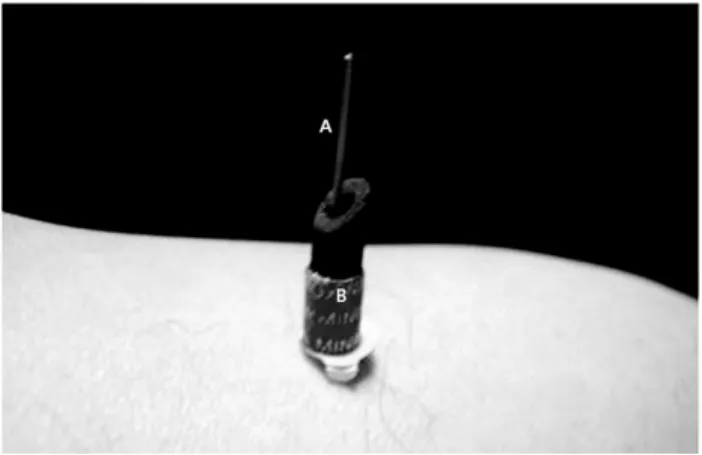
Fig. 1. Features of warm needling.
At first, an acupuncture needle was inserted in the acupoint(A).
Then, the moxa stick(B) was attached on top of the inserted needle by sliding it onto the needle, using the previously prepared hole in the stick.
Introduction
Knee osteoarthritis(OA) is a chronic progressive disease that is difficult to manage and control, discouraging both patients and medical doctors. Once knee OA develops, it results in a progressive deterioration of the pathological region of the knee, often accompanied by inflammation.
Curative therapies for knee OA are only partially successful.
Therefore, both pharmacological and non pharmacological interventions are used in order to reduce the pain and functional limitations1).
One of the most important causes of knee OA, from an Eastern medical point of view, is external wind-cold- dampness(風寒濕)2). An external wind-cold-dampness syn- drome results in pain, edema, numbness, deformation, and difficulty in bending and stretching the knee joint. The knee OA treatment used in Korean medicine includes acupuncture, moxibustion, cupping, warm needling, and herbal medi- cation. Warm needling therapy(Fig. 1) is described in the Zhenjiuzishengjing(鍼灸資生經)3) as combining the effects of acupuncture and moxibustion in a single treatment. In this technique, dried and pounded Folium Artemisiae Argyii(Ai Ye, or mugwort) is attached to the handle of the acupuncture needle after it has been inserted into an acupuncture point2). The mugwort is then lit and allowed to burn. Typically, there is about an inch between the surface of the skin and the ball
of burning mugwort so that the warmth is conducted from the handle of the needle to the needle itself and then to the surrounding tissue2). This method is primarily appropriate for vacuity cold diseases and wind-damp impediment conditions.
Therefore, it is used mainly for diseases characterized by an external wind-cold-dampness and chronic deficiency pat- tern. Examples of these include arthritis with soft tissue inflammation and musculoskeletal diseases such as ligament sprain, traumatic inflammation, and lumbago4,5).
In previous reports, warm needling has been used to treat knee OA6), lumbar intervertebral disc herniation7,8), sciatica9), and myasthenia gravis10). It has been suggested that warm needling could be a useful therapeutic approach for pain re- lief. In order to assess the efficacy of warm needling, acu- puncture was selected as a positive control group. Acu- puncture efficacy and safety issues associated with knee OA patients have been addressed in several clinical trials11-14). In addition, one recent systematic review of seven randomized controlled trials with a total of 393 patients found acu- puncture effective in reducing pain; yet the results were inconclusive regarding its efficiency in improving joint func- tion15). This report by Berman et al.12) was based on small sample sizes, local acupuncture points, and a randomized controlled trial. The significant differences in the total the Western Ontario and McMaster Universities Osteoarthritis Index(WOMAC) scores at 4 and 8 weeks indicated acupunc- ture’s ability to ameliorate the patients’ symptoms. In choo- sing the acupoints, we followed the method used by Berman et al.11) and Li et al.6) Additional acupoints were selected based on the occurrence of tenderness and pain along involved meridians.
The goals of this investigation were to determine whether warm needling is a clinically effective method for relieving pain in patients with knee OA and to compare the thera- peutic effects of warm needling with those of acupuncture.
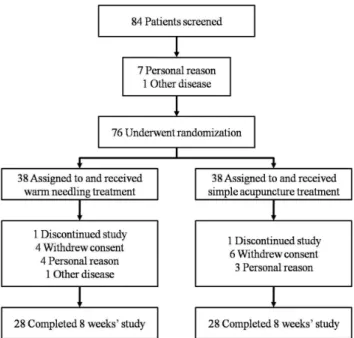
Fig. 2. The flowchart of participants.
Materials and Methods
1. Target population
Male and female volunteers were recruited through adver- tisements. After all patients provided their informed consent, this study was carried out under the supervision of an ethics committee of Eastern medical doctors and a religious scholar(Kyungwon Gil Oriental Medical Hospital). All subjects were screened through the following set of inclusion and exclusion criteria:
Inclusion criteria:
□ Female or male over the age of 50.
□ Diagnosis of knee OA(American College of Rheuma- tology criteria applied).
□ Knee OA duration of over 6 months.
□ Documented radiographic changes of osteoarthritis (Kellgren-Lawrence grade of 1 or more).
□ Signed informed consent.
Exclusion criteria:
□ Female or male over the age of 70.
□ Intra-articular corticosteroid injection in the knee wi- thin the four-week period immediately preceding the beginning of the trial.
□ Severe chronic or uncontrolled concomitant illness.
□ Diagnosis of rheumatoid arthritis of the knee.
□ History or clinical indications of bleeding diathesis and cardiovascular disease, including current use of anti- coagulants.
□ Allergy to metal.
□ Blood test: Rheumatoid Factor≥1:40, Erythrocyte Sedimentation Rate≥40 mm/hour.
□ Previous treatment with acupuncture within four weeks of entry into the study.
□ Taking hormone medications.
□ Fears related to moxibustion or warm sensations.
The subjects that met both the inclusion and exclusion criteria were selected(the subject flowchart is shown in Fig.
2). In total, 76 volunteers with knee OA participated in the study. The subjects were randomly divided into a warm
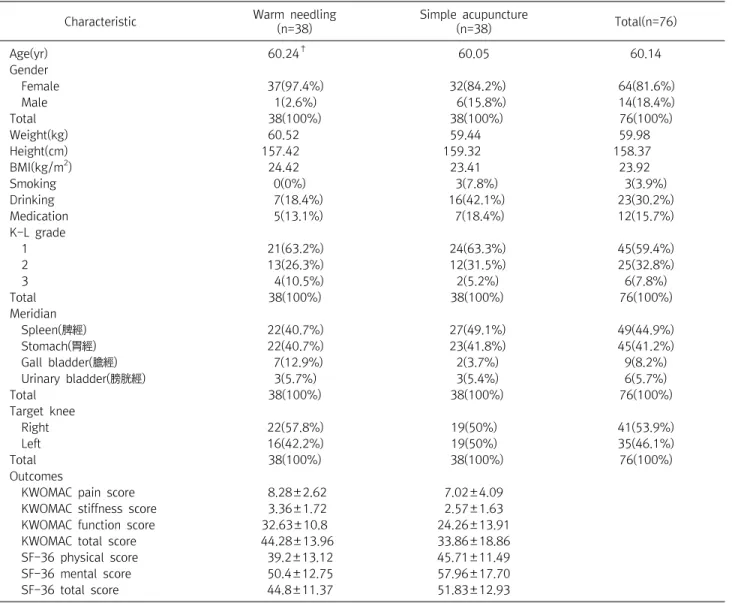
needling and an acupuncture group; the demographic and baseline characteristics for both groups are shown in Table 1.
The subjects were not acupuncture naïve since acupuncture treatment is common in South Korea. Both groups exhibited similar characteristics in their general features and baseline outcomes, showing that the randomized assignment of the subjects was appropriate for this clinical study. During the trial, the warm needling and acupuncture groups each had 10 dropouts as can be seen in Fig. 2. In the warm needling group the dropouts were classified as follows: 4 by with- drawal of consent(denial of participation and further treat- ment), 1 because of other diseases, 1 discontinued study, and 4 for personal reasons. In the acupuncture group, the dropouts were classified as follows: 6 by withdrawal of consent(denial of participation and further treatment), 1 discontinued study, and 3 for personal reasons.
2. Study design
1) Randomization: The subjects in inclusion criteria were divided into a warm needling and an acupuncture group through a random table generated by SPSS 12.0. Two practitioners licensed in Korean medicine, each with over seven years of experience in clinical treatment, performed the acupuncture and warm needling16). The subjects of both
Characteristic Warm needling (n=38)
Simple acupuncture
(n=38) Total(n=76)
Age(yr) 60.24† 60.05 60.14
Gender
Female 37(97.4%) 32(84.2%) 64(81.6%)
Male 1(2.6%) 6(15.8%) 14(18.4%)
Total 38(100%) 38(100%) 76(100%)
Weight(kg) 60.52 59.44 59.98
Height(cm) 157.42 159.32 158.37
BMI(kg/m2) 24.42 23.41 23.92
Smoking 0(0%) 3(7.8%) 3(3.9%)
Drinking 7(18.4%) 16(42.1%) 23(30.2%)
Medication 5(13.1%) 7(18.4%) 12(15.7%)
K-L grade
1 21(63.2%) 24(63.3%) 45(59.4%)
2 13(26.3%) 12(31.5%) 25(32.8%)
3 4(10.5%) 2(5.2%) 6(7.8%)
Total 38(100%) 38(100%) 76(100%)
Meridian
Spleen(脾經) 22(40.7%) 27(49.1%) 49(44.9%)
Stomach(胃經) 22(40.7%) 23(41.8%) 45(41.2%)
Gall bladder(膽經) 7(12.9%) 2(3.7%) 9(8.2%)
Urinary bladder(膀胱經) 3(5.7%) 3(5.4%) 6(5.7%)
Total 38(100%) 38(100%) 76(100%)
Target knee
Right 22(57.8%) 19(50%) 41(53.9%)
Left 16(42.2%) 19(50%) 35(46.1%)
Total 38(100%) 38(100%) 76(100%)
Outcomes
KWOMAC pain score 8.28±2.62 7.02±4.09
KWOMAC stiffness score 3.36±1.72 2.57±1.63
KWOMAC function score 32.63±10.8 24.26±13.91
KWOMAC total score 44.28±13.96 33.86±18.86
SF-36 physical score 39.2±13.12 45.71±11.49
SF-36 mental score 50.4±12.75 57.96±17.70
SF-36 total score 44.8±11.37 51.83±12.93
*There were no statistical differences between the warm needling group and the simple acupuncture group at baseline. †The mean scores are given.
KWOMAC : Korean Westernand McMaster Universities Osteoarthritis Index, SF-36 : 36-Item Short-Form Health Survey.
The values presented with a plus/minus sign are means’s.
Table 1. Subject Demographic and Baseline Characteristics*
groups were randomly assigned to the two practitioners.
2) Blinding and materials: Because it was impossible to blind the practitioners, all the subjects and the analyzers of the data were blinded.
3. Acupoint
We based the selection of acupuncture points on the Eastern Traditional Medicine meridian theory for treating knee joint pain, known as "Bi(痺)" syndrome caused by external wind-cold-dampness, which uses local points on
channels that transverse the area of pain. The selected acupoints are listed in Table 2. The acupoints consisted of common and additional acupoints. The common acupoints were the 4 local points used most commonly on knee OA.
Additional acupoints were those found by using meridian diagnosis. On average, 1∼2 local points were added for each subject. These additional acupoints were selected after the practitioners pressed acupoints along one or two involved meridians. The points that were eventually selected were those at which this process induced pain. The total number
Classification of
the acupoints Criterion of the selection(Meridian Characteristics) Name of acupoint Common acupoints The acupoints to use for all subjects(Stomach meridian) Ex-LE4(Xiyan)
ST35(Dubi) ST36(Zusanli) Ex-LE2(Heding) Additional acupoints Pain above and dorsal to the medial condyle of the tibia(Spleen meridian) SP9(Yinlingquan)
SP10(Xuehai) Pain at the medial end of the popliteal crease, dorsal to the medial
condyle of the tibia(Liver meridian)
LR8(Ququan) Pain ventral and distal to the head of the fibula(Gallbladder meridian) GB34(Yanglingquan)
GB33(Xiyangguan) Pain in the middle of the popliteal fibula crease(Bladder meridian) BL40(Weizhong) Pain at the lower edge of the patella, lateral to the patella ligament
(Stomach meridian)
ST34(Liangqiu)
Pain in the medial part of the popliteal fossa between the tendons of the semi-tendinosus and semi-membranosus muscles(Kidney meridian)
KI10(Yingu) Table 2. List of the Acupoints that Were Used in This Study
of acupoints used for each subject was 5∼6 points.
4. Procedure
The warm needling group’s treatment was performed at the selected acupoints(see Table 2). Patients received warm needling treatments twice a week over an eight-week period.
The depth of acupuncture was about 2∼10 mm, and treatment duration was about 20 minutes. As can be seen in Fig. 1, a moxa stick with a hole in the middle was attached to the handle of the needle. The burning time for a stick was around 7∼8 minutes and each stick was used only one time.
Twirling reinforcement-reduction methods were not used.
Acupoint, frequency, and duration of the operation on the acupuncture group were the same as those applied to the warm needling group with the exception of moxibustion.
5. Measurement of the pain relief effects of warm needling
To estimate the pain relief effects of warm needling on knee OA, the Western Ontario and McMaster Universities Osteoarthritis Index(WOMAC) was used to measure the pri- mary outcomes following eight weeks of treatment17). To measure secondary outcomes, the Korean version of the 36-Items Short-Form Health Survey(SF-36)18) was used to estimate the patients’ quality of life at the pre-trial, 4week, and 8week periods. In addition, the Patient Global Assess-
ment was used to assess the improvement of symptoms after eight weeks of treatment. The measurements were carried out with the evaluator groups thoroughly blinded. Finally, in both groups, there were no side effects in any of the subjects.
6. Statistical analysis
The differences in the demographic and baseline charac- teristics of the subjects were assessed using a Chi square test and the changes of the mean scores between pre-trial base- lines and post-trial outcomes between the warm needling and the acupuncture groups were assessed using ANCOVA.
Patient Global Assessment was assessed using Mann-Whitney U-test(SPSS 12.0).
Results
1. Based on the WOMAC index scores, both the 8- week warm needling treatment and the acupunc- ture treatment were effective in treating knee OA(Table 3)
The WOMAC total score for the warm needling group was 45.43±19.50 in the pre-trial and 20.61±12.19 after the 8 weeks of treatment. Thus, the change in the WOMAC total score in the warm needling group was -24.82±13.96, showing significance with a paired t-test(p<0.000). The
Pre-trial (n=28)
Post-trial
(n=28) p value Warm needling 45.43±19.50* 20.61±12.19 p<0.000† Simple acupuncture 33.67±25.77 16.36±17.96 p<0.000
*The means and standard deviations are given. †Indicates that the paired t-test showed a significant difference between the pre-trial and post-trial(p<0.05).
Table 3. Changes of the KWOMAC Total Scores in the Warm Needling Group and the Simple Acupuncture Group
Warm needling group (n=28)
Acupuncture group
(n=28) p value
KWOMAC
KWOMAC total(n=28) -24.82±13.96 -17.21±18.86 0.010*
KWOMAC pain(n=28) -5.07±2.62 -3.89±4.09 0.038*
KWOMAC stiffness(n=28) -1.89±1.72 -1.35±1.63 0.188
KWOMAC function(n=28) -17.86±10.87 -11.96±13.91 0.012*
SF-36
SF-36 total(n=28) 14.41±11.37 13.43±12.93 0.321
SF-36 physical health(n=28) 15.68±13.12 13.65±11.49 0.539
SF-36 mental health(n=28) 13.13±12.75 13.21±17.70 0.394
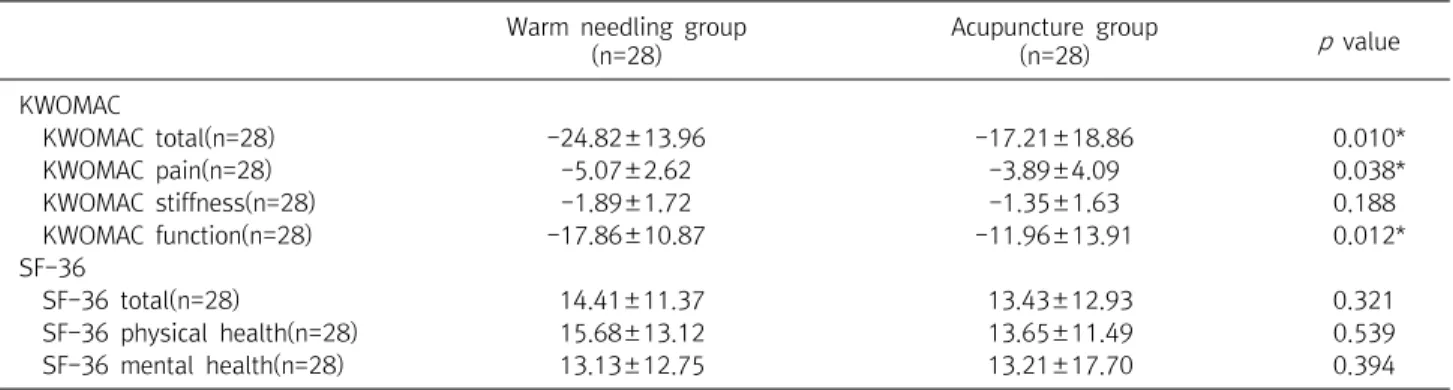
The result and p value from ANCOVA with the changes from baselines. The values presented with a plus/minus sign are means's.
*Indicates that the ANCOVA showed a significant difference between the pre-trial and post-trial(p<0.05). KWOMAC : Western Ontario and McMaster Universities Osteoarthritis Index translated into Korean language, SF-36 : 36-Items Short-Form Health Survey.
Table 4. The Changes of the Mean Score Between Pre-trial Baselines and Post-trial Outcomes
Poor Fair Good Excellent p value Warm needling group
(n=28)
0* 7 9 12 0.044†
Simple acupuncture group(n=28)
1 11 9 7
*The numbers indicate how many subjects rated the improve- ment of the disease as either; poor, fair, good, or excellent. †In- dicates that the Mann-Whitney U-test showed a significant difference between the warmneedling group and the simple acupuncture group(p<0.05).
Table 5. Patient Global Assessment at the End of the 8 Weeks’
Trial
paired t-test showed a significant change of the WOMAC total score(-17.21±18.86) in the acupuncture group as well(p
<0.000).
2. Based on the WOMAC index scores, the 8- week warm needling treatment was more effective than acupuncture in the treatment of knee OA(Table 4) The change in the WOMAC total score in the warm needling group was -24.82±13.96. The change of the WOMAC total score in the acupuncture group was -17.21±
18.86. The change of the WOMAC pain score was -5.07±
2.62 in the warm needling group and -3.89±4.09 in the acupuncture group, showing significance(p=0.038). The change of the WOMAC function score was -17.86±10.87 in the warm needling group and -11.96±13.91 in the acu- puncture group, also showing significance(p=0.012). These results indicate that the changes in the warm needling group reveal a significant amelioration compared to the acupunc- ture group(p=0.010). There was no significant change in
either group with respect to the WOMAC stiffness scores.
Overall, the results of the WOMAC scores indicate that warm needling for 8 weeks has a therapeutic effect on OA of the knee.
3. According to the SF-36 results, neither warm need- ling nor acupuncture was effective in enhancing health related life quality(Table 4)
The pre-trial SF-36 total score was 45.54±16.65 in the warm needling group and was 59.95±13.63 after the 8-week trial. In the acupuncture group, the pre-trial SF-36 total score was 52.09±17.93 and its total score after the 8 week trial was 65.53±16.21. The change of the SF-36 total score was 14.41±11.37 in the warm needling group and 13.43±12.93 in the acupuncture group, showing no significance(p=0.321).
In addition, the SF-36 physical and mental health scores did not show statistical significance between the two groups
(Table 4)(The mean scores of SF-36 after 4 weeks treatment show in supplementary table).
4. According to the Patient Global Assessment, the 8 weeks of warm needling were more effective than acupuncture for knee OA(Table 5)
A Patient Global Assessment was carried out by the sub- jects themselves at the end of the 8 week trial in order to evaluate the condition of their knee OA. Among the 28 subjects in the warm needling group, the distribution of the Patient Global Assessment was 42.9% in "Excellent", 32.1% in
"Good", 25.0% in "Fair" and 0% in "Poor". The distribution among the 28 subjects in the acupuncture group was 25.0%
in "Excellent", 32.1% in "Good", 39.3% in "Fair" and 3.6% in
"Poor". These results strongly suggest a significant improve- ment in the knee OA conditions of the subjects in the warm needling group relative to those receiving acupuncture (p=0.044).
Discussion
Warm needling is a therapy combining the practices of acupuncture and moxibustion. The effects of acupuncture stimulation are known to be augmented by the burning moxi- bustion, which conducts heat through the needle. It is further believed that this heat can facilitate blood circulation and thus relieve pain, the feeling of chilliness, and paralysis4). To maximize the treatment efficiency of warm needling at the early and middle stages of knee OA, it is recommended to use therapeutic strategies that promote blood circulation, eliminate hemostasis, and reduce edema and pain. At a later stage, other strategies that promote blood synthesis and warm meridians to reduce the pain are recommended5).
We evaluated the therapeutic efficacy and safety of warm needling and compared them to those of traditional acupuncture treatment. The results of our study indicate that patients with knee OA showed significant improvement after 8 weeks of either acupuncture or warm needling therapy.
However, the warm needling group showed a more signi-
ficant pain relief effect on knee OA than the acupuncture group according to the pain, function, and total scores of WOMAC at the 4-week and 8-week points and the Patient Global Assessment. In addition, no patients reported adverse effects from either the warm needling or acupuncture therapy, which required 16 sessions per patient.
Previous studies have led to the general opinion that acupuncture is effective in relieving pain and dysfunction of the knee in elderly patients with knee OA compared to non-acupuncture treated control groups12,15). Some additional reports11,12,19-22)
showed significant pain relief in patients treated with acupuncture compared to those treated with sham acupuncture or exercise and education. Other stu- dies23,24) showed no significant difference in pain reduction between patients treated with acupuncture and those in a control group or those treated with sham acupuncture. Due to methodological problems in comparing the studies that were done so far, the general consensus is that the results are promising but that more research is needed(see also:
http://vsearch.nlm.nih.gov/vivisimo/cgi-bin/query-meta?v%3 Aproject=medlineplus&query=acupuncture). To investigate the effectiveness of warm needling for knee OA, we desig- nated the acupuncture group as the positive control group.
Among the outcome measurements used to estimate the effectiveness of warm needling on knee OA, the SF-36 did not show a significant improvement. Although the SF-36 results for warm needling might have been expected to differ from those of simple acupuncture, our findings for warm needling are consistent with those of the previous literature on acupuncture11,12,23).
There were several limitations in this study. First, due to coincidence, all smokers were included in the control group.
However, although previous studies reported that smoking could worsen knee OA symptoms25,26), the results of the control group still showed an improvement. It is thought that control group also received acupuncture treatment, so their symptoms were improved because acupuncture treatment has effect on knee OA27). A second limitation of this study was that the ratio of drop-outs was somewhat high. This can be a reason of statistical error. We selected acupuncture as
a positive control group so could not compare efficacy with negative control group like non-treatment group. Finally, we could not blind the practitioners in current study, which may affect the results. For the correct data collecting, we need to find out methods to blind practitioners in acupuncture research.
In our study, warm needling evoked relief of the pain and inflexibility28) caused by knee OA and was found to have improved therapeutic efficacy compared to simple acupunc- ture. These findings indicate the possibility that warm needling may be a promising alternative acupuncture therapy for knee OA.
Conclusion
In our study, we found that both warm needling and acu- puncture provided a pain relief effect in knee OA according to the WOMAC index scores. In addition, the warm needling group showed greater improvement than the acupuncture group according to the WOMAC index scores and the Patient Global Assessment.
Acknowledgements
This work was supported by a Korea Research Foundation Grant funded by the Korean Government(MOETHD) and Kyung Hee University(KRF-2005-005-J00702).
References
1. Felson Felson DT, Lawrence RC, Hochberg MC, McAlindon T, Dieppe PA, Minor MA, et al. Osteoarthritis: new insights. Part 2:
treatment approaches. Ann Intern Med. 2000 ; 133 : 726-37.
2. World Health Organization. International Standard Terminolo- gies on Traditional Medicine in the Western Pacific Region.
2007.
3. Zhizhong W. Zhenjiuzishengjing(鍼灸資生經) - Classic of Nou-
rishing Life with Acupuncture and Moxibustion. Seoul : Iljungsa. 1991.
4. Moxibustion and meridian of oriental medical laboratory.
Colleges of the whole university. Acupuncture & Moxibustion.
Seoul : Jipmoondang. 2000 : 1048-9, 1335-8.
5. Yoo SI, Ahn CB. The modern clinical acupuncture & moxi- bustion. Seoul : Euisungdang. 2000 : 707-9.
6. Li CD, Huang XY, Yang XG, Wang QF, Huang SQ. Observation on therapeutic effect of warming needle moxibustion on knee osteoarthritis of deficiency-cold type. Chin Acupunct Moxibu- stion. 2006 ; 26 : 189-91.
7. Chen N. Observation on therapeutic effects of bird-pecking needling and needle warming moxibustion on bulging of lum- bar intervertebral disc. Chin Acupunct Moxibustion. 2006 ; 26 : 213-4.
8. He XW, Huang JH, Zeng LY. Observation on the therapeutic ef- fect of warming needle moxibustion on prolapse of lumbar in- tervertebral disc. Chin Acupunct Moxibustion. 2007 ; 27 : 264-6.
9. Chen MR, Wang P, Cheng G, Guo X, Wei GW, Xu-hui C. Effect of warming needle moxibustion on pain threshold in the pa- tient of sciatica. Chin Acupunct Moxibustion. 2005 ; 25 : 831-3.
10. Xu FQ, Li HX, Huang T. Observation on therapeutic effect of warming needle moxibustion combined with medicine on 128 cases of myasthenia gravis. Chin Acupunct Moxibustion. 2006 ; 26 : 339-41.
11. Berman BM, Lao L, Langenberg P, Lee WL, Gilpin AM, Hochberg MC. Effectiveness of acupuncture as adjunctive therapy in os- teoarthritis of the knee: A randomized, controlled trial. Ann Intern Med. 2004 ; 141 : 901-10.
12. Berman BM, Singh BB, Lao L, Langenberg P, Li H, Hadhazy V, et al. A randomized trial of acupuncture as an adjunctive therapy in osteoarthritis of the knee. Rheumatology. 1999 ; 38 : 346-54.
13. Brinkhaus B, Witt CM, Jena S, Linde K, Streng A, Hummelsberger J, et al. Physician and treatment characteristics in a randomized multicentre trial of acupuncture in patients with osteoarthritis of the knee. Complement Ther Med. 2007 ; 15 : 180-9.
14. Thomas M, Eriksson SV, Lundeberg T. A comparative study of diazepam and acupuncture in patients with osteoarthritis pain:
A placebo controlled study. Am J Chin Med. 1991 ; 19 : 95-100.
15. Ezzo J, Hadhazy V, Birch S. Acupuncture for osteoarthritis of the knee: A systematic review. Arthritis Rheum. 2001 ; 44 : 819-25.
16. MacPherson H, White A, Cummings M, Jobst K, Rose K, Niemtzow R. Standards for reporting interventions in con- trolled trials of acupuncture : The STRICTA recommendati ons.
J Altern Complement Med. 2002 ; 8 : 85-9.
17. Bae SC, Lee HS, Yun HR, Kim TH, Yoo DH, Kim SY. Cross-cul- tural adaptation and validation of Korean Western Ontario and McMaster Universities(WOMAC) and Lequesne osteoarthritis indices for clinical research. Osteoarthritis Cartilage. 2001 ; 9 : 746-50.
18. Han CW, Lee EJ, Iwaya T, Kataoka H, Kohzuki M. Development of the Korean version of Short-Form 36-Item Health Survey:
Health related QOL of healthy elderly people and elderly pa- tients in Korea. Tohoku J Exp Med. 2004 ; 203 : 189-94.
19. Witt CM, Jena S, Brinkhaus B, Liecker B, Wegscheider K, Willich SN, et al. Acupuncture in patients with osteoarthritis of the knee: A randomised trial. Lancet. 2005 ; 366 : 136-43.
20. Singh BB, Berman BM, Hadhazy V, Bareta J, Lao L, Zarow FM, et al. Clinical decisions in the use of acupuncture as an adjunctive therapy for osteoarthritis of the knee. Altern Ther Health Med.
2001 ; 7 : 58-65.
21. Manheimer E, Lim B, Lao L, Berman B. Acupuncture for knee os- teoarthritis: A randomised trial using a novel sham. Acupunct Med. 2006 ; 24 : S7-S14.
22. Vas J, Mendez C, Perea-Milla E, Vega E, Panadero MD, Leon JM,
et al. Acupuncture as a complementary therapy to the pharma- cological treatment of osteoarthritis of the knee: Randomised controlled trial. BMJ. 2004 ; 329 : 1216.
23. Scharf HP, Mansmann U, Streitberger K, Witte S, Kramer J, Maier C, et al. Acupuncture and knee osteoarthritis: A three-armed randomized trial. Ann Intern Med. 2006 ; 145 : 12-20.
24. Foster NE, Thomas E, Barlas P, Hill JC, Young J, Mason E, et al.
Acupuncture as an adjunct to exercise based physiotherapy for osteoarthritis of the knee: Randomised controlled trial. BMJ.
2007 ; 335 : 436.
25. Amin S, Niu J, Guermazi A, Grigoryan M, Hunter DJ, Clancy M, et al. Cigarette smoking and the risk for cartilage loss and knee pain in men with knee osteoarthritis. Ann Rheum Dis. 2007 ; 66 : 18-22.
26. Gullahorn L, Lippiello L, Karpman R. Smoking and osteo- arthritis: Differential effect of nicotine on human chondrocyte glycosaminoglycan and collagen synthesis. Osteoarthritis Cartilage. 2005 ; 13 : 942-3.
27. Lansdown H, Howard K, Brealey S, MacPherson H.
Acupuncture for pain and osteoarthritis of the knee: a pilot study for an open parallel-arm randomised controlled trial.
BMC Musculoskeletal Disorders. 2009 ; 10 : 130.
28. Kudriavtsev A, Vlasik T. Gentle and strong acupuncture: A short review of the two main approaches to treatment. Am J Chin Med. 1994 ; 22 : 221-33.
국문초록
목적 : 본 연구는 퇴행성 슬관절염 환자의 통증을 줄이고 증상을 개선하는데 있어 현재 침구임상에서 활용되고 있는 온침이 침보다 더욱 유효한 지를 알아보기 위하여 임상연구로 시행되었다. 방법 : 총 76명의 퇴행성 슬관절염 지원자가 연구에 참가하였으며, 이들 모두는 선정기준과 제외기준에 의하여 선발되었고 최종적으로 임상연구를 마친 지원자는 66명이었다. 지원자들은 무작위로 온침군과 침군 중에 할당이 되었다.
실험군(온침)에 속한 38명은 온침시술을, 대조군(침)에 속한 38명은 침시술을 받았으며, 8주 동안 총 16회의 시술을 환측의 무릎에 시행하였 다. 주된 평가척도는 Western Ontario and McMaster Universities Osteoarthritis Index(WOMAC)이었고, 부수적 평가척도는 physical health score based on the 36-Item Short-Form Health Survey(SF-36), Patient Global Assessment이었다. 결과 : 실험군이 대조군에 비 해서 WOMAC의 pain, function, total score와 Patient Global Assessment에서 월등한 감소를 나타내었으나 SF-36에서는 유의한 변화가 없었다. 결론 : 이번 연구의 결과를 통해 온침이 침에 비하여 퇴행성 슬관절염 환자의 통증 감소와 기능개선에 유의성있게 효과가 있음을 확인 하였다.
Warm needling group(n=28)
Acupuncture group(n=28)
SF-36 total (n=28) 52.96 59.65
SF-36: 36-Items Short-Form Health Survey.
Supplementary Table. The Mean Score of SF-36 scores after 4 weeks treatment