• 검색 결과가 없습니다.

The Effect of Robo-horseback Riding Exercise on Trunk Muscle Activity Ratios in Patients with Low Back Pain J K S P T

N/A
N/A
Protected

Academic year: 2021

Share "The Effect of Robo-horseback Riding Exercise on Trunk Muscle Activity Ratios in Patients with Low Back Pain J K S P T"

Copied!
5
0
0

로드 중.... (전체 텍스트 보기)

전체 글

(1)

The Effect of Robo-horseback Riding Exercise on Trunk Muscle Activity Ratios in Patients with Low Back Pain

Hyungkyu Kang

1

, Sookyung Chang

2

1

Department of Physical Therapy, Graduate School, Sahmyook University,

2

Department of Physical Therapy, Ansan University

Purpose: We investigated to identify the effect of robo-horseback riding exercise (RHRE) on trunk muscle activity ratios for patients with low back pain.

Methods: Twelve patients with low back pain and twelve healthy adults were recruited for this study. Subjects performed the RHRE with the neutral spine position. The amplitude of electromyography activity was recorded from the selected trunk muscles (internal oblique [IO], rectus abdominis [RA], multifidus [MF], the thoracic part of the iliocostalis lumborum [ICLT]).

The ratios of the relative local muscle activity to the global muscle activity in abdominal and lumbar parts were calculated.

Results: There were significant differences in the change values of the IO/RA and the MF/ICLT between low back pain (LBP) patients and healthy adults. The IO/RA ratio and the MF/ICLT ratio showed significant increase in LBP patients after training.

Conclusion: The RHRE improved the trunk muscle activity ratio in patients with low back pain. The information presented here is important for investigators who use lumbar stabilization exercises as a rehabilitation exercise.

Keywords: Robo-horseback riding exercise, Low back pain, Electromyography

I. Introduction

Low back pain (LBP) is the most common musculoskeletal pain syndrome

1,2

and the 75~85% of patients with LBP have nonspecific chronic LBP.

3-6

The chronicity of LBP patients occurs due to the instability of spine caused by a weakness of muscular strength at the vertebra region and an injury in soft tissues of trunk.

7

If the instability of spine sustains, the repetitive impairments in trunk muscles occur and the muscle thickness around the vertebra region is decreased with showing up of atrophy phenomenon as time passed, therefore it worsen the LBP.

8,9

LBP patients get more atrophy and impairments in local muscles relative to healthy adults,

10

and, as a compensatory

action, these phenomena lead to the activation of global muscle such as erector spinae, thereby worsening the LBP.

11

Hence, the improvement of co-contraction with global muscles by increasing the strength of local muscles of trunk is the effective factor.

12

The selective activation of specific muscle is inefficient in increasing lumbar stabilization.

13

Therefore, the level of lumbar stabilization by evaluating ratio of muscle activity is clearer than evaluating specific muscle activity.

14

In the clinics, various training methods have been applied to LBP patients to allow the efficient stabilization between local and global muscles.

12,15

Horseback riding induces a movement to a human pelvic as same as the dynamic movement occurs when a horse walk,

16

and the speed and diversity in direction of the walking horse shifts the weight of human riding on it and stimulates his or her postural stability.

17

The improvement of postural stability increases the symmetry of muscle activity so that the stability and strength of trunk muscle is improved.

18

Recently, The robo-horseback riding exercise (RHRE) has been used as a therapeutic method because it increases postural stability Received November 15, 2012 Revised December 6, 2012

Accepted December 11, 2012

Corresponding author Sookyung Chang, [email protected]

Copyright © 2012 by The Korean Society of Physical Therapy

This is an Open Access article distributed under the terms of the Creative Commons Attribution Non-Commercial License (http://creativecommons.org/licenses/by-nc/3.0/) which permits unrestricted non-commercial use, distribution, and reproduction in any medium, provided the original work is properly cited.

The J ournal of K orean S ociety of P hysical T herapy Original Article

(2)

of various patients due to its indoor accessibility and also induces the similar movement to patients as horseback riding does.

19-21

The effect of the RHRE on strengthening the trunk is already proved. Lee et al.

22

reported that the RHRE increases the trunk muscle size of patients with scoliosis, and Benda et al.

18

reported that the RHRE improves the stability of trunk muscles of patients with cerebral palsy by increasing its symmetry.

But, the RHRE study that reduces pain of LBP patients by improving the stability of trunk muscles is insufficient, and there is no study about the effect of the RHRE on trunk local muscles. Therefore, in this study, we observed the effect of the RHRE on trunk muscle activity of LBP patients and compare the ratio of muscle activation between the local and global muscles, thereby understanding the usefulness of lumbar stabilization exercise program in future.

II. Materials and Methods

1. Subjects

Subjects are 20~50-years-old LBP patients (n=12) and healthy adults (n=12) who listen to the research purpose and agree with the voluntary participation. The inclusion criteria of LBP patients were that visual analogue score above 5, experience of LBP more than 6 months, no pathological disease that can affect the result of study clinically, and no limitation in the performance of exercise about intervention. The inclusion criteria of healthy subjects were people who do not have musculoskeletal disease at lumbar.

23-25

General characteristics of the subjects were found in Table 1.

2. Procedures

Subjects were measured trunk muscle activity during the RHRE between each group. Before starting the intervention,

subjects kept their lumbar at neutral position and the angle between hip and knee joints as 90

o

, and the surface Electromyography (EMG) was measured the pre-test before starting the intervention and the post-test during the RHRE using a robo-horseback riding machine (EU-6441, Panasonic, Osaka, Japan). Subjects got explanation of the RHRE to perform it before the intervention and then evaluation was conducted. We applied moderate level of RHRE intensity, and two therapists were assisting for the safety of subjects.

Peak EMG amplitudes were total three times measured and the mean value was used for data analysis. There were three-minute breaks in each measurement to evaluate with minimum muscle fatigues.

3. Measurement

In this study, to measure the trunk muscle activity ratios during the RHRE, EMG system (Telemyo 2400T-G2 Telemetry EMG system, Noraxon Inc., Scottsdale, AZ, USA, 2007) was used, and, for the data analysis, Noraxon MyoResearch software 2.10 (Myoresearch XP Master Edition, Noraxon Inc.) was used.

1) Surface EMG

To measure the muscular activation of the internal oblique (IO), rectus abdominis (RA), multifidus (MF), and iliocostalis lumborum (ICLT) groups during a RHRE. The EMG system was used the disposable bipolar surface EMG electrodes. To decrease impedance of skin to electrode, remove hairs at an attached area and sterilize the skin with alcohol. Ag-AgCl type of surface electrode was used, the distance between electrodes was kept as below 2.5 cm, and the electrode was attached to a dominant side. The reference electrode was attached the superior aspect of the right iliac crest.

The attached areas of electrodes to four muscles were as

Table 1. General characteristics of the subjects

Group (n=24) Gender (male/female) Age (yr) Height (cm) Weight (kg) VAS score

Healthy adults (n=12) LBP patients (n=12)

7/5 4/8

34.4±9.4 36.7±10.1

165.3±12.8 163.8±10.6

62.4±9.6

60.8±8.2 7.1±1.5

Values are presented as number or mean±standard deviation.

VAS: visual analog scale, LBP: low back pain.

(3)

follows: the IO (midway between the anterior iliac spine and symphysis pubis, above the inguinal ligament), the MF (lateral to the midline of the body, above and below a line connecting both posterior superior iliac spines), the RA (3 cm lateral to the umbilicus), and the ICLT (above and below the L1 level, midway between the midline and the lateral aspect of the body).

26-29

2) EMG data analysis

Sample rate was 1,024 Hz, band-pass filter was 20~450 Hz, notch filter was 60 Hz during the EMG measurement. To normalize the measured action potential in each muscle, maximum voluntary isometric contraction (MVIC) was measured and the measurement pose was taken according to the one described in Kendal methods. MVIC value in each muscle was normalized by converting the mean values acquired from three times of measurements for five-seconds and removal of the first and the last second to % MVIC. The ratios of the relative local muscle activity to the global muscle activity in abdominal and lumbar parts were calculated.

4. Statistical analysis

The SPSS 12.0 program (SPSS Inc., Chicago, IL, USA) was used for data analysis. The Mann-Whitney U test was used to determine the difference of EMG ratios between each group.

The Wilcoxon signed rank test was used to compare the difference of EMG ratios between pre-test and post-test into each group. The statistical significance was set to p<0.05.

III. Results

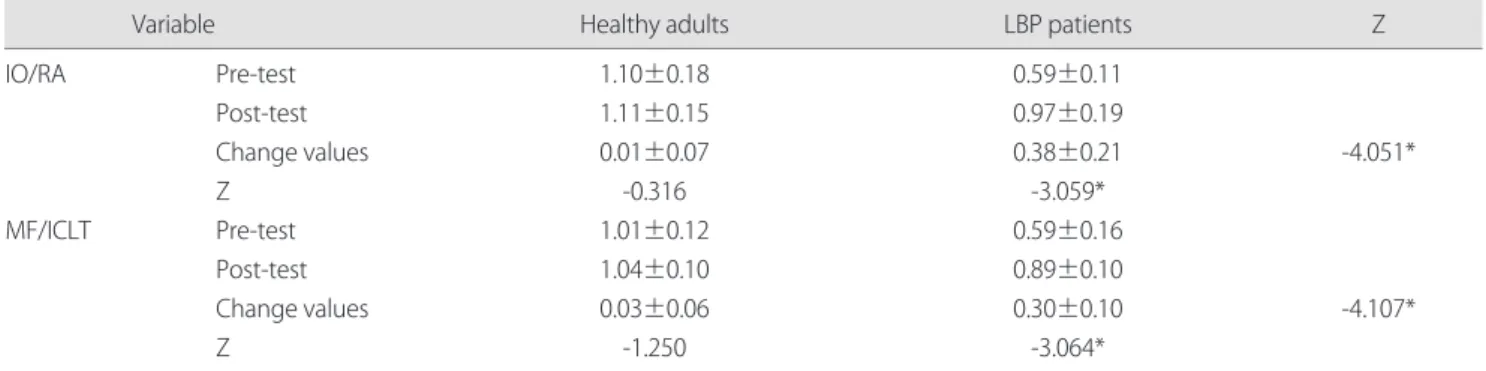
The peak EMG amplitudes of the different trunk muscle ratios between LBP patients and healthy adults are presented in Table 2. Because the contribution of local muscle activity was the main effectiveness of this study, abdominal muscle activation and back muscle activation were analyzed separately.

There were significant differences in the change values of the IO/RA and the MF/ICLT between LBP patients and healthy adults (p<0.05). The IO/RA ratio and the MF/ICLT ratio showed a significant increase in LBP patients after training (p<0.05).

IV. Discussion

This study examined the differences of the RHRE on trunk muscle activity and ratio in individuals with LBP. As a result, the four muscle activation of LBP patients were significantly increased in the RHRE than the static sitting position.

The horse walking during the horseback riding leads to up and down, right and left, and rotational movements, which are similar to movements of trunk and pelvic when a human walks. The RHRE shifts the center of gravity of rider and improves the control ability to changes in the base of support for a postural response.

30

Also, shaking of trunk in riding stimulates neuromuscular system by activating muscle through spinal reflex. Moreover, rapid movements stimulates

Table 2. Modulation of trunk muscle activity ratios by robo-horseback riding exercise

Variable Healthy adults LBP patients Z

IO/RA

MF/ICLT

Pre-test Post-test Change values Z

Pre-test Post-test Change values Z

1.10±0.18 1.11±0.15 0.01±0.07 -0.316 1.01±0.12 1.04±0.10 0.03±0.06 -1.250

0.59±0.11 0.97±0.19 0.38±0.21 -3.059*

0.59±0.16 0.89±0.10 0.30±0.10 -3.064*

-4.051*

-4.107*

Values are presented as mean±standard deviation.

LBP: low back pain, IO: internal oblique muscle, RA: rectus abdominis muscle, MF: multifidus muscle, ICLT: iliocostalis lumborum muscle.

*p<0.05.

(4)

muscle spindles contacting to muscles by activating 1a muscle spindle α-motorneurons.

31

Lee et al.

22

reported that the RHRE is effective as a strengthening method for patients with scoliosis, and Almeida et al.

32

reported that the maintenance of balance to alternative shakings in front and back directions is effective in trunk stabilization by increasing co-contraction of muscles. Our study also supports that the RHRE is effective in the activation of trunk muscle as the previous studies.

In the changed values of IO/RA and MF/ICLT ratio, LBP patients show significantly increased values than healthy adults. Lumbar stabilization is the most effective exercise method to LBP patients

33

as it improves the co-contraction and strengthening between trunk local and global muscles.

34

LBP patients have problems in the co-contraction between local and global muscles with the weakness of trunk muscles, and these factors worsen the LBP by decreasing the lumbar stabilization.

13

Therefore, the increase in IO/RA and MF/ICLT ratio representing co-contractions of lumbar and abdominal areas are important indicators for the recovery of LBP patients. Also neutral position of lumbar is a useful method to distinguish healthy adults and LBP patients, and it improves the co-contraction between local and global muscles by contracting weakened local muscles of LBP patients.

14

Stevens et al.

13

reported that the trunk movement during the exercise keeping the neutral position at an unstable surface increases the ratio between local and global muscles. Also, it was reported that local muscles are tonically activated during dynamic spinal movements.

35-37

Therefore, keeping the neutral position and performance of dynamic movements activate local muscles and improve the coordination of global and local muscles.

38

In a conclusion, our study suggests that the increase of local muscle activation and the ratio are the results of performance of dynamic movements keeping the neutral position. Moreover, an exercise method at sitting position is necessary due to the long maintenance of sitting position of LBP patients in their life.

Previously, there were many reports about that the RHRE improves the symmetry of patients with cerebral palsy and scoliosis inducing asymmetry of trunk muscles. On the other hand, in this study, we proved that the RHRE is effective in muscle coordination of LBP patients. Since it is hard to

generalize the result of this study due to the small number of subjects, measuring the trunk muscle activation in a single position among various RHRE sitting postures should be performed in future to compare the effects of various RHRE postures on trunk muscle activation.

In conclusion, the RHRE improved the trunk muscle activity ratio in patients with LBP. Therefore, the RHRE is important for patients and physical therapists using lumbar stabilization exercises as a rehabilitation exercise.

References

1. Koes BW, van Tulder MW, Thomas S. Diagnosis and treatment of low back pain. BMJ. 2006;332(7555):1430-4.

2. IJzelenberg W, Burdorf A. Impact of musculoskeletal co- morbidity of neck and upper extremities on healthcare utilisation and sickness absence for low back pain. Occup Environ Med.

2004;61:806-10.

3. Sheeran L, Sparkes V, Caterson B et al. Spinal position sense and trunk muscle activity during sitting and standing in nonspecific chronic low back pain: classification analysis. Spine (Phila Pa 1976). 2012;37(8):E486-95.

4. Kang SS, Goo BO. The effects of yoga low back pain exercise and lumbar extensor muscle endurance exercise on chronic low back pain patients. J Korean Soc Phys Ther. 2012;24(2):107-12.

5. Seo JK, Kim SY. The relationship between hip abductor muscle strength and lumbar instability in patients with chronic low back pain. J Korean Soc Phys Ther. 2011;23(4):15-22.

6. Yoon JY, Jang MG, Hyun SJ et al. Influence of the application to hyperbaric oxygen therapy and physical therapy on chronic low back pain in elderly. J Korean Soc Phys Ther. 2011;23(4):27-8.

7. Gill KP, Callaghan MJ. The measurement of lumbar proprioception in individuals with and without low back pain. Spine (Phila Pa 1976). 1998;23(3):371-7.

8. Deyo RA, Walsh NE, Martin DC et al. A controlled trial of transcutaneous electrical nerve stimulation (TENS) and exercise for chronic low back pain. N Engl J Med. 1990;322(23):1627-34.

9. O’Sullivan P, Twomey L, Allison G et al. Altered patterns of abdominal muscle activation in patients with chronic low back pain. Aust J Physiother. 1997;43(2):91-8.

10. França FR, Burke TN, Hanada ES et al. Segmental stabilization and muscular strengthening in chronic low back pain: a comparative study. Clinics (Sao Paulo). 2010;65(10):1013-7.

11. Costa LO, Maher CG, Latimer J et al. Motor control exercise for chronic low back pain: a randomized placebo-controlled trial.

Phys Ther. 2009;89(12):1275-86.

12. Lehman GJ, Hoda W, Oliver S. Trunk muscle activity during bridging exercises on and off a Swiss ball. Chiropr Osteopat.

2005;13:14.

13. Stevens VK, Bouche KG, Mahieu NN et al. Trunk muscle activity

in healthy subjects during bridging stabilization exercises. BMC

(5)

Musculoskelet Disord. 2006;7:75.

14. O’Sullivan PB, Twomey L, Allison GT. Altered abdominal muscle recruitment in patients with chronic back pain following a specific exercise intervention. J Orthop Sports Phys Ther. 1998;27(2):114- 24.

15. Luomajoki H, Kool J, de Bruin ED et al. Improvement in low back movement control, decreased pain and disability, resulting from specific exercise intervention. Sports Med Arthrosc Rehabil Ther Technol. 2010;2:11.

16. Jung JH, Yu JH. The effects of hippotherapy over 8 weeks on trunk proprioception, stability and posture in cerebral palsy patients. J Korean Soc Phys Ther. 2010;22(5):63-70.

17. Freeman G. Hippotherapy-therapeutic horse riding. Clinical Management. Physical Therapy. 1984;4(3):20-5.

18. Benda W, McGibbon NH, Grant KL. Improvements in muscle symmetry in children with cerebral palsy after equine-assisted therapy (hippotherapy). J Altern Complement Med. 2003;9(6):817- 25.

19. Brogren E, Hadders-Algra M, Forssberg H. Postural control in children with spastic diplegia: muscle activity during perturbations in sitting. Dev Med Child Neurol. 1996;38(5):379-88.

20. Herrero P, Gómez-Trullén EM, Asensio A et al. Study of the therapeutic effects of a hippotherapy simulator in children with cerebral palsy: a stratified single-blind randomized controlled trial.

Clin Rehabil. 2012;26(12):1105-13.

21. Silva e Borges MB, Werneck MJ, da Silva Mde L, Gandolfi L, Pratesi R. Therapeutic effects of a horse riding simulator in children with cerebral palsy. Arq Neuropsiquiatr. 2011;69(5):799-804.

22. Lee DR, Lee NG, Cha HJ et al. The effect of robo-horseback riding therapy on spinal alignment and associated muscle size in MRI for a child with neuromuscular scoliosis: an experimenter-blind study.

NeuroRehabilitation. 2011;29(1):23-7.

23. Kim SY. Changes in cross-sectional area of lumbar muscle in patients with chronic back pain. J Korean Soc Phys Ther.

2010;22(5):39-47.

24. Lee GC. Postural stability change in young people with low back pain. J Korean Soc Phys Ther. 2012;24(3):181-5.

25. Song CH, Bae HS, Lee SW. The effects of dry-hydrotherapy on the low back disability and pain for patients with low back pain. J

Korean Soc Phys Ther. 2006;18(2):1-6.

26. Lee SW, Shin WS, In TS et al. Immediate effects of load stimulation on static balance and muscle activities in chronic stroke patients. J Korean Soc Phys Ther. 2009;21(1):19-26.

27. Kwon HC. A myometric and electromyographic analysis of hip abductor musculature in healthy right-handed persons. J Korean Soc Phys Ther. 1990;2(1):35-46.

28. Chang JS, Lee HY, Lee MY. The study of lumbar erector spinea and rectus abdominis activations according to the different gait velocities in young healthy adults. J Korean Soc Phys Ther.

2012;24(3):186-90.

29. Kang HK, Jung JH, Yu JH. Comparison of trunk muscle activity during bridging exercises using a sling in patients with low back pain. J Sports Sci Med. 2012;11(3):510-5.

30. Heine B. An introduction to hippotherapy. NARHA Strides Magazine.

1997;3(2):10-3.

31. Rees S, Murphy A, Watsford M. Effects of vibration exercise on muscle performance and mobility in an older population. J Aging Phys Act. 2007;15(4):367-81.

32. Almeida GL, Carvalho RL, Talis VL. Postural strategy to keep balance on the seesaw. Gait Posture. 2006;23(1):17-21.

33. França FR, Burke TN, Caffaro RR et al. Effects of muscular stretching and segmental stabilization on functional disability and pain in patients with chronic low back pain: a randomized, controlled trial. J Manipulative Physiol Ther. 2012;35(4):279-85.

34. Richardson CA, Jull GA. Muscle control-pain control. What exercises would you prescribe? Man Ther. 1995;1(1):2-10.

35. Cresswell AG, Grundström H, Thorstensson A. Observations on intra-abdominal pressure and patterns of abdominal intra- muscular activity in man. Acta Physiol Scand. 1992;144(4):409-18.

36. Oddsson L, Thorstensson A. Task specificity in the control of intrinsic trunk muscles in man. Acta Physiol Scand.

1990;139(1):123-31.

37. Zetterberg C, Andersson GB, Schultz AB. The activity of individual trunk muscles during heavy physical loading. Spine (Phila Pa 1976).

1987;12(10):1035-40.

38. Aspden R. Review of the functional anatomy of the spinal ligaments

and the lumbar erector spinae muscles. Clin Anat. 1992;5:372-87.

수치

Table 1. General characteristics of the subjects
Table 2. Modulation of trunk muscle activity ratios by robo-horseback riding exercise

참조

관련 문서

“Trunk muscle stabilization training plus general exercise versus general exercise only: randomized controlled trial of patient with recurrent low back pain”,

Trunk strength and lumbar paraspinal muscle activity during isometric exercise in chronic low back pain patients and controls.. Radiographic demonstration

The purpose of this study was to compare the electromyography (EMG) activities of the lumbar ex- tensor muscles during motion of trunk flexion-extension and compare range

As discussed above, the heterogeneity of NS-CLBP, and merely examining muscle amplitudes without consid- eration for the relationship between trunk muscle activation

A study that compared sling and swiss-ball exercise effects in patients with LBP showed higher muscle activity of abdominal muscles with the sling than with the swiss-ball in

Effects of Active Release Technique and Lumbar Stabilization Exercise on Pelvic Asymmetry, Muscle Activation and Pain in Chronic Low Back Pain Patients.. Nam Seungmin,

Effect of task-oriented training with anticipatory abdominal muscle contraction on trunk control and balance of chronic stroke patients. Graduate school of

Conclusion : Based on the above findings, a program to restore the lumbar lordosis angle, and increase muscle strength should be developed at by applying the combine