ISSN: 2233-601X (Print) ISSN: 2093-6516 (Online)
Department of Thoracic and Cardiovascular Surgery,
1Hanyang University Seoul Hospital,
2Hanyang University Guri Hospital,
3Department of Pediatrics, Hanyang University Seoul Hospital, Hanyang University College of Medicine
†This article was presented at the 45th Fall Meeting of the Korean Society for Thoracic and Cardiovascular Surgery, November 7, 2013.
‡This article, written by Jun Ho Lee (lead author), was approved as a thesis for the Master of Thoracic and Cardiovascular Surgery, Hanyang University Graduate School, February 28, 2014.
Received: February 4, 2014, Revised: March 16, 2014, Accepted: March 20, 2014, Published online: October 5, 2014
Corresponding author: Hyuck Kim, Department of Thoracic and Cardiovascular Surgery, Hanyang University Seoul Hospital, Hanyang University College of Medicine, 222-1 Wangsimni-ro, Seongdong-gu, Seoul 133-791, Korea
(Tel) 82-2-2290-8467 (Fax) 82-2-2290-8467 (E-mail) [email protected]
C
The Korean Society for Thoracic and Cardiovascular Surgery. 2014. All right reserved.
CC
This is an open access article distributed under the terms of the Creative Commons Attribution Non-Commercial License (http://creative- commons.org/licenses/by-nc/3.0) which permits unrestricted non-commercial use, distribution, and reproduction in any medium, provided the original work is properly cited.
Surgical Ligation on Significant Patent Ductus Arteriosus in Very Low Birth Weight Infants: Comparison
between Early and Late Ligations
Jun Ho Lee, M.D.
1, Sun Kyun Ro, M.D.
2, Hyun Ju Lee, M.D.
3, Hyun Kyung Park, M.D.
3, Won-Sang Chung, M.D.
1, Young Hak Kim, M.D.
1, Jeong Ho Kang, M.D.
1, Hyuck Kim, M.D.
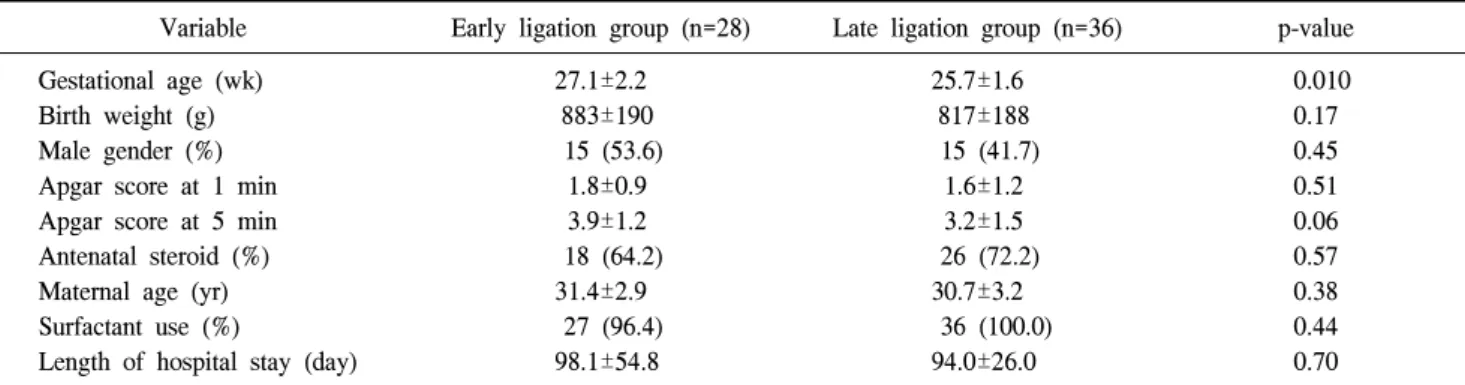
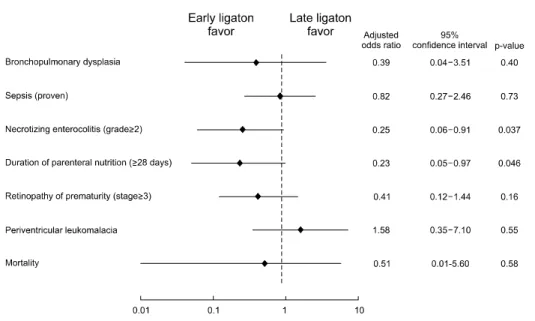
1Background: We aimed to evaluate the efficacy and safety of early surgical ligation (within 15 days of age) over late surgical ligation (after 15 days of age) by a comparative analysis of very low birth weight (VLBW) infants un- dergoing surgical correction for symptomatic patent ductus arteriosus (PDA) over the course of 6 years in our hospital. Methods: We retrospectively reviewed all the medical records in the neonatal intensive care unit at Hanyang University Seoul Hospital, from March 2007 to May 2013, to identify VLBW infants (<1,500 g) who un- derwent surgical PDA ligation. Results: The gestational age (GA) in the late ligation (LL) group was significantly younger than in the early ligation (EL) group (p=0.010). The other baseline characteristics and preoperative con- ditions did not differ significantly between the two groups. The intubation period before surgery (p<0.001) and the age at surgery (p<0.001) were significantly different. The postoperative clinical outcomes of the study patients, in- cluding major morbidity and mortality, are summarized. There were no significant differences in bronchopulmonary dysplasia, sepsis, or mortality between the EL and the LL groups. However, the LL group was significantly asso- ciated with an increased risk of necrotizing enterocolitis (p=0.037) and with a prolonged duration of the total paren- teral nutrition (p=0.046) after adjusting for GA. Conclusion: Early surgical ligation for the treatment of PDA that failed to close after medical treatment or in cases contraindicated for medical treatment might be desirable to re- duce the incidence of necrotizing enterocolitis and to alleviate feeding intolerance in preterm infants.
Key words: 1. Congenital heart disease (CHD) 2. Infant
3. Outcomes
INTRODUCTION
Patent ductus arteriosus (PDA) is a congenital anomaly in- volving the proximal descending thoracic aorta and is asso-
ciated with increased morbidity and mortality in preterm infants. In particular, symptomatic PDA adversely affects the regional blood flow, resulting in necrotizing enterocolitis (NEC), particularly in very low birth weight (VLBW) infants.
http://dx.doi.org/10.5090/kjtcs.2014.47.5.444
constricts the smooth muscle cells of the ductus. The ductus arteriosus closes spontaneously during the first four days after birth in 90% to 95% of full-term infants and 80% to 90% of premature infants born at 30 to 37 weeks of gestational age (GA) [2]. However, the rate of spontaneous ductus arteriosus closure is inversely proportional to birth weight. In particular, in VLBW infants, the closure of the ductus arteriosus is often delayed or fails altogether because of an increase in prosta- glandin E1 in the blood. This failure results in a persistent left-to-right shunt.
PDA increases the risk of prolonged ventilation, pulmonary edema, pulmonary hemorrhage, and bronchopulmonary dys- plasia (BPD). Additionally, the comorbidities associated with PDA include NEC, intestinal ischemia, renal hypoperfusion, retinopathy, cerebral hypoperfusion, and intraventricular hem- orrhage (IVH) [3].
Although PDA ligation is a definitive treatment, there are few comparisons between early surgical ligation and con- servative management for symptomatic PDA in the available literature. Prompt ductal closure is desirable to minimize the deleterious effects of PDA in preterm infants. However, the benefits or side effects of surgical ligation in preterm infants remain unclear.
Gerhardt and Bancalari [4] demonstrated that the surgical closure of PDA decreased the need for ventilatory support and the incidence of significant pulmonary morbidity.
Cassady et al. [5] reported that early prophylactic ligation of PDA in preterm infants reduced the incidence of NEC. Perez et al. [6] demonstrated that PDA ligation was technically fea- sible and safe, even in premature, low birth weight infants.
Finally, Little et al. [7] reported that delaying surgical liga- tion could increase the likelihood of developing morbidity and mortality.
In this context, we aimed to evaluate the efficacy and safe-
1) Study populations
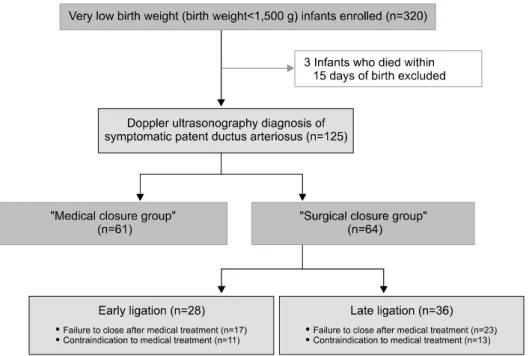
We retrospectively reviewed all the medical records of the neonatal intensive care unit (NICU) at Hanyang University Seoul Hospital, from March 2007 to May 2013, in order to identify VLBW infants (<1,500 g) who underwent surgical PDA ligation. Infants manifesting other congenital anomalies or congenital heart diseases and 3 infants who died within 15 days of birth were excluded.
A total of 320 VLBW infants have been treated in the NICU during the study period, and of them, 125 patients (39.1%) were diagnosed with symptomatic PDA. Excluding 61 patients who improved by medical treatment alone, in the end, 64 patients who underwent surgical correction for symp- tomatic PDA were enrolled in our study. Of these patients, 28 patients underwent surgical ligation at 15 days of age or earlier (EL group), whereas 36 patients underwent surgical li- gation at 16 days of age or later (LL group) (Fig. 1).
2) Definitions
Symptomatic PDA indicated hemodynamically significant PDA, which was defined as tachycardia with a heart rate of 160 bpm or more, hyperdynamic precordium, murmur (≥grade II), worsening of the respiratory status, and cardiomegaly on a simple chest X-ray. Symptomatic PDA was defined as the duc- tus arteriosus having a diameter of 2 mm or more and a ratio of 1.5 or more of the size of the left atrium to the diameter of the aortic root on portable echocardiography (HD11 Diagnostic Ultrasound Imaging System and Transducers; Philips Ultra- sound, Bothell, WA, USA).
BPD was defined using Jobe and Bancalari’s criteria [8].
Sepsis was defined as the presence of at least one positive
blood culture and clinical manifestations of infection. NEC
was classified using Bell’s modified staging criteria [9]. The
stages of retinopathy of prematurity (ROP), previously known
Fig. 1. Flow diagram of the study patients.
Table 1. Protocol for indomethacin and ibuprofen treatment
Age at 1st dose 1st 2nd 3rd
Indomethacin (mg/kg)
a)<48 hr
2–7 day >7 day Ibuprofen (mg/kg)
b)0.2 0.2 0.2 10
0.1 0.2 0.25 5
0.1 0.2 0.25 5
a)