Current Status of Therapeutic Strategies for Patent Ductus Arteriosus in Very-Low-Birth-Weight Infants in Korea
This study aimed to investigate current therapeutic strategies for patent ductus arteriosus (PDA) in very-low-birth-weight (VLBW) infants in Korea. A total of 2,254 VLBW infants among 2,386 from Korean Neonatal Network cohort born from January 2013 to June 2014 were included. No PDA was seen for 1,206 infants (53.5%) and the infants diagnosed or treated for PDA were 1,048 infants (46.5%). The proportion of infants with PDA was decreased according to the increase in gestational age (GA) and birthweight. Infants with PDA were divided into groups according to the therapeutic strategies of PDA: prophylactic treatment (PT, n = 69, 3.1%), pre-symptomatic treatment (PST, n = 212, 9.4%), symptomatic treatment (ST, n = 596, 26.4%), and conservative treatment (CT, n = 171, 7.6%). ST was the most preferred treatment modality for preterm PDA and the proportion of the patients was decreased in the order of PST, CT, and PT. Although ST was still the most favored treatment in GA < 24 weeks group, CT was more preferred than PST or ST when compared with GA ≥ 32 weeks group [CT vs. PST, OR 5.3, 95% CI 1.56-18.18; CT vs. ST, OR 2.9, 95% CI 1.03-8.13]. A total of 877 infants (38.9%) received
pharmacological or surgical treatment about PDA, and 35.5% (801 infants) received pharmacological treatment, mostly with ibuprofen. Seventy-six infants (3.4%) received primary ligation and 8.9% (201 infants) received secondary ligation. Diverse treatment strategies are currently used for preterm PDA in Korea. Further analyses of neonatal outcomes according to the treatment strategies are necessary to obtain a standardized treatment guideline for preterm PDA.
Keywords: Very-Low-Birth-Weight Infant; Patent Ductus Arteriosus; Treatment; Korea Jin A Lee,1,2 Myo-Jing Kim,3 Sohee Oh,4
and Byung Min Choi5
1Department of Pediatrics, Seoul National University Boramae Hospital, Seoul; 2Seoul National University College of Medicine, Seoul; 3Department of Pediatrics, Dong-A University College of Medicine, Busan; 4Department of Biostatistics, Seoul National University Boramae Hospital, Seoul; 5Department of Pediatrics, Korea University College of Medicine, Seoul, Korea
Received: 29 April 2015 Accepted: 25 September 2015 Address for Correspondence:
Byung Min Choi, MD
Department of Pediatrics, Ansan Hospital Korea University Medical Center, 123 Jeokgeum-ro, Danwon-gu, Ansan 15355, Korea
Tel: +82.31-412-6557, Fax: +82.31-405-8591 E-mail: [email protected]
Funding: This work was supported by the Research Program funded by the Korea Centers for Disease Control and Prevention (2013-E63008-01).
http://dx.doi.org/10.3346/jkms.2015.30.S1.S59 • J Korean Med Sci 2015; 30: S59-66
INTRODUCTION
Failure of patent ductus arteriosus (PDA) constriction is com- mon in extremely premature infants, affecting 60-70% of infants with less than 28 weeks of gestation (1). Failure to close PDA in the early postnatal days is associated with increased mortality (2) and serious morbidities including bronchopulmonary dys- plasia (BPD) (3), periventricular hemorrhage (4), and necrotiz- ing enterocolitis (NEC) (5). However, causality between these morbidities and failure to close PDA has not yet been proven.
Because there are potential risks associated with pharmacolog- ic treatment and surgical ligation, we have to carefully weigh the potential benefits of the pharmacological and/or surgical intervention against its significant risks when we decide on PDA management (6).
There are conflicting or inconclusive results on optimal treat- ment strategies for preterm PDA. Results from the few random- ized controlled clinical trials and recent observational studies have not provided a consensus on PDA treatment (1,7-10).
Many reports support the pharmacologic closure of symptom- atic PDA and PDA ligation for cases of symptomatic PDA re-
fractory to pharmacologic treatment (11). However, a few re- ports support conservative treatment due to a spontaneous closure rate of 73% without any specific treatment in infants born before 28 weeks of gestation (12). Diverse treatment strat- egies are still used, so the current management practice of pre- term PDA in Korea has to be evaluated using a national cohort in order to obtain a standardized treatment guideline.
Korean Neonatal Network (KNN) database is the first nation- wide prospective cohort of infants discharged from neonatal intensive care units (NICUs) whose birthweight is less than 1,500 g. We aimed to investigate current status of the therapeu- tic strategies for PDA in very-low-birth-weight (VLBW) infants in Korea using the KNN database. We assessed whether demo- graphic and baseline characteristics are different between PDA and no PDA groups, and also between diverse therapeutic strategies for preterm PDA groups. We also assessed whether the proportion of infants diagnosed or treated as PDA and the proportion of PDA treatment strategies were different accord- ing to the gestational age (GA) and birthweight. Finally, we searched for a pattern of pharmacological and surgical treat- ment of preterm PDA in Korea.
Pediatrics
MATERIALS AND METHODS Study population
We identified a cohort of total 2,386 VLBW infants born be- tween January 2013 and June 2014 that were registered with the KNN. Clinical data were prospectively recorded in the KNN da- tabase from 55 NICUs of the KNN participating hospitals as previously described (13) and analyzed retrospectively for the purposes of this manuscript. We excluded 81 infants due to any major congenital or chromosomal anomaly from analysis. Fifty- one infants were also excluded because of missing or mis- matched information about the PDA treatment strategy and details of pharmacological or surgical treatment of PDA. A total of 2,254 VLBW infants were finally included in the analysis.
Among these infants, we identified cases whose PDA closed spontaneously or had minimal ductal shunting before any signs and symptoms were attributable to PDA (defined as “no PDA group”). Subsequently, the remaining patients (we defined as
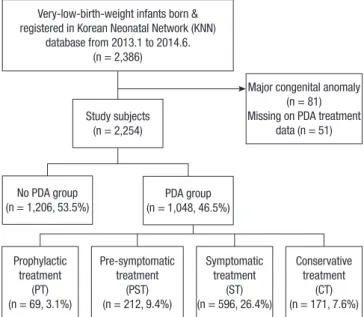
“PDA group”) were classified into 4 groups according to the therapeutic treatment strategy: prophylactic treatment group (PT), pre-symptomatic treatment group (PST), symptomatic treatment group (ST), and conservative treatment without medication or surgical intervention group (CT) (Fig. 1).
First, we compared the baseline characteristics between the PDA group and no PDA group. We also compared the baseline characteristics in patients between 5 groups (no PDA, PT, PST, ST, and CT). After that, we examined the differences in the pro- portion of each PDA treatment strategy according to the GA and birthweight group. GA group was divided into 4 groups (< 24 weeks, 24-27 weeks, 28-31 weeks, and ≥ 32 weeks) and birth-
weight group was divided into 4 groups (< 750 g, 750-999 g, 1,000- 1,249 g, and 1,250-1,499 g). Finally, we searched for the treatment pattern of pharmacological and surgical treatment i.e., kinds of medicine, route of pharmacological treatment, postnatal days for the first day of pharmacological or surgical treatment.
Definitions
We defined “no PDA group” as the group of patients whose PDA had closed spontaneously or had minimal ductal shunting before any signs and symptoms were attributable to PDA.
PDA treatment strategies were defined according to the KNN manual of operation as follows: 1) PT, namely treatment of PDA was done without any clinical symptoms or diagnostic abnor- malities in echocardiography or increased B-natriuretic peptide (BNP) suggestive of PDA; 2) PST, where PDA was confirmed by echocardiography or BNP and treatment of PDA was done with- out any clinical symptoms or signs attributable to PDA; 3) ST, as treatment of PDA was done because there were clinical symp- toms by hemodynamically significant left to right shunt through PDA; and 4) CT, applied only conservative and supportive treat- ment without any pharmacological or surgical intervention for PDA although there were clinical symptoms of PDA.
Presence of clinical symptoms attributable to PDA was de- fined when there were 2 out of 5 symptoms caused by PDA as follows: 1) systolic or continuous murmur; 2) bounding pulse or hyperactive precordial pulsation; 3) hypotension; 4) respira- tory difficulty; and 5) pulmonary edema or cardiomegaly (car- diothoracic ratio > 60%) on chest radiograph.
Small for gestational age (SGA) was defined according to the definitions published by Olsen et al. (14). Pregnancy induced hypertension (PIH) was defined if there was any maternal diag- nosis of eclampsia or preeclampsia. Delivery room (DR) resus- citation was defined when cardiac compression was done or medication was administered in the DR. Early sepsis was de- fined as a positive blood culture less than 7 days from birth. Pri- mary ligation was defined when the patient received PDA liga- tion without any pharmacological treatment about preterm PDA. Secondary ligation was defined when the patient received PDA ligation after failing to close a PDA with pharmacological treatment. Postnatal days (PND) of first day of treatment about preterm PDA was defined as the difference between the date of first day of treatment and the date of birth. 0 day meant less than 24 hr from birth.
Statistical analysis
All the continuous variables were expressed as the mean ± stan- dard deviation (SD) and categorical variables were expressed as numbers and proportions. For analysis, we first compared the demographic and baseline characteristics between PDA group and no PDA group. Chi-square test and t-test were done to compare variables between PDA group and no PDA group.
Fig. 1. Study population. A total of 2,254 very-low-birth-weight (VLBW) infants regis- tered in the Korean Neonatal Network (KNN) from 2013.1. to 2014.6. were included.
“No PDA group” was 1,206 patients (53.5%) and “PDA group” was 1,048 patients (46.5%).
Very-low-birth-weight infants born &
registered in Korean Neonatal Network (KNN) database from 2013.1 to 2014.6.
(n = 2,386)
No PDA group
(n = 1,206, 53.5%) PDA group
(n = 1,048, 46.5%)
Prophylactic treatment
(PT) (n = 69, 3.1%)
Pre-symptomatic treatment
(PST) (n = 212, 9.4%)
Symptomatic treatment
(ST) (n = 596, 26.4%)
Conservative treatment
(CT) (n = 171, 7.6%) Study subjects
(n = 2,254)
Major congenital anomaly (n = 81) Missing on PDA treatment
data (n = 51)
We also compared the baseline characteristics among 5 differ- ent treatment groups (no PDA, PT, PST, ST, and CT). The one- way analysis of variance (ANOVA) with Tukey test for multiple comparisons was used for continuous variables and chi-square test with Bonferroni correction was used for the analysis of cat- egorical variables. We examined the proportion of different PDA treatment strategies according to the GA and birthweight groups by chi-square test. Multinomial logit model analysis was conducted to assess the preference of certain treatment strate- gies according to the GA and birthweight group. The statistical analysis was conducted using IBM SPSS Statistics version 20 (IBM Corp., Amarok NY, USA) and R version 3.1.2. (http://www.
r-project.org). P values less than 0.05 were considered statisti- cally significant.
Ethics statement
The KNN registry was approved by the institutional review board at each participating hospital and informed consent was ob- tained from the parents at enrollment in NICUs participating in the KNN.
RESULTS Study groups
A total of 2,254 infants with birthweight < 1,500 g born from January 2013 to June 2014 were included in our analysis. PDA that closed spontaneously or with minimal ductal shunting be- fore any signs and symptoms were attributable to PDA (no PDA group) was observed in 1,206 (53.5%) infants. The 1,048 (46.5%)
infants in whom PDA was diagnosed or who received PDA treatment (PDA group) were divided into study groups accord- ing to the therapeutic strategies of PDA: PT (69 infants, 3.1%), PST (212 infants, 9.4%), ST (596 infants, 26.4%), and CT (171 in- fants, 7.6%) (Fig. 1). ST was the most preferred treatment mo- dality of preterm PDA, and infants received other treatment modalities in the order of PST, CT, and PT. A total of 877 infants (38.9%) of patients received pharmacological or surgical treat- ment about preterm PDA.
Demographic and baseline characteristics of groups according to the PDA treatment strategies
When compared with no PDA group, PDA group was younger and lighter at birth. Fewer infants were delivered by cesarean section in the PDA group. Maternal histologic chorioamnionitis was more prevalent; however, maternal PIH was less prevalent in PDA group when compared with no PDA group. One minute Apgar score and five minute Apgar score of at least 3 or less were more frequent in PDA group. More infants received sur- factant and early sepsis was more prevalent in PDA group when compared with no PDA group.
All 4 subgroups were younger at birth when compared with no PDA group. PST and ST were older at birth when compared with CT. There was no difference in sex ratio between the 5 groups. When compared with no PDA group, histologic chorio- amnionitis was more prevalent in ST and PIH was less preva- lent in CT. SGA was less prevalent in all PDA subgroups when compared with no PDA group. Five minute Apgar score of at least 3 or less were more frequent in PT and ST. All PDA sub- Table 1. Patient characteristics according to the patent ductus arteriosus (PDA) treatment strategies in very-low-birth-weight infants in Korea
Characteristics No PDA (n = 1,206) PDA (n = 1,048) PDA treatment strategies
PT (n = 69) PST (n = 212) ST (n = 596) CT (n = 171)
% Total 53.5 46.5 3.1 9.4 26.4 7.6
% PDA NA 100.0 6.6 20.2 56.9 16.3
GA (week)* 29.6 ± 2.9 26.9 ± 2.6ll 26.5 ± 2.9† 27.3 ± 2.5†,‡ 27.1 ± 2.4†,‡ 26.0 ± 2.7†
Birthweight (g)* 1,177 ± 258 944 ± 270ll 943 ± 280†,‡ 984 ± 260†,‡ 966 ± 265†,‡ 819 ± 265†
Male 622 (51.6%) 508 (48.5%) 32 (46.4%) 104 (49.1%) 277 (46.5%) 95 (55.6%)
Cesarean section* 921 (76.4%) 759 (72.4%)ll 42 (60.9%)†,‡ 153 (72.2%) 430 (72.1%) 134 (78.4%)
Multiple gestation* 435 (36.1%) 383 (36.5%) 23 (33.3%) 61 (28.8%)‡ 217 (36.4%)‡ 82 (48.0%)†
HCA* 309 (30.7%) 338 (37.9%)ll 20 (31.3%) 66 (33.3%) 191 (40.1%)† 61 (39.6%)
PIH* 246 (20.4%) 163 (15.6%)ll 6 (8.7%) 35 (16.5%) 104 (17.4%) 18 (10.5%)†
Antenatal steroid, complete 573 (48.6%) 515 (50.0%) 33 (48.5%) 101 (48.1%) 284 (48.6%) 97 (57.4%)
SGA* 404 (33.8%) 189 (18.3%)ll 4 (6.3%)†,‡ 39 (18.6%)† 111 (18.6%)† 35 (21.5%)†
DR resuscitation* 53 (4.4%) 52 (5.0%) 2 (2.9%) 2 (1.0%)‡,§ 35 (6.0%) 13 (7.6%)
1 min AS ≤ 3* 297 (24.8%) 405 (38.9%)ll 35 (51.5%)† 64 (30.3%)§ 247 (41.8%)† 59 (34.5%)†
5 min AS ≤ 3* 52 (4.3%) 98 (9.4%)ll 18 (26.5%)†,‡,§ 12 (5.7%) 54 (9.1%)† 14 (8.2%)
Surfactant use* 798 (66.2%) 996 (95.0%)ll 69 (100.0%)† 195 (92.0%)†,‡ 563 (94.5%)† 169 (95.0%)†
Early sepsis* 33 (2.7%) 47 (4.5%)ll 2 (2.9%) 6 (2.8%) 26 (4.4%) 13 (7.6%)†
*P < 0.05 in one-way ANOVA with Tukey or chi-square test with Bonferroni correction between no PDA, PT, PST, ST, and CT groups; †P < 0.05 when compared with no PDA group; ‡P < 0.05 when compared with CT group; §P < 0.05 when compared with ST group; llP < 0.05 in chi-square test or t-test between no PDA group and PDA group. PT, prophylactic treatment; PST, pre-symptomatic treatment; ST, symptomatic treatment; CT, conservative treatment without any intervention; PDA, patent ductus arteriosus; GA, gestational age at birth; HCA, histologic chorioamnionitis; PIH, pregnancy induced hypertension; SGA, small for gestational age; DR, delivery room; AS, apgar score, NA: not ap- propriate.
groups received more surfactants. Early sepsis was more preva- lent in CT group. When compared with CT, fewer infants re- ceived cesarean section in PT. SGA was less prevalent in PT and five minute Apgar score of at least 3 or less were more frequent in PT. Surfactant was less frequently used in PST (Table 1).
Proportion of patients according to the GA
Infants with PDA were 75.2%, 70.9%, 36.3%, and 12.3% of GA groups < 24 weeks, 24-27 weeks, 28-31 weeks, and ≥ 32 weeks, respectively. The proportion of PDA group was decreased as the GA was increased (Table 2).
The proportion of PDA treatment strategy was different be- tween subgroups of GA in PDA group (Table 2, P < 0.001). ST was the most favored treatment strategies in all GA subgroups.
Although ST was still the most favored treatment in GA < 24 weeks group, when compared with infants of GA ≥ 32 weeks in multinomial logit model, the chance of choosing CT rather than PST or ST was higher [CT vs. PST, odds ratio (OR) 5.3, 95% con- fidence interval (CI) 1.56-18.18; CT vs. ST, OR 2.9, 95% CI 1.03- 8.13]. When compared with infants with GA 28-32 weeks in mul- tinomial logit model, the chance of choosing CT rather than PST or ST was also higher in GA < 24 weeks group [CT vs. PST, odds ratio (OR) 6.4, 95% confidence interval (CI) 2.84-14.48; CT vs.
ST, OR 5.1, 95% CI 2.79-9.26].
Proportion of patients according to the birthweight PDA group was 73.4%, 64.6%, 45.7%, and 21.9% of infants with birthweight < 750 g, 750-999 g, 1,000-1,249 g, and ≥ 1,250 g, re- spectively. The proportion of PDA group was decreased accord- ing to the increase in birthweight (Table 3).
The proportion of PDA treatment strategy was different among subgroups of birthweight in PDA group (Table 3, P <
0.001). ST was the most favored treatment strategy in all birth- weight subgroups; however, the proportion of CT among 4 dif- ferent PDA treatment strategy groups increased according to the decrease in birthweight. Although ST was still the most favored treatment in infants with birthweight < 750 g group when compared with infants with birthweight 1,250-1,499 g group, CT was more preferred than PT, PST, and ST (CT vs. PT, OR 3.6, 95% CI 1.45-9.17; CT vs. PST, OR 9.2, 95% CI 2.93-12.66;
CT vs. ST, OR 4.5, 95% CI 2.39-8.62). CT was also preferred in infants with birthweight 750-999 g group when compared with birthweight 1,250-1,499 g group (CT vs. PT, OR 2.8, 95% CI 1.08- 7.41; CT vs. PST, OR 2.1, 95% CI 1.00-4.24; CT vs. ST, OR 2.0, 95%
CI 1.06-3.94).
Pharmacological treatment of preterm PDA
Eight hundred and one infants (35.5%) among the total VLBW infants in the KNN received pharmacological treatment. The proportion of infants with pharmacological treatment was dif- ferent according to the GA (P < 0.001, Fig. 2A) and birthweight (P < 0.001, Fig. 2B).
Most of the patients received ibuprofen as pharmacological treatment of PDA (787 infants, 98.2% of total patients with phar- macological treatment) and only 13 infants received indometh- acin. In infants treated with ibuprofen, intravenous ibuprofen was used in 503 patients (62.8%), oral ibuprofen was used in 275 patients (34.3%) and both oral and intravenous ibuprofen was used in 9 infants (1.1%, Table 4).
When we divided patients with pharmacological treatment Table 2. Patent ductus arteriosus (PDA) treatment strategies according to the gesta-
tional age group Treatment
Gestational age at birth (weeks)
Total (n = 2,254)
< 24
(n = 113) 24-27
(n = 766) 28-31
(n = 1,043) ≥ 32 (n = 332) No PDA group 28
(24.8%) 223
(29.1%) 664
(63.7%) 291
(87.7%) 1,206 (53.5%)
PDA group 85
(75.2%) 543
(70.9%) 379
(36.3%) 41
(12.3%) 1,048 (46.5%)
PT group 11
(9.7%)
31 (4.0%)
24 (2.3%)
3 (0.9%)
69 (3.1%) PST group 10
(8.8%) 107
(14.0%) 84
(8.1%) 11
(3.3%) 212
(9.4%)
ST group 35
(31.0%) 307
(40.1%) 233
(22.3%) 21
(6.3%) 596
(26.4%)
CT group 29
(25.7%)
98 (12.8%)
38 (3.6%)
6 (1.8%)
171 (7.6%)
*In multinomial logit model, the odds ratio (OR) of the ratio of CT vs. PST was 5.3 [95% confidence interval (CI) 1.56-18.18] and OR of the ratio of CT vs. ST was 2.9 (95% CI 1.03-8.13) in GA < 24 weeks group when compared with GA ≥ 32 weeks group. P < 0.001 in 4 PDA treatment subgroups according to GA by chi-square test.
PT, prophylactic treatment; PST, pre-symptomatic treatment; ST, symptomatic treat- ment; CT, conservative treatment; PDA, patent ductus arteriosus; GA, gestational age;
OR, odds ratio.
Table 3. Patent ductus arteriosus (PDA) treatment strategies according to the birth- weight group
Treatment
Birthweight (g)
Total (n = 2,254)
< 750
(n = 379) 750-999
(n = 511) 1,000-1,249
(n = 593) 1,250-1,499 (n = 771) No PDA group 101
(26.6%) 181
(35.4%) 322
(54.3%) 602
(78.1%) 1,206 (53.5%)
PDA group 278
(73.4%) 330
(64.6%) 271
(45.7%) 169
(21.9%) 1,048 (46.5%) PT group 20
(5.3%)
16 (3.1%)
21 (3.5%)
12 (1.6%)
69 (3.1%) PST group 41
(10.8%) 75
(14.7%) 55
(9.3%) 41
(5.3%) 212
(9.4%) ST group 138
(36.4%) 190
(37.2%) 165
(27.8%) 103
(13.3%) 596 (26.4%)
CT group 79
(20.9%)
49 (9.6%)
30 (5.1%)
13 (1.7%)
171 (7.6%)
*In multinomial logit model, the odds ratio (OR) of the ratio of CT vs. PT was 3.6 (95%
CI 1.45-9.17), OR of the ratio of CT vs. PST was 9.2 (95% CI 2.93-12.66), and the OR of the ratio of CT vs. ST was 4.5 (95% CI 2.39-8.62) in birthweight < 750 g group when compared with birthweight 1,250-1,499 g group. P < 0.001 in 4 PDA treat- ment subgroups according to the birthweight by chi-square test. PT, prophylactic treat- ment; PST, pre-symptomatic treatment; ST, symptomatic treatment; CT, conservative treatment without any intervention; PDA, patent ductus arteriosus; OR, odds ratio.
according to the PDA treatment strategies, pharmacological treatment was done in 67 infants (97.1%) in PT, 209 infants (98.6%) in PST, and 525 infants (88.1%) in ST. Intravenous ibu- profen was used in 92.5% of PT, 40.7% of PST, and 67.8% of ST in infants with pharmacological treatment (Table 4). Mean postnatal days (PND) at the first dose of cyclooxygenase inhibi- tors treatment was 4.6 ± 6.4 days in total patients (Fig. 3), and 0.7 ± 1.3 days in PT, 3.2 ± 4.3 days in PST, and 5.6 ± 7.1 days in ST (P < 0.001, Table 5). Secondary ligation was done in 6 infants (8.7%) in PT, 38 infants (17.9%) in PST, and 157 infants (26.3%) in ST, with significant differences among the 3 groups in uni- variate analysis (P = 0.001).
When we compared the baseline characteristic between in- travenous ibuprofen group and oral ibuprofen group, intrave- nous ibuprofen was used in infants with younger GA (26.9 ± 2.4 weeks vs. 27.8 ± 2.5 weeks, P < 0.001) and lower birthweight (943 ± 259 g vs. 1,041 ± 263 g, P < 0.001) as compared with oral ibuprofen group. Intravenous ibuprofen was used in earlier PND (4.0 ± 5.5 days vs. 5.7 ± 7.7 days, P < 0.001), when com- pared with oral ibuprofen group. There was no difference in the
frequency of secondary ligation between intravenous and oral ibuprofen groups [128 infants (25.4%) vs. 62 infants (22.5%), P = 0.368].
Surgical treatment of preterm PDA
A total of 277 infants (12.3%) received PDA ligation. Of which, 76 infants (3.4%) received primary ligation and 201 infants (8.9%) received secondary ligation. The proportion of infants with surgical treatment was different according to the GA (P <
0.001, Fig. 2A). Mean PND was 10.9 ± 10.4 days in infants with primary ligation and 21.3 ± 16.2 days in infants with secondary ligation (P = 0.024, Fig. 3).
Table 5. Postnatal days of the first days of pharmacological treatment according to the different strategies of patent ductus arteriosus (PDA) treatment (days)
PT group PST group ST group Total Ibuprofen* Total 0.7 ± 1.3 3.2 ± 4.3 5.6 ± 7.2 4.6 ± 6.4
Oral 0.0 ± 0.0 3.7 ± 5.1 7.4 ± 9.0 5.7 ± 7.7 IV 0.7 ± 1.3 2.6 ± 2.8 4.8 ± 6.1 4.0 ± 5.5 Oral+IV NA 3.5 ± 0.7 3.9 ± 4.2 3.8 ± 3.6
Indomethacin 0.5 ± 0.7 6.0 7.5 ± 6.7 6.3 ± 6.3
Others 0.0 NA NA 0.0
Total 0.7 ± 1.3 3.2 ± 4.3 5.6 ± 7.1 4.6 ± 6.4
P < 0.05 compared between oral, intravenous, and both oral and intravenous treat- ment of ibuprofen groups by one-way ANOVA test. PT, prophylactic treatment; PST, pre-symptomatic treatment; ST, symptomatic treatment; IV, intravenous; NA, not ap- plicable; others, other medications used for treatment of preterm patent ductus arte- riosus such as acetaminophen.
Table 4. Pharmacological treatment of preterm PDA according to the PDA treatment strategies
PT group
(n = 67) PST group
(n = 209) ST roup
(n = 525) Total (n = 801) Ibuprofen Total 64 (95.5%) 208 (99.5%) 515 (98.1%) 787 (98.2%)
Oral 2 (3.0%) 121 (57.9%) 152 (29.0%) 275 (34.3%) IV 62 (92.5%) 85 (40.7%) 356 (67.8%) 503 (62.8%) Oral+IV 0 (0.0%) 2 (0.9%) 7 (1.3%) 9 (1.1%) Indomethacin 2 (3.0%) 1 (0.5%) 10 (1.9%) 13 (1.7%)
Others 1 (1.5%) 0 (0.0%) 0 (0.0%) 1 (0.1%)
PT, prophylactic treatment; PST, pre-symptomatic treatment; ST, symptomatic treat- ment; IV, intravenous; others, other medications used for treatment of preterm patent ductus arteriosus such as acetaminophen.
Fig. 2. Preterm patent ductus arteriosus (PDA) treatment. Proportion of patients who received pharmacological (with or without surgery) and surgical treatment (both primary and secondary ligation) was decreased with the increase in gestational age and birthweight. (A) According to the gestational age, (B) According to the birthweight.
Proportion (%)
Gestational age at birth (week)
< 24 24 25 26 27 28 29 30 31 ≥ 32
60 50 40 30 20 10 0
Pharmacological treatment Primary ligation Secondary ligation
A
Proportion (%)
Birthweight (g)
< 500 500-599 600-699 700-799 800-899 900-999
1,000-1099 1,100-1,199 1,200-1299 1,300-1399
≥1,400
60 50 40 30 20 10 0
Pharmacological treatment Primary ligation Secondary ligation
B
Fig. 3. Proportion of patients according to the postnatal days of the first day of patent ductus arteriosus (PDA) treatment (Proportion of patients in each treatment modality:
pharmacological treatment, primary ligation, and secondary ligation). Mean postnatal days at the first dose of pharmacological treatment was 4.6±6.4 days. Mean post- natal days of surgery was 10.9±10.4 days in primary ligation group and 21.3±16.2 days in secondary ligation group.
Proportion of patients (%)
Days from birth
0-24 hr 3 5 7 9 11 14 17 20 23 26 29 32 35 38 42 46 50 56 > 60 25
20 15 10 5 0
Pharmacological treatment Primary ligation Secondary ligation
DISCUSSION
Based on the KNN database, no PDA group was 53.5% and PDA group was 46.5% of the VLBW infants. Infants with pharmaco- logical or surgical treatment of preterm PDA were 38.9% of the infants. Pharmacological treatment was done in 35.5% of VLBW infants and surgical treatment was done in 12.3% of VLBW in- fants. ST was the most preferred treatment modality for pre- term PDA; however, more infants received CT rather than PST or ST in infants with lower GA and birthweight.
Ductus arteriosus in normal term infants usually constricts within 72 hr of birth. Most preterm infants > 29 weeks GA achi- eve ductal contraction by day 4; however, failure rate of constric- tion was up to 70% of infants with GA < 28 weeks and 80% in 24-25 weeks (6). Clyman et al. (15) reported that PDA was closed in 90% of infants ≥ 30 weeks GA on the day 4 and 98% at dis- charge. However, in infants with GA 24 weeks, 8% had PDA closed on day 4 and 13% on day 7 in his report. According to the birth- weight in his report, PDA was closed in 35% of infants with birth- weight 1,000-1,500 g on day 4, 67% on day 7, and 94% at dis- charge. In infants with birthweight < 1,000 g, PDA was closed in 21% on day 4 and 34% on day 7. Recently, contrary to the previous reports, Rolland et al. (12) performed a retrospective cohort analysis of 103 infants with GA 24-27 weeks, and they re- ported that spontaneous closure was observed in 73% of infants without any specific treatment to close PDA. According to such concepts, quite a number of centers in Korea started to favor conservative treatment strategies.
There are several reports on the epidemiologic data of treat- ment of preterm PDA using large national cohort data. Accord- ing to the National Institute of Children Health and Human Development and Neonatal Research Network (NICHD-NRN) data in infants with GA 22-28 weeks and birthweight < 1,000 g between 2003 and 2007 (16), indomethacin therapy for PDA was done in 71% and surgical treatment of PDA was performed in 27% of the infants, which was a higher treatment rate than from the KNN data (49.0% infants with GA ≤ 28 weeks received pharmacological treatment and 20.0% infants received surgical treatment, data not shown in the results). According to the Ca- nadian Neonatal Network database (17), of the infants with GA
≤ 32 weeks between 2004 and 2008, 3,673 (25%) infants were diagnosed with PDA. Laughon et al. (9) reported in a cohort study of infants born between 23 and 30 weeks gestation man- aged by Pediatrix Medical Group from 1997 and 2004 that 52%
had no PDA, which was higher than the KNN data (44.6% of in- fants with GA ≤ 30 weeks had no PDA in our cohort).
Established treatments for PDA are prostaglandin H2 synthe- tase inhibitors (indomethacin and ibuprofen) and surgical liga- tion. Recently, the effects of paracetamol (acetaminophen) have been studied (18). PDA treatment can be classified ac- cording to the timing of treatment as prophylactic, pre-symp-
tomatic, and symptomatic treatment. Currently, many neona- tologists prefer supportive therapy alone in infants who appear to tolerate PDA awaiting spontaneous closure because of no clear evidence of benefits in neonatal outcomes and potential side effects. Also in our results with the KNN, CT was more pre- ferred than PST or ST in infants with lower GA and birthweight, which suggests that quite a number of centers in Korea now fa- vor CT.
For prophylactic treatment, most demonstrable benefit is a reduction in rates of intra-ventricular hemorrhage (IVH) in pro- phylactic indomethacin treatment. However, lack of improved long-term developmental outcome and mortality makes pro- phylactic indomethacin treatment less compelling (19). Pro- phylactic treatment of ibuprofen decreased the need for rescue treatment with cyclo-oxygenase inhibitors and decreased the need for surgical closure. However, prophylactic ibuprofen treatment exposes many infants to a drug that has potential re- nal and gastrointestinal side effects without any short-term benefits (20). Pre-symptomatic treatment with indomethacin showed a trend towards a reduction in chronic lung disease (CLD) without statistical significance on meta-analysis (21).
Laughon et al. (9) reported that in infants with GA ≤ 30 weeks managed by Pediatrix, 18% patients received prophylactic in- domethacin, 16% received the indicated treatment after day 1 of birth, and 11% had a PDA without treatment. Our data indi- cates that PT was 3.7%, PST was 11.1%, ST was 31.1% and CT was 9.5% in infants with GA ≤ 30 weeks (data are not shown in results). In our cohort, fewer infants received PT and more in- fants received ST when compared with infants in Pediatrix group. According to the Canadian Neonatal Network data, for infants with GA ≤ 32 weeks between 2004 and 2008, 16% re- ceived conservative management. Hoellering et al. (22) per- formed a survey on the management of patent ductus arterio- sus in Australia and New Zealand, and they reported that in in- fants with GA ≤ 28 weeks or birthweight ≤ 1,000 g, prophylac- tic treatment was done in 17%, pre-symptomatic treatment in 16% and echocardiographic targeted prophylaxis was done in 32% of the entire patient cohort reflecting a variation in man- agement approach across Australia and New Zealand. Because the evidence that prophylactic or pre-symptomatic treatment of PDA improve neonatal outcomes in preterm infants is not sufficient, most Korean neonatologists hesitate to perform pro- phylactic treatment than neonatologists in other countries do.
Contrary to data from other countries, the most frequently used drug for PDA treatment was ibuprofen, because indometh- acin is not supplied in Korea. Intravenous ibuprofen group was younger and lighter at birth when compared with oral ibuprofen group. Although there is some evidence that oral ibuprofen is more effective in closure of preterm PDA when compared with intravenous ibuprofen (23), as enteral feeding can be started in later days after birth and advanced slower in infants with young-
er GA, intravenous ibuprofen may be preferred in younger in- fants.
Proportion of patients who received primary ligation was 9%
of infants with GA ≤ 32 weeks in the Canadian Neonatal Net- work (17). In a telephone interview of preferences and practices to the 136 Canadian neonatologist (24), 9% of neonatologists chose surgery as first-line treatment for infants, 4% choose it for infants 23-26 weeks’ gestation, 2% for infants older than 21 days of age, and 2% for infants weighing less than 800 g. No neona- tologist used surgery as a prophylactic treatment. Our data in- dicated that more infants received secondary ligation in ST when compared with PT and PST; however, multivariate analy- sis should be done to adjust for the risk factors of secondary li- gation to assess the association between PDA treatment strate- gies and the frequency of secondary ligation.
According to our data, the mean PND of the first day of pre- term PDA treatment was 4.6 ± 6.4 days for pharmacological treatment. Mean PND at the first dose of cyclooxygenase inhib- itor treatment was 0.7 ± 1.3 days in PT, 3.2 ± 4.3 days in PST, and 5.6 ± 7.1 days in ST. For the association between the timing of pharmacological treatment for PDA and the risk of second- ary surgery, death or bronchopulmonary dysplasia (BPD), Gudmundsdottir et al. (25) reported that intermediate start (postnatal days 3-6 days after birth) was not associated with any risk of BPD, while late PDA treatment ( ≥ 7 days) was associated with a lower BPD risk when compared with early start (0 to 2 days). So, further analysis about the relationship between the timing of PDA treatment and the neonatal outcomes are need- ed using the KNN database.
This study had several limitations. First, although it was the first epidemiologic study representing the current therapeutic strategies of preterm PDA in Korea, the number of patients in- cluded in this study were still small due to short inclusion peri- od of the KNN cohort. More infants should be included for both epidemiologic and outcome analysis to obtain a standardized protocol on preterm PDA treatment. Second, when we checked whether the classification of PDA treatment strategy matched the other information such as pharmacological treatment and PDA ligation, there were several cases with discordant informa- tion. For example, some cases without any pharmacological or surgical treatment were coded as PT, PST or ST. We excluded such cases (2.3%) from the analysis, which was not a big por- tion of the total patient set. Third, because our cohort was based on the birthweight, and not on the GA especially for infants with GA > 30 weeks, not all infants at each GA could be includ- ed in the analysis. Fourth, we could not obtain the information about the centers where a given treatment was performed, hence we could not assess the variation of treatment strategies according to the centers. Fifth, we defined prophylactic PDA treatment as treatment without any test for PDA regardless of the start time of the medication. Some reports defined prophy-
lactic treatment only when treatment was done within 24 hr af- ter birth (9,17), so the proportion of patients who received pro- phylactic treatment could differ according to the definition for prophylactic treatment.
This study was the first epidemiologic study on the current treatment practices of preterm PDA in VLBW infants in Korea.
For VLBW infants, 46.5% were confirmed as preterm PDA or received treatment for PDA and although ST was the most pre- ferred method, more infants received CT in lower GA and lower birthweight group. For a standardized treatment guideline for PDA, outcome analysis including in-hospital outcome and long-term neurodevelopmental outcome are needed for a more complete analysis. In addition, a multi-center, random- ized controlled trial should be planned in order to more effec- tively and thoroughly assess the effect of treatment for PDA in preterm infants.
DISCLOSURE
The authors have no conflicts of interest to disclose.
AUTHOR CONTRIBUTION
Conception and design of the study: Lee JA, Choi BM. Acquisi- tion of data: Lee JA. Statistical analysis: Oh S. First draft of the manuscript: Lee JA, Choi BM. Revision and critical review of the manuscript: Lee JA, Kim MJ, Choi BM. Manuscript approv- al: all authors.
ORCID
Jin A Lee http://orcid.org/0000-0002-9194-0529 Myo-Jing Kim http://orcid.org/0000-0002-8296-3382 Sohee Oh http://orcid.org/0000-0002-3010-448X Byung Min Choi http://orcid.org/0000-0003-0931-2353
REFERENCES
1. Madan JC, Kendrick D, Hagadorn JI, Frantz ID 3rd; National Institute of Child Health and Human Development Neonatal Research Network.
Patent ductus arteriosus therapy: impact on neonatal and 18-month outcome. Pediatrics 2009; 123: 674-81.
2. Noori S, McCoy M, Friedlich P, Bright B, Gottipati V, Seri I, Sekar K.
Failure of ductus arteriosus closure is associated with increased mortali- ty in preterm infants. Pediatrics 2009; 123: e138-44.
3. Marshall DD, Kotelchuck M, Young TE, Bose CL, Kruyer L, O’Shea TM.
Risk factors for chronic lung disease in the surfactant era: a North Caro- lina population-based study of very low birth weight infants. North Car- olina Neonatologists Association. Pediatrics 1999; 104: 1345-50.
4. Evans N, Kluckow M. Early ductal shunting and intraventricular haem- orrhage in ventilated preterm infants. Arch Dis Child Fetal Neonatal Ed 1996; 75: F183-6.
5. Dollberg S, Lusky A, Reichman B. Patent ductus arteriosus, indometha- cin and necrotizing enterocolitis in very low birth weight infants: a pop- ulation-based study. J Pediatr Gastroenterol Nutr 2005; 40: 184-8.
6. Heuchan AM, Clyman RI. Managing the patent ductus arteriosus: current treatment options. Arch Dis Child Fetal Neonatal Ed 2014; 99: F431-6.
7. Gersony WM, Peckham GJ, Ellison RC, Miettinen OS, Nadas AS. Effects of indomethacin in premature infants with patent ductus arteriosus: re- sults of a national collaborative study. J Pediatr 1983; 102: 895-906.
8. Benitz WE. Patent ductus arteriosus: to treat or not to treat? Arch Dis Child Fetal Neonatal Ed 2012; 97: F80-2.
9. Laughon M, Bose C, Clark R. Treatment strategies to prevent or close a patent ductus arteriosus in preterm infants and outcomes. J Perinatol 2007; 27: 164-70.
10. Chorne N, Leonard C, Piecuch R, Clyman RI. Patent ductus arteriosus and its treatment as risk factors for neonatal and neurodevelopmental morbidity. Pediatrics 2007; 119: 1165-74.
11. Alan S, Karadeniz C, Okulu E, Kilic A, Erdeve O, Ucar T, Atasay B, Atalay S, Arsan S. Management of patent ductus arteriosus in preterm infants:
clinical judgment might be a fair option. J Matern Fetal Neonatal Med 2013; 26: 1850-4.
12. Rolland A, Shankar-Aguilera S, Diomande D, Zupan-Simunek V, Boi- leau P. Natural evolution of patent ductus arteriosus in the extremely preterm infant. Arch Dis Child Fetal Neonatal Ed 2015; 100: F55-8.
13. Chang YS, Ahn SY, Park WS. The establishment of the Korean Neonatal Network (KNN). Neonatal Med 2013; 20: 169-78.
14. Olsen IE, Groveman SA, Lawson ML, Clark RH, Zemel BS. New intra- uterine growth curves based on United States data. Pediatrics 2010; 125:
e214-24.
15. Clyman RI, Couto J, Murphy GM. Patent ductus arteriosus: are current neonatal treatment options better or worse than no treatment at all? Se- min Perinatol 2012; 36: 123-9.
16. Stoll BJ, Hansen NI, Bell EF, Shankaran S, Laptook AR, Walsh MC, Hale EC, Newman NS, Schibler K, Carlo WA, et al. Neonatal outcomes of ex-
tremely preterm infants from the NICHD Neonatal Research Network.
Pediatrics 2010; 126: 443-56.
17. Mirea L, Sankaran K, Seshia M, Ohlsson A, Allen AC, Aziz K, Lee SK, Shah PS; Canadian Neonatal Network. Treatment of patent ductus arte- riosus and neonatal mortality/morbidities: adjustment for treatment se- lection bias. J Pediatr 2012; 161: 689-94.e1.
18. Oncel MY, Yurttutan S, Erdeve O, Uras N, Altug N, Oguz SS, Canpolat FE, Dilmen U. Oral paracetamol versus oral ibuprofen in the manage- ment of patent ductus arteriosus in preterm infants: a randomized con- trolled trial. J Pediatr 2014; 164: 510-4.e1.
19. Fowlie PW, Davis PG, McGuire W. Prophylactic intravenous indometh- acin for preventing mortality and morbidity in preterm infants. Cochrane Database Syst Rev 2010: CD000174.
20. Ohlsson A, Shah SS. Ibuprofen for the prevention of patent ductus arte- riosus in preterm and/or low birth weight infants. Cochrane Database Syst Rev 2011: CD004213.
21. Cooke L, Steer P, Woodgate P. Indomethacin for asymptomatic patent ductus arteriosus in preterm infants. Cochrane Database Syst Rev 2003:
CD003745.
22. Hoellering AB, Cooke L. The management of patent ductus arteriosus in Australia and New Zealand. J Paediatr Child Health 2009; 45: 204-9.
23. Cherif A, Jabnoun S, Khrouf N. Oral ibuprofen in early curative closure of patent ductus arteriosus in very premature infants. Am J Perinatol 2007; 24: 339-45.
24. Lai LS, McCrindle BW. Variation in the diagnosis and management of patent ductus arteriosus in premature infants. Paediatr Child Health 1998; 3: 405-10.
25. Gudmundsdottir A, Johansson S, Håkansson S, Norman M, Källen K, Bonamy AK. Timing of pharmacological treatment for patent ductus ar- teriosus and risk of secondary surgery, death or bronchopulmonary dys- plasia: a population-based cohort study of extremely preterm infants.
Neonatology 2015; 107: 87-92.