Received March 8, 2019, Revised May 28, 2019, Accepted for publication July 1, 2019
Corresponding author: Hyang-Joon Park, Department of Dermatology, Gachon University Gil Medical Center, 21 Namdong-daero 774beon-gil, Namdong-gu, Incheon 21565, Korea. Tel: 82-32-460-2763, Fax: 82-32- 460-2374, E-mail: [email protected]
ORCID: https://orcid.org/0000-0002-2143-0080
This is an Open Access article distributed under the terms of the Creative Commons Attribution Non-Commercial License (http://creativecommons.
org/licenses/by-nc/4.0) which permits unrestricted non-commercial use, distribution, and reproduction in any medium, provided the original work is properly cited.
Copyright © The Korean Dermatological Association and The Korean Society for Investigative Dermatology
Ann Dermatol Vol. 31, No. 5, 2019 https://doi.org/10.5021/ad.2019.31.5.525
ORIGINAL ARTICLE
The Reappraisal of the Slide-Swing Skin Flap: A Versatile Technique for Surgical Defects
Min-Soo Kim, Seul-Ki Lee1, Mihn-Sook Jue, Hyang-Joon Park1
Department of Dermatology, Veterans Health Service Medical Center, Seoul, 1Department of Dermatology, Gachon University Gil Medical Center, Incheon, Korea
Background: The slide-swing skin flap is a combination of transposition and adjacent skin sliding and can be used to close large, round defects with a flap that is smaller than the primary defect to produce aesthetically good results.
Objective: To evaluate the efficacy and safety of the slide- swing skin flap for various surgical defects caused by skin tu- mor excisions. Methods: This retrospective case series, which includes 33 Asian patients between the ages of 25 and 86 years, describes the slide-swing skin flap after primary ex- cision for malignant or premalignant skin conditions. The outcomes were assessed 12 weeks after surgery using the pa- tient and observer scar assessment scale (POSAS). Results:
Patients were 25 male and 8 female, and the causes of sur- gery were various malignant skin tumors including malig- nant melanoma, dermatofibrosarcoma protuberans, and ma- lignant nodular hidradenoma. Tumors were on the lower limb in eleven patients, back in nine patients, chest in five pa- tients, face in three patients, buttock in three patients and two patients had tumors in other locations. The mean defect size was 3.5×3.1±1.9×2.2 cm (range, 1.4×0.9∼9.0×12.0 cm). The mean patient POSAS total score was 9.7±3.0 and mean patient overall opinion score was 1.8±0.7. The mean observer POSAS total score was 11.0±2.7 and mean ob-
server overall opinion score was 1.9±0.5. All flaps survived and postoperative recoveries were uneventful. Conclusion:
The slide-swing skin flap is highly versatile and can be used to cover various surgical defects, irrespective of size and lo- cation, with excellent functional and cosmetic results. (Ann Dermatol 31(5) 525∼529, 2019)
-Keywords-
Skin neoplasms, Surgical flap
INTRODUCTION
Surgical excision of benign and malignant skin tumors cre- ates surgical defects with a variety of sizes and shapes. For small defects, primary closure after undermining surround- ing tissues is optimal, but when defects are too large to en- able primary closure or to produce aesthetically accept- able results, reconstruction using a local flap or skin graft is mandatory1.
The slide-swing skin flap technique, also known as slide-swing plasty, is a type of transposition flap that was developed by Schrudde and Petrovici2-4. However, it does not only show transposition like other transposition flaps, but instead shows a combination of transposition with skin sliding, so is in part based on the principle of Z-plas- ty2. This technique is usually used to close large, round defects but is also effective for defects with oval or hemi- spherical shapes. Methods such as the Limberg flap gen- erally require round defects to change the geometric fig- ure, which requires additional excision of healthy skin.
Also, the flap should be cut to exactly the same size as the defect5. The slide-swing skin flap allows the incision line to be adjusted to the shape of the defect. Then, the lifted flap is pushed into the primary defect and the adjacent
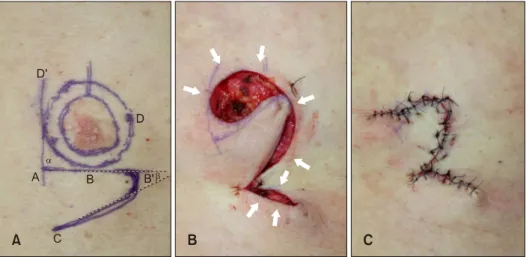
Fig. 1. Application of the slide- swing skin flap. (A) Preoperative design of the surgical excision with safety margins and two flaps (DBB’
and AB’C). (B) After tumor excision, wide undermining and additional mobilization of the adjacent skin tissue (arrows) reduced surgical defect size. (C) Postoperative view.
skin surrounding the defect is slid into primary and secon- dary defects without sacrificing healthy skin. Therefore, in this technique, the flap used for closure is designed to be smaller than the defect and the resulting scar is relatively small.
Herein, we report our experiences using the slide-swing skin flap for the reconstruction of surgical defects after the excision of malignant skin tumors of variable sizes and anatomical locations.
MATERIALS AND METHODS
Patients and methods
A retrospective chart review was conducted to identify all patients with a surgical defect after the excision of a pri- mary malignant or premalignant skin tumor treated by slide-swing skin flap reconstruction at the Veterans Health Service Medical Center and Gachon University Gil Medical Center between 2011 and 2017. Data were col- lected on tumor location, tumor type, defect size after pri- mary tumor excision and intraoperative and postoperative complications, such as, wound dehiscence, flap necrosis or flap failure. We received the patient’s consent form about this study and publishing all photographic materials.
Approval for this study was obtained from the Institutional Review Board of the Veterans Health Service Medical Center and Gachon University Gil Medical Center (IRB no.
BOHUN 2018-02-004, GDIRB2018-365).
Flap design
A round or oval defect was first created during a wide lo- cal excision with sufficient healthy margins, and then a slide-swing skin flap was designed alongside the surgical defect (Fig. 1A). Two lines (AD’ and AB’) bordering the surgical defect were drawn at right angles (α) to each
other. A rounded flap (flap AB’C) was then designed with sides that would form an acute angle (β) if they were extended. This flap (AB’C) was then swung into the pri- mary defect. Another flap, DBB’, was slid into the secon- dary defect, that is, into the origin site of flap AB’C. This swing-slide movement between flaps AB’C and DBB’ is the equivalent of the asymmetric exchange plasty (DABC) with the basic incision (AB) as seen in the Z-plasty.
Additional wide undermining and advancing of the skin around the surgical defect causes a reduction in defect size (Fig. 1B), which means that flap AB’C can be smaller than the surgical defect. Both the primary and secondary defects, were covered with a combination of transposition flap AB’C and skin sliding flap DBB’ and sutured into place (Fig. 1C). If necessary, burrow triangles were ex- cised to eliminate standing cone deformities.
Outcome assessment
Twelve weeks post-surgery, a physician observed the wounds and made objective clinical assessments. The pa- tient and observer scar assessment scale (POSAS) was used to assess scar quality6. The POSAS consists of two separate six-item scales (observer scale and patient scale).
The patient scale measures pain, itching, color, stiffness, thickness, and irregularity. Two trained dermatosurgeons assessed the observer component which measured vascu- larity, pigmentation, thickness, relief, pliability, and sur- face area. All questions are graded on a 10-point scale with one indicating the best possible score and 10 indicat- ing the worst possible score. The scores from the six ques- tions on the patient and observer scales were summed to be total (combined) scores ranging from 6 to 60 (6 repre- senting normal skin and 60 representing the worst imagi- nable scar) for both patient and observer scales.
Table 1. Patient and defect data
Characteristic Value
Male:female 25:8
Age (yr) 66.2±15.0
(25∼86) Diagnosis
Basal cell carcinoma 9
Basosquamous carcinoma 1
Squamous cell carcinoma 3
Bowen disease 13
Malignant melanoma 2
Malignant nodular hidradenocarcinoma 1
Eccrine porocarcinoma 1
Atypical fibroxanthoma 1
Dermatofibrosarcoma protuberans 1
Bowenoid actinic keratosis 1
Location Face
Cheek 2
Chin 1
Trunk
Chest (including breast) 5
Abdomen 1
Back 9
Buttock 3
Extremities
Shoulder 1
Thigh 5
Knee 3
Calf 3
Surgical defect size (cm) 3.5×3.1±1.9×2.2 (1.4×0.9∼9.0×12.0) Values are presented as number only or mean±standard deviation (range).
Table 2. Summary of average POSAS scores
Overall opinion Total score Patient scale score 1.8±0.7 9.7±3.0 Observer scale score 1.9±0.5 11.0±2.7 Values are presented as mean±standard deviation. Agreement between two scores was relatively good. POSAS: patient and observer scar assessment scale.
RESULTS
A total of 33 patients (25 male and 8 female) who under- went slide-swing skin flap reconstruction were identified.
The mean age was 66.2±15.0 (range, 25∼86) years.
Slide-swing skin flaps were used to reconstruct surgical defects caused by the excision of Bowen disease in thir- ty-three cases, basal cell carcinoma in nine cases, squ- amous cell carcinoma in three cases, malignant melanoma in two cases, and basosquamous cell carcinoma, poro- carcinoma, malignant nodular hidradenoma, dermatofi- brosarcoma protuberans, atypical fibroxanthoma, and Bowenoid actinic keratosis in one case each. Tumors were located on the lower limb in eleven patients, back in nine patients, chest in five patients, face in three patients, but- tock in three patients, and two patients had tumors in oth- er locations. Surgical defects varied in size from 1.4×0.9 to 9.0×12.0 cm (mean±standard variation, 3.5×3.1±
1.9×2.2 cm). Postoperative recovery was uneventful in all cases and, with the exception of focal superficial skin ne- crosis in several patients, there were no serious complications. Patient and defect information is summar- ized in Table 1.
POSAS score
POSAS scores were collected from 29 of 33 patients.
Patients responded to the scar outcomes as follows: pain (mean: 1.3), itching (mean: 1.2), color (mean: 1.7), stiff- ness (mean: 2.0), thickness (mean: 1.8), and irregularity (mean: 1.7). The mean patient POSAS total score was 9.7±3.0 (out of 60), and the mean patient overall opinion score was 1.8±0.7 (1 represents best possible score and 10 represents the worst possible score). Using the ob- server component of the POSAS, the scar outcomes were as follows: vascularity (mean: 1.9), pigmentation (mean:
1.2), thickness (mean: 1.9), relief (mean: 2.0), pliability (mean: 2.1), and surface area (mean: 1.8). The mean total observer score was 11.0±2.7 and the mean observer overall opinion score was 1.9±0.5. Lowest and highest observer scale values were 6 and 17, respectively. POSAS scores are summarized in Table 2.
DISCUSSION
The slide-swing skin flap is employed to close large round or oval defects using a combination of transposition and skin sliding. That is in part based on the principle of Z-plasty2. However, triangular skin flaps in Z-plasty are only undermined around flaps, but the slide-swing skin flap also uses the mobilization of the skin surrounding the defect. This mobilization of surrounding skin results in skin movement in all directions and exploits skin reserves around the defect, which allows the use of flaps smaller than the primary defect. There is also a difference be- tween the slide-swing skin flap and conventional trans- position flaps. The flap in the latter occurs at the midline of the defect while the former flap originate the bottom of the defect and the base of the flap is slightly wider than the apex as shown in Fig. 1A2,5,7. In addition, no further
Fig. 2. A 41-year-old female with malignant melanoma on her back.
(A) The lesion was 3.5×4.5 cm and the resultant surgical defect was 9.0×12.0 cm. (B) Postoperative view at 2 weeks.
Fig. 3. An 82-year-old male with squamous cell carcinoma on his cheek. (A) The lesion was 3.0×2.6 cm. (B) Immediate postoperative view. A 70-year-old male with basal cell carcinoma on his right shoulder. (C) The lesion was 2.5×2.0 cm. (D) Postoperative view at 8 months.
normal skin sacrifice is required, unlike the Limberg flap5,8,9. Slide-swing skin flaps may be employed on al- most all parts of the body. There have been three basic types of the slide-swing skin flap. Type one is used to close a round defect. Type two uses an oblong flap to close a defect. Type three use a straight stretch of the round defect edge when forming the flap. We applied mostly type one slide-swing skin flaps because most pa- tients had round skin lesions, type two was used for some patients with oval shaped defects. We were successfully performed at various locations on the body with good POSAS scores. Defect closure is determined by size and location, and flap size is dependent on skin elasticity3,9, which is greatest in the trunk, especially the flanks, back, abdomen, and buttocks. In our 33 patients, the slide-swing skin flap was applied to the trunk of 18 patients. The larg- est defect treated was 9.0×12.0 cm on the back of a pa- tient with melanoma (Fig. 2). In buttock lesions, with very
high (worst) observer scale POSAS scores occurred in two patients. These patients were young, physically active fe- male in their twenties and had relatively large defects of 4.0×4.0 cm and 1.5×1.5 cm, respectively. In addition, we thought that since the buttock area is a region where there is constant tension due to sitting that the scar is like- ly to become hypertrophic. In limbs, skin mobility is slightly limited, but we obtained excellent results in all 12 of cases. In general, there were no serious complication and all the flaps survived well. Most patients were sat- isfied with the postoperative results, showing low average total POSAS scores of 9.7±3.0 and overall opinion score of 1.8±0.7. In observer scale values, the total mean POSAS score was 11.0±2.7 and mean overall opinion score was 1.9±0.5, which were not different from those of the patient group, indicating high agreement between the two groups.
This slide-swing skin flap technique has several advan-
tages for the repair of surgical defects2-4. First, it can be used to cover large defects because it involves the addi- tional mobilization of adjacent surrounding healthy skin.
Second, skin grafting is not required, and it does not in- volve the sacrifice of healthy skin as demonstrated by Fig.
2. Third, it results in smaller surgical scars2. Finally, the flap has a broad base that ensures a good blood supply.
For these reasons, we applied the slide-swing skin flap among various types of flap options. Disadvantages of the slide-swing skin flap are that skin tension at suture sites is high and trapdoor scarring can occur, which means the technique may not be appropriate on curved surfaces, such as the face or shoulder8. Nevertheless, we executed this flap successfully on the face and the shoulder (Fig. 3).
In designing a flap for the face, excess tissue near the de- fect is more important than the relaxed skin tension line5. Available tissue is manually determined by digital manipu- lation (pulling or pinching) for each individual case5. In the head and neck area, the more caudal the defect, the easier it is to use this method become of the elasticity of the skin. In case of Fig. 3A, since the lesion was located on the lower cheek and the patient was aged, we exe- cuted the flap without any tension despite a large defect.
In case with a shoulder defect (Fig. 3C), we massively un- dermined the adjacent, surrounding tissue to avoid high tension and that flap survived well without complications.
The limitations of the present study include the retro- spective nature, small number of patients, mainly the elde- ly (mean 66 years), and lack of a comparative group with other types of flaps. Therefore, further large-scale studies will be necessary including young patients and comparing multiple surgical modalities.
In summary, this study shows that the slide-swing skin flap could serve as a useful, versatile method for covering vari- ous surgical defects with good cosmetic outcomes. To the best of our knowledge, this is the first study in the derma- tologic literature to evaluate the efficacy and safety of the slide-swing skin flap.
CONFLICTS OF INTEREST
The authors have nothing to disclose.
ORCID
Min-Soo Kim, https://orcid.org/0000-0001-6133-6243 Seul-Ki Lee, https://orcid.org/0000-0002-0481-4795 Mihn-Sook Jue, https://orcid.org/0000-0002-8253-6188 Hyang-Joon Park, https://orcid.org/0000-0002-2143-0080
REFERENCES
1. Kwon KH, Lee DG, Koo SH, Jo MS, Shin H, Seul JH.
Usefulness of v-y advancement flap for defects after skin tumor excision. Arch Plast Surg 2012;39:619-625.
2. Schrudde J, Petrovici V. Slide-swing skin flap. In: Strauch B, Hall-Findlay EJ, Grabb WC, Vasconez LO, editors. Grabb's encyclopedia of flaps. Philadelphia: Lippincott, 1998:399- 402.
3. Schrudde J, Petrovici V. The use of slide-swing plasty in closing skin defects: a clinical study based on 1,308 cases.
Plast Reconstr Surg 1981;67:467-481.
4. Schrudde J, Beinhoff U. Covering defects in the breast region by the slide-swing plasty. Aesthetic Plast Surg 1989;
13:41-46.
5. Grekin RC. Flap surgery. In: Lask GP, Moy RL, editors.
Principles and techniques of cutaneous surgery. New York:
McGraw Hill, 1996:309-328.
6. Shao K, Parker JC, Taylor L, Mitra N, Sobanko JF. Reliability of the patient and observer scar assessment scale when used with postsurgical scar photographs. Dermatol Surg 2018;44;
1650-1652.
7. Miller CJ. Design principles for transposition flaps: the rhombic (single-lobed), bilobed, and trilobed flaps. Dermatol Surg 2014;40 Suppl 9:S43-S52.
8. Choi SM, Suh IS, Ha JW. The comparison of the clinical applicability of double z-rhomboid plasty and slide swing plasty. Arch Aesthet Plast Surg 1996;2:24-31.
9. Rustemeyer J, Günther L, Bremerich A. Complications after nasal skin repair with local flaps and full-thickness skin grafts and implications of patients' contentment. Oral Maxillofac Surg 2009;13:15-19.