Trend in Hip Fracture Incidence and Mortality in Korea:
A Prospective Cohort Study from 2002 to 2011
This prospective longitudinal cohort study was to assess the 10-yr hip fracture incidence and mortality trend of person ≥ 50 yr of age between 2002 and 2011 of eight hospitals in Jeju Island. Sex-specific incidence rate (per 100,000 person-years) were calculated based on that estimated for the population in the United States in 2008. Poisson and logistic regressions were used to examine trends in incidence and mortality. There was a 101%
increase in the number of hip fractures from 151 in 2002 to 304 in 2011. The crude incidence of hip fractures in the Jeju population ≥ 50 yr of age increased from
126.6/100,000 to 183.7/100,000. The fracture incidence in the population standardized to the 2008 population in the United States increased from 100.6/100,000 for men and 194.4/100,000 for women in 2002 to 114.2/100,000 for men and 278.4/100,000 for women in 2011. The annual increasing incidence rate of hip fracture was 4.3% (5.3% in women and 2.2% in men). Poisson regression did not show significant trends in the mortality rates for all age groups or for both genders. The total number of hip fractures increased two-fold and the incidence rate of hip fractures increased markedly during the 10-yr study period.
Keywords: Hip Fractures; Incidence; Mortality; Osteoporosis; Trend; Korea Yong-Chan Ha,1 Yong-Geun Park,2
Kwang Woo Nam,2 and Sang-Rim Kim2
1Department of Orthopedic Surgery, Chung-Ang University College of Medicine, Seoul; 2Department of Orthopedic Surgery, Jeju National University School of Medicine, Jeju, Korea
Received: 11 June 2014 Accepted: 3 December 2014 Address for Correspondence:
Sang-Rim Kim, MD
Department of Orthopedic Surgery, Jeju National University School of Medicine, 15 Aran 13-gil, Jeju 690-767, Korea Tel: +82.64-717-1640, Fax: +82.64-717-2352 E-mail: [email protected]
Funding: This research was supported by a grant of the Korea Health Technology R&D Project through the Korea Health Industry Development Institute (KHIDI), funded by the Ministry of Health & Welfare, Korea (grant number: HI13C1522).
http://dx.doi.org/10.3346/jkms.2015.30.4.483 • J Korean Med Sci 2015; 30: 483-488
INTRODUCTION
Hip fractures in elderly patients are most serious consequence of osteoporotic fractures and can result in significant morbidity, loss of independence, and high mortality. Many longitudinal cohort studies have conducted over the past several decades have evaluated the trends of hip fracture incidence using popu- lation-based or medical claims data. Recently, decreasing trends of hip fracture incidence were reported in several developed countries including Australia (1), Denmark (2), France (3), Nor- way (4), Sweden (5), Canada (6), and other North American countires (7). However, little longitudinal cohort study has been performed in a developing country.
Beginning in 2002, we undertook a cohort study regarding os- teoporotic hip fracture. Jeju Island, the study site, is geographi- cally isolated from the Korean peninsula; and patients with hip fractures typically require hospitalization, which makes ascer- tainment easier and much more reliable than other types of fractures (8). In addition, all of the hospitals in the area were in- cluded in the study, and all of the patient data including medical records and radiographies could be reviewed (8). We previously performed a hip fracture survey in the Jeju cohort and found that the incidence of hip fractures increased from 2002 to 2006 (8). We extended the study period to 2011.
The purpose of the present study was to assess the trends of annual incidence of hip fracture and the mortality after hip frac- ture in the Jeju cohort ≥ 50 yr of age over a period of a decade.
MATERIALS AND METHODS Subjects
In 2011, Jeju Island (the biggest island of Korea, which is located southwest of the Korean peninsula) had a population of 576,156 including 74,985 men and 90,481 women ≥ 50 yr of age, with 12.1% being ≥ 65 yr of age (9.3% of men and 14.9% of women).
There were eight hospitals (one university hospital and seven general hospitals) which had an orthopedic department and emergency admission facilities (8). The medical records of and radiographies of patients taken from the eight hospitals between January 2002 and December 2011 were reviewed to identify pa- tients who had hip fractures. Patients were recruited who met the diagnostic criteria for femoral neck and intertrochanteric fractures of the International Classification of Diseases (Tenth Revision, ICD-10: S720 and S721) and who were also aged 50 yr or older after reviewing radiologic and medical records regard- ing trauma history and residence in study cohort at the time of fracture diagnosis (8). The exclusion criteria were non-residents of Jeju Island, high energy injury (traffic accident and fall from Musculoskeletal Disorders
height), pathological bone fractures (metastasis), isolated frac- tures of greater trochanter or lesser trochanter, and fractures of the subtrochanteric region due to high energy injuries. All en- rolled patients were analyzed for age, gender, seasonal variations, and type of fracture.
Of the 2,055 hip fractures, 98 patients (13 men and 85 women) experienced second hip fracture between 2002 and 2011. Sur- vival duration in 98 sec hip fracture was indexed at the time of second hip fracture. Mortality status were identified using hos- pital records and/or by interviewing with patient’s family. A sys- temic search for death certificates at the National Statistical Of- fice was conducted for patients who were lost to follow-up.
Statistical analyses
The denominator to calculate the crude fracture incidence was the mid-year population of each year (the population at July 1 of each year). We used the resident population data released annually by the Korea National Statistical Office to calculate the mid-year population, which was the mean of two populations of two consecutive years (8). For example, the mid-year popu- lation of Jeju Island in 2002 was calculated as (registered popu- lation in 2001 + registered population in 2002) ÷ 2. The age-ad- justed and gender-specific incidence rate (per 100,000 person- years) were calculated based on the general population of Ko- rea during each year. The annual numbers of mortality (those who died within 30, 180, and 365 days after hip fracture) were recorded. The mortality rates at 30, 180, and 365 days after the index date for the gender-specific group were calculated by di- viding the numbers of deaths by the numbers of hip fracture episodes of the corresponding gender specific groups (9). Pois- son and logistic regression models were used to examine the trends in hip fracture incidence and mortality, respectively (9).
Year of occurance, gender, and age group were used as inde- pendent variables. In the Poisson model, the age-sex-specific population was used as an offset population. To assess the het- erogeneity in the effect of these factors on trends, all pair-wise interaction terms between them were included in the model.
Insignificant interaction terms were removed to obtain the final model.
To compare the incidence of the hip fractures between the Jeju Island cohort and other geographic areas, we used age- standardized incidence rates, which are weighted averages of the age-specific incidence rates of people in the corresponding age groups in a standard population, which in this case was es- timated for the population of the United States in 2008 (10, 11).
Ethics statement
The design and protocol of this study were approved by the insti- tutional review board at the Jeju National University Hospital (JNUH-IRB No 2014-05-009) and informed consent was waived.
RESULTS
There were 2,055 hip fractures, 1,042 femoral neck fractures (50.7%), and 1,013 intertrochanteric fractures (49.3%) in 406 men and 1,551 women during the study periods. The mean age of the patients was 78.9 yr (72.2 yr in men [range, 50-97 yr] and 80.6 yr in women [range, 50-105 yr]). The fractures occurred during win- ter in 604 hips (29.4%), fall in 513 (25.0%), spring in 488 (23.7%), and summer in 450 (21.9%).
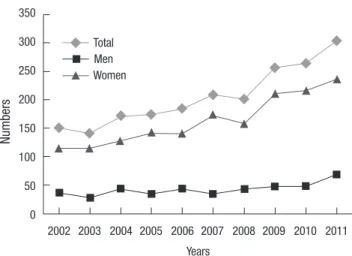
The annular number of hip fractures increased two-fold over the 10 yr of the study (151 in 2002 and 304 in 2011) (Fig. 1). The increase in the number of individuals older than 50 yr in the ge- neral population was 37.9% (120,022 in 2002 and 165,466 in 2011).
The crude incidence of hip fractures in the Jeju population aged 50 yr and older increased from 126.6/100,000 in 2002 (70.9/
100,000 in men and 167.9/100,000 in women) to 183.7/100,000 in 2011 (89.4/100,000 in men and 261.9/100,000 in women).
The standardized incidence of hip fracture to the general Korean population aged 50 yr and older increased from 102.8/100,000 in 2002 (71.2/100,000 in men and 129/100,000 in women) to 146.2/100,000 in 2011(86.7/100,000 in men and 197.9/100,000 in women) (Table 1). However, the standardized incidence of hip fracture in the general Korean population was lower than the crude incidence of hip fracture in the Jeju cohort .
In terms of the gender-specific distribution of hip fractures from 2002 to 2011, the increase in incidence of hip fracture of women (56%) was more than that of men (26.1%). The annual growth rate of hip fracture was 4.3% (5.3% in women and 2.2%
in men) during these 10 yr. The proportion of hip fracture inci- dence in the age-specific incidence for 10-yr age groups showed a similar pattern during the 10-yr study period. The mean age- specific incidence by 10-yr age groups increased from 18.1/
100,000 for those aged 50-59 yr to 1,052.5/100,000 for those ≥ 85 yr of age in women and 23.8/100,000 to 605.8/ 100,000 in men (Fig. 2). In terms of gender differences, although the hip frac-
Numbers
2002 2003 2004 2005 2006 2007 2008 2009 2010 2011 Years
350 300 250 200 150 100 50 0
Total Men Women
Fig. 1. Total numbers of hip fractures among persons ≥ 50 yr of age between 2002 and 2011.
Incidence (/100,000)
50-59 60-69 70-79 80-
Age (yr) 1,200
1,000 800 600 400 200 0
Total Men Women
Fig. 2. Age and gender-specific mean incidences of hip fractures during study periods.
Table 2. Age-adjusted incidence (per 100,000) of osteoporosis-related fractures over 50 yr old in different population
Author Region Study periods Men Women
Falch et al. (23) Norway 1988-1989 382 885
Lippuner et al. (24) Switzerland 2000 235 576
Ho et al. (25) USA 1988-1989 204 535
Sanders et al. (26) Australia 1996 193 490
Balasegaram et al. (22) England 1997 177 488
Lau et al. (21) Hong kong 1997-1998 195 468
Hagino et al. (27) Japan 2006 128 413
Lau et al. (21) Singapore 1997-1998 154 395
Lau et al. (21) Thailand 1988-1989 112 241
Lau et al. (21) Malaysia 1997-1998 83 195
Current study Korea (Jeju island) 2002 101 194
Korea (Jeju island) 2011 114 278 Standardized to the US population in 2008.
Fig. 3. During study periods, 70-79 age group in man (A) and over the eighty group in woman (B) shows higher increasing incidence rate.
Incidence (/100,000)
2002 2003 2004 2005 2006 2007 2008 2009 2010 2011 700
600 500 400 300 200 100 0
50-59 60-69 70-79 80-
Incidence (/100,000)
2002 2003 2004 2005 2006 2007 2008 2009 2010 2011 1,400
1,200 1,000 800 600 400 200 0
50-59 60-69 70-79 80-
A B
ture rates of both genders increased substantially for those old- er than 70 yr, the incidence of hip fractures in women increased more rapidly (Fig. 2). In addition, 70-79 age group in man and over the eighty group in woman shows higher increasing inci- dence rate (Fig. 3A and B).
Poisson regression models showed a significant increasing trend of the incidence rate of hip fractures (P value < 0.001). The rate of increase was significant between the age groups (age-year
interaction with P value < 0.001). However, there was no gender difference (gender-year interaction with P value 0.096).
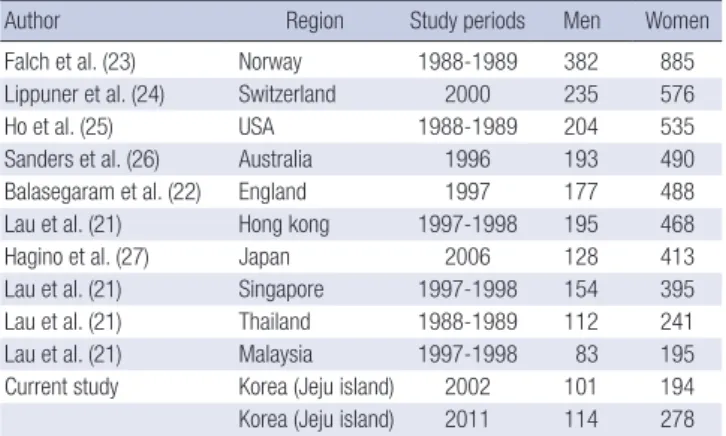
The fracture incidence in the population standardized to the 2008 population of the United States increased from 100.6/
100,000 for men and 194.4/100,000 for women in 2002 to 114.2/
100,000 for men and 278.4/100,000 for women in 2011 (Table 2).
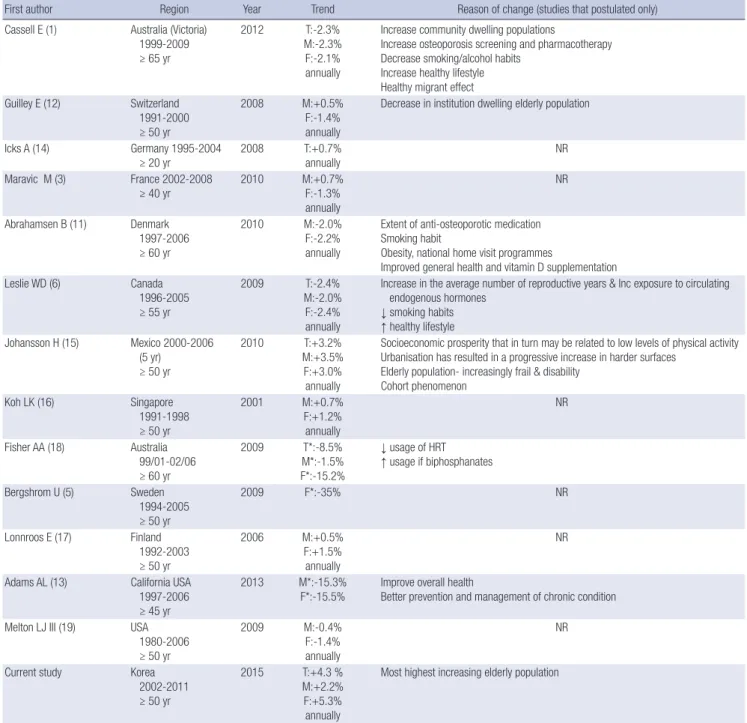
The annual increase in rate of hip fracture incidence was 4.3%
(5.3% in women and 2.2% in men) (Table 3).
Table 1. Age-adjusted incidence rate (per 100,000) of hip fractures among persons ≥ 50 yr of age from 2002 to 2011. Standardized to the Korean population
Year Population Fracture Rate
Total Men Women Total Men Women Total Men Women
2002 10,220,238 4,635,088 5,585,150 10,503 3,300 7,202 102.8 71.2 129.0
2003 10,575,719 4,807,627 5,768,092 9,653 2,355 7,298 91.3 49.0 126.5
2004 10,971,935 4,997,040 5,974,895 11,983 4,025 7,958 109.2 80.5 133.2
2005 11,430,579 5,217,928 6,212,651 12,151 3,081 9,070 106.3 59.0 146.0
2006 11,943,212 5,473,663 6,469,549 12,926 3,846 9,079 108.2 70.3 140.3
2007 12,479,694 5,741,961 6,737,733 14,309 3,051 11,258 114.7 53.1 167.1
2008 13,047,524 6,025,375 7,022,149 14,112 4,007 10,106 108.2 66.5 143.9
2009 13,644,741 6,320,453 7,324,288 17,841 4,233 13,608 130.8 67.0 185.7
2010 14,256,478 6,618,749 7,637,729 18,850 4,341 14,509 132.2 65.6 190.0
2011 14,865,850 6,914,708 7,951,142 21,729 5,993 15,736 146.2 86.7 197.9
Table 3. Studies of longitudinal trends since 2000
First author Region Year Trend Reason of change (studies that postulated only)
Cassell E (1) Australia (Victoria) 1999-2009 ≥ 65 yr
2012 T:-2.3%
M:-2.3%
F:-2.1%
annually
Increase community dwelling populations
Increase osteoporosis screening and pharmacotherapy Decrease smoking/alcohol habits
Increase healthy lifestyle Healthy migrant effect Guilley E (12) Switzerland
1991-2000 ≥ 50 yr
2008 M:+0.5%
F:-1.4%
annually
Decrease in institution dwelling elderly population
Icks A (14) Germany 1995-2004
≥ 20 yr
2008 T:+0.7%
annually
NR Maravic M (3) France 2002-2008
≥ 40 yr 2010 M:+0.7%
F:-1.3%
annually
NR
Abrahamsen B (11) Denmark 1997-2006 ≥ 60 yr
2010 M:-2.0%
F:-2.2%
annually
Extent of anti-osteoporotic medication Smoking habit
Obesity, national home visit programmes
Improved general health and vitamin D supplementation
Leslie WD (6) Canada
1996-2005 ≥ 55 yr
2009 T:-2.4%
M:-2.0%
F:-2.4%
annually
Increase in the average number of reproductive years & Inc exposure to circulating endogenous hormones
↓ smoking habits
↑ healthy lifestyle Johansson H (15) Mexico 2000-2006
(5 yr) ≥ 50 yr
2010 T:+3.2%
M:+3.5%
F:+3.0%
annually
Socioeconomic prosperity that in turn may be related to low levels of physical activity Urbanisation has resulted in a progressive increase in harder surfaces
Elderly population- increasingly frail & disability Cohort phenomenon
Koh LK (16) Singapore
1991-1998 ≥ 50 yr
2001 M:+0.7%
F:+1.2%
annually
NR
Fisher AA (18) Australia 99/01-02/06 ≥ 60 yr
2009 T*:-8.5%
M*:-1.5%
F*:-15.2%
↓ usage of HRT
↑ usage if biphosphanates Bergshrom U (5) Sweden
1994-2005 ≥ 50 yr
2009 F*:-35% NR
Lonnroos E (17) Finland 1992-2003 ≥ 50 yr
2006 M:+0.5%
F:+1.5%
annually
NR
Adams AL (13) California USA 1997-2006 ≥ 45 yr
2013 M*:-15.3%
F*:-15.5% Improve overall health
Better prevention and management of chronic condition Melton LJ III (19) USA
1980-2006 ≥ 50 yr
2009 M:-0.4%
F:-1.4%
annually
NR
Current study Korea
2002-2011 ≥ 50 yr
2015 T:+4.3 %
M:+2.2%
F:+5.3%
annually
Most highest increasing elderly population
*Total incidence change during study period. T, total population; M, male; F, female; NR, not reported; HRT, hormone replacement therapy.
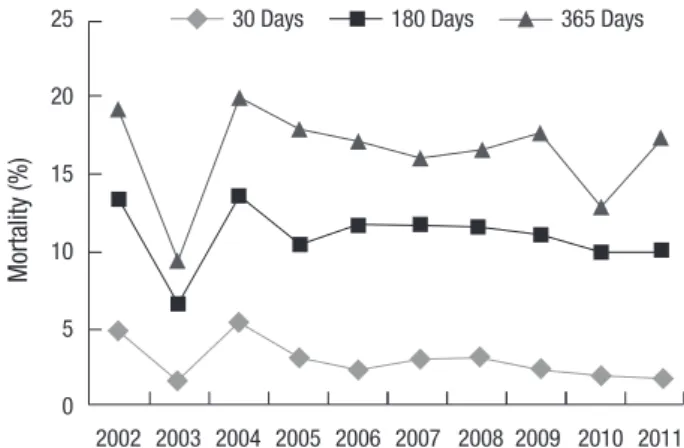
The mortality rate of hip fracture at 365 days was similar, 19.2%
in 2002 to 17.1% in 2011 (Fig. 3). The mean mortality rate at 30 days, 180 days, and 365 days were 2.7% (3.3% in men, 2.5% in women), 10.8% (12.9% in men, 10.3% in women), and 16.3%
(19.5% in men, 15.5% in women), respectively. Poisson regres- sion did not show significant trend in the (30/180/365-day) mor- tality rates for all age groups and both genders (Fig. 4).
DISCUSSION
The long-term change of incidence of hip fracture has been re-
ported since the 1990s. Studies conducted in Australia (1), Den- mark (12), Canada (6), Switzerland (13), USA (14), and Sweden (5) consistently reported a 1% to 3.5% of annual decrease in age- adjusted incidence rate of hip fracture in this decade. In contrast, Germany (15), Mexico (16), Singapore (17), and Finland (18) re- ported a 0.7% to 3.2% increase in age-adjusted hip fracture inci- dence rate in this decade. In this study, the trend of hip fracture exhibited a steep rise of up to 45% of age-adjusted hip fracture incidence rate during the study period with an average annual increase of 4.3%. To our knowledge, this finding is the highest incidence reported to date (3, 5, 6, 12, 13, 15-20) (Table 3).
Mortality (%)
2002 2003 2004 2005 2006 2007 2008 2009 2010 2011 25
20
15
10
5
0
30 Days 180 Days 365 Days
Fig. 4. A 30/180/365 days mortality rate of hip fractures among persons ≥ 50 yr of age between 2002 and 2011.
Suggested reasons for the decreasing trend of hip fracture in- cidence include a healthy life-style, drug therapy for osteoporo- sis, and fall prevention programs (6, 12-14, 19). The exact rea- sons are still unknown. The increasing trend of hip fractures in Mexico was attributed to a lower level of physical activity, ur- banization that has resulted in a progressive increase in harder surfaces, and an increasing elderly population (16). In our co- hort, the increasing trend of hip fractures might reflect the rate of the elderly population, which is the highest in the world. Ko- rea became an aging society (elderly population ≥ 7% of the to- tal population) in 2000. In 2018, Korea will become an aged so- ciety (defined as an elderly population ≥ 14% of the total popu- lation), and by 2026 will be a super-aged society (elderly popu- lation ≥ 20% of the total population).
The age group with the highest change in incidence of hip fractures has also been showing a specific trend (5, 16, 18, 21). In Mexico and Finland, the largest increase in the incidence of hip fractures is in those over 75 yr of age (16, 18). Bergstrom et al. re- ported an overall decrease in hip fracture rates in Sweden, but with the curve shifted towards the older portion of the popula- tion (5). The same authors reported a 114% increase in fracture incidence in women aged 90 yr or older over a 10-yr period. A similar trend was also reported by Dimai et al. (21). However, the trend was reversed in developed countries like Australia, Switzerland, France, and the US, where there was reduction in the incidence in the older age groups (3, 13, 19, 20). Our cohort showed a steep rise and shift in the fracture incidences of those
≥ 75 yr of age (Table 2) and 70-79 age group in man and over the eighty group in woman shows higher increasing incidence rate.
These findings are consistent with a country moving towards becoming an aged society.
The rate of hip fractures in Korea is similar to reports from population-based studies in South East Asia (Thailand and Ma- laysia) and Mexico (8, 22). However, in this study, the standard- ized incidence of hip fracture in 2011 was higher than that in Thailand and Malaysia (22). The incidence of hip fracture in
this cohort was still lower than the rates from other advanced Asian countries (Japan, Hong Kong, and Singapore), Norway, Australia, Switzerland, England, and the US (22-28).
In this study, mortality rate was not changed from 2002 to 2011. These findings are similar to another study. Chau et al. (9) performed post-fracture mortality analysis from 2001 to 2009 among the population aged 65 yr and over in Hong Kong. They reported no change in post-fracture mortality trends. Yoon et al.
(29) reported mortality rate following hip fracture using nation- wide claim data in Korea. They reported that crude mortality within 12 months after hip fracture showed a similar trend (18.8% in 2005 and 17.8% in 2007).
This study has several limitations. Firstly, study periods were not consistent compared to other regions. Although we stan- dardized all data for comparison, these data could not reflect recent incidence of hip fracture. Secondly, index age for gather- ing incidence of hip fracture was diverse and might have con- founded comparison of the incidence of hip fracture. Third, the population of the Jeju cohort was relatively small and contained a higher portion of elderly population (12.1% being ≥ 65 yr of age) than the general Korean population (10.9% being ≥ 65 yr of age). The crude incidence of hip fracture was higher than the age adjusted incidence of the general Korean population, as shown in Table 1. However, Jeju island that is isolated from main- land has unique advantage for hip fracture cohort study because patients with hip fracture have to visit hospitals in Jeju island and get permission for using airplane to transfer mainland. There- fore, we sure that incidence of hip fracture in this study is reli- able and representative. Finally, this study did not evaluate the cause of death. Although most deaths were related with aggra- vation of their comorbidities, deaths such as traffic accident and suicide are different causal factors and not related with hip fracture (30). Therefore, mortality following hip fracture in this study might be included deaths unrelated of hip fracture.
Our study showed a trend of steeply increasing hip fracture incidence in women. We have to start preparing nationwide strategies, and we have to establish preventive programs and guidelines to minimize complications after hip fracture to re- duce the socioeconomic burden.
DISCLOSURE
No benefits in any form have been received or will be received from a commercial party related directly or indirectly to the subject of this article.
AUTHOR CONTRIBUTION
Conception and coordination of the study: Ha YC, Kim SR. De- sign of ethical issues: Ha YC, Kim SR, Park YG, Nam KW. Acqui- sition of data: Park YG, Nam KW. Data review: Ha YC, Kim SR,
Park YG, Nam KW. Statistical analysis: Ha YC, Kim SR. Manu- script preparation: Ha YC, Kim SR, Park YG, Nam KW. Manu- script approval: all authors.
ORCID
Yong-Chan Ha http://orcid.org/0000-0002-6249-0581 Yong-Geun Park http://orcid.org/0000-0002-9156-1203 Kwang Woo Nam http://orcid.org/0000-0003-1096-149X Sang-Rim Kim http://orcid.org/0000-0001-5814-1031
REFERENCES
1. Cassell E, Clapperton A. A decreasing trend in fall-related hip fracture incidence in Victoria, Australia. Osteoporos Int 2013; 24: 99-109.
2. Giversen IM. Time trends of age-adjusted incidence rates of first hip fractures: a register-based study among older people in Viborg County, Denmark, 1987-1997. Osteoporos Int 2006; 17: 552-64.
3. Maravic M, Taupin P, Landais P, Roux C. Change in hip fracture inci- dence over the last 6 years in France. Osteoporos Int 2011; 22: 797-801.
4. Lofthus CM, Osnes EK, Falch JA, Kaastad TS, Kristiansen IS, Nords- letten L, Stensvold I, Meyer HE. Epidemiology of hip fractures in Oslo, Norway. Bone 2001; 29: 413-8.
5. Bergström U, Jonsson H, Gustafson Y, Pettersson U, Stenlund H, Svens- son O. The hip fracture incidence curve is shifting to the right. Acta Or- thop 2009; 80: 520-4.
6. Leslie WD, O’Donnell S, Jean S, Lagacé C, Walsh P, Bancej C, Morin S, Hanley DA, Papaioannou A; Osteoporosis Surveillance Expert Working Group. Trends in hip fracture rates in Canada. JAMA 2009; 302: 883-9.
7. Melton LJ 3rd, Atkinson EJ, Madhok R. Downturn in hip fracture inci- dence. Public Health Rep 1996; 111: 146-50; discussion 51.
8. Kim SR, Ha YC, Kim JR, Kim R, Kim SY, Koo KH. Incidence of hip frac- tures in Jeju Island, South Korea: a prospective study (2002-2006). Clin Orthop Surg 2010; 2: 64-8.
9. U.S. Census Bureau. United States Census 2010. Available at http://www.
census.gov/en.html [accessed on 2 November 2012].
10. Lewinnek GE, Kelsey J, White AA 3rd, Kreiger NJ. The significance and a comparative analysis of the epidemiology of hip fractures. Clin Orthop Relat Res 1980: 35-43.
11. Abrahamsen B, Vestergaard P. Declining incidence of hip fractures and the extent of use of anti-osteoporotic therapy in Denmark 1997-2006. Os- teoporos Int 2010; 21: 373-80.
12. Guilley E, Chevalley T, Herrmann F, Baccino D, Hoffmeyer P, Rapin CH, Rizzoli R. Reversal of the hip fracture secular trend is related to a decrease in the incidence in institution-dwelling elderly women. Osteoporos Int 2008; 19: 1741-7.
13. Adams AL, Shi J, Takayanagi M, Dell RM, Funahashi TT, Jacobsen SJ.
Ten-year hip fracture incidence rate trends in a large California popula- tion, 1997-2006. Osteoporos Int 2013; 24: 373-6.
14. Icks A, Haastert B, Wildner M, Becker C, Meyer G. Trend of hip fracture
incidence in Germany 1995-2004: a population-based study. Osteoporos Int 2008; 19: 1139-45.
15. Johansson H, Clark P, Carlos F, Oden A, McCloskey EV, Kanis JA. In- creasing age- and sex-specific rates of hip fracture in Mexico: a survey of the Mexican Institute of Social Security. Osteoporos Int 2011; 22: 2359-64.
16. Koh LK, Saw SM, Lee JJ, Leong KH, Lee J; National Working Committee on Osteoporosis. Hip fracture incidence rates in Singapore 1991-1998.
Osteoporos Int 2001; 12: 311-8.
17. Lönnroos E, Kautiainen H, Karppi P, Huusko T, Hartikainen S, Kiviranta I, Sulkava R. Increased incidence of hip fractures. A population based- study in Finland. Bone 2006; 39: 623-7.
18. Fisher AA, O’Brien ED, Davis MW. Trends in hip fracture epidemiology in Australia: possible impact of bisphosphonates and hormone replace- ment therapy. Bone 2009; 45: 246-53.
19. Melton LJ 3rd, Kearns AE, Atkinson EJ, Bolander ME, Achenbach SJ, Huddleston JM, Therneau TM, Leibson CL. Secular trends in hip frac- ture incidence and recurrence. Osteoporos Int 2009; 20: 687-94.
20. Dimai HP, Svedbom A, Fahrleitner-Pammer A, Pieber T, Resch H, Zwet- tler E, Chandran M, Borgström F. Epidemiology of hip fractures in Aus- tria: evidence for a change in the secular trend. Osteoporos Int 2011; 22:
685-92.
21. Lau EM, Lee JK, Suriwongpaisal P, Saw SM, Das De S, Khir A, Sambrook P. The incidence of hip fracture in four Asian countries: the Asian Osteo- porosis Study (AOS). Osteoporos Int 2001; 12: 239-43.
22. Balasegaram S, Majeed A, Fitz-Clarence H. Trends in hospital admis- sions for fractures of the hip and femur in England, 1989-1990 to 1997- 1998. J Public Health Med 2001; 23: 11-7.
23. Falch JA, Kaastad TS, Bøhler G, Espeland J, Sundsvold OJ. Secular in- crease and geographical differences in hip fracture incidence in Norway.
Bone 1993; 14: 643-5.
24. Lippuner K, Johansson H, Kanis JA, Rizzoli R. Remaining lifetime and absolute 10-year probabilities of osteoporotic fracture in Swiss men and women. Osteoporos Int 2009; 20: 1131-40.
25. Ho SC, Bacon WE, Harris T, Looker A, Maggi S. Hip fracture rates in Hong Kong and the United States, 1988 through 1989. Am J Public Health 1993; 83: 694-7.
26. Sanders KM, Seeman E, Ugoni AM, Pasco JA, Martin TJ, Skoric B, Nich- olson GC, Kotowicz MA. Age- and gender-specific rate of fractures in Australia: a population-based study. Osteoporos Int 1999; 10: 240-7.
27. Hagino H, Furukawa K, Fujiwara S, Okano T, Katagiri H, Yamamoto K, Teshima R. Recent trends in the incidence and lifetime risk of hip frac- ture in Tottori, Japan. Osteoporos Int 2009; 20: 543-8.
28. Chau PH, Wong M, Lee A, Ling M, Woo J. Trends in hip fracture inci- dence and mortality in Chinese population from Hong Kong 2001-09.
Age Ageing 2013; 42: 229-33.
29. Yoon HK, Park C, Jang S, Jang S, Lee YK, Ha YC. Incidence and mortality following hip fracture in Korea. J Korean Med Sci 2011; 26: 1087-92.
30. Lee SR, Ha YC, Kang H, Park YG, Nam KW, Kim SR. Morbidity and mor- tality in Jeju residents over 50-years of age with hip fracture with mean 6-year follow-up: a prospective cohort study. J Korean Med Sci 2013; 28:
1089-94.