This research was supported by the High Value-added Food Technology Development Program, Ministry of Agriculture, Food and Rural Affairs, South Korea.
Received: 18 June, 2016 Revised: 16 August, 2016 Accepted: 17 August, 2016
†Corresponding Author: Jae-Joon Lee Tel: +82-62-230-7725 E-mail: [email protected]
This is an Open-Access article distributed under the terms of the Creative Commons Attribution Non-Commercial License (http://creativecommons.org/licenses/by-nc/3.0) which permits unrestricted non-commercial use, distribution, and reproduction in any medium, provided the original work is properly cited.
Korean J Community Living Sci 27(3) : 437~449, 2016 http://dx.doi.org/10.7856/kjcls.2016.27.3.437
Bacillus subtilis
SN7이 생성한 조항균 물질의 단회 경구투여 독성 시험 및 4주 반복 경구투여 용량 결정 시험장 해 춘ㆍ고 상 범1)ㆍ이 재 준† 조선대학교 식품영양학과
한국화학융합시험연구원 헬스케어연구소1)
Single Oral Dose Toxicity Test and Four Weeks Repeated Oral Dose Determination Test of Crude Antifungal Compounds Produced by
Bacillus subtilis SN7 in Rats
Hae-Choon ChangㆍSang-Bum Koh1)ㆍJae-Joon Lee† Dept. of Food and Nutrition, Chosun University, Gwangju, Korea
Korea Testing & Research Institute, Health Care Research Laboratory, Hwasun, Korea1) 1)
ABSTRACT
To provide information on the safety of crude antifungal compounds produced by
Bacillus subtilus
SN7 isolated from Meju, we carried out an acute (single) oral dose toxicity test and 4 week repeated oral dose determination test on crude antifungal compounds in male and female Sprague Dawley rats. In the acute toxicity test, rats were treated with crude antifungal compounds produced byBacillus subtilus
SN7 orally at increasing dose levels (500, 1,000, and 2,000 mg/kg) and observed for 2 weeks. In the repeated-dose 28-day oral dose determination study, rats were orally administered doses of 500, 1,000, and 2,000 mg/kg daily for 4 weeks. There were no test article-related deaths or abnormal clinical signs in the two studies. In the 4 week repeated oral dose determination test, there were also no significant differences in clinical signs, body and organ weight changes, or any other hematological and biochemical parameters between the control and treated groups. The results suggest that the crude antifungal compounds produced byBacillus subtilus
SN7 up to a dosage level of 2,000 mg/kg are not toxic in male and female rats.Key words:
Bacillus subtilus
SN7, crude antifungal compounds, acute toxicity, safety, 4 week repeated dose determination, safetyI. 서론
콩 발효식품의 원료인 메주는 간장, 된장 및 고추 장 등 장류의 품질을 결정하는데 중요한 역할을 한 다. 콩을 삶아서 다양한 모양으로 빚은 메주는 띄워 말리는 동안 다양한 종류의 세균과 곰팡이류에 의해 발효되면서 이들 미생물이 생산하는 효소나 2차 대 사산물에 의하여 품질특성이 나타나게 된다(Lee et al. 2003; Kim et al. 2007). 그러나 이런 전통 콩 발 효식품들은 제조과정 중 혼입되는 독소생성 Bacillus cereus ( B . cereus )나 aflatoxin 생성 곰팡이의 오염 위험성이 문제점으로 지적되고 있다(Lee et al. 2016).
B . cereus 는 흙, 수중, 공기 등 자연계에 널리 분포하 는 세균의 일종으로 아포 형태로 존재하다가 식품에 오염되어 독소 물질을 생성하여 식중독을 유발할 수 있다(Schoeni & Wong 2005; Stenfors Arnesen et al. 2008). 따라서 식중독 원인 미생물과 관련한 안전 성을 확보하기 위하여 항균물질의 연구가 필요하다.
항균물질 중에서 bacteriocin은 여러 종의 미생물이 생산하는 천연 항균성 단백질(antimicrobial peptide)로 일반적으로 bacteriocin을 생산하는 미생물과 형태학 적 또는 계통학적으로 유사한 균종에 대하여 살균기 작을 갖는 물질을 의미한다(Tagg et al. 1976;
Cleveland et al. 2001). Bacteriocin은 인간 또는 동 물의 소화기관의 단백질 가수분해 효소에 의해 분해 되므로 인체에 무독하고 잔류성이 없어 식품에서 안 전한 천연보존제로 사용이 가능하다(Fuller 1989;
Friedman et al. 2000).
Bacillus 속은 식품 및 각종 발효산업에 중요한 균
주 중 하나이며, 다양한 효소와 항균활성 물질들을 생산하는 것으로 알려져 있다(Schallmey et al.
2004). Bacillus 속 중 B. subtilis , B. licheniformis , B. amyloliquefaciens , B. pumilus 은 European Food Safety Authority(EFSA)에 의해 “Qualified Presuaption of Safe(QPS)”로 인정되어 안전성이 확보 된 균주이 다. 또한 이 중 B. subtilis 는 Generally Regarded As Safe(GRAS) 미생물로 인정됨에 따라(Sharp et al.
1989) 생균제로의 이용이나, 이들이 생산하는 항균물 질을 이용한 천연 식품보존제의 개발은 차세대 천연 보존제 및 발효식품의 생물제어제로 활용 가능성이 매우 클 것으로 생각된다.
따라서 최근 발효식품들로부터 유해균 증식을 억 제하면서 식품의 품질은 향상시키는 균주를 분리하 고, 이들이 분비하는 항균물질을 정제하여 특성을 구 명하고 해당 균주나 항균물질을 식품보존에 응용하 려는 연구들이 이루어지고 있다. 발효식품으로부터 균주를 분리하여 안전성에 관한 연구로는 청국장에 서 분리한 항균활성이 우수한 B. subtilis JNS의 probiotics로서의 활용성을 검증하기 위한 단회경구 투여 독성시험 실험 결과 경구투여 시 ICR계 암수 마 우스에서 독성학적인 변화가 없었다고 보고하였다 (Kim et al. 2015). 된장에서 분리된 Bacillus sp.
A9184 균주의 암·수 Sprague-Dawley(SD) rat에서 의 급성독성 연구결과 마리당 10
8까지 투여하여도 체 중변화나 임상적인 이상 증상이 없어 안전하였다고 보고하였다(Lim et al. 2004). 또한 김치로부터 분 리·동정한 김치산막효모 억제 유산균인 Lactobacillus plantarum ( Lb. plantarum ) AF1이 생산하는 조항진균 물질의 흰쥐에 대한 4주간 반복투여 독성연구(Lee et al. 2013)와 김치에서 분리한 Lb. plantarum HD1과 Lb. plantarum AF1이 생성한 조항진균물질 부분 정 제물을 식품보존제로서 활용 가능성을 알아보기 위 한 안전성평가의 일환으로 단회투여 및 반복투여에 의한 독성시험(Chang et al. 2015) 연구가 안전하다 고 보고하였다. 이렇듯 이러한 물질들이 실제 식품에 적용 시에는 안전성이 검증되어야 하고 이의 식품 적 용 여부 가능성은 식품의약품안전처에서 승인을 받 아야 한다. 지금까지 Bacillus 속이나 이들이 생산하 는 물질인 항진균 물질에 관한 독성연구는 미비한 실 정이다.
따라서 본 연구는 전통 메주로부터 분리·동정하
여 B . cereus 에 항균활성을 가지며, bacteriocin을 생
산 할 수 있는 B. subtilis SN7이 생산하는 조항진균
물질 부분 정제물의 안전성 평가를 위해 SD 계열 흰
쥐에게 단회투여 독성시험 및 4주 반복투여 용량결 정 시험을 실시하여 사망률, 일반증상, 체중 및 식이 섭취량변화, 혈액학적 검사, 혈액생화학적 검사, 장기 중량, 부검에 대한 영향을 평가하였다.
II. 연구방법
1. 시험물질
시험 균주는 메주로부터 분리한 것으로 조선대학 교 식품영양학과 식품미생물실험실에서 B . cereus 에 항균활성을 가지며, bacteriocin을 생산 할 수 있는 B. subtilis SN7을 선별하여 이들이 생산한 조항진균 물질을 사용하였다(Lee 2014). TSB(Difco Laboratories, Detroit, MI, USA) 5 mL 액체배지에 분리균주 1%를 접종하여 37℃에서 12시간 진탕상태에서 전 배양을 실시한 후, TSB 50 mL 액체 배지에 전배양액 1%을 접종하여 37℃에서 24시간 동안 본 배양을 실시하였 다. 본 배양액을 원심분리(9,950×g, 15 min, 4℃)하 여 상징액을 취한 후, 상징액은 0.20 μm membrane filter로 제균하였으며, 배양 상징액으로 부터 아래와 같이 조항진균 물질을 정제하였다.
2. 조항진균 물질의 정제
제균 된 상징액은 50% aqueous acetonitrile (HPLC- grade, Fisher Scientific, Fair Lawn, NJ, USA)에 녹여 0.20 μm syringe filter를 통해 여과한 다음 preparative LC 9104 HPLC system(Japan Analytical Indusry, Tokyo, Japan)으로 분리하였다. 칼럼과 detector는 JAIGEL-W gel permeation chromatography column (W252, 20x500 mm, Japan Analytical Industry)와 3702 UV detector(Japan Analytical Industry)를 사용 하였다. 시료는 Speed vaccum concentrator(CentraVac VS-802, Vision Co., Speed, Seoul, Korea)를 이용하 여 용매를 제거한 후 정제 시료로 사용하였다.
3. 실험동물
실험동물은 특정병원체 부재(SPF) 상태의 SD 계통
의 5주령 암·수 흰쥐를 중앙실험동물(주)(Seoul, Korea)에서 구입하였다. GLP 연구기관인 한국화학 융합시험연구원 헬스케어 연구소(Hwasun, Jeonnam, Korea)의 동물사육실에서 1주일 적응기간 동안 임상 관찰 등을 시행하여 건강하면서 정상적인 실험동물 만 시험에 사용하였다. 체중 범위에 따른 무작위법을 이용하여 암·수 각각 20마리의 실험동물을 투여 용 량별로 5마리씩 실험군으로 분리하였다. 시험동물의 사육실은 온도 23 ± 2℃, 습도 50 ± 5%, 환기 횟수 10~18회/시간, 형광등 명암 12시간 주기, 조도 300~500 Lux로 조절하였으며, 폴리카보네이트 사육 상자(220 W × 270 L × 130 H mm) 케이지에서 사육 하였다. 사료는 멸균된 Laddiet 5L79(Laddiet, NJ, USA)를, 음수는 R/O수를 UV살균하여 자유롭게 공급 하였다. 두 시험 모두 동물보호법에 근거한 한국화학 융합시험연구원 헬스케어연구소 동물실험윤리위원회 의 심의를 받아 동물실험윤리위원회의 규정에 따라 실시하였다(승인번호: 단회 경구투여 독성시험 IAC2015- 0253, 4주 반복 경구투여 용량결정시험 IAC2015- 0163).
4. 단회투여(급성) 용량 증가 독성시험
단회투여 용량은 시험물질 투여 전 12시간 절식시 킨 후, 체중을 측정한 다음 예비시험결과를 토대로 독성징후가 관찰되지 않았던 용량을 사용하였는데, 이는 식품의약품안전처 독성시험기준(KFDA, 2009a, 2009b)에 따라 설정한 급성독성시험 허용 한계 용량 인 2,000 mg/kg/day을 최고 용량군으로 설정하였다.
용량 설정은 공비를 2로 두어 체중 kg 당 2,000,
1,000 및 500 mg으로 고용량, 중용량, 저용량으로 실
시하였다. 시험물질은 멸균증류수로 희석하였으며,
대조군은 멸균증류수만을 투여하였다. 투여량은 당
일 체중을 기준으로 매일 일정한 시간대(오전 10시)
에 체중 kg당 10 mL를 경구투여용 존데를 정착한 주
사관을 이용하여 위내에 직접 투여하였다. 시험물질
투여 일에는 2시간 동안 사료의 섭취를 제한하였으
며, 음수는 전 시험기간 동안 제한 없이 계속 공급하
였다. 모든 실험동물의 체중 변화 관찰은 시험물질 투여 개시일, 7일, 14일 째에 각각 측정하였다. 실험 동물의 관찰은 시험물질 투여 후 30분 이내는 1회 이 상, 투여 후 6시간 이내는 매시간, 투여 후 1일부터는 매일 1회 이상씩 빈사 및 사망동물을 관찰하였고, 일 반 상태의 변화, 중독증상의 발현 등 임상증상을 관 찰하였다. 시험물질 투여 후 14일째에 CO
2를 이용하 여 마취시키고, 방혈시킨 후에 부검하여 주요 내부 장기들의 이상 유무를 검사하였다.
4. 4주 반복투여 용량 결정시험
4주 반복투여 용량 결정시험의 농도 설정은 본 시 험에 대한 단회투여 예비시험 결과, 암수 모두 2,000 mg/kg 용량에서 시험물질에 대한 독성이 없음이 관 찰되었고, 일반적으로 시험물질의 반복투여 용량은 OECD Guideline(OECD 2001)에 따라 최고 농도인 2,000 mg/kg/day를 고용량으로 사용하기 때문에 단 회투여 용량 설정과 마찬가지로 용량 설정은 공비를 2로 두어 체중 kg 당 2,000, 1,000 및 500 mg으로 고 용량, 중용량, 저용량으로 실시하였다. 시험물질의 투여는 투여 당일 날 제조하여 잘 현탁한 후, 매일 오 전 일정한 시간대에 바로 투여하였으며, 투여 횟수는 1일 1회 4주간 실시하였다.
5. 반복투여 시험의 일반증상 및 사망동물의 관찰
시험물질 경구투여 당일은 6시간까지는 매시간 시 험물질 투여로 인하여 나타날 가능성이 있는 증상에 대하여 주의하여 관찰하였다. 투여 다음날부터 1일 1 회 모든 실험동물에 대하여 일정한 시간에 일반증상 의 변화(Lorke 1983)와 중독 발현, 사망과 빈사동물 의 유무를 관찰하였다.
6. 반복투여 시험의 체중변화 및 사료섭취량 측정
모든 동물에 대하여 시험물질 투여 개시 일, 시험 기간 중에는 매주 1회, 부검일(절식 체중)의 체중을 측정하였다. 사료섭취량은 매주 1회 측정하여 1일 평 균섭취량으로 계산하였다.
7. 반복투여 시험의 부검 및 장기 중량 측정
시료물질 투여 개시 후 4주까지 모두 생존한 동물 은 12시간 이상 절식시킨 다음 isoflurane으로 마취 시킨 후 복대동맥으로부터 채혈하고 안락사 시켰다.
부검하여 모든 장기에 대하여 육안적 검사를 실시하 였으며, 뇌, 폐, 흉선, 비장, 심장, 간, 신장, 부신, 전 립선, 부고환, 고환, 난소 및 자궁을 적출하여 습중량 (wet weight)을 측정하였고, 절식 체중에 대한 상대 장기 중량비를 산출하였다.
8. 반복투여 시험의 혈액학적 검사
12시간 절식시킨 실험동물의 혈액학적 검사는 부 검 당일 채취한 혈액 1 mL를 EDTA 시험관(EDTA 2K, BD vacutainer)에 채취하여 혈구분석기(ADVIA, 120E, Seimens, USA)로 측정하였다. 검사항목으로는 백혈구수, 적혈구수, 헤모글로빈 함량, 헤마토크리트 치, 평균 적혈구 용적, 평균 적혈구 혈색소량, 평균 적혈구 혈색소 농도, 망상적혈구수, 혈소판, 호중구, 호산구, 호염기구, 림프구 및 단핵구를 측정하였다.
혈액응고시간은 vacutainer tube(9NC sodium citrate, BD vacutainer, NJ, USA)에 혈액을 채취하여 원심분 리(3000 rpm, 4℃, 10분)하여 혈장을 분리하여 혈액 응고분석기(ACL 7000, Instrumentation Laboratory, NY, USA)로 측정하였다.
9. 반복투여 시험의 혈액 생화학적 검사
부검 당일 채혈한 혈액 중 일부를 3,000 rpm(4℃)
으로 20분간 원심분리하여 혈청을 취하여 혈액생화
학 자동분석기(Hitachi-747, Hitachi Medical., Tokyo,
Japan)로 검사항목은 alkaline phosphatase(ALP),
aspartate aminotransferase(AST), alanine aminotransferase
(ALT), glucose(GLU), blood urea nitrogen(BUN),
total cholesterol(TC), triglyceride(TG), total protein
(TP), albumin, albuminglobulin ratio(A/G), total
bilirubin(T-BIL), creatinine(CREA), 칼슘(Ca), 무기인
(IP), 나트륨(Na), 칼륨(K) 및 염소(Cl)를 측정하였다.
10. 통계처리
자료들에 대한 통계분석은 SPSS 19.0 P/C package 를 이용하여 수행하였으며, 모든 시험값들은 평균과 표준편차로 나타내었다. 단회투여 독성시험은 Levene’s test를 통해 등분산 검정을 실시한 후, one-way ANOVA에 의하여 각 군 간의 유의성을 조사하였다. 4 주 반복투여 독성시험은 체중, 장기 중량, 시료섭취량, 혈액학적 검사 및 혈액생화학적 검사의 자료에 대하여 one-way ANOVA를 실시하여 유의성을 조사하였다.
III. 결과 및 고찰
1. 단회투여(급성) 용량증가 독성평가
B. subtilis SN7이 생산한 조항진균 물질 부분 정 제물을 저, 중, 고용량(500, 1,000 및 2,000 mg/kg)으 로 흰쥐에게 단회 경구투여한 후 14일간 관찰한 결과 는 Table 1과 같다. Table 1에서와 같이 시험물질 투 여로 의한 사망동물 및 이상소견은 관찰되지 않았다.
OECD guideline에 따르면 시험물질의 농도가 2,000 mg/kg 일 때 사망 개체가 없는 경우 무독성하다고 인정해주므로 본 실험에서 사용한 B. subtilis SN7이 생산한 조항진균 물질 부분 정제물의 안전성을 확인 할 수 있었다. 독성 유무를 판단할 수 있는 중요 지표 인 체중 변화는 Table 2와 같이 경구투여 후 개시 체
중에 비하여 체중이 증가하였으며, 실험군 간의 유의 적인 체중 변화는 관찰되지 않았다. 부검 결과도 시 험물질 투여로 인한 이상소견이 관찰되지 않았다.
Kim et al.(2015)은 청국장에서 분리한 항균활성이 우수한 고초균인 B. subtilis JNS가 probiotices으로의 활용 가능성을 알아보기 위하여 ICR계 암·수 마우 스에 단회 경구투여 결과 사망례가 관찰되지 않았으 며, 일반증상, 임상증상 및 이상적 소견 등이 보이지 않았다고 보고하여 본 연구결과와 비슷한 경향이였 다. Kim et al.(2015)의 연구와 본 연구의 차이점은 고초균인 B. subtilis SN7 자체의 독성을 검사한 것이 아니라 B. subtilis SN7이 생성한 조항진균 물질의 독 성검사를 실시한 것이다.
2. 4주 반복 경구투여 용량 결정시험의 사망률, 일반증상, 체중변화 및 사료섭취량
B. subtilis SN7이 생산한 조항진균 물질 부분 정 제물을 저, 중, 고용량(500, 1,000 및 2,000 mg/kg)으 로 흰쥐에게 4주 반복 경구투여한 후 매일 일정한 시 간에 사망률, 일반증상을 관찰한 결과, 암·수 모든 시험군에서 사망례가 관찰되지 않았다. 또한 일반증 상 관찰 결과, 시험 전 기간 동안 암·수 흰쥐 모든 시험군에서 특이적인 이상증상도 관찰되지 않았다.
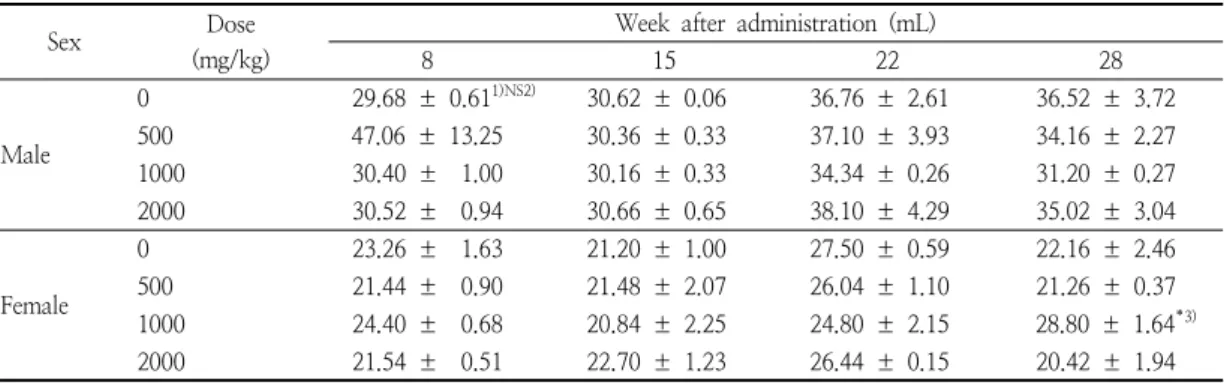
체중변화는 Table 3와 같이 정상적인 체중 증가가 관 찰되었으며, 전 시험기간 동안 실험군 간의 유의적인 체중변화는 관찰되지 않았다. 사료섭취량의 경우 Table 4와 같이 수컷에서는 대조군과 시험물질 투여 군 간의 유의적 차이가 관찰되지 않았으나, 암컷에서 는 투여 4주차에 중용량군(1,000 mg/kg)이 대조군에 비해 유의하게 증가하였으나 정상 범위내의 변화로 추정된다. Chang et al.(2015)은 김치 유산균인 Lb.
plantarum AF1와 Lb. plantarum HD1이 생산하는 조 항진균 물질의 부분 정제물을 동량으로 섞어서 4주 동안 반복 경구투여 실험결과 암·수 흰쥐 모두 대조 군을 포함한 시험물질 투여군에서도 사망례, 체중변 화 및 일반증상 등 특이적 이상증상이 발견되지 않았 다고 보고하였다.
Sex Dose
(mg/kg B.W.) Mortality Clinical signs
Male
0 0% (0/5) NAD1)
500 0% (0/5) NAD
1000 0% (0/5) NAD
2000 0% (0/5) NAD
Female
0 0% (0/5) NAD
500 0% (0/5) NAD
1000 0% (0/5) NAD
2000 0% (0/5) NAD
1) NAD: No Abnormality Detected.
Table 1. Mortality and clinical signs in male and female rats treated orally with crude antifungal compounds produced by
Bacillus
subtilis
SN7 for 2 weeksSex Dose (mg/kg B.W.)
Days after administration (g)
0 7 14
Male
0 176.4 ± 4.41)NS2) 267.2 ± 9.3 314.9 ± 13.1
500 176.6 ± 5.1 258.9 ± 16.9 299.1 ± 29.4
1000 174.2 ± 4.9 258.4 ± 11.5 302.2 ± 14.5
2000 173.1 ± 7.0 260.0 ± 6.6 303.1 ± 12.2
Female
0 137.2 ± 6.2 190.1 ± 10.4 211.4 ± 15.0
500 140.3 ± 5.1 191.3 ± 7.1 210.4 ± 9.1
1000 141.5 ± 7.6 194.4 ± 17.2 217.0 ± 20.5
2000 139.2 ± 5.9 196.0 ± 5.2 214.7 ± 4.3
1) Values are expressed as means ± SD (n=5)
2) NS: not significantly different among groups.
Table 2. Body weight changes in male and female rats treated orally with crude antifungal compounds produced by
Bacillus subtilis
SN7 for 2 weeksSex Dose
(mg/kg)
Days after administration (g)
1 2 3 4
Male
0 262.6 ± 12.31)NS2) 322.2 ± 18.9 368.7 ± 25.2 402.6 ± 27.1
500 268.8 ± 12.4 330.4 ± 21.5 374.3 ± 32.2 404.0 ± 35.8
1000 263.0 ± 12.3 318.8 ± 20.6 356.4 ± 24.6 378.8 ± 24.4
2000 265.8 ± 13.1 325.9 ± 26.8 371.8 ± 37.7 404.2 ± 45.3
Female
0 178.3 ± 17.5 206.7 ± 15.5 226.3 ± 16.2 238.1 ± 13.5
500 179.7 ± 11.4 205.7 ± 15.0 230.0 ± 17.4 240.7 ± 16.4
1000 184.1 ± 9.5 211.7 ± 17.5 234.6 ± 21.0 245.8 ± 24.5
2000 175.6 ± 9.2 205.4 ± 7.7 225.0 ± 6.9 236.4 ± 10.2
1) Values are expressed as means ± SD (n=5)
2) NS: not significantly different among groups.
Table 3. Body weight changes in male and female rats treated orally with crude antifungal compounds produced by
Bacillus subtilis
SN7 for 4 weeksSex Dose
(mg/kg)
Week after administration (mL)
8 15 22 28
Male
0 29.68 ± 0.611)NS2) 30.62 ± 0.06 36.76 ± 2.61 36.52 ± 3.72
500 47.06 ± 13.25 30.36 ± 0.33 37.10 ± 3.93 34.16 ± 2.27
1000 30.40 ± 1.00 30.16 ± 0.33 34.34 ± 0.26 31.20 ± 0.27
2000 30.52 ± 0.94 30.66 ± 0.65 38.10 ± 4.29 35.02 ± 3.04
Female
0 23.26 ± 1.63 21.20 ± 1.00 27.50 ± 0.59 22.16 ± 2.46
500 21.44 ± 0.90 21.48 ± 2.07 26.04 ± 1.10 21.26 ± 0.37
1000 24.40 ± 0.68 20.84 ± 2.25 24.80 ± 2.15 28.80 ± 1.64*3)
2000 21.54 ± 0.51 22.70 ± 1.23 26.44 ± 0.15 20.42 ± 1.94
1) Values are expressed as means ± SD (n=5).
2) NS: not significantly different among groups.
3) Statistically significant from control (*p<0.05).
Table 4. Food consumption in male and female rats treated orally with crude antifungal compounds produced by
Bacillus subtilis
SN7 for 4 weeks3. 4주 반복 경구투여 용량 결정시험의 부검소견 B. subtilis SN7이 생산한 조항진균 물질 부분 정 제물을 저, 중, 고용량(500, 1,000 및 2,000 mg/kg)으 로 흰쥐에게 4주 반복 경구투여한 후 부검하여 외관 및 주요 장기에 대한 육안적 소견을 관찰한 결과는 Table 5와 같다. 암수투여군 모두 시험물질 투여로 인한 이상소견이 관찰되지 않았다.
Sex Dose
(mg/kg B.W.)
Necropsy finding Extrenal Internal
Male
0 NAD1) NAD
500 NAD NAD
1000 NAD NAD
2000 NAD NAD
Female
0 NAD NAD
500 NAD NAD
1000 NAD NAD
2000 NAD NAD
1) NAD: No Abnormality Detected.
Table 5. Necropsy findingsin male and female rats treated orally with crude antifungal compounds produced by Bacillus subtilis SN7 for 4 weeks
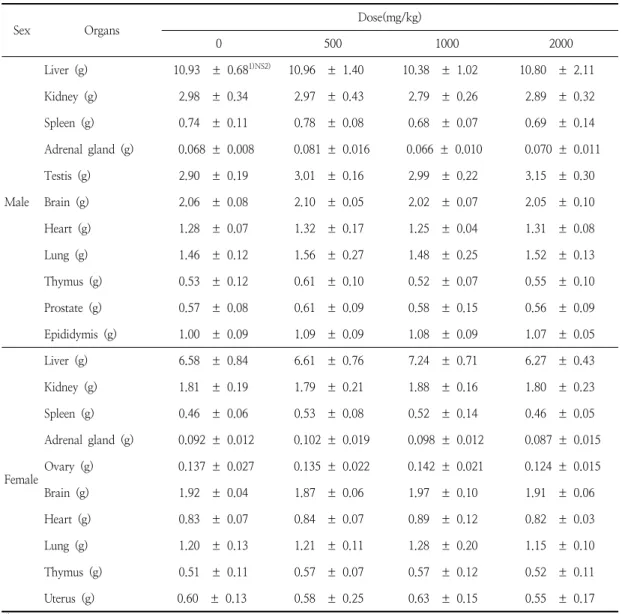
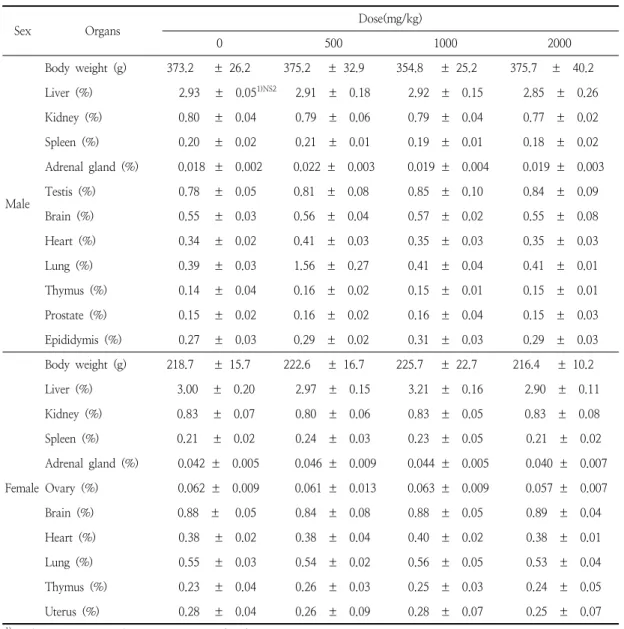
4. 4주 반복 경구투여 용량 결정시험의 장기 중량 변화 Table 6과 Table 7은 B. subtilis SN7이 생산한 조 항진균 물질 부분 정제물을 투여한 장기 절대중량 (absolute weight) 혹은 상대중량(relative wight)을 각각 나타낸 것이다. 암수투여군 모두 시험물질 투여 에 따른 유의한 차이가 나타나지 않았으며, 투여 용 량에 따른 이상 변화도 보이지 않았다. Lee et al.
(2010)에 의하면 독소가 들어있는 음식을 섭취하게 되면 해독기관인 간이 가장 큰 영향을 받는다고 보고 하였는데, 본 연구 결과 간의 무게는 실험군 간에 유 의할 만한 차이가 나타나지 않았다. 이러한 결과는 B. subtilis SN7 이 생산한 조항진균 물질 부분 정제 물의 투여는 장기무게의 변화에 영향을 미치지 않는 것으로 사료된다.
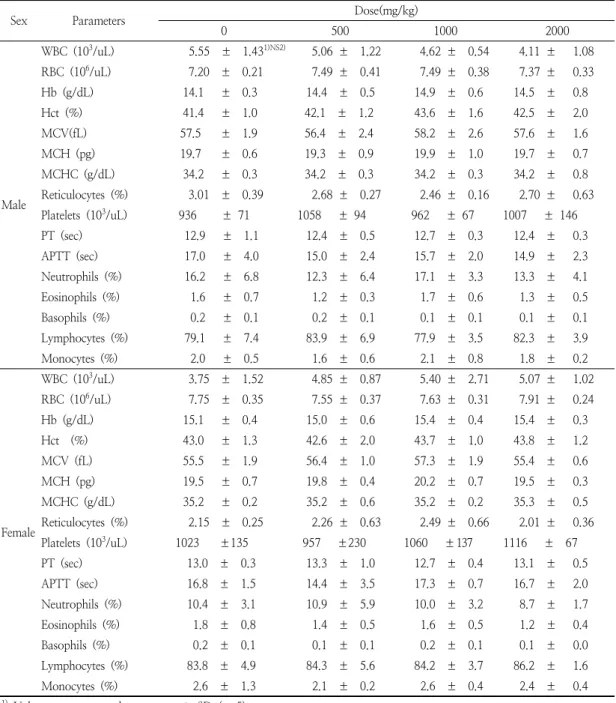
5. 4주 반복 경구투여 용량 결정시험의 혈액학적 검사
Table 8은 B. subtilis SN7이 생산한 조항진균 물 질 부분 정제물을 투여한 암컷 및 수컷 SD 흰쥐에 대 한 혈액학적 검사 결과이다. 암·수컷 흰쥐 모두 혈액 측정 지표인 백혈구수(white blood cells, WBC), 적혈 구수(erythrocyte count, RBC), 혈색소량(hemoglobin, Hb), 헤마토크리트치(hematocrit, HCT), 평균 적혈구 용적(mean corpuscular volume, MCV), 평균 적혈구 혈색소량(mean corpuscular hemoglobin, MCH), 평균 적혈구 혈색소 농도(mean corpuscular hemoglobin concentration, MCHC), 망상적혈구수(reticulocytes), 혈소판(platelets), 프로트롬빈 시간(prothrombin time, PT), 활성화 부분 트롬보플라스틴 시간(activated partial htromboplastin time, APTT), 호중구(neutrophils), 호산구 (eosinophils), 호염기구(basophils), 림프구(lymphocytes) 및 단핵구(monocytes)의 수치가 시험물질 투여군과 대 조군 간에 유의한 차이가 없었으며, 용량 의존성도 나타 나지 않았다. 모든 실험군의 혈액학적 측정 수치는 정 상 범위(Kang et al. 2004)에 속하였다.
6. 4주 반복 경구투여 용량 결정시험의 혈액생화 학적 검사
Table 8은 B. subtilis SN7이 생산한 조항진균 물 질 부분 정제물 500, 1,000 및 2,000 mg/kg을 흰쥐에 게 4주 반복 경구투여한 후, 복대정맥 혈액으로부터 분리한 혈장으로부터 혈액생화학적 지표를 분석한 결과이다. 혈청 중 ALP, AST, ALT, 포도당, 요소, 총 콜레스테롤, 중성지질, 총 단백질, 알부민, 알부민/글 로불린 비, 총 빌리루빈, 크레아티닌, 칼슘, 무기인, 나트륨, 칼륨 및 염소 등의 수치는 암·수컷 흰쥐 모 두 대조군과 시험물질 투여군 간에 유의성 있는 변화 가 관찰되지 않았다. 대조군과 시험물질 투여군 모두 혈액생화학적 검사 결과 정상 범위(Wolford et al.
1986)에 속하였으며, 용량 의존성도 보이지 않아 독
성학적인 의미는 없었다.
Sex Organs Dose(mg/kg)
0 500 1000 2000
Male
Liver (g) 10.93 ± 0.681)NS2) 10.96 ± 1.40 10.38 ± 1.02 10.80 ± 2.11 Kidney (g) 2.98 ± 0.34 2.97 ± 0.43 2.79 ± 0.26 2.89 ± 0.32 Spleen (g) 0.74 ± 0.11 0.78 ± 0.08 0.68 ± 0.07 0.69 ± 0.14 Adrenal gland (g) 0.068 ± 0.008 0.081 ± 0.016 0.066 ± 0.010 0.070 ± 0.011 Testis (g) 2.90 ± 0.19 3.01 ± 0.16 2.99 ± 0.22 3.15 ± 0.30 Brain (g) 2.06 ± 0.08 2.10 ± 0.05 2.02 ± 0.07 2.05 ± 0.10 Heart (g) 1.28 ± 0.07 1.32 ± 0.17 1.25 ± 0.04 1.31 ± 0.08 Lung (g) 1.46 ± 0.12 1.56 ± 0.27 1.48 ± 0.25 1.52 ± 0.13 Thymus (g) 0.53 ± 0.12 0.61 ± 0.10 0.52 ± 0.07 0.55 ± 0.10 Prostate (g) 0.57 ± 0.08 0.61 ± 0.09 0.58 ± 0.15 0.56 ± 0.09 Epididymis (g) 1.00 ± 0.09 1.09 ± 0.09 1.08 ± 0.09 1.07 ± 0.05
Female
Liver (g) 6.58 ± 0.84 6.61 ± 0.76 7.24 ± 0.71 6.27 ± 0.43 Kidney (g) 1.81 ± 0.19 1.79 ± 0.21 1.88 ± 0.16 1.80 ± 0.23 Spleen (g) 0.46 ± 0.06 0.53 ± 0.08 0.52 ± 0.14 0.46 ± 0.05 Adrenal gland (g) 0.092 ± 0.012 0.102 ± 0.019 0.098 ± 0.012 0.087 ± 0.015 Ovary (g) 0.137 ± 0.027 0.135 ± 0.022 0.142 ± 0.021 0.124 ± 0.015 Brain (g) 1.92 ± 0.04 1.87 ± 0.06 1.97 ± 0.10 1.91 ± 0.06 Heart (g) 0.83 ± 0.07 0.84 ± 0.07 0.89 ± 0.12 0.82 ± 0.03 Lung (g) 1.20 ± 0.13 1.21 ± 0.11 1.28 ± 0.20 1.15 ± 0.10 Thymus (g) 0.51 ± 0.11 0.57 ± 0.07 0.57 ± 0.12 0.52 ± 0.11 Uterus (g) 0.60 ± 0.13 0.58 ± 0.25 0.63 ± 0.15 0.55 ± 0.17
1) Values are expressed as means ± SD (n=5).
2) NS: not significantly different among groups.
Table 6. Organ weights of male and female rats treated orally with crude antifungal compounds produced by
Bacillus subtilis
SN7 for 4 weeksSex Organs Dose(mg/kg)
0 500 1000 2000
Male
Body weight (g) 373.2 ± 26.2 375.2 ± 32.9 354.8 ± 25.2 375.7 ± 40.2 Liver (%) 2.93 ± 0.051)NS2) 2.91 ± 0.18 2.92 ± 0.15 2.85 ± 0.26 Kidney (%) 0.80 ± 0.04 0.79 ± 0.06 0.79 ± 0.04 0.77 ± 0.02 Spleen (%) 0.20 ± 0.02 0.21 ± 0.01 0.19 ± 0.01 0.18 ± 0.02 Adrenal gland (%) 0.018 ± 0.002 0.022 ± 0.003 0.019 ± 0.004 0.019 ± 0.003 Testis (%) 0.78 ± 0.05 0.81 ± 0.08 0.85 ± 0.10 0.84 ± 0.09 Brain (%) 0.55 ± 0.03 0.56 ± 0.04 0.57 ± 0.02 0.55 ± 0.08 Heart (%) 0.34 ± 0.02 0.41 ± 0.03 0.35 ± 0.03 0.35 ± 0.03 Lung (%) 0.39 ± 0.03 1.56 ± 0.27 0.41 ± 0.04 0.41 ± 0.01 Thymus (%) 0.14 ± 0.04 0.16 ± 0.02 0.15 ± 0.01 0.15 ± 0.01 Prostate (%) 0.15 ± 0.02 0.16 ± 0.02 0.16 ± 0.04 0.15 ± 0.03 Epididymis (%) 0.27 ± 0.03 0.29 ± 0.02 0.31 ± 0.03 0.29 ± 0.03
Female
Body weight (g) 218.7 ± 15.7 222.6 ± 16.7 225.7 ± 22.7 216.4 ± 10.2 Liver (%) 3.00 ± 0.20 2.97 ± 0.15 3.21 ± 0.16 2.90 ± 0.11 Kidney (%) 0.83 ± 0.07 0.80 ± 0.06 0.83 ± 0.05 0.83 ± 0.08 Spleen (%) 0.21 ± 0.02 0.24 ± 0.03 0.23 ± 0.05 0.21 ± 0.02 Adrenal gland (%) 0.042 ± 0.005 0.046 ± 0.009 0.044 ± 0.005 0.040 ± 0.007 Ovary (%) 0.062 ± 0.009 0.061 ± 0.013 0.063 ± 0.009 0.057 ± 0.007 Brain (%) 0.88 ± 0.05 0.84 ± 0.08 0.88 ± 0.05 0.89 ± 0.04 Heart (%) 0.38 ± 0.02 0.38 ± 0.04 0.40 ± 0.02 0.38 ± 0.01 Lung (%) 0.55 ± 0.03 0.54 ± 0.02 0.56 ± 0.05 0.53 ± 0.04 Thymus (%) 0.23 ± 0.04 0.26 ± 0.03 0.25 ± 0.03 0.24 ± 0.05 Uterus (%) 0.28 ± 0.04 0.26 ± 0.09 0.28 ± 0.07 0.25 ± 0.07
1) Values are expressed as means ± SD (n=5).
2) NS: not significantly different among groups.
Table 7. Relative organ weights ofmale and female rats treated orally with crude antifungal compounds produced by
Bacillus subtilis
SN7 for 4 weeksSex Parameters Dose(mg/kg)
0 500 1000 2000
Male
WBC (103/uL) 5.55 ± 1.431)NS2) 5.06 ± 1.22 4.62 ± 0.54 4.11 ± 1.08 RBC (106/uL) 7.20 ± 0.21 7.49 ± 0.41 7.49 ± 0.38 7.37 ± 0.33 Hb (g/dL) 14.1 ± 0.3 14.4 ± 0.5 14.9 ± 0.6 14.5 ± 0.8 Hct (%) 41.4 ± 1.0 42.1 ± 1.2 43.6 ± 1.6 42.5 ± 2.0 MCV(fL) 57.5 ± 1.9 56.4 ± 2.4 58.2 ± 2.6 57.6 ± 1.6 MCH (pg) 19.7 ± 0.6 19.3 ± 0.9 19.9 ± 1.0 19.7 ± 0.7 MCHC (g/dL) 34.2 ± 0.3 34.2 ± 0.3 34.2 ± 0.3 34.2 ± 0.8 Reticulocytes (%) 3.01 ± 0.39 2.68 ± 0.27 2.46 ± 0.16 2.70 ± 0.63 Platelets (103/uL) 936 ± 71 1058 ± 94 962 ± 67 1007 ± 146 PT (sec) 12.9 ± 1.1 12.4 ± 0.5 12.7 ± 0.3 12.4 ± 0.3 APTT (sec) 17.0 ± 4.0 15.0 ± 2.4 15.7 ± 2.0 14.9 ± 2.3 Neutrophils (%) 16.2 ± 6.8 12.3 ± 6.4 17.1 ± 3.3 13.3 ± 4.1 Eosinophils (%) 1.6 ± 0.7 1.2 ± 0.3 1.7 ± 0.6 1.3 ± 0.5 Basophils (%) 0.2 ± 0.1 0.2 ± 0.1 0.1 ± 0.1 0.1 ± 0.1 Lymphocytes (%) 79.1 ± 7.4 83.9 ± 6.9 77.9 ± 3.5 82.3 ± 3.9 Monocytes (%) 2.0 ± 0.5 1.6 ± 0.6 2.1 ± 0.8 1.8 ± 0.2
Female
WBC (103/uL) 3.75 ± 1.52 4.85 ± 0.87 5.40 ± 2.71 5.07 ± 1.02 RBC (106/uL) 7.75 ± 0.35 7.55 ± 0.37 7.63 ± 0.31 7.91 ± 0.24 Hb (g/dL) 15.1 ± 0.4 15.0 ± 0.6 15.4 ± 0.4 15.4 ± 0.3 Hct (%) 43.0 ± 1.3 42.6 ± 2.0 43.7 ± 1.0 43.8 ± 1.2 MCV (fL) 55.5 ± 1.9 56.4 ± 1.0 57.3 ± 1.9 55.4 ± 0.6 MCH (pg) 19.5 ± 0.7 19.8 ± 0.4 20.2 ± 0.7 19.5 ± 0.3 MCHC (g/dL) 35.2 ± 0.2 35.2 ± 0.6 35.2 ± 0.2 35.3 ± 0.5 Reticulocytes (%) 2.15 ± 0.25 2.26 ± 0.63 2.49 ± 0.66 2.01 ± 0.36 Platelets (103/uL) 1023 ± 135 957 ± 230 1060 ±137 1116 ± 67 PT (sec) 13.0 ± 0.3 13.3 ± 1.0 12.7 ± 0.4 13.1 ± 0.5 APTT (sec) 16.8 ± 1.5 14.4 ± 3.5 17.3 ± 0.7 16.7 ± 2.0 Neutrophils (%) 10.4 ± 3.1 10.9 ± 5.9 10.0 ± 3.2 8.7 ± 1.7 Eosinophils (%) 1.8 ± 0.8 1.4 ± 0.5 1.6 ± 0.5 1.2 ± 0.4 Basophils (%) 0.2 ± 0.1 0.1 ± 0.1 0.2 ± 0.1 0.1 ± 0.0 Lymphocytes (%) 83.8 ± 4.9 84.3 ± 5.6 84.2 ± 3.7 86.2 ± 1.6 Monocytes (%) 2.6 ± 1.3 2.1 ± 0.2 2.6 ± 0.4 2.4 ± 0.4
1) Values are expressed as means ± SD (n=5).
2) NS: not significantly different among groups.
Table 8. Hematology of male and female rats treated orally crude antifungal compounds produced by
Bacillus subtilis
SN7 for 4 weeksSex Parameters Dose(mg/kg)
0 500 1000 2000
Male
ALP (U/L) 675 ± 185 1)NS2) 690 ± 73 691 ± 118 534 ± 76 AST (U/L) 111 ± 26 114 ± 26 114 ± 23 115 ± 25
ALT(U/L) 33 ± 3 30 ± 5 30 ± 5 29 ± 1
GLU (mg/dL) 154 ± 13 159 ± 17 151 ± 10 150 ± 23 BUN (mg/dL) 12.2 ± 2.0 12.4 ± 3.1 12.5 ± 1.9 13.3 ± 1.6
TC (mg/dL) 61 ± 19 61 ± 15 52 ± 11 68 ± 10
TG (mg/dL) 24 ± 11 26 ± 22 34 ± 5 31 ± 13
TP (g/dL) 5.9 ± 0.2 5.8 ± 0.1 5.7 ± 0.2 5.8 ± 0.4 Albumin (mg/dL) 3.8 ± 0.1 3.8 ± 0.0 3.8 ± 0.1 3.8 ± 0.1
A/G 1.8 ± 0.1 1.9 ± 0.1 2.0 ± 0.1 1.9 ± 0.1
T-BIL (mg/dL) 0.03 ± 0.02 0.02 ± 0.01 0.02 ± 0.02 0.02 ± 0.01 CREA (mg/dL) 0.4 ± 0.1 0.5 ± 0.0 0.5 ± 0.1 0.5 ± 0.1 Ca (mg/dL) 9.0 ± 0.3 8.9 ± 0.4 8.0 ± 0.4* 8.2 ± 0.6 IP (mg/dL) 7.8 ± 0.8 7.4 ± 1.0 7.5 ± 0.4 7.3 ± 0.6 Na (mmol/L) 145.7 ± 0.7 146.6 ± 0.9 146.5 ± 1.4 145.9 ± 1.2 K (mmol/L) 4.35 ± 0.35 4.37 ± 0.35 4.32 ± 0.35 4.56 ± 0.34 Cl (mmol/L) 106.7 ± 1.2 106.8 ± 1.5 107.4 ± 1.0 106.4 ± 0.9
Female
ALP (U/L) 428 ± 80 436 ± 83 448 ± 88 388 ± 76
AST (U/L) 102 ± 16 102 ± 9 94 ± 26 92 ± 20
ALT (U/L) 21 ± 4 21 ± 4 21 ± 1 22 ± 2
GLU (mg/dL) 121 ± 14 124 ± 18 132 ± 11 130 ± 8 BUN (mg/dL) 15.2 ± 1.3 18.1 ± 4.4 15.4 ± 2.2 16.0 ± 1.6
TC (mg/dL) 51 ± 7 43 ± 12 58 ± 20 51 ± 10
TG (mg/dL) 14 ± 5 13 ± 7 14 ± 5 9 ± 3
TP (g/dL) 5.9 ± 0.2 6.0 ± 0.2 6.1 ± 0.1 6.0 ± 0.1 Albumin (mg/dL) 3.9 ± 0.1 4.0 ± 0.1 4.0 ± 0.1 3.9 ± 0.1
A/G 2.0 ± 0.1 2.0 ± 0.1 1.9 ± 0.1 1.9 ± 0.1
T-BIL (mg/dL) 0.03 ± 0.01 0.03 ± 0.02 0.04 ± 0.01 0.03 ± 0.02 CREA (mg/dL) 0.5 ± 0.0 0.6 ± 0.1 0.5 ± 0.1 0.5 ± 0.0 Ca (mg/dL) 8.6 ± 0.6 8.8 ± 0.6 8.8 ± 0.6 8.6 ± 0.5 IP (mg/dL) 7.3 ± 0.1 7.4 ± 0.4 7.2 ± 0.7 7.5 ± 0.3 Na (mmol/L) 144.9 ± 0.8 144.1 ± 1.2 144.8 ± 1.3 144.3 ± 0.4 K (mmol/L) 4.11 ± 0.22 4.05 ± 0.39 3.80 ± 0.07 4.04 ± 0.19 Cl (mmol/L) 105.1 ± 0.9 104.7 ± 1.3 106.1 ± 1.3 106.0 ± 1.4
1) Values are expressed as means ± SD (n=5).
2) NS: not significantly different among groups.
Table 9. Levels of serum biochemical indices in male and female rats treated orally with crude antifungal compounds produced by
Bacillus subtilis
SN7 for 4 weeksIV. 요약 및 결론
메주에서 분리한 항균활성을 가지며, bacteriocin 을 생산 할 수 있는 B. subtilis SN7이 생산하는 조항 진균 물질 부분 정제물의 안전성을 평가하고자 SD 계열 흰쥐에게 시험물질을 단회 경구투여와 4주 반 복 경구투여 용량 결정시험을 실시하였다. 조항진균 물질을 저, 중, 고용량(500, 1,000 및 2,000 mg/kg)으 로 단회 경구 투여한 결과, 시험물질 투여로 인한 사 망례가 관찰되지 않았으며, 체중변화, 일반증상, 임상 증상 및 육안적 소견 등에서 이상소견이 보이지 않아 안전성을 확인할 수 있었으며, 조항진균 물질에 대한 LD
50은 2,000 mg/kg 이상일 것으로 보여진다. 4주 반복 경구투여 용량 결정시험 결과도 모든 실험군 (500, 1,000 및 2,000 mg/kg)에서 사망동물 및 특이 한 임상증상이 관찰되지 않았다. 체중변화는 모든 실 험군에서 4주간 지속적으로 증가하였으나, 유의적인 체중변화는 없었다. 부검 후 장기의 육안적 소견, 장 기중량(상대 및 절대중량), 혈액학적 및 혈액생화학 적 검사에서도 시험물질 투여로 인한 독성학적인 변 화가 나타나지 않았으며, 모두 정상 범위에 속하였 다. 이상의 결과 시험물질인 B. subtilis SN7이 생산 하는 조항진균 물질의 부분 정제물은 단회 경구투여 혹은 4주 반복 경구투여 용량 결정시험에 의한 독성 평가 시 독성학적인 변화가 관찰되지 않았으며, 저독 성의 안전한 물질로 판정되었다. 본 결과는 이후 수 행하게 될 13주 실험에서의 용량 설정의 근거 자료로 사용될 수 있을 것이며, 13주 반복투여 독성시험에서 도 고용량은 2,000 mg/kg의 설정하는 것이 바람직하 다고 사료된다. 또한 B. subtilis SN7이 생산하는 조 항진균 물질의 부분 정제물은 여러 식품에서 천연보 존제 및 생물제어제로서 활용할 수 있는 후보물질로 사료된다.
References
Chang HC, Koh SB, Lee JJ(2015) Oral toxicity of crude antifungal compounds produced by Lactobacillus plantarum AF1 and Lactobacillus plantarum HD1.
Korean J Community Living Sci 26(3), 511-522 Cleveland J, Montcile TJ, Nes IF, Chikindas ML(2001)
Bateriocins; safe, natural antimicrobials for food preservation. Int J Food Microb 71(1), 1-20 Friedman CR, Neiemann J, Wegenr HC, Tauxe RV(2000)
Epidemiology of Campylobacter jejuni infections in the United States and other industrialized nations.
Campylobacter 2(6), 121-138
Fuller R(1989) Probiotics in man and animal. Bacteriol 66(5), 265-378
Kang BH, Kim YB, Lee HS, Kim YH, Im WJ, Ha CS(2004) Background data on hematology, blood biochemistry and organ weights for 2 weeks and 4 weeks repeated-dose toxicity studies using Sprague-Dawley (SD) rats. Korean J Lab Ani Sci 20(2), 134-140 KFDA(2009a) Good laboratory practice regulation for
non-clinical laboratory studies. Korea, pp1-74 KFDA(2009b) Guidelines for toxicity tests of drugs and
related materials notification. Korea, pp1-5 Kim BS, Thee CH, Hong YA, Woo Ch, Jang CM, Kim YB,
Park HD(2007) Changes of enzyme activity and physiological functionality of traditional doenjang during fermentation using Bacillus Sp. SP-KSW3.
Korean J Food Preserv 14(5), 545-551
Kim KH, Jeong CH, Joo SJ, Park JH, Moon JY, Cho EJ, Lee HT, Kwon HJ, Kim BW, Eom SH, Lee EW(2015) Single dose oral toxicity of Baciluus subtilis JNS in ICR mice. J Korean Soc Food Sci Nutr 44(1), 24-28 Lee H, Lee MY, Chang HC, Lee JJ(2013) Repeated-dose
oral toxicity study of crude antifungal compounds produced by Lactobacillus plantarum AF1 in rats.
Korean J Food Preserv 20(3), 394-403
Lee HD, Lee CH, Lee GG(2003) Changes in sensory characteristics during salt aging of doenjang(fermented soybean paste) made by different starters. Food Engin Prog 7(1), 13-19
Lee JY, Shim JM, Liu X, Yao Z, Lee KW, Cho KM, Kim GM, Shin JH, Kim JS, Kim JH(2016) Inhibition of Bacillus cereus in Cheonggukjang fermented with Bacillus starters with antimicrobial activities. J Korean Soc Food Sci Nutr 45(5), 736-745
Lee SG(2014) Isolation and characterization of Baciluus subtilis harboring anti-Baciluus cereus activity from Meju and purification of its antimicrobial compound.
MS Dissertation, Chosun university
Lee SG, Han KS, Jeong SG, Oh MH, Jang AR, Kim DH, Bae IH, Ham JS (2010) A study on the sensory characteristic of yogurt and antimicrobial activity of Lactobacillus plantarum LHC52 isolated form kimchi.
Korean J Food Sci Ani Resour 30(2), 328-335 Lim JH, Park BK, Kim MS, Rhee MH, Park SC, Yun
HI(2004) Acute oral toxicity and pathogenicity of a potential probiotic Bacillus sp. A9184 isolated from soybean paste. J Toxicol Pub Health 20(4), 359-363 Lorke DA(1983) A new approach to practical acute toxicity
testing. Arch Toxicol 54(4), 275-287
Organization for Economic Cooperation and Development (OECD)(2001) OECD Guideline for the Testing of Chemicals, Acute Oral Toxicity; Up-down-Procedure (UDP). p425
Schallmey M, Singh A, Ward OP(2004) Development in the use of Bacillus speecies for industrial production.
Can J Microbiol 50(1), 1-17
Schoeni JL, Wong AC(2005) Bacillus cereus food poisoning and its toxins. J Food Protect 68(3), 636-648 Sharp RJ, Scawen MD, Atkinson T(1989) Fermentation and
downstream processing of Baciluus. Biotechnol Handbooks 2, 255-292
Stenfors Arnesen LP, Fagerlund A, Granum PE(2008) From soil to gut: Bacillus cereus and its food poisoning toxins. FEMS Microbiol Rev 32(4), 579-606 Tagg JR, Dajani AS, Wannamaker LW(1976) Bactericoins
of gram-positive bacteria. Bacteriol Rev 40(3), 722-756 Wolford ST, Schroer RA, Cohs FX(1986) Reference range
data base for serum chemistry and hematology values in laboratory animals. J Tox Env Health18(2), 161-188