- 189 -
Analysis on the Dielectric Characteristics of SF
6Gas for Developing a High Voltage Superconducting Coil
Seokho Nam, Jonggi Hong, Jeong Il Heo, and Hyoungku Kang
*Korea National University of Transportation, Chungju, Korea (Received 28 March 2012; accepted 03 April 2012)
고전압 초전도코일 개발을 위한 이용률에 따른 SF
6가스의 절연특성에 관한 연구
남석호, 홍종기, 허정일, 강형구
*Abstract
Studies on the development of high voltage superconducting apparatuses, such as transmission superconducting fault current limiters (SFCLs) and superconducting cables, have been performed worldwide. In this paper, a study on the electrical insulation characteristics of electro negative gas according to various pressures and utilization factors was conducted as a part of developing a high voltage superconducting coil with a sub-cooled nitrogen cooling system. Some gases such as helium (He), nitrogen (N2), and sulfur hexafluoride (SF6) are considered for pressurizing the sub-cooled nitrogen cooling system of high voltage SFCLs and superconducting cables. SF6 is used to pressurize and enhance the dielectric performance of a superconducting system of a sub-cooled nitrogen cooling system for superconducting cables being developed in the Republic of Korea. In this paper, dielectric experiments on AC voltage, as well as lightning impulse voltage of SF6, are conducted according to various utilization factors by using several kinds of sphere-to-plane electrode systems. As results, it is known that the empirical formulae of SF6, known as an electro negative gas, are derived according to various pressures and utilization factors. Also, the appropriate pressure condition for designing a high voltage superconducting coil is found from the viewpoint of dielectric performance.
Keywords : dielectric experiments, electro negative gas, insulation characteristics, utilization factors
I. Introduction
The 21st Century Frontier R&D Program funded
by the Ministry of Science and Technology was conducted in the Republic of Korea over the last decade [1]. Many noticeable research outcomes were deduced and the core technologies for designing a transmission high voltage superconducting cable and a superconducting fault
*Corresponding author. Fax : +82 43 841 5145 e-mail : [email protected]
current limiter could be developed through the 21st Century Frontier R&D Program [2, 3]. It is reported that a sub-cooled nitrogen cooling system is a form of the most promising method to develop a high voltage superconducting apparatus [4]. As well known, pressurizing gas is necessary to control the pressure of a sub-cooled nitrogen cooling system.
Several kinds of pressurizing gas, such as helium, nitrogen, and SF6, are being considered as candidates to adjust the pressure of a cooling system [5]. The research on the pressurizing gas to develop a high voltage superconducting apparatus is under way in many research institutes and Universities for those dielectric characteristics and condensability.
SF6 is used as an insulation medium due to its excellent dielectric performance to manufacture conventional high voltage apparatuses, such as switchgears, transformers, and circuit breakers. SF6
is regarded as a candidate to control the pressure of a cooling system for a superconducting cable in the Republic of Korea due to its excellent insulation characteristics, in spite of its condensability into liquid nitrogen. In this paper, experiments on the dielectric characteristics of SF6 are conducted according to various pressures and utilization factors. Experimental results are analyzed by the finite element method and empirical formulae to estimate the electrical breakdown voltage of SF6 are derived.
II. Experiments 1. Experimental Set-up
Experiments on AC breakdown voltage and lightning impulse breakdown voltage are conducted to verify the dielectric characteristics of SF6. All dielectric experiments are performed for a mixture gas of SF6 and N2, because it is reported that the pressurizing gas exists as a mixture gas in the sub-cooled nitrogen cooling system. SF6 is a pressurized gas in a cooling system and N2 is an evaporated gas from the liquid nitrogen. It is known that the component ratio of a mixture gas is about
7:3 (SF6:N2) [6].
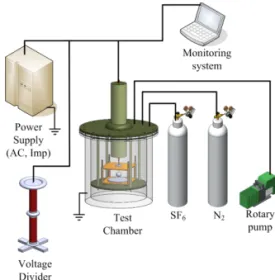
AC breakdown voltage experiment is conducted using a power supply that has a capacity of 200 kV, 60 kVA, and 60 Hz. The ramping up rate of AC voltage is about 1 kV/s and the interval between two successive AC voltages is 60 s. It is known that 60 s is sufficient to eliminate any influence of the surface charge on the statistical determination of the electrical breakdown voltage. Lightning impulse breakdown voltage experiment facility has a peak voltage of 500 kV, a wave front time T1 of 1.2 µs, a wave tail time T2 of 50 µs. Fig. 1 shows the schematic drawing of the experimental set-up. As shown in Fig. 1, a sphere-to-plane electrode system is set on the plate in a cryostat and SF6 and N2 gases are injected according to the mixture ratio and pressure after vacuuming.
Fig. 1. Schematic drawing of experimental set-up.
Six kinds of sphere-to-plane electrode systems with different diameters are manufactured to analyze the dielectric characteristics of a mixture gas at various pressures (up to 4 bar pressure). Table 1 describes the specifications of the experimental set-up. Dielectric experiments are repeated 12 times for every condition and ten values, excepting the extrema, are selected to calculate the statistical value of the electrical breakdown voltage, VBD,50%. VBD,50% denotes that the electrical breakdown voltage occurs with 50 % probability and the value
can be calculated by a statistical computational method. Also, EMAX,BD,50% denotes the maximum electric field intensity at sparkover that occurs with 50 % probability. All dielectric experiments are conducted at a 300 K temperature to consider the thermal weak point of current leads [7].
Table 1. Specifications of an electrode system.
Material stainless steel 316 Electrode system type sphere-to-plane
Gap length (mm) 3, 10, 15, 20, 30 Diameter of sphere
electrode (mm) 2, 4, 6, 8, 15, 30, 40, 50
Plane electrode size (mm) Dia.: 200, thickness: 10, radius of curvature: 5
2. Calculation of Utilization
The utilization factors, ξ denotes a relative value of the mean electric field intensity (Emean) compared with the maximum electric field intensity (Emax) for an electrode system with a certain condition. The utilization factors calculated in these experiments varied from 0.035 to 0.7324. The big utilization factors signify a relatively quasi-uniform field system, while small utilization factors indicate a non-uniform field system. A voltage of 1 kV is applied to the sphere electrode and the plane electrode is grounded to analyze the electric field distribution and utilization factors of an electrode system. Electric field intensity increases proportionally to the applied voltage, ; it does not saturate as the applied voltage increases. Therefore, electric field intensity at sparkover can be calculated by multiplying the analytic maximum electric field intensity (Emax,1kV) calculated by putting 1 kV into the sphere electrode by VDBD,50%. VDBD,50% indicates the dimensionless value proportional to the experimental sparkover voltage (VBD,50%). The relation of EMAX,BD,50%, Emax,1kV, and VDBD,50% could be represented as follows:
= ×
MAX,BD,50% max,1kV DBD,50%
E E V
(1)After the experiments, EMAX,BD,50% based on the utilization factors was calculated using Eq. (1).
3. Experimental Results
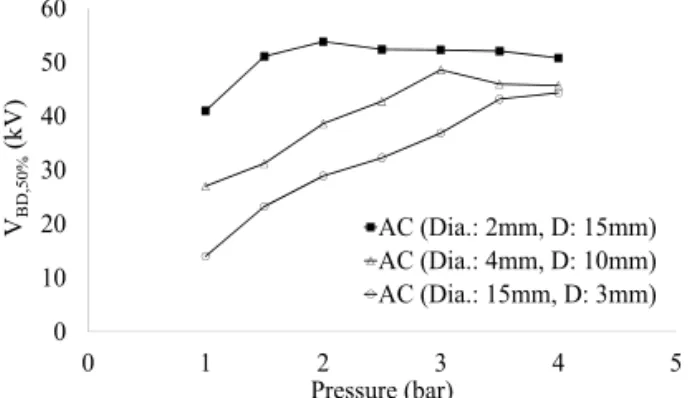
Dielectric experiments on AC voltage and lightning impulse voltage for SF6 were conducted with various pressures. Fig. 2 shows the AC electrical breakdown voltage of SF6 mixture gas according to pressures. It was proved that AC breakdown voltage does not increase proportionally to pressure in the case of a non-uniform electric field system. AC breakdown voltage decreases above a certain pressure in a non-uniform field.
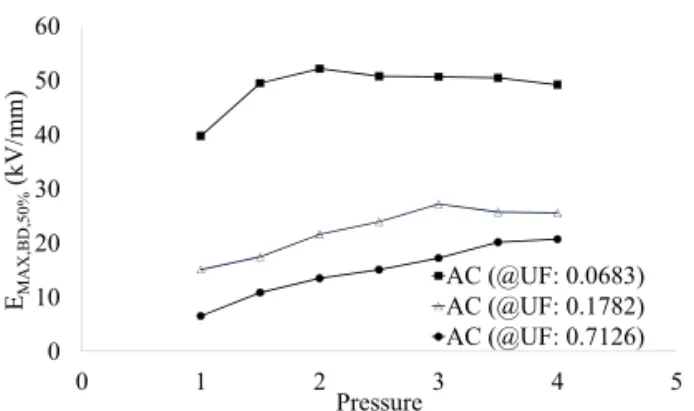
However, it was found that AC breakdown voltage increases proportionally according to pressure in a quasi-uniform electric field (@ Dia.: 15 mm, D: 3 mm). Where, Dia. denotes the proportionally according to pressure in a quasi-uniform electric diameter of a sphere electrode and D is the gap distance between a sphere electrode and a plane electrode. Fig. 3 shows the lightning impulse breakdown voltage of SF6 versus pressure with different electrode systems. The experimental results of lightning impulse voltage are similar to those of AC voltage. It was found that the dielectric characteristics of SF6 mixture gas were similar to those of an electro negative gas, pure SF6. These electro negative characteristics of the SF6 mixture gas can be observed in Fig. 4 and Fig. 5. Fig. 4 experimental results system does not increase according to pressure. VBD,50% and EMAX,BD,50%
decreases above a certain pressure in a non-uniform
Fig. 2. AC breakdown voltage of SF6 vs. pressure with different electrode systems.
0 10 20 30 40 50 60
0 1 2 3 4 5
VBD,50%(kV)
Pressure (bar)
AC (Dia.: 2mm, D: 15mm) AC (Dia.: 4mm, D: 10mm) AC (Dia.: 15mm, D: 3mm)
Fig. 3. Lightning impulse breakdown voltage of SF6 vs.
pressure with electrode systems.
Fig. 4. EMAX,BD,50% under AC breakdown voltage of SF6 vs.
pressure with different electrode systems.
Fig. 5. EMAX,BD,50% under lightning impulse breakdown voltage of SF6 vs. pressure with different electrode systems.
electric field system. It is reported that the electro negative characteristics of SF6 disappears above 4 bar pressure. Therefore, the pressure to operate a high voltage apparatus should be determined to be above 4 bar pressure.
Fig. 6. Functional relation of EMAX,BD,50% under AC breakdown voltage of SF6 vs. utilization factors for various pressures.
Fig. 7. Functional relation of EMAX,BD,50% under lightning impulse breakdown voltage of SF6 vs. utilization factors for various pressures.
The relation between EMAX,BD,50% and utilization factors of SF6 according to various pressures is analyzed by numerical calculation in this paper. Fig.
6 shows the functional graphs of EMAX,BD,50% under AC electrical breakdown voltage of SF6 mixture gas versus utilization factors for various pressures. Fig.
7 shows the functional graphs of EMAX,BD,50% under lightning impulse electrical breakdown voltage of SF6 versus utilization factors for various pressures.
As shown in Fig. 6 and Fig. 7. However, EMAX,BD,50%
under AC electrical breakdown voltage at the utilization factor of 0.0683 for a 2 bar pressure is larger than for other values and EMAX,BD,50% on lightning impulse electrical breakdown voltage at the utilization factor of 0.0683 for 1.5 bar pressure is larger than other values in a non-uniform electric
0 20 40 60 80 100 120
0 1 2 3 4 5
VBD,50%(kV)
Pressure (bar)
Imp. (Dia.: 2mm, D: 15mm) Imp. (Dia.: 4mm, D: 10mm) Imp. (Dia.: 15mm, D: 3mm)
0 10 20 30 40 50 60
0 1 2 3 4 5
EMAX,BD,50%(kV/mm)
Pressure
AC (@UF: 0.0683) AC (@UF: 0.1782) AC (@UF: 0.7126)
0 10 20 30 40 50 60 70 80
0 1 2 3 4 5
EMAX,BD,50%(kV/mm)
Pressure
Imp. (@UF: 0.0683) Imp. (@UF: 0.1782) Imp. (@UF: 0.7126)
0.0683
0.0683
field region. The empirical formulae to calculate the EMAX,BD,50% under AC breakdown voltage versus pressure using utilization factors could be deduced as follows:
. 42
. 4 )
( ,1 0.775
1 ,
%, 50 , ,
× −
=
= ξAC bar ξ
bar AC BD
Max f
E (2)
. 85 . 7 )
( ,1.5 0.625
5 . 1 ,
%, 50 , ,
× −
=
= ξAC bar ξ
bar AC BD
Max f
E (3)
. 39
. 9 )
( ,2 0.591
2 ,
%, 50 , ,
× −
=
= ξAC bar ξ
bar AC BD
Max f
E (4)
. 87 . 11 )
( ,2.5 0.504
5 . 2 ,
%, 50 , ,
× −
=
= ξAC bar ξ
bar AC BD
Max f
E (5)
. 09 . 14 )
( ,3 0.451
3 ,
%, 50 , ,
× −
=
= ξAC bar ξ
bar AC BD
Max f
E (6)
. 39 . 16 )
( ,3.5 0.376
5 . 3 ,
%, 50 , ,
× −
=
= ξAC bar ξ
bar AC BD
Max f
E (7)
. 95 . 16 )
( ,4 0.354
4 ,
%, 50 , ,
× −
=
= ξAC bar ξ
bar AC BD
Max f
E (8)
EMAX,BD,50% under AC breakdown voltage of SF6
mixture gas for various pressures could be calculated from the eight above-described equations and VBD,50% could be estimated. In this way, EMAX,BD,50% on lightning impulse breakdown voltage for various pressures could be summarized as numerical functions as follows:
. 98 . 10 )
( Im ,1 0.571
1 , Im
%, 50 , ,
× −
=
= ξ p bar ξ
bar p BD
Max f
E (9)
. 84 . 22 )
( Im,1.5 0.386
5 . 1 , Im
%, 50 ,
,BD p bar= ξ p bar = ×ξ−
Max f
E (10)
. 76 . 25 )
( Im ,2 0.329
2 , Im
%, 50 , ,
× −
=
= ξ p bar ξ
bar p BD
Max f
E (11)
. 56 . 37 )
( Im,2.5 0.183
5 . 2 , Im
%, 50 , ,
× −
=
= ξ p bar ξ
bar p BD
Max f
E (12)
. 51 . 39 )
( Im ,3 0.169
3 , Im
%, 50 , ,
× −
=
= ξ p bar ξ
bar p BD
Max f
E (13)
. 74 . 42 )
( Im ,3.5 0.177
5 . 3 , Im
%, 50 , ,
× −
=
= ξ p bar ξ
bar p BD
Max f
E (14)
. 20 . 46 )
( Im ,4 0.138
4 , Im
%, 50 , ,
× −
=
= ξ p bar ξ
bar p BD
Max f
E (15)
It is verified that EMAX,BD,50% and VBD,50% could be calculated for AC breakdown voltage and lightning impulse breakdown voltage using these equations for various pressures. Also, it is found that that EMAX,BD,50% shows a saturation tendency at the scope of relatively large utilization factors.
III. Discussions
Dielectric characteristics of gaseous insulation medium are very important in the design of a high voltage superconducting apparatus. Therefore, a study on the electrical insulation performance of gaseous insulation medium is essential to design a current lead part of transmission superconducting apparatuses. In the case of designing high voltage electric apparatuses, the metallic structure (electrode system) should be designed as a quasi-uniform electric field system. This means that the electrical insulation design should be performed in the region of large utilization factors. Therefore, dielectric design should be conducted with a saturated EMAX,BD,50% at the region of large utilization factors.
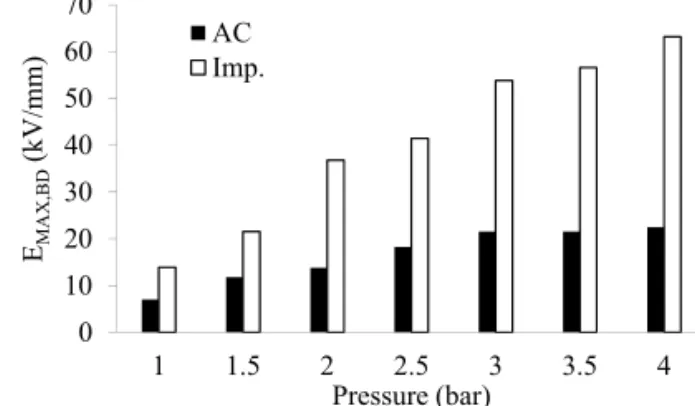
Fig. 8 summarizes the saturated EMAX,BD,50% under AC and lightning impulse breakdown voltage. As show in Fig. 8, it is found that a saturated EMAX,BD,50%
under AC and lightning impulse breakdown voltage increases according to pressure, regardless of its electro negative characteristics. This means that the electro negative characteristics of SF6 mixture gas
Fig. 8. Comparison of saturated EMAX,BD,50% under AC and lightning impulse breakdown voltage of SF6 mixture gas vs. pressure.
0 10 20 30 40 50 60 70
1 1.5 2 2.5 3 3.5 4
EMAX,BD(kV/mm)
Pressure (bar) AC
Imp.
appear at the scope of relatively small utilization factors, a non-uniform electric field system.
IV. Conclusions
This paper conducted a study on the dielectric characteristics of SF6 mixture gas as a gaseous insulation medium for developing a high voltage superconducting apparatus. The AC and lightning impulse breakdown voltage of SF6 mixture gas were measured by dielectric experiments. This verified that EMAX,BD,50% under AC and lightning impulse breakdown voltage of SF6 mixture gas has a functional relation to utilization factors. EMAX,BD,50%
has a saturation tendency as utilization factor increases for every pressure. As results, empirical formulae to estimate VBD,50% under AC and lightning impulse breakdown voltage were deduced versus various pressures. Also, it is found that SF6 mixture gas shows electro negative characteristics in a non-uniform electric field system. However, it was observed that the saturated EMAX,BD,50% under AC and lightning impulse breakdown voltage according to pressure, regardless of its electro negative characteristics. This means that the electrical insulation design to develop a high voltage superconducting apparatus with high reliability should be conducted by taking into account the saturated EMAX,BD,50%. The experimental results are helpful to design a current lead part for commercial transmission superconducting apparatuses.
Acknowledgments
This research was supported by Basic Science Research Program through the National Research Foundation of Korea(NRF) funded by the Ministry of Education, Science and Technology. (2010- 0003558)
References
[1] Hyoungku Kang, Min Cheol Ahn, Yong Ku Kim, Duck Kweon Bae, Yong Soo Yoon, Tae Kuk Ko, Jung Ho Kim, and Jinho Joo, “Design, Fabrication and Testing of Superconducting DC Reactor for 1.2 kV/80 A Inductive Fault Current Limiter”, IEEE Trans. on Applied Superconductivity, vol. 13, no. 2, pp. 2008- 2011, June 2003.
[2] Hyoungku Kang, Chanjoo Lee, Kwanwoo Nam, Yong Soo Yoon, Ho-Myung Chang, Tae Kuk Ko, and Bok-Yeol Seok, “Development of a 13.2 kV/630 A (8.3 MVA) High Temperature Superconducting Fault Current Limiter”, IEEE Trans. on Applied Superconductivity, vol. 18, no. 2, pp. 628-631, June 2008.
[3] Kim, H.J.; Kwag, D.S.; Kim, S.H.; Cho, J.W.; Seong, K.C.; “Electrical Insulation Design and Experimental Results of a High-Temperature Superconducting Cable”, IEEE Trans. on Applied Superconductivity, vol. 17, no. 2, pp. 1743-1747, June 2007.
[4] Hyoungku Kang, Chanjoo Lee, Tae Kuk Ko, and Bok-Yeol Seok, “Electrical Breakdown Characteristics of Superconducting Magnet System in Sub-Cooled Liquid Nitrogen”, IEEE Trans. on Applied Superconductivity, vol. 17, no. 2, pp. 1509-1512, June 2007.
[5] S.H. Lee, W.J. Shin, Umer A. Khan, S.H. Oh, J.K.
Seong, B.W. Lee, “Design and installation of extra high voltage cryogenic dielectric test facilities for the superconducting electric equipment”, Physica C, In Press, 2011.
[6] Yeon Suk Choi, Ho-Myung Chang, and Steven W.
Van Sciver, “Performance of extended surface from a cryocooler for subcooling liquid nitrogen by natural convection”, Cryogenics, vol. 46, pp. 396-402, 2006.
[7] H. Kang, T.K. Ko, “Experimental Study on the Dielectric Characteristics of Gaseous Insulation Medium according to Temperature and Pressure”, International Symposium on Superconductivity, SAP73, 2010.