• 검색 결과가 없습니다.

Modification and Properties of Polyolefin with Maleic Anhydride as a Functional Monomer

N/A
N/A
Protected

Academic year: 2021

Share "Modification and Properties of Polyolefin with Maleic Anhydride as a Functional Monomer"

Copied!
6
0
0

로드 중.... (전체 텍스트 보기)

전체 글

(1)

Modification and Properties of Polyolefin with Maleic Anhydride as a Functional Monomer

Jong Hun Mo, Jae Seok Lee, Im Cheol Choi, Won Kee Lee Sang Bo Park, Seong Kee Min, and Chan Young Park

Department of Polymer Engineering, Pukyong National University Busan 608-739, Korea (Received April 2, 2012, Revised April 23, 2012, April 25, Accepted April 26, 2012)

관능성 단량체로서 Maleic Anhydride를 이용한 Polyolefin의 개질 및 물성

모종헌 ․ 이재석 ․ 최임철 ․ 이원기 ․ 박상보 ․ 민성기 ․ 박찬영

부경대학교 공과대학 고분자공학과

접수일(2012년 4월 2일), 수정일(1차 : 2012년 4월 23일, 2차 : 4월 25일), 게재확정일(2012년 4월 26일)

ABSTRACT:Surface modification of macromolecules renders a progressive and favorable method to enhance the properties of polymeric materials and improves conductivity, wettability, stability, adhesion, antibacterial properties, etc. of polymeric surfaces without deterioration of the polymer bulk properties. Polyolefins such as polyethylene and polypropylene were grafted with maleic anhydride(MAH) as a functional monomer in solution. Evidence for grafting was shown with FTIR measurement. The grafting ratio was determined from chemical titration. The higher MAH loading, the lower contact angle() was obtained. With the increasing content of MAH, melting temperature(T

m

) of maleic anhydride grafted polymer decreased while decomposition temperature(T

d

) of maleic anhydride grafted polymer increased.

요 약:거대분자의 표면개질은 고분자재료의 물성을 향상시키기 위한 점진적이고 바람직한 방안을 제공하며 고분자의 주요 물성을 손상시키지 않고 고분자 표면의 전도도, 젖음성, 안정성, 접착 및 항박테리아성 등을 개선시킨다. PE 또는 PP 등의 polyolefin을 관능성 단량체로서 MAH와 용액상에서 그래프트시켰다. FTIR측정을 통하여 그래프팅이 일어났음을 확인하였다. 그래프팅율은 화학적정에 의하여 결정하였다. MAH량이 많아질수록 접촉각은 낮은 값을 얻었다. 또한 MAH량이 증가함에 따라 polyolefin-g-MAH의 융점(T

m

)은 감소하는 한편 분해온도(T

d

)는 증가하는 경향을 보였다.

Keywords:modification, polyolefin, functional monomer, graft polymerization, maleic anhydride, wettability

Corresponding Author. E-mail: [email protected]

Ⅰ. Introduction

In order to expand the applications of polyolefins and produce useful substances which have improved mechanical, thermal, and chemical properties chemical modification of polyolefins is usually employed as an important alternative. In the mod- ification of polyolefins free radical graft polymerization of maleic anhydride(MAH) with base polymer employing an ini- tiator is paid much attention over the past decades. With the incorporation of glow discharge, ultraviolet (UV) irradiation, x-ray and photografting, modifications of useful product such as film, fiber, and powder etc. were also examined and in- tensified mainly by surface grafting reactions.

1,2

Through the

interfacial interaction between the components in polymeric materials PP-g-MAH or PE-g-MAH has been widely used for improving of the physical properties.

3~5

By utilizing of melts,

6~8

solution

9~11

and solid-state

12~14

modifying of poly- olefins has been successfully performed. Surface treatment is required for most polymer materials which are chemically inert to improve their adhesion properties to other materials. In addi- tion graft polymerization is a fascinating means to render a various functional groups to a polymer. In the past several years, emphasis on applications of modified polymers through grafting has been increased.

15

There has been significant re- search in techniques of graft polymerization of different mono- mers on backbone polymers.

16

Surface modification techniques including chemical,

17,18

plasma

19,20

treatments, flame,

21

ultraviolet (UV) irradiation and

corona discharge

22,23

which improve interfacial adhesion by

changing surface energy to increase wettability have been ex-

(2)

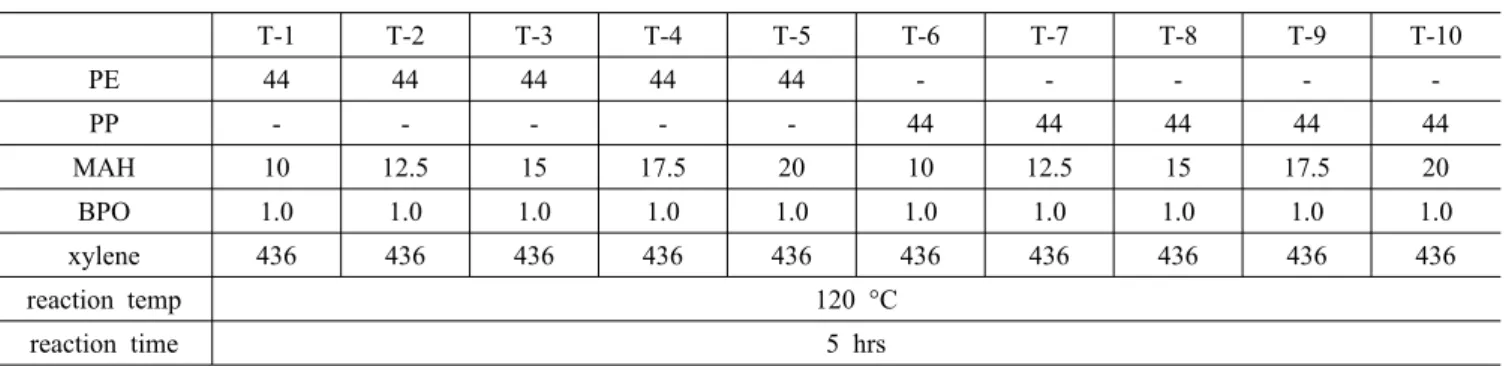
Table 1. Experimental Conditions in Graft Polymerization of Polyolefin with Maleic Anhydride

T-1 T-2 T-3 T-4 T-5 T-6 T-7 T-8 T-9 T-10

PE 44 44 44 44 44 - - - - -

PP - - - - - 44 44 44 44 44

MAH 10 12.5 15 17.5 20 10 12.5 15 17.5 20

BPO 1.0 1.0 1.0 1.0 1.0 1.0 1.0 1.0 1.0 1.0

xylene 436 436 436 436 436 436 436 436 436 436

reaction temp 120 °C

reaction time 5 hrs

tensively employed. Feasible introduction of graft chains with a high density and exact localization of graft chains with in- variable bulk properties to the surface makes grafting attractive in its benefits compared to other methods. Radical polymer- ization is suggested as a useful method for polymer grafting on the surface.

In this experiment, graft polymerizations of PE and/or PP with MAH were performed and the effect of maleic anhydride on the spectroscopic, thermal properties and contact angle in the maleic anhydride grafted polyethylene (PE-g-MAH) and/or maleic anhydride grafted polypropylene(PP-g-MAH) were examined.

Ⅱ. Experimental

PE used was low density PE(Daehan Petrochemicals, E-308, d = 0.956, MI = 0.8 g/10min). PP (d = 0.9, Mn = 5,000, Brook- field viscosity 6,000 poise at 190 ℃) was purchased from Sigma-Aldrich, USA. Maleic anhydride(MAH), benzoyl per- oxide and xylene used in this experiment were purchased from Junsei Chemical Co. The typical formulations of the polymer- ization are given in Tables 1. Grafting of MAH onto PE or PP was carried out in xylene with benzoyl peroxide(BPO).

24,25

A mixture of BPO and MAH dissolved in xylene was added dropwise to the solution of PE in xylene for the first 3 hr of 5 hr reaction. The reaction was carried out at 120 ℃ with mild agitation in nitrogen gas purging. At the end of reaction, the mixture was cooled to room temperature and washed with acetone several times and dried in vacuum overnight. Evidence for grafting was obtained from FTIR measurement. The graft- ing ratio(GR) of PE-g-MAH was determined from chemical titration.

26

The chemical titration is such as the following procedure. Purified PE-g-MAH (0.3–0.4 g) was dissolved com- pletely in 120 ml of xylene at 120 ℃, and after addition of 0.2 ml of deionized water, the mixture was refluxed for 1hr.

Adding dropwise 10.0 ml of a 0.1 M isopropanolic KOH sol- ution, the mixture was refluxed for another 2 hrs to ensure complete reaction with the MAH groups. With 0.1 ml of a

1.0% phenolphthalein ethanol solution as an indicator, the hot solution was titrated with a 0.1 M isopropanolic HCl solution.

A blank solution also was treated under the same conditions.

The grafting ratio(%) was calculated by the equation

Grafting Ratio(%) = 100 × N( 

-  ) × 

/ (2 × W × 1000) (1)

where N is the acid concentration of the isopropanolic HCl solution(mol/L), W is the weight of PE-g-MAH(g),  and 

are the volumes(ml) of the isopropanolic HCl solution added to the PE-g-MAH and blank solutions, respectively, and 

is the molecular weight of MAH(98.06). The press-moulded films of the PE-g-MAH were immersed into acetone at room temperature to remove the unreacted monomer and other sec- ondary products. The FTIR spectra of the PE-g-MAH and PP-g-MAH films were recorded with a Nicolet MAGNA-IR 750 spectrometer. The grafted polyethylenes with different GR were obtained by changing MAH concentrations in the pres- ence of BPO. The contact angle ( ) data were obtained from an angle subtended at the triple line by the tangents onto the solid/liquid and liquid/vapor interfaces in a system with sol- id/liquid/vapor phases being a thermodynamic equilibrium.

27

The contact angle of distilled water on the PE-g-MAH and PP-g-MAH film was measured using a contact angle meter (VCA-2500, ASC products, USA). Each contact angle meas- ured was the average value of five runs with a maximum error of ±2

o

. The polymer plates of dimensions 10×10×1 mm

3

were used in the contact angle measurement. To get rid of unreacted MAH on the sample surface, the plates were first put into acetone followed by washing with distilled water and dried.

DSC thermogram data were provided with DSC-20l0(TA

Instruments Co.) differential scanning calorimeter. 2~3 mg

samples were crimp-sealed in 30 μl aluminum pans and first

heating scan was performed from 20 to 250 °C. In order to

cancel the thermal history effects, sample was held at this tem-

perature for five minutes before starting the cooling and the

second heating sweeps, and then cooled with the rate of 10

(3)

°C/min to room temperature. The thermal analysis was carried out under a nitrogen purge (20 ml/min) and degree of crystal- linity (Xc) of the grafted PE samples was calculated by the following equation:

Xc = ΔHc / ΔH

o

(2)

where ΔHc is the overall enthalpy of crystallization acquired from the integral area(S) of the cooling thermogram, ΔH

o

is given to 293 J/g exhibiting the enthalpy of 100% crystallinity of polyethylene.

28

In order to get information on its degree of crystallinity, ΔH values were usually normalized to the amount of the phase under consideration. In addition the proc- essing temperature of polymeric materials is generally de- termined by the T

m

of the matrix polymer. For smooth manu- facture of final product, the processing temperature of polymer was set about 10 to 30 ℃ higher than that of polymer.

Thermogravimetric analysis(TGA) was provided with TGA 1500 manufactured by Polymer Laboratories Co. at the heating rate of 20 ℃/min under nitrogen purge. Thermal stability of specimen was investigated from TGA data. For quantitative evaluation of its thermal stability, the temperature at which two tangents are intersected is used as the decomposition tem- perature( 

) of a specific component.

Ⅲ. Results and Discussion

It is usually believed that grafting of maleic anhydride (MAH) to polyolefins proceeds through a free radical mecha- nism.

29

Free radicals produced from thermal decomposition of a peroxide abstract hydrogen atoms from polyethylene back- bones, thus polymer free radicals are resulted. Polymer radicals then attack monomer(MAH) and then results in grafting of monomer to polymer backbones. The specimen for grafting ratio of PE-g-MAH is free from the residual monomer by dis- solving the grafted polyethylene with xylene, precipitating with acetone.

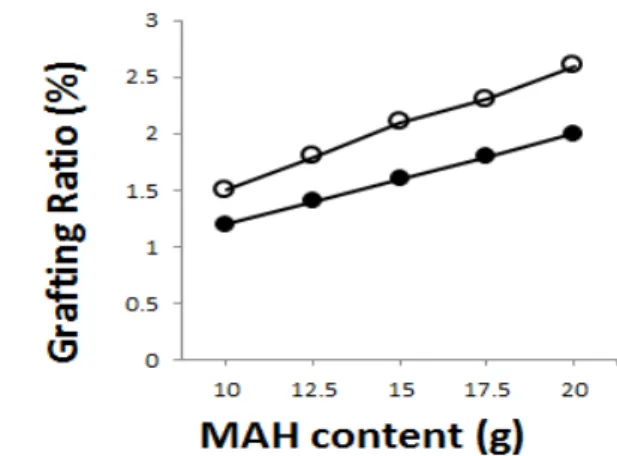
Figure 1 illustrates the effect of MAH content on grafting ratio. The graph indicates that grafting ratio increases with the increase of MAH content. This is attributed to the fact that higher MAH content increases the feasibility which reacts with PE macroradicals to graft in the present experiment.

Figure 2 shows the variation of BPO concentration with MAH content in grafting ratio. The experiment conditions are T-5 and T-10 in Table1. Generally the grafting reaction in- volves initiation to form macroradicals through abstraction of hydrogen atoms from the polymer chain by the initiator radi- cals, and addition of the unsaturated monomer to the macro- radicals. Also grafting of MAH onto PE was carried out nor- mally at a high temperature to generate free radicals from the thermal decomposition of the initiator. With the increasing

Figure 1. Effect of MAH content on grafting ratio : PE-g- MAH(○), PP-g-MAH(●).

Figure 2. Effect of BPO content on grafting ratio : PE-g-MAH (○), PP-g-MAH(●).

loading of initiator, more PE radicals are produced, leading to a higher grafting ratio. So the grafting ratio increases with the increasing of BPO concentration as shown in Figure 2.

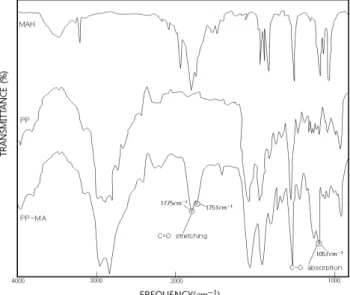
Figures 3 and 4 show FTIR spectra of PE-g-MAH and PP-g-MAH. An infrared spectrum is obtained by passing infra- red radiation through a sample and determining which fraction of the incident radiation is absorbed at a particular energy.

The energy at which any peak in an absorption spectrum ap- pears corresponds to the frequency of vibration of a part of the sample molecule. Most infrared spectroscopy is carried out by using Fourier-transform infrared(FTIR) spectrometers. This method is based on the interference of radiation between two beams to yield an interferogram, i.e. a signal produced as a function of the change of path length between the two beams.

The two domains of distance and frequency are interconver- tible by the mathematical method of Fourier transformation.

The radiation emerging from the source is passed through an

interferometer to the sample before reaching a detector. Upon

amplification of the signal, in which high-frequency con-

(4)

Figure 3. FTIR spectra of PE and PE-g-MAH.

Figure 4. FTIR spectra of PP and PP-g-MAH.

tributions have been eliminated by a filter, the data are con- verted to a digital form by using an analog-to-digital converter and then transferred to the computer for Fourier transformation to take place. From Figures 4 and 5 it can be seen that two new absorption peaks appear at 1775 and 1751 cm

-1

, which are attributed to the stretching of the carbonyl from the PE-g-MAH and PP-g-MAH sample. On the other hand the new peak which appeared at about 1057 cm

-1

is associated with the C-O absorption of the grafted sample. Therefore it was inferred that MAH grafting on the backbone of PE and PP chain occurred.

Surface tension and contact angle are correlated with each other and in this experiment as the content of MAH is in-

Figure 5. Effect of MAH content on contact angle : PE-g- MAH(○), PP-g-MAH(□).

creased surface tension is expected to be decreased. The effect of MAH content on contact angle is shown in Figure 5 with PE-g-MAH and PP-g-MAH. It can be seen that the contact angle decreases with increasing MAH content. The reduction in the contact angles is probably attributed to the increase of the polarity of the grafted polymer.

The thermal analysis describes a number of techniques which involve measuring a physical property of a material as a function of temperature. Differential scanning calorimetry (DSC) is such a thermal method that may be used to compare and evaluate polymer samples. It is a technique which records the energy necessary to establish a zero temperature difference between the sample and a reference material as a function of time or temperature. In this method, the two specimens are subjected to identical temperature conditions in an environ- ment which is heated or cooled at a controlled rate. DSC curves are plotted as a function of time or temperature at a constant rate of heating. In the DSC graph a shift in the base- line results from the change in heat capacity of the sample.

Figures 6 and 7 show the effect of MAH content on melting temperature(T

m

) in PE-g-MAH and PP-g-MAH. Introduction of anhydride grafting decreases melting temperature(T

m

).

Bulky grafted moiety on maleic anhydride grafted polymer

limits the folded chain arrangement of segments and may act

as defects in its crystalline structures. The crystallite size of

this polymer is therefore reduced and with weakening of the

crystalline structure the melting temperature decreases.

30

Polar

group on the grafted PE increases the nucleation and percent

of crystalline sections,

31

therefore the melting enthalpy of

grafted polyethylene is higher than PE. From Figures 6 and

7 it can be seen that melting temperature decreases with in-

creasing MAH content. The degrees of crystallinity were ob-

tained with 24.9%, 23.4%, 22.1% and 20.4% respectively for

PE and PE-g-MAH (MAH : 2 wt%, 3 wt% and 4 wt%) calcu-

(5)

Figure 6. DSC thermograms of (A) PE, (B) PE-g-MAH (MAH : 2wt%), (C) PE-g-MAH (MAH : 3wt%) and (D) PE-g-MAH (MAH : 4wt%).

Figure 7. DSC thermograms of (A) PP, (B) PP-g-MAH (MAH : 2wt%), (C) PP-g-MAH (MAH : 3wt%) and (D) PP-g-MAH (MAH : 4wt%).

Figure 8. TGA thermograms for PE and PE-g-MAH with dif- ferent amount of MAH.

lated by eq (2). As the contents of MAH were increased Xc were decreased. A similar result was also observed in PP- g-MAH.

The thermal stability of PE-g-MAH was evaluated using thermogravimetric analysis (TGA). The temperature at which two tangents are intersected is used as the decomposition tem- perature( 

) of a particular component to quantitatively eval- uate its thermal stability. The onset temperature of main weight loss in TGA is used as an indication of thermal stability. Figure 8 shows the weight loss curves for the PE-g-MAH. It repre- sents that the second decomposition temperature of PE-g-MAH was increased obviously as the MAH content was increased.

So the more MAH content in PE-g-MAH, the better thermal stability is obtained.

Ⅳ. Conclusions

The grafting ratio increases with the increasing of MAH content. This is attributed to the fact that higher MAH content increases the feasibility which reacts with PE macroradicals to graft. With the increasing loading of initiator, more PE radi- cals are produced, leading to a higher grafting ratio. So the grafting ratio increases with the increasing of BPO concent- ration. It can be seen that contact angle decreased from 104

o

for pure PE to 82

o

for PE-g-MAH. The reduction in the contact angles is probably attributed to the increase of the polarity of the grafted polymer. DSC results indicate that melting tem- perature decreases with increasing of MAH content. From TGA thermogram the more MAH content in PE-g-MAH, the better thermal stability is obtained.

Acknowledgement

This research was supported by a grant from the Korean Ministry of Knowledge and Economy through the Industry Foundation Technology Development Project (2011).

References

1. K.E. Russell, “Free radical graft polymerization and copoly- merization at higher temperatures”, Prog Polym Sci, 27, 1007 (2002).

2. J. Gao, J.X. Lei, Z.J. Su, B.S. Zhang, and J. Wang, “Photo- grafting of maleic anhydride on low density polyethylene powder in the vapor phase”, Polym J, 33, 147 (2001).

3. G. Moad, “The synthesis of polyolefin graft copolymers by reactive extrusion”, Prog Polym Sci, 24, 81 (1999).

4. E. Boucher, J.P. Folkers, H. Hervet, L. Leger, and C. Creton,

“Effects of the formation of copolymer on the interfacial ad- hesion between semicrystalline polymers”, Macromolecules, 29, 774 (1996).

5. W.L. Qiu, F.R. Zhang, T. Endo, and T. Hirotsu, “Preparation

(6)

and characteristics of composites of high-crystalline cellulose with Polypropylene: effects of maleated polypropylene and cellulose content”, J Appl Polym Sci, 87, 337 (2003).

6. G. Samay, T. Nagy, and J.L. White, “Grafting maleic anhy- dride and comonomers onto polyethylene”, J Appl Polym Sci, 56, 1423 (1995).

7. B. De Roover, M. Sclavons, V. Carlier, J. Devaux, R. Legras, and A. Momtaz, “Molecular characterization of maleic anhy- dride-functionalized polypropylene”, J Polym Sci Polym Chem, 33, 829 (1995).

8. D.A. Shi, J.H. Yang, Z.H. Yao, Y. Wang, H.L. Huang, W.

Jing et al., “Functionalization of isotactic polypropylene with maleic anhydride by reactive extrusion: mechanism of melt grafting”, Polymer, 42, 5549 (2001).

9. K.E. Russell, “Free radical graft polymerization and copoly- merization at higher temperatures”, Prog Polym Sci, 27, 1007 (2002).

10. C.J. Wu, C.Y. Chen, G. Woo, and J.F. Kuo, “A kinetic study on grafting of maleic anhydride onto a thermoplastic elas- tomer”, J Polym Sci Polym Chem, 31, 3405 (1993).

11. A.V. Machado, J.A. Covas, and M. van Duin, “Effect of poly- olefin structure on maleic anhydride grafting”, Polymer, 42, 3649 (2001).

12. B. De Roover, J. Devaux, and R. Legras, “Maleic anhydride homopolymerization during melt functionalization of isotactic polypropylene”, J Polym Sci Polym Chem, 34, 1195 (1996).

13. R. Rengarajan, M. Vicic, and S. Lee, “Solid phase graft copolymerization. I. Effect of initiator and catalyst”, J Appl Polym Sci, 39, 1783 (1990).

14. M. Lazár, L. Hrčková, A. Fiedlerová, E. Borsig, M. Rätzsch, and A. Hesse, “Functionalization of isotactic poly(propylene) with maleic anhydride in the solid phase”, Die Angew Makromol Chem, 243, 57 (1996).

15. I. Kaur, B.N Misra, and R. Barsola, “Radiation-induced graft polymerization of vinyl monomers onto polyamide-6”, Angew.

Macromol. Chem., 1, 234 (1996).

16. Mishra BN, Mehta IK, and Khetrapal RC, “Grafting onto cellulose. VIII. Graft copolymerization of poly(ethylacrylate) onto cellulose by use of redox initiators. Comparison of ini- tiator reactivities”, J Polym Sci Polym Chem, 22, 2767 (1984).

17. Pepenzhik MA, Virnik AD, and Rogovin ZA, “Synthesis of graft cellulose copolymers and calcium salt of poly(acrylic acid)”, Vysokomol Soedin Ser B, 11, 245 (1969).

18. Misra BN, Dogra R, and Mehta IK, “Grafting onto cellulose.

V. Effect of complexing gents on Fenton’s Reagent (Fe2þ–

H

2

O

2

) initiated grafting of poly (ethyl acrylate)”, J Polym

Sci Polym Chem, 18, 749 (1980).

19. Hsueh CL, Peng YJ, Wang CC, and Chen CY, “Bipolar mem- brane prepared by grafting and plasma polymerization”, J Membr Sci, 219, 1 (2003).

20. Han TL, Kumar RN, Rozman HD, and Md Noor MA, “GMA grafted sago starch as a reactive component in ultraviolet radi- ation curable coatings”, Carbohydr Polym, 54, 509 (2003).

21. Mishra BN, Mehta IK, and Khetrapal RC, “Grafting onto cellulose. VIII. Graft copolymerization of poly(ethylacrylate) onto cellulose by use of redox initiators. Comparison of ini- tiator reactivities”, J Polym Sci Polym Chem, 22, 2767 (1984).

22. Prasanth KVH and Tharanathan RN, “Studies on graft copoly- merization of chitosan with synthetic monomers”, Carbohydr Polym, 54, 43 (2003).

23. Bajpai UDN, Jain A, and Ray S, “Grafting of polyacrylamide onto guar gum using ascorbic acid redox initiator”, J Appl Polym Sci, 39, 2187 (1990).

24. N. G. Gaylord and M. K. Mishra, “Nondegradative reaction of maleic anhydride and molten polypropylene in the presence of peroxides”, J. Polym. Sci. Polym. Lett. Ed., 21, 23 (1983).

25. B.K. Kim, S.Y. Park, and S.J. Park, “Morphological thermal and rheological properties of blends: polyethylene/nylon 6/(maleic anhydride-g-polyethylene) and (maleic anhydride- g-polyethylene)/nylon 6”, Eur. Polym. J., 27, 349 (1991).

26. W. Qiu, T. Endo, and T. Hirotsu, “Interfacial interaction, mor- phology, and tensile properties of a composite of highly crys- talline cellulose and maleated polypropylene”, J Appl Polym Sci, 102, 3830 (2006).

27. J. Konar, A. K. Sen, and A. K. Bhowmick, “Characterization of grafted polyethylene by contact-angle hysteresis and ESCA studies”, J. Appl. Polym. Sci., 48, 1579 (1993).

28. J.J. Janimak and G.C. Stevens, “Comparative crystallisation and exploratory microstructure studies of novel polyethylenes with tailored molecular characteristics”, Polymer, 41, 4233 (2000).

29. K. E. Russel, “Free radical graft polymerization and copoly- merization at higher temperature”, Prog. Polym. Sci., 27, 1007 (2008).

30. A. Colbeaux, F. Fenouillot, L. David, J-F. Gerard, M. Taha, and H. Wautier, “Multifunctional covalent and ionic coupling agents of maleic anhydride modified polyethylene”, J. Appl.

Polym. Sci., 105, 2605 (2007).

31. Y. Güldoğan, S. Eğri, Z.M.O. Rzaev, and E. Pişkin, “Compar- ison of maleic anhydride grafting onto powder and granular polypropylene in the melt by reactive extrusion”, J. Appl.

Polym. Sci., 92, 3675 (2004).

수치

Table 1. Experimental Conditions in Graft Polymerization of Polyolefin with Maleic Anhydride T-1 T-2 T-3 T-4 T-5 T-6 T-7 T-8 T-9 T-10 PE 44 44 44 44 44 - - - -  -PP - - - - - 44 44 44 44 44 MAH 10 12.5 15 17.5 20 10 12.5 15 17.5 20 BPO 1.0 1.0 1.0 1.0 1.0
Figure 1. Effect of MAH content on grafting ratio : PE-g-  MAH(○), PP-g-MAH(●).
Figure 5. Effect of MAH content on contact angle : PE-g-  MAH(○), PP-g-MAH(□).
Figure 8. TGA thermograms for PE and PE-g-MAH with dif- dif-ferent amount of MAH.

참조

관련 문서

1 John Owen, Justification by Faith Alone, in The Works of John Owen, ed. John Bolt, trans. Scott Clark, "Do This and Live: Christ's Active Obedience as the

7 Effect of annealing temperature on the tensile properties of high manganese austenitic stainless steel with two phases of reversed austenite and

1. Free radical initiator abstract a hydrogen from polymer chains 2. Through chain transfer of propagating chain with polymer chain 3. Polymer mixtures are mechanically

skeleton bond energy differences of monomer, oligomers, and polymer. Skeletal bond energy difference

2) polymer reactions using a polymer as a carrier or support for some component of a reaction system (polymeric brominating and Wittig reagents, the Merrifield

: Development of Microstructure and Alteration of Mechanical Properties.. 4.6 The homogeneous nucleation rate as a function of undercooling ∆T. ∆T N is the critical

As a result of comparing with the temperature change, the coldest month mean temperature (January, February, December) showed positive value in the whole

Express the