• 검색 결과가 없습니다.

Measurement of Toluene Solubility in PVAc Using a Quartz Crystal Microbalance

N/A
N/A
Protected

Academic year: 2021

Share "Measurement of Toluene Solubility in PVAc Using a Quartz Crystal Microbalance"

Copied!
7
0
0

로드 중.... (전체 텍스트 보기)

전체 글

(1)

대표저자(e-mail : [email protected])

Measurement of Toluene Solubility in PVAc Using a Quartz Crystal Microbalance

S. B. Kim

Department of Chemical Engineering, Kyonggi University, Suwon 443-760, Korea (Received June 17, 2008, Revised & Accepted July 16, 2008)

PVAc

에서

Quartz Crystal Microbalance

를 이용한 톨루엔의 용해도 측정에 관한 연구

김 상 범 경기대학교 화학공학과

(2008년 6월 17일 접수, 2008년 7월 16일 수정 및 채택)

ABSTRACT : The resistance and frequency change of a quartz crystal microbalance during toluene absorption was measured for poly(vinyl acetate) (PVAc) with 268 nm thickness. Solubility of toluene in PVAc were measured at temperatures from 25℃ to 42℃ and pressures up to 28.4 torr. The frequency of a quartz crystal microbalance increased with increasing temperature and decreased with an increase in toluene vapor pressure. The resistance of a quartz crystal microbalance increased with increasing toluene vapor pressure and decreased with an increase in temperature. A greater pressure of toluene results in a greater solubility of the toluene into the PVAc film. The change of solubility was calculated by Sauerbrey equation.

요 약 : 268 nm두께의 PVAc가 코팅된 수정결정 미소저울(QCM)을 사용하여 저항과 진동수 변 화를 측정하였다. 이를 이용하여 온도(25℃~42℃)와 톨루엔의 증기압(12.4~28.4 torr)변화에 따 른 톨루엔의 폴리비닐아세테이트에 대한 용해도를 측정하였다. 진동수는 온도가 증가함에 따라 증가하였으나 톨루엔의 증기압이 증가하면 감소하는 경향을 보였다. 톨루엔의 온도가 증가함에 따라 저항은 감소하였으며, 증기압이 증가하면 저항도 증가하는 경향을 나타내었다. Sauerbrey 식을 이용하여 온도와 압력변화에 따른 용해도 변화를 측정하였다.

Keywords : QCM, PVAc, frequency, solubility

Ⅰ. Introduction

The solubility of vapors of low molecular weight substance in polymers is important in the design and operation of polymer plants. The removal of residual monomers, oligomers, and polymerization solvents from the produced polymers requires this know-

ledge. While vapor-liquid equilibria and solubility data have been measured for many years and are available in the literature, the data are limited in the number of systems and in the experimental con- ditions available.

1,2

The exploration of the properties of thin materials

is a vital area of interest for the burgeoning field

of technology, especially with regard to lubrication,

adhesion, and biomaterials. The importance of un-

(2)

The QCM is a very sensitive tool to detect changes in weight and thus a helpful method to sense adsorption processes at solid/gas or sol- id/liquid interfaces. The basis of the QCM is a thin quartz exhibiting the inverse piezoelectric effect.

Applying an alternating current excites a mechanical oscillation of the quartz plate. Using the specific res- onance frequency of the quartz leads to a direct pro- portionality of the mass load and the frequency change. This effect was first found by G. Sauerbrey in 1959. Due to this property quartzes are for exam- ple used in evaporating chambers. Since the eighties the QCM is also applied as a biosensor. An advant- age of this technique is the possibility to coat the quartz with thin layers of any material.

The application of QCM devices for sensing chemical vapor was first described by King and has remained an active research field.

3

This technique has been applied by many researchers for the sol- ubility measurement of organic vapors and high- pressure gases in polymers.

4-11

The method has high sensitivity and offers the advantageous of generating data much more rapidly than alternative gravimetric methods such as electronic and quartz spring micro- balances as shown by Mikkilineni et al., French and Koplos, and Boudouris et al.

11-13

In this study, a QCM apparatus was used to de- termine the solubility of toluene in PVAc at various temperatures and pressures.

A 5.0 MHz crystal was initially coated and found to have a thickness of 268 nm. The solubilities of this coating in a toluene atmosphere were studied at varying temperatures using two different methods.

The first included a constant toluene atmosphere while varying the temperature of the crystal chamber from 25˚C to 42˚C. The second method included

1. Materials

Poly(vinyl acetate) (PVAc, Tg = 30 ℃, Mn = 1.67 x 10

5

) and Toluene (>99.5% purity) were purchased from Aldrich. Characteristic of the polymer was re- ported by the supplier.

2. Apparatus and methods

A diagram of the apparatus is shown in Figure 1. The sample chamber is a stainless steel pressure vessel that houses the holder for the quartz crystal.

Sealed tubing goes from the crystal holder though one of the chamber ranges and carries wiring to in- struments outside the chamber. The holder has gold leads that connect to the back side of the crystal when it is snapped into position. This provides con- nection to the electrical signal from the frequency oscilloscope. The output resonant frequency is col- lected on computer. A thermocouple wire is inserted into one of the sealed tubes going into the crystal holder. In this way, the temperature vary close to the crystal can be monitored during an experiment.

This thermocouple is also connected to a PID tem- perature controller that powers heating tapes wrap- ped around the chamber. When insulating tape is mapped on the outside and fiberglass insulation is secured to the sides of the chamber flanges, the tem- perature inside was controlled to within ± 0.1℃.

Tubing going through the other chamber flange con- nects to lines for vacuum, solvent source and argon.

When the solvent is a liquid at ambient conditions,

as in these PVAc/toluene experiments, it is placed

in a glass boiler that is connected to the incoming

line. The controlled temperature of the boiler de-

termines the vapor pressure of solvent that will be

(3)

Figure 1. Schematic diagram of the quartz crystal microbalance apparatus.

maintained during the experiment. A pressure trans- ducer in the solvent vapor line provides a check of the pressure and also monitors for leaks. The vac- uum line is used to evacuate the chamber as well as degas the solvent in the boiler. The argon line is used to pressurize the system to check for the location of leaks.

6 MHz quartz crystals were uscd in the experi- ments. They were circular and approximately 1.4 cm in diameter. The first step was to measure the reso- nant frequency of the clean uncoated crystal. It is the frequency change after the coating is added that will determine the mass and thickness of polymer, which is too small to be measured by a micro- balance. Once the bare crystal frequency is meas- ured, the polymer coating is applied. A spin coater is used to rotate the crystal at high speed while a drop of dilute PVAc-toluene solution, on the order of 1% polymer concentration, is placed in the center.

After two minutes of spinning, the majority of the solvent has evaporated. The remainder is removed by placing the crystal in a vacuum oven at 90℃

for 30 minutes. The coated crystal is then placed in the QCM sample chamber at 40℃ under vacuum and the frequency is recorded.

The difference in frequencies allowed for the de- termination of the mass of the thin film by the

Sauerbrey Equation. This equation shows the direct relationship of the change in frequency to the change in mass. This equation is only valid for rigid masses attached to the crystal and only in air. It has been determined from other works that when a coating of a polymer is sufficiently thin, the polymer coating is able to be considered a rigid mass, allowing for the use of this equation.

  

 

  

 Sauerbrey Equation (1)

A = Active Area of Crystal ρ

q

= Density of Quartz μ

q

= Shear Modulus of Quartz

f

0

= Resonant Frequency of the Crystal

△f = Frequency Change

△m = Mass Change

log           Antoine Equation (2) P = Vapor Pressure

T = Absolute Temperature A, B, C = Coefficient

The crystal was then placed in the QCM and the

computer was used to collect data which recorded

(4)

ing a temperature controlled boiler with high purity toluene. The pressure of toluene present was calcu- lated using an Antoine equation. The pressures were low, ranging from 10 to 30 torr. The solubility of toluene was calculated using the Sauerbrey equation in terms of mass fraction.

Ⅲ. Results and Discussions

1. Frequency and resistance of bare crystal After coating the crystal, the first data that was collected was the vacuum frequency. This was done in order to explore how thin film responds to changes in temperature.

Figure 2 display the linear relationship between frequency and temperature of the crystal. This is al- so present for a bare crystal. As the temperature of the crystal increases, the modulus of the crystal in- creases and lowers the frequency.

A toluene atmosphere was then introduced into the QCM chamber in order that solubility could be investigated. The pressures of toluene introduced range from 12.4 to 28.4 torr which corresponds to toluene boiler temperatures of 10˚C to 25˚C. Higher pressures could not be explored because the temper-

Figure 2. Relationship between frequency and temperature of the bare crystal.

Figure 3. Relationship between resistance and temperature of the bare crystal.

ature of the boiler could not be higher than the tem- perature of the chamber. This would lead to con- densation of the toluene in the chamber.

2. Frequency and resistance of PVAc coated crystal

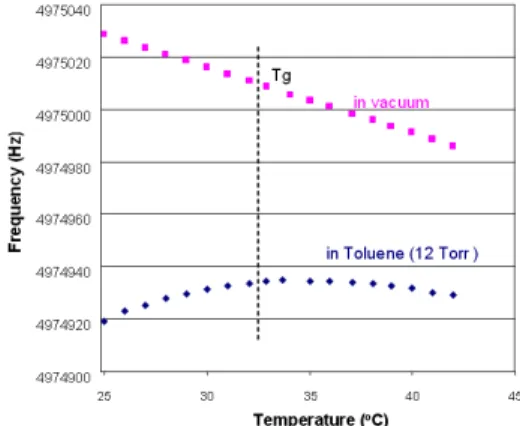
As Figure 4 displays, the introduction of toluene reduced the frequency of the crystal. This is due to the mass adsorption of toluene into the thin film of PVAc. As the temperature increased, the differ- ence between the vacuum and the toluene atmos- phere leads to the conclusion that the solubility of toluene decreases with temperature. This trend was seen in all of the toluene atmospheres including 12.4, 16.5, 21.5, and 28.4 torr. Figure 5 displays the frequencies of all of the different atmospheres versus temperature. Figure 6 shows the resistance and temperature relationships. It appears that the

Figure 4. Relationships between frequency and temperature

in vacuum and in 12 torr toluene atmosphere of PVAc

coated crystal.

(5)

Figure 5. Relationships between frequency and temperature at various toluene atmospheres.

Figure 6. Relationships between resistance and frequency at various toluene atmospheres.

Figure 7. Relationships between frequency and vapor pressure at constant chamber temperature.

higher toluene pressures have a higher resistance with coated crystal. This may be due to the plasticiz- ing effect of toluene which would increase the mod- ulus and thus make it more difficult for the crystal

Figure 8. Relationships between resistance and vapor pressure at constant chamber temperature.

to resonate.

In addition to the constant toluene temperature and varying temperatures tests, the temperature of the chamber was held constant while varying the pressure. Figures 7 and 8 show the response of fre- quency and resistance to these variations respec- tively.

3. Solubility of PVAc coated crystal The change in frequency of the crystal in the vac- uum to the toluene atmosphere allows for the calcu- lation in solubilities. The change in mass can be cal- culated using the Sauerbrey equation and thus the mass of the toluene is able to be calculated. Figure 9 is shown with the solubilities of the four different pressures. This data was collected with a constant toluene pressure and varying the temperature of the crystal. The solubilities increased with toluene pres- sure and decreased with an increase in temperature.

Figure 9. Relationships between solubility and temperature

of toluene in PVAc.

(6)

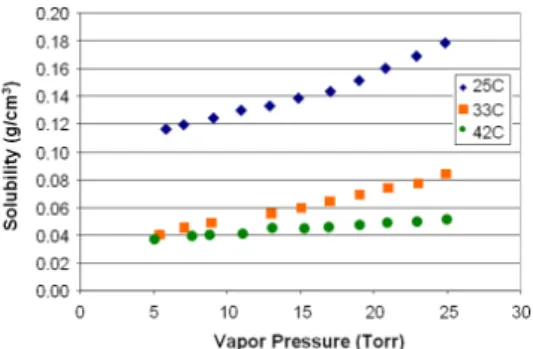
Figure 10. Relationships between solubility and vapor pressure of toluene in PVAc at constant chamber temperature.

Another method that was used to calculate sol- ubilities included holding the temperature of the crystal constant while varying the toluene pressure.

Figure 10 displays the calculated solubilities from this experiment. It should be noted that the sol- ubilities of toluene in PVAc increased with increas- ing toluene vapor pressure and decreased with an increase in temperature.

The two methods used to determine solubilities had various advantages and disadvantages. The method of varying the pressure while holding the crystal temperature constant took only about half the time to perform. The method of varying the crystal temperature gives a broader range of data. Because they are both time consuming and yield basically the same information, only the test determined to be superior will be performed.

Ⅳ. Conclusions

The resistance and frequency change of a quartz crystal microbalance during toluene absorption was measured for poly(vinyl acetate) (PVAc) with 268 nm thickness. Solubility of toluene in PVAc were measured at temperatures from 25℃ to 42℃ and pressures up to 28.4 torr. The frequency of a quartz crystal microbalance increased with increasing tem- perature and decreased with an increase in toluene vapor pressure. The resistance of a quartz crystal microbalance increased with increasing toluene va-

This research was supported by Kyonggi Univer- sity Overseas Research Grant 2005.

References

1. H. Wen, H.S. Elbro, and P. Alessi, Polymer Solution Data Collection Part 1; DECHEMA Chemistry Data Series; DECHEMA: Frankfurt am Main, Germany (1992).

2. H. Wen, H.S. Elbro, and P. Alessi, Polymer Solution Data Collection Part 2+3; DECHEMA Chemistry Data Series; DECHEMA: Frankfurt am Main, Germany (1992).

3. W.H. King, Using quartz crystal as sorption de- tectors part2. Res./Dev. May, 28 (1969).

4. D.C. Bonner and Y.A Cheng, “New method for determination of equilibrium sorption of gases by polymers at elevated temperatures and pres- sures” J. Polym. Sci., Polym. Lett. 13, 259 (1975).

5. H. Masuoka, N. Murashige, and M. Yorizane,

“Measurement of solubility of organic solvents in polyisobutylene using the piezo-electric-quartz sorption method” Fluid Phase Equilib., 18, 155 (1984).

6. N. Wang, S. Takishima, and H. Masuoka,

“Solubility measurements of benzene and cyclo- hexane in molten polyisobutylene by the piezo- electric-quartz sorption method and its correla- tion by modified dual sorption model” Kagaku Kogaku Ronbunshu, 15, 313 (1989).

7. N. Wang, S. Takishima, and H. Masuoka,

“Solubility of benzene, toluene and cyclohexane in polystyrene below its glass temperature”, Kagaku Kogaku Ronbunshu, 15, 795 (1989).

8. N. Wang, S. Takishima, and H. Masuoka,

“Solubility measurements of gas in polymer by

the piezoelectric-quartz sorption method and its

(7)

correlation”, Kagaku Kogaku Ronbunshu, 16, 931 (1990).

9. H. Wong, S.C. Campbell, and B.R. Bhethana- botla, “Sorption of benzene, toluene and chloro- form by poly(styrene) at 298.15k and 323.15k using a quartz crystal microbalance”. Fluid phase Equilib., 139, 371 (1997).

10. H. Wong, S.C. Campbell, and B.R. Bhethana- botla, “Sorption of benzene, tetrahydrofuran and 2-buranone by poly(binyl acetate) at 323.15k us- ing a quartz crystal balance”. Fluid Phase Equilib., 179, 181 (2001).

11. S.P.V.N. Mikkilineni and D.A. Tree, “High, M.

S. Thermophysical properties of penetrants in

polymers via a piezoelectric quartz crystal mi- crobalance”, J. Chem. Eng. Data, 40, 750 (1995).

12. R.N. French and G.J. Koplos, “Activity co- efficients of solvents in elastomers measured with a quartz crystal microbalance”, Fluid Phase Equilib., 160, 879 (1999).

13. D. Boudouris, J. Prinos, M. Bridakis, M.

Pantoula, and C. Panayiotou, “Measurement of HFC-22 and HFC-152a sorption by polymers using a quartz crystal microbalance”, Ind. Eng.

Chem. Res., 40, 604 (2001).

14. G. Sauerbrey, “Verwendung von schwingquarqen

zur mikrowagung”, J. Phys., 155, 206 (1959).

수치

Figure 1. Schematic diagram of the quartz crystal microbalance apparatus.
Figure 3. Relationship between resistance and temperature  of the bare crystal.
Figure 6. Relationships between resistance and frequency  at various toluene atmospheres.
Figure 10. Relationships between solubility and vapor  pressure of toluene in PVAc at constant chamber  temperature.

참조

관련 문서

Transmittance values of hexane/toluene solutions containing heavy oil with/without the PSMAA copolymers of various acid contents as a function of revolution time....

- All single-crystal grains within the aggregate experience the same state of deformation (strain);. experience the same state

A crystal plane at an angle θ to the close-packed plane will contain broken bonds in excess of the close-packed plane due to the atoms at the steps..

a second phase forms because of the limited solubility of zinc in

– extra half-plane of atoms inserted in a crystal structure – b perpendicular (⊥) to dislocation line..

The slip system ( =Slip plane + Slip direction) depends on the crystal structure of the metal and is such that the atomic distortion that accompanies the motion of a dislocation

In sum-frequency generation, UV beam output power improved 1.4 times greater with walk-off compensator, and 2-crystal set as sum-frequency generation crystal improved

As a result we should improve the potential that HVPE with high growth rate can become a new AlN crystal growth method because the high-quality