Concentration Effects on Improved Mechanical Properties of Chopped Kenaf Fiber Filled Polypropylene Composite
Jeong Seok Oh, Seong-Hoon Lee, and Kwang-Jea Kim*,**,†
Hyundai-Kia Motors Co., Materials Development Center, Republic of Korea
*Institute of Polymer Engineering, The Univ. of Akron, Akron, OH 44325-0301, USA
**Department of Polymer Science and Engineering, Inha Univ., Incheon 402-751, Republic of Korea (Received June 14, 2010, Revised July 14, 2010, April 4, 2011, Accepted May 13, 2011)
케냐프섬유로 강화된 PP복합재료내의 섬유의 함량이 기계적특성 향상에 미치는 효과
오정석 ․ 이성훈 ․ 김광제*,**,†
현대기아자동차, *애크론대 고분자공학과, **인하대 고분자공학과
접수일(2010년 6월 14일), 수정일(1차: 2010년 7월 14일, 2차 : 2011년 4월 4일), 게재확정일(2011년 5월 13일)
ABSTRACT:The effects of chopped kenaf fiber concentration on mechanical property of polypropylene (PP) composite are investigated. The addition of kenaf increased the tensile strength, flexural modulus, impact strength, specific gravity, and HDT, while decreased the elongation%, flexural strength, and melt flow index. The increase of mechanical properties is due to increased surface area contacting between fiber and polymer matrix and fiber-fiber interaction. Volatile extractives in the kenaf seemed to decrease the interfacial adhesion between kenaf surface and PP.
요 약:일정한 길이로 분쇄한 케냐프섬유를 일정한 비율로 PP수지에 복합화하여 섬유의 함량에 따른 기계적특성을 조사하였다. 케냐프 섬유의 함량이 증가할수록 인장강도, 굴곡탄성률, 충격강도, 비중, 열변형온도가 증가하는 경향을 나타내었으나 신장률, 굴곡강도, 용융유동지수는 감소하는 경향을 나타내었다. 기계적물성증가의 원인은 섬유와 PP간 의 계면접촉면적의 증가와 섬유간의 연결간섭으로 고찰되었다. 케냐프섬유내에 존재하는 증발성추출물질이 PP와 의 계면접착에 있어서 감소에 영향을 미치는 것으로 고려된다.
Keywords:wood plastic composites, chopped kenaf fiber, PP, mechanical properties, volatile extractives
†Corresponding Author. E-mail: [email protected]
Ⅰ . Introduction
Most of natural fibers are fibrous in structure and are com- posed mostly of cellulose, with minor amounts of lignin and other components. The unit cell structure of natural cellulose is cellulose I, while chemically regenerated manmade cellulose fiber from cellulose of a wood pulp is cellulose II, which is an allotropic modification of natural cellulose and they are totally bio-degradable.1 Celluloses are the most abundant or- ganic fillers on earth and their typical diameter ranges 10-100 μm or bigger. Cellulose is the most major component of wood. Typically moisture content of wood flour ranges 5%
to 8% and they are thermally stable up to 200 ℃.2 Lignocellulosic fibers have chemical compositions of 55% cellulose, 28% lig- nin, 8% hemicellulose, 6% water (3% of residual water) and 3% minerals. Most wood fibers initially contain extractable
chemicals, such as fatty acids, sugars, starches, oils, resins, waxes, pectins, tannins, amino acids, proteins, etc. ranging from 5 to 20 wt%.3 The main extractives of wood are fatty acids, sugars, resins, tannins, etc.4 Wood fibers are known to low cost, renewability, biodegradability, low specific gravity compared to mineral particles. The typical main applications for wood-plastic compounds (WPCs) are decking, consumer goods, car interior parts, house-wares, construction, etc. WPCs have many inherent benefits such as consistent material quality and attractive visual appearance. In the case of WPC decks, additional positive attributes include ease of installation, ab- sence of splinters and the fact that periodic pressure washing is not needed. Practically bio-fibers are used in the manufactur- ing of automotive textiles in order to replace the non-degrad- able, non-recyclable contents of salvaged automobiles to the biodegradable content due to increased social awareness of environmental problems.5 Bio-fiber reinforced polymer com- posites are now generally accepted for automotive applications
such as door liners/panels, outside doors, parcel shelves, boot liners, glass windows, tires, etc.5 About 30 components of a car are manufactured from bio-fiber reinforced composites for the newest automotives.6 Increasing modulus, improving dura- bility and reducing water absorption of WPC are essential problems that need to be addressed in order for the continued growth of WPCs, especially for construction and automotive applications.
Kenaf (Hibiscus cannabinus) fibers are obtained from the bast of the plant and they contain cellulose, hemicelluloses, lignin and other extractable ingredients such as pectin and wax, which varies depending on size, type, harvest season etc. They have been typically a major source of rope, twine, fishing net, strap, fabric, paper, etc. Currently they are used for a variety of biocomposite purposes.
Polypropylene (PP) is one of the most commonly used ther- moplastic homopolymer. Isotactic PPs are commercially avail- able in the market. They were originally developed by Natta and his coworkers7,8 at Milan Polytechnic and Montecatini.
There have been several researches on natural kenaf filled composites;9-11 however, they did not carefully control the length of the fiber, which is one of the major factors influenc- ing the uniformity/quality and the processability of the com- pound. For example long fibers tend to wrap around the screw channel build up pressure and break down during processing thus the use of an optimum length of the fiber is essential for quality of the composite and for processing safety. There were researches on kenaf fiber filled PP composites; however, there were few researches on chopped kenaf fiber concen- tration effects on PP filled composites upon improved mechan- ical properties.
In this research, we add chopped natural kenaf fibers into polypropylene and investigate fiber concentration effects on mechanical property of the compounds and discuss volatile extractive effects on the compound.
Ⅱ. Experimental
1. Materials
The polymer used in this study was polypropylene (PP), supplied by Samsung Total Co., Korea (grade BJ-500). The melt flow index (MI) of extruded polymer was 15 g/10 min in 1 inch PVC die with 5.0 Kg at 190 ℃ (ASTM D 1238).
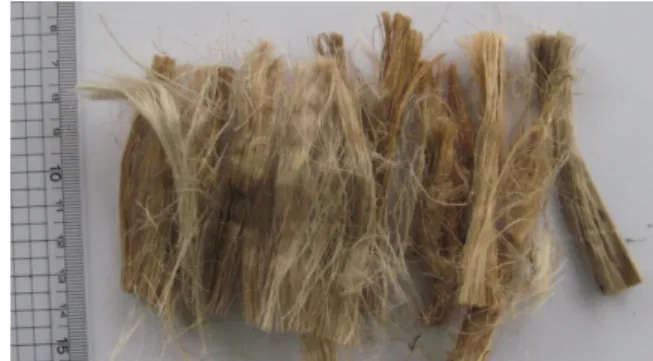
The chopped natural kenaf used in this study was supplied by Sue Trading Co., South Korea and photograph of the fiber is shown in Figure 1. The average length, density and bulk density of the kenaf supplied by the manufacturer was 7 cm, 1.42 g/cm3 and 0.85 g/cm3- 0.90 g/cm3, respectively. The mois- ture content of the natural kenaf was 8.2% measured by DSC.
The kenaf was pre-dried in a vacuum oven for two hours at
Figure 1. Photograph of chopped natural kenaf used in this study.
Table 1. The Mixing Formulations of Chopped Natural Kenaf filled PP Compounds for This Study
Composition (wt%) kenaf (>100 μm) PP Code
0 100 kenaf 00
20 80 kenaf 20
30 70 kenaf 30
50 50 kenaf 50
100 ℃. The moisture content after drying was 5.7%.
2. Mixing
Hankuk EM co-rotating twin screw extruder (model STS32HS-40-2V/SF/IF/SNP2/CPC) was used for mixing the kenaf and PP at a mixing temperature of 190 ℃. The screw speed and feeding volume was set to 150 RPM and 100 g/min, respectively. The mixing formulations are summarized in Table 1.
3. Injection Specimen Preparation
For the elongation test measurement, dumbbell shape speci- mens were prepared following ASTM D 638 method using an injection molding machine. The processing temperature, mold temperature, injection pressure, and holding time to in- jection were set to 180 ℃, 56 kgf/cm2, and 20 sec, respec- tively. The dimension of the injection molding bar was width(13 mm) /length(57) (total length(190 mm))/thickness (3.18 mm) following ASTM D 638 Type VI as shown in Figure 2 (a), and photograph of the injection specimens of PP/kenaf was shown in Figure 2 (b).
4. Melt Flow Index Measurements
Melt flow index (M. I.) was measured by using a melt index
(a)
(b)
Figure 2. Kenaf/PP injection molding bar used for this research (a) dimension as of ASTM D. 638, (b) photograph of injection molding specimen.
tester manufactured by CEAST, Italy following ASTM D 1238. Each compound was pressed with 5.0 Kg load at 190
℃ and the weight passed through an orifice for 10 min. was measured.
5. Mechancal Property Measurement
A universal testing machine (model SFM-10) manufactured by United Co., USA was used for elongation test at room temperature. The cross-head speed for mechanical strength test was set to 50 mm/min.
The mechanical test curves were obtained from the dumbbell shaped specimens following ASTM D 638. The tensile strength (stress maximum) (kgf/cm2), elongation% (strain max- imum), flexural strength (kgf/cm2), flexural modulus (kgf/cm2), of each compound was measured. The dimension of the speci- men was 127.0x12.7x6.35 mm (length(L) x width(W) x thick- ness(T)) as described in Figure 2(a). The impact strength (KJ/m2) was measured by using an Izod impact test machine manufactured by CEAST, Italy following ASTM D 256. A notched sample (L x W x T (127.0 x 12.7 x 6.35 mm)) as described in Figure 2(a) was placed in a cantilevered beam and an arm held at a specific height (constant potential energy) was released. The arm hit the sample and broke it. From the energy absorbed by the sample, its impact strength was determined. The impact strength was calculated following Eq’n (1).
(1)
6. Heat Distortion Temperature (HDT) Measurements The Heat Deflection Temperature (HDT) test measurement measures the deflection temperature of a specimen sample (LxWxT (127.0x12.7x6.35 mm)) as of ASTM D648. HDT was measured by using a Bending Stress Load type manufactured by CEAST, Italy following ASTM D 648. The test specimen was loaded in three-point bending in the edgewise direction.
The outer fiber stress used for testing was either 1.82 MPa or 0.455 MPa, and the temperature was increased at 2 ℃/min until the specimen deflected by 0.254 mm.
7. Specific gravity
Specific gravity was measured by using an electric balance manufactured by TOLORANT in Korea following ASTM D 792.
Ⅲ . Results
1. Melt Flow Index Measurements
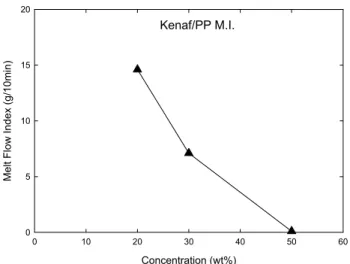
Figure 3 shows the melt flow index (M.I.) of each compound measured. As the concentration of the kenaf was increased,
Kenaf/PP M.I.
Concentration (wt%)
0 10 20 30 40 50 60
Melt Flow Index (g/10min)
0 5 10 15 20
Figure 3. The melt flow index (M.I.) of kenaf/PP compounds.
Kenaf/PP Tensile Strength
Concentration (wt%)
0 10 20 30 40 50 60
Tensile Strength (kgf/cm2)
340 341 342 343 344 345 346
Figure 4. The tensile strength (stress maximum) (kgf/cm2) of kenaf/PP compounds.
the M.I. was decreased, i.e. M.I. [kenaf 20 (14.6)> kenaf 30 (7.1)> kenaf 50 (0.1)]. The kenaf 50 showed almost no flow due to high kenaf concentration. The decreased M.I. of each compound seemed due to increased inter-particle interactions.
2. Mechanical Property Measurement
Figure 4 shows the tensile strength (T.S.) (stress maximum) (kgf/cm2) of each compound obtained from an Instron tensile tester. As the concentration of the kenaf was increased, the tensile strength was increased, i.e. T.S. [kenaf 20 (341.4) <
kenaf 30 (342.4) < kenaf 50 (345.0)]. This seemed due to increased surface area contacting between fiber surface and polymer chain.
Figure 5 shows the elongation (E) % (strain maximum) of each compound obtained from an Instron tester. As the concen-
Kenaf/PP Elongation%
Concentration (wt%)
0 10 20 30 40 50 60
Elongation%
0 2 4 6 8 10
Figure 5. The elongation% (strain maximum) of kenaf/PP compounds.
Concentration (wt%)
0 10 20 30 40 50 60
Bending Strength (kgf/cm2)
341 342 343 344 345 346
Kenaf/PP Bending Strength
Figure 6. The flexural strength (kgf/cm2) of kenaf/PP compounds.
tration of the kenaf was increased, the elongation% was de- creased, i.e. E. % [kenaf 20 (7.3)> kenaf 30 (5.7)> kenaf 50 (3.2)].
Figure 6 shows the flexural strength (F.S.) (kgf/cm2) of each compound obtained from an Instron tester. As the concen- tration of the kenaf was increased, the flexural strength was decreased, i.e. F.S. [kenaf 20 (531.5) > kenaf 30 (524.7) >
kenaf 50 (503.1)].
Figure 7 shows the flexural modulus (F.M.) (kgf/cm2) of each compound obtained from an Instron tester. As the concen- tration of the kenaf was increased, the flexural modulus was increased, i.e. F.M. [kenaf 20 (26,956) < kenaf 30 (32,935)
< kenaf 50 (44,276)].
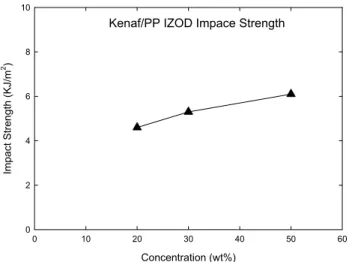
Figure 8 shows the impact strength (I.S.) (KJ/m2) of each compound obtained from an Izod impact tester. As the concen- tration of the kenaf was increased, the impact strength was
Kenaf/PP Bending Modulus
Concentration (wt%)
0 10 20 30 40 50 60
Bending Modulus (kgf/cm2)
25000 30000 35000 40000 45000 50000
Figure 7. The flexural modulus (kgf/cm2) of kenaf/PP com- pounds.
Kenaf/PP IZOD Impace Strength
Concentration (wt%)
0 10 20 30 40 50 60
Impact Strength (KJ/m2)
0 2 4 6 8 10
Figure 8. The impact strength (KJ/m2) of kenaf/PP compounds.
increased, i.e. I.S. [kenaf 20 (4.6) < kenaf 30 (5.3) < kenaf 50 (6.1)], due to increased contacting surface area between fiber surface and polymer chain.
3. Heat Distortion Temperature (HDT) Measurements Figure 9 shows the HDT of each compound. As kenaf con- centration was increased the HDT was increased from 115.8
℃ (kenaf 00) to 142.0 ℃ (kenaf 20), 150.4 ℃ (kenaf 30), and 154.6 ℃ (kenaf 50), respectively, i.e. HDT [kenaf 20(142.0) < kenaf 30 (150.4) < kenaf 50 (154.6)].
4. Specific gravity
Figure 10 shows the specific gravity (Sp.gr) of each com- pound obtained following ASTM D 792 method. As the con-
Kenaf/PP HDT
Concentration (wt%)
0 10 20 30 40 50 60
Heat Distortion Temperature (oC)
140 150 160
Figure 9. The HDT of kenaf/PP compounds.
Kenaf/PP Sp.Gr.
Concentration (wt%)
0 10 20 30 40 50 60
Specific Gravity
0.8 1.0 1.2
Figure 10. The specific gravity of kenaf/PP compounds.
centration of the kenaf was increased, the specific gravity was increased, i.e. Sp.gr. [kenaf 20 (0.97) < kenaf 30 (1.00) <
kenaf 50 (1.04)].
Ⅳ . Discussion
In this research, as the concentration of kenaf was increased, the tensile strength, flexural modulus, impact strength, specific gravity, and HDT were increased, while the elongation%, flexural strength, and melt flow index were decreased. The increase of mechanical properties is due to increased surface area contacting between fiber and polymer matrix, which leads to reduction of polymer chain mobility.
Similar trend could find in the other fiber filled com- pounds.12-18 Wambua et.al. showed the same trend that the ad- dition of kenaf into PP increased the mechanical properties (tensile modulus, impact strength, and ultimate tensile stress);11
however, they did not carefully controlled the length of kenaf.
When as is natural long fibers are processed in a screw ex- truder, they tend to wrap around on the screw channel and build up on the screw channel and breakdown during process- ing in the extruder, which yields uneven distribution and dis- persion of the fibers in the polymer matrix. This gives an irreg- ular mechanical property among composites. The use of chop- ped kenaf fiber reduces these problems.
It is well known that, at the same volume, the addition of fiber increases surface area contacting polymer chain, which leads to increased mechanical property of the composite.11-19 However, when volatile extractives are present in natural fiber, the mechanical property of the compound decreases.18 When surface of a particle is covered with a low surface tension material such as impurity or adsorbed water layer, poor adhe- sion occurs at the interface.20 This leads to the development of void gaps between fiber surface and polymer matrix. Wood- ward21,22 argued that void network is responsible for crack propagation, which leads to composite failure. It has been known that some volatile extractives are present in natural fiber.23,24 We also have reviewed that natural fibers contain cellulose, pectin, lignins and various extractives including fatty acids, water, etc.16-18. The adhesion of natural wood particle with matrix polymer is hindered by the presence of lignins and volatile extractives on the cellulose surface. This leads to poor adhesion with polymer matrix.12,13 The volatile ex- tractives such as fatty acids and water revolutionizes from liq- uid to gas state at processing stage where processing temper- ature is close to 200 ℃. Kenaf contains 11.0% crude protein, 52.0% neutral detergent fiber (NDF), 41.2% acid detergent fiber (ADF), 30.0% cellulose, 10.5% lignin, 2.9% ether extract and 11.8% ash.25
Overall, the effects of impurities including volatile ex- tractives seemed decrease the interfacial adhesion between ke- naf surface and PP and reduce the mechanical properties of PP/kenaf compounds; however, as the concentration of the ke- naf was increased the mechanical properties, specific gravity, and HDT were increased due to increased surface area contact- ing between fiber and PP matrix. And increased fiber-fiber interactions also increased the mechanical property of the compound.
Ⅴ . Conclusions
We investigated concentration effects of chopped natural ke- naf filled PP compounds upon mechanical properties.
The results are summarized as follow.
As the concentration of kenaf was increased, the tensile strength, flexural modulus, impact strength, specific gravity, and HDT were increased, while the elongation%, flexural strength, and melt flow index were decreased. The increase
of mechanical properties is due to increased surface area con- tacting between fiber and polymer matrix and fiber-fiber interaction. Volatile extractives seemed to decrease the inter- facial adhesion between kenaf surface and PP.
Acknowledgment
The authors gratefully recognize Dr. J. H. Yun and Mr. J.-H.
Baek for supporting and assisting experimental measurements.
This research was sponsored by BK21 of Inha University fund- ed by NGV of Hyundai-Kia Motors Co.
References
1. J. L. White and K. J. Kim, “Thermoplastic and Rubber Compounds: Technology and Physical Chemistry”, Hanser Publisher, Munich, Cincinnati (2008).
2. F. Houllier, N. Boquillon, P. Dole, B. Monties, and L.
Averous, “Novel Biodegradable Composites Based on Lignocellulosic Fibres”, Cité mondiale-Bordeaux, France, March (2003).
3. R. G. Stanly, “Biosynthesis of Cellulose Outside of Living Tree”, Forest Prod. J., 16, 62 (1966).
4. J. W. Rowe and A. H. Conner, “Extractives in Eastern Hardwoods-A Review, General Technical report FPL18”, Forest products laboratory, Forest service, U.S. Department of Agriculture, Madison, WI (1979).
5. A. K. Bledzki, O. Faruk, and V. E. Sperber, “Cars From Bio-Fibres”, Macromol. Mater. Eng., 291, 449 (2006).
6. H. B. Buttlar, “Natural Fibre Reinforced Construction Materials for SMCApplications”, RIKO-2005,November 10, Hannover, Germany (2005).
7. M. Zampaloni, F. Pourboghrat, S. A. Yankovich, B. N.
Rodgers, J. Moore, L. T. Drzal, A. K. Mohanty, and M. Misra, Compos. Part A: Appl. Sci. Manufac., 38, 1569 (2007).
8. G. Natta, “Isotactic Polymers”, Makromol. Chem., 16, 213 (1955).
9. G. Natta, P. Corradini, and P. Ganis, “Prediction of the Conformation of the Chain in the Crystalline State of Tactic Polymers”, J. Polym. Sci., 53, 1191 (1962).
10. A. R. Sanadi, D. F. Caulfield, R. E. Jacobson, and R. M.
Rowell, “Renewable Agricultural Fibers as Reinforc- ing Fillers in Plastics: Mechanical Properties of Kenaf Fiber- Polypropylene Composites”, Ind. Eng. Chem. Res., 34, 1889 (1995).
11. P. Wambua, J. Ivens, and I. Verpoest, “Natural Fibres: Can They Replace Glass in Fibre Reinforced Plastics?”, Compos.
Sci. and Tech., 63, 1259 (2003).
12. K. J. Kim and J. L. White, “Relationship Between Interfacial Adhesion and Dynamic Viscosity of Cellulose Fiber Filled Polypropylene and ε-Caprolactone: A Review”, Compos.
Interf., 16, 539 (2009).
13. K. J. Kim, S. Bumm, and J. L. White, “Effects of Regenerated
Cellulose and Natural Fiber on Interfacial Adhesion, Rheology, and Crystallization in ε-Polycaprolactone Compounds”, Compos. Interf., 16, 619 (2009).
14. W. P. Chang, K. J. Kim, and R. K. Gupta, “Ultrasound- Assisted Surface-Modification of Wood Particulates for Improved Wood/Plastic Composites”, Compos. Interf., 16, 687 (2009).
15. W. P. Chang, K. J. Kim, and R. K. Gupta, “Moisture Absorption Behavior of Wood/Plastic Composites made With Alkali-Treated Wood Particulates”, Compos. Interf., 16, 937 (2009).
16. K. J. Kim, S. Bumm, and J. L. White, “Interfacial Adhesion of Pine Wood Filled PP Compounds via Effects of Volatile Extractives”, Compos. Interf., 15, 231 (2008).
17. K. J. Kim, S. Bumm, R. K. Gupta, and J. L. White,
“Interfacial Adhesion of Cellulose Fiber and Natural Fiber Filled Polypropylene Compounds and Their Effects on Rheological and Mechanical Properties”, Compos. Interf., 15, 301 (2008).
18. K. J. Kim, S. Bumm, and J. L. White, “Volatile Extractives Effects of Pine Wood on PP/Pine Wood Compounds on Rheological Properties”, J. Biobased Materials and Bioen- ergy, 1, 388 (2007).
19. Y. Suetsugu and J. L. White, “The Influence of Particle Size and Surface Coating of Calcium Carbonate on The Rheologi- cal Properties of Its Suspensions in Molten Polystyrene”, J.
Appl. Polym. Sci., 28, 1481 (1983).
20. R. Yosomiya, K. Morimoto, A. Nakajima, Y. Ikada, and S.
Toshio, “Adhesion and Bonding in Composites”; Dekker, New York (1989).
21. A. E. Woodward, “Atlas of Polymer Morphology”, Munich, Hanser (1988).
22. A. E. Woodward and D. R. Morrow, “Plastic Deformation of Poly-4-Methylpentene-1 Crystals”, J. Polym. Sci. A2, 7, 1651 (1969).
23. G. M. Rizvi, L. M. Matuana, and C. B. Park, “Foaming of PS/Wood-Fiber Composites using Moisture as A Blowing Agent”, Polym. Eng. Sci., 40, 2124 (2000).
24. G. Guo, G. M. Rizvi, C. B. Park, and W. S. Lin, “Critical Processing Temperature in The Manufacture of Fine-Celled Plastic/Woof-Fiber Composite Foams”, J. Appl. Polym. Sci., 91, 621 (2004).
25. R. S. Swingle, A. R. Urias, J. C. Doyle, and R. L. Voigt,
“Chemical Composition of Kenaf Forage and Its Digestibility by Lambs and in Vitro”, J. Anim. Sci., 46, 1346 (1978).